Author: Security – Computerworld

AI threatens jobs that can be ‘unbundled’

There have been plenty of warnings about job losses due to AI, particularly in the world of IT and in the reduction of entry-level positions. Doom mongers’ claims that AI is going to eradicate all our jobs look to be exaggerated but there is little room for complacency as there are some roles most definitely at risk — and software engineers, in particular, should be looking over their shoulders.

Economists Luis Garicano, Jin Li, and Yanhui Wu, report in a new research paper that jobs that can be unbundled — with tasks AI can perform easily separated from those requiring human input — are at greater risk than jobs where the two kinds of tasks are indissociable. “The effect of AI depends on how costly it is to break the bundle,” they wrote. This means that “In strong-bundle occupations, where tasks are not independently reallocable, AI improves performance inside the job, but does not remove the human from the bundle,” consequently, protecting jobs.

Garicano et al don’t provide examples of such jobs, but point out that jobs cannot be unbundled when there is a high coordination cost to separating their tasks, such as when one person must assume liability for all the tasks, when performing one task improves performance at another, or when a shared context is needed to perform all the tasks.

Meanwhile, a US study by Digital Planet at Tufts University suggests that the activities that will see the greatest AI-driven job losses are writers and authors (57% of such jobs affected), computer programmers (55%), and web and digital interface designers (55%), while software developers, management analysts, and market research analysts will see the greatest total income losses.

This article first appeared on CIO.com.

One-third of help-desk tickets stop work, says study

Nearly one-third of all help-desk tickets handled by large organizations are work-stoppers, according to a study from help-desk automation company Fixify, which also found Tuesday to be the busiest day of the week for help desks.

“Monday gets the reputation, but Tuesday gets the tickets,” it the study said.

Around one in eight of the tickets it studied cited Okta, putting it far ahead of Salesforce, Microsoft and Slack as the next most troublesome apps. In total, 83 distinct applications appeared in the study, representing nearly 500 different tools. Large organizations support, on average, 63 applications, demonstrating the greater complexity and possible reasons for greater disruption.

Enterprises also find themselves having to handle a more diverse range of problems, with more onboarding and offboarding issues than smaller companies; this was especially true in healthcare. A greater proportion of tickets in larger companies concerned hardware problems, too.

One area that Fixify found wasn’t an issue was AI. Most requests about it were for implementation rather than specific problems — although that time may come.

Fixify offered several recommendations to businesses.  Companies should set aside Wednesday as a day for improving response. They should also be benchmarking themselves against companies in the same industry, allocate one to one-and-a-half support staff per 100 workers and (no great surprise from a help-desk automation company) add more automation to the system.

AI regulations are already out of date — IT leaders need to think ahead

Most AI regulations passed in the last few years are already irrelevant, but enterprises should think ahead with rudimentary governance plans for quicker compliance, said legal experts in two panel discussions at Nvidia’s GTC developer show last week.

Current AI regulations target frontier models, high-risk models, and transparency. They typically focus on LLMs and the prevention of voice and video deepfakes.

But efforts to future-proof these laws when they were conceived have not always been successful, said William Dunning, managing associate for AI regulation at UK-based law firm Simmons & Simmons, in the AI in the Age of Regulation: Build Trust Through Compliance panel discussion. The legislation doesn’t cover new technologies such as agentic systems or self-updating models, which are expected to be significant in the coming years, Dunning said.

Technologists have discussed self-updating AI systems as agents that develop new skills by interacting with other agents or referencing materials such as company documents or research papers.

“Some obligations, like human oversight, are going to be really challenging when it comes to things like AI agents,” Dunning said.

It also isn’t clear how regulations will apply to emerging technologies such as world models for smart robots.

Current laws focus on system-to-human interactions, so people know when AI is being used. But system-to-system AI interaction hasn’t been considered, panelists said.

“There’s quite a lot of uncertainty as to how current AI regulations are going to work,” Dunning said.

The main change in the next 12 months will be a shift from policymaking to enforcement, said Nikki Pope, senior director for AI and legal ethics at Nvidia. The EU AI Act will be enforced this year, but significant ambiguity remains around what will actually be enforced, creating uncertainty for businesses, she said.

Editor’s note: On March 26, the European Parliament voted to delay parts of the EU AI Act, but the delay has not yet been approved by the Council of the European Union.

The wide-ranging EU AI Act, which passed in 2024, requires companies to label deepfakes and regulate high-risk AI content, said Minesh Tanna, partner and global AI lead at Simmons & Simmons, in the separate Global Governance and the Future of AI Safety Regulation panel discussion at GTC. 

The US federal government considers the EU AI Act too intrusive, but California has passed laws to regulate deepfakes and AI-generated content, Tanna noted.

Pope said something similar during the AI in the Age of Regulation discussion. No federal regulations will come out of the United States anytime soon, and states are publishing their own rules, she said. California, for instance, is focused on transparency, watermarking, and how AI will affect individuals and groups.

The National Institute of Standards and Technology (NIST), meanwhile, is working to address AI trustworthiness and safety. Product liability litigation will likely continue as AI companies face lawsuits for alleged harm caused to people, Pope said.

“If it isn’t safe, it’s going to cause harm, and existing frameworks like product liability will kick in to compensate victims and to deter companies from causing that harm,” Tanna said in the Global Governance discussion.

Looking ahead, regulation is likely to cover a wide range of workplace tasks, from how AI is trained, to bias in hiring and interviews, to distinguishing between AI and human-generated content. Companies need governance plans to comply or face fines and lawsuits. With governance comes trust, panelists said.

“There is going to be culpability with respect to any harms that are caused,” said Jennifer Barrera, president and CEO of the California Chamber of Commerce, during the Global Governance panel discussion. For example, AI-based hiring requires experts, systems, and guardrails to avoid bias and discrimination violations, Barrera said.

Tanna compared the goal of AI regulation to airplane travel. People should feel safe using AI, the way passengers feel when they board a plane.

AI is evolving fast, but the ultimate goal is to build trust, and panelists offered a few tips on where to start.

Lawyers, IT leaders, and engineers need to take an inventory of the AI tools in use in any organization. The use cases for a tool like Microsoft Copilot may be benign, but its usage still needs to be recorded, with guidelines defining how it should be utilized.

Engineers also need to be a central part of AI governance. Lawyers interpret regulation but are not technical experts, and bridging that gap is essential. Both sides are needed to operationalize AI governance. It’s not dissimilar to the work done in cybersecurity, in which engineers work with management to identify gaps and put security measures in place, panelists said.

Engineers can identify missing pieces and steps needed to reach that delta that helps lawyers create compliance and governance measures, Tanna said.

Anthropic wins reprieve against US DoD ban, buying time for contractors to assess AI supply chains

The Pentagon’s attempt to brand Anthropic a supply chain risk was “likely both contrary to law and arbitrary and capricious,” a US federal judge wrote in a ruling halting a ban on use of Anthropic’s products in defense contracts.

In granting Anthropic a preliminary injunction against the ban, US District Judge Rita Lin of the US District Court for the Northern District of California delivered a legal setback for the Department of Defense and complicated plans by other agencies to remove Anthropic from federal systems.

She also took aim at the scope of the Pentagon’s directive, which effectively sought to extend beyond internal procurement decisions and into the wider private sector contractor ecosystem. At issue was a sweeping restriction under which “no contractor… may conduct any commercial activity with Anthropic,” a move that would have forced companies doing business with the DoD — and other government agencies that have announced their own Anthropic bans — to unwind relationships or risk federal revenue.

Judge Lin made clear that this kind of ecosystem-wide restriction raised serious legal concerns, particularly where it would force contractors to sever commercial ties beyond the scope of federal work.

Following the ruling, Anthropic issued a statement saying, “We’re grateful to the court for moving swiftly, and pleased they agree Anthropic is likely to succeed on the merits. While this case was necessary to protect Anthropic, our customers, and our partners, our focus remains on working productively with the government to ensure all Americans benefit from safe, reliable AI.”

Court questions rationale behind ‘supply chain risk’ label

The Pentagon banned Anthropic in late February, after the company resisted allowing its Claude AI model to be used for certain military applications, including autonomous weapons and domestic surveillance. The Department of Defense took the unprecedented step of formally designating the company a “supply chain risk,” a categorization that has previously only applied to foreign companies.

The designation triggered a cascade of consequences for Anthropic: federal agencies halted usage, contractors distanced themselves, and enterprise customers began reassessing their exposure.

Judge Lin was openly skeptical of the Pentagon’s approach, suggesting it looked less like a narrowly tailored national security measure and more like an “attempted corporate murder.”

“It is the Department of War’s prerogative to decide what AI product it uses,” Lin wrote, using the Department of Defense’s secondary name. “Everyone, including Anthropic, agrees that the Department of War may permissibly stop using Claude and look for a new AI vendor who will allow ‘all lawful uses’ of its technology.”

But the court took issue with the government’s reasoning, rejecting the idea that Anthropic’s restrictions on uses such as mass surveillance or autonomous weapons justified branding it a supply chain threat.

“Defendants’ designation of Anthropic as a ‘supply chain risk’ is likely both contrary to law and arbitrary and capricious,” Lin wrote. “The Department of War provides no legitimate basis to infer from Anthropic’s forthright insistence on usage restrictions that it might become a saboteur.”

She added, “At oral argument, government counsel suggested that Anthropic showed its subversive tendencies by ‘questioning’ the use of its technology, ‘raising concerns’ about it, and criticizing the government’s position in the press. Nothing in the governing statute supports the Orwellian notion that an American company may be branded a potential adversary and saboteur of the US for expressing disagreement with the government.”

What the ruling means for the private sector

The ruling interrupts an active compliance timeline already imposed on both federal agencies and their contractors. A March Pentagon memo had already directed companies doing business with the DoD to begin removing Anthropic technology, with a full phase-out expected within months. The injunction halts that process — but only temporarily.

For federal contractors, the pause is operationally significant, but it functions more as a buffer than as relief. Many had already begun auditing systems, mapping dependencies, and preparing attestations tied to contract obligations.

That work should continue. If a higher court reverses the injunction, or the Pentagon revises its designation to address the court’s concerns, the same obligations could return quickly — potentially with clearer legal footing and less room to challenge them.

More broadly, the case signals that supply chain risk in the AI era is no longer limited to compromised code or foreign ownership. It now extends to how a vendor governs the use of its own technology — and whether that governance aligns with federal priorities.

If a higher court reverses the injunction, or if the Pentagon revises its designation to address the court’s concerns, the same obligations could return quickly, potentially with a clearer legal footing and less room for challenge.

The next move, whether by an appellate court or a revised Pentagon directive, will determine how far federal authority regarding AI contracts ultimately reaches. In the meantime, contractors are left operating in a narrow window of uncertainty, where the safest course is to assume the pressure will return and prepare accordingly.

This article first appeared on CIO.com.

The ‘AI slop’ backlash kills Sora

OpenAI just killed Sora.

That’s an amazing development. When the company rolled out the video-creation site, and later the app, reviewers called it a trailblazer because it combined video creations with sound effects, spoken dialog, and the ability for users to generate a specific character using a reference image and reuse them in multiple videos (a Sora 2 feature called “Character”).

Sora was seen as a threat to jobs in filmmaking and marketing. After watching an early demo of Sora, actor and filmmaker Tyler Perry canceled the construction on an expansion to his film studio in Atlanta, Georgia.

Hollywood’s powerful CAA talent agency in October issued a statement saying that Sora was a threat to the livelihood of actors.

The Los Angeles Times said Sora represented a “firestorm” in the movie industry.

And critics pointed out how easily and convincingly Sora could create realistic videos involving actual people. (OpenAI recently banned users from uploading pictures of real human faces.)

So if Sora was so disruptive, threatening and money-saving, why did OpenAI shut it down?

The company even tore up a $1 billion deal with Disney, signed in December, which would have brought 200 Disney characters into the Sora video app.

Though OpenAI claimed on Tuesday that it killed Sora to focus on robotics, critics and skeptics argue that the real reasons include high computing costs, shrinking user numbers, legal threats over copyright, and a strategic shift ahead of an expected fourth-quarter 2026 IPO.

In other words, AI-generated video isn’t worth it, isn’t a priority, and isn’t the technology miracle everybody thought it was.

Still, that’s a long distance from the hype and fear of two years ago. What happened?

The backlash

With each passing day, it becomes clearer that the initial reaction to ever-improving AI generation tools was more of a parlor trick and novelty, and that the novelty is wearing off.

When gamers reacted negatively to Nvidia’s generative AI graphics enhancement tool called DLSS 5, which launches this fall, fearing that it replaces human artists, Nvidia CEO Jensen Huang said, “I don’t love AI slop myself,” but also said that critics misunderstand what the tool is all about.

A TikTok account got millions of likes and followers for so-called “fruit slop” videos about a reality show called “Fruit Love Island” starring “fruit people,” but the backlash against the account came even faster than its rise. Critics say the popularity of the videos represents a society gone mad and a generational crisis for young people. The account is now gone, replaced by hundreds of copycat accounts.

Parents are also concerned that low-quality AI slop is infiltrating children’s content on sites like YouTube. These videos seem mass-produced with little care about content. Many of these videos show the kind of nonsense we’ve grown to expect from AI slop. From an article on Undark:

“The video opens with the children riding, without seatbelts, in the front row of a moving vehicle. The next scene shows the girl defying physics, floating alongside a moving car, while the boy is seated in what appears to be the hood of the vehicle as it travels backward down a busy street. The third and fourth scenes show the children walking in the middle of the road with moving cars behind them.”

But these stories don’t quite identify the larger problem, which is that a huge number of people and businesses think that AI slop is some kind of secret weapon to represent their ideas and brands in the real world.

Small shops and restaurants in New York City, for example, are using AI pictures to advertise food. The food tends to look nothing like the actual food, creating a persistent, low-level false advertising problem among small businesses.

AI slop is used for all kinds of purposes on social media. One of my least favorite uses is to depict historic information. It’s always misleading. For example, I’m a big fan of Mexican history, and I’ve seen multiple AI slop videos showing, say, the island city of Tenochtitlan (the Aztec city that existed in the place where Mexico City now sits). Designed to enable people to visualize the past, they always create a completely false impression of that past.

AI slop: it’s just cheap

AI slop, which is appealing to some users because it’s cheap, and opposed by other people because it’s cheap, is causing unexpected problems.

Brands like J.Crew and Coca-Cola have seen their reputations tarnished when they tried to use AI-generated pictures or videos for marketing actual products.

It’s also causing resentment because one of its main uses is to emotionally manipulate people. The Chinese version of TikTok, for example, is awash with “regret videos,” whereby aging parents with unmarried offspring use AI to try to frighten their kids into marriage.

The shaming videos use AI to “age” women, showing them bitter and alone, often in hospitals, juxtaposed to happy women with their families. Some have dialog, such as: “I regret it. My parents told me to get married and have kids. I didn’t listen, thinking it was too much trouble. Look at me now!,” according to one report.

AI-generated imagery is often used explicitly to evoke in others the emotions you want others to feel: fear, revulsion, outrage, and pity.

AI-generated slop often seeks to bypass reason and get straight at emotions. It replaces words with pictures. Often, the pictures make no sense, and that hardly matters. The aim is emotion. And while some believe emotional manipulation through AI is something they want, a larger number resent being manipulated.

And the world of content is taking a stand as well. In January, San Diego’s Comic-Con banned all AI comics. Last week, the digital comic platform GlobalComix removed AI content. Marvel Comics Editor-in-Chief C.B. Cebulski established a strict anti-AI policy during the New York Comic Con in late 2025.

Book publishers are resisting as well. Hachette Book Group canceled the upcoming release of a horror novel titled “Shy Girl” by Mia Ballard because they suspected the author used AI to write it.

By early 2026, many public libraries had begun writing strict collection policies to filter out books with AI-generated content.

In early 2026, Instagram updated its system to actively penalize highly polished, synthetic content.

So what we’re witnessing is a massive backlash to AI slop, especially visual content like videos and pictures. And the backlash is so great, it even killed Sora.

AI disclosure: I don’t use AI to do my writing. The words you see here are mine. I do use a variety of AI tools via Kagi Assistant (disclosure: my son works at Kagi) — backed up by both Kagi Search, Google Search, as well as phone calls to research and fact-check. I used a word processing application called Lex, which has AI tools, and after writing the column, I used Lex’s grammar checking tools to hunt for typos and errors and suggest word changes. Here’s why I disclose my AI use. 

Don’t sleep on this powerful new Chrome security booster

When it comes to staying safe online, the teensiest shred of common sense goes an impressively long way.

That’s absolutely true on Android, as I’ve been preaching for more years than I can even remember at this point — and it’s true on the web, too, especially when you’re working within the desktop browser you almost certainly use alongside your mobile device.

With the web, the desktop domain adds in the extra wrinkle of browser extensions — which can add powerful new possibilities into your web-wide work space but can also open up windows into worrisome security scenarios, since many such add-ons inevitably require access to activity-related data or even the ability to modify what you’re seeing on the web and inject extra elements into your view.

For the most part, the “common sense” approach still works wonders. You should always assess something carefully before installing it to make sure the developer seems trustworthy, the reviews seem positive, and the requested permissions seem sensible — particularly with whatever privacy assurances are provided. All of that info is always available within Google’s Chrome Web Store when you’re looking at something new, and ideally, you’ll revisit it periodically and regularly eliminate anything you no longer need.

But increasingly over time, an asterisk has emerged that creates a tricky-to-avoid risk: Sometimes, perfectly legitimate Chrome extensions get sold — and the buyer ends up being far less reputable than the original developer you considered and ultimately decided to trust. And, since you already have the thing in place on your browser, you’re none the wiser to the change and its potential implications for your security.

This very prickly predicament just popped up days ago, when a popular Chrome extension for saving images from the web starting showing signs of shifty behavior. Sure enough, the extension seems to have changed hands a matter of months ago, and the million-plus people who had previously trusted it were suddenly subjected to a new developer’s under-the-hood changes. That continued until enough folks noticed to cause the extension to get flagged — a step that, unfortunately, may have come too late for some people.

Such scenarios may seem hopeless, but take heed: There’s actually an easy way to preemptively protect yourself from these very sorts of shenanigans. And it takes just 20 seconds of one-time setup, now, to achieve.

[Get new knowledge in your inbox every Friday with my free Android Intelligence newsletter. Three new things to try each week!]

Your simple new Chrome security guard

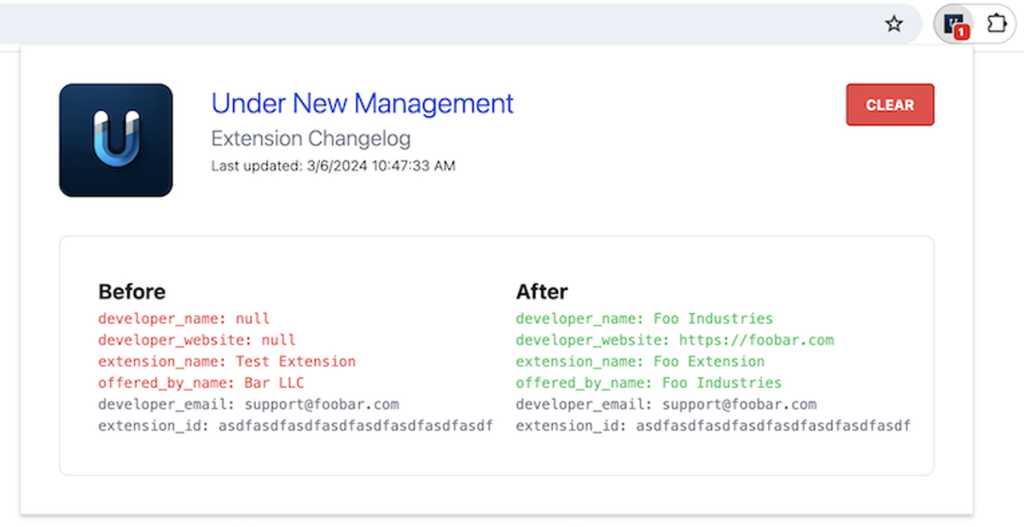
Our wily web-fortifying hero comes in the form of a crafty Chrome extension for desktop web browsers called Under New Management.

Under New Management does one thing and one thing only: It watches all of your installed browser add-ons and alerts you anytime any of ’em changes hands and accepts a new owner.

Now, software being sold isn’t necessarily a red flag, of course. Developers can legitimately pass the baton to a trustworthy new steward in a reputable transaction that’s no cause for concern.

But with Chrome extensions in particular, we’ve seen so many instances like the one we mentioned a moment ago — where a once-reputable add-on gets pawned off to someone with less-than-honorable intentions and its users ultimately pay the price — that it’s at the very least something you deserve to know about and should be able to consider closely when it occurs.

And that’s what Under New Management is there to do: It just keeps an eye on everything you’ve got installed, quietly and in the background, and puts up a simple red badge in your browser toolbar whenever a developer change occurs.

Chrome browser security; Under New Management
Under New Management alerts you anytime an extension changes hands.
Class V Software

All you’ve gotta do is install the extension from the Chrome Web Store, then pin it to your toolbar (by clicking the puzzle-shaped extension icon in Chrome’s upper-right corner, finding “Under New Management” in the list that appears, and clicking the pushpin alongside it) so you’ll always see any changes it uncovers.

(And since so many other browsers are based on the same Chromium foundation as Chrome, you can also install and use Under New Management in them as well — everything from Edge to Vivaldi, Brave, Opera, and beyond.)

Notably, Under New Management itself doesn’t require access to anything more than monitoring your installed apps and extensions. It doesn’t request any permissions, and its developer is clear that it doesn’t collect or share any manner of data, either. The extension is also open source, so anyone with the right know-how can inspect the code and confirm that it’s doing exactly what it says and nothing more.

So install it, pin it, then forget about it. The extension probably won’t demand your attention often, if ever, and it won’t have any meaningful impact on your day-to-day browser performance or experience.

But if and when it does pop up a warning, you’ll be glad to know it alerted you. And you’ll be able to look closely at whatever changed hands to keep an eye on what it’s doing — or just uninstall it, if you’re in the least bit uncomfortable — before any unfortunate additions come along and catch you by surprise.

Got Android? Get my free Android Intelligence newsletter to keep up with all my latest tips and recommendations — with three new things in your inbox every Friday.

European Parliament votes to delay EU AI Act implementation

The European Parliament’s Thursday vote to delay parts of the EU AI Act adds more uncertainty to the already chaotic AI compliance universe. But analysts say that CIOs must proceed as though the compliance rules are in effect. 

Members of the European Parliament voted to delay application of rules on high-risk artificial intelligence (AI) systems to give European authorities time to prepare planned guidance and standards to help companies with implementation.

Although the Parliament and the European Commission are now in agreement on the delay, they still need the approval of a third law-making institution, the Council of the European Union.

With the first of the deadlines MEPs voted to delay coming up in August 2026, this presents a planning challenge for CIOs: Should they rush to implement changes before the existing deadline, without the promised guidance, or wait and hope the Council approves the delay?

Delay is not a reprieve

Analysts and consultants were virtually unanimous in their recommendations that enterprise CIOs must not wait and must instead operate as though the rules are already in effect.

“It’s good that they have clarified the extension [because] previously it was a moving target,” said Nader Henein, a Gartner VP analyst. “It’s not great that the final decision will happen so close to the old deadline that organizations have no choice but to proceed as originally planned. Since the first draft of the EU’s Digital Omnibus proposal back in November, our guidance to clients has been to treat any potential extension as an opportunity to better test-out and improve the process for cataloging and managing AI systems.”

Henein added: “The major gating factor for the current timeline was that regulators would not have been ready to enforce. This is still the case. Spain is one of a handful of countries who stood up a regulator, and even the EU AI board is behind on the kind of guidance needed by organizations to properly understand their obligations when it comes to high risk AI systems. Those obligations that, as it stands, come into effect on August 2.”

Cybersecurity consultant Brian Levine, executive director of FormerGov, said that the move to delay major AI Act restrictions until 2027 “leaves CIOs in a regulatory limbo, but it doesn’t change the underlying reality: enterprises still own the risk their AI systems create.”

“Whether Brussels enforces the rules next year or two years from now, the operational, legal, and reputational exposure from poorly governed AI is already here. CIOs shouldn’t treat the delay as a reprieve,” Levine said. “The organizations that wait for perfect regulatory clarity are the ones most likely to discover that their models have been quietly generating compliance, privacy, or safety liabilities long before any enforcement clock started ticking.”

Parliament proposed that “for high-risk AI systems specifically listed in the regulation–including those involving biometrics, and those used in critical infrastructure, education, employment, essential services, law enforcement, justice and border management,” the regulation would be applied on Dec. 2, 2027. For AI systems “that are “covered by EU sectoral legislation on safety and market surveillance,” it set a date of Aug. 2, 2028. The statement also noted that members are “in favor of giving providers until November 2, 2026 to comply with rules on watermarking AI-created audio, image, video or text content to indicate its origin.” 

Use time to prepare

Jason Hookey, executive counselor at the Info-Tech Research Group, said that he agreed with some of Parliament’s decision.

“The EU’s choice to delay high-risk AI obligations makes sense. Most people agree with the purpose of these rules, but there are concerns that organizations won’t be able to meet them without sufficient guidance, technical standards, or appropriate support. It’s important to note that the delay only changes the timeline, not the main goals around high-risk AI,” Hookey said. “Organizations that use this time well will be better prepared for compliance, control, and building market trust. Those who wait may only put off problems and miss out on the benefits of well-managed AI.”

Others pointed out that the European Union’s decisions are only recommendations to its many member states, who have the authority to make any changes they want for their countries. 

Procedural risk

EU resolutions operate at two levels, noted Flavio Villanustre, CISO for the LexisNexis Risk Solutions Group. 

“There is a policy decision at the EU level and there is an implementation definition at the member states level. For this reason, even after the policy is set and published, they usually leave years-long implementation times for the member states to comply and release their own legislation that will define the implementation requirements for that member state,” Villanustre said. “I don’t think this particular case will be any different, so the actual deadline may be further in the future than what the draft legislation indicates.”

In addition, Doug Barbin, president of compliance firm Schellman, warned CIOs, “there’s also a real procedural risk here: if Council and Parliament negotiations drag past August 2026, the original deadlines stay on the books. CIOs who’ve been sitting on their hands are the most exposed to that scenario. The organizations investing in governance infrastructure now won’t be the ones in crisis mode later. This is extra time — use it.”

Barbin said the market is slowly shifting to broader strategies. “This is where compliance is going: less around specific actions and more about governance and risk,” he said.

High cost of waiting

Yvette Schmitter, CEO of the Fusion Collective consulting firm, said she is concerned that CIOs will take the wrong message away from what the European Parliament did. 

“I think it is bad in the sense that it gives people a false sense of security in that they have more time. [It is] trying to give them more time, but companies will never be ready,” Schmitter said. “Courts don’t care about your regulatory compliance timeline. When your AI system produces detrimental or discriminatory outcomes at scale, ‘we were waiting for final guidance’ won’t survive depositions.”

Sanchit Vir Gogia, chief analyst at Greyhound Research, argued that these decisions amount to mixed messages, which serve to deepen the AI regulatory confusion.

“The shift in timelines has removed a clear enforcement anchor, but it has not reduced the expectation of accountability. If anything, it has made decision-making harder. Enterprises are now operating in a mixed state where some obligations are already in force, others are expected later, and internal teams are interpreting risk in different ways. That combination creates confusion long before any regulator steps in,” he said, noting that many companies will want to slow down and wait for the final regulation.

“That instinct is misplaced,” he said. “Waiting assumes clarity will arrive early enough to act on it. In practice, clarity tends to arrive late, unevenly, and often after internal decisions have already been made. CIOs who choose to pause are not reducing exposure. They are simply postponing the moment when that exposure becomes visible.”

Gogia also suggested that there are hardcore financial costs associated with waiting.

“There is a belief that delays reduce spend. In reality, the opposite often happens. Work that is paused has to be restarted. Teams lose context. Designs are revisited. Governance added late is more expensive than governance built in from the start,” he said. “Vendor contracts entered into without clarity become difficult to unwind. None of this shows up immediately, which is why it is often underestimated. But over time, the cost of waiting tends to exceed the cost of acting with intent.”

This article originally appeared on CIO.com.

Google: The quantum apocalypse is coming sooner than we thought

Google isn’t just responsible for the encryption of a big chunk of the communications on the internet. It is also building its own quantum computers, so it’s well placed to evaluate how close the technology is to fruition.

Until now, the company has been aligned with the NIST timeline, which specifies 2030 for deprecating quantum-unsafe algorithms and their full disallowance by 2035.

But on Wednesday, Google said that 2029 is now the deadline for the migration to post-quantum cryptography (PQC). It also said that it has adjusted its threat model to prioritize PQC migration for authentication services, and urged other engineering teams to follow suit.

Quantum computers increasingly powerful

Quantum computers are expected to break traditional asymmetric encryption, which is used to secure communications, financial transactions, and websites, once they get powerful enough.

That time is coming, says Jordan Kenyon, chief scientist in the quantum practice at Booz Allen Hamilton. “The first version of Shor’s [algorithm] was projected to require 20 million qubits [to break] and recent results have shrunk those requirements down to as a little as around 100,000 qubits.”

It’s not just that the hardware is getting better, she tells CSO. There have also been advances in error correction and algorithms.

“The magnitude of change is tough to deny,” she says.

In 2019, Google estimated that it would take 20 million qubits to break RSA encryption. By May of 2025, Google revised those estimates down to 1 million. And last month, researchers at Australia’s Iceberg Quantum said in a pre-print report that only 100,000 physical qubits were needed.

Fortunately, NIST has already finalized four algorithms that should withstand quantum computing, and has selected a fifth. But unfortunately, according to the Post Quantum Cryptography Coalition, most PQC standards have not achieved broad adoption yet.

Worse yet, says the Trusted Computing Group, its research shows that 91% of businesses do not have a roadmap in place. In addition, 80% say their current crypto libraries and hardware security modules are not ready for PQC integration, and only 39% have begun their PQC compliance readiness assessments.

CSOs can’t afford to watch and wait

Google has upped the ante on PQC migration, Michela Menting, an analyst at ABI Research, tells CSO.

That means that enterprises will also need to step up their transition plans, she says, “to align earlier than what they might have originally thought was acceptable based on the NIST deprecation timelines — especially if they want to keep pace with hyperscalers.”

She expects Microsoft and AWS to set similar migration schedules, and CSOs will need to move their PQC transition plans up the priority list.

“It’s not a side project anymore, with an extended time frame that they can just get to whenever they have extra time to work on it,” she says. “They really can’t afford to watch and wait anymore.”

According to Google, some data is already being collected by attackers. In a post last month, Kent Walker, president of global affairs at Google and Alphabet, wrote, “Malicious actors are not waiting until a cryptographically relevant quantum computer is ready. They are likely already carrying out ‘store now, decrypt later’ attacks and collecting encrypted data, just waiting for the day when a quantum computer can unlock it.”

This means that enterprises need to up their game. According to Gartner, 61% of organizations lack full visibility into their cryptographic systems. The research firm recommends that companies conduct a comprehensive cryptographic inventory, invest in cryptographic agility and visibility, establish a cryptographic center of excellence, and prioritize PQC migration for assets with long-term sensitivity.

This article originally appeared on CSOonline.

Hexnode CEO: MacBook Neo forces IT to rethink its budget laptop strategy

Apple’s MacBook Neo (reviewed here) challenges what we expect from budget laptops. Accompanied by shrewd enterprise-focused moves, the new model gives Apple a chance to convert hitherto resistant IT purchasers to adopt its platforms. I spoke with Hexnode CEO Apu Pavithran to get some sense of this potential.

Apple’s decision to introduce a $599 laptop is hugely significant, said Pavithran. “Apple is positioning itself on price and gunning for the volume markets it previously ceded to other players,” he said. The company is using its existing strengths with the product, exploiting its in-house processing power, repackaging its hardware for new customers, and “breaking the perception that Mac is premium-only.”

Pavithran leads one of the new breed of device management services designed to serve cross-platform fleets. That gives him insight into the potential attraction the Neo may yield for established Windows-based enterprises.

Opening Windows

“There are growing problems with Windows 10 end-of-life and a wave of users facing upgrade decisions,” he pointed out. At its price, Apple’s Neo offers users in that segment an affordable introduction to the Mac ecosystem. It’s appealing for some enterprise edge cases that need a real computer at a low price point, such as for use as kiosks or at reception desks.

Much of this is about perception, and that’s where Apple has struck a huge blow. “The Neo is shaping up as an industry reset, changing expectations for what a “cheap” laptop can look and feel like,” said Pavithran.

“I can’t think of any entry-level portable computers with Retina display, aluminium build, 16-hour battery, and full desktop OS. This will put pressure on Chromebook and Windows OEMs to justify plastic builds and shorter battery life at similar prices. I hope other makers take up the challenge and we see a race to the top in the budget laptop segment.”

Does the MacBook Neo have enterprise appeal?

As Pavithran sees it, the big challenge Apple still has is winning over IT. There’s plenty of pressure in the company’s favor, not least that employees will now overwhelmingly choose Apple if given a choice. The challenge is to convince IT to offer that choice in the first place. “Competing on price certainly helps because it’s often the biggest hurdle for budget-conscious bosses across SMEs,” he said.

That’s one of the ways MacBook Neo opens the argument.

Since the introduction of the product, Apple has expanded its Apple Business service across 200 countries. Among other things, Apple Business makes it easy for SMBs of any size to secure and manage their Apple-based business systems, including support for zero-touch deployments and SSO. 

I spoke with Pavithran just before that launch. Apple Business will almost certainly help the MacBook Neo open up more space in business markets, as the services it provides are among the challenges he thought Apple faced pushing its platforms to enterprise purchasers. “Apple has the building blocks, but the enforcement layer still relies heavily on third-party tools,” he said then. 

Apple needs to make sure its systems “integrate smoothly with unified endpoint management (UEM) so IT isn’t juggling multiple dashboards, drowning in alerts, and suffering from siloed visibility,” he said. After we spoke, Apple announced that it will offer APIs that enterprises and their device management partners can use to help ease those challenges.

What about the education market?

The MacBook Neo isn’t just for the enterprise; it offers plenty to education too, with a tempting $499 price tag for students, who will be attracted by the looks and brand appeal Apple provides. 

The impact may not be immediate. “K-12 won’t overhaul its entire ecosystem just because there’s a cheaper Mac,” Pavithran said.

“These classrooms are already deeply embedded in Google Workspace and will take some time and tooling to completely onboard. The education sweet spot is in universities and colleges, because these students buy their own devices (rather than school-issued), need creative and STEM software, and benefit most from integration with iPhone,” he said.

Apple needs to sell this product line to admins more than students, and that’s a sticking point for both lower and higher education. “Following the pandemic, Google’s device management in education only got better, with admins feeling very confident in this ecosystem. Moving to Apple devices means rethinking management at scale — and this is where the company will need to make life as easy as possible for those making the switch.”

How Apple thrives in a difficult business environment

Global conflict and the unraveling of decades-long trade agreements in favor of vibes rather than values poses huge strain on business systems. While there’s no arguing away the challenges of that environment, Apple does have advantages, Pavithran points out. “Apple’s vertical integration (own silicon, own OS) gives it more levers than competitors reliant on third-party chips and Microsoft licensing,” he said.

Please follow me on Twitter, or join me in the AppleHolic’s bar & grill and Apple Discussions groups on MeWe. Also, now on Mastodon.

Enterprise laptops adopt Intel’s new Core Ultra Series 3 chips

Intel’s Core Ultra Series 3 processors with Intel vPro, built for business PCs, are off to a fast start, already powering more than 125 designs including newly-announced systems from Dell and HP, the company said.

Unveiled this week at an event in New York City, the Core Ultra Series 3 with Intel vPro brings what Intel described as “next-generation performance efficiency and integrated AI acceleration,” as well as providing an enhanced vPro management platform.

[ Related: More Intel news and insights ]

The company first announced the Core Ultra Series 3 processors in October 2025. Previously codenamed Panther Lake, they will also appear in new consumer PCs.

Users of systems running on the new chips will see over 30% faster performance, up to 80% better graphics, and up to 4x AI performance compared to four-year-old systems, the average PC refresh period for businesses, according to Intel.

While the new systems can run code faster, Intel is also pushing for them to be more intelligent about the code they do run. Enhancements to vPro include the Intel vPro Certification Program that Intel said results in as much as 59% reduced CPU utilization, a 74% reduction in background activity, and power efficiency improved by 56%.

AI is also playing a bigger role in the form of vPro Intelligence with Device IQ, which offers AI-driven analytics to detect, diagnose, and resolve issues. There’s also vPro Fleet Services to simplify out-of-band manageability via a fully managed SaaS-based activation and integration with Microsoft Intune, and security enhancements including Intel Total Storage Encryption for Microsoft BitLocker and AI-based threat detection using Intel’s chip-based Threat Detection technology (DTECT).

Business PCs incorporating these technologies will be available beginning on March 31.

Dell has launched an updated Dell Pro Notebook lineup which includes devices powered by the Intel Core Ultra Series 3 processor. It offers models with and without vPro.

The Dell Pro Premium is designed for on-the-go executives and managers; the Dell Pro 7 is for users such as consultants and sales professionals who need systems that are portable, yet capable; the Dell Pro 5, the company said, provides mobility for users such as financial analysts while maintaining the performance they need for their business applications; and the Dell Pro 3 was created for users who run core productivity applications such as email, document creation, and collaboration.

The Dell Pro Premium will be available on March 31, and the other models will hit the shelves in May. Pricing has not yet been announced.

HP’s refreshed portfolio for business includes 31 new models powered by Intel, AMD, and Arm processors. Intel-powered devices include multiple configurations in the EliteBook 8 G2 series, an AI PC designed for knowledge workers, and the EliteBook 6 G2 series for mobile professionals and office collaborators. Other models are directed at the SMB market. The company also announced the EliteDesk 8 G2 for enterprise workers.

The EliteBook 8 G2 devices are expected to be available in April, as are the EliteDesk models. The EliteBook 6 G2 is scheduled for June. Pricing has not yet been announced.

More Intel news: