Month: April 2026

Are we ready to give AI agents the keys to the cloud? Cloudflare thinks so

Cloudflare is giving AI agents full autonomy to spin up new apps.

Starting today, agents working on behalf of humans can create a Cloudflare account, begin a paid subscription, register a domain, and then receive an API token to let them immediately deploy code.

To kick things off, human users must first accept the cloud company’s terms of service. From there, though, their role in the loop is optional; they don’t have to return to the dashboard, copy and paste API tokens, or enter credit card details. The AI agent just does its thing behind the scenes and has everything it needs to deploy “in one shot,” according to Cloudflare.

While this could be a boon to developers and product builders, it also signals a larger, concerning trend of over-trust in autonomous tools, to the detriment of governance and security.

For example, noted David Shipley of Beauceron Security, cyber criminals are being forced to constantly set up new infrastructure as security firms and law enforcement fight back to block online attacks and scams. “Making it even faster to build new infrastructure and deploy it quickly is a huge win for them,” he said.

Giving agents the OAuth keys

Cloudflare co-designed the new protocol in partnership with Stripe, building upon the Cloudflare Code Mode MCP server and Agent Skills. Any platform with signed-in users can integrate it with “zero friction” for the user, Cloudflare product managers Sid Chatterjee and Brendan Irvine-Broque wrote in a blog post.

The new protocol is part of Stripe Projects (still in beta), which allows humans and their agents to provision multiple services, including AgentMail, Supabase, Hugging Face, Twilio, and a couple of dozen others, generate and store credentials, and manage usage and billing from their command line interface (CLI). An agent is given an initial $100 to spend per month, per provider.

Users need only install the Stripe CLI with the Stripe Projects plugin, login to Stripe, start a new project, prompt an agent to build something new, and deploy it to a new domain. If their Stripe login email is associated with a Cloudflare account, an OAuth flow will kick off; otherwise Cloudflare will automatically create an account for the user and their agent.

From there, the autonomous agent will build and deploy a site to a new Cloudflare account, then use the Stripe Projects CLI to register the domain. Once deployed, the app will run on the newly-registered domain.

Along the way, the agent will prompt for input and approval “when necessary,” for instance, when there’s no linked payment method. As Cloudflare notes, the agent goes from “literal zero” to full deployment.

To build momentum, the company is offering $100,000 in Cloudflare credits to startups that make use of the new capability via Stripe Atlas, which helps companies incorporate in Delaware, set up banking, and engage in fundraising.

How the agent takes action

Agents interact with Stripe and Cloudflare in three steps: discovery (the agent calls a command to query the catalog of available services); authorization (the platform validates identity and issues credentials); and payment (the platform provides a payment token that providers use to bill humans when their agents start subscriptions and make purchases).

Cloudflare emphasizes that this process builds on standards like OAuth, the OpenID Connect (OIDC) identity layer, and payment tokenization, but removes steps that would otherwise require human intervention.

During the discovery phase, agents call the Stripe Projects catalog command, then choose among available services based on human commands and preferences. However, “the user needs no prior knowledge of what services are offered by which providers, and does not need to provide any input,” Chatterjee and Irvine-Broque explained.

From there, Stripe acts as the identity provider, and credentials are securely stored and available for agents that need to make authenticated requests to Cloudflare. Stripe sets a default $100 monthly maximum that an agent can spend on any one provider. Humans can raise this limit and set up budget alerts as required.

The platform, said Cloudflare, acts as the orchestrator for signed-in users. Agents make one API call to provision a domain, storage bucket, and sandbox, then receive an authorization token.

The company argued that the new protocol standardizes what are typically “one off or bespoke” cross-product integrations. It uses OAuth, and extends further into payments and account creation in a way that “treats agents as a first-class concern.”

Concerns around security, operations

The trend of people buying products “wherever they are” will become ever more widespread, noted Shashi Bellamkonda, a principal research director at Info-Tech Research Group.

For instance, Uber has announced an Expedia integration for hotel bookings that will make it an ‘everything app.’ Other vendors are similarly expanding their partner ecosystems, because obtaining customers via other established platforms as well as their own is more cost-efficient, and “generally results in a higher lifetime value,” said Bellamkonda.

“This is Cloudflare turning every partner with signed-in users into a sales channel, and that is how you grow revenue in a developer market,” he said.

Beauceron’s Shipley agreed that Cloudflare is the “big winner” here. “Making it faster for anyone to buy your service and get using it is technology platform Nirvana.”

It’s “super cool, bleeding edge” and in theory, for legitimate developers becomes part of the even more automated build process, he said; “Vibe coders will rejoice.” But, he noted, so will cyber crooks.

Further, Bellamkonda pointed out, from an operational perspective, this could create added complexity for each vendor’s partner network when it comes to transaction execution and accountability. If issues related to provisioning or billing transactions arise, businesses must have a clearly defined process for resolving them with all parties.

“This will require considerable upfront thought on developing these comparatively new business models,” Bellamkonda said.

This article originally appeared on InfoWorld.

Friendlier chatbots can be less reliable, study says

New research from the Oxford Internet Institute indicates that AI chatbots trained to be extra warm, friendly, and empathetic can also become less reliable, according to the BBC.

The researchers analyzed more than 400,000 responses from five different AI models from Meta, Mistral AI, Alibaba, and OpenAI. The results showed that the “kinder” versions more often gave incorrect answers, reinforced users’ misconceptions, and avoided stating uncomfortable truths.

For example, a friendlier model might deal with conspiracy theories about the moon landing more cautiously instead of clearly stating that they are false.

On average, incorrect answers increased by about 7.43 percentage points when the models were made to sound warmer in tone. Cooler and more direct models made fewer mistakes. According to the researchers, AI makes the same trade-off as humans: it sometimes prioritizes being perceived as pleasant rather than being direct.

Gartner sees untamed growth in agentic AI

Fortune 500 enterprises will be deploying armies of AI agents by 2028 — to the tune of 150,000 digital “workers,” Gartner said in a survey released this week. That would represent a sharp jump from the average of about 15 agents deployed per company last year.

And agents as actual co-working tools are likely to go mainstream within the same time frame, said Max Goss, senior director analyst for Gartner. These agents won’t just be text boxes from which users get responses, but assistants to which actual work can be delegated.

“We’ve seen a sort of new appreciation in the industry of what agent AI can do,” Goss said.

Many AI agents can already handle basic tasks such as summarizing documents on behalf of workers. Upcoming agents will be able to take spreadsheets and word documents, automate work, and offer an interface that makes the tools friendlier to use, Goss said.

That’s already happening in applications such as Google Workspace and Microsoft 365, with easy-to-use AI interfaces, automated workflows and collaboration. 

Despite the fast uptake for agentic AI, fully autonomous agents are uniquely to be in place in just two years, Goss said. Humans will still need to be part of the loop from a security and governance standpoint, with semi-autonomous agents trusted to handle multi-step processes in specific domains replacing prompts.

The 150,000-agents-per-organization estimate is a ballpark figure pulled from multiple surveys and data gathered by Gartner. “We’ve got some good numbers now on agent usage and we can see how it’s been growing,” Goss said.

Gartner’s aggressive projection, if it holds true, represents a more optimistic view of the technology than other surveys — some of which have pegged failure rates for generative AI tools as high as 95%. But companies like EY and Lumen have demonstrated successful agent deployments, mostly for knowledge workers and customer service.

“Agentic usage tends to be…most valuable in the customer service and data and analytics space…. Those are areas where we have more confidence that AI tools can add value,” Goss said.

Agentic AI use in other areas is likely to advance more slowly. For example, highly regulated fields such as finance and healthcare have to be careful with agent deployment and require guardrails in place to reduce hallucinations and errors.

And agents at the scale envisioned by Gartner will need 100% uptime, just like servers. As a result, companies will likely have to ensure agent reliability by spreading them across multiple models and hardware resources, Goss said.

Excessively high use has at times prompted companies like Anthropic and OpenAI to  shut down access to the large language models (LLMs), undermining the reliability of AI services within enterprises.

There are many things IT leaders can do now to prepare for successful deployments, Goss said, such as sanctioning agent use and pro-actively allowing them to be deployed. “If they just block all agents, then employees…are going to probably go around your controls…. They might use unsanctioned tools otherwise known as shadow AI and I think that’s a greater risk,” he said.

Decision-makers will need to guard against AI agent sprawl, and put the right controls in place to govern them. “If you don’t have any visibility of them, then that’s a huge risk for the organization,” Goss said.

Poor management can also leave gaps that break processes or create security vulnerabilities.

And as AI automates legacy business processes, new processes will need to be drawn up for agents. “I don’t think it’s a good idea to be like, ‘Well, this is the process we’ve already done and let’s slap an agent on top of it and see what happens’…. Process design and agentic AI go hand in hand,” Goss said.

genetic AIHe argued that companies should be prepared for some agentic AI tools to fail, which can happen even with safeguards in place to minimize risks. “That [failure] is kind of okay, because actually we need…to understand where these tools can help us and where they can’t,” Goss said.

Apple reportedly abandons Vision Pro

It was only this month that incoming Apple CEO John Ternus said of the Vision Pro, “I think we’re still very much in the early innings of spatial computing. We’re super excited about it.”

Now, we’re hearing Apple has stopped working on the headset following lackluster sales of the only slightly upgraded M5 chip-powered model introduced in October, which retained its hefty $3,499 price and shipped with a more comfortable head strap. 

MacRumors claims Apple has “given up” on the Vision Pro as a response to soft sales of the upgraded model, distributing the product engineering team elsewhere across the company. It also seems to be focused on Meta-devouring AR glasses in near term, which we knew. 

What this really seems to be about is building Vision Pro’s successor.

The next generation

This might or might not be the sunglasses-style form factor everyone is speculating about. And it might or might not include the cutting-edge features provided in the Pro. (CitiGroup predicts sales of items in this category could reach $40 billion by 2030.)

Given the recent introduction of the A18-powered MacBook Neo, it seems the plan could eventually involve a lower-cost Pro-style model equipped with two or more cheaper A-series chips. I don’t see that as a realistic possibility until at least 2028 — once Apple hits 1nm chips.

It makes sense, then, that Apple is diverting engineering resources from those projects toward Siri and its artificial intelligence work; it’s existentially important for the company to deliver big improvements to Apple Intelligence, Siri, and AI on its platforms in time for WWDC in June. Recent delays have damaged the company’s reputation, and while many believe it will win in the end, it’s going to take a little longer for everyone else to see it.

When he spoke, Ternus was positive about the current headset, saying, “The Vision Pro is an extraordinary product…, it’s like we reached into the future and pulled it into the present.” 

It’s also hardware that has a place in some specific enterprise deployments. “People are continuing to find exciting new use cases for it. There’s a lot of compelling stuff in enterprise and medicine and other areas, and that’s going to continue to grow. It’s fun. We’re at the beginning of the journey.”

Grabbing the future and building it

Apple seems to know it’s a beginning, too. The company has been tweaking the operating system regularly with updates (major or minor) every couple of months and a raft of entertainment and enterprise software that continues to appear at a steady clip.

At its price, Vision Pro was never intended to be a mass market product akin to the iPhone, but a highly experimental solution to help determine the future of this part of the industry. Apple’s outgoing CEO, Tim Cook, has consistently described the product as “tomorrow’s engineering, today,” and it remains that.

The lessons Apple has learned will now be deployed in successor products, including smart eyeglasses to compete with Meta’s offerings. For the most part, these solutions will likely be connected accessories that use the chip inside your iPhone, iPad, or Mac for their advanced functions. But as processor designs continue to shrink, it’s only a matter of time before standalone devices appear.

These won’t offer everything we get now in the Vision Pro, which requires more processor and battery power than can be crammed inside smaller devices. Once the tech of the future catches up with Apple’s vision, as it were, I’ve little doubt that a Vision Pro successor will appear at a not-so-prohibitive cost. 

Apple already built the future. Now, as it did with the Newton, it just needs to wait for reality to catch up. Meanwhile, those enterprise use cases for the existing headset remain, which strongly suggest there’s real-world, but limited demand.

You can follow me on social media! Join me on BlueSky,  LinkedIn, Mastodon, and MeWe. 

AI venture funding to shoot up this year as bubble looms

Venture funding of AI companies in 2026 will easily smash funding records set in 2025, with some heavy deals already consummated in the first quarter, according to market researchers.

Data from Crunchbase shows that $300 billion poured into 6,000 startups worldwide during the first quarter of 2026. That’s a quarterly record for venture funding in AI companies, a Crunchbase news report said.

A study from S&P Global measured generative AI funding reaching over $140 billion in the first quarter of 2026, outpacing all of 2025, according to a story published on the company’s website. Amid economic concerns, inflation, and the war in Iran, there were fewer deals overall, but the funding rounds were large in scope compared to any made in 2025.

X.AI, for example, kicked off 2026 with a series-E round of $20 billion. OpenAI received $122 billion in a massive funding round in March, with a valuation of $852 billion. Anthropic received $30 billion in one round of funding that valued the company at $380 billion.

Chip maker Nvidia invested in both OpenAI and Anthropic, in the process striking deals to use Nvidia’s GPUs for their genAI models. Nvidia also invested in genAI startup Thinking Machines Lab, which was founded by Mira Murati, the former CTO (and temporarily CEO) of OpenAI.

Venture capitalists are ramping up investments as enterprises across every sector add to their AI portfolios.

“I can say investment velocity for 2026 is fast and on pace or ahead of 2025,” said John Mannes, partner at venture capital firm Basis Set, which focuses solely on AI investments.

“For VCs, it’s a gold rush,” said Jack Gold, principal analyst at J. Gold Associates. “There is lots of potential capital floating around out there in search of the next big thing. AI is the next supposed killer investment, and no one wants to be left behind.”

Gold sees clear signs of an AI bubble, starting with the murky path to profitability for AI firms. “Does AI have the potential to generate lots of revenues? Yes, but with the current spend rate on infrastructure, it’s hard to see how [AI vendors] can be revenue-positive in the short term (two to three years),” he said.

Another sign of the bubble is the “circular financing” that happens when, for example, Nvidia invests in a new company that promises to buy Nvidia products, Gold said.

“As long as people are willing to throw money at AI, then the bubble will remain. But if we hit a point where investors say, ‘We’ve put enough into the field; now show us how our investments will pay off’ (other than through inflated IPO stock prices), then the bubble will likely burst,” Gold said.

“We’re not at that point yet, but it could happen if the economy goes south,” he added.

Clear winners and losers will emerge in the AI sector, said Brad Harrison, founding partner at Scout Ventures. His firm does not invest in large-language models; its AI investments are largely directed toward military and defense, particularly AI technologies for deterrence on the battlefield.

“Without a doubt, we’re in an AI bubble,” Harrison said.

Many AI companies will fail because platforms from large AI vendors will be used to create agents that solve what the other AI companies were trying to do, Harrison said. Breakthrough tools like Claude Code are already improving developer productivity.

“You’re going to see a lot of SaaS companies get a lot smaller… If you don’t need all these people doing all the work, then you don’t need all those software licenses,” Harrison said.

Additionally, he noted, infrastructure and energy demands have reached unsustainable levels, which has raised questions about the resources available for AI.

“Is it good to devote these resources to feeding AI? … Do you think [citizens] want us to spend trillions of deficit that we don’t have on building AI infrastructure and energy? Or do you think they’d rather have some food?” Harrison asked.

Related reading:

Scaling up a tech startup in Europe is hard — ‘EU Inc.’ aims to help

Europe produces a large number of new tech startups each year – 28 crossed the $1 billion valuation mark in 2025 alone – yet few become global technology leaders. Many that do succeed look elsewhere to scale, particularly in the US.

Founders point to multiple barriers to growing their business in the European Union (EU), including the complexity of navigating 27 different national legal systems. Despite access to the EU’s single market — home to 450 million consumers and 23 million companies — expanding across borders still brings significant legal, financial and operational complexity.

These are among the challenges the European Commission’s proposed “EU Inc.” framework, unveiled last month, aims to tackle, with plans for a standardized, pan-EU company structure or “28th Regime.” Rather than navigating distinct national systems, companies that opt in to EU Inc. can incorporate once and operate under a single set of rules. Measures include digital incorporation within 48 hours, simplified cross-border registration, and more consistent treatment of employee stock options.

The move comes as a number of European nations are at least considering cutting ties with US tech firms amid ongoing geopolitical uncertainty — part of a digital sovereignty movement that has gained ground in recent months.

While the EU has attempted to create pan-European corporate structures before, including the Societas Europaea, uptake has been limited. But the initial reactions to EU Inc. have been upbeat, with startup founders and legal experts seeing it as a step toward easing some of the friction involved in building across borders, alongside broader reforms.

Gerardo Gagliardo, co-founder and chief financial officer at Exein, an Italian embedded security vendor, has spent seven years navigating the legal and financial challenges of scaling a European “deep tech” company across borders. “The technology is borderless for us, but the commercial legal layer is not,” he said. “That’s the main challenge for us, and I think the EU Inc. framework could help here.” 

“One of the biggest challenges for European startups today is fragmentation,” said Sebastien Marchon, CEO and founder of Belgian expense management software firm Rydoo. “Building a company across Europe still means navigating multiple legal systems, regulatory frameworks and administrative processes. Anything that reduces this friction and helps entrepreneurs scale faster across the continent is a step in the right direction.”

Jeroen Ten Broecke, an associate lawyer at Belgian firm Philippe & Partners, said the EU Inc. proposals could “significantly reduce fragmentation” in corporate law, lowering administrative costs and friction for cross-border activity, particularly for early-stage startups. The standardized, digital-by-default approach should also “make it easier to incorporate and operate across member states,” he said.

Complexity begins at incorporation

For startups just getting going, the administrative burden begins when setting up their company. For Exein, founded in Italy, the incorporation process required a notary and lawyers, creating additional costs and bureaucracy in its early days. “At the beginning, when you are a young startup, this overcomplicates things because you don’t have money,” said Gagliardo. “You have a lot of costs and it’s really time consuming.”  

Augustin Prot, co-founder of the French website translation tool Weglot, took a different approach. When the company launched in 2015, it initially operated without a formal legal structure to “avoid unnecessary admin costs,” he said. Weglot continued that way for six months before the founders felt they could justify investing in the administrative setup process required to create a legal entity in France. 

The proposed EU Inc. framework could have simplified those early decisions, said Prot. “Having a single, harmonized option, such as being registerable in 48 hours for under €100, would have meaningfully simplified our early days,” he said. It would also have reduced the difficulty of choosing a legal structure. In France, startups can choose between several incorporation types, including SAS, SARL and SA. “Choosing the wrong one can cost you time and energy to fix afterwards,” he said.

As companies grow, the number of administrative challenges can multiply.

Since launching in 2018, Exein has expanded to offices in Germany, the US, and Taiwan, and there are plans to open a legal entity in Japan.Each EU member state effectively requires a new legal setup, said Gagliardo, creating an added burden.  

“Every new market treats us as a new company,” he said. “If you sell in France or Germany, for example, it’s different from Italy.”

That fragmentation can slow routine business operations. For example, a recent revolving credit facility with JP Morgan involved hiring lawyers in Germany, UK and Italy, with three separate governance and authorization processes. The process took three months of work, said Gagliardo, something that could have been done in hours if laws had been harmonized. Despite these challenges, the company remains committed to building in Europe.

Another challenge for companies across Europe involves employee stock options. Tax treatment and grant rules vary significantly across member states, making it difficult to offer equity to employees. 

“The problem of complexity around the stock option plans…, it’s really a mess right now,” said Gagliardo. EU Inc. proposals “will be a game changer for Europe” in this regard, he said, with uniform rules making it easier to attract and retain workers.

Prot agrees. Harmonized stock options are “a powerful tool for attracting and retaining talent in a growing startup,” he said, adding that differing rules across Europe create “an uneven playing field compared to the US, where the framework is far simpler and more attractive.” EU Inc. could include “a clear European standard on this point.”

These challenges can slow growth and force startups to look to other markets —  particularly the US. “Expanding across Europe quickly exposes the gap between the idea of a single market and the operational reality,” said Marchon.

“You essentially have to rebuild your compliance, tax, and labor structures every time you cross a border,” said Damir Špoljarič, CEO of Czech cloud infrastructure provider VSHosting and managing partner at investment firm Gi21 Capital. “This dynamic completely shapes a founder’s go-to-market strategy…. If I am going to spend six months and significant capital jumping through regulatory hoops just to reach 10 [million] or 20 million new customers in an adjacent EU country, I might as well spend that same effort entering the US to reach over 330 million.

“It’s the primary reason so many ambitious European founders are effectively forced to target the US for their primary growth phase,” Špoljarič said. “The return on operational effort is simply much higher.” 

Roughly 18% of European tech startups are headquartered outside Europe at seed stage, and by Series C funding that figure rises to around 30%, according to Atomico’s State of European Tech 2025 report.

“That’s typically where we lose them,” said Tord Topsholm, CEO at 0to9, a Stockholm-based fintech venture builder. “The US is a big single market; Europe is a lot of different countries, with different cultures, languages, and legislation. It’s messier to scale here.”

EU Inc. — a way to fix Europe’s scaling challenge?

The question now is whether the EU Inc. proposal — which the Commission aims to have [in place] by the end of 2026 – can help reduce the barriers to scaling across Europe. Simon Miller, co-founder and head of broker international at German fintech Scalable Capital, sees the effort as a promising first step.

“To try to do everything at once would be challenging, so to focus on the incorporation piece, I think, is the right direction,” he said. “Obviously, the execution and the adoption will determine how impactful it is, but any initiative that creates momentum towards alignment between the EU countries and reduces fragmentation sets a precedent. This will only be positive for businesses like ours looking to operate across all of Europe.”

Ten Broecke said he’s “cautiously enthusiastic,” noting that, if successful, the real impact will probably be over the long term and “defined by a gradual and collective mindset shift.” But to achieve its aims, EU Inc. will need to overcome political resistance from member states keen to preserve competitive advantages in areas such as tax regimes and labor standards.

He anticipates “lobbying pressure from various interest groups” including labor organizations, as well as uneven uptake of the EU Inc idea, depending on how attractive the option proves compared to existing national company laws.

Even if its early plans are successful, EU Inc. is not intended to resolve all the challenges facing startups and scale-ups in Europe. Founders point to broader structural issues, including fragmented tax and employment rules.

Gagliardo would like to see harmonized rules for startups, for example, so that engineers working for the same European company in different countries are treated comparably.  

Managing differing VAT rules across member states also creates extra work, said Prot. “Even with a finance background, this can give you headaches,” he said, noting that Weglot had to hire an external accountant and dedicate at least a full day every month to compliance — “a real and recurring operational cost.”  

“It’s a surprising amount of complexity for something that’s supposed to be a single market,” he said. 

Access to capital is another issue. The Commission is seeking to address this through other initiatives under its EU Startup and Scale-up Strategy, including the Scale-up Europe Fund; the latter aims to make €5 billion available for investment in high-growth companies. Separately, the Savings and Investments Union aims to unlock more of Europe’s household savings for investment, potentially increasing the capital available to startups and scale-ups across the region. 

“A unified legal framework only fixes the paperwork. If we want to stop European tech giants from offshoring, this legal reform must be paired with aggressive late-stage capital and localized infrastructure,” said Špoljarič. 

Public markets present a further obstacle. Gagliardo’s goal is to take Exein to an IPO, but without a European equivalent of the Nasdaq, that would likely happen in the US under current conditions. “We are still too far from a framework that will allow us to do an IPO in Europe,” he said.   

Even so, his commitment to building in Europe remains firm. “We want to grow and expand our revenue in Europe, and I hope that this regulation will help us in that,” he said. “We choose to build in Europe — and we would choose it again — but we have done this despite the system, not because of it.”

Apple will be behind on AI — until it isn’t

Apple is building new AI photo editing tools to introduce with its next major software updates this fall, and these won’t be the only AI tools and services it wants to talk about at the Worldwide Developers Conference (WWDC) in a few weeks’ time.

While it is correct to say Apple has had setbacks in AI development, it has also had successes. Was it ready for the generative AI (genAI) juggernaut? Probably not, nor has it successfully developed its own response in-house. Is Apple’s platform ready for AI? Indisputably, with the power and performance across all its hardware products to run AI on the edge, in the cloud, and as-a-service. Right now, Apple doesn’t offer the world’s best AI services, but does offer the world’s best platform on which to run them.

Given you can’t have one without the other, no matter how you slice and dice it, Apple has therefore seen partial success in AI. Now, it just needs to add the software and the services, about which we’ll find out much more in June.

What can we expect from the New Apple AI?

Apple’s AI photo editing updates will join the existing Clean Up tool and include tools that include Extend, Enhance, and Reframe:

  • Extend: Extends an image beyond the original frame using the source image as a guide, this works in a similar way to Adobe Photoshop’s Generative Expand.
  • Enhance: Scan the image and optimize it improved color, lighting, and other effects.
  • Reframe: A spatial feature that can shift the perspective of an image, so a photo of the side of someone’s head can become a portrait shot, thanks to AI.

Bloomberg tells us development of these new tools isn’t yet complete and warns they may be delayed, though that only makes it possible they will arrive later in the iOS 27 beta testing process. We know the company is working on additional tools.

We also know Apple will improve Siri and expand other Apple Intelligence features. To accomplish this, its engineers are working with Google Gemini to build dedicated large language models (LLMs) capable of running on the devices themselves, or via its own Private Cloud Compute. The company also intends to roll out a dedicated Siri app with a chat interface similar to that used by all the other genAI services, such as ChatGPT. 

The idea that Apple will turn Siri into an app implies plans to permit users to download alternative LLM-based apps to use. Apple likely recognizes it might need to provide that level of choice to avoid giving regulators yet another stick to slap it with. 

Big plans for AI services

Apple’s actions in AI show that its management believes AI services are likely to become commodities, which means they will continue to be highly reliant on the platforms where they run, which is good news for Apple’s hardware. Apple’s move to secure its processor development road map with more advanced 1.4nm and smaller chips over the coming years will only build up the company’s advantage. As Apple Senior Vice President Johny Srouji put it, the recently introduced M5 chip “ushers in the next big leap in AI performance for Apple silicon.” He means it — and when it comes to hardware, Apple knows to expect imitators.

The approach also suggests the company will offer AI services via an App Store for AI. You might purchase or subscribe to AI agents for specific tasks via a customer-focused App Store, for example. Offering these commodities via a dedicated online portal makes sense, while the company’s famed curation model means customers will be able to use those agents in relative confidence that their data isn’t being swiped in the process.

If I’m right, then the face of Apple’s so-called “AI failure” looks liked a combined hardware/software/services model in which customers have complete choice in which breeds of AI services they want to use, boosted by an App Store for useful AI services, Apple’s own Apple Intelligence tools supported by Google Gemini, all running happily on best-in-the-industry hardware with enough horsepower to handle most tasks natively.

Now, I may be an Appleholic, but I find it pretty difficult to see that connected AI ecosystem as much of a failure at all. I predict at WWDC 2026 we’re going to see the story change from one of losing the AI race to another fable of iconic AI recovery. That’s assuming, of course, the company manages to meet its own promises this time.

You can follow me on social media! Join me on BlueSky,  LinkedIn, and Mastodon.

EU lawmakers fail to agree on watered-down AI Act, talks pushed to May

EU member states and the European Parliament failed to agree on changes that would have softened the bloc’s AI Act and pushed back its toughest enforcement deadlines.

The talks ran for about 12 hours on Tuesday and ended without an agreement, Reuters reported, citing a Cypriot official who said it had not been possible to reach a deal with Parliament. Cyprus holds the rotating presidency of the EU Council, which negotiates on behalf of member states. According to the report, the talks broke down over the insistence by some member states and lawmakers that industries already covered by sectoral safety rules be left out of the AI legislation.

Tuesday’s session was the last political trilogue on the Digital Omnibus on AI scheduled before formal adoption, according to the European Parliament’s legislative tracker. Talks will resume in May, and if no deal is reached before August 2, the AI Act’s high-risk obligations will apply that day as originally drafted.

The European Parliament’s co-rapporteurs on the file, Arba Kokalari and Michael McNamara, were scheduled to brief journalists in Strasbourg on Wednesday on the negotiations to update EU rules, but the briefing was cancelled at the last moment.

Neither of the rapporteurs’ offices immediately responded to a request for comment. The Cypriot presidency press service also did not respond by the deadline.

Why were the deadlines to be pushed back

The Digital Omnibus on AI, which the trilogue was meant to finalise, was proposed by the European Commission on November 19 last year. The Commission framed it as part of a wider effort to simplify the EU’s digital rulebook for businesses, in response to the Draghi report on EU competitiveness.

Both the Council and the Parliament had agreed before trilogue that the deadlines should be pushed back. The Council, in its March 13 negotiating mandate, proposed new dates of “2 December 2027 for stand-alone high-risk AI systems, and 2 August 2028 for high-risk AI systems embedded in products.” Parliament voted to adopt the same dates on Mar. 26 by 569 votes to 45, with 23 abstentions.

The deadlines were pushed back because the technical standards that companies need to demonstrate compliance with are not ready. Communications from CEN-CENELEC’s Joint Technical Committee 21, which is drafting the standards, suggest the full set may not be available before December 2026, according to a client note from law firm Morrison Foerster.

What Council and Parliament could not agree on was an exemption Parliament wanted for AI used in products that already fall under EU safety rules, such as machinery, toys, and medical devices, the report added.

The exemption “faced limited enthusiasm in the Council, with different compromise proposals being discussed,” the Center for Democracy and Technology Europe said in its April bulletin.

Consumer, medical, and academic groups have opposed the exemption. Forty such organisations warned in an open letter earlier this month that the proposals “still risk reopening core elements of this framework, crucially weakening the AI Act.”

For affected industries, the case for the exemption is the cumulative compliance burden, said Neil Shah, vice president for research and partner at Counterpoint Research. “In already highly regulated industries such as medical, an additional AI regulation further increases compliance and headaches for the enterprises,” he said. “Complying with both physical and digital safety is important, but there has to be a way to reduce the compliance burden and be answerable to a single regulatory authority.”

What happens next

CIOs should treat August 2 as a hard deadline regardless of what happens in May, Shah said. “I believe CIOs are in a tough spot right now. They should be prepared, irrespective of the regulatory limbo, and treat this summer as a hard deadline. If it gets delayed, then it’s a bonus and if not, then it would be a regulatory risk.”

If lawmakers fail to land a deal before August 2, the high-risk obligations apply as drafted, regardless of whether harmonised standards or national enforcement authorities are ready. Patchy readiness across member states does not reduce the risk for businesses, said Enza Iannopollo, vice president and principal analyst at Forrester.

“It’s obvious that if the authorities responsible for enforcing the rules are not in place, there won’t be enforcement, despite the deadlines,” she said. “But Member States can accelerate that process and put those authorities in place rather quickly. Some countries have already named them. The risk is that businesses lose track of developments across each Member State and find themselves exposed to regulatory scrutiny and fines.”

Other parts of the AI Act will keep moving on their original schedule. The prohibitions on unacceptable-risk AI have applied since February 2025. The general-purpose AI rules came into force in August 2025. The transparency obligations under Article 50, including disclosure for chatbot interactions and labelling of deepfakes, are set to apply from August 2.

For CIOs, Iannopollo said, the underlying compliance work continues regardless of trilogue politics. “Waiting is not an option. CIOs must start building the foundations of AI governance and compliance,” she said. “If they are not inventorying their AI use cases, assessing risks in light (also) of the EU AI Act’s risk categorisation, and defining risk management measures, they risk not only fines. They risk reputational damage and the inability to effectively scale their AI initiatives.”

The Cypriot presidency runs until June 30, after which Ireland takes over.

Android reminders, reinvented

Sometimes, the hardest part about getting stuff done is simply remembering what you have to do — and when.

And ironically, lots of the tools that exist to help us juggle our endless array of incoming tasks only seem to make it even more overwhelming. Truly, it doesn’t take much for the very act of managing your tasks — or maybe even just figuring out the best way to do it — to become a chore in and of itself.

Like many perpetually perplexed plebeians, I’ve exerted far too much energy on the impossible-seeming task of finding a system for tracking tasks that (a) actually works — and (b) doesn’t feel like a burden of its own. I’ve gone through more tasks and reminders systems than any sane person should ever encounter in a lifetime.

And lemme tell ya: At long last, I’ve encountered one that’s the perfect blend of simplicity and power.

It’s a brand new, off-the-beaten-path Android app you probably haven’t heard of but that absolutely should be on your radar. It’s both easier and more effective to use than most of the big-name tasks apps out there right now — and it almost, dare I say, even makes managing your to-dos enjoyable instead of exhausting.

Lemme show ya how it works.

[Keep the knowledge coming with my free Android Intelligence newsletter — three new things to try every Friday and my Android Notification Power-Pack as a special welcome bonus!] 

A new gold standard for Android reminders

My fellow memory-challenged marsupial, allow me to introduce you to the amusingly named Ruff Reminders.

Ruff Reminders is an Android-first creation that’s only been in the Play Store for a matter of hours now —  though I’ve had the opportunity to use it during its development for the past couple of months, as it’s progressed from a, well, rough framework into a polished and well-rounded place for storing all of your tasks both personal and professional and ensuring you never forget anything.

If the Ruff name sounds familiar, by the way, you might be thinking of the similarly themed Ruff Writing app — which puts a simple scrolling scratchpad right on your home screen for on-the-fly thought storing. I’ve featured it as one of my must-have Android widgets for some time now.

Ruff Reminders comes from the same source — an indie Android app developer named Bardi Golriz — and it exists as a perfect companion to its sibling’s scratchpad concept.

So let’s get into it: When you first open up Ruff Reminders, you’re greeted with a simple screen showing you the current day and a prompt to add any new reminders you need into the mix. The idea is that your focus belongs on the here and now — and starting with what you need to do today is the best way to actually get your tasks accomplished.

Android reminders app: Ruff Reminders today
Ruff Reminders always starts you with a view of your tasks for the current day.

JR Raphael, Foundry

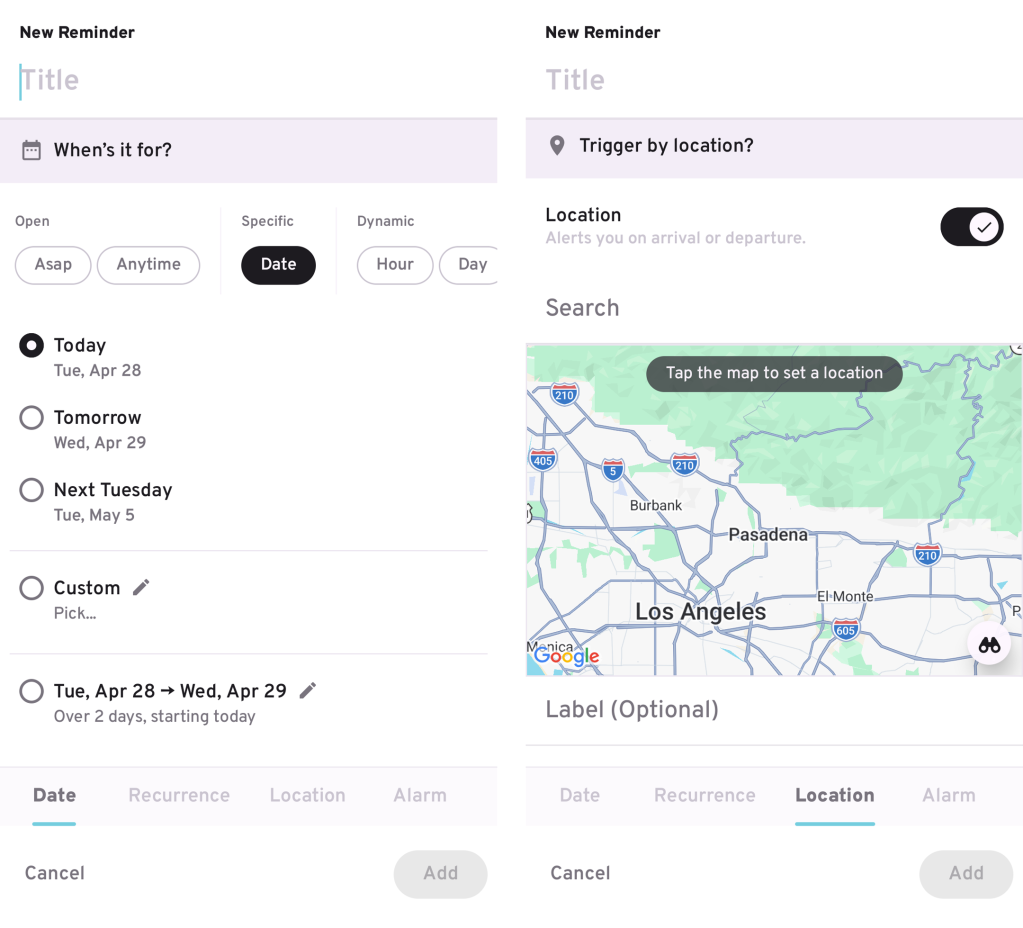
Creating a new task is as easy as tapping the “quick entry” prompt toward the top of the screen and typing. You can also use the plus icon in the lower-right corner of the screen for a more elaborate and detail-oriented task creation mechanism — and that’s where some of Ruff Reminders’ most impressive powers come into play.

To wit: For any task you create, you can schedule yourself a reminder for…

  • A specific date and time
  • A dynamic date or time — as in every Monday, every weekend, the first day of each month, and so on
  • And (drumroll, please…) a specific location — if, say, you want to be reminded about something when you get to the office, when you get home, or maybe even when you walk into a particular store or business
Android reminders app: Ruff Reminders location reminders
You can set all sorts of different reminders, including ones based on your physical location.

JR Raphael, Foundry

That last one in particular is a true treat to see. Like many Android-appreciating animals, I’ve been irked by Google’s ongoing retirement of location-based reminders all across the platform — first within the old Google Assistant system and then more recently within Google Keep as well. Ruff Reminders handily fills that void while offering a whole lot of other enticing extras that Assistant and Keep never provided.

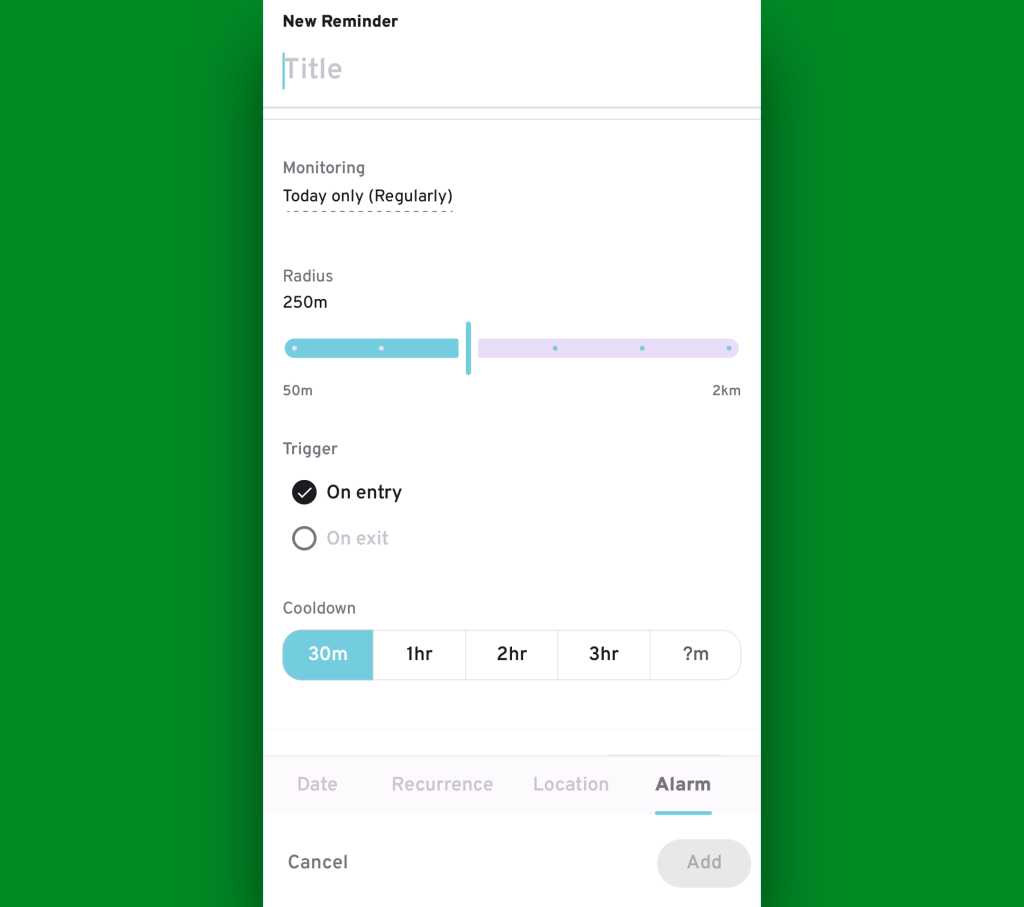
For instance: For any location-based reminder, Ruff Reminders gives you the option to have a task pop up when you reach whatever location you specify either within a certain specific timeframe or anytime — and to have that reminder exist only once or as a recurring thing, every time you come or go from the location in question.

On that latter point, you can also set the reminder to trigger when you arrive at your chosen location or when you leave it — and you can choose exactly how wide of a radius the app uses to identify the spot — both of which add a whole other layer of flexibility and potential usefulness into the feature.

Android reminders app: Ruff Reminders location reminder
Ruff Reminders’ location reminders are especially versatile and powerful.

JR Raphael, Foundry

And all of that is still just the start.

Remembering — and beyond

Once you have tasks created, Ruff Reminders really does work to make sure you remember ’em. In addition to setting all of your own preferred reminder patterns for each new task you create, you can tell the app to always nudge you about still-pending tasks for the present day at specific times as well as to keep “chasing” you with more prominent alarms — even multiple alarms, if you want — for items you haven’t finished.

All of those options exist within the dog-shaped Ruff icon in the lower-left corner of the screen:

width="1024" height="919" sizes="auto, (max-width: 1024px) 100vw, 1024px">
Ruff’s “nudges” and “chases” add in even more flexibility and reliability with making sure you never forget anything important.

JR Raphael, Foundry

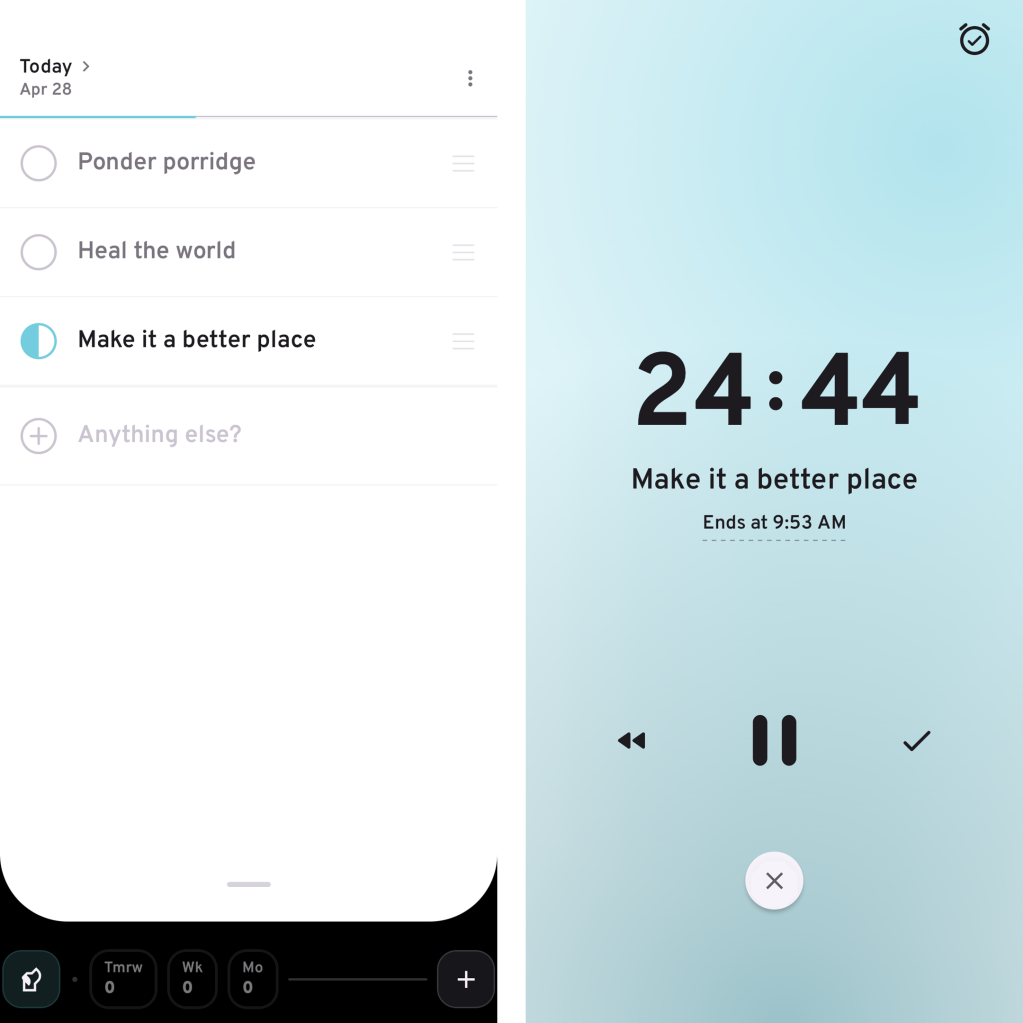
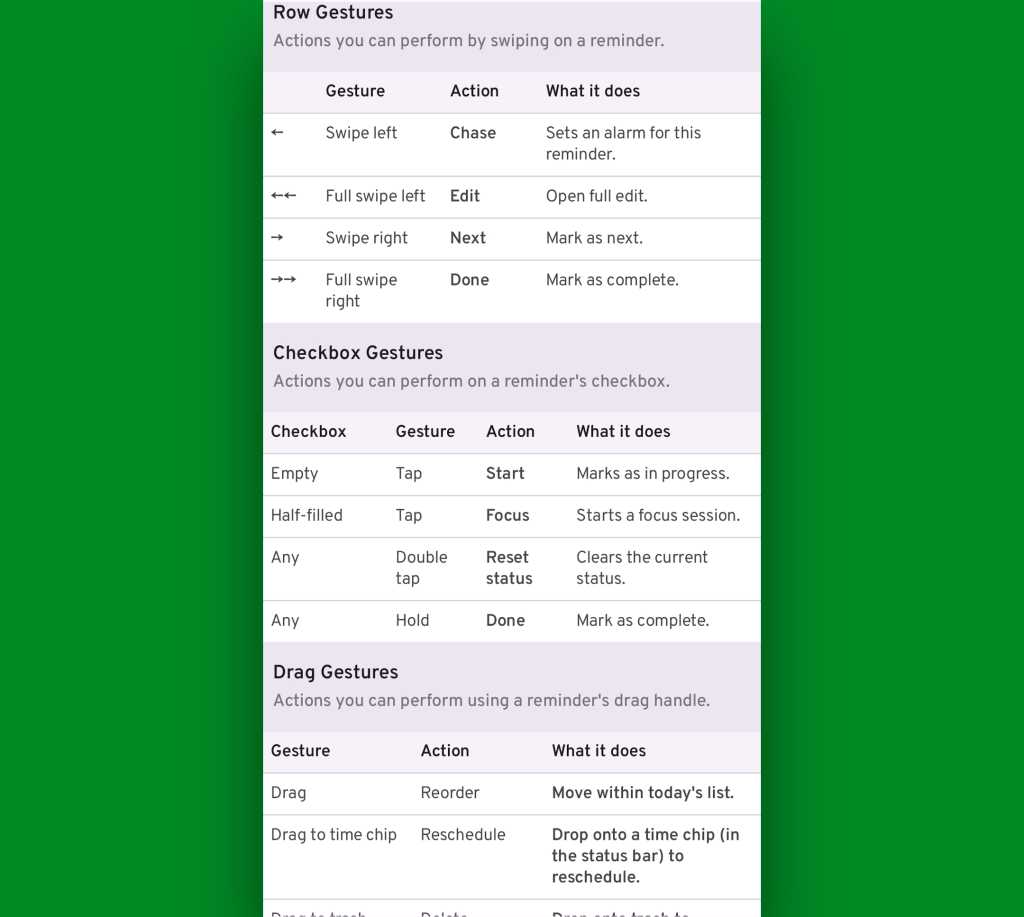
Once you’ve started a task, one tap on its line tells Ruff Reminders that it’s in progress and marks it accordingly. Another tap starts a full-screen timer (for any length you choose) to help you actually focus on the task. And pressing and holding the task marks it as finished.

You can also double-tap to reset an item’s status, if such a need ever arises.

Android reminders app: Ruff Reminders in-progress, timer
Marking a task as in progress (left) exposes the option to begin a full-screen focus timer (right), if you want.

JR Raphael, Foundry

If something does still manage to slip by without getting completed, it’ll move down to the app’s command bar, at the bottom of the screen — where it shows up inside a red box with the number of unfinished past tasks front and center.

Android reminders app: Ruff Reminders command bar
The Ruff Reminders command bar shows you how many missed tasks are still active and pending.

JR Raphael, Foundry

You can always tap that box to revisit and reschedule any missed tasks — or you can find any past task via the app’s swipe-up-from-the-bottom search system. But even more helpful are the ongoing reminders the app will keep bringing front and center whenever you tell it to keep chasing you about any particular item.

Android reminders app: Ruff Reminders missed task
Tapping the double up arrows on a missed task moves it right back into your current “today” view.

JR Raphael, Foundry

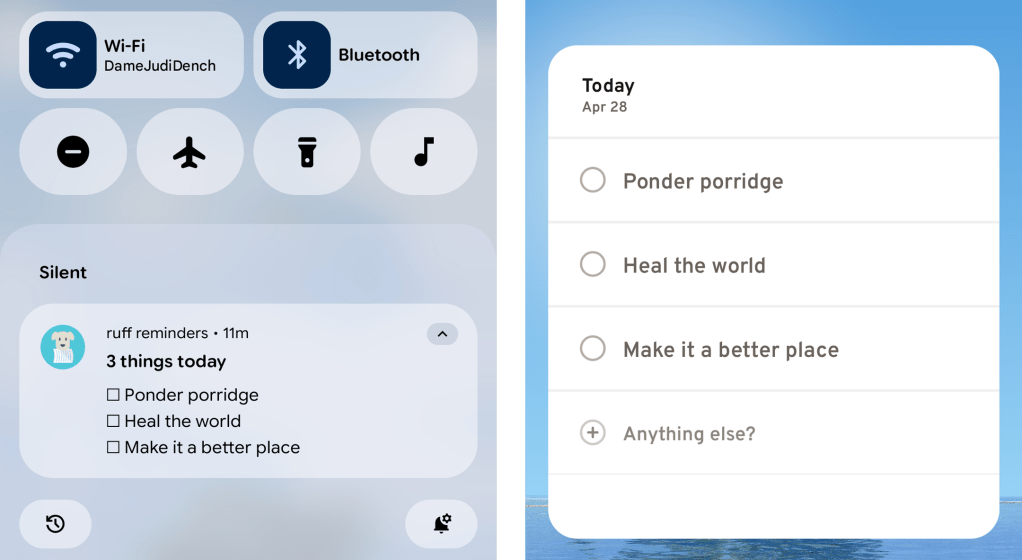
What else? Let’s see — for any items you set as “ongoing,” Ruff will create a persistent notification so you can easily see what’s lingering on your list. And as you’d expect for any serious Android productivity app, Ruff Reminders has a widget that lets you look at all your tasks for the current day and add new tasks right then and there, on your home screen, without ever having to open anything up.

Android reminders app: Ruff Reminders ongoing notification, widget
Between Ruff Reminders’ persistent notification of ongoing tasks and its home screen widget showing today’s tasks, you’ve got no shortage of ways to keep important stuff front and center.

JR Raphael, Foundry

For the true productivity-obsessed power-user nerds among us, Ruff Reminders also has a whole host of step-saving gestures built into its interface. Like all of the app’s more advanced options, you absolutely don’t have to mess with ’em if you don’t want to — but if you’re the type of person who likes learning shortcuts and flying around your phone with taps and swipes, you’ll be delighted by all the possibilities this unlocks. 

The more you use it, the more thoughtful and useful little touches you keep discovering — again, if and only if you want to explore those types of options.

Android reminders app: Ruff Reminders gestures
Gestures galore await for the shortcut adorers among us.

JR Raphael, Foundry

What’s most interesting to me about Ruff Reminders is the space it fills between the everything-style, intensive-need to-do apps out there — things like Todoist or even all-purpose productivity tools like Notion, which are great for the right type of purpose and person but can be overwhelming overkill for more casual task tracking — and the super-simple, at times too-limited apps like Google Keep, which are fine for basic info-dumping but lacking in more powerful task management and reminder magic.

Ruff Reminders manages to be both simple and effective — an often overlooked middle-ground for those of us who want to track tasks and remember stuff in a way that goes beyond the most barebones basic approach but that doesn’t require an entire intricate platform to do it.

Oh, and as far as privacy goes, Ruff Reminder’s policy on that front is also refreshingly simple: It doesn’t collect or process any personally identifiable information. Period.

The app doesn’t have ads, either. Instead, it allows you to use its most fundamental setup for free and offers a paid subscription for its full set of features — three bucks a month or $20 per year, at the moment, with the latter price set to bump up to $30 after a while. (That pricing does also vary by country, so the rates will be slightly lower in certain parts of the world.)

For now, all you’ve gotta do is try it out and see if it works as well for you as it has been for me.

And if you need a helping hand to remind you, I know just the app to get the job done.

Increase your Android intelligence quotient with my free Android Intelligence newsletter — three new things to try every Friday and my free Android Notification Power-Pack today.

Meta’s compute grab continues with agreement to deploy tens of millions of AWS Graviton cores

Meta is continuing its compute grab as the agentic AI race accelerates to a sprint.

Today, the company announced a partnership with Amazon Web Services (AWS) that will bring “tens of millions” of AWS Graviton5 cores (one chip contains 192 cores) into its compute portfolio, with the option to expand as its AI capabilities grow. This will make the Llama builder one of the largest Graviton customers in the world.

The move builds on Meta’s expansive partnerships with nearly every chip and compute provider in the business. It’s working with Nvidia, Arm, and AMD, as well as building its own internal training and inference accelerator chip.

“It feels very difficult to keep track of what Meta is doing, with all of these chip deals and announcements around in-house development,” said Matt Kimball, VP and principal analyst at Moor Insights & Strategy. This makes for “exciting times that tell us just how incredibly valuable silicon is right now.”

Controlling the system, not just scale

Graphics processing units (GPUs) are essential for large language model (LLM) training, but agentic AI requires a whole new workload capability. CPUs like Graviton5 are rising to this challenge, supporting intensive workloads like real-time reasoning, multi-step tasks, frontier model training, code generation, and deep research.

AWS says Graviton5 has the ability to handle “billions of interactions” and to coordinate complex, multi-stage agentic tasks. It is built on the AWS Nitro System to support high performance, availability, and security.

“This is really about control of the AI system, not just scale,” said Kimball. As AI evolves toward persistent, agentic workloads, the role of the CPU becomes “quite meaningful;” it serves as the control plane, handling orchestration, managing memory, scheduling, and other intensive tasks across accelerators.

“This is especially true in agentic environments, where the workloads will be less linear and more stateful,” he pointed out. So, ensuring a supply of these resources just makes sense.

Reflecting Meta’s diversified approach to hardware

The agreement builds on Meta’s long-standing partnership with AWS, but also reflects what the company calls its “diversified approach” to infrastructure. “No single chip architecture can efficiently serve every workload,” the company emphasized.

Proving the point, Meta recently announced four new generations of its MTIA training and inference accelerator chip and signed a massive deal with AMD to tap into 6GW worth of CPUs and AI accelerators. It also entered into a multi-year partnership with Nvidia to access millions of Blackwell and Rubin GPUs and to integrate Nvidia Spectrum-X Ethernet switches into its platform, and was also one of Arm’s first major CPU customers.

In the wake of all this, Nabeel Sherif, a principal advisory director at Info-Tech Research Group, posed the burning question: “What are they going to do with all this capacity?”

Primarily it will support Meta’s internal experimentation and innovation, he said, but it also lays the groundwork and provides the capacity for Meta to offer its own agentic AI services, for instance, its Llama AI model as an API, to the market.

“What those [services] will look like and what platforms and tools they’ll use, as well as what guardrails they’ll provide to users, is still unclear, but it’s going to be interesting to see it develop,” said Sherif.

The expanded capacity will enable a diversity of use cases and experimentation across various architectures and platforms, he said. Meta will have many options, and access to supply in an environment currently characterized not only by a wide variety of new CPU approaches, but by significant supply chain constraints. The AWS deal should be viewed as a complement to its partnerships and investments in other platforms like ARM, Nvidia, and AMD.

Kimball agreed that the move is “most definitely additive,” not a replacement or substitution. Meta isn’t moving off GPUs or accelerators, it’s building around them. “This is about assembling a heterogeneous system, not picking a single winner,” he said. “In fact, I think for most, heterogeneity is critical to long term success.”

Nvidia still dominates training and a lot of inference, while AMD is becoming “more and more relevant at scale,” Kimball noted. Arm, meanwhile, whether through CPU, custom silicon or other efforts, gives Meta architectural control, and Graviton5 fits into that mix as a “cost- and efficiency-optimized general-purpose compute layer.”

A question of strategy

The more interesting question is around strategy: Does this signal Meta is becoming a compute provider? Kimball doesn’t think so, noting that it’s likely the company isn’t looking to directly compete with hyperscalers as a general-purpose cloud. “This is more about vertical integration of their own AI stack,” he said.

The move gives them the ability to support internal workloads more efficiently, as well as providing the infrastructure foundation to expose more of that capability externally, whether through APIs, partnerships, or other means, he said.

And there’s a cost dynamic here, too, Kimball noted. As inference becomes persistent, especially with agentic systems, economics shift away from peak floating-point operations per second (FLOPS) (a measure of compute performance) and toward sustained efficiency and total cost of ownership (TCO).

CPUs like Graviton5 are well positioned for the parts of that workload that don’t require accelerators, but still need to run continuously. “At Meta’s scale, even small efficiency gains per workload compound quickly,” Kimball pointed out.

For developers and enterprise IT, the signal is pretty clear, he noted: The AI stack is getting more heterogeneous, not less so. Enterprises are going to see tighter coupling between CPUs, GPUs, and specialized accelerators, with workloads increasingly split across them based on behavior (prefill versus decode, stateless versus stateful, burst versus persistent).

“The implication is that infrastructure decisions have to become more workload-aware,” said Kimball. “It’s less about ‘which cloud?’ and more about ‘where does this specific part of the application run most efficiently?’”

This article originally appeared on NetworkWorld.