Author: Security – Computerworld

Claude Code and Cowork can now use your computer

Anthropic’s Claude is getting a new feature that allows the AI model to use your computer to perform tasks automatically. Both Cowork and Code can then navigate the screen by pointing, clicking, and scrolling, open files, use the browser, and run development tools without the need for special integrations.

The feature also supports the recently launched Dispatch, which allows a user to assign tasks to Claude from their phone and have them executed on the computer.

Anthropic emphasized that the system always requires a user’s approval before opening new applications, and that the process can be canceled at any time. However, the feature can make mistakes, runs slowly, and users are advised to avoid sensitive information.

The computer control feature is currently available as a “research preview” for Claude Pro and Max subscribers on macOS.

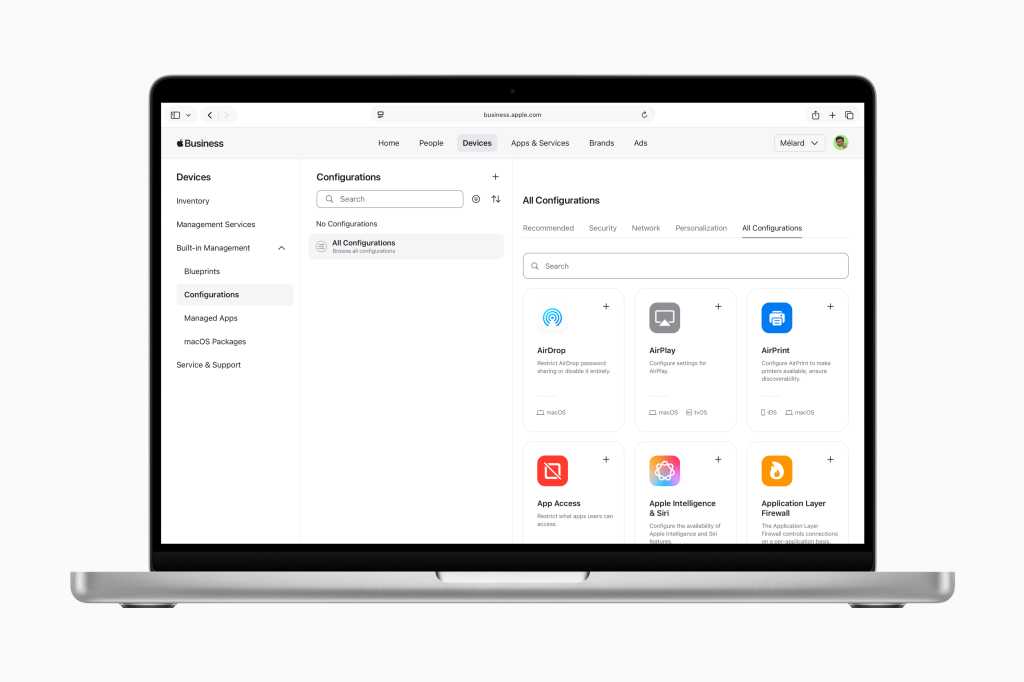
Apple goes global with key MDM tools and services for business

As it steadily grows its share in business markets, Apple has at last introduced its very useful collection of services for small and mid-sized businesses (SMBs), Apple Business Essentials, outside the US; except it’s not called Apple Business Essentials, and much of it will be free.

First introduced November 2021 following the company’s acquisition of Fleetsmith, Business Essentials is a collection of tools focused on the needs of SMBs. It includes Apple-friendly MDM tools, services, storage, and premium AppleCare and support options. It also includes free business-class domain-based email and calendar services, custom domain support, and location-based advertising within Apple Maps along with powerful tools for brand management.

The entire cornucopia of services is being made available via the all-new Apple Business portal, which combines Apple Business Connect, Apple Business Essentials, and Apple Business Manager all in one place. The idea is to make it much easier for any business to manage its tech and its presence from within the Apple ecosystem, though not every feature will be available in every place. 

“Apple Business is a significant leap forward in our decades-long commitment to helping companies of all sizes leverage the power of Apple products and services to run and grow,” Susan Prescott, Apple’s vice president of enterprise and education marketing, said in a statement. “We’ve unified Apple’s strongest business offerings into one simple, secure platform, delivering key features for organizations in every stage and sector, including built-in device management, collaboration tools, and additional ways to reach new customers….” 

What is Apple Business?

Apple Business will be available starting April 14 in more than 200 countries and regions. The new platform offers all of Apple’s key business-focused services with a few additions. For most business users, the most important tool will be the built-in mobile device management service Apple can provide. While not pretending to be anything as granular as MDM services from the likes of Jamf, Iru, or Hexnode, what is available will help SMBs manage, deploy and configure new Apple hardware.

Some of the features include:

  • Managed Apple accounts that separate private employee data from company information through integration with an identity service provider.
  • The ability to configure employees and/or employee groups.
  • Tools to manage device settings and security.
  • Tools to manage and deploy apps and settings using Blueprints and the App Store.
  • Zero-touch deployment of new hardware.

Apple’s APIs offering access to device, user, audit, and MDM service data are also now available to businesses seeking even more control — particularly for larger deployments. For many smaller enterprises, what matters most is that the basic MDM features are now free, rather than requiring a subscription as before. The company offers 5GB storage for employee accounts, with higher amounts starting at 99 cents per person.

The company also announced that AppleCare+ for Business coverage is available per device or per user, starting at $6.99 per month, or $13.99 per month per user for up to three devices.  When this was first introduced in 2022, it offered 24/7 access to phone support, training for both IT admins and employees, and up to two device repairs per plan — by individual, group, or device — each year. (I’m not clear yet on whether that component of the service offers as much.)

Competing with Google Workspace and M365?

What Apple now has on offer means it is putting together a viable competitor for existing productivity suites. Not only has it made it possible to use custom domains for email, and to populate your online presence with pro-seeming details such as logos that appear in outbound emails, but it also supports Apple Business with free apps such as Pages or Keynote. And it now provides fully integrated email, calendar, and directory services. 

Put it all together and you can use Apple Business to drive efficiency in business, with scheduling tools like calendar delegation, a company directory, and personalized contact cards.

Apple also offers its own collaboration tools such as Messages, FaceTime, and FreeForm, which, when you add it up, means many business users might now think Apple’s platforms offer particularly good value — particularly as the cost of entry to the ecosystem falls.

The only surprise to m, is why Apple hasn’t corralled all of this together under the iconic “Apple Works” brand. But, as predicted shortly after the service first appeared, today’s news can only intensify the company’s bid to woo business users. 

You can follow me on social media! Join me on BlueSky,  LinkedIn, and Mastodon.

Apple: Local business ads are coming to Apple Maps

Following years of speculation, Apple has confirmed it intends to introduce advertising in Apple Maps — specifically a business-focused offering designed to grab a chunk of the estimated $296 billion location-based ads market. 

Announced alongside big changes in Apple’s services for business, including international introduction of services previously available with Apple Business Essentials in the US, Apple’s Maps ad plan should generate more cash for Cupertino’s coffers; the company promises user privacy will not be for sale.

Ads on Maps begins this summer in the US and Canada. Aimed at small business, the idea is that these ads will appear when users search in Maps. These will be presented at the top of search results (when relevant) and within a new Suggested Places section in Maps. Ads will be clearly marked, so you’ll know when your search experience has generated one of the things.

Business users gain a suite of Apple tools

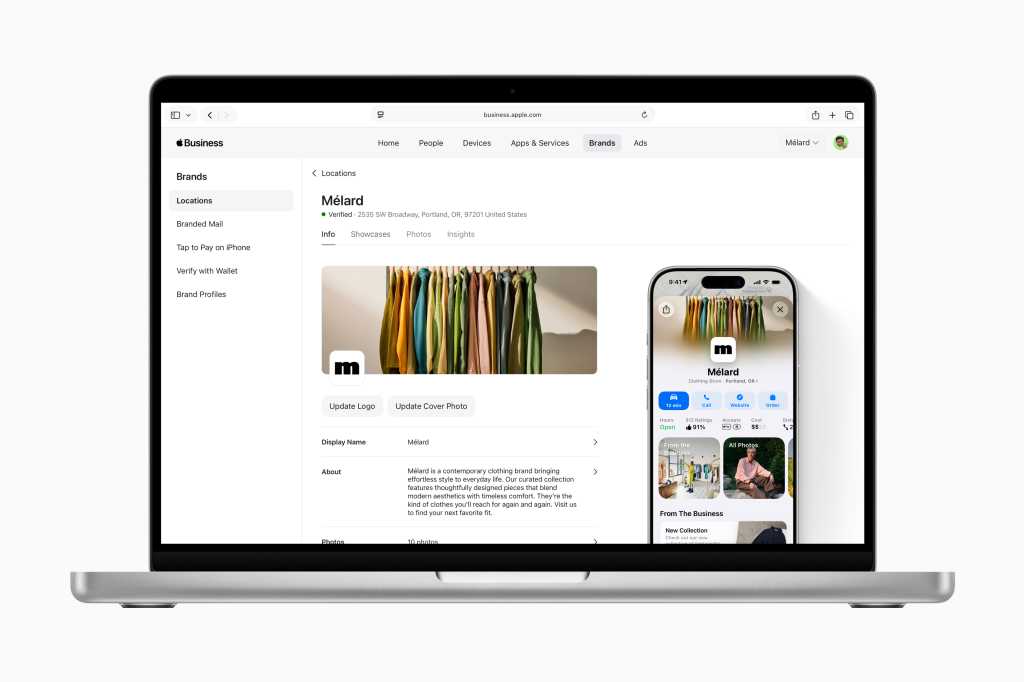
Apple has combined these new Ads on Maps services with other existing business-focused services, including Apple Business Essentials and Apple Business Connect, making all of these available via a new portal at Apple Business.

When it comes to ads in Maps, business users will be able claim their location and create ads via that portal, which requires confirmation of who they are and the status of their business to help prevent fraud.

Brand management tools allow companies to:

  • Manage brand name, logo, and key details consistently across Maps, Wallet, and other Apple features and services. 
  • Customize their Map entry with Rich Place Card, offering images, information and other useful details. These will then appear across Maps, Safari, Spotlight and so on.
  • Highlight deals, special offers, new products, or seasonal items on place cards in Maps. Add custom actions like order or reserve to direct customers to a preferred website or app.
  • Utilize a series of analytical tools to get business insight into their performance on Maps.

When Apple Business is available in April, businesses will need to first claim their location on Maps before they are able to use Apple’s fully automated ads creation tools.

Current Apple Ads advertisers and agencies will be able to book ads through their existing portal, which will gain additional options for their campaigns. Ads on Apple Maps will be available to businesses starting this summer in the US and Canada. For more information, visit ads.apple.com/maps.

The privacy thing

While it remains unclear why, or if, anyone really needs ads across their online experience, Apple likely feels the need to create a new income stream as it faces the inevitable end of any search-generated income it may have received from Google. It’s also true that highly localized and contextualized advertising for stores and services has become popular, particularly for business users seeking to connect with local customers. 

The devil will be in how these ads are served. From what I’ve seen, the ads are quite discreet and clearly labelled with a small blue icon that says “Ad,” so you are unlikely to feel fooled into clicking something you don’t want to see.

Apple also promises that Ads on Maps maintains Apple’s broader privacy-first approach to advertising. That means a user’s location and the ads they see and interact with in Maps are not associated with their Apple Account. It also means personal data stays on a user’s device, is not collected or stored by Apple, and is not shared with third parties. 

You can follow me on social media! Join me on BlueSky,  LinkedIn, and Mastodon.

How digital brains for humanoid robots are being built

Every year, the highlight of Nvidia’s GTC developer event is a cool robot chilling out with CEO Jensen Huang during his keynote.

At last year’s event, Blue a bipedal robot, fumbled around the stage, disobeyed Huang’s simple commands and navigated in seemingly random directions.

This year, the robot was Olaf from the animated movie Frozen. Olaf was more animated than Blue was in 2025, walking, answering questions and behaving much like its character in the movie.

Olaf offered a real-world glimpse at how much humanoid robots have improved in just one year.

Not surprisingly, enterprises are chasing the idea of humanoid robots that embody human characteristics and work in real-world conditions. “We have reached a tipping point where robots are getting out of the lab and making their way into the messy physical world,” Amit Goel, head of robotics and edge computing ecosystem at Nvidia, said during a panel discussion at GTC.

Morgan Stanley has said that as many as 1 billion robots could be on earth by 2050. But robot makers still face sizable hurdles in their efforts to ensure humanoid robots are safe for the real world.

In particular, building the robot brain has been more challenging than expected, the panelists said. While AI can help robots reason, decide and act, there’s still a gap between that and the complex calculations brains continually make.

With that in mind, the panelists talked about the various approaches to building a brain for humanoid robots.

Data collection: Robot makers first need to train and simulate robots for real-world environments. That led some of the panelists to collect internet videos to get an idea of human behavior.

“Learning from just watching other humans from just any sort of camera or internet video datasets and so on — those are very rich datasets,” said Ashok Elluswamy, vice president of AI at Tesla, which is building the Optimus humanoid robot.

The collection of human-scale data, Elluswamy said, helped build Tesla’s autonomous driving capabilities. Among the techniques used was teleoperation, which collects data from a human controlling a robot’s operations and uses that information for training.

Brain architecture: Not all robots are alike. Some companies, such as Skild.AI and Tesla, are building universal robots that can do everything. Others, such as Hexagon, build robots for specialized tasks.

Tesla’s architecture resembles the human brain, in which every bit of information in different regions is shared across units. For example, information gathered from cameras, sensors, or other data sources is shared across the system, which helps train the robot and determine its next steps.

Hexagon focuses on locomotion and high-precision robots, isolating the brain activity to specific tasks. It uses agentic AI and large language models (LLMs) to drive its brain architecture.

“If you have many different models…, you need to orchestrate them so that you always take the best model for the right task, given the right environment,” said Arnaud Robert, president of Hexagon.

Agility Robotics and Physical Intelligence are using modular brain architecture, which separates the brain into hierarchies to conduct different tasks. Agility’s Digit robot, for instance, has a “task” layer that describes what needs to be done, a “skill” layer that covers how to do it, and a “control” layer that executes the job, including locomotion and task completion.

“We have a combination of AI-learned and also engineered skills…. We can mix and match those different layers together…, which is really useful for practical deployment,” said Pras Velagapudi, CTO at Agility Robotics.

Simulating the real world: Simulation helps evaluate robot behaviors and whether robots stick to policies and adhere to safety requirements. “As policies get more and more general, you need to be testing them in more and more situations…. Doing that in the real world can be increasingly costly, increasingly challenging,” said Chelsea Finn, assistant professor at Stanford and co-founder of Physical Intelligence.

Simulation provides real-world validation and can be an important data source to fine-tune robotic behavior. “We simulate, we go in reality. We capture what it is, and then we feed it back to the simulator to converge the gap towards zero,” said Robert.

For example, Hexagon wanted to teach its Aeon robot how to climb stairs. Engineers suggested locking the wheel it uses to move, then decided on the optimal leg motor movement to go up stairs.

“If you use simulation and reinforcement learning, the best way for a wheel-based humanoid to go up the stairs is actually to have slow speed and never go to zero,” Robert said.

Safety: Robotic safety can’t be simulated — it needs to be done in the real world. “Having a fleet of robots practice…tasks in the real world and using the data to make sure the simulation is grounded in reality is quite helpful,” Elluswamy said.

Safety testing needs to be at every level of the robotic stack, panelists said. “A lot of the safety measures are at the lowest level, because that’s where you can really guarantee and ensure that it will be operating in the ways that you expect,” Finn said.

Agility Robotics’ Velagapudi said it might not be obvious that a robot can slip on a dusty warehouse floor. That means adding a controller that can maintain robustness on various types of surfaces and textures, and resistance to being pushed, pulled or caught on objects.

Safety is critical if the robot is expected to autonomously execute tasks for a very long time, Elluswamy said.

“Robotics’ last mile is extremely hard,” said Skild.AI CEO Deepak Pathak said during the panel discussion.

HP launches TPM Guard to help defeat physical TPM attacks

The Trusted Platform Module (TPM), developed by the Trusted Computing Group (TCG), is a mandatory security component in any computer running Windows 11. It stores sensitive information such as encryption keys in a separate, secure chip, passing it to the CPU as required.

However, there’s a problem. If an attacker can get physical access to the device, they can use hardware costing less than $20, running readily available software, to grab those encryption keys as they are sent to the CPU, allowing data on the system to be readily decrypted by the attacker and stolen.

At its Imagine event this week, HP announced a product that it says prevents this kind of attack without the need to make changes to device encryption software such as BitLocker. TPM Guard is a combination of hardware and firmware that creates an authenticated and encrypted tunnel between the TPM and the CPU to protect the communication between them, said Ian Pratt, HP’s vice president of security and commercial systems. The TPM is cryptographically bound to the host processor so if the chip is removed from the system, the TPM will cease to function.

“This isn’t just about espionage agents sneaking into hotel rooms of executives while they’re out at dinner,” he said during a media briefing. “Many laptops get stolen every day, and if a laptop is owned by an enterprise, there’s potentially a lot more value to the data it contains than the resale value of the device itself. And hence, opportunity for that device to work its way through the black market to a crime group that is capable of extracting the data and monetizing it, perhaps using the credentials it contains to gain access to enterprise systems or threatening to leak customer data.”

Most companies today rely on BitLocker to encrypt that data, but the TPM issue can negate that protection, putting organizations at risk.

TPM Guard can prevent a whole class of bus interception and interposition attacks, Pratt said.

HP wants the technology behind it to become an industry standard, and has already submitted a proposal to the TCG, he said.

Starting in July, TPM Guard will be available as a firmware update at no additional charge on “selected” HP G2 commercial PCs, and will be built in to supported PCs in the future.

Structurally significant

“HP TPM Guard is arguably the most structurally significant announcement [at HP Imagine] for enterprise, government, and high-compliance customers,” said Anurag Agrawal, chief global analyst at Techaisle. “From an architectural standpoint, it closes a massive physical edge loophole.”

It’s “a brilliant maneuver” against Microsoft’s Pluton architecture, Agrawal said, noting that Pluton eliminates the bus by putting security directly on the CPU die, while TPM Guard gives highly regulated customers the physical security of Pluton without forcing them to abandon their preferred TCG-certified discrete TPMs.

HP’s proposal of TPM Guard to the Trusted Computing Group (TCG) as a new industry standard “creates immediate security debt for HP’s rivals,” he said.

“By positioning TPM Guard as the first and only solution to this physical bus attack, HP is implicitly stating that the existing ‘secure’ fleets from competitors like Dell and Lenovo carry a known, exploitable vulnerability, giving HP and its channel partners a highly aggressive wedge issue to force early device refresh cycles,” he said.

TPM hasn’t been significantly updated for some time, making HP’s TPM Guard all the more important, said Rob Enderle, principal analyst at Enderle Group. “In the face of rising threats, it is always important to reinvest in defense, and that is what they are doing here.”

This article first appeared on CSO.

Microsoft maps Windows 11 quality overhaul after acknowledging gaps

Microsoft is planning a broad push to improve Windows 11.

The development comes just months after the company publicly admitted that the operating system fell short on performance, following user criticism. Users have been experiencing inconsistencies, recurring bugs, and performance issues. The company has now outlined a clear roadmap to enhance performance and reliability.

The plan is to raise the bar on Windows 11 quality this year, with a focus on areas that have a meaningful impact on how users experience Windows, how quickly it starts and responds, how stable it remains under real workloads, and how consistent and thoughtful the overall experience feels, said Pavan Davuluri, EVP of Windows and Devices, in a blog post.

Fixing performance bottlenecks

Microsoft is focusing on making Windows 11 more responsive and consistent by improving system and application performance across the board. The company plans to reduce resource usage and lower memory footprint to make more capacity available for apps, and to ensure performance remains stable under heavy workloads.

Core experiences such as file operations, search, and navigation within File Explorer will be optimized to reduce latency and improve responsiveness, alongside faster file operations, the company said.

Microsoft is also working to reduce interaction delays by moving core Windows experiences to the WinUI3 framework.

For developers, the company is working on improving the Windows Subsystem for Linux (WSL) experience by trying to enhance performance and integration for developers using Linux tools and environments on Windows.

Strengthening reliability and reworking updates

For reliability, the company has aimed to reduce OS-level crashes, improve driver quality and app stability, and enable stable connections with Bluetooth accessories, USB devices, cameras, and audio.

Unexpected Windows updates have been a pain point for both users and enterprises, resulting in disruptions at critical moments. Microsoft plans to make them less disruptive by moving devices to a single monthly reboot and clearer progress visibility.

However, the option for installing new features and faster updates will continue to exist in case a user or an organization wishes to get them faster.

In addition, the company said it will hand over significant update control to users by allowing them to decide when to pause updates and for how long, and the ability to restart or shut down without being forced to install the updates.

Additionally, enhancements to Windows Hello will focus on more reliable facial and fingerprint recognition, enabling faster and more dependable sign-in experiences.

Reworking usability and AI integration

Microsoft also plans to make Windows 11 more intuitive and less distracting by offering greater personalization and giving users more control over how Windows behaves. This includes improvements across the Start menu and taskbar for better consistency, a streamlined setup and notification experience, and enhanced search across the system.

Microsoft said it will also take a more measured approach to AI integration, ensuring new capabilities are introduced with transparency and user control to enhance the experience, instead of complicating.

“Microsoft is not stepping away from AI in Windows. It is correcting how AI is positioned and deployed within the operating system. The earlier approach pushed Copilot aggressively across multiple surfaces without always delivering clear, contextual value. That created friction, confusion, and in some cases resistance from both users and enterprises,” said Sanchit Vir Gogia, chief analyst, founder and CEO at Greyhound Research.

Are these fixes enough?

While Microsoft has outlined a comprehensive plan, analysts say the issues highlighted by the company may not represent the full scope of challenges facing Windows 11.

“The real issue with Windows 11 is structural and systemic. Windows today sits at the intersection of legacy code, modern UI frameworks, diverse OEM hardware, third-party drivers, enterprise security layers, and now AI services. This creates a multi-layer failure surface where issues are not always caused by Microsoft alone, but are experienced by the user as a single breakdown,” explained Gogia. Many of the recent issues tracked in release cycles have emerged from these interactions rather than isolated OS bugs.

Gogia noted that while reliability, performance, and updates are real issues, the deeper concern is predictability, control, and coherence. That is the gap Microsoft is still working to close.

China’s use of open‑source AI threatens the US lead in AI development, US Commission warns

China’s open-source AI strategy is building a self-reinforcing competitive advantage that US export controls were not designed to counter, the US-China Economic and Security Review Commission has warned.

“US export controls primarily target the digital loop, restricting access to advanced chips used for frontier model training — but are not well suited to addressing the physical loop of deployment-driven data creation and accumulation across China’s manufacturing base,” the Commission said in a paper. “As open models reduce the compute required for effective deployment, China’s ability to generate proprietary industrial data at pace and scale becomes increasingly independent of access to cutting-edge hardware.”

The paper, titled Two Loops: How China’s Open AI Strategy Reinforces Its Industrial Dominance, argues that Chinese labs have built a global diffusion engine through permissive licensing and pricing that undercuts US rivals and that widespread adoption is generating industrial data advantages that no current policy framework addresses.

Chinese model adoption runs deep

The scale of that adoption is visible in the numbers. Alibaba’s Qwen model family is now the largest ecosystem on Hugging Face with over 100,000 derivative models, the paper said. From November to December 2025, seven of the ten most downloaded models on the platform came from Chinese labs, including derivatives of DeepSeek, whose rapid rise has already unsettled enterprise AI procurement assumptions.

The paper further added that commercial penetration extends deep into US enterprises. One partner at venture capital firm Andreessen Horowitz estimated that roughly 80% of US startups use Chinese base models to build derivative applications, the paper noted. On pricing, Moonshot AI’s Kimi K2.5 costs four times less than OpenAI’s GPT-5.2 while matching it on capability scores, the paper said, citing Artificial Analysis benchmark data.

“Enterprises are no longer making a clear, deliberate choice about which AI model they adopt,” said Sanchit Vir Gogia, chief analyst at Greyhound Research. “Models are entering enterprise environments through copilots, SaaS platforms, API layers, and fine-tuned derivatives. The enterprise is often several layers removed from the original source.”

Traditional third-party risk management was never designed for this, Gogia added. “It does not track model ancestry, fine-tuning chains, training data inheritance, or runtime routing behaviour.”

Security risks outpace governance

The security risks attached to that invisible exposure are documented. The US National Institute of Standards and Technology evaluated DeepSeek’s models in September 2025 and found agents based on DeepSeek’s most secure model were, on average, 12 times more likely than US frontier models to follow malicious instructions, the paper said. In simulated tests, hijacked agents sent phishing emails, downloaded malware, and exfiltrated user login credentials.

The paper also noted that Chinese models are subject to political content restrictions, and that enterprises routing workloads through Chinese-linked providers face data jurisdictional risks — a concern that has drawn regulatory scrutiny across Europe and South Korea.

“CIOs should extend risk frameworks to include model lineage, mandating vendors to disclose model origins and training data,” said Deepika Giri, AVP and regional head of AI, analytics, and data at IDC. “It is not just adequate if models are small — they also must be safe to be enterprise-grade. This becomes extremely critical for regulated industries.”

Gogia said enterprises need to treat AI like a software supply chain. “A Model Bill of Materials must capture base model origin, derivative history, datasets used, and hosting geography — and must be continuously updated, because these systems change in production without triggering traditional procurement events.”

Factory deployment widens the gap

The commission’s deeper concern is that China’s advantage operates through two distinct cycles.

The first is digital: open models drive adoption, adoption drives iteration, and iteration produces more capable models. The second runs through the physical economy — AI deployed across China’s factories, logistics networks, and robotics sector generates proprietary real-world data that feeds back into model improvement. Beijing formalized this in 2020, designating data as the fifth factor of production, and became the first country to allow enterprises to carry data assets on their balance sheets, the commission noted in the paper.

The models most consequential for enterprise deployment, the paper argued, are not frontier large language models but small, task-specific models — a category China’s open ecosystem already dominates. A Nvidia research paper cited by the commission found that small models handle the bulk of operational subtasks in agentic AI systems at costs 10 to 30 times lower than frontier alternatives.

“The real question is no longer which flagship model a vendor uses,” Gogia said. “The real question is which models are actually executing tasks in production — what they are derived from, how often they are updated or swapped, and how they are governed.”

US response remains fragmented

The commission acknowledged nascent steps by US firms, but warned the overall response remains uncoordinated. OpenAI released its first open-weight models since GPT-2 in August 2025, followed by Nvidia’s Nemotron 3 in March 2026. But Meta is reportedly preparing to shift its next-generation model to a closed, API-only approach.

“If sustained,” the paper said, “Meta’s retreat from openness would leave the United States without a major frontier model developer anchoring its open AI ecosystem at precisely the moment China’s state-backed open development is accelerating.”

Caught in the Iranian War crossfire: Big Tech, Microsoft and Windows

Iran’s most potent weapon in the war with the United States is pretty clear: attack the world’s oil and gas infrastructure by closing off access to the Strait of Hormuz. But Big Oil isn’t the only industry Iran is aiming for — it’s also attacking Big Tech. And that includes Microsoft, which is directly in Iran’s cross-hairs. The longer the war goes on, the more likely it is that Iran will hit Microsoft in big ways and small.

Microsoft and tech giants such as Google, Amazon, OpenAI and others are vulnerable because Persian Gulf countries have been among the world’s most aggressive investors in AI and in the massive infrastructure needed to support AI data centers — all those cloud services and multi-gigawatt power-generating plants at the heart of the current boom.

Gulf countries have gone all in on AI for several reasons. They’re looking to invest profits from oil and gas sales, and figure AI is a good bet. Their electric costs are cheaper than in the US — five cents per kilowatt hour in Bahrain and Saudi Arabia and three cents per kilowatt hour in Qatar versus 18 cents per kilowatt hour in the United States. And they want to find an alternative to oil revenues; over the long term, oil will likely be replaced with more sustainable forms of energy.

Microsoft has been part of that investment scene. In just one example, it partnered with G42, , a United Arab Emirates-based company which The New York Times notes, “is building an artificial intelligence industry as an alternative to oil income.” The deal was brokered in part by the Biden Administration. Since then, however, US President Donald J. Trump has been helping tech companies, including Microsoft, make other big deals as well. 

Microsoft’s facilities at risk in the Middle East 

As a result, Microsoft now has a sprawling presence throughout the Gulf, Israel and Middle East that is vulnerable to drone and missile attacks. In mid-March, after the data center of an Iranian bank was attacked by air, Iran threatened to attack holdings of American tech firms, including Microsoft and others.

It listed the holdings it might go after, including Microsoft cloud and data center infrastructure in Israel, the United Arab Emirates (UAE) and Bahrain, as well as corporate offices in Israel and the UAE. Microsoft has far more facilities than that in the Middle East that could also eventually be targeted.

Microsoft hasn’t yet been hit directly by Iran. But Amazon has been — with drone attacks on Amazon Cloud Services in data centers in the UAE and Bahrain, causing emergency shutdowns, fires, and service outages. Iran’s state-run media said it attacked the centers because they directly supported the US and Israel’s war efforts.

(There’s been no evidence so far that Microsoft cloud or data center infrastructure is being used in the war, and Microsoft has made no statements about whether that’s the case.) 

Iranian hackers target Windows

In another avenue of attack, Iranian hackers have been behind cyberattacks against US companies – and they’ve used security holes in Windows to do so.

The largest known attack was on the giant medical tech firm Stryker. The Iranian hacker group Handala claimed that in the attack it completely wiped more than 200,000 servers and other devices, which forced Stryker to close its offices in 79 countries. The hackers also claimed to have stolen 50TB from Stryker systems. 

The group apparently created a Global Administrator account in Microsoft Intune, Microsoft’s cloud service for managing and securing devices, and used that account to launch the attack.

Security firm Tenable warns that there’s an even more dangerous Microsoft-related security hole that hasn’t been publicized that could spell larger problems for companies. “Tenable’s exposure data analysis across seven target countries reveals that the largest exploitable attack surface isn’t the headline threat, it’s a Microsoft Word N-day affecting nearly 14 million assets,” the company said.

More troubling still, Tenable claims that even after the war is over, the threat will remain:  “The access obtained during these weeks will persist in networks for months or years after a ceasefire.”

The hacking danger doesn’t directly harm Microsoft today, but it could lead to a long-term weakening of the trust enterprises put in it and its products. 

The longer this goes on…

The longer the war lasts, the more likely it is that Microsoft infrastructure in the Persian Gulf and throughout the Middle East might be hit — and the more likely that hackers will hit companies that use Microsoft technologies throughout the world.

Microsoft is finding out the hard way that although Trump’s reign may bring short-term benefits to it and other tech companies, in the long term, his actions in this war will only hurt the company.

What’s coming next for LLMs and AI agents?

“Three or four years ago, we were super excited when our [AI] models could solve eighth-grade math problems,” Jeff Dean, chief scientist, Google DeepMind and Google Research, said during a panel discussion at Nvidia’s GTC developer show last week.

By last year, Google’s Gemini had reached the gold-medal standard at the International Mathematical Olympiad and it has now won a variety of coding contests.

That’s just one example of how quickly AI has upended the world. It’s taken over businesses, warped economies, rapidly changed the job market and careers and, perhaps, could even alter the future of humanity.

Tech industry experts have described AI as more revolutionary than electricity and the internet. (It’s also been called more dangerous than nuclear weapons, because the technology in the wrong hands could wreak havoc.)

After several years of rapid evolution, what’s next for AI? Dean and Nvidia’s chief scientist, Bill Dally, shared some ideas during the panel discussion at GTC. Here’s a rundown on some of what they envision for large language models (LLMs) and agentic AI.

Autonomous models: The arrival earlier this year of OpenClaw provides a glimpse of how AI agents can complete work unsupervised without any human intervention. But the current computing pipeline — including chips, power requirements, communications and cost — are lagging. To empower these kinds of futuristic agents, things need to be faster, Dean said.

Nvidia is working to make agents faster, including the use of technology that allows data to be transferred using optical networking technologies. “We call it the speed of light,” said Dally. 

Free agents evolving on their own: Here’s a scary thought: agents could be creating the next version of themselves, or least creating updated versions that can run the latest large language models (LLMs) and genAI tools.

That’s not happening quite yet, but there are signs it’s coming, Dean said, noting that AI agents can already self-evolve by accepting and dismissing ideas.

There’s history here, too. In 2017, AI researchers came up with the concept of “meta learning,” where AI could search for models best suited for experiments and problem solving. The search parameters at the time were mostly specified in code, but now that can be done with natural language, Dean said.

Natural language interaction makes it easier for agents to find ways to get better, such as finding new information, specific algorithms, or distillation mechanisms. AI can be seen as a performance multiplier that frees researchers to think up new ideas. “It’s a partnership between super-capable researchers and super-capable agents,” Dean said.

More interactive LLMs: As AI technology progresses, LLMs could become more interactive with the real world, actually re-learning and updating themselves in real time and taking actions based on that new knowledge.

Today’s LLMs are basically strapped on a board, streamed through internet data, and then presented to the world, Dean said, with results that are largely predetermined.

But future models will learn on the fly by instantly interleaving physical and digital information. With that information, LLMs will be better able to direct robotic actions and predict answers to questions.

While that is already done in post training, what’s better is interleaving at the pre-training stage. “We sort of have this artificial distinction now…. It seems like that shouldn’t exist for the long term,” Dean said.

Continual-learning models are already emerging without any fixed parameters, with organically growing models advancing, pruning and compressing parameters, Dean said.

The Master agent: Nvidia and Google are already using AI for chip design; the next step is to figure out how to automate the process so chip designers and developers can do other things.

The process might well involve a “master” agent calling on sub-agents that specialize in creating on-chip functions or fixing bugs. Those agents would have to negotiate improvements on chips and iterate if the results aren’t good.

“They’ll have the same kind of meetings we have, but between agents,” Dally said.

Machine speed agents: AI development tools are designed for human speed, but need to perform at machine speed, the panelists said. Because agents reason, decide and act significantly faster than people, human tools like a slow-loading C++ compiler get in the way of quick progress.

“We’re going to need to start to reengineer the tools that these models [use],” Dean said.

That’s already happening for coding tools and document manipulation, which previously extracted information at human speed. Put simply, ”We’ll need new forms of tools,” Dean said.

Security experts highlighted the ability for machine-speed AI agents to tackle cyberattacks. That’s because humans might be too slow at stopping agentic AI-based  attacks.

Better educational tools: The panelists criticized universities that have restricted the use of AI in classrooms. Instead, educators need to lean into AI to accelerate learning, said Dally, who previously was a computer science professor at Stanford University.

Models will soon serve as “amazing” personalized tutors that promote learning concepts efficiently without giving away answers, Dean said. He noted how calculators removed bottlenecks around learning math, helping students quickly move to higher levels.

“Maybe I should quit my day job and go and do it myself,” Dean said.

Here’s what $5,849 gets you in an M5 Max MacBook Pro

The M5 Max MacBook Pro is a symphony of performance. On the surface, it looks like any other MacBook Pro, but its capabilities define top-notch performance. It aces every performance benchmark and handles everything you throw at it, quietly and with 22 hours of battery life. Put simply: it’s portable computing done right.

The 14-in. MacBook Pro I’ve been working with is undoubtedly a pro machine (as it should be with a nearly $6,000 price tag). This particular unit uses Apple’s most advanced M5 Max processor (count ’em, 18 CPU cores, 40 GPU cores), has a whopping 128GB RAM and 4TB of SSD storage. Price with options is: $5,849.

A benchmark for excellence

So much of what makes these Macs great relates to the processor. The M5 Max in my test machine (thanks, Apple) is one of the most advanced chips on the planet. It introduces a new “Fusion” architecture that connects two chip dies together, forming a single system-on-a-chip (SOC) in a move that delivers amazing performance. 

Three statistics illustrate this:

  • Single-core processor performance: 4,351
  • Multi-core processor performance: 29,510
  • Super fast SSD performance. Blackmagic’s Disk Speed Test returns a phenomenal 12,587.3 MBps read speed, and 12,661.1 MBps write speed — twice as fast as before. That one change alone means you’ll get more done faster. 

Together, the processor and disk speed mean this Mac will crunch swiftly through even the largest and most demanding files; it’s great for video as well as CAD, complex simulations, medical imaging, on-device AI tools, data analysis, and beyond. Max Tech’s tests showed a 16-in. MacBook Pro beat an $11,238 Dell Pro Max 18 Plus in Blender 3D Rendering tests by a country mile. 

Apple’s amazing silicon journey

Apple’s work on silicon is astonishing. Each core is powerful. The 18 CPU cores host 6 “super” cores and 12 performance cores for ridiculously fast handling of the pro tasks your business is built on, from AI modelling to code compiling, effects rendering, audio compositing/mixing, CGI — even the most demanding professional will find it challenging to push these Macs beyond the wire.

The same is true for all those GPU cores, each of which includes its own dedicated Neural Accelerator. What that means is that if you are using your Mac to run AI workloads, you’ll get around 4x the performance of the last generation high-end Mac and 8x the performance of M1 Max machines. These Macs munch through professional (multi-core) tasks, while the 40 GPU cores shrug through everything else. 

It is important to consider the cadence of Apple’s processor improvements; the M4 Max appeared just 18 months ago in October 2024. Apple has already exceeded the records set by that machine. Today, excepting any act of force majeure, Apple seems on track to beat this latest set of records by summer 2027. 

Thanks for the memory

The MacBook Pro is no MacBook Neo, which is limited to 8GB RAM. My test ‘Pro held the maximum 128GB RAM, and to get a loose sense of how it performs, I ran some Passmark tests:

  • 19,479 thousand operations per second for database operations.
  • 30,108 MBps for memory read cached (or 33,676 MBps uncached).
  • Memory write benchmark of 33,512 MBps and 14 nanoseconds memory latency. 

For comparison, a MacBook Neo can deliver 4,939 thousand operations per second with lower memory write speeds and higher (22 nanoseconds) memory latency.

Pro users often handle huge files, which is why these Macs are perfect for that kind of task. You get a serious 614GBps of memory bandwidth, which means you can multitask to your heart’s content, run some of the largest generative AI (genAI) models on device, and work with massive files. If creating, manipulating, or understanding huge chunks of data is your jam, this Mac will help you earn more of it.

And if you need to use any external accessories (including displays) the decision to include three Thunderbolt 5 USB-C ports means those big chunks of data will continue to fly at 120GBps. That interconnectivity means that if you have multipole MacBooks that support RDMA, you can cluster them together using Exolabs to run LLMs at speeds that exceed cloud-based AI. Everything about these Macs is focused on performance.

In the hood

It’s also important to recognize the extent to which Apple is leaning into AI. It understands that the one thing people will need as AI proliferates will be systems capable of running that infrastructure outside the cloud. These Macs are more than capable of doing so. When it comes to building AI models, MacBook Pro has you covered there, too — thanks to the on-board. Neural Accelerators. They give AI developers the kind of performance they can get from a desktop workstation in a system they can take with them to their local coffee shop. (Of course, at this price, only the very brave will choose to use these systems anywhere near liquids.)

Apple also supports its power focus with support for key production codecs including HEVC, H.264, ProRes, 4k and 8K video, and more. The company’s hardware designers have obviously thought about what their customers will need and how to deliver the goods for them. This is also why the company equipped these machines with such fast SSDs, capable of handling speeds up to 12GBps. Not only can the processor race through data, but the overall system can sift through it quickly as well.

And when doing those tasks, you’ll find yourself enjoying the 12MP Center Stage Camera, excellent, studio-quality microphone, and six-speaker immersive sound stage. The sound is particularly impressive, and maintains the company’s track record for great sounding kit.

Here’s looking at you

As noted, these top-of-the-line models look just like other MacBook Pros, featuring beautiful slabs of rounded, milled aluminium with an Apple logo and a display to match. The screen is critical to the experience of using these Macs, and the Liquid Retina XDR screen offers exceptional, super-bright performance (1,600 nits peak brightness), with support for a billion colors.

The review unit in hand also had the nano-texture display, which noticeably reduces glare, reflections, and smudges. You can work effectively on your Mac in all kinds of lighting conditions, including when you work outside on bright, sunny days. And Apple promises up to 22 hours of battery life, though my real-world testing shows if you are handling huge files and demanding workflows you’ll certainly get less than that. How much less is hard to state. But I believe a typical Mac videographer working on video outdoors should have a full working day on the MacBook pro, with some left over for watching the world unravel on social media.

Buying advice

What you have in this box proves that everything in these Macs is about performance. That’s as true of the processor as it is to the internal components, the ports, the speedy SD 4.0 SDXC card slot, and even the inclusion of Wi-Fi 7, which supports speeds up to 2.4Gbps in the 6GHz band. 

These Macs are also about workflow, both in terms of the power they bring and the accessories you’ll need, including support for not one, not two, but four external displays in my test unit. Two of these displays will dance happily with your content at full 5K resolution at 120Hz refresh rates. The user experience is made even more lovely by the backlit Magic Keyboard.

So, who is this for?

Well, to use a tired analogy, if MacBook Neo is the Volkswagen Beetle, then MacBook Air could be a Tesla, and this MacBook Pro is absolutely a Porsche. You’ll choose your drive for many reasons, but if you need a system to deliver consistent, capable performance for the very toughest of tasks, I have no hesitation recommending this Mac to you. 

Please follow me on Twitter, or join me in the AppleHolic’s bar & grill and Apple Discussions groups on MeWe. Also, now on Mastodon.