
Author: Security – Computerworld

Apple’s AI Revolution: Insights from WWDC

After this year’s WWDC, I’m feeling a lot more positive about Apple’s efforts to weave artificial intelligence into its ecosystem. While a contextual Siri may not arrive until next year, the focus right now is on developing the inherent technologies rather than mass market AI interactions.

At Apple’s big developer event, developers were served a feast of AI-related updates, including APIs that will let them use Apple Intelligence in their apps and ChatGPT-augmentation from within Xcode. What this means is that as a development environment, Apple has secured its future, with Macs forming the most computationally performant systems you can affordably purchase for this work.

Apple’s role in AI innovation

The power of Apple Silicon has already made the MacBook Pro a favored device for AI development, and the announcements at WWDC consolidate that status. If you want a machine that can build AI, makes use of AI, and can even run its own on-device AI to support the work you’re doing, get a Mac.

Ensuring the Mac remains a chosen development tool makes it more likely the products of that labor will work on the platform in the future. Apple is smart to continue to invest in its platforms to ensure they continue to be the best system for AI development, especially because the future of artificial intelligence isn’t yet written and far from certain.

When smart isn’t so smart

In a widely-discussed, statistics-driven report published just before WWDC began, Apple clarified some of the shortcomings of generative AI (genAI) in the current innovation cycle, showing the intelligent machines are still not as smart as they are so often portrayed. What this means is that even the most sophisticated genAI systems you might use are not yet as smart as they’re made out to be. 

What do you do with a technology that has so many unwritten futures to it? I guess you enter the story line, which Apple achieved at WWDC. Being part of the development narrative may not be the same as being the company that owns a ChatGPT, Anthropic, or Gemini, but it does mean you sit in the same room. Being in the same room matters to AI developers, as professionals in the field really like to speak together, which goes with the territory when working at the cutting-edge of human endeavor. To an extent, it implies that developers at WWDC might all be hoping for more from Apple Intelligence but could well be working on its competitors. On a Mac.

To climb a mountain

I’m not saying Apple has no mountain to climb. It will clearly continue to struggle on the ascent. It’s just that I’ve become more certain the company will reach the summit — because that summit is not defined by consumer-facing AI chatbots. It is defined by powerful, intelligent tools to help humans achieve things they’ve been unable to do before. There’s a huge difference between applied AI and a glorified search engine, and while Apple’s report hints that machines might never match human cognition at the highest levels, that’s not to say Apple’s self-developed large language models (LLMs) can’t amplify what we can do. 

Perhaps the focus around AI is misplaced — the aim should not be on creating smart machines to replace human beings, but on building tech to augment them. Why replace the most sophisticated organic machine that has evolved with a computer when humans already have their own minds? Why not just build an AI to extend and enable what those amazing minds can achieve?

Can AI be a path to freedom?

If we follow that direction of travel, we end up in a place that seems to align with Apple’s moves at WWDC. Focused AI solutions to help people get things done will always be both more useful and less societally challenging than smart machines that seek to replace us. So, it’s with this in mind that I think through a confluence of historical internal decisions and unfortunate failure, Apple has managed to arrive in a pretty good place. 

The company that perhaps wants to develop an artificial intelligence for humanity now offers developers a great platform on which to build it. Perhaps one day, when humans once again make it to the mountain top, we will look with fresh eyes at tech’s promised land, a world in which computing devices augment and liberate humanity, rather than being exploited to keep us all in line.

We’ve just got to fight for it.

You can follow me on social media! Join me on BlueSky,  LinkedIn, and Mastodon.
Gazing into the future of eye contact

Humans need eye contact. It can make people feel closer, more honest, and more respected. When people share eye contact, their brains show similar activity, which helps them bond and understand each other. Eye contact also helps people focus better and remember more during conversations.

Eye contact is a human need. But it also offers big business benefits. 

Brain scans show that eye contact activates parts of the brain linked to reading others’ feelings and intentions, including the fusiform gyrus, medial prefrontal cortex, and amygdala. These brain regions help people figure out what others are thinking or feeling, which we all need for trusting business and work relationships.

A century and a half ago, all business meetings and work-related conversations with co-workers took place in person, face-to-face. Then phones entered the workplace. Email took off in the 1990s. Skype started video calls in 2003 and Zoom launched in 2011. The COVID-19 pandemic in 2020 forced nearly all work online, and rocketed Zoom into prominence. In 2025, most business meetings now happen via video calls.

From an eye contact perspective, video calls seem like they should be better than old-school phone calls. But they’re not. 

Standard Zoom and other video calls make real eye contact impossible. The camera sits above or beside the screen, so when you look at someone’s face on your screen, you are not looking into the camera. If you look into the camera to simulate eye contact, you can’t see the other person’s face or reactions. This means both people always appear to be looking away, even if they are trying to pay attention. It is not just awkward — it changes how people feel and behave.

On a phone call, you don’t have visual information about the other person’s attention. But on a video call, the visual information tells you they’re not paying attention to you, even when they are. 

Over the decades, we’ve slowly lost the benefits of eye contact, including better honesty, trust, bonding, focus, and memory.

But what technology has taken away, technology is bringing back.

HP Dimension

The world recently took two big leaps forward in the quest for remote eye contact. The first such advance comes from HP and Google.

HP unveiled its new HP Dimension system at InfoComm 2025 this week, bringing Google’s Beam technology — once called Project Starline — to businesses for the first time.

The HP Dimension costs $25,000. The Beam service itself has a separate fee, but Google has not yet announced the price.

The system uses Google Beam’s AI video model, which relies on six cameras, a spatial audio setup, and adaptive lighting to turn regular video calls into 3D meetings. The 65-in. display shows people in life-like size, color, and depth, tracking head movements and running at 60 frames per second. This lets users make that all-important eye contact and also see small cues from subtle facial expressions, making meetings feel more real. Users have described the effect as so real it feels like you could reach out and grab an object shown on the screen.

Google is also working on speech translation for Beam, which will let people talk in different languages and still understand each other in real-time, keeping their voice and tone. Beyond that, it’s also working with partners like Diversified and AVI-SPL to bring Beam to more companies. Big names like Deloitte, Salesforce, Citadel, NEC, Hackensack Meridian Health, Duolingo, and Recruit plan to use the technology.

But wait, you say. $25,000? Are you nuts?

The truth is, however, that the price is a steal. In fact, the technology will pay for itself in mere months for many companies, provided one condition is met: if the realism and eye contact provided by the technology replaces expensive business travel.

Because what’s truly nuts is how much money businesses spend now on business travel for employees and executives to go somewhere else to have meetings.

Here’s my back-of-the-napkin calculation: If we conservatively estimate that an average domestic business trip costs $354 (for airfare, Uber, hotel, meals, and incidentals) and an average international trip costs $2,600 — and assume a business traveler makes half their trips domestically and half internationally — then it takes just 17 business trips to reach $25,000.

When you look at it that way, it not only makes sense for smaller businesses to buy an HP Dimension, it would even make sense to buy one for each employee who travels on business. The catch, of course, is that both meeting attendees would need one.

There are cheaper alternatives.

Apple Vision Pro

At its developers conference earlier this week, Apple announced the release of VisionOS 26, which includes an upgraded Spatial Personas feature for Apple Vision Pro.

Personas are 3D avatars that appear during FaceTime calls and virtual meetings. The update dramatically improves the realism of face-to-face calls via Apple Vision Pro.

Initially, Personas were mocked for their horrible appearance, often showing issues like holes in the back of heads, hair lacking volume, and stiff movements. Now, they appear more refined and expressive. When users smile or laugh, their teeth, cheeks, and eyebrows move “more naturally,” a stark contrast to their previous stiffness. Apple attributes these advances to its “industry-leading volumetric rendering and machine learning technology.”

The process for capturing these Personas still involves 3D scanning the user’s face with the Vision Pro’s cameras. Capturing is the same, but the result is now much better.

According to Apple, these enhanced Personas are designed to foster more meaningful connections. They allow users who both have an Apple Vision Pro headset to interact during FaceTime calls as if they are together in the same room.

Most importantly, they enable eye contact. While up to five participants can engage with Spatial Personas in a call, people not using a Vision Pro or who haven’t activated the feature will still appear in a traditional 2D tile view.

Apple Vision Pro costs $3,500, which is far cheaper than HP Dimension — though still far more expensive than many users are willing to pay. But returning to my napkin, if Apple Vision Pro replaces one average international business trip and two or three domestic ones, it pays for itself.

Better yet, there are even cheaper options for eye contact.

Eye contact camera hardware

The iContact Camera Pro is a 4K webcam that uses a retractable arm that places the camera right in your line of sight so that you can look at the person and the camera at the same time. (You can tilt the arm so the camera is between the other person’s eyes or just to the side of their head at eye level.) It lets you adjust video and audio settings in real time. It’s compact and folds away when not in use. It’s also easy to set up with a USB-C connection and works with Zoom, Microsoft Teams, Google Meet, and other major platforms.

Center Cam is another option; it’s a small webcam that hangs in the middle of your screen and uses “eye-to-eye” HD camera tech to make calls feel more like real conversations.

Another option is the PlexiCam, a clear, adjustable mount that lets you put any webcam right in the middle of your screen, so you’re always looking at the person you’re talking to. It works with any camera and any monitor, and you can move it anywhere on your screen. (The latest PlexiCam Mag2 uses a magnetic base for even more flexibility.)

Eye contact software

Finally, there’s Casablanca AI, software that fixes your gaze in real time during video calls, so it looks like you’re making eye contact even when you’re not. It works by using AI and GAN technology to adjust both your eyes and head angle, keeping your facial expressions and gestures natural, according to the company. 

Casablanca AI runs on Windows and Macs with Apple Silicon. If you look away from the screen, Casablanca doesn’t force fake eye contact; your gaze shifts naturally, just like in person. It costs $7 a month, $20 a year, or $200 for a lifetime license.

The same caveat applies to software-only solutions as it does to hardware ones: Both parties need the same stuff for actual eye contact, which is, by definition, mutual.

Don’t look now, but the future of remote eye contact is already here. And it will get ever better over time. Best of all, when technology replaces business travel at your company, even the most expensive solutions will pay for themselves in the blink of an eye. 

Meta’s new architecture helps robots interact in environments they’ve never seen before

Thanks largely to AI, robotics has come a long way in a short period of time, but robots continue to struggle in certain scenarios that they haven’t been trained for and need to adjust to.

This week, Meta (Nasdaq:META) said it has overcome some of these major hurdles with its new open-source Video Joint Embedding Predictive Architecture 2 (V-JEPA 2), the first world model trained primarily on video. V-JEPA 2 can predict next actions and respond to environments it hasn’t interacted with before.

“Meta’s recent unveiling of V-JEPA 2 marks a quiet but significant shift in the evolution of AI vision systems, and it’s one enterprise leaders can’t afford to overlook,” said Ankit Chopra, a director at Neo4j. “Built on self-supervised learning and optimized for agentic, low-supervision use, V-JEPA 2 moves beyond the confines of traditional computer vision, introducing a model that is both leaner and more predictive.”

Trained for predictive tasks on more than 1 million hours of video

Meta says V-JEPA 2, the follow-up to its first video-trained model, V-JEPA, released last year, achieves state-of-the-art performance on visual understanding and prediction in physical environments. It can also be used for zero-shot planning, when robots successfully navigate new settings.

The model represents a “genuine step forward,” said Wyatt Mayham, lead AI consultant at Northwest AI Consulting. “The core challenge in robotics has always been operating in unpredictable and unstructured environments,” he said. “V-JEPA 2 is certainly designed to tackle that.”

The 1.2-billion-parameter V-JEPA 2 was trained through self-supervised learning from more than one million hours of video and one million images from a variety of sources.

“This rich visual data helps the model learn a lot about how the world works, including how people interact with objects, how objects move in the physical world, and how objects interact with other objects,” Meta researchers wrote in a blog post.

The model can support foundational tasks like reaching, picking up objects, and placing them in a new location, achieving a 65% to 80% success rate in pick-and-placing objects. It is equipped with motion understanding, can anticipate and predict what action will be performed one second into the future, and excels on video question-answering benchmarks, they wrote.

V-JEPA 2 has two main components: An encoder that processes raw video and outputs embeddings that capture useful semantic information about the world, and a predictor that takes in a video embedding and additional context and outputs predicted embeddings.

“This evolution has far-reaching implications,” said Chopra. “V-JEPA 2 is not just more efficient, it can enable AI systems that understand, adapt, and evolve with operational workflows.”

A step towards ‘advanced machine intelligence’; new benchmarks for model performance

Meta says V-JEPA 2 is the next step toward its goal of achieving “advanced machine intelligence (AMI)” where AI agents can effectively operate in the physical world. According to Meta researchers, these models should be capable of observing the world (including recognizing objects, actions, and motions); predicting how the world will evolve and change if it takes action; and planning sequences of actions that achieve a given goal.

“As we work toward our goal of achieving AMI, it will be important that we have AI systems that can learn about the world as humans do, plan how to execute unfamiliar tasks, and efficiently adapt to the ever-changing world around us,” Meta researchers wrote.

Meta is also releasing three new benchmarks to evaluate how well models can use video to reason about the physical world. These include IntPhys 2, which measures models’ ability to distinguish between physically plausible and implausible “physics breaking” scenarios, minimal Video Pairs (MVPBench), which tests models’ physical understanding abilities through multiple choice questions, and CausalVQA, which measures models’ ability to answer questions related to physical cause-and-effect.

Potential use cases in enterprise

Neo4J’s Chopra pointed out that current models rely on labeled data and “explicit visual features”. V-JEPA 2, on the other hand, focuses on inferring missing information in the latent space, “in essence capturing abstract relationships and learning from context rather than pixel-perfect details.”

This means it can reliably function in unpredictable environments where data is sparse, making it particularly well-suited for use cases including manufacturing automation, surveillance analytics, in-building logistics, or robotics, said Chopra. Other use cases could include autonomous equipment monitoring, predictive maintenance, and low-light inspections. Meta’s own data center operations could serve as an initial testing ground. And, over time, it could power more advanced scenarios such as autonomous vehicles performing self-diagnostics and initiating robotic repairs.

Ultimately, Chopra said, V-JEPA 2 marks a shift from passive perception to active decision-making, and a new phase of automation where “AI doesn’t just see, but acts.”

“For decision-makers tasked with modernizing industrial systems, reducing maintenance costs, or scaling automation without constant retraining, V-JEPA 2 introduces a new playbook,” he said. “It opens the door to self-learning systems that can operate in low-visibility environments or dynamically respond to changing inputs, arming critical capabilities for sectors like logistics, infrastructure, and defense.”

Still, said Northwest AI Consulting’s Mayham, there has been a lot of hype about robots, but many have only performed well in controlled settings. AI did boost adaptability, and V-JEPA 2 allows bots to think before they act, but it remains to be seen how well it will do with edge use cases.

“It genuinely does seem like real progress,” said Mayham. “But models often disappoint once you deploy them outside the lab.”

But this is a fast-moving area, he noted, and companies building autonomous systems for manufacturing, in delivery, or surveillance should ultimately bet on adaptable AI. “Enterprises should closely monitor and start plotting partnerships now,” Mayham said.

More Meta news:

>

>

After AI setbacks, Meta turns to Scale AI and ‘superintelligence’ research

Meta has recently lost some traction in the AI space, notably halting a major model rollout last month, but the social media company is looking to turn that around with a new $15 billion investment in Scale AI.

The Mark Zuckerberg-led company has reportedly inked a deal to acquire a large minority stake in the startup, which offers data labeling and model evaluation services for industry leaders including OpenAI, Google, and Microsoft.

According to reports, the $14.8 billion investment would give Meta a 49% stake in Scale AI.

This move comes as Meta is also strategically forming a new research lab to pursue “superintelligence,” with Scale AI founder and CEO Alexandr Wang reportedly being tapped to join that initiative.

“Somewhat ironically in the era of AI, Scale AI excels at human-in-the-loop labeling of data,” said Hyoun Park, CEO and chief analyst at Amalgam Insights. “Meta sees this ability to train models and access human curated training data at massive scale as a necessary capability for Meta’s models to keep up with the extremely competitive world of LLMs.”

What Scale AI can bring to Meta

Reports have described Zuckerberg’s frustration with Meta’s AI progress as its competitors, OpenAI, Anthropic and others, continue to innovate and pull ahead. Notably, in May, the company delayed the launch of its new flagship model, Behemoth, purportedly due to internal concerns about its performance capabilities compared to competitors.

“Meta’s models have struggled to keep up with OpenAI and Anthropic in terms of alignment and polish,” said Wyatt Mayham, lead AI consultant at Northwest AI Consulting. Also, he noted, its Llama family of models “haven’t gained much enterprise traction due to weaker instruction tuning and less reliable output quality.”

Mayham pointed out that Scale AI’s “crown jewel” isn’t just labeled data; it’s high-quality enterprise grade human feedback pipelines. Scale would give Meta a fast track path to improve reinforcement learning from human feedback (RLHF) and model steering at scale. The company could dramatically tighten gaps with instruction tuning and output quality by upgrading alignment and task-following performance.

“If this acquisition does indeed go through, it signals that Meta is serious about continued data dominance,” said Mayham.

However, enterprise customers should be both “cautious and curious,” he said.

If Meta owns both the model and the feedback infrastructure, it raises important questions: Who controls alignment priorities? Will fine tuning pipelines be vertically integrated or open? Enterprise teams should watch for lock-in risk if Meta starts to offer end-to-end AI services that compete with open ecosystems, Mayham advised.

And, he said, if enterprises are evaluating which model to bet on long term, this move reinforces the trend that alignment and control are differentiators; not just raw model size. “Whoever owns the human feedback loop owns the intelligence layer.”

‘Superintelligence’ requires a whole new infrastructure

Zuckerberg seems to be going all-in on the development of “superintelligence” — AI systems that exceed human cognitive capabilities. This hypothetical type of AI is the next step above artificial general intelligence (AGI), AI that can match human cognitive abilities. AGI is also still in its hypothetical stages, with experts varying widely on what exactly it could look like, or if it’s even achievable at all.

Behind the hype of AGI is a more “basic threshold of competence” that users are expecting from AI, said Amalgam’s Park. Hallucinations, when AI makes stuff up or outright lies, are actually demonstrations of each LLM’s world view, he noted.

Models need better training and grounding to be more closely aligned to “our worldview, the view of reality and common sense,” said Park. “This investment by Meta is fundamentally focused on providing more human context, metadata, and assumptions into Meta’s next set of models.”

A new type of infrastructure and focus on security and bias is vital as the industry journeys towards AGI, agreed Jimmie Lee, founder and CEO at JLEE.com.

“With the expectation that this superintelligence will far surpass human intelligence, we need to ensure that this new ‘consciousness’ understands the human context,” he said. “Our humanity, the summation of our mindsets, experiences, dreams, and desires, factors into the thousands of decisions we make daily.”

Tomorrow’s AI infrastructure

This potential investment by Meta indicates a shift from a sole focus on LLM development to a more comprehensive strategy centered on the “critical need” for evolved data infrastructure, said Lee.

“As AI and agentic AI continue to develop and grow, the future limiter is not innovation, application, or talent; it will be infrastructure,” he contended. “Currently, modern technologies are outpacing the growth of the very infrastructure that they require to operate.”

For enterprise users, Lee noted, this means deeper integrations and enriched LLMs and data engines that can be more “hyper-specialized and domain-specific,” thus allowing for richer platforms that better support builders. “This results in less infrastructure, greater simplicity, and improved tools and technologies to build on,” he said.

Ultimately, Meta seems to be re-shifting its strategy, Lee noted: It’s going back to its roots of making large bets to try to drive innovation, rather than merely responding to market demands and increasing market share.

Park agreed: “Zuckerberg knows that AI is the biggest battle in tech and intends to do everything he can to make Meta one of the global giants in artificial intelligence.”

Is genAI a gateway drug to runaway costs?

As much as enterprise IT executives complain today about the sky-high cost of generative AI (genAI) model access, some fear those costs will skyrocket in the next couple of years. 

Why? The theory is that the large language model (LLM) makers will wait until their code has become such an integral part of the enterprise environment that unraveling it and starting over with a different model will be cost-prohibitive. Once that happens, genAI firms will pretty much have their customers over an LLM barrel.

Manuel Kistner, the CEO of software development group New Gravity, recently wrote on LinkedIn about those potential genAI price hikes.

“Remember when Uber rides cost $3 across town? When they threw promo codes at us like confetti? Venture capital was bleeding money to get us addicted to convenience. Then the subsidies stopped. That $3 ride became $25, then $100. We were hooked, so we paid. AI is following the exact same playbook, and the signs are everywhere,” Kistner wrote. “Look at enterprise software pricing. Salesforce charges $300/user/month. Adobe Creative Suite went from $50/month to $600/year per license. These companies price based on value delivered, not development costs.”

New, improved — and pricey

Others echo the point. Dev Nag, the CEO of QueryPal, said recent IT industry history suggests that any technology that is sufficiently different — and delivering materially better value — can obliterate pricing expectations.

“When Netscape tried to charge for browsing, Microsoft answered with a free Internet Explorer and the price of web navigation never recovered,” Nag said. “Chrome later cemented the zero-dollar norm. Let’s Encrypt vaporized the certificate market so completely that 300-dollar SSL fees are now folklore. Skype wrecked international-calling tariffs by moving minutes onto IP, flipping the surplus to consumers in a single release cycle. Smartphones then did the same to point-and-shoot cameras, slicing shipments from 109 million units in 2010 to under 2 million in 2023, while photo taking surged. Each case shows that once a digital good can be cloned at near-zero marginal cost, the lion’s share of value sticks to users.”

Aaron Cohen, an AI consultant, offered his own examples. “Think about Amazon. Is shipping for free and not making a profit still happening?  No, they changed certain practices,” Cohen said. “Expect different pricing models. Like Uber, expect surge pricing for AI.”

Cohen argued that this problem is almost certainly going to get worse. “As the models get better, the dependency will get worse and the prices will eventually be, well, they are going to be stuck with a very large bill,” he said. 

The sad reality is that there are two mostly unrelated issues going on here, both of which could deliver even more stratospheric genAI price issues for very different reasons. 

The old vendor lock-in game

The first issue is good, old-fashioned vendor lock-in. GenAI companies are pushing these models globally, urging every business unit to use it in a variety of ways. Let’s say an enterprise has mainly invested in a language model from just one company, say, maybe AWS, Google or OpenAI. Imagine how disruptive and expensive it would be to reverse that decision in two years if prices rise. (And since most companies are already using multiple models, doesn’t that make tossing everything overboard if prices jump even more complicated?)

The second issue is value pricing, where model makers start to charge based on the value delivered. 

Some have argued that any big price increase won’t happen — at least not to an overly painful extent — because of the large number of genAI competitors. That might be true now, but it won’t be true forever. GenAI consolidation is inevitable. Still, even consolidation will likely leave a good handful of viable players.

But the competition factor only influences the second issue, the value pricing one. It does nothing to help a company that went almost all-in on one model maker.

The vendor lock-in is more than end users relying on a model and the code being deeply embedded in your systems. Your team will have by then spent a massive amount of money fine-tuning those models and feeding it your company-specific data.

That combination is likely to mean vendor lock-in. But there are steps companies can take now to reduce the chance that any one genAI firm could soon hold you hostage for whatever price hike they feel like imposing.

“It’s similar to what the old mainframe timeshare model was in that they are renting not owning. [IT is] literally stuck paying token charges in perpetuity. It’s absolutely insane,” said Stephen Klein, CEO of Curiouser.AI. “It would be just as easy to implement an agnostic, multi-LLM model or, even better, open source [option] that (IT) can own. The problem is that open source is kind of like buying furniture from Ikea. It needs assembly and fine tuning.”

Klein’s point is valid, but enterprises are already doing a lot of assembly and fine tuning. That is a big part of what is going to create the lock-in problem.

Could competition keep prices in check?

Not everyone fears big price hikes. Take James Villarrubia, for example. Until May 30, Villarrubia was a head of NASA digital innovation and AI, serving as a presidential innovation fellow for a NASA unit called the Convergent Aeronautics Solutions Project. 

Villarrubia said he doesn’t see any upcoming pricing changes as being materially different from what IT experienced in the past. “This does not strike me as any different than the panic we saw during early cloud migration,” Villarrubia said, when feared price hikes never materialized. 

One reason he’s sanguine about pricing involves the way many genAI vendors have been interacting with each others’ systems.

Enterprises have been “designing their systems to be linked to tools in the lightest way possible,” Villarrubia said. GenAI vendors “were all so desperate to get in on OpenAI business that they were using an OpenAI-flavored API. That made swapping way cheaper.”

Also, Villarrubia argued, the extensive fine-tuning that enterprises are doing will also not likely lock them into any one model. Most are “going straight to a core model” such as Meta’s LLama 4, Villarrubia said. 

“I see the [customized] fine tuning tasks significantly dropped from where it was a year ago,” he said — mostly because Meta made Llama more open, basically telling IT to use it to do model fine-tuning.

“I don’t see a deep monopolistic play yet,” Villarrubia said. “The vendor lock-in is not the thing I see driving up costs. When the new models come out, that is when prices will increase.”

Even then, he doubts price hikes will be unreasonably large because model makers will very much want to encourage upgrades.  “It simplifies their architecture,” Villarrubia said.

Some have suggested trying to negotiate longer-term contracts — such as five-year agreements — to avoid exposure to unlimited price hikes. But Villarrubia questions whether that makes business sense.

“A five-year contract seems insane for products that haven’t been on the market for five years yet,” he said. 

WWDC: What we know so far about Apple’s Liquid Glass UI

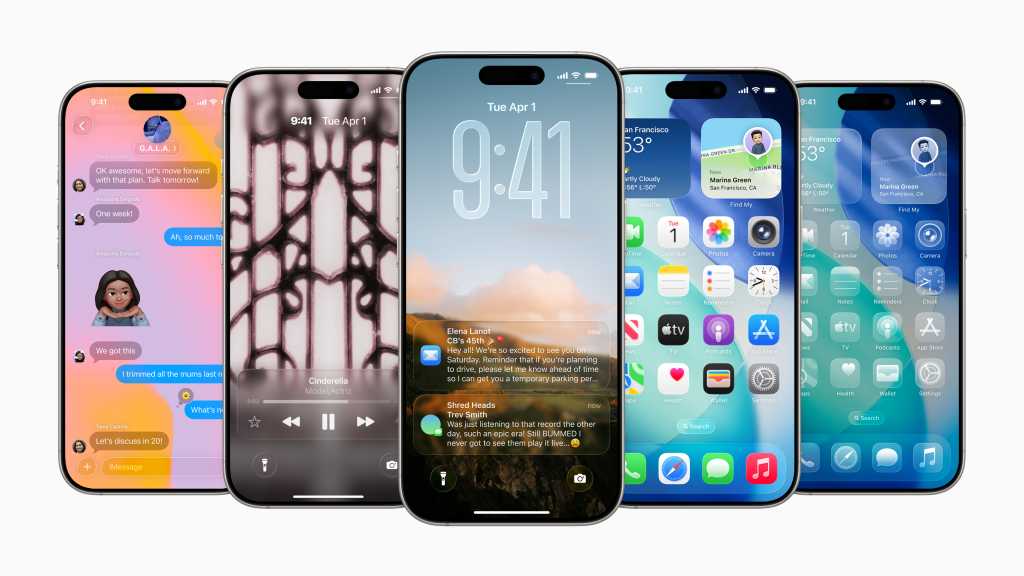
At WWDC 2025, Apple changed how we interact with our devices with the introduction of a new user interface it calls Liquid Glass. Apple CEO Tim Cook described it this way: “Expressive. Delightful. But still instantly familiar.”

First appearances matter, and what Apple has tried to achieve with Liquid Glass is to bring together the optical quality of glass and the fluidity of liquid to emphasize transparency and lighting when using your devices. It’s a move away from the flat UI we’ve become accustomed to and is supported by tweaks across the operating systems. That means elements that were rectangular, such as tool bars in apps, have been redesigned with rounded corners.

Apple is also maximizing content displayed on-screen through translucent tool bars with groups of dynamic controls to allow for easier navigation across apps.

Apple’s design teams were given rare permission to break cover following the introduction. One Apple Human Interface designer explained that the work was the product of an army of designers and engineers, explaining: “We’re designing it to bend and shape light while feeling like an elastic, flexible material that can dynamically shape shift, to make apps feel fluid and organic.”

What people are saying about Liquid Glass

While reality-distorting Apple critics seem to want to compare Apple’s design to Microsoft Vista’s failed attempt to emulate Mac OS X’s Aqua interface, more serious insight is emerging from across the industry, with the consensus quite positive. 

Anastasiia Satarenko, senior design researcher at technological R&D center MacPaw, told me: “The ‘Liquid Glass’ concept combines fluidity and dynamic motion to present a subtle beauty that mimics water; when static, it may be a bit unassuming, but it really shines when it’s in motion.”

Satarenko also noted: “They’re working to build off of the Vision Pro/visionOS and incorporate it into all their products to finally reconnect the user interface again. This decision makes total sense, and it was just a matter of time before they implemented it. Also, this update makes it simpler to incorporate any apps into the Vision Pro, as the software will already be designed for it.”

Morgan Stanley analyst Erik Woodring put it this way in a statement to Computerworld: “Apple’s broad OS redesign across platforms simplifies the UI and makes for a more unified experience…, which enhances the ecosystem experience. Overall, these enhancements remind us of old WWDC’s and highlight Apple’s innate attention to detail.”

Despite the plaudits, there have been criticisms around readability, particularly when the UI is set to its most translucent mode.

“It’s hard to read sometimes,” said designer Allan Yu, “I think because they’ve set it to be a little too transparent.” Apple will almost certainly address these criticisms before it arrives in final form on various operating systems. (It’s currently only available in early developer betas.) To my eyes, Liquid Glass is a particular problem in Control Center; Apple may need to make everything underneath the controls more opaque.

So just what is Liquid Glass?

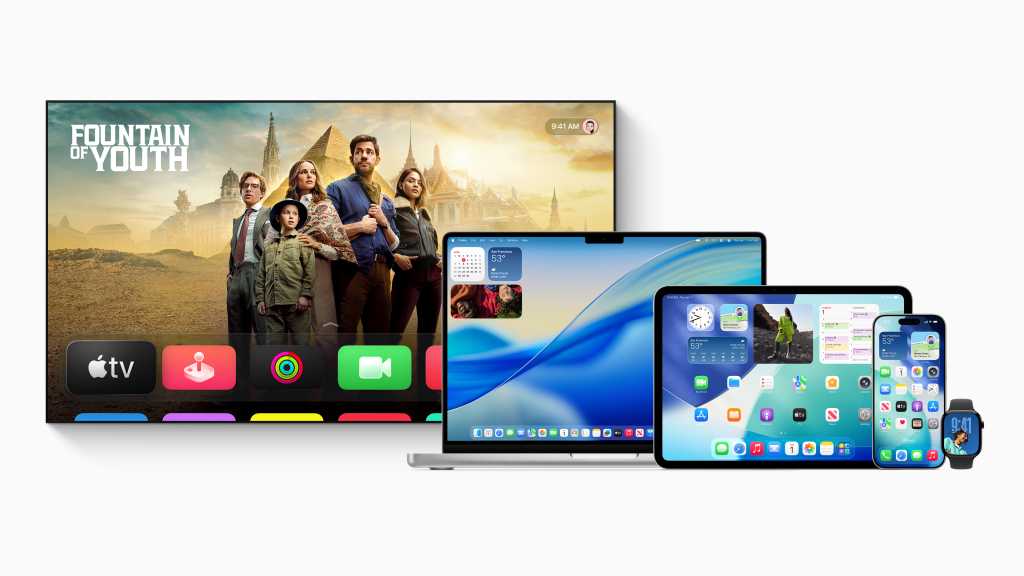
It is important to stress that Liquid Glass will be deployed across all Apple devices, from Macs, iPhones, and iPads, to Apple TV and even Apple Watch. In use, the new interface elements are both translucent and dynamic, giving you the impression that your device is made of liquid, not metal and glass. It delivers a graphics-rich environment made possible by the power of Apple Silicon, which has the power to run it.

Like glass, you’ll find the color of interface elements is informed by the content it surrounds or sits above. Apple calls some of this “lensing” — the ability to dynamically bend and shape light to reflect what you’re working with. “Liquid Glass objects materialize in and out by gradually modulating the light bending and lensing, ensuring a graceful transition that preserves the optical integrity of the material,” Apple said in a statement.

You’ll see interesting specular highlights and on-screen physics in action; some elements seem to bounce, others like to reflect light, and all these interactions are rendered in real time.

The new UI also makes demands of the elements used most — buttons, switches, text, media controls, as well as tab bars and sidebars — all have been tweaked for the new design paradigm. In part, this means all those elements become concentric, with the rounded corners of Apple’s hardware and app windows.

Controls are somewhat nested; they sit on a functional layer above the apps and morph into other controls as you seek them. They are also grouped within the interface; in one example, the Apple Music volume slider pops up above the content browser.

Also, when you scroll, you’ll find tab bars and sidebars work differently; tab bars shrink so they get out of the way of the content, while sidebars have been designed to feel more contextual to the content you’re viewing.

To get a sense of how this all fits together, Apple took pains to show how the time clock now fluidly adapts itself to fit behind the subject of a photo if you use an image as a wallpaper on your iPhone’s Home screen. Apple has done detailed work here — even the San Francisco typeface now dynamically scales the weight, height, and width of each character to fit the scene.

What about developers?

As you’d expect, Apple put together extensive information to help developers deploy Liquid Glass in their apps and created new APIs for use in SwiftUI, UIKit and AppKit. And while some developers will likely lag behind as they always do, most will be able to relatively easily refresh the design of their apps for the new UI.

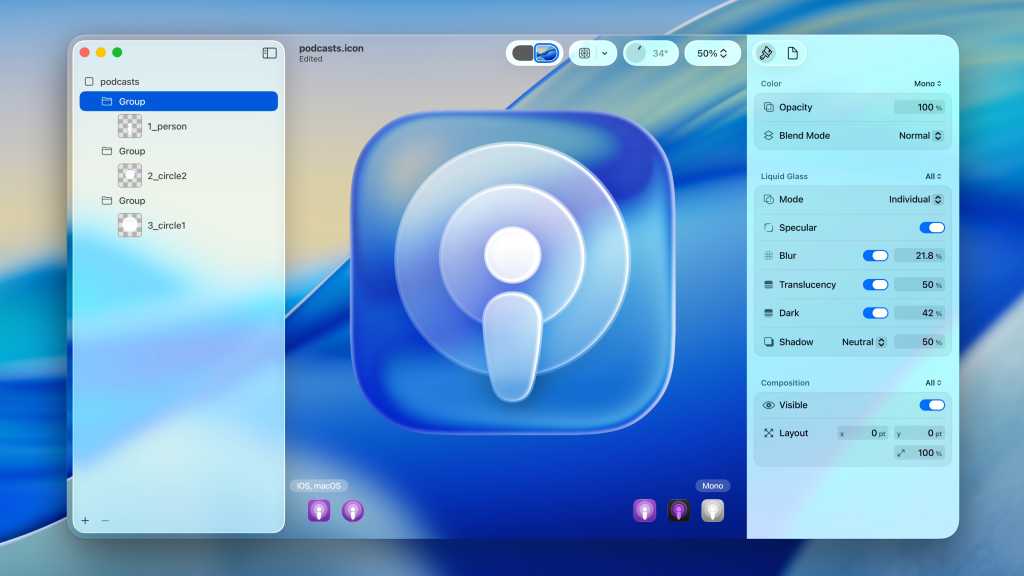
One new tool is Icon Composer, a tool with which to create Liquid Glass icons that render in the different looks the UI supports – light, dark, tinted, and clear.

Making sure apps properly support the subtle nesting within the new UI is a task in itself. Apple’s guidelines advise developers to think about a clear hierarchy of interface elements in order to make it easy for users to get to the element they require. Apple is also pushing developers to craft their apps to better reflect the rounded corners on its hardware and software and to rigorously adhere to the new platform conventions.

While it will take time for Apple users and developers to become fully accustomed to using Liquid Glass, the interface is quite beautiful, and lends itself for use across all manner of hardware and software devices. That makes it an appropriate change as Apple prepares for another decade of product design.

You can follow me on social media! Join me on BlueSky,  LinkedIn, and Mastodon.
RedNote joins China’s open-source AI wave with the launch of dots.llm1

Chinese social media platform RedNote has released its first open-source large language model, dubbed “dots.llm1,” joining a growing wave of Chinese technology companies pursuing open-source AI strategies that challenge Western proprietary models.

The model, developed by RedNote’s internal Humane Intelligence Lab, activates 14 billion parameters out of a total of 142 billion when responding to queries — an architecture designed to balance performance with cost-efficiency.

The company achieved performance comparable to Alibaba’s Qwen2.5-72B after pretraining on 11.2 trillion high-quality tokens without synthetic data, according to the model’s description on Hugging Face.

RedNote, known domestically as Xiaohongshu, operates one of China’s most influential social commerce platforms with over 300 million monthly active users.

A strategic divergence, not just technology

While OpenAI and Google keep their best AI models locked away, Chinese tech companies are taking the opposite approach — giving away their technology for free. But this isn’t just about different business models, according to industry experts.

“Chinese firms like RedNote are deploying open-source LLMs not just as models but as instruments of ecosystem control and geopolitical leverage. Meanwhile, Western firms such as OpenAI and Google remain committed to proprietary architectures,” said Sanchit Vir Gogia, chief analyst and CEO at Greyhound Research. “This is no longer a tactical split in model licensing — it’s a structural divergence in trust frameworks, one that will define the next generation of enterprise AI procurement.”

The split goes deeper than technology choices. “Western AI leaders are optimizing for shareholder return, compliance insulation, and platform lock-in through closed API-delivered models. In contrast, Chinese vendors like RedNote and DeepSeek are aggressively open-sourcing to expand national influence, cultivate developer mindshare, and drive localization-led adoption,” Gogia explained.

Performance vs. purpose

So, how does RedNote’s AI stack up? According to another detailed document on Github, dots.llm1 scored 56.7 on C-SimpleQA, a test of Chinese language skills — not quite as high as DeepSeek-V3’s 68.9, but respectable for a newcomer.

However, some analysts question whether RedNote is playing to its strengths. “Rednote, which has pioneered content-driven commerce, is well-positioned to build a large model based on the ton of data its ecosystem generates,” said Neil Shah, VP for research and partner at Counterpoint Research. “However, in this race of LLMs, Rednote would be better off building a more targeted model to drive AI-driven commerce sitting on a gold mine of data around users’ likes, dislikes, purchase behaviours, etc.”

The economics of free AI

The model uses a “mixture of experts” design that activates only the parts it needs for each task, making it cheaper to run than traditional models. But the economics go beyond technical efficiency.

“RedNote’s dots.LLM1 is less a revenue product and more a market accelerant,” Gogia explained. “The open-source model isn’t a broken business plan — it’s a strategic play to become foundational infrastructure across sovereign cloud ecosystems and public developer communities. The long game is not monetization through licensing but platform entrenchment through adoption.”

This approach is enabled by structural advantages. “Chinese firms benefit from central government subsidies, national procurement incentives, and policy exemptions that support loss-leader behavior in the short term. What might be financially unsustainable in the West becomes strategically viable in China due to alignment with state AI priorities,” Gogia said.

For Chinese vendors, open-source LLMs serve as soft power tools, exporting not only code but also embedded ideologies and governance frameworks into markets across Southeast Asia, Africa, and Latin America.

From social media to a global AI player

RedNote’s AI ambitions go beyond just releasing models. The company has already put AI to work on its main platform with Diandian, a search tool that helps users find content among the platform’s vast trove of lifestyle posts. With nearly 600 million daily searches—about half of what Google rival Baidu handles—RedNote has a real testing ground for its AI.

The timing isn’t coincidental. RedNote grabbed international headlines earlier this year when more than three million Americans joined the platform during TikTok uncertainty, giving the company a taste of global reach. Last week, it opened its first office outside mainland China in Hong Kong.

The trust challenge

For enterprises considering these open-source alternatives, the calculation isn’t straightforward.

“The core trade-off for enterprise buyers is no longer just cost versus performance — it is transparency versus control,” Gogia noted. “Controlled open LLMs provide a bridge across this chasm, giving CIOs and CISOs the ability to audit, customize, and self-host AI models without being beholden to proprietary ecosystems. However, the burden of governance shifts inward — enterprises must build their own trust scaffolding to make openness production-grade.”

The geopolitical dimension adds another layer of complexity. “Chinese open-weight models like dots.llm1 may be technically transparent—but in the eyes of global enterprises, transparency is no substitute for trust. Especially in regulated industries — banking, healthcare, and defense — geopolitical risk is now baked into AI architecture decisions,” Gogia warned.

What this means for business

The rise of capable, free AI models from Chinese companies is forcing a rethink of enterprise AI strategy. Companies that once assumed they’d need to pay premium prices for cutting-edge AI now have alternatives that might work just as well for many tasks, but with new considerations around governance, geopolitics, and long-term strategy.

RedNote’s entry into open-source AI represents more than technological competition — it’s part of a fundamental shift in how AI power will be distributed globally. While these models offer compelling technical capabilities at attractive price points, enterprises must weigh transparency benefits against new governance challenges and geopolitical considerations.

WWDC first look: How Apple is improving its ecosystem

While the new user interface design Apple execs highlighted at this year’s Worldwide Developers Conference (WWDC) might have been a bit of an eye-candy distraction, enterprise users were not forgotten, with announcements unveiled that could make a difference in the business world.

Apple’s WWDC keynote speech was far from the disappointment many had anticipated, given the number of changes announced. In addition to that new user interface, which will show up across all Apple products and is called Liquid Glass (we’ll look at it in more depth elsewhere), there were also APIs designed to help developers work AI into their software. The last is a nod to the company’s slow efforts to make Apple Intelligence the showcase tech promised at last year’s WWDC.

But for now I’m focused on just some of the changes Apple introduced that should have the most impact on enterprise users. Many, but not all, of these changes will be similar across all Apple’s devices, whether that’s macOS, iOS iPadOS, or others.

What’s a computer? The iPad

For me, the big news concerns the iPad, which gains noteworthy improvements that will transform its use. Not only can you open multiple app windows at once, but Apple has done this with a clever and versatile windowing system that even supports windows resizing, pervasive position memory and more. (You can even see all your currently open windows in Expose.)

These multitasking and windowing improvements should make it much easier to engage in professional work on an iPad and are the kind of improvements people have wanted for years. Changes on the iPad extend to the Files app, too, which gets important updates that will make it particularly useful.

Files for the rest of us

All Apple users, not just iPad owners, should see benefits from changes coming to Files. For iPad users, they make it easier to find and work with the files you need, and to add additional sorting options in the Files window; but Files is an app, which implies that at least some of those improvements will be available across other Apple devices. Pro users will likely also appreciate the new ability to customize folders with symbols, emoji, and colors.

The transformation of automation

Apple rolled out improvements in Shortcuts, including the capacity to create them and the ability to use Spotlight to identify and invoke them. And since the Shortcuts you do create can sync across all your devices, users will be able to build powerful productivity shortcuts on one device and use them on another, where they’re supported. This integration is, of course, also reflected by the Liquid Glass UI, which should create a real sense of familiarity as you move from Mac to tablet to iPhone.

Spotlight is evolving

Apple also announced big changes in Spotlight search on the Mac, including intelligent actions built around Shortcuts and Apple Intelligence, as well as Spotlight actions and quick keys; the latter automatically surface actions you might want to take with a Spotlight-selected item and commit those actions from within the search. This is powerful — you can find an item, change and save it, and share it, all from within Spotlight. The software can also learn from what you do, offering personalized actions for what you might want to do. 

“During a search, all results — including files, folders, events, apps, messages, and more — are now listed together and ranked intelligently based on relevance to the user,” Apple said. N”ew filtering options rapidly narrow searches to exactly what a user is looking for, like PDFs or Mail messages. Spotlight can also surface results for documents stored on third-party cloud drives. And when a user doesn’t know exactly what they’re searching for, Spotlight’s new browse views make it easy to scan through their apps, files, clipboard history, and more.”

You can also take hundreds of actions from directly inside Spotlight, such as sending an email or writing a note. While many of these features are being promoted as for the Mac, Spotlight operates across Apple’s platforms, so it will be interesting to see where else these features might show up as beta testing begins and future support rolls out.

App Intents

That brings me to App Intents. App Intents have been around for a while, but the framework will now let developers make actions in their apps in available across the system via Shortcuts or Spotlight. If nothing else this, should make work itself easier to get on with, and as those improvements percolate across Apple’s ecosystem, the hardest task will probably become simply remembering what actions you are able to take.

App Intents also gain support for visual intelligence, which means apps will be able to provide and make use of visual search results.

Etsy CTO Rafe Colburn explained what this means in a statement provided by Apple: “The ability to meet shoppers right on their iPhone with visual intelligence is a meaningful unlock and makes it easier than ever for buyers to quickly discover exactly what they’re looking for while directly supporting small businesses,” he said.

Vision Pro

Enterprises are already using Vision Pro devices, and Apple talked up the spatial computing headset during its WWDC keynote. Given the cost of these devices ($3,499), it is a welcome change that it’s now much easier to share them in workgroups; each user can save their own vision OS profile to their iPhone and then set the vision device up to suit. Apple also unveiled a new Vision Pro tool that lets you save a piece of content as Protected Content. (There are new APIs app developers can use for this, too.) The intention here is to ensure content shared on a Vision Pro doesn’t get shared outside your business.

There’s also support for a new Vision Pro peripheral, one that doesn’t come from Apple. Logitech Muse is a new pen/control device for spatial reality that lets you tweak and draw when working on projects with others. Look to Scroll allows users to explore apps and websites using just their eyes, and users can customize the scroll speed to their liking. Not surprisingly, developers will be able to integrate Look to Scroll into their visionOS apps.

Apple Intelligence was everywhere

Reading between the lines, you can see that artificial intelligence is actually everywhere in this year’s WWDC announcements. One of the biggest announcements does hint at the contextual intelligence Apple has previously told us about: Visual Intelligence now understands what is on screen, lets you ask questions about what you are looking at, and allows you to search for specific items or add events to your calendar. Apple has, of course, made it possible for developers to build support for this feature within their apps. 

“Last year, we took the first steps on a journey to bring users intelligence that’s helpful, relevant, easy to use, and right where users need it, all while protecting their privacy. Now, the models that power Apple Intelligence are becoming more capable and efficient, and we’re integrating features in even more places across each of our operating systems,” said Craig Federighi, Apple’s senior vice president of software engineering.

What this means: developers can now use Apple Intelligence APIs to build its tools within their apps, thanks to the Foundation Models Framework.

Developers can also look forward to Xcode 26, which can connect large language models (LLMs) directly into their coding experience, thanks to built-in support for ChatGPT. (Developers can also use API keys from other providers or run local models to support Xcode.)

Apple Intelligence features will be coming to eight more languages by the end of the year: Danish, Dutch, Norwegian, Portuguese (Portugal), Swedish, Turkish, Chinese (traditional), and Vietnamese. 

Live Translation

Live Translation is profound. It’s built into Messages, FaceTime, and iPhone and runs entirely on device. In use, it can automatically translate messages between languages, offer translated live captions on FaceTime calls, or speak the translation aloud during a conversation while on a phone call. It’s a fantastic feature I can’t wait to try and I expect to see it used in very interesting ways. 

Apple also did confirm a new system to help promote accessibility in apps. Accessibility Nutrition Labels for App Store product pages will let developers tell customers what accessibility features their apps support.

Summing up, even if this is a lean year for flashy announcements, the size of Apple’s ecosystem is now so vast the company is still capable of introducing changes that will delight customers, while also helping them get things done.

Apple rolled out the first betas of the new operating systems on Monday, with public betas following over the next few weeks. So you will be able to see for yourself which improvements make the most difference to you. Follow me through one of the networks below to learn more about these changes as I explore them.

You can follow me on social media! Join me on BlueSky,  LinkedIn, and Mastodon.
At WWDC, Apple infuses AI into the Vision Pro

Sluggish sales of Apple’s Vision Pro mixed reality headset haven’t dampened the company’s enthusiasm for advancing the device’s 3D computing experience, which now incorporates AI to deliver richer context and experiences.

Apple has upgraded the newly renamed visionOS 26 operating system to improve usability, blending AI into the background to enhance images and user interaction, Apple executives said at the company’s Worldwide Developer Conference on Monday.

Apple calls Vision Pro a “spatial computer” in which users can watch movies or interact with digital experiences in the real world using hands, eyes, and other senses.

A new feature called “spatial scenes” uses AI to give a 3D feel to traditional two-dimensional photos, which will be available in the Photos app. The AI model uses computational depth to add more perspectives to images, Haley Allen, senior director of visionOS program management, said during the presentation.

“Spatial scenes will make your web browsing experience more engaging, too,” Allen said.

In Safari, users will be able to select a feature called “spatial browsing” to view two-dimensional inline photos in supported articles in a three-dimensional format. Apple also introduced a curated app called “spatial gallery” to showcase curated spatial image content.

And the company is making major AI-driven changes to its Persona feature, which will now create more realistic avatars of users for the FaceTime video chat application. Previous avatars had lifelike renditions, but the updated Personas will be more personal and familiar, Allen said.

“Hair, lashes, complexion, all look remarkably accurate,” Allen said.

Apple also added many AI-driven improvements to apps such as Image Playground, which are supported across Apple devices. Apple has updated Image Playground to create more creative emojis by tapping into OpenAI’s ChatGPT AI application, which supports text and image creation.

The company also introduced a variety of non-AI features.

Vision Pro users will now be able to access widgets using their headset. The widgets will remain fixed within the visual field and will be clearly accessible at all times, Mike Rockwell, vice president of the Vision Products Group, said during a pre-recorded Apple video detailing the new features.

Widgets such as calendar and battery indicator are already popular in macOS. The company also introduced new widgets, such as a circular clock, music, real-time weather, and photos that can show snapshots of pictures from personal collections.

The widgets are blended into a user interface built around the new “liquid design” color scheme, which focuses on sharp colors and window edges.

Users can also now share Vision Pro experiences with others, which could help enterprises collaborate on three-dimensional engineering and design applications. Teams in hundreds of companies already use Vision Pro headsets for design, sales, training, and more, Rockwell said.

With that in mind, companies can also now create a pool of Vision Pro devices that can be shared among team members and guest users. Users can save their hand, eye, accessibility, and prescription information to their iPhone and activate a shared headset.

Apple also added new APIs such as “Protected Content,” which can show confidential materials to authorized users.

The company is also adding new input options such as the Logitech Muse, a pen-like device that can be used to draw within the 3D interface, and support for the Sony PlayStation VR2 Sense Controller; the latter can be worn on the hand to play motion-controlled video games within the headset.

Eleuther AI releases 8TB collection of licensed and open training data

AI research organization Eleuther AI has launched a massive text database, Common Pile v0.1, that can be used to train AI systems, according to Techcrunch. The 8TB database consists exclusively of publicly licensed texts, or texts that are classified as public domain.

Common Pile v0.1 was developed over two years in collaboration with Poolside, Hugging Face, the US Library of Congress and the University of Toronto, among others.

The data collection was released after concerns arose about several generative AI (genAI) companies using copyrighted material to train their models without the permission of the copyright owners. Eleuther AI was also behind the collection, The Pile, which has become a central point in the debate; it now wants to show with Common Pile v0.1 that training is possible without copyrighted material.

Common Pile v.01 was reportedly used to train the Comma v0.1-1T and Comma v0.1-2T AI models; Eluther AI claims Comma v0.1-2T performs as well as Meta’s first Llama model in terms of programming, image understanding and math. Eluther AI plans is release more open data collections in the future.