Meta (Nasdaq:META) is restructuring its AI division into two distinct units, AI Products and AGI Foundations, marking its most significant internal overhaul as it races to compete with OpenAI and Google.
The move, detailed in an internal memo from Chief Product Officer Chris Cox and reported by Axios, appoints Connor Hayes to lead AI product integration while Ahmad Al-Dahle and Amir Frenkel will co-direct long-term AGI research.
The restructuring comes amid mounting crises, including the delayed Llama 4 Behemoth model and the departure of key Llama architects to competitors like Mistral AI. This marks Meta’s second major AI reorganization since CEO Mark Zuckerberg’s 2023 attempt to “turbocharge” generative AI efforts, which saw the company fall further behind rivals despite early promise.
“Structural changes alone won’t solve Meta’s AI challenges,” said Amandeep Singh, practice director at QKS Group. “While the new AGI Foundations unit creates clarity, retaining elite talent requires a seamless pipeline from research to real-world deployment. Meta has struggled with fragmented pipelines and unclear priorities,” added Singh.
Talent exodus and technical setbacks
The restructuring follows talent losses that have exposed fundamental weaknesses in Meta’s AI strategy. Only three authors remain from the original 14-person Llama research team, according to Business Insider. Internal surveys cited by The Information reveal plummeting morale in Meta’s AI division, where employees cite resource constraints and sluggish progress.
“Talent follows momentum, and right now, momentum lives where research decisions directly shape deployed capabilities,” noted Singh.
This talent drain coincides with technical setbacks, most notably the underperforming Llama 4 model, which has struggled with reasoning and mathematical tasks. These combined challenges have left Meta playing catch-up in the race toward artificial general intelligence, despite its early open-source advantages.
The company’s strategy, bolstered by initiatives such as Llama for Startups and the recent Llama API launch, aims to attract developers and differentiate it from competitors’ proprietary models. But analysts caution these initiatives alone may not be enough to win enterprise trust.
The enterprise adoption dilemma
While Llama’s cost advantages remain attractive to businesses, growing concerns about its governance controls and the looming copyright lawsuit over training data are giving enterprises pause.
“Companies love Llama’s affordability but expanding safety gaps and legal risks are becoming hard to ignore,” Singh said. “For mission-critical applications, many will ultimately choose more reliable, if more expensive, options like GPT or Gemini.”
These cost benefits can lose their appeal when weighed against operational risks. Meta’s reorganization attempts to mitigate these concerns through specialized teams, one deploying generative AI across products, another advancing AGI research, but analysts remain skeptical about whether structural changes alone can solve deeper issues.
Unlike Microsoft’s turnkey OpenAI integration or Google’s enterprise-ready Vertex AI platform, Meta lacks both the sales infrastructure and compliance pedigree for regulated industries. As Singh argued, “Enterprise AI adoption hinges on proven compliance frameworks, operational reliability, and mature support systems. Meta still needs to build that trust at Fortune 500 scale.”
Meta’s race to close the AGI gap
“Meta’s AGI push focused on models with reasoning, multimedia, and voice capabilities aligns with the broader industry trend toward multimodal AI as a catalyst for enterprise transformation,” said Surjyadeb Goswami, research director for AI and Automation at IDC Asia Pacific. He noted that open-source models are critical to enabling cost-effective, transparent, and customizable deployments, especially as organizations deepen their GenAI investments.
For Meta to truly capitalize on this opportunity and succeed in its AGI bid, it must rebuild trust especially for enterprise adoption. Singh highlighted the need for Linux-like community stewardship, OpenAI-level safety protocols, and robust enterprise tooling. “Balancing openness with responsibility is Meta’s real challenge, especially as models approach general-purpose cognitive capability.”
Meta now needs to show this reorganization yields meaningful improvements in model performance, talent retention, and enterprise adoption to validate its new approach. “Meta’s open-source vision is bold, but execution is everything,” Singh concluded.
The European Commission has published its full Digital Markets Act (DMA) decision against Apple, and it’s far, far worse than anybody expected. The Commission, the executive arm of the European Union, has accepted absolutely none of Apple’s arguments against being fined, and the decision threatens yet more existential damage to the company.
Europe announced in April that it would fine Apple an eye-popping €500 million for noncompliance with the DMA, giving Apple 60 days to comply with its decision. One month later, the Commission published the full ruling against Apple, which details that changes the company made to its App Store rules did not go far enough to bring it into compliance.
The decision warns that Apple is subject to additional periodic fines in the future if it fails to comply with the Commission’s strict interpretation of the DMA, no matter how inherently punitive some of its demands may be. (Can anyone else spell “tariffs”?)
We’ll know soon enough if there are to be wider consequences to Europe’s demands. Apple now has 30 days to fully comply with the DMA (in Europe’s opinion) or face additional fines.
The act itself came into force in November 2022 and began to be implemented against companies defined as ‘gatekeepers’ in 2023. The intention is to stop Apple and others from using their market position to impose anticompetitive limitations on developers.
Who is steering?
The big bugbear relates to Apple’s anti-steering restrictions, which prevent developers from telling customers they can purchase services outside the App Store. The DMA demands that Apple let developers offer this option, which Apple does, but Europe argues that the limitations the company makes on doing so are not in compliance with the law.
Europe also says Apple’s existing restrictions, fees, and technical limitations undermine the effectiveness of the DMA. That seems to mean Apple cannot charge a commission and cannot warn users of the consequences they face when shopping outside the App Store.
The Commission even plays dumb to the potential significance of permitting developers to link out to any website from within their apps, rather than being constrained to approved (and secure) sites. It says Apple has provided insufficient justification for this restriction and also wants Apple to remove messages warning users when they are about to make a transaction outside the App Store.
While I understand the original aim of Europe’s Digital Markets Act, the demands the Commission is making of Apple appear to go far beyond the original objective, which was to open up Apple’s platforms to competition.
The decisions now open Apple’s platform up to competitors.
There is a difference between the two, and, as described, it means Apple must now create and manage its platforms while permitting competitors to profit from those platforms at little or no cost.
Apple rejects Europe
Apple will fight in Europe.
“There is nothing in the 70-page decision released today that justifies the European Commission’s targeted actions against Apple, which threaten the privacy and security of our users in Europe and force us to give away our technology for free,” the company said. “Their decision and unprecedented fine came after the Commission continuously moved the goalposts on compliance, and repeatedly blocked Apple’s months-long efforts to implement a new solution. The decision is bad for innovation, bad for competition, bad for our products, and bad for users. While we appeal, we’ll continue engaging with the Commission to advocate on behalf of our European customers.”
When the fine was initially revealed, the company also said:
“Today’s announcements are yet another example of the European Commission unfairly targeting Apple in a series of decisions that are bad for the privacy and security of our users, bad for products, and force us to give away our technology for free. We have spent hundreds of thousands of engineering hours and made dozens of changes to comply with this law, none of which our users have asked for. Despite countless meetings, the Commission continues to move the goal posts every step of the way.”
My take?
Far from saving Europe’s tech industry, the manner in which the DMA is being applied will make the region even less relevant. Lacking a significant platform of its own, Europe’s approach will reduce choice and increase insecurity.
As the clear first target of the DMA, Apple will inevitably be forced to increase prices, charge developers more for access to its developer tools, and will I think simply stop selling some products and services in Europe, rather than threaten customer security. We know it can do this because it has done so before.
Fundamentally, of course, the big question remains unaddressed: How much profit it is legitimate to make on any product or service? I imagine the European Commission doesn’t want to go near a question as fundamental to capitalist wealth extraction as that. Can you imagine the collapse in executive bonuses that would follow a decision to define what the maximum profit made in any business transaction should be?
Lobbyists across the political spectrum would be appalled — that extra profit pays for their meals. Looking to the extent to which the current application of the DMA seems to favor Apple’s biggest competitors, I can’t help but imagine it’s been paying for a few European meals already. Nice work, if you can get it.
Using Microsoft OneDrive to upload a file to ChatGPT, Slack, or Zoom could lead to a user handing over access to more than just that one file.
According to an Oasis Security research, applications using Microsoft’s official OneDrive File Picker may get full read access to a OneDrive account in addition to write access, in certain circumstances.
Microsoft became the world leader in AI by investing $13 billion in OpenAI, creator of ChatGPT, then using ChatGPT as the engine behind its Copilot AI assistant, which it has integrated into just about every product it creates.
But that was just the first phase of Microsoft’s AI plans. Now it’s launched the next one: hosting AI models and services from the world’s biggest AI companies and startups, essentially its competitors. Microsoft says it’s hosting more than 1,900 AI models, from Meta’s Llama AI, to Musk’s xAI, to European startups Mistral and Black Forest Labs, to China’s DeepSeek and beyond.
That way, even if Copilot doesn’t pan out the way Microsoft hopes, it will share in its competitors’ successes. This strategy likely guarantees that Microsoft will remain the world’s biggest AI company.
It’s all about the data centers
Microsoft’s data centers have, from the start, been key to its AI strategy. Thanks to its deal with OpenAI, OpenAI runs its workloads on Microsoft’s Azure cloud platform. When businesses subscribe to OpenAI’s ChatGPT enterprise service, Microsoft gets a portion of the revenue, thanks to its cloud services.
To capitalize on that business model, Microsoft in 2023 launched its Azure OpenAI service, which lets Azure customers build genAI apps using OpenAI’s models. Some 60,000 customers have signed up with Microsoft for the service, according to The Motley Fool.
Microsoft’s arrangement with a wide variety of AI companies supercharges that model and reduces the company’s reliance on OpenAI as a partner. Just before Microsoft’s annual Build developers’ conference in mid-May, Microsoft announced it would be hosting Elon Musk’s Grok AI models (called xAI) on its Azure AI Foundry service. In addition to hosting xAI and OpenAI, the service hosts Meta’s AI Llama models and many others.
That way, Microsoft piggybacks onto the success of its competitors — if those competitors get more customers, Microsoft succeeds as well.
That’s only part of the company’s AI plans. At its Build conference last week, it described in detail its vision for allowing businesses to create AI agents to perform a wide range of tasks. At the center of that vision is Microsoft’s Azure AI Foundry, which lets businesses create agents using any one of the 1,900 AI services it hosts — or even build agents by combining several of those services.
In that way, businesses won’t have to subscribe individually to any one AI service. Instead, they can subscribe to Microsoft’s Azure AI Foundry and pick whichever agents they want to build what they need. So if enterprises want to use AI tools from a Microsoft competitor, Microsoft still wins, because enterprises can get the tools straight from Microsoft. And Microsoft also wins because its Azure AI Foundry has become the place for customers to go when they want to build agents using multiple AI services at the same time.
Microsoft also announced at Build that it’s adding agents that can write code on the company’s GitHub service, used by many businesses and software companies to manage their code bases. Already, OpenAI and Google-backed startup Anthropic have their agents on GitHub. So in yet one more way, Microsoft is piggybacking onto the success of its competitors.
Where’s Amazon in all this?
All this happening even though Amazon, not Microsoft, is the world’s biggest cloud provider. (Microsoft is slowly closing the gap with the cloud leader, though.) You would expect that Amazon would use its long-dominant market position to sew up hosting AI services in the way Microsoft has been doing.
Amazon has tried but has not had nearly the same success as Microsoft. Amazon Bedrock competes directly against Microsoft’s Azure AI Foundry but hosts far fewer AI models.
In this head-to-head battle, there’s no doubt Microsoft will win. An analysis by a provider of AI-powered banking solutions concludes that Microsoft’s offering is far better for enterprises, better for those who want access to AI chatbots, and better for data analytics. The analysis also concludes that Microsoft’s services are more cost-effective. Bedrock, the report concludes, is better only for startups and development-focused companies.
Microsoft has been capitalizing on its enormous enterprise footprint — it’s using its entire product line, from Microsoft 365 to Azure, to sell existing enterprise customers on using Azure AI Foundry services. Amazon has no way to compete against that.
The upshot
The bottom line is that Microsoft will remain the world’s most valuable AI company and will probably even extend its lead. No other company offers nearly as extensive a range of AI tools, and with Microsoft’s one AI hosting service to rule them all, that shows no sign of changing.
The company has found the ideal “heads-I-win-tails-I-also-win” strategy. From here on in, the only battle will be for second place.
Windows is about to get even deeper AI integration, complete with chatbots gaining access to your PC’s apps — if you want. But it’s not just about the operating system. The humble web browser is about to change in a big way for those of us using Windows, too. It’s going to happen soon — and fast.
Already, Google is rolling out AI Mode in Google Search, which may seem like a monumental (if perhaps also questionable) change. But that’s just scratching the surface. The entire web is about to undergo a total generative AI transformation, starting at the browser level.
There’s lots to come — and especially if you’re using Windows for professional purposes, you’d be well-advised to be ready.
Everyone’s talking about Google Search transforming into something more like Perplexity via a new “AI Mode” that will be an option at first but is clearly Google’s long-term vision for search on the web.
But, at Google I/O 2025, Google also announced Gemini coming into Chrome itself. You will have a Gemini icon right on Chrome’s title bar whenever you open up the browser in Windows. You can click that icon to get a summary of the current web page or ask questions. You can type a question or use Gemini Live to chat about the web page with your voice.
That’s the initial version of the Gemini integration, and it sounds like everyone should see it soon. You can even get early access with a Google AI Pro or Google AI Ultra subscription.
In the future, Google says Gemini in Chrome will do more — pulling in information from across all your open tabs at once.
Google also announced a new Gemini feature named Agent Mode that will rely on Gemini to browse the web for you and perform tasks like searching for apartments. It seems obvious that this will come to Chrome in the future, too — letting Gemini navigate and browse the web on your behalf.
Copilot Mode in Edge
Google isn’t the only one sticking AI everywhere imaginable, of course. Microsoft Edge already has plenty of AI integration — including a Copilot icon on the toolbar. Click that, and you’ll get a Copilot sidebar where you can talk about the current web page.
But the integration runs deeper than most people think, with more coming yet: Copilot in Edge now has access to Copilot Vision, which means you can share your current web view with the AI model and chat about what you see with your voice. This is already here — today.
Following Microsoft’s Build 2025 developers’ conference, the company is starting to test a Copilot box right on Edge’s New Tab page. Rather than a traditional Bing search box in that area, you’ll soon see a Copilot prompt box so you can ask a question or perform a search with Copilot — not Bing.
It looks like Microsoft is calling this “Copilot Mode” for Edge. And it’s not just a transformed New Tab page complete with suggested prompts and a Copilot box, either: Microsoft is also experimenting with “Context Clues,” which will let Copilot take into account your browser history and preferences when answering questions. It’s worth noting that Copilot Mode is an optional and experimental feature.
The rise of Dia
Forget the big boys for a second. A relatively scrappy startup known as The Browser Company (which, yes, is actually its name) made waves when it first released the Arc browser back in 2022. The project was designed to reimagine the web browser and challenge our existing notions around that framework. A startup creating a new web browser was daring enough to get attention. The design was interesting, and it grew a dedicated cult following.
But Arc was more of a power-user browser than something mainstream, and it didn’t catch on in the way The Browser Company wanted. Plain and simple, it isn’t the future of the web browser, as the company eventually came to realize.
With that in mind, The Browser Company is now focusing on a new web browser named Dia — designed to be an “AI browser,” first and foremost. As the creator of Arc just wrote in an open letter:
Let me be even more clear: traditional browsers, as we know them, will die.
He lays out a vision for how web pages will still be important — but how the browser will need to change. The Browser Company is now making a browser for the vision he describes.
Agentic browsing in Opera Neon
Opera just launched a resurrected version of Opera Neon with local AI built in. Like the vision The Browser Company has for Arc — and like Gemini’s Agent Mode — Opera is pushing a vision of “agentic browsing” where the browser could do your online shopping research for you. Interestingly enough, Opera says its browser will do all of this AI work locally, using an offline, local chatbot, rather than sending any data to cloud servers.
Mozilla Firefox and Brave’s AI choice
Even the less AI-obsessed browsers of Mozilla Firefox and Brave are now quietly embracing AI in an interesting way.
Firefox recently added an AI chatbot sidebar that lets you choose your favorite chatbot. While Google builds Gemini into Chrome and Microsoft builds Copilot into Edge, Firefox asks which one you prefer — ChatGPT, Claude, or something else entirely.
Meanwhile, the Brave browser has a built-in Leo AI feature that also gives you multiple options. Most intriguingly, it lets you “bring your own model.” You can choose a large-language-model AI engine hosted anywhere you like — on your own computer, in a data center you trust, or wherever else you like. You aren’t limited to a few chatbots designed for consumers.
Quite frankly, if deep AI integration is the future, I’d rather see this kind of choice than having each web browser choose its preferred AI chatbot for you.
The OpenAI hardware question
Last but not least, OpenAI hasn’t announced a browser of its own (yet, at least), but right after last week’s Microsoft Build and Google I/O events, the company behind ChatGPT announced it was enlisting Jony Ive — designer of the iPhone and beyond — to help create an entirely new hardware product.
While Google is pushing its Android XR and smart glasses as a way to interact with Gemini AI, it sounds like OpenAI is pursuing something else entirely. That’s all we really know right now.
Stay tuned for the future
Whatever you think about AI, one thing is clear: The tech industry isn’t exactly boring as we approach the middle of 2025. Things are evolving quickly, and the way AI is integrated into our tried-and-true browser experience is almost certainly in for a serious shake-up.
Android’s in the midst of an ambitious reinvention — but sometimes, the most exciting new elements aren’t even connected to the actual operating system or anything Google itself is giving us.
At a time when the bulk of Google’s new-feature attention is aimed at overhyped AI technology, independent Android developers are doing some of the most interesting work that’s likely to have a immediate positive impact on our day-to-day lives.
That’s absolutely the case with the small but significant touch I want to share with you today. It’s an easily overlooked update to an outstanding Android app that opens the door to some truly transformative improvements — ones that’ll be much more helpful than what any accuracy-challenged answer engines can offer. Heck, it doesn’t even involve AI at all (in the current generative-AI-centric definition of the term, at least).
Instead, it’s a simple and extremely approachable new possibility in the area of Android automation. And embraced in the right way, it’ll make whatever Android device you’re using more efficient, less distracting, and generally just better at keeping you tuned into what actually requires your attention.
The app at the center of this handy new Android automation option is a splendid power-user tool we’ve talked about before — a fantastically useful (and easy to use!) creation called BuzzKill.
The simplest way to think about BuzzKill is as a Gmail-filter-like framework for your phone’s notifications. In short, you use it to create super-simple “if this, then that”-style rules for how incoming alerts are handled — so, for instance, you might tell BuzzKill:
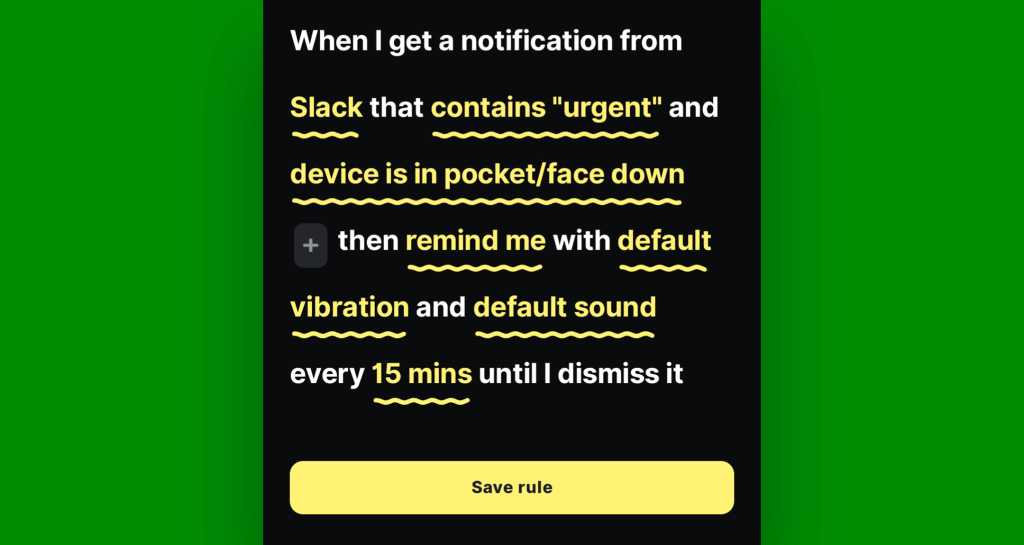
If I get a Slack message with the word ‘urgent’ in it, trigger a full-screen alarm and sound to make sure I notice.
If I get a text from my department head, have the notification sound repeat every five minutes until I acknowledge it.
If my co-worker messages me 10 times within the span of two minutes, only alert me once.
If I get notifications from social media apps or Google Photos during the workday, hang onto ’em and send ’em all to me at once at 5 p.m. — or even as a single summarized alert, when I can deal with such matters more efficiently and without having them create any ongoing distractions.
You get the gist. The possibilities are practically endless, and with a sliver of creative thinking, there’s allsorts of incredible stuff you can get BuzzKill to do — all with zero technical knowledge and mere minutes of effort.
The reason we’re talking about BuzzKill now, though, is that the app just recently got updated with the ability to support a new type of condition — the “if” part of the “if this, then that” equation, in other words, and the trigger that causes a certain type of behavior to occur.
Specifically, you can now ask it to detect if your phone is in your pocket or face-down on a table and then adjust how it handles specific sorts of notifications as a result.
That may seem insignificant or maybe even slightly silly on the surface, but think about the ways you could use that to your advantage. Just as a few off-the-cuff examples, you could tell BuzzKill to…
Make an especially loud sound for any important, maybe work-related notifications that arise when your phone is in your pocket and thus a standard single ding is less likely to be noticed.
Repeat any alerts that arrive in that context — or, perhaps, just any alerts from certain specific apps, like your Android email and messaging apps — 15 minutes later.
Override your phone’s do-not-disturb setting and unsilence the device to make sure you hear the sound from a specific sort of high-priority alert — say, an email or message from your boss or a text from an important client.
Create a unique custom vibration pattern for specific notifications so you can immediately identify ’em and know what they are without even having to pull your phone out of your pocket.
And onward from there. The sky really is the limit — and, unlike with other Android automation solutions, you don’t have to wade your way through a complex coding process or any sort of time-consuming, headache-inducing setup to make any of this happen.
In fact, you’ll need just a few short minutes to get your first rule going.
3 minutes to advanced Android automation
All right — ready to dive into these easy-moving automation waters?
First things first, you’ll need to download BuzzKill from the Google Play Store, if you haven’t already. The app costs four bucks up front as a single, one-time purchase — and if you’re anything like me, it’ll pay for itself and then some in no time at all.
Of note: BuzzKill doesn’t require any unusual permissions, doesn’t collect any form of data from your phone, and doesn’t have any manner of access to the internet — meaning it’d have no way of sharing your information even if it wanted to.
Once you open ‘er up and get through the quick initial setup, tap the “+Create rule” button in the lower-right corner of the main BuzzKill screen — and you’ll then see a screen that looks a little somethin’ like this:
A blank BuzzKill rule, ready for you to fill in the missing pieces.
JR Raphael, IDG
From there, all you’ve gotta do is tap each of those underlined phrases to fill in the blanks and create the rule you want:
To start, tap the words “any app” and select which specific app — or apps — you want to be included.
If you want the rule to affect only Slack, for instance, you could select it. If you want it to affect Slack, Messages, and Gmail, you could select all three. Or if you want it to apply to any app without restriction, you can just leave it as-is and not select anything at all.
Next, tap “contains anything,” then tap “Phrase” and type in whatever specific phrase you want BuzzKill to watch for — and tap “Apply filter” to save when you’re done.
You might use a word like “urgent,” or you might use the name of a specific contact or Slack channel. The phrase can be anything at all, as long as you’re sure it’ll appear in notifications and thus be visible to BuzzKill to detect.
If you don’t want to limit the rule based on the exact contents of the notification and instead want it to apply to any notification within whichever apps you selected, you can skip this step and leave this field blank.
Back on the main rule configuration screen, tap the small gray plus symbol directly next to the “contains” line we just went over and select “Filter by in pocket/face down” in the menu that appears.
The new “in pocket” option adds a valuable variable into the BuzzKill rule equation.
JR Raphael, IDG
Last but not least, tap “do nothing” and think carefully about what action you want BuzzKill to perform. Options that may be especially relevant for this purpose include:
“Alarm,” which will cause your phone to make a specific loud sound and vibration and pop up a full-screen alert whenever the conditions are met.
“Remind me,” which will allow you to set up a specific interval at which your phone should continue alerting you to the notification until you acknowledge it.
“Unsilence,” which will override your phone’s do-not-disturb setting when a matching notification arrives to ensure you see it.
“Custom alert,” which empowers you to create a unique buzzing pattern and sound to make the notification easily identifiable.
Be sure to tap the “Pick action” button at the bottom of the screen to save and confirm once you’re done, and you should then see your final rule spelled out in front of you — possibly with a few extra configurable options, depending on what action you picked.
A BuzzKill rule in its final form, with automatic pocket detection at the core.
JR Raphael, IDG
If you want to adjust any of the available options any further, tap on their words to tweak ’em as you wish. Otherwise, tap “Save rule” — and with that, your fresh slice of advanced Android automation will be silently working on your behalf and doing what you requested anytime your phone’s in your pocket and your conditions are met.
You’ll see any active rules in the main BuzzKill screen, with a prominent toggle confirming their status.
JR Raphael, IDG
This is just scratching the surface of how you can use BuzzKill to make your phone more effective. But whether you’re already an Android automation aficionado or this is your first dip into this delightfully deep ‘n’ briny ocean, you’re officially on your way to a more intelligent Android experience — with a phone that thoughtfully works for you on a genuine, not at all artificial, level.
Claude has failed its creator Anthropic during the startup’s defense in a court case.
A district court in California has struck a portion of testimony from an Anthropic data scientist that referenced a fictitious academic article hallucinated by the AI.
The mistake was discovered in a court filing from Anthropic as part of its defense in the case in which Universal Music Group, Concord, and ABKCO are accusing the $61-billion-valued startup of using copyrighted song lyrics without permission to train its AI chatbot, Claude.
[ Learn why AI vs. copyright is a particularly ugly legal fight. ]
Anthropic admitted its mistake last week, and must now present 4 million more records of Claude’s interactions with users, particularly focusing on how frequently users prompted the chatbot for copyrighted lyrics.
The development underscores a growing, concerning prevalence of hallucinations introduced by AI in legal filings, which can put enterprises at risk if their lawyers use AI tools in legal discovery and documentation.
“AI-induced laziness is becoming an epidemic in the legal profession,” said Brian Jackson, principal research director at Info-Tech Research Group. “AI research tools shouldn’t be relied upon to create court-ready output.”
‘An honest citation mistake’
In March, Universal Music Group, Concord, and ABKCO asked federal judges in California to stop Anthropic from using their song lyrics to train the company’s models. Judges shot that request down in March; the plaintiffs then filed an amended copyright infringement complaint against Anthropic in April.
One of the points of contention in the case is what constitutes a suitable sample size of Claude’s interactions to be examined.
On April 30, Anthropic data scientist Olivia Chen submitted a filing arguing for a sample size of 1 million, which she said would represent a “reasonable prevalence rate” for a “rare event” (users seeking song lyrics) that could be as low as 0.01% of all user interactions. Her testimony cited an academic article from The American Statistician that does not exist.
Earlier this month, the plaintiffs asked the court to examine Chen and strike her declaration because of the hallucination.
The court gave Anthropic time to investigate the matter. The startup’s attorney called it “an honest citation mistake” and admitted Claude was used to “properly format” at least three citations. In doing so, it generated a fictitious article name with inaccurate authors who have never even worked together.
However, while the text in the document was hallucinated, the footnotes do link to the proper article that was “located by a human being” using Google search. Therefore, judges noted in their decision, this was not a case where “attorneys and experts [have] abdicate[d] their independent judgment and critical thinking skills in favor of ready-made, AI-generated answers.”
Judges called it a “plain and simple AI hallucination” and also questioned how a manual citation check did not catch such an error.
The court determined that a margin of error of roughly 11.3% is “within the range that will yield a representative sample.” Thus, Anthropic must now produce a sampling of 5 million prompt-output pairs equally drawn from pre-suit and post-suit data — 2.5 million from between September 22, 2023 and October 18, 2023, and 2.5 million from between October 19, 2023 and March 22, 2024. These must be randomly selected, and Anthropic must provide them to the court no later than July 14, 2025.
Models trained for law are the best bet
AI gaffes in law are becoming so significant that they are spawning a slew of research papers and legal deep dives. AI researcher Damien Charlotin, for one, keeps a running database chronicling legal decisions in cases where generative AI produced hallucinated content (typically fake citations).
“CIOs have an important role to play in explaining not only hallucinations, but also cybersecurity risks,” said Irina Raicu, who heads the internet ethics program at Santa Clara University’s Markkula Center for Applied Ethics. “Most lawyers, whether in-house or not, are not familiar with these new challenges.”
She also pointed out that last July, the American Bar Association issued its first ethics guidance on a lawyer’s use of AI tools. The use of AI in the legal system has significant implications, not just for competence, but for the duties of confidentiality, communications, and disclosure, and more.
“All enterprises should be encouraging greater sharing of information between their legal and technical staff,” said Raicu.
Legal professionals being called out for including incorrect or hallucinated AI outputs in legal documents seem to typically be using consumer-grade or general AI tools like ChatGPT or Gemini, Jackson noted. But law firms using AI should seek out industry-specific tools. One example is Harvey, built with OpenAI. Others include Alexi and Clio.
Jackson noted that AI research tools can support the work of paralegals or legal assistants who put together case files and relevant materials including decisions, client-submitted documentation, and precedents. They report that it can help them reduce their research work by 30% to 50%.
“It’s augmenting the process, not automating it,” he said. “The human in the loop here should be the lawyer running the case, reviewing what’s being submitted, and spotting the errors in the material and the false citations.”
Generative AI tools not built for legal research will “at best” find cases on the internet, and “at worst” make something up based on their training data, noted Mathew Kerbis, founding attorney at Subscription Attorney LLC.
That said, the Stanford Institute for Human-Centered AI found that even legal models still hallucinate in 1 out of 6 (or more) benchmarking queries.
Kerbis suggests that lawyers use legal AI tools that use retrieval augmented generation (RAG), with models pulling from a database of case law and checking against that database before providing an answer.
“The most reliable tools have a legal-specific large language model (LLM) that does the research, rather than a general model,” he said. “General models will always do worse than specialized models.”
Long predicted, the end of the smartphone as we know it now seems to be gradually approaching. The reason: instead of laboriously moving from app to app, artificial intelligence (AI) will enable AI assistants to carry out cross-app tasks in the future, including by voice command.
A look back at the development of user interfaces shows just how significant this step is: While the command line still dominated in the early 1970s, it was gradually replaced by the graphical user interface (GUI) from the 1980s onwards. Touch operation followed in the 2000s and voice input was gradually added. Nevertheless, apps are still silos in which users operate in relative isolation — a situation that is now slowly disappearing with the triumph of generative AI (genAI) and AI agents.
Off to a shaky start
Pioneers in the field of AI devices include the Humane AI Pin and the Rabbit r1. These devices broke away from the classic form factor of a smartphone and were primarily operated by voice. But contrary to what the marketing promised, the technology was not ready for practical use and the commands were not well implemented, disappointing both reviewers and users. Although the Rabbit r1 is still available, the more expensive Humane AI Pin was discontinued in early 2025, less than a year after its launch.
The Humane AI Pin lasted less than a year.
shutterstock.com – Tada Images
Deutsche Telekom also presented a concept AI phone at MWC 2024, in which the countless apps on a smartphone were to be replaced by an AI-based assistant.
The idea: like a concierge, the AI understands the user’s wishes and then takes care of the details. Instead of searching for a flight to the World Cup quarter-finals in various portals or airline apps, for example, the user should be able to order this simply by voice command via their smartphone. This is at least one scenario that appears to have been borrowed from the connected car sector.
Deutsche Telekom intends to stick with this idea. The company presented an updated version of its AI phone in Barcelona this year and announced that it would be available “at an affordable price” in the second half of the year.
While the unassuming exterior of the Android smartphone has remained the same, Deutsche Telekom’s technology partner has changed. Instead of Natural AI from Brain.ai, a genAI solution from Perplexity (also cloud-based) is now used. The Telekom phone will offer additional AI features in the form of applications from Google Cloud AI (object recognition), Elevenlabs (a podcast generator) and Picsart (a genAI design tool).
srcset="https://b2b-contenthub.com/wp-content/uploads/2025/03/MWC_DT_KI_Phone_Magenta_AI_teleko_16.jpg?quality=50&strip=all 6000w, https://b2b-contenthub.com/wp-content/uploads/2025/03/MWC_DT_KI_Phone_Magenta_AI_teleko_16.jpg?resize=300%2C168&quality=50&strip=all 300w, https://b2b-contenthub.com/wp-content/uploads/2025/03/MWC_DT_KI_Phone_Magenta_AI_teleko_16.jpg?resize=768%2C432&quality=50&strip=all 768w, https://b2b-contenthub.com/wp-content/uploads/2025/03/MWC_DT_KI_Phone_Magenta_AI_teleko_16.jpg?resize=1024%2C576&quality=50&strip=all 1024w, https://b2b-contenthub.com/wp-content/uploads/2025/03/MWC_DT_KI_Phone_Magenta_AI_teleko_16.jpg?resize=1536%2C864&quality=50&strip=all 1536w, https://b2b-contenthub.com/wp-content/uploads/2025/03/MWC_DT_KI_Phone_Magenta_AI_teleko_16.jpg?resize=2048%2C1152&quality=50&strip=all 2048w, https://b2b-contenthub.com/wp-content/uploads/2025/03/MWC_DT_KI_Phone_Magenta_AI_teleko_16.jpg?resize=1240%2C697&quality=50&strip=all 1240w, https://b2b-contenthub.com/wp-content/uploads/2025/03/MWC_DT_KI_Phone_Magenta_AI_teleko_16.jpg?resize=150%2C84&quality=50&strip=all 150w, https://b2b-contenthub.com/wp-content/uploads/2025/03/MWC_DT_KI_Phone_Magenta_AI_teleko_16.jpg?resize=854%2C480&quality=50&strip=all 854w, https://b2b-contenthub.com/wp-content/uploads/2025/03/MWC_DT_KI_Phone_Magenta_AI_teleko_16.jpg?resize=640%2C360&quality=50&strip=all 640w, https://b2b-contenthub.com/wp-content/uploads/2025/03/MWC_DT_KI_Phone_Magenta_AI_teleko_16.jpg?resize=444%2C250&quality=50&strip=all 444w" width="1024" height="576" sizes="(max-width: 1024px) 100vw, 1024px">Deutsche Telekom’s AI phone relies on a cloud AI solution from Perplexity.
Deutsche Telekom
Users can get an impression of how it works with the Perplexity Assistant (not to be confused with the AI-supported search engine), which is freely available as an app. On Android devices, the AI tool is able to open various apps, send messages, reserve tables in restaurants via OpenTable, and translate texts on the screen, among other things.
On the iPhone, the app’s functionality is somewhat limited but can easily outshine Siri when accessing third-party apps. The iOS version of Perplexity also offers a function that the company calls “Persistent Listening.” If this is activated, the voice assistant continues to listen to the user’s voice, even if they leave or switch apps. This is a workaround, as Apple naturally does not allow a “wake-up word” such as “Hey Siri.”
OpenAI and Google are getting involved
In view of the current trend towards AI agents, or agentic AI, similar approaches can also be found among other providers. In January, for example, OpenAI presented Operator, an AI agent that can independently perform a range of repetitive tasks on the web. According to the provider, the agent, which is currently only available in the US (as a preview for Pro users of ChatGPT), can be tasked with a variety of repetitive browser-based tasks, such as filling out forms or ordering food. Operator is powered by OpenAI’s Computer-Using Agent (CUA), an AI model that combines the visual capabilities of GPT-4o with reasoning.
According to OpenAI, CUA is trained to interact with graphical user interfaces (GUIs) in the same way that humans do. This is done with the help of numerous “screenshots” of the website, which are evaluated by the AI in order to initiate the next step. According to the company, this makes the agent flexible enough to carry out digital tasks without using operating system or web-specific APIs.
It’s worth noting, too, that OpenAI is showing strong interest in developing AI devices with its $6.5 billion purchase of io, an AI hardware startup founded by former Apple design wunderkind Jony Ive.
Google is working on the topic of AI assistants in several projects. At its I/O 2025 developer conference, the tech giant demonstrated the latest advances in Project Astra, among other things. The most revolutionary innovation: Astra can now act proactively. Instead of only reacting to direct commands, the assistant continuously observes its surroundings and decides independently when it should intervene.
Project Mariner, which was first presented in December 2024, now comprises a system of agents that can perform up to 10 different tasks simultaneously. Among other things, they are able to look up information, make bookings, and make purchases — all at the same time.
In a demo at I/O, Google showed how a simple command such as “Plan a weekend trip to Berlin” led to a cascade of actions: the agent researched flights, hotels, and activities and presented a complete itinerary, all without further user interaction. As with the other tools, the principle of “Human in the Loop” (HITL) applies to such steps: the agents explain their actions, ask questions when important decisions are made, and can be interrupted by the user at any time.
On-device AI or cloud AI — or both?
While cloud AI promises further AI expansion and — with good connectivity — better performance, hardware manufacturers such as Apple, Samsung, and Qualcomm are focusing on “on-device AI” to differentiate themselves and create incentives to buy new, high-quality devices.
At the launch of its new flagship smartphone, the Galaxy S25, Samsung proudly announced that the corresponding features had almost doubled compared to its predecessor. As an example of this, the Korean company cited the ability to activate settings such as dark mode via voice command. And Google’s Gemini assistant can be activated via the function key to use Samsung and Google apps without having to select them individually. Some third-party apps such as Spotify and WhatsApp can also be controlled in this way.
Qualcomm, which provides the necessary AI computing power for high-end smartphones such as the S25 with its Snapdragon 8 Elite chipset (or the Hexagon NPU built into it), is also driving the trend towards on-device AI. The company provides a large number of small language models (SLMs) on its AI Hub. Although the language models are trained in the cloud, inferencing takes place on the device.
And Apple? The iPhone manufacturer is lagging far behind in the field of AI agents, although the original Siri app was already quite advanced in 2014 before Apple bought it and was able to make dinner reservations, find a movie theater, or call a cab. After the death of Steve Jobs, the development team had a hard time convincing software boss Craig Federighi to take AI seriously, Bloomberg reports, citing informed sources and quoting an insider: “When ChatGPT was publicly unveiled in November 2022, Apple Intelligence didn’t even exist as an idea, although it was no secret what OpenAI was doing.”
Apple is now working on “LLM Siri,” but the launch planned for 2025 is still delayed for technical reasons. According to Bloomberg, the biggest problem is that Apple had to split Siri’s infrastructure in half in order to bring the new functions to market as quickly as possible. The old code was used for old functions (such as setting an alarm) and the new code for requests that use personal data. However, this trick caused integration problems that led to delays.
How much personalization is needed?
In order to create context for some tasks, it is of course an advantage if the agents can incorporate personal knowledge about the user, such as gender and age, but also things like location and place of residence or culinary preferences. A classic marketing example is a scenario in which a user wants to eat something on the way home. He asks the AI assistant to find him a restaurant and reserve a table.
When it comes to finding a restaurant that suits the user’s eating habits and is on the route, classic data collectors such as Google have a clear advantage. However, a device such as the smartphone, as a constant companion, is also able to collect a lot of personal data about the user. At the same time, the inhibition threshold for sharing information should not be as high.
Announcements by companies such as OPPO prove that such a personal knowledge graph is not fiction. The smartphone manufacturer recently announced that it is developing a new knowledge system that will serve as a central repository for user data. “The system is designed to learn and adapt from users’ activities, interests, data and memories. This should enable highly personalized AI experiences and thus progress towards a future vision of intelligent, AI-driven operating systems,” the announcement states.
Samsung, for its part, laid the foundation for such a knowledge graph back in 2024 with the acquisition of Oxford Semantic and has now integrated it into its Galaxy S25 family. “RDFox is the technology behind Samsung’s Personal Data Engine, which creates hyper-personalized user experiences while ensuring the privacy and security of data on the device,” Oxford Semantic announced at the launch of the new Samsung flagship. By using knowledge graph technology to integrate and link data, RDFox improves the understanding of how people use a product or service and enables relevant information to be retrieved quickly and recommendations to be made.
Additional considerations
Once such a personal knowledge graph is up and running, the problems are only just beginning: To prevent misuse, it must be stored in a secure enclave in a highly encrypted form. In the case of the Galaxy S25, for example, they are stored in Samsung’s Knox Vault and protected by the blockchain-based Knox Matrix security system.
At the same time, however, numerous other questions arise, some of which still need to be answered, such as:
To what extent is this information passed on when devices are changed? What scenarios are there when switching to the successor model, a model from the same manufacturer, a model with the same operating system or even a different operating system?
Is there a backup in the cloud for migration or loss scenarios?
Do multiple devices — such as a tablet and smartphone — share knowledge?
Is there a cross-device knowledge graph for several agents or several separate ones?
Are there different databases for different personas (e.g., private or professional)?
But more technical aspects also need to be addressed if the AI is constantly listening — such as energy management. One option is to use several AIs: a power-saving AI module waits in the background for commands and then passes them on to other, specialized AIs.
Possible app applications
If the AI agents primarily access functions and services via APIs, this naturally also has consequences for the user interface of apps. “Apps will not become meaningless, but different,” comments the Fraunhofer Institute for Experimental Software Engineering (IESE) on the development in a blog post.
A future-proof software concept must therefore be designed in such a way that it also works when users do not even see the software interface. “The ability to function seamlessly in different contexts and across different interfaces is becoming the decisive factor for success,” Fraunhofer IESE states.
“The challenge and the art of native app development will be to see these developments not as competition, but as an opportunity,” adds Mark Zimmermann, Head of CoE for Mobile Application Development at EnBW. “Successful apps of the future will not only rely on classic UI elements, but will also be intelligently interlinked with AI-controlled systems.”
Mobility expert Mark Zimmermann advises app developers to get to grips with the trend early on.
EnBW
According to Zimmermann, the key to success lies in integration: “Customers need to be met where they expect to be — be it through voice interaction, multimodal interfaces, or directly in existing ecosystems. So it’s not about the end of the UI, but about its transformation. Those who get to grips with these technologies early on and integrate them will remain competitive in the long term.”
Apple continues to put forth the proposition that how it runs its App Store is good for customers. The company’s annual App Store fraud analysis puts a number to this benefit, revealing that Apple has prevented over $9 billion in fraudulent transactions at the App Store in the last five years.
Apple’s data comes as the company continues to trudge through ice and fire concerning how it runs the App Store, with payment methods and support for transactions outside its store all being attacked by regulators everywhere. And while the arguments against it gain favor, Apple wants its own arguments heard, countering the sometimes one-sided reportage around its mythical “Apple Tax.”
“In the last five years, the App Store has protected users by preventing over $9 billion in fraudulent transactions, including over $2 billion in 2024 alone, according to Apple’s annual App Store fraud analysis,” Apple said.
The cost of security is, they say, eternal vigilance, which is what Apple promises at its stores. Achieving that vigilance takes a big investment, not just of time but also of money to pay people to do the watching.
To give a sense of scale, Apple told us that 7.7 million apps were submitted to the App Store last year, and of these, 1.9 million were rejected. With Apple’s teams assessing 150,000 app submissions every week, third-party stores logically need to be able to provide the same degree of security oversight to protect their own.
Perhaps one of the more staggering takeaways is the scale at which attempts against the store are being made. Apple says that in the last month, it stopped almost 4.6 million attempts to install or launch illicitly distributed apps. It also blocked more than 10,000 illegitimate apps distributed by what the company calls “pirate storefronts.”
What threats are users exposed to?
Apple shares a few, including deceptive apps designed to steal personal information, and fraudulent payment schemes that attempt to exploit users. Some of the other commonly used attack forms Apple says it blocked last year:
Apps with hidden features and functionality that are only enabled after the app passes App Review. Apple rejected over 43,000 apps for this kind of thing last year.
More than 320,000 submissions that copied other apps, were spam, or otherwise misled users were rejected.
Risky software disguised as innocuous apps. Apple’s App Review team removed over 17,000 apps for bait-and-switch maneuvers such as these in 2024, the company said.
Apple also rejected 400,000 app submissions for privacy violations.
Of course, the company may have highlighted these attack categories as an oblique way to warn consumers using other stores of the kinds of attacks they may fall victim to.
Payment and ratings fraud
Fans of alternative payment methods to Apple Pay take note: Apple identified nearly 4.7 million stolen credit cards and banned over 1.6 million accounts from transacting again in the last year.
The company also stressed that the way its transaction system works gives customers a lot more privacy and security, as actual card details are never shared online. This of course helps prevent those details being stolen in future database attacks.
As Epic’s Fortnite storms up the App Store charts, it is also interesting that Apple’s report pays particular attention to apps that use insalubrious methods to achieve the same thing.
Apple says it removed more than 143 million fraudulent ratings and reviews from the 1.2 billion posted to the App Store last year as it identified attempts to use bots or paid services to game its reviews system. The company also kicked over 7,000 apps out of its store that made such attempts.
Developers, developers…
Of course, it’s not just customers who benefit from a well-curated app reviews system. Developers also benefit from a more equal chance to reach customers, Apple pointed out.
It is to be hoped that any future third-party stores share some of these commitments.
Those commitments should, logically, extend to discipline against developers. Apple says that in order to prevent fraud, it terminated over 146,000 developer accounts last year. It also blocked 139,000 developer enrollments.
Why are tens of thousands of attempts to overcome App Store security taking place? It could be the sheer number of people using the store, which is currently serving 813 million visits each and every week.
What’s not being said, but could perhaps be inferred, is that once Apple is forced to open up access to third-party stores, consumers will need to become very, very certain the stores they use are delivering at least as secure a purchasing experience as Apple already does or face the consequences of that risk.
Given choice, some stay
Apple’s critics will likely mock the company’s approach, arguing that any good retailer should provide similar protections and that the company’s attempts to reinforce perception of the potential risks reflects its prime need to protect its own revenue.
Perhaps that is true, to some extent — but what is also true is that once Apple is forced to open up access to its stores and devices on a wider basis, then the gloves will be off when it comes to promoting App Store as a service.
Apple will continue to promote the advantages its already trusted service brings, while competitors will be forced to match those commitments or be exposed as providing a more insecure, less trustworthy service. For many customers, Apple’s service will still be the choice they make.
As concerns around the economy have risen in the US, the number of full-time employees doing side work or gig jobs has reached record highs.
According to the US Bureau of Labor Statistics, about 8.9 million Americans, or 5.4% of the civilian workforce, now hold more than one job, an all-time high.
A new survey by global HR tech firm Remote placed the percentage of those working more than one job even higher. The survey of 2,000 full-time, desk-based US employees revealed that 18% have already taken on a second job or side hustle, and another 57% are considering one.
The survey also found that only 17% of full-time office workers say their employer is giving them the resources and support they need to feel stable and motivated at work.
Additionally, 79% of those surveyed by Remote indicated that they’re more concerned about the economic direction of the nation compared to last year. The top concerns driving those sentiments include retirement savings and financial preparedness (60%), followed by layoffs (45%) and job security (44%).
Side gigs more common, but problems remain
Gig workers, earning through short-term, flexible jobs via apps or platforms, are in high demand, according to career site JobLeads.
JobLeads analyzed data from the Online Labour Observatory and the World Bank Group to reveal the countries dominating online gig work. The United States is leading in the number of online freelancers, with 28% of the global online freelance market. Software and tech roles dominate in the US, representing 36.4% of freelancers, followed by creative/multimedia (21.1%) and clerical/data entry jobs (18.2%).
Emily Rose McRae, a senior director analyst at Gartner Research, said a new normal has emerged within organizations where employees working side gigs isn’t necessarily considered a problem. Prior to the pandemic in 2020, employers were much more sensitive to employees performing work for secondary companies.
The real issue isn’t fraud — it’s poor performance, McRae said. If someone isn’t meeting expectations and it goes unnoticed, that’s a failure of management, not the fact that they have two jobs.
“[Employers] are actually saying, ‘Well, if this starts to be a problem, let me know,’” she said. “You have to more actively manage the issue, instead of trying to prevent the problem.”
Another issue with side gigs: “What if they’re doing a side hustle where they do work as a contractor that’s quite similar to the work they do for you as an employer?” McRae asked. “What if they’re doing it for a competitor? Where is the line there in terms of what you are comfortable having shared and not shared?”
The other problem that has arisen is workers contracting out their jobs to cheap overseas labor — a practice known as “shadow stand-ins.” This trend has gained traction with the rise of remote work and online platforms like Fiverr and Upwork.
To address these concerns, organizations should be actively monitoring their employees to ensure they’re holding to work standards and not burning out due to their self-imposed workloads across multiple gigs, McRae said. The bottom line is they need to not only pay attention to potential employees during the hiring process but continue to check in on employees regularly once they’re on board.
“At a minimum, they need to pay much more active attention to potential intellectual property and other international informational security issues, and it also requires that managers be a little bit more attentive,” she said.
Stress is up
Remote’s survey also showed that 62% of those surveyed reported higher work-related stress than a year ago. Motivation is an issue as well: just 24% describe themselves as ‘very motivated’ at work, 31% say they are only slightly motivated, and 8% report being not at all motivated.
“People are showing up, doing the work, and carrying real pressure, but the data shows they’re not hearing directly from leadership, and they’re not seeing action that matches the moment,” said Barbara Matthews, Chief People Officer at Remote. “That gap doesn’t close with simple perks or surface-level fixes. It takes real attention and follow-through.”
According to Remote, employers need to acknowledge and accommodate employees’ lives outside work. By doing so, companies can better retain talent, while also expanding the talent pool to potential employees who can’t meet the rigid requirements of a traditional 9-5, fully in-office job.
Employers should also:
Prioritize regular, transparent communication about business performance and future plans.
Offer development pathways and mentorship to help employees grow and adapt. The ability to chart a clear path forward can make employees feel more secure in their role.
Check in on financial wellness and offer support (e.g., planning resources, education, or benefits) where possible.
Create a space for honest feedback, especially when the conversations are likely to feel tough.
“The findings serve as a reminder that people-first leadership isn’t about guesswork; it’s about listening, responding, and proactively creating environments where employees can maintain stability and productivity even in uncertain times,” Matthews said.