Two of the biggest names in artificial intelligence are independently developing new AI tools that encourage learning, at a time when the technology has been criticized for dumbing down smart users in the enterprise and discouraging critical thinking. While the new initiatives from OpenAI and Anthropic are aimed at transforming how AI is used in higher education, the opportunities they open up extend beyond universities.
The approach taken by the two AI firms, emphasizing learning, retention, and critical thinking, has implications for enterprises that are increasingly integrating AI into their workflows.
Such education-focused initiatives arrive at a crucial moment, as research increasingly shows that improper use of AI in workplaces leads to what experts call “cognitive atrophy” — a decline in employees’ ability to think critically when AI handles too many cognitive tasks.
Like it or not, those who use Windows Update to obtain and install updates, patches, and fixes will occasionally encounter issues. Sometimes, a specific update may not download. At other times, an update may fail to install. Every now and then, Windows Update (a.k.a. WU) may refuse to interact with the Windows servers from which updates come.
That’s where these steps come into play. Try these troubleshooting techniques in the order outlined below to get WU operational again.
Although I’ve illustrated the WU troubleshooting steps in Windows 11 here, the same techniques also work with Windows 10, with only minor variations. This story covers both Windows OSes quite nicely.
1. If at first you don’t succeed…try again
Though the most basic of all troubleshooting techniques for Windows Update doesn’t always work, it can help sometimes. That is, if WU fails to work as expected, the first thing to try is running the Windows Update request again.
For best results, restart the target PC before trying again. It’s not absolutely necessary, but it may clear some pending or transitory conditions (such as an already-downloaded update that needs to be applied, or some other pending system action) that will put Windows Update back to rights.
Here’s what to do (see Figures 1 and 2):
1. Click Start, then the power button icon (far right), then Restart from its pop-up menu.
Figure 1: After saving all work, click the power button in the Start menu (lower right), and then click Restart in the menu.
Ed Tittel / Foundry
2. When the desktop reappears, click Start > Settings > Windows Update, then click the Check for updates button.
Figure 2: Click Start > Settings > Windows Update. Then click Check for updates. It may work!
Ed Tittel / Foundry
In my own experience, this works one-quarter to one-half of the time when a WU problem manifests. The upload and install simply succeeds on a second try. Could it have been a download hiccup, or perhaps cosmic rays? Whatever: getting it on that next try is a good thing!
But if restarting the PC provides no relief, move onto the next section.
2. Try the Windows Update troubleshooter (or Get Help app)
As the trite software saying goes, “There’s an app for that.” For common Windows issues — which definitely include WU — it’s equally valid to observe, “There’s a troubleshooter for that.” Troubleshooters are built-in Windows mini-apps meant to diagnose and fix specific Windows problems.
In Windows 11, troubleshooters are being deprecated in favor of a new universal Get Help app, but for now, at least, the Windows Update troubleshooter remains the go-to for WU problems in both Windows 10 and Windows 11. Indeed, if you enter troubleshoot Windows Update errors into the Get Help app, it takes you to this very same troubleshooter.
At some as-yet-unknown point in the future, that troubleshooter may be replaced with another tool available via Get Help. In the meantime, here’s how to fire up the WU troubleshooter directly:
1. Click Start> Settings.
2. Insider the Settings app, type trouble into search. You’ll see something like the list shown in Figure 3 appear. Click Troubleshoot Other problems.
Figure 3: The WU troubleshooter falls under Troubleshoot Other problems.
Ed Tittel / Foundry
3. In the “Other troubleshooters” pane, Windows Update appears in position 4 (from top) under the “Most frequent” heading, as shown in Figure 4. Click the Run button at the right-hand side of that entry.
Figure 4: Click the Run button to the right of Windows Update to launch that troubleshooter.
Ed Tittel / Foundry
4. The Windows Update troubleshooter runs in its own window. You’ll pick one of two options: I can’t download, install, or uninstall an update or I installed an update, but that update has caused a problem. Pick the one that matches your situation. (For this story, I picked I can’t download…) The troubleshooter asks permission to run an automated diagnostic. Choose Yes, and it runs — be patient, this can take a minute or two.
When it finishes, you’ll see a final report window like the one in Figure 5.
Figure 5: When the error check completes, the troubleshooter asks if its fix worked. How can you tell?
Ed Tittel / Foundry
The troubleshooter asks if its fix solved the problem, but it’s difficult to tell that without running another update check in WU. I usually answer Yes to the question shown in Figure 5, restart the PC, and run Windows Update again. Only then is the real Yes/No answer clear.
In my experience, the WU troubleshooter actually fixes what’s wrong one-third to one-half of the time. If it doesn’t, advance to the next section, please.
3. Completely reset WU
If the WU troubleshooter doesn’t address your issue, there is heavier artillery you can bring to bear. It’s fully described in the excellent Windows 11 Forum tutorial entitled “Reset Windows Update in Windows 11.” This tutorial includes a download link to a special batch file that turns off all WU related services, resets all Windows Update components and policies, then restarts all the services it turns off. (There’s a similar tutorial for resetting WU in Windows 10 on Windows 10 Forums, complete with its own batch file.)
The download ends in a ZIP extension, so you’ll need to unzip it after you download. This will reveal the batch file named Reset_Reregister_Windows_Update_Components_for_Windows11.bat.
Next, you’ll need to open an administrative command prompt or PowerShell session. (Type either cmd or powershell in the Windows search box, right-click Command Prompt or Windows PowerShell in the list of results, select Run as administrator, and enter the password if prompted.)
Next, navigate to the folder where the aforenamed batch file resides. (It’s so handy, I keep it on the desktop on my Windows 10 and 11 PCs, as shown in Figure 6.)
Figure 6: The filename is so long you need to open Properties to see it on the desktop.
Ed Tittel / Foundry
Cut and paste the filename into the command line, and then hit the Enter key to run it. That’s all there is to it.
This batch file takes a while to run and involves checking and stopping WU services (bits, wuauserv, and cryptsvc). It then flushes the DNS cache, clears pending update requests, deletes temporary files and folders related to WU downloads, and resets Windows Update policies in the Windows Registry. Then it restarts the services it stopped, and finally ends by offering a Restart button. Use it, because the PC must restart for all these changes to take effect.
I’ve used this batch file on most of my Windows 10 and 11 PCs (and 7, 8, and 8.1 PCs before that), and it’s worked in every case except two to put WU back in action. On the machines where it failed, it turned out I had a hardware problem (a failing SSD) on one of them. On the other, Microsoft’s update was later documented to pose problems for certain PCs.
IMO, the reset-reregister batch file is something of a silver bullet for WU problems. Thus, if you don’t mind waiting the time it can take to work through its processes (under 2 minutes on my 8th-gen i7 Lenovo X12 hybrid tablet), it’s always worth a try.
After I ran it on my first test PC, it cleared the error condition the troubleshooter found but couldn’t fix, and successfully downloaded and installed a pending Cumulative Update (CU).
If the silver bullet doesn’t work, then what?
On one of the two occasions when the batch file didn’t fix WU, I had to take my affected PC to the shop, where they were able to detect and diagnose a failing drive (SSD) that I did not catch on my own. Once that component was replaced, the system returned to normal working order.
On the other machine, I learned from the chatter around KB5053390 on Windows 11 Forum that others were having similar problems. After I used DISM to install that package manually, WU resumed working correctly. Thus, online research can also help prevent unnecessary flailing about when WU problems present.
Before you take a PC that gets to this stage to the shop, I’d recommend trying an in-place repair install. And if that fails, try a clean OS install next. Only then should a trip to the shop be needed. Hopefully, you’ll never get that far!
Additional reading on WU issues and errors
The Microsoft Learn collection called “Windows deployment documentation” covers the ins and outs of Windows deployment, including WU and updates. It includes a Troubleshoot section broken into two parts — namely, “Resolve Windows upgrade errors” and “Windows Update issues troubleshooting.” Both dispense lots of useful advice and techniques, plus discussions of (and references to) Windows Update error codes. For those who want to learn and do more about WU and its workings, these are must-reads.
This article was originally published in November 2022 and updated in April 2025.
The Social Security Administration (SSA) payment system has more than 60 million lines of COBOL code. That makes it one of the world’s largest, not to mention oldest, codebases. Everyone agrees it needs to be updated. But, sorry, there’s no way it can be updated in mere months.
As for SSA, it was going to replace COBOL with Java in 2017, a code translation expected to take five years; it failed. (That’s why we’re having this conversation now.) Part of the problem was due to the COVID-19 pandemic. But, as Ernst & Young noted, the agency also didn’t have a real plan for modernizing its legacy IT systems, nor one to identify and track the systems.
I doubt any of them can even read COBOL code. This is, after all, the same crew who thought there were hordes of 150-year-old fraudsters ripping off Social Security. What they didn’t realize was that COBOL doesn’t have a standardized way of dealing with dates, which led to records for numerous century-old-plus people who were not — I repeat- — not getting an unfair penny of government funds.
Thinking of dates, that’s not the only data in that codebase kept in formats incompatible with modern languages. Converting this data accurately is crucial and fraught with risks. Any errors during the conversion process could result in data loss or corruption, which would have catastrophic consequences for the millions of Americans who rely on Social Security benefits.
Commerce Secretary Howard Lutnick believes that if Social Security checks didn’t go out one month, his mother-in-law “wouldn’t call and complain.” Maybe she wouldn’t — after all, she has a billionaire son-in-law. I don’t. I bet the vast majority of the 73 million other Americans who depend on it don’t have billionaires in the family either.
Even if these youngsters did grok the language, knowing COBOL is only part of the problem. You see, COBOL is more than just a coding language. It also incorporates organizational processes and policies. That’s not an approach modern developers deal with.
In addition, COBOL systems were not designed to integrate seamlessly with modern technologies. A migration requires extensive customization to ensure compatibility with newer software and hardware, which is both costly and complex. This integration challenge was exacerbated by the need to maintain the system’s functionality during the transition, a delicate balancing act that demands meticulous planning and execution.
Meticulous is not the word I’d use for Musk and his move-fast and break-things bunch.
As Waldo Jaquith, former director of technology acquisition for the Inflation Reduction Act, said on Bluesky about the scheme, “I’m an expert in modernizing legacy government software systems. This is profoundly stupid and will definitely fail, and it’s just a question of whether our social security system fails along with it.
“I cannot think of a single legitimate reason for DOGE to perform such a modernization, especially on such a time scale.”
Jason Fichtner, a former SSA deputy commissioner, told CNBC: “If you start messing with the system’s code, that could impact those who are currently getting benefits now, and that’s a new front-and-center concern.
“You can’t just flip a switch one night and expect to be able to upgrade. It takes due diligence, and you have to understand the complexity of the programs,” he added.
In light of DOGE’s employee cuts at the agency, Fichtner and Kathleen Romig, director of Social Security and Disability Policy at the Center on Budget and Policy Priorities, warned in a column: “If Social Security’s computer systems experience an outage, which has happened twice in recent years, the agency may lack the expertise to resolve it.”
Unless Congress acts soon to block DOGE’s misguided technology plans, Social Security, which has never missed a payment in its nearly 90 years, might finally not deliver American workers’ hard-earned retirement checks. Yes, legacy systems should be replaced and upgraded. No one’s arguing they shouldn’t be.
But waving a magic AI wand powered up by a political agenda isn’t the way to do it.
Enterprise IT leaders are facing a double-whammy of uncertainties complicating their data center building decisions: The ever-changing realities of genAI strategies, and the back-and-forth nature of the current tariff wars pushed by the United States.
“This is obviously a fluid situation. The stated goal of the [US] administration is to bring more development into the US,” said Forrester Senior Analyst Alvin Nguyen. “But with some of these activities, there is the potential that it draws some manufacturing and other capabilities of the data center away from the US.”
Nguyen, who advises enterprises on data center strategies, said the tariffs are adding complexity and uncertainty into the already volatile genAI data center strategies.
“Right now, there’s too much variability. With all of the tariffs, this may be the thing that slows down AI,” Nguyen said. “And if you slow down AI, that will slow down the data centers.”
How many group chats are you involved in? For me, it varies. Right now, there are only two — and both are of a more private nature.
Group chats are something that’s not really discussed much; they represent a newer technical form of communication that perhaps is better understood as a way of organizing oneself socially. As such, it has emerged sort of organically.
It has never been a “trend” to start group chats and there is really no major innovation behind it. Despite that, almost everyone now participates in various forms of group chats. It can be with family or friends, for parents in a school class, the football team, different groups or project teams at work, and so on. The simplicity of setting them up and the immediacy of communication has allowed group chat to impact our society at all levels.
I’ve been thinking about this for a while, but it was, of course, brought to the fore by the news this week in the US of the “Signal Chat”, where Jeffrey Goldberg, editor-in-chief of The Atlantic magazine, was accidentally invited to a Trump administration war chat. Goldberg suddenly found himself in a group chat with the US Secretary of Defense, the Vice President, the National Security Advisor, the head of the CIA and a number of others; the purpose of the group was to plan bombings of Houthi rebels in Yemen.
That a group chat, even on a secure service like Signal, was used for this purpose — and that a journalist happened to be invited to it — became a major scandal that has put some unusual pressure on the Trump administration.
But this is far from the first time a group chat has taken the form of a corridor of power. Remember the UK government’s Whatsapp groups during the COVID-19 pandemic? They came under intense scrutiny when the handling of the pandemic was later investigated. And in Sweden, there is the “Gingänget” in Alingsås, where top political parties vied for power in a secret group chat that was revealed by the Göteborgs-Posten newspaper, resulting in resignations.
Over the years, it has also been revealed several times that Swedish police officers have communicated in group chats on Whatsapp and just the other week Dagens Nyheter reported that there is apparently a group chat for Swedish billionaires used to share private flights with each other.
As I said, group chats are not a new phenomenon and similar ways of communicating digitally have been around since the internet went mainstream. For a while, mailing lists were popular and more tech-savvy people had chats on IRC. But since Slack, Teams, Whatsapp, Messenger and Signal made group chats more accessible, their use has become a real grassroots movement, organizing everything from everyday tasks to world politics.
Is this a problem? Yes, sometimes it is. The exercise of power without transparency is always problematic, and there’s a reason why democratic countries have laws requiring that important communications be documented and preserved. The latest “Signal Chat” is probably illegal for several reasons, at least on paper, and it would be in Sweden, too.
At the same time, it should be remembered that it is not the group chat technology itself that is the culprit here. Technology has just made it much easier to achieve what used to be done in other forums. In the same way that group chats between classmates have replaced phone chains, chatting with those in power is essentially a modern version of the old gentlemen’s clubs — now in your pocket. And technology or not, it is still possible for people in power to meet over lunch without any transparency.
However, group chat as a phenomenon remains interesting and I think that when future sociologists study how society and people’s social interaction and decision-making changed with digitalization, group chats will actually play a central role.
This column is taken from CS Weekly, a personalized newsletter with reading tips, link tips and analysis sent directly from the desk of Editor-in-Chief Marcus Jerräng. Would you like to receive the newsletter on Fridays? Sign up for a free subscription here.
What if you could build a business-specific generative AI (genAI) solution that was hosted in the cloud? What if that cloud used the most energy-efficient systems in the world? And what if those services were also all running on the world’s most secure computing platform, the Mac?
We’ve talked about both companies before. MacStadium is a force to be reckoned with and offered the first major deployment of hosted Apple-as-a-service cloud solutions; webAI, meanwhile, has created quite a stir with its offering, which runs quite happily on a MacBook Air – and runs even better when hosted in the cloud. The two companies together now offer a service that lets you install and use webAI models on MacStadium-hosted racks of Macs. This delivers quite a lot to business users: it means they can run their own, self-trained genAI models to support their own unique business goals on Macs in the cloud, making those models available across their company as a hosted solution.
This beats other hosted approaches, as the service remains business-unique, protected by Mac security, and boosted by the lower energy costs Macs require. In other words, the combined solution should help businesses maintain their own data privacy and security policies by being hosted on a highly secure set of platforms. This isn’t for every company, of course — many will want to create their own Mac-based clusters. But the service does mean that companies of any size can now reasonably deploy and manage a bank of Macs to support their business with AI.
Et tu, Apple?
To my mind it also hints at a highly plausible future for Apple’s own server-based solution, Private Cloud Compute. It’s a reasonable next step to imagine Apple’s protected solutions offering up AI-as-a-service to enterprise customers, all protected by a low-energy, high-security promise. Even if Apple never does commence competing in the hosted cloud infra space, you now have the alliance between MacStadium and webAI.
“This collaboration with webAI represents a significant milestone in the evolution of AI for the enterprise,” MacStadium CEO Ken Tacelli said in a statement. “By combining our macOS cloud expertise with webAI’s interconnected model approach, we’re creating a platform that will fundamentally change how organizations develop and deploy advanced AI systems on Apple silicon.”
There are some significant advantages to what’s on offer — for example, the system supports up to 20,000 concurrent API requests per minute. In addition, the way webAI has been architected means you get an up to 30% reduction in model size with minimal loss of accuracy. It also makes it possible for enterprise customers to host and operate the world’s largest AI models natively on Apple Silicon.
That’s really important when you consider just how much more energy efficient Macs are at this level and should help cut a big chunk out of the environmental running costs of AI. That’s a good thing, not just in terms of the dollar per kWh, but also in terms of the wider impact of energy consumption. The service also makes use of AI inferencing, which helps reduce model size without undermining accuracy.
More affordable than Nvidia?
Cost is a positive force in these deployments. webAI co-founder and CEO David Stout told server-focused site, The New Stack, that on a cost-per-token basis, these Mac clusters are more affordable to run than Nvidia GPUs. “It’s more private than any other solution,” he said.
Working with MacStadium, Stout claims that the system should be seen as one of “the most secure systems for private processing off-site. And it’s going to be an AI-native solution, not something that we retrofitted to fit AI into the story.”
What this means to most businesses, of course, is that they can deploy powerful, cloud-hosted AI models on the world’s most secure platform at an affordable cost, which should enable even smaller business to securely deploy, and provision hosted AI solutions in order to compete. And all with a Mac.
New generative AI (genAI) models introduced this week by Google and OpenAI have put the companies’ data centers under stress — and both companies are trying to catch up to demand.
OpenAI’s CEO Sam Altman on Thursday tweeted that his company was temporarily restricting the use of GPUs after overwhelming demand for its image generation service on ChatGPT.
OpenAI primarily relies on Nvidia GPUs to power its ChatGPT service, and in the past has run into issues with its AI infrastructure being overwhelmed. Altman said OpenAI would introduce rate limits — which limits the use of AI creation on GPUs — until the system becomes more efficient.
“We are seeing a huge amount of demand for Gemini 2.5 Pro right now and are laser focused on getting higher rate limits into the hands of developers ASAP,” Logan Kilpatrick, product lead for Google’s AI Studio developer tools, said in a post on X.
Google has built its AI infrastructure on its homegrown TPUs (Tensor Processing Units) — custom-built chips tuned to run Gemini. The TPUs are different from GPUs, which can run a wide range of AI, graphics and scientific applications.
The problems with surging demand are a reminder for enterprises to secure stable computing capacity to prevent AI downtimes, said Jim McGregor, principal analyst at Tirias Research. “The shift to images, video, agents…, it’s going to drive the demand for more AI compute resources for the foreseeable future,” he said.
OpenAI and Google are widely used by individuals and enterprises. Typically, it takes time for the hardware to catch up to efficiently operate new AI software, and unintended interruptions can affect productivity of companies, analysts said.
OpenAI has always had capacity issues when new models are launched, said Dylan Patel, founder of semiconductor consulting firm SemiAnalysis. “The demand for AI is insatiable,” Patel said.
OpenAI’s image creation tool is more compute intensive than text creation, and it also demands more computing power from GPUs, said Bob O’Donnell, principal analyst at Technalysis. “That’s just classic system overload,” he said.
Nvidia’s GPUs consume massive amounts of power and can throttle down performance if overloaded or overheated. GPUs also operate at lower temperatures, which affects performance.
CentML, which provides AI services on Nvidia GPUs, has experienced significant spikes in demand, particularly when supporting new models, said Gennady Pekhimenko, CEO of the Toronto-based company.
The company saw a spike in sign-ups within the first few days after it started serving DeepSeek, which was released earlier this year.
CentML has plans in place that guarantee uptimes, reserved instances, and guaranteed outputs, all of which are part of its service-level agreements.
There are many things OpenAI could do to catch up with demand, including reducing the size of the model or optimizing code, said Pekhimenko, who is also an associate professor for computer science at the University of Toronto.
For some commercial use cases, the large language models (LLMs) used by OpenAI and Google Gemini may be too heavy; smaller or open-source language models that require fewer computing resources and cost less might be enough, Pekhimenko said.
Enterprises can also buy genAI computing capacity from different companies, which provides protection against downtime from industry behemoths, Pekhimenko said.
Altman’s evocative take on GPUs “burning” may have been a way to promote the new image-generation models. “Probably [OpenAI] also liked to generate a little bit more hype around it. So, they tried to frame it this way,” Pekhimenko said.
Major cloud providers are investing billions in new data centers to keep up with the growing demand. US President Donald J. Trump recently touted a private-sector investment of $500 billion to build out the AI infrastructure from companies including OpenAI, SoftBank, and Oracle.
But the release of the DeepSeek model from China proved AI could be done at a more reasonable cost with software optimizations. It undercut the notion that more hardware is always needed to scale AI.
Recent reports indicated that OpenAI may be looking to build its own data centers, as Microsoft pulls out of data center projects in the US and Europe. That indicates a potential oversupply of AI computing capacity.
Generative AI (genAI) companies are starting to do real damage to the internet.
One of the internet’s main purposes is to serve as a global network for free and open communication and information exchange between scientists, academics, and the public and to be an uncensorable place for the expression of free speech.
(One of the most dangerous threats to the internet is recent bipartisan support for repealing Section 230 of the Communications Decency Act, which, if actually repealed, would seriously harm free speech online. That’s an issue you can read about on the EFF website.)
The purest expression of the internet’s purpose is the world of Open Access (OA) websites. These are sites that provide free and unrestricted access to scholarly information such as research articles, books, data, and educational resources. Open Access allows users to get content without technical barriers. It provides legal permissions for reading, downloading, copying, distributing, and reusing content with proper attribution. And it’s part of the broader Open Science movement.
But now, OA sites are under attack. AI bots, or AI crawlers, constantly scanning for data to add to training data sets for genAI chatbots and related services, are overwhelming OA websites and others, straining resources and leading to outages.
Of course, there are many different kinds of bots, which collectively generate more traffic on the internet than humans. DesignRush says that bots now account for 80% of all web visits.
Bot types include search engine bots, SEO and analytics bots, social media bots, malicious bots, and web scraping bots.
But AI crawlers are by far the fastest-growing kind of bot. According to DesignRush, the crawlers from one company — OpenAI’s GPT bots — now account for about 13% of all web traffic and make hundreds of millions of requests per month.
Their mission is to take data and essentially replace the original source. For example, instead of using Google to find scientific articles on a subject, the AI crawlers seek to take those articles and present a new “article” for the user cobbled together from many articles and many sites, incentivizing the user to ignore the source sites and get their information from the chatbots.
To oversimplify the problem, harvesting more data from OA sites makes chatbots faster and more convenient to use. However, the harvesting itself makes the OA sites slower and harder to use.
While much digital ink has been spilled decrying the taking of content, it’s also important to know that the chatbot companies are overwhelming many of the sites they’re copying content from, much like a daily DDOS attack.
Different kinds of bots affect different types of websites indifferent ways, but they can have a huge impact on OA sites.
Fighting back
Cloudflare is now deliberately poisoning large language model (LLM) training data, fighting back against the AI companies that are taking data from websites without permission. (The company offers content delivery networks, cybersecurity, DDoS mitigation, and web performance optimization.)
Here’s the problem Cloudflare is trying to solve: Companies like OpenAI, Anthropic, and Perplexity have been accused of harvesting data from websites, ignoring robots.txt files on the sites (originally designed to tell search engines which files were off-limits for indexing), and taking data anyway. In addition to these big names, all kinds of smaller, less legitimate companies are capturing data without permission from the rightful owners.
Cloudflare’s solution is a feature available to all customers called “AI Labyrinth.” The program redirects incoming bots to its own special-purpose websites, which are filled with huge quantities of factually accurate but irrelevant (irrelevant to the target website) AI-generated information.
In addition to wasting the time of the companies in control of the bots, AI Labyrinth is also a honeypot, enabling Cloudflare to add those companies to a blacklist.
The idea is somewhat similar to the “Nightshade” project from the University of Chicago; it was designed to protect artists’ work by poisoning image data. The project enabled digital image artists to download Nightshade for free and convert the pixels of their artwork in a way that made people see the same image but AI models to completely misread what the pictures looked like.
One way to stop AI crawlers is via good old-fashioned robots.txt files, but as noted, they can and often do ignore those. That’s prompted many to call for penalties such as infringement lawsuits, for doing so.
Another approach is to use a Web Application Firewall (WAF), which can block unwanted traffic, including AI crawlers, while allowing legitimate users to access a site. By configuring the WAF to recognize and block specific AI bot signatures, websites can theoretically protect their content. More advanced AI crawlers might evade detection by mimicking legitimate traffic or using rotating IP addresses. Protecting against this is time-consuming, forcing the frequent updating of rules and IP reputation lists — another burden for the source sites.
Rate limiting is also used to prevent excessive data retrieval by AI bots. This involves setting limits on the number of requests a single IP can make within a certain timeframe, which helps reduce server load and data misuse risks.
Advanced bot management solutions are becoming more popular, too. These tools use machine learning and behavioral analysis to identify and block unwanted AI bots, offering more comprehensive protection than traditional methods.
Lastly, advocacy and policy changes are being developed to make sure content creators have more control over how their work is used.
In the meantime, something needs to be done about the impact of AI crawlers on OA websites, which offer some of the best sources of information on the internet both to people and to LLM-based chatbots.
While the legality or acceptability of simply taking content is argued online, in the courts and in government, we can’t let those same companies essentially sabotage, attack, and crush the same sites they’re taking from while the debate rages on.
Oh — hi there! Sorry for the slightly nonsensical greeting. I’ve been thinking a lot about keyboards this week, y’see, and how that trusty ol’ QWERTY surface has evolved in our lives.
Also, saying “QWERTY” over and over again is surprisingly fun to do. Go ahead and try it. I’ll wait.
Back? Cool. So, about that QWERTY contemplation: ‘Twas a time not so long ago that our QWERTY interactions on the mobile-tech front revolved almost entirely around actual physical keys. (Drooooooid, anyone?) Then, even when we started relying on on-screen QWERTY surfaces, we were hunting and pecking and doing an awful lot of correcting.
I remember when Google bought out a now-forgotten promising Android keyboard project called BlindType. BlindType’s entire premise was that it was smart enough to figure out what you were trying to type, even when your fingers didn’t hit all the right letters.
The concept seemed downright revolutionary at the time — which is funny now, of course, ’cause that feels like such a common and expected feature in the land o’ Android keyboards. But my goodness, have we come a long way.
These days, you can absolutely type like a clumsy caribou and still see your thoughts come out mostly the way you’d intended. You can seamlessly switch between tapping and swiping, too, and you can even speak what you want to write with surprisingly decent reliability (…most of the time).
But when it comes to Google’s Gboard keyboard, your options for intelligent text input don’t end there. In addition to its many useful shortcuts and shape-shifting form choices, Gboard has some out-of-sight options for advanced text interactions that’ll save you time and make your days significantly easier.
They aren’t things you’ll use all the time, in place of the now-standard sloppy-tappin’, wild-swipin’, and hopeful-speaking methods. Rather, they’re specific tools you’ll use alongside those other Android text input options — like smart supplements for the especially enlightened among us.
Check ’em out for yourself and see which of these Gboard goodies are either new to you or maybe just gems you’ve gotten out of the habit of using.
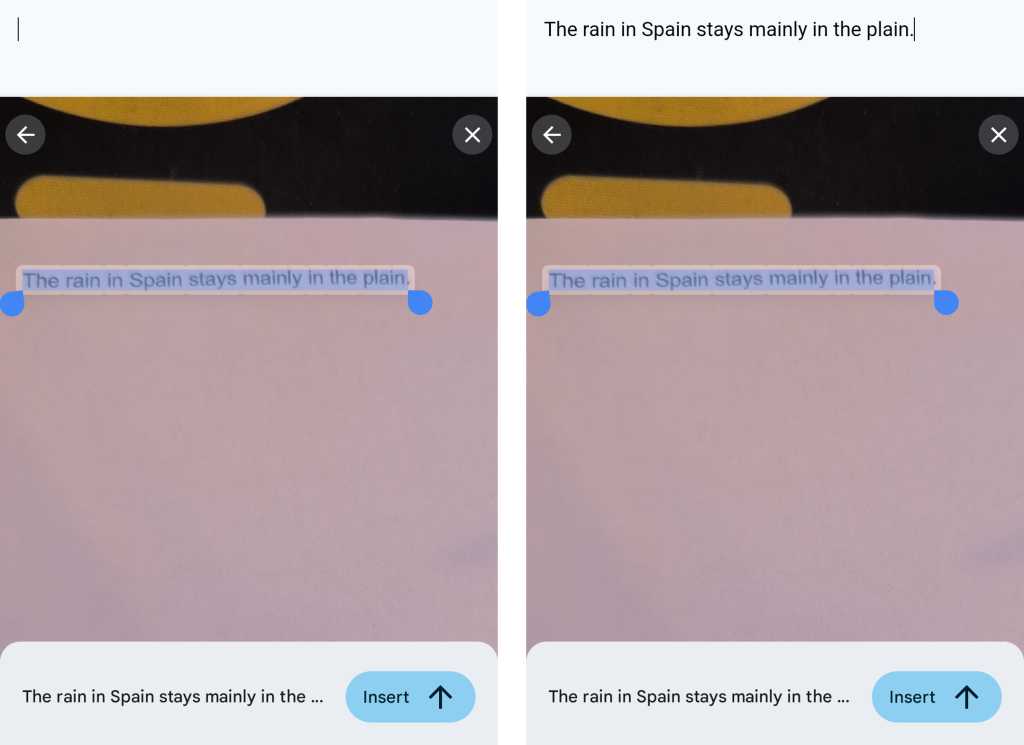
First up is a super-handy way to import text from the real world and then use it as a starting point for whatever it is you’re typing.
It’s all too easy to overlook or forget, but Gboard has a simple built-in trick for snagging text from a monitor, document, or anything else around you and then importing it directly into your current text field.
Just find the icon that looks like a document with arrows on its corners — either in Gboard’s top row or in the menu of options that comes up when you tap the four-square menu button in the keyboard’s upper-left corner. (And remember: You can always change what’s in that Gboard top row by touching and dragging any icons in that full menu area and placing ’em in whatever position you want.)
Tap that bad boy, point your phone at the text in question — and hey, how ’bout that?!
Scanned words, in a text field and ready — with precisely three taps in Google’s Gboard Android keyboard.
JR Raphael, IDG
You’ve got words from the real world right in front of you — ready to write around or edit as you see fit.
Gboard Android trick #2: Undo (whew!)
While we’re thinking about that bar at the top of your Google-scented Android keyboard, give your future self a gift that keeps giving by digging up the recently added Gboard Undo button.
The button does exactly what you’d expect: With a single swift tap, it empowers you to undo any keyboard-related action you’ve taken — be it an accidental backspace, an errant overwriting, or even just the unintentional typing of an unflattering sentence.
srcset="https://b2b-contenthub.com/wp-content/uploads/2025/03/android-typing-gboard-undo-keyboard.webp?quality=50&strip=all 800w, https://b2b-contenthub.com/wp-content/uploads/2025/03/android-typing-gboard-undo-keyboard.webp?resize=300%2C295&quality=50&strip=all 300w, https://b2b-contenthub.com/wp-content/uploads/2025/03/android-typing-gboard-undo-keyboard.webp?resize=768%2C755&quality=50&strip=all 768w, https://b2b-contenthub.com/wp-content/uploads/2025/03/android-typing-gboard-undo-keyboard.webp?resize=709%2C697&quality=50&strip=all 709w, https://b2b-contenthub.com/wp-content/uploads/2025/03/android-typing-gboard-undo-keyboard.webp?resize=171%2C168&quality=50&strip=all 171w, https://b2b-contenthub.com/wp-content/uploads/2025/03/android-typing-gboard-undo-keyboard.webp?resize=85%2C84&quality=50&strip=all 85w, https://b2b-contenthub.com/wp-content/uploads/2025/03/android-typing-gboard-undo-keyboard.webp?resize=489%2C480&quality=50&strip=all 489w, https://b2b-contenthub.com/wp-content/uploads/2025/03/android-typing-gboard-undo-keyboard.webp?resize=366%2C360&quality=50&strip=all 366w, https://b2b-contenthub.com/wp-content/uploads/2025/03/android-typing-gboard-undo-keyboard.webp?resize=254%2C250&quality=50&strip=all 254w" width="800" height="786" sizes="(max-width: 800px) 100vw, 800px">The new Gboard Undo button makes it laughably easy to undo and redo any keyboard-related action.
JR Raphael, Foundry
All you’ve gotta do is uncover that Undo option — then shift it into a prominent position for easy ongoing access. Just open up that main Gboard menu once more, by tapping the four-square button in the keyboard’s upper-left corner, then look for the newly present Undo button within the screen that comes up.
Undo? We do! (Woohoo.)
JR Raphael, Foundry
Press and hold your finger onto that button, then drag it up into one of the primary spots in the keyboard’s upper row.
It’ll then always be there and ready, one tap away — whenever the need arises.
Gboard Android trick #3: Write right
Few mere mortals realize it, but in addition to tapping, swiping, and talking, you can also enter text into any field on Android with some good old-fashioned handwriting on your fancy phone screen.
It’s an interesting option to keep in mind for moments when you feel like your own scribbly scrawling might be more efficient than any other text input method.
This one takes a little more legwork to get going the first time, but once you do that, it’ll never be more than a quick tap away:
First, head into Gboard’s settings by tapping the four-square menu icon in the keyboard’s upper-left corner and then tapping the gear-shaped Settings option in the full Gboard menu.
Select “Languages” followed by the Add Keyboard button. Type “English (US)” (or whatever language you prefer), then make sure “Handwriting” is active and highlighted at the top of the screen.
Tap the Done button to apply the changes.
Now, make your way to any open text field to pull up Gboard, and you should be able to either press and hold the space bar or hit the newly present globe icon next to it to toggle between the standard keyboard setup and your snazzy new handwriting recognition system.
And once you’ve got that handwriting canvas open, all that’s left is to write, write, write away and watch Google’s virtual genie translate your illegible squiggles into regular text almost instantly.
As you can see above, it works even if your handwriting resembles the harried scrawls of a clumsy caribou. (No offense intended to my caribou comrades.)
Gboard Android trick #4: Quick clips
One of my all-time favorite Gboard tricks is the keyboard’s intelligent integration of the Android system clipboard — and some incredibly helpful tricks that come along with that.
Look for the clipboard-shaped icon either in the keyboard’s top row or within the main Gboard menu to get started. The first time you tap it, you might have to activate the system (via the toggle in the upper-right corner of its interface) and also grant Gboard permission to access your system clipboard. You may also need to mosey back into the Gboard settings to find the “Clipboard” section and enable all the options there to get every piece of the puzzle up and running.
Once you do, though, good golly, is this thing amazing. It’ll automatically show every snippet of text and any images you’ve copied recently, for one-tap inserting into whatever text field you’re working in — and it’ll show your recently captured screenshots for the same purpose, too.
Gboard’s clipboard integration makes it easy to find anything you’ve copied and insert it anywhere.
JR Raphael, IDG
Perhaps most useful of all, though, is the Gboard clipboard’s capability to store commonly used items and then make ’em readily available for you to insert anytime, anywhere. You could use that for email addresses, physical addresses, Unicode symbols, snippets of code, or even just phrases you find yourself typing out often in Very Important Work-Related Emails™.
Whatever the case may be, just copy the item in question once, then pull up the Gboard clipboard and press and hold your finger onto the thing you copied. Tap the “Pin” option that pops up, and poof: That text (or image) will be permanently stored in the bottom area of your Gboard clipboard for easy retrieval whenever you need it.
Pinned items in the Gboard clipboard are like your own on-demand scratchpad for easy inserting anywhere.
JR Raphael, IDG
As an extra bonus, Gboard also now syncs your pinned clipboard data and continues to make any pinned items available on any Android device where you sign in.
Gboard Android trick #5: Your personal editor
When you’re banging out a Very Important Business Email And/Or Document™ on your phone, it’s all too easy to mix up a word or inadvertently accept an errant autocorrect. We’ve all been there — and all had the same ducking reaction — right?
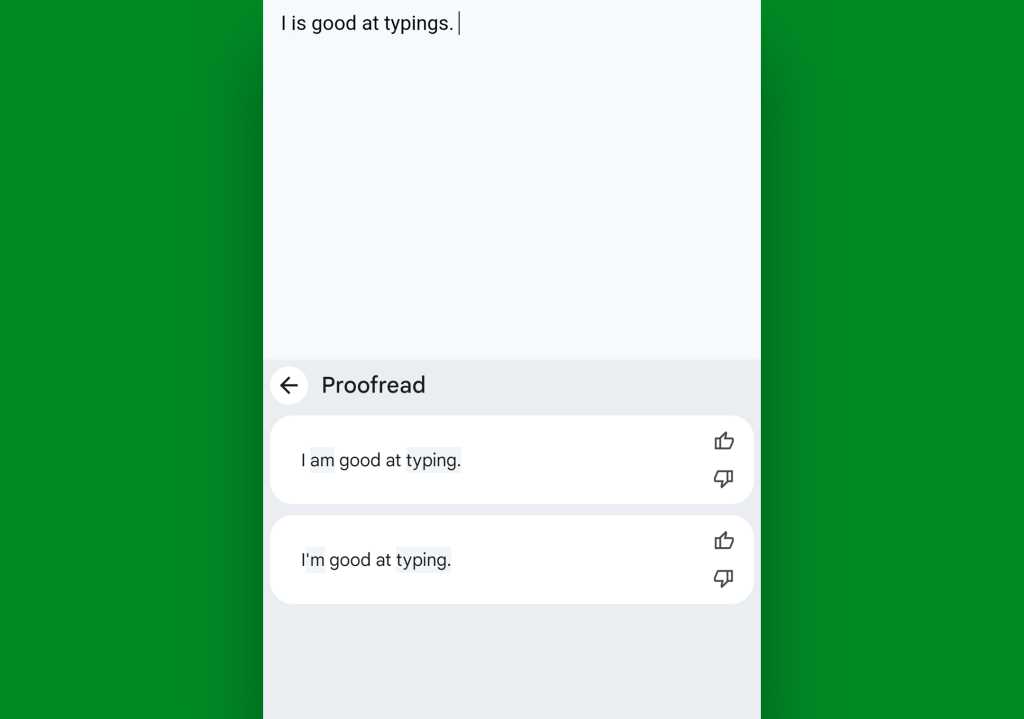
You may not always have a second set of human (or even caribou) eyes to look over your words whilst composing on the go, but Gboard’s recently added proofreading feature can at least give you some second layer of assurance before you hit that daunting Send button.
To find it, tap the four-square menu icon in Gboard’s upper-left corner and look for the Proofread button — with an “A” and a checkmark on it.
Tap that bad boy and tap it good, and in a split second, Gboard will analyze whatever text you’ve entered and offer up suggestions to improve it.
Need a quick confirmation that your text makes sense? Gboard’s proofreading feature’s got your back.
JR Raphael, IDG
Not bad, Gboard. Not bad. You is clearly the one who is gooder at typings today.
Gboard Android trick #6: The translation station
Last but not least in our text input improvement list is a serious time-saver and communication-booster, and that’s the Gboard Android app’s built-in translation engine.
Hit that four-square menu icon in your keyboard’s upper-left corner once more, find the Translate button, and tap it — then select whatever languages you want and type directly into the Gboard translate box.
Gboard will translate your text in real-time and insert the result, in whatever language you selected, directly into whatever text field you had selected.
Any language, anytime, with Gboard’s on-demand translation system.
JR Raphael, IDG
Pas mal, eh?
Keep all these advanced input tricks in mind, and you’ll be flyin’ around your phone’s keyboard like a total typing pro — with or without a caribou at your side.
Get six full days of advanced Android knowledge with my free Android Shortcut Supercourse. You’ll learn tons of time-saving tricks for your phone!
A team that included researchers at a US bank says it has created a protocol that can generate certified truly random numbers, opening the possibility that current generation quantum computers can be used for secure applications in finance, cryptography, cybersecurity, and privacy.
However, an industry analyst is cautious.
“The JPMorgan team’s findings are interesting, but won’t be applicable in the near term for most CSOs, unless they are responsible for high security environments,” said Sandy Carielli, a principal analyst at Forrester Research.
“Quantum random number generation has been around for a while,” she pointed out, “and some CSOs may already be using products in that area. The certification could be a nice extra for highly regulated environments.”