
Category: Apple, IT Leadership, Vendors and Providers

Tim Cook’s legacy: a successful CEO who stumbled over AI

Apple’s Tim Cook was viewed as a worthy successor to Steve Jobs when he took over as CEO in August 2011, two months before Jobs’ death. 

Apple products became successful (and profitable) in many ways due to his success as COO, where he whipped company operations and supply chains into shape. Cook expanded the company’s product portfolio into new devices such as the Vision Pro and Apple Watch, rolled out a plethora of profitable services, and cut off failed projects like the rumored Apple car.

But Cook, who announced this week he will step down as CEO on Sept. 1 to become executive chairman, has one major blemish on his legacy. He missed perhaps one of the most important moments in computing history — the AI revolution. 

Apple could still win AI war, and it now falls on incoming CEO John Ternus, formerly Apple’s senior vice president of hardware engineering, to play catch-up with AI rivals Google, Microsoft and OpenAI. 

When ChatGPT took the world by storm in late 2022, Apple was years behind in the AI race and had to scramble to catch up. Cook’s failure is mostly attributable to Apple believing it could always go it alone when it comes to technology, said Jack Gold, principal analyst at J. Gold Associates

“They have a bias to doing everything in house,” Gold said.

The company did not believe in AI until ChatGPT emerged to take the tech industry by storm, according to a 2025 Bloomberg news report, and Cook did not provide the resources needed in-house to develop an AI-powered Siri. Apple was forced in early 2025 to look at partnering with Anthropic and OpenAI to push Siri into the AI era; in finally settled on working with Google’s Gemini.

The stumble was even more apparent since Apple was onto the AI trend early on, when it introduced neural chips for AI in iPhones as early as 2017. (Qualcomm introduced AI chips in its smartphone chips around the same time.)

At the time, the neural engine was hailed as a revolutionary development for developers to plug AI into applications. Apple wanted to use the neural chip’s matrix computing features to accelerate image and video processing, and users loved the results. 

Then in 2024, Apple introduced Apple Intelligence to much fanfare, hoping to bring AI technology across its devices and platforms. The AI layer was based on homegrown foundation models. 

Though it arrived nearly two years after ChatGPT, Apple Intelligence at the time offered truly innovative features. It had better OS and app integration and privacy features that kept user data secure — in part because of Private Cloud Compute. Other AI providers at the time were harvesting user data to improve their AI models.

Behind the scenes, however, Apple leadership and technological challenges slowed the development of Apple Intelligence. Apple in 2018 had hired former Google executive John Giannandrea to bring AI to Apple products. Giannandrea’s leadership was largely seen as ineffective and he retired last December. In early 2026, Apple turned to former Microsoft AI leader Amar Subramanya to lead the company’s AI efforts.

As a result, many of the main Apple Intelligence features were delayed, with hopes they  would finally arrive in 2026.

Then in January came the partnership with Google: “The next generation of Apple Foundation Models will be based on Google’s Gemini models and cloud technology,” the companies said in a joint statement.
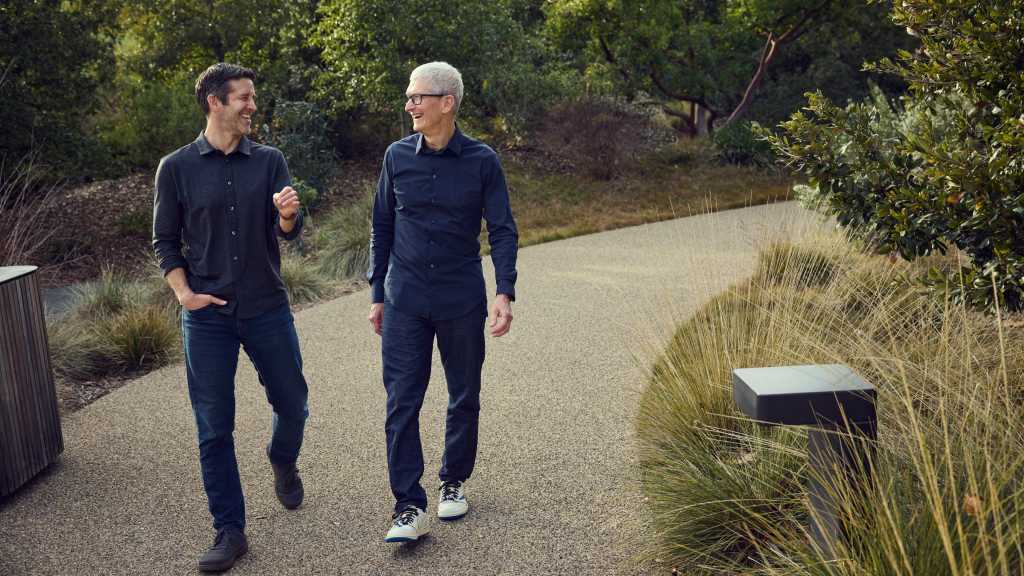
Tim Cook and John Ternus

Incoming Apple CEO John Ternus and current CEO Tim Cook.

Apple

Now, the work for Apple’s soon-to-be CEO Ternus is clear: bring the company fully into  the AI age. “Unlike previous market inflections and transitions, Apple can’t afford to come in late to the party this time around,” said Jim McGregor, principal analyst at Tirias Research.

With its experience in devices and talent, Apple is well equipped to build AI into a personal experience, McGregor said. “Apple has to chart a path to reinvent the personal experience, which will drastically change devices and how we use them,” he said.

To succeed, Ternus will have to look at more partnerships and drop Apple’s reliance on in-house development, analysts said.

“When AI is moving at such a fast pace, no one company like Apple can really move fast enough to keep up,” Gold said.

The Google partnership is a solid step in that direction, as finding the expertise to hire the right people is a major hurdle, given the compensation package that others are offering, Gold said.

Whether the company has finally righted the AI ship should become clear in a little over a month at its annual Worldwide Developers Conference — the last one of the Cook era.

With John Ternus as CEO, expect Apple’s platforms to proliferate

Apple now has a new iCEO, as current leader Tim Cook (65) announced late Monday that he is set to become chairman of the board, while current head of hardware engineering, John Ternus, prepares to take over as CEO on Sept. 1.

As you’d expect, this leadership transition at one of the world’s most successful firms, is generating reams of news reports and hot takes. Here’s mine: Just as Steve Jobs presided over the resurrection of Apple and Cook led the company through unprecedented business growth, Ternus will guide the company through an era of equally unprecedented hardware proliferation. 

Expect more growth

He’s someone who cares about craft in hardware design and recently appeared in a worth-watching video interview (chaperoned by Greg Joswiak, the company’s senior vice president of worldwide marketing). The soon-to-be-CEO did well in what was an obvious media training exercise. “Everything we do, even if our customers don’t necessarily see it, everything we do has some new ideas in it…, we feel like we’re innovating all the time,” he said. 

Among a range of achievements, Cook innovated operations to the extent that every product Apple makes is supported by the world’s most efficient multinational manufacturing and logistics system. While he did, Ternus innovated product. “John Ternus has the mind of an engineer, the soul of an innovator, and the heart to lead with integrity and with honor,” said Cook.

The current CEO has had to handle huge supply chain challenges while scaling logistics to support growth. The numbers illustrate this: Apple sold 18.1 million Macs in the year following his appointment as CEO 15 years ago. In 2025, it sold 27.2 million. iPhone sales grew from 136 million in 2011 to 247 million last year. Rumor has it the MacBook Neo has shifted as many as 10 million units, just as Ternus turns up to take that figure higher.

“Tim’s unprecedented and outstanding leadership has transformed Apple into the world’s best company,” said outgoing Apple board chairman Arthur Levinson. 

You don’t need a weatherman

You can see which way the wind blows. 

Apple’s hardware is selling in record quantities, even as the company seems more prepared – and better able – than ever before to widen its addressable market with more affordable products. It is able to do this without compromising on product quality or user experience for three big reasons: 

  • The massive per-customer services income built by Cook.
  • Huge iPhone sales as an inheritance from Steve Jobs.
  • The adoption of Apple Silicon, which has been presided over by Ternus and led by Johny Srouji.

Srouji will take on the hardware leadership role being vacated by Ternus and as part of this will combine the hardware technologies and hardware engineering teams, separated in 2012. “I am excited to bring these teams together and deepen their integration to help us innovate even more than we do today. There is no limit to what we can achieve together,” he wrote. 

That optimism is well-founded. Apple’s processor designs will enable the company to push fast in its new phase of proliferation. With 1nm chips on the horizon, Apple’s processors are small, powerful, and energy efficient, making them suitable for a plethora of new hardware designs the world hasn’t even seen yet.

Making impossible things possible

Apple under Ternus will no doubt lean into that opportunity. This approach means that not only will you see Apple widen its addressable market with a combination of product quality at better prices, but you’ll also watch it expand its offer with new product families. 

It’s no coincidence, for example, that Ternus at one point led Apple’s robotics team as the company prepares to introduce its first robotic products in the coming months. Apple’s hardware is supported by Apple’s software, of course. 

While it will offer some of its own solutions within Apple Intelligence, Apple doesn’t even need to make the AI. It just needs to make the best hardware to run AI on, which is what Ternus is going to focus on. 

You can already see it. With Ternus leading hardware, the Mac is more powerful and more popular today than at any point in its history — and the MacBook Neo is building on that success. It represents the thin end of a wider wedge of hardware-driven market share growth across all Apple’s products that will now accelerate under Ternus, even while the latter makes his own transition.

As board chairman, Cook will turn to handling the complex political and strategic relationships he’s been dealing with as CEO. Cook is very good at that, which also raises the question of whether he has wider ambitions for political engagement.

You can follow me on social media! Join me on BlueSky,  LinkedIn, Mastodon, and MeWe. 

The new Apple thinks different?

The latest Apple leadership changes set the stage for a new approach from the company on a range of issues, including international relations, the environment, and beyond. If great artists steal, great leaders reflect the spirit of their age. 

Apple’s current general counsel, Kate Adams, will leave late next year, following a transition to a new general counsel — Meta Chief Legal Officer Jennifer Newstead — in March 2026. Apple also announced that Lisa Jackson, vice president for environment, policy, and social initiatives, will retire in late January. 

The new faces

Newstead’s appointment is perhaps the biggest hint of the potential for change. She brings with her extensive experience in foreign policy and international affairs, both topics of major importance to Apple in the shifting sands of current global politics and alliances. She also served as a top lawyer in the first Trump administration before leaving that position to move to Meta. 

A second sign of change might be the departure of Jackson, who served as US Environmental Protection Agency head in the Obama administration. She has been instrumental in guiding Apple toward its oft-stated target to be completely carbon neutral by 2030. Apple CEO Tim Cook praised her for, “advocating for the best interests of our users on a myriad of topics, as well as advancing our values, from education and accessibility to privacy and security.”

What’s unusual here is that there doesn’t appear to be a clear succession path for this role, which seems odd given the depth of talent Apple already has within Jackson’s departments. Apple says Jackson’s Environment and Social Initiatives team will report to Apple’s Chief Operating Officer (COO), Sabih Khan, while work on government affairs will transition to Apple’s former general counsel, Kate Adams, for a while until it becomes part of Adams’ new domain.

Who will advocate now?

It is important not to read too much into this, but these leadership changes do make it easier to think there might be no one at Apple’s top table to advocate over some of the environment, social, and government affairs the company has regularly shown leadership in across the last decade. 

Newstead will have enough on her plate handling international regulators, particularly in Europe, while Apple’s COO will be more focused on manufacturing and supply – particularly around how Apple’s $600 billion investment in US manufacturing can boost US employment. 

That doesn’t mean Apple won’t hit its 2030 goals, but does suggest that those ambitions might take second place to operational concerns. (It is also notable that Cook praised Adams as having been an important advocate for Apple’s push for privacy. Will Newsom prize privacy as much?)

Given Apple’s recent warnings that meeting regulatory obligations in the EU will force it to remove privacy safeguards from products sold there, is the company preparing to give up that struggle? After all, if people continue to vote for authoritarian governments in different color shades, at what point must private enterprise concede state surveillance is what people want?

Apple’s new order

If nothing else, the changing of the guard strongly suggests that there is plenty at stake, and while Cook may now always be known for giving a lump of gold to a President to protect Apple’s shareholders, who knows what other compromises the company has had to make? Speculation Cook might himself retire also opens the gate to a new approach from company leadership. The complex political realities we face will inevitably be reflected across corporate boardrooms, eager to foster permanent growth for their shareholders.

None of this could be true, of course. But what is true is that while the departure of Alan Dye means Apple’s products might in the future work differently, Apple’s latest board-level leadership changes — coming mere months since COO Jeff Williams left the company — make it possible the company will think different, too. 

You can follow me on social media! Join me on BlueSky,  LinkedIn, and Mastodon.