
Category: Artificial Intelligence, Careers, Generative AI, IT Skills and Training

Entry-level AI workers now need ‘senior-level’ skills, PwC says

AI has created a tough job environment for entry-level workers and things aren’t getting better anytime soon — even those with AI capabilities now need “senior-level” skills to land a job.

“AI-exposed entry-level roles are seven times more likely to require traditionally senior-level skills such as judgement and leadership,” consulting firm PwC said in a study released this month.

That’s because AI is changing the traditional career ladder. Companies are increasingly looking for candidates that use the cutting-edge tools and services to amplify their performance and grow faster. “Organizations must rethink how they mentor and train junior staff, helping them step up to complex decision-making much earlier in their careers,” PwC said.

Entry-level job seekers with or without AI skills are already dealing with stagnant wages,  layoffs, and stalled hiring. 

(The PwC findings echo similar concerns raised late last year in McKinsey’s State of AI report. Many companies are reducing headcount by deploying AI agents to take over entry-level jobs.)

Early-career AI job postings “have flatlined in highly AI exposed sectors,” and listings for junior roles with mid-career or senior-level skills have grown 35% since 2019, PwC said.  The consulting firm largely discounted the notion that AI is taking jobs away, though other studies point in the opposite direction. 

By the end of May, AI-driven job cuts had reached 87,174 for 2026, already outpacing the total of around 54,836 in 2025, according to figures released by Challenger, Gray and Christmas earlier this month.

The AI-driven layoffs haven’t reached the “jobpocalypse” stage yet, and workers are more productive with it, said Andy Challenger, chief revenue officer at Challenger, Gray and Christmas. But companies are rethinking hiring and long-term operational strategies as AI becomes a routine component in daily workflows and processes, he said.

Businesses are “restructuring aggressively as they reposition for an AI-driven economy,” he said.

That’s putting downward pressure on entry-level hiring as AI tools absorb more routine work, said Kye Mitchell, head of Experis US, a part of ManpowerGroup. “That doesn’t remove opportunity, but it changes the expectations. Employers now expect candidates to come in with hands-on experience, AI familiarity, and the ability to contribute faster,” Mitchell said.

Compensation remains strong for specialized, in-demand skills, while more commoditized roles such as customer service, helpdesk, and some entry-level positions  are flattening. “The shift overall is toward skills-based hiring, where demonstrable capability matters more than credentials alone,” Mitchell said.

Graduates who combine technical fundamentals with practical experience, AI fluency and strong communication skills stand out quickly. Job candidates can’t rely solely on academic credentials. 

“Employers are moving away from ‘train-from-scratch’ hiring and looking for talent that can contribute earlier and continue to adapt,” Mitchell said.

The PwC study also focused on the productivity gap between companies that have invested heavily in AI and companies lagging in adoption.

Since ChatGPT showed up in 2022, AI-exposed companies have seen productivity gains of 40% versus other companies. “The companies achieving the biggest productivity gains from AI are not using it only to cut costs,” PwC said.

AI-forward firms are also raising headcounts and wages. “Far from being a job killer, AI may actually be a job expander when used to unlock growth and enter new markets,” PwC said. 

Workers who use their domain expertise to supplement AI tools can advance, with AI-exposed roles “2.5 times more likely to rely on skills like empathy, judgement, and creativity that become even more valuable as AI absorbs some routine work,” PwC said.
Here’s one career emerging from the AI shift: ‘forward-deployed engineers’

On Thursday, Google Cloud CEO Thomas Kurian issued a call for “forward-deployed engineers” to apply for jobs in the company’s go-to-market AI team. Their task: help non-tech organizations scale up their AI deployments.

That term — forward-deployed engineers, FDE for short — has been coming up a lot lately in conversations with CTOs, software engineers, and experts tracking the technology and job markets.

Google currently has 1,513 openings for that specific role and OpenAI, which just this week launched an organization called the Deployment Company, has 31. Microsoft is on board, too; in March, it partnered with Accenture to launch a forward-deployment partnership.

OpenAI’s new Deployment Company is, not surprisingly, designed to “help organizations build and deploy AI systems they can rely on every day across their most important work,” the company said in a blog post.

Forward-deployed engineering has seen the fastest growth in jobs created by AI, with the number of positions increasing 42-fold between 2023 and 2025, LinkedIn reported in a study earlier this year. (AI engineer jobs, by comparison, have grown 13-fold in that same time frame.)

Vendors and service providers created the FDE position to help clients install AI, said Jack Gold, principal analyst at J.Gold Associates.

Many non-tech firms have taken shots at deploying AI projects internally, without success or quick ROI. Some of the reasons those efforts haven’t worked out include poor vision, lack of talent, skimpy budgets, and underestimating the complexity of deploying AI.

That’s led to the arrival of FDEs — essentially hired guns for AI deployments. They focus on successful outcomes for customers instead of writing code. 

“They have skills that the organization may not have, and usually have done similar work with others before, so they bring expertise that companies need,” Gold said. 

FDEs analyze strategies, battle plan, discover applications, build agentic frameworks, and roll out AI systems with help from customers’ own domain experts and engineers. They also work with AI models, solve context and reasoning problems, evaluate models, and put security and governance guardrails in place. 

A good FDE can provide a much higher probability of successful implementations, Gold said.

Many software engineers have worried that AI would make their careers irrelevant. But the FDE role embodies where the role is going, analysts and IT experts said.

Code can now be written using human language, allowing software engineers to focus  more on outcomes than servicing code, said Alex Spinelli, senior vice president for AI and developer platforms at Arm.

“I think that’s where engineering is moving to…, much more blending of the sort of technical product management thinking, design thinking, and architecture thinking,” Spinelli said.

While AI can make engineering invisible, it also opens a toolbox to solve business problems, said Stephen Jones, CUDA architect at Nvidia. “You have more tools than you ever had before to solve problems that were previously completely unsolvable,” he said.

The FDE roll in the future might well entail reducing AI costs for customers, said Deepak Seth, senior director analyst at Gartner. “Some companies are moving towards outcome-based pricing…. [And] when people start realizing the real cost of tokens, then companies will start looking at token efficiency.”

Gold said the FDEs’ implementation efforts can help drive those token savings. “If the implementation is optimized, it can save on token costs for processing the workflows, …especially as companies move to agents,” he said.

AI-led job cuts don’t always mean stronger ROI — Gartner

Businesses tend to eye AI spending as a way to reduce headcount, but firms that cut staffers as a result of AI are doing no better than those who don’t, according to new Gartner research.

Gartner recently surveyed 350 global business leaders at large organizations already using AI agents and intelligent automation tools and found that 80% of them reported a lowered headcount as a result of AI initiatives — in some cases by up to 20%. 

But those layoffs appear to be less beneficial than senior leaders might assume. 

“There’s no connection or correlation between people who are achieving ROI and layoffs,” said Helen Poitevin, distinguished vice president analyst at Gartner, adding that labor reduction is “not the best” ROI metric. Other factors such as revenue, growth, and time to market are more effective in achieving a strong ROI. 

“Those who only look to the workforce tend to be the ‘laggards,’ because they’re not going after the broader set of value that they can get to,” she said. This approach can also be “very disruptive more broadly,” she said, noting that some organizations who cut staff were forced to quickly rehire employees soon after.

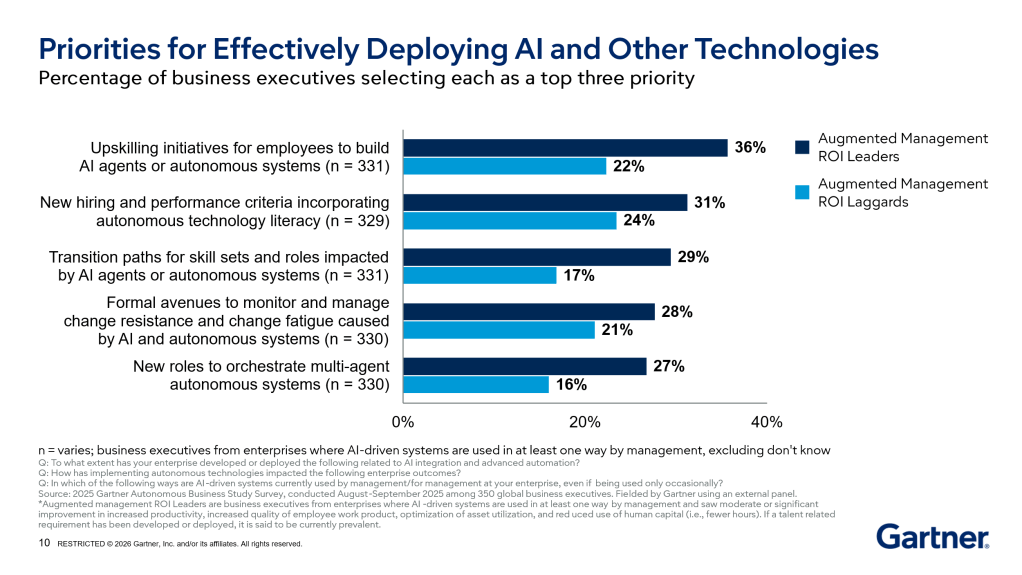
That’s not to say companies aren’t cutting jobs, said Poitevin, but doing so isn’t the main route to solid ROI. Instead, organizations with higher levels of return on their spending looked beyond workforce reductions and saw AI as a way to improve employee productivity.  

These organizations are more likely to upskill staff to use AI tools, link employee hiring and performance criteria to AI proficiency, and set “transition paths” for skill sets and roles that will be affected by automation plans, said Poitevin.

“You have to plan for layoffs where they happen, but, more importantly, you have to plan for workforce transformation, and you have to go after broader forms of value through your AI investment portfolio than just labor cost,” she said.

For those panicking at the prospect of an AI-led jobs apocalypse, Gartner offers some hope: The analyst firm predicts that by 2029 the number of jobs created by AI will outpace those that are lost. 

Between 2023 and 2029, approximately 6 million roles will be automated globally, as businesses deploy AI agents and other intelligent automation technologies, according to Gartner; that’s a small proportion of the roughly 2 billion jobs available to workers. 

The prediction adds to a growing expectation among industry watchers that AI will reshape the workplace rather than replace workers en masse, at least for the foreseeable future. “AI is not leading to a jobs apocalypse, but it’s unleashing job chaos, changing the shape of what people do,” said Poitevin.

That doesn’t mean disruption can be avoided entirely. A larger portion of the workforce — around 32 million workers each year — will see their roles transformed with the introduction of AI and intelligent automation, forcing them to “rethink what they do, how they do it, what ‘good’ looks like,” said Poitevin. 

At the same time, the deployment of AI is expected to generate new labor demand in 2027 and 2028, with that demand offsetting AI-related job cuts the following year.

The AI-led job gains will include higher demand for existing roles boosted by AI-driven productivity gains, as well as the creation of new roles related specifically to the deployment and management of AI systems – change management and business transformation, for example. 

Wider adoption of AI tools will also lead to the emergence of new business models, according to Gartner – similar to higher demand for logistics systems and delivery drivers after the e-commerce boom or the increase in financial analysts after Excel replaced old-fashioned bookkeeping.

AI deployment tips

Strategies for deploying AI technology.

Gartner