Month: April 2025

Nvidia expects ban on chip exports to China to cost $5.5B

Nvidia now expects new US government restrictions on exports of its H20 chip to China will cost the company as much as $5.5 billion, Reuters reports.

Nvidia’s H20 chip is used for AI development; the US government has said it wants to restrict exports of the chip to China because of concerns it could be used to build a supercomputer. The H20 chip is the most advanced that Nvidia has been allowed to sell in China, though it is not as fast as the chips the company sells outside China.

AMD’s MI308 chip and its counterparts have also been restricted, a move the company estimates will cost it $800 million, Techcrunch reports.

EU equips US-bound staff with burner phones

The European Commission has issued so-called burner phones and simple laptops to certain staffers traveling to the US to reduce the risk of espionage, according to The Financial Times.

The Commission issued the new guidelines to commissioners and senior officials traveling to the International Monetary Fund and World Bank spring meetings next week. The EU has in the past used the same approach for staffers traveling to China.

“They are worried about the US getting into the Commission’s system,” an anonymous source told the Times.

The European Commission confirmed it recently updated its security advice for travel to the US, but said no specific instructions on burner phones were given in writing. Those instructions for travel to the US recommend turning off the phone at the border and placing it in a special bag to protect it from spying if it is unattended.

The US White House has not commented on the matter.

CVE funding cuts reversed after security concerns raised

Editor’s note: After this story was published earlier today, CISA signed a contract extension that averts a shutdown of the MITRE CVE program.

A CISA spokesperson sent CSO (a sister publication to Computerworld) a statement saying: “The CVE Program is invaluable to cyber community and a priority of CISA. Last night, CISA executed the option period on the contract to ensure there will be no lapse in critical CVE services. We appreciate our partners’ and stakeholders’ patience.” (Sources indicate the contract extension will last 11 months.)

The story below reflects the state of events prior to the contract extension.

In what may yet be seen by some as a triumph of some kind, funding for the Common Vulnerabilities and Exposures (CVE) system, the world-renowned security service trusted and used by Apple and other tech firms across the planet, has been summarily cut.

CVE numbers are part of a globally recognized system used to identify and track vulnerabilities. Weakening it might save the US government budget a few dollars — at the cost of creating havoc across a security community already stretched by a politically-driven spike in cyberattacks. See also: CVE program averts swift end after CISA executes 11-month contract extension

What it is and why it matters

The CVE service provides a really easy way for individuals and organizations to report security vulnerabilities they find in any product. You can tell how important it is, given that a CVE number has pretty much become the market standard for identifying such problems. The numbers act as a common language and ensure everyone is referring to the same bug. But federal funding for the program has been cut, which could leave tech users less safe than before. 

In a letter to board members, MITRE Corporation (a not-for-profit, federally-funded group that supports CVE) warned that a break in the service might generate multiple bad impacts, “including deterioration of national vulnerability databases and advisories, tool vendors, incident response operations, and all manner of critical infrastructure.”

Mitre laid off more than 400 employees in anticipation of the cuts earlier this month; the funding reduction comes as the National Institute of Standards and Technology (NIST) continues to struggle to stay on top of the accelerating number of vulnerabilities disclosures.

No times like the present

With an accelerating number of active vulnerability disclosures and a growing volume of attacks, chaos in the language used by researchers to describe and act against these attacks can’t help but weaken ongoing security protection by slowing reaction times as new flaws are reported. 

Critics of the CVE system exist, and the people running it will admit that it was designed for a time when the level and scale of threat was lower. But the system is internationally accepted, works, and provides a level of infrastructure security on which researchers depend.

A funding cut with little warning will cause chaos in the community – though hopefully the big companies that rely on CVE for their own work will dig deep into their revenue to finance the organization. Doing so is, after all, in their own interests – the very rich, will, after all, be the only real beneficiaries of any tax cuts coming down the pipe in exchange for changes such as these.

It isn’t clear what Apple’s reaction will be, but given it has been referencing CVE numbers for years, there’s little doubt the system is important to the company and its network of independent security researchers. Before the system emerged, security researchers each used their own unique terminology to refer to risks, creating a lot of confusion when securing platforms. Weakening the system now makes little sense to professionals in the field.

“CVE is a cornerstone of cybersecurity, and any gaps in CVE support will put our critical infrastructure and national security at unacceptable risk,” Luta Security founder and CEO Katie Moussouris told The Register. “All industries worldwide depend on the CVE program to keep their heads above water when it comes to managing threats, so an abrupt halt like this would be like depriving the cybersecurity industry of oxygen and expecting it to spontaneously sprout gills.”

Not giving up yet

The people behind the effort aren’t giving up. One group of CVE board members immediately repositioned themselves as a nonprofit group to be called the CVE Foundation, which will continue the mission. “CVE, as a cornerstone of the global cybersecurity ecosystem, is too important to be vulnerable itself,” said Kent Landfield, an officer of the foundation. “Cybersecurity professionals around the globe rely on CVE identifiers and data as part of their daily work — from security tools and advisories to threat intelligence and response. Without CVE, defenders are at a massive disadvantage against global cyber threats.” 

Other entities are also stepping up to mitigate the inevitable damage. “VulnCheck is actively monitoring the MITRE situation, and will ensure that our customers, partners, and the entire cybersecurity community will have continued access to timely, accurate vulnerability data,” said Anthony Bettini, founder and CEO of VulnCheck. “We recognize the critical role that the CVE program plays in the cybersecurity ecosystem, and we are actively preparing for any potential disruptions.”

We’ll see how this develops, but one way most everyone using digital devices could help maintain security is by being much more careful when clicking links in emails or elsewhere. Those aren’t the only attack vectors, of course, but when you can’t rely on the tech to save itself, you need to gather the fruit closest to the floor. Now is a good time to be more security aware, on any platform.

You can follow me on social media! Join me on BlueSky,  LinkedIn, and Mastodon.

This article was originally published with the headline “CVE funding shut down, giving the security community jitters.”

South Korean full-stack AI startup Upstage eyes expansion in the US and Japan

South Korean AI startup Upstage is ramping up global expansion in the US and Japan, positioning its full-stack AI platform to serve enterprise clients. With a focus on boosting productivity through proprietary technologies, the AI firm is trying to replicate its domestic success in two of the world’s most advanced AI markets.

Co-founded in 2020 by Sung Kim, former AI development lead at Naver, the startup announced its global expansion strategy, aimed at helping countries build “sovereign AI” models based on their business productivity-focused AI technologies, reported Yonhap News Agency.

In April last year, Upstage raised 100 billion won ($72 million) from investors including SK Networks and KT Corp to fuel its expansion. Kim said the funding would help accelerate the development of purpose-trained LLMs and strengthen the company’s global presence.

Upstage’s strategy is built around its own AI technologies, like the OCR “DP” technology and the large language model “Solar.” Kim pointed out that these innovations are central to their goal of using AI to boost productivity across industries.

The company believes its control over the entire AI stack sets it apart. The latest Solar Pro model, with 22 billion parameters, has shown substantial improvements in key benchmarks. Upstage plans to introduce a multimodal AI model in June that will integrate its DP technology and Solar LLM, along with a new inference AI model.

Their latest language model, Solar Pro 1.3, claims to have the “highest benchmark performance” among Korean AI, and they’re promising even more muscle with the 33-billion-parameter “Solar Pro 1.5,” expected to arrive in June 2025.

In the US, Upstage plans to leverage its expertise in document parsing, especially within industries like insurance, where it has successfully deployed solutions for Korean insurers such as Samsung Life Insurance.

Upstage’s DP technology can process documents at approximately 0.6 seconds per page, translating to 100 pages in under a minute.

This ability to quickly convert unstructured documents into structured data is especially relevant for US sectors such as legal, healthcare, and finance, which routinely handle large volumes of text. The structured output supports downstream AI applications like summarization, question answering, and intelligent search capabilities increasingly sought by document-heavy enterprises.

As part of its global growth strategy, Upstage has also been involved in a project to develop a Thai-language-specific LLM.

Syn-ergy in Japan

The company, which counts South Korean firms such as Samsung Card and Hanwha Life among its clients, is focusing on Japan’s extensive document-driven enterprise market. To make inroads, the company is working on a Japanese-specific language model with local partners. It has recently appointed Hiroyuki Matsushita, who has held senior roles at Panasonic and AWS, as head of its Japanese operations.

A key offering from the company for the Japanese market is “Syn,” a compact language model co-developed with the Japanese chatbot startup Karakuri. Designed specifically for sectors like finance, healthcare, manufacturing, and legal services, Syn aims to enhance operational efficiency for Japanese companies.  

Full-stack AI

Upstage is pursuing a full-stack approach to AI by developing and managing its core technologies in-house. Its proprietary ecosystem spans the entire AI adoption journey—from data ingestion to model deployment—anchored by its Document Parse (DP) engine and Solar large language model, which are designed to work in tandem to address specific enterprise needs.

By building these foundational tools internally, Upstage aims to offer more integrated, customizable solutions, with the added benefit of faster iteration and seamless system integration. To support broader adoption, the company is also organizing developer hackathons in key regions such as the US, alongside its ongoing R&D efforts. In June 2025, Upstage plans to roll out a multimodal AI model that combines its DP engine and Solar LLM to process both structured documents and unstructured text. The launch is part of its broader push to deliver scalable AI solutions tailored for enterprise environments.

Analysts: Go slow on M365, Google Workspace ‘agent-ish’ AI rollouts

The last few months have seen an explosion of new agentic-like AI tools that can automate workflows within productivity applications, but analysts are recommending that enterprises carefully assess deployment risks before adopting them.

“Enterprise leaders need to come up with a strategy for thinking about agentic AI in its true sense, and also governance for these solutions,” said JP Gownder, vice president and principal analyst on Forrester’s Future of Work team.

Gownder said these tools aren’t truly agentic AI, but “agent-ish” tools, which is how Forrester is terming these applications. “Agent-ish solutions can solve point problems, but they aren’t the ‘digital coworkers’ that vendors are talking about, at least not yet,” Gownder said.

Google and Microsoft have been developing AI plugins for their productivity suites, and third parties are providing their own AI plugins for the applications.

At last week’s Google Cloud Next, Google introduced new AI tools for its Workspace suite to automate work across productivity apps. Workspace Flows can automate a stream of jobs involved in document reviews, customer support requests, or product analysis. The “help me analyze” feature in Google Sheets can take information from tables and provide instant data analysis and insights.

Microsoft celebrated its 50th anniversary earlier this month with a gaggle of unique Copilot automation features that can work with the 365 productivity suite or independently. 

The company’s Microsoft 365 roadmap touts an exhaustive list of upcoming Copilot automation features, including automation tools to write Word documents, learning companions based on learning needs, and automated HR tools.

This week, Anthropic introduced the integration of its Claude AI model with Gmail and Calendar, in addition to Google Docs, which helps “gain deeper insight into your work context” by searching emails, reviewing documents, and scanning the calendar, the company said via email.

“Whether you’re managing projects, planning trips, or handling personal and family tasks, Claude now understands your full context to provide better assistance. Navigate to settings to connect to the Google Workspace beta,” Anthropic said.

And Adobe is developing an Adobe Express AI agent for Microsoft 365  that can create multimedia and presentations via Copilot.

Deploying these specific AI plugins in productivity applications safely could involve years of fine-tuning and implementation; first, enterprises need to understand what the tools do, understand potential security issues, and prepare guardrails, analysts said.

A technical rollout of AI systems and agents doesn’t mean enterprises are doing the right thing — they could be moving too quickly.

“We’re at the very beginning of the journey toward agentic AI, but vendors like to use the term ‘agent,’ even though they lack the autonomy and actionability they will eventually possess,” Gownder said.

Microsoft Copilot Agents are good for tapping into specific data sources — such as a SharePoint site — to ensure that the right data sources are being queried, Gownder said. “It’s helpful for a sort of RAG (retrieval augmented generation) model of computing. But these aren’t complex agents,” he said.

Agents can be stacked so that one agent calls another to do a special task, a process that could include several agents before a result is shown to the end user, said Jack Gold, principal analyst at J. Gold Associates.

As with any new technology, enterprises need to learn how to best use the technology, including asking the right questions in the right sequence so that the agent itself is productive. “It’s also critical that the questions asked are succinct, because agents have a tendency to ‘wander’ if you don’t give them specific criteria,” Gold said.

The “user training” process will likely include trial-and-error, and it can be quick or not, depending on the role and complexity. “The biggest challenge will be: can you trust the results that the agents just provided you,” Gold said.

As with any enterprise-class system, the CISO needs to be involved to determine any danger points, and HR and legal teams might also need to be involved in rollouts that involve corporate data.

“But with AI, it’s amplified by the ability for these systems to actually enhance the types of information that can be retrieved by surmising new data from the old. It’s a different level of requirements,” Gold said.

One big risk to watch out for is agent “anarchy,” in which the prospect of thousands of poorly orchestrated agents could collide and cause vicious loops of automated interactions, said Jason Wong, vice president and analyst on the App Design and Development team at Gartner. “Without proper planning and supervision, agent anarchy is a near-term and serious threat to the stability of enterprise applications,” he said.

Employees with access to genAI tool builders such as Copilot Studio Agent Builder or Google AI Studio — when mixed with other agents that come with applications — can also create issues.

It typically takes at least three months to change ingrained behavior for most employees using genAI, Wong said. “Sysadmins must upskill to become more of an enablement function to the building and management of agents, rather than just focusing on administering operations.”

Anthropic’s Claude AI can now search through your Gmail account for ‘Research’

Anthropic has introduced two new features to its Claude AI assistant — Research and Google Workspace integration — marking its latest effort to position its AI assistant as a collaborative enterprise AI partner.

These features, now in beta for select paid plans, enable Claude to autonomously search the web and organizational content while connecting to Gmail, Google Calendar, and Google Docs to enhance contextual understanding and streamline workflows.

“In line with our vision for Claude as your collaborative partner that delivers hours of work in minutes, we’re continuing to expand the context that Claude has access to,” Anthropic said in a statement.

The move signals Anthropic’s intent to sharpen its edge in the increasingly crowded AI assistant market, where rivals such as OpenAI’s ChatGPT, Microsoft Copilot, and Google’s Gemini are pushing deeper into enterprise integrations.

“Claude is based on ‘constitutional AI’ training and brings in unique capabilities complementing Google’s Gemini — from handling longer contexts, effective reasoning to focus on privacy and security,” said Neil Shah, VP for research and partner at Counterpoint Research. “Enterprises using Workspace now have multiple model choices, from Gemini to Claude, to get the best possible output—safely and speedily.”

“Anthropic’s latest upgrades — Claude’s Research agent and Workspace-native integration — shift the competitive centre of enterprise AI,” said Sanchit Vir Gogia, chief analyst and CEO at Greyhound Research. “No longer content with fast answers, CIOs are demanding audit-ready, multi-document synthesis.”

Research: agentic exploration with citation

Claude’s new Research feature moves beyond reactive question-answering by conducting autonomous, multi-step investigations into user queries, pulling insights from both internal documents and the open web. Responses come with inline citations, supporting auditability and fact verification, the statement added.

“Anthropic’s emphasis on citation-backed reasoning and secure document retrieval is more than an academic choice — it’s a compliance lever,” Gogia said.

Unlike standard web search tools, Research applies reasoning to synthesize findings and deliver holistic, source-backed summaries, making it particularly useful for enterprise scenarios such as market analysis, technical due diligence, or executive briefings.

“By focusing on citation-backed responses and secure document retrieval, Claude addresses the critical needs of regulated industries where transparency and compliance are non-negotiable,” said Abhivyakti Sengar, practice director at Everest Group.

Workspace integration and enterprise features

Anthropic’s integration with Google Workspace tools allows Claude to securely access a user’s Gmail, Calendar, and Docs, enabling it to retrieve relevant files, extract meeting highlights, and summarize follow-up emails without repeated manual input.

Anthropic emphasized that data access is permission-based and session-limited, ensuring users retain control over their information, an important consideration for enterprises prioritizing compliance.

“This move strengthens Claude’s ability to learn more about enterprise workflows and become more proactive and autonomous — from processing extensive documentation to integrating citation and verification workflows,” Shah added.

For enterprise users, Claude now supports advanced document cataloging, building a searchable index across organizational files that allows Claude to surface specific information buried in long documents or scattered across multiple formats.

“When cataloging is enabled, Claude leverages a specialized index of your organization’s documents to find the information you need,” Anthropic statement added.

At the technical level, Claude’s Research and cataloging capabilities are powered by Retrieval-Augmented Generation (RAG), a framework that augments large language models with real-time information retrieval.

Anthropic noted that Claude’s access to both Workspace tools and document repositories is strictly permission-controlled, and access is not retained after sessions unless explicitly configured, helping maintain compliance with enterprise policies.

“Unless vendors like OpenAI and Google match Claude’s standards for sandboxed context and retrieval integrity, enterprise AI adoption will continue to be throttled by fear, not lack of functionality,” Gogia said.

Anthropic outlined how the new features can support a variety of enterprise functions. In marketing, Claude can analyze strategy documents and external sources to shape product launch plans. Sales teams can use it to compile briefings by summarizing past correspondence and surfacing relevant updates. Engineers may streamline technical planning by referencing design documents and external API specifications in a unified view.

Strategic positioning against competitors

These updates bring Claude into closer competition with Microsoft Copilot and Google Gemini, though Claude differentiates itself through agentic research workflows and explicit source citations — features designed to build trust in environments where decision-making relies on verifiable data.

“Anthropic does have an edge when it comes to retrieving safe, compliant, and verified outputs, especially in regulated verticals such as finance, healthcare, or even education, research, where Google Workspace is the strongest,” Shah pointed out. “For example, Claude on Google Cloud’s Vertex AI is now authorized for FedRAMP High and IL2 workloads, making it more apt for these verticals. Google’s recent deal with the government gives a very good runway for Claude. So, timing is perfect.”

Anthropic has crossed the threshold from assistant to analyst, pressuring rivals like Copilot and ChatGPT Enterprise to catch up on defensibility—not just capability, Gogia added.

While Microsoft and Google benefit from tight ecosystem lock-in with Office 365 and Google Workspace respectively, Claude aims to provide a more flexible overlay across platforms. Anthropic’s bet is that organizations working across diverse toolsets and managing complex document repositories will value Claude’s autonomy and interpretability over deep native integration.

“Google, being one of the key investors in Anthropic, it is natural to help Anthropic extend its reach in a more controlled way, complementing Gemini and at the same time, offering more choice to users based on the AI tasks in the Workspace,” Shah explained. “So, this combination gives Google an edge in enterprise vs standalone agents or agentic workflows such as CoPilot or OpenAI.”

Availability

The Research capability is now in early beta for users on Claude’s Max, Team, and Enterprise plans in the US, Japan, and Brazil. Web search functionality, which launched in the US in March, is now also available in Japan and Brazil. The Google Workspace integration is available in beta for all paid users. “These enhancements are only the beginning,” Anthropic said in the statement. “In the coming weeks, we’ll expand the range of content sources available and the ability for Claude to do research in more depth.”

Microsoft at 50: The 7 biggest game-changers through five decades

When Microsoft was founded 50 years ago this month, it wasn’t clear the company would last 50 weeks, much less 50 years. Since then, it’s grown from a three-person company with barely any revenue to one worth approximately $1 trillion, depending on the day’s stock price, with 228,000 employees in 190 countries.

These seven game-changers paved the way for the company’s success. (In my next column, I’ll look at Microsoft biggest bombs over the years.)

Gates declares war on share-and-share alike

In the earliest days of the PC revolution during the early-to-mid 1970s, 1960s-style idealism reigned. Many of the earliest techies believed technology could usher in a more equitable world, and as a model for that, they shared knowledge and work with each other freely. Nowhere was this more true than in the influential Homebrew Computer Club, in which people traded tips and advice on how to use the earliest PC, the Altair 8800 (which had to be assembled by hand).

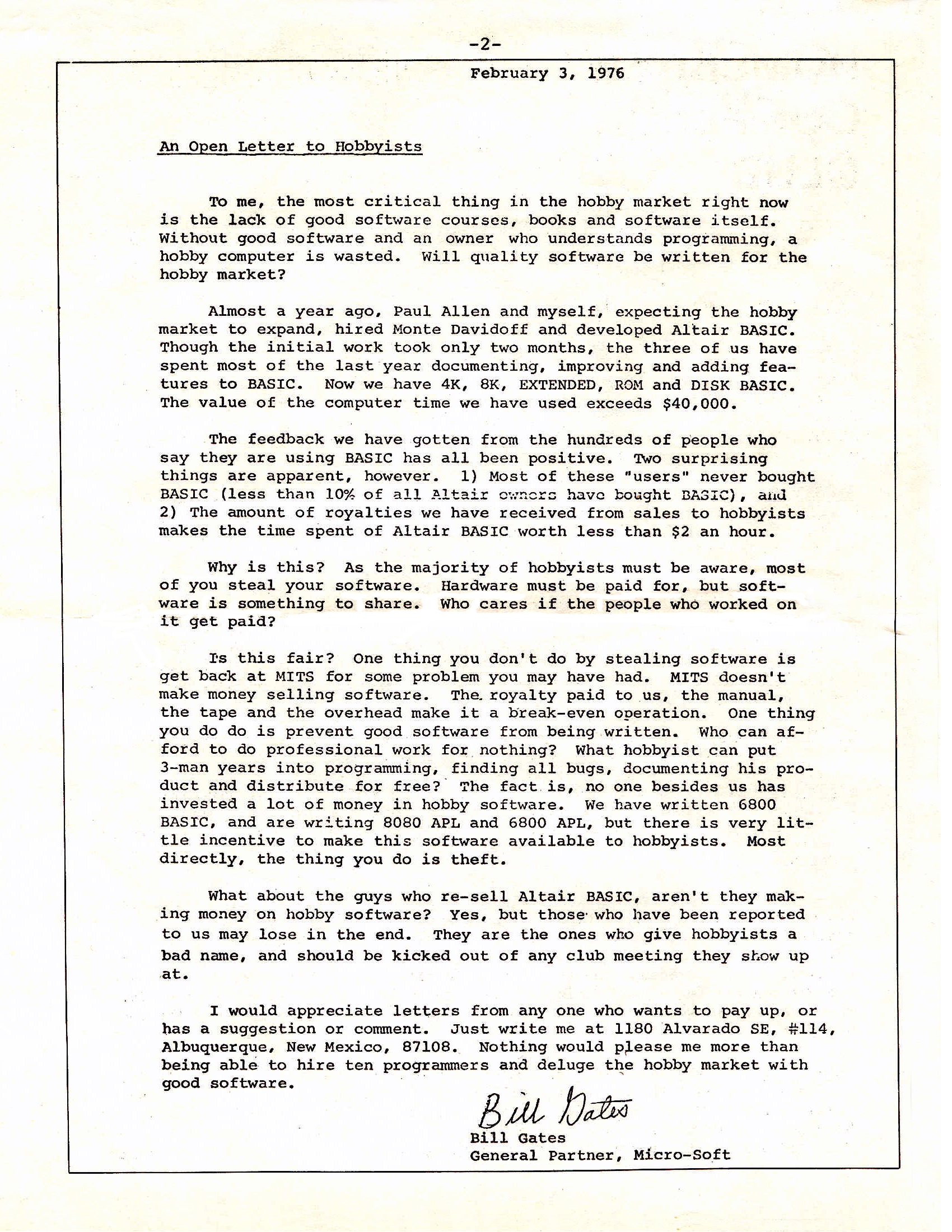
Microsoft’s first product was a version of the BASIC programming language for the machine. Much to Gates’ chagrin, though, people weren’t paying for it. Instead, they shared copies of it with each other for free.

So in February 1976 he wrote an open letter to the Homebrew Computer Club titled “An Open Letter to Hobbyists.” It was a declaration of war on those he saw as thieves, and laid the operating principles that would later grow his company (then called Micro-Soft) into a behemoth.  Gates wrote, in part:

“The amount of royalties we have received from sales to hobbyists makes the time spent on Altair BASIC worth less than $2 an hour.

“As the majority of hobbyists must be aware, most of you steal your software…. Who cares if the people who work on it get paid?

“Who can afford to do professional work for nothing? What hobbyist can put 3 man- years into programming, finding all bugs, documenting his product and distribute for free?…Most directly, the thing you do is theft.”

So much for the share-and-share-alike ethos of the 1960s. The letter worked. After it, Microsoft had a solid cash flow.

Microsoft hits big with MS-DOS

For its first few years, Microsoft continued to write and sell programming languages for personal computers. It was a profitable niche. But that’s all it was…a niche, and a small one at that. Gates had bigger things in mind.

The company’s first big breakthrough came in 1981 when he convinced IBM to pay Microsoft $430,000 to develop an operating system and provide other services for its still-secret, yet-to-be released new PC. IBM thought it was getting a great deal — it had expected to pay even more. But Gates outsmarted Big Blue. He negotiated terms that allowed Microsoft to sell the same operating system to other personal computer makers. (Microsoft called IBM’s operating system DOS and its own compatible operating system MS-DOS.) 

So-called “clones” of the IBM PC flooded the market, and Microsoft got a royalty for every one of them sold because they all needed an operating system compatible with IBM’s PC. The company soon was rolling in money.

Microsoft didn’t have to spend much time or money developing DOS and MS-DOS. It paid $50,000 to a company for an existing operating system called QDOS (short for “quick-and-dirty operating system”) and tweaked it to run on IBM’s PC and clones.

Windows 3.0 and 3.1 rule the world

To run MS-DOS and DOS you had to use a command line, which was no one’s idea of a good time and not particularly easy to do. While IBM PCs and clones were stuck in the old world, Apple was creating a new one with its graphically based operating system for the Lisa computer in 1983, and then the groundbreaking Macintosh operating system in 1984. It became clear graphical OSes were the future, and Microsoft eventually released its first version of one, Windows, in 1985. But it didn’t run as an operating system; instead, it ran as an application inside DOS. The same was true for Windows 2.0. 

Neither version of Windows went anywhere fast.

Then, in 1990 Microsoft released Windows 3.0 and two years later, the improved version called Windows 3.1. The operating systems were far easier to use than MS-DOS. But they were also inelegant and awkward, kludgy, crashed far too often and at times were head-scratchingly confusing to use. But they were good enough to replace MS-DOS as the standard for PCs, and they cemented Microsoft’s worldwide monopoly over operating systems. 

They might not have been pretty, easy-to-use or reliable, but they accomplished their primary purpose: printing cash by the billions for Microsoft.

Microsoft aims for its next target, businesses

By the late 1980s, it was clear the PC revolution that had begun in the 1970s for hobbyists had gone big-time in the business world. Microsoft went after the market with a vengeance, launching Office in 1990. It included not just a software suite (Word, Excel and PowerPoint), but server software as well. Gates swept away the competition with shark-like tactics, some of which were found to violate antitrust laws.  

Microsoft followed suit with countless other business services and software, including SQL Server, Power BI, Dynamics 365, Power Platform and many more. Microsoft soon owned the enterprise market.

Satya Nadella replaces Steve Ballmer as CEO

In 2000, Steve Ballmer replaced Gates as CEO. Under his hard-charging, sometimes clownish leadership that focused obsessively on Windows to the detriment of other products and technologies, Microsoft slowly drifted into irrelevance. It missed out on the mobile revolution and became an also-ran in the internet and social media. Ballmer tried to solve most problems with the bluster and business tactics that did well in the 1970s through 2000, but failed miserably in the 21st century.

Bill gates y Steve Ballmer, Microsoft

Bill Gates and Steve Ballmer during a meeting in the ’90s.

Microsoft

He lasted until 2014, when Satya Nadella took over. Many people’s first reaction to the choice was “Who?” Nadella didn’t brag and shout like Ballmer or swagger and resort to illegal tactics like Gates. Instead, with a calm demeanor, he dragged the company into the new century, killing flailing multi-billion-dollar projects like Windows Mobile, turning the company into a smooth operation rather than a series of warring fiefdoms, and pouring billions into new technologies that would eventually make Microsoft a tech leader again.

Nadella turns to the cloud 

Microsoft launched Azure, its cloud platform, under Ballmer in 2010. But it took Nadella to see its importance. He refocused the company away from Windows and towards the cloud. By 2024, its Intelligent Cloud division tallied $100 billion in sales. But that vastly understates how much cloud-related revenue the company brings in, because software and services like Office (now called Microsoft 365) have become cloud services as well.

Satya Nadella Microsoft Build

Satya Nadella addresses the Microsoft Build event in Seattle on May 21, 2024.

Dan DeLong / Microsoft

In essence, Microsoft became a cloud company.

Microsoft bets big on AI

Six years ago, Microsoft made what was at the time something of an under-the-radar investment: $1 billion into the startup OpenAI. Few people took notice. Three years later, in November 2022, OpenAI’s ChatGPT took the world by storm — thanks in part to $12 billion more in Microsoft investments. A year after that, Microsoft released its own version of ChatGPT, called Copilot, for enterprises. 

Now, Copilot is integrated into virtually every part of the company, and Microsoft is building its own AI team and products separate from OpenAI. It’s become the world leader in AI, with no end in sight — a solid starting point for the company’s next 50 years.

I made a better way to scroll in Windows. Here’s the script.

I’ve got a better way to scroll on Windows — especially on large monitors. This instantly boosted my productivity and fixed a major annoyance I had with Windows 11. And you can try it yourself in just a few seconds.

This isn’t just a typical tech article about Windows. This is one that offers a better way to use Windows. It’s not an existing tool that you will find elsewhere, in other words — it’s a new way to use the Windows desktop you can install right now, written just for this column.

I’ll be honest: I made this script for me, first and foremost. I’ll be using this script for years to come. But I think it’s amazing, and I hope you’ll get use out of it, too.

Want more Windows PC tweaks? Check out my free Windows Intelligence newsletter. I’ll send you free in-depth Windows Field Guides (a $10 value) as a special welcome bonus!

Why scrolling on Windows 11 is so annoying

Here’s the issue: Windows 11’s scrolling system is pretty bad. Microsoft shrunk the scroll bars from past Windows versions. The larger your monitor, the more annoying those tiny scroll bars are. If you move your mouse cursor to the right edge of the screen, you’re grabbing the window border — not the tiny scroll bar. You have to carefully position your mouse cursor over those little scroll bars.

And sure, you could simply spin the wheel on your mouse instead, but that’s too slow for scrolling longer distances. You could middle-click and move the mouse, too, but that feels awkward. Or you could aim at those scroll bars and wonder why the targets are so small.

While thinking over how annoying this all is, I realized the way the scroll wheel should work. And so I built a script.

Meet ‘Grab to Scroll,’ a transformative AutoHotkey script

The result is an incredibly simple script for AutoHotkey, a free Windows automation framework. It’s called Grab to Scroll. You can download it here.

You’ll just need to install the core AutoHotkey 2.0 program first; you then double-click the script to run it. That’s all.

Here’s how it works:

  • Position your mouse cursor anywhere over a window — Chrome, Slack, Excel, or any open program.
  • Click and hold the middle mouse button. (That’s usually the mouse wheel itself.)
  • Move the mouse up, down, left, or right — not the scroll wheel, but the mouse itself.
  • The script translates your mouse movements into quick, precise scrolling.
  • Release the middle mouse button when you’re done.

That’s a lot of words to describe something so simple that it immediately feels like how mice should work in Windows in the first place.

srcset="https://b2b-contenthub.com/wp-content/uploads/2025/04/Grab-to-Scroll-animation.webp?quality=50&strip=all 800w, https://b2b-contenthub.com/wp-content/uploads/2025/04/Grab-to-Scroll-animation.webp?resize=300%2C210&quality=50&strip=all 300w, https://b2b-contenthub.com/wp-content/uploads/2025/04/Grab-to-Scroll-animation.webp?resize=768%2C538&quality=50&strip=all 768w, https://b2b-contenthub.com/wp-content/uploads/2025/04/Grab-to-Scroll-animation.webp?resize=240%2C168&quality=50&strip=all 240w, https://b2b-contenthub.com/wp-content/uploads/2025/04/Grab-to-Scroll-animation.webp?resize=120%2C84&quality=50&strip=all 120w, https://b2b-contenthub.com/wp-content/uploads/2025/04/Grab-to-Scroll-animation.webp?resize=686%2C480&quality=50&strip=all 686w, https://b2b-contenthub.com/wp-content/uploads/2025/04/Grab-to-Scroll-animation.webp?resize=514%2C360&quality=50&strip=all 514w, https://b2b-contenthub.com/wp-content/uploads/2025/04/Grab-to-Scroll-animation.webp?resize=357%2C250&quality=50&strip=all 357w" width="800" height="560" sizes="(max-width: 800px) 100vw, 800px">
Here’s how Grab to Scroll looks in action — but it’s a lot smoother, of course.

Chris Hoffman, IDG

Because of how this works, the script takes over your middle-mouse button. That means middle-clicking won’t work in the usual way while it’s running. I’ve built in a bypass: When you hold down the Ctrl key and middle-click, the script will send a normal middle-click action. That way, you can hold Ctrl and middle-click to close browser tabs, for example.

Want to stop using it altogether? Just locate the green AutoHotkey icon in your system tray, right-click it, and select “Exit.”

srcset="https://b2b-contenthub.com/wp-content/uploads/2025/04/AutoHotkey-in-system-tray.png?quality=50&strip=all 800w, https://b2b-contenthub.com/wp-content/uploads/2025/04/AutoHotkey-in-system-tray.png?resize=300%2C127&quality=50&strip=all 300w, https://b2b-contenthub.com/wp-content/uploads/2025/04/AutoHotkey-in-system-tray.png?resize=768%2C325&quality=50&strip=all 768w, https://b2b-contenthub.com/wp-content/uploads/2025/04/AutoHotkey-in-system-tray.png?resize=150%2C64&quality=50&strip=all 150w, https://b2b-contenthub.com/wp-content/uploads/2025/04/AutoHotkey-in-system-tray.png?resize=640%2C271&quality=50&strip=all 640w, https://b2b-contenthub.com/wp-content/uploads/2025/04/AutoHotkey-in-system-tray.png?resize=444%2C188&quality=50&strip=all 444w" width="800" height="339" sizes="(max-width: 800px) 100vw, 800px">
To stop running the script, close AutoHotkey from your system tray.

Chris Hoffman, IDG

I’ve built in a few preferences you can fine tune, if you like — just in case the scrolling feels too fast or slow with your particular PC and mouse.

It’s pretty self-explanatory: You just need to change the numbers on a few lines and save the script file. It includes comments that explain how to tweak it. You can use Notepad, Notepad++, or your text editor of choice to change its settings. (Then, be sure to right-click the green AutoHotkey icon in your system tray and select “Reload Script.)

The joy of ‘vibe-coding’

I could have written this myself if I put serious time into it. But I didn’t. I used generative AI (genAI).

The reality is that I’m a writer, not a programmer. I wrote every single word in this article myself. But I didn’t write the script by hand.

Given some time, I probably could have taught myself how to put this script together. But I didn’t have to do that.

Instead, I “vibe-coded” this Grab to Scroll script. That’s a new term for describing a problem you have and a solution you want and having an genAI tool put together the code for you. It wasn’t a one-shot solution: The tool got it wrong at first, and there was some back and forth. 

The critical insight was knowing how I wanted scrolling on Windows to work. That was all me, not genAI. I came up with a vision — one so convenient that it seems obvious to me in retrospect. But with genAI handling the grunt work, I was able to quickly throw together a script that works so shockingly well I’m writing it up for Computerworld the same day.

The entire process — from “Windows 11’s scrolling sure is annoying on a big monitor, how can I fix this?” to a working script that transforms scrolling everywhere in Windows and implements a vision that came from my own brain — took less than an hour. And now I’m sharing it with you.

The cool thing isn’t just this script. It’s that you can also now tweak it to work in whatever way you want. You can take the script I created to a chatbot like ChatGPT, copy-paste it in, and ask for your own custom changes. You can follow this same sort of process to develop another script that makes Windows work the way you want it to, even if you’re not a programmer.

To me, “vibe-coding” is a bit of a stretch at the moment — especially if you don’t have prior programming experience. But “vibe-scripting” — throwing together lightweight problem-solving solutions like this? That’s well within reach.

At my previous home, How-To Geek, we used to share AutoHotkey scripts — simple little things that disabled the Caps Lock key, for example. Now you can build that type of thing — whatever you like — with plain English. No digging through documentation necessary!

In short, if you’re annoyed about something in Windows, you might be able to fix it yourself with a similar process.

AI’s brain-augmenting abilities

This is two articles in one, but they’re the same article. Grab to Scroll is an awesome script that I will be using for years to come. And it’s one I hope other people will love, too. I hope people copy it and this type of thing spreads far and wide.

But, again, I used genAI to make it all happen. That matters because it shows what’s possible when you think about genAI the right way. You can use these tools as an accelerator for your brain. You can test an idea in seconds when it normally would have taken hours of research to find out just how to write the script.

Sure, you can use AI to shut off your brain and avoid thinking entirely, for better or worse. But you can also use it to accelerate your brain — to be more creative, to get more done, to test and explore more things. Grab to Scroll is just one example of what’s now within your reach.

The way genAI tools are advertised is often boring — another email summarizer, another customer service chatbot that isn’t particularly helpful, and so on. But you can use the tools to do so much more.

To get started, revisit our previous discussion around the secret to using generative AI effectively. But also, I hope you enjoy Grab to Scroll. Scrolling now feels so much better on my big monitor! And of course it does: I custom-designed the ideal solution that works specifically for me.

There’s more where this came from! Sign up for my free Windows Intelligence newsletter, and I’ll send you three new things to try each Friday. Plus, you’ll get free copies of Paul Thurrott’s Windows Field Guides as a welcome gift.

A handy new Android memory superpower

Tell me if this sounds familiar: You stumble onto something scintillating during your various digital dalliances — something you think might be a useful nugget of knowledge for work or maybe even a pertinent update for your personal life.

Maybe it’s in an article you encounter somewhere online — in your browser, in a news app of some sort, in your Google Discover feed. Maybe it’s something someone mentioned to you in Slack or in Google Messages. Maybe it’s something someone emailed you or posted onto LinkedIn. With all the places we all bounce between these days, who the hell can remember?

And there’s the rub: When that moment arises that your battered ol’ butter-brain comes back to the thing in question, you inevitably won’t remember where exactly you saw it — or what exactly it was called, for that matter. You’ll dance from app to app trying to retrace your steps and rediscover where and how you’d encountered whatever it was that’s on your tip of your amygdala but not quite coming through. And no matter where you look or what words you search for, somehow, the right thing never seems to resurface.

We’ve all been there — some of us more than others (insert awkwardly self-aware eye-darting here). So what if there were some sort of magic-seeming system that’d quietly observe all our online wanderings, take private notes about everything we’re seeing, and make it impossibly easy to retrace those steps and find anything we encountered along the way, no matter where it was or in what context we first saw it?

My friend and fellow mushy-brained mammal, have I got just the treat for you.

[Hey — want even more advanced Android knowledge? Check out my free Android Shortcut Supercourse to learn tons of time-saving tricks for your phone.]

Your Android recall advantage

Oh ye Android-appreciating animal, allow me to introduce you to a crafty little creation called Snapseek.

Snapseek is a simple Android app that’s similar on the surface to Microsoft’s eternally under-development Windows Recall feature — only as an optional external add-on, the privacy worries surrounding it seems far less pronounced (and the app provides plenty of assurances about how it protects you, too).

In short, Snapseek runs quietly in the background of your favorite Android device and works to capture frequent behind-the-scenes screenshots of everything you’re doing, in whichever apps you select for it to follow. Each screenshot gets saved only locally, on your device and within the app itself, with on-the-fly optical character recognition to process all the visible words and make ’em easily searchable later.

The result is a virtual breadcrumb trail of all your online meanderings in whichever areas you authorize. You can browse through that history anytime — or, in the especially useful memory advantage, you can simply search for any word imaginable and see an instant list of every screen you interacted with where that specific term appeared.

Android memory: Snapseek recall search
Snapseek lets you search through all of your Android activity in any apps where it’s active.

JR Raphael, Foundry

Critically, Snapseek looks only at apps that you ask it to monitor — something you select when you first set up the app and can easily adjust later.

Android memory: Snapseek recall apps
It’s up to you to decide exactly which apps Snapseek watches and makes available for future searching.

JR Raphael, Foundry

Out of the box, the free version of Snapseek lets you select up to two apps for ongoing following. And it’s perfectly functional for those two apps, with no other asterisks or limitations.

If you want to be able to create memory trails for more than two apps, you’ll have to make a one-time $4 upgrade to the app’s pro version. That’s it — just the one-time $4 charge, with no subscriptions or ongoing payments.

Android memory: Snapseek upgrade
An optional $4 upgrade unlocks Snapseek’s two-app limitation.

JR Raphael, Foundry

To emphasize a key factor here: Snapseek stores all of its data only locally on your own device. It doesn’t collect any manner of private info or share any personal data in any way. There are no ads or trackers involved in the app. You can require biometric authentication to protect your history from prying eyes, and you can tell Snapseek to automatically delete all of the screenshots it saves every seven, 14, 30, or 90 days, if you don’t want your history to stick around forever.

It’s an interesting way to enhance your memory and give yourself a sleek, swift, ‘n’ simple new searching superpower — one that’s bound to be a lifesaver the next time you know you saw something significant but can’t for the life of you remember where or what it was.

Erm, right. What were we talking about, again?

Get six full days of advanced Android knowledge with my free Android Shortcut Supercourse. You’ll learn tons of time-saving tricks for your phone!

Agentic AI – Ongoing coverage of its impact on the enterprise

Over the next few years, agentic AI is expected to bring not only rapid technological breakthroughs, but a societal transformation, redefining how we live, work and interact with the world. And this shift is happening quickly. “By 2028, 33% of enterprise software applications will include agentic AI, up from less than 1% in 2024, enabling 15% of day-to-day work decisions to be made autonomously,” according to research firm Gartner.

Unlike traditional AI, which typically follows preset rules or algorithms, agentic AI adapts to new situations, learns from experiences, and operates independently to pursue goals without human intervention. In short, agentic AI empowers systems to act autonomously, making decisions and executing tasks — even communicating directly with other AI agents — with little or no human involvement.

Agentic AI will enable machines to interact with the physical world with unprecedented intelligence, allowing them to perform complex tasks in dynamic environments, which could be especially useful for industries facing labor shortages or hazardous conditions.However, the rise of agentic AI also brings security and ethical concerns. Ensuring these autonomous systems operate safely, transparently and responsibly will require governance frameworks and testing.

Follow this page for ongoing agentic AI coverage from Computerworld and Foundry’s other publications.

Agentic AI news and insights

AI agents aren’t failing. The coordination layer is failing

April 10, 2026: Our multi-agent AI system was impressive in demos. One agent handled customer inquiries. Another managed scheduling. A third processed documents. Each worked beautifully in isolation. In production, AI agents fought each other. 

Microsoft’s new Agent Governance Toolkit targets top OWASP risks for AI agents

April 8, 2026: Microsoft has quietly introduced the Agent Governance Toolkit, an open source project designed to monitor and control AI agents during execution as enterprises try, and move them into production workflows.

Multi-agent AI is the new microservices

April 6, 2026: Our current infatuation with multi-agent systems risks mistaking a useful pattern for an inevitable future, just as we once did with microservices. Remember those? 

Without controls, an AI agent can cost more than an employee

April 3, 2026:  Long-time tech investor Jason Calacanis noted that agent costs quickly rose to $300 a day while using the Claude API at one of his organizations. At the same time, these $100,000-a-year agents were replacing a fraction of an employee’s work.

4 agentic AI success stories

April 2, 2026: Organizations are leveraging agentic AI for everything from managing customer inquiries to automating logistics, optimizing workflows, detecting fraud, and generating and testing code.

Asana’s chief product officer: Why enterprise AI agents should be ‘multiplayer by design’

April 1, 2026: As AI agents become more embedded in workplace tools, Asana is positioning its approach around collaboration rather than individual productivity.

The one-model trap: Why agentic AI won’t scale in production

March 26, 2026: Production agents don’t fail because the model is “bad.” Agentic AI fails because the operating environment is messy: requests change shape, latency budgets conflict, tools flake out, costs spike, policy constraints shift and failure modes compound.

Oracle bets on agentic apps in Fusion suite to ‘fully’ automate business processes

March 24, 2026: Oracle is recasting its Fusion Cloud Applications suite as something that not just flags insights for humans to act on. The debut of Fusion Agentic Applications, an upgraded set of applications that embeds AI agents directly into transactional business workflows, is designed to make decisions without human intervention.

Cisco goes all in on agentic AI security

March 26, 2026: Cisco is rolling out identity and access management capabilities, a toolkit customers can use to embed security controls in AI agents, and automation features that will allow security operations teams to quickly see and respond to problems.

AI agents still need humans to teach them

February 20, 2026: AI agents need skills — specific procedural knowledge — to perform tasks well, but they can’t teach themselves, a new research suggests.

Why most agentic AI projects stall before they scale

February 18, 2026: As enterprises race from pilots to autonomous systems, rising costs, fragile governance, and unrealistic expectations are forcing a reckoning. So what separates agentic AI initiatives that survive from those that quietly shut down?

How agentic AI helps prospective and existing students at DeVry

February 18, 2026: DeVry is no stranger to AI. It’s used the technology in its classrooms for 10 years and started experimenting with NLP bots and gen AI use cases for internal use as soon as it became widely available. So in April 2025, Devry University deployed its first AI agent.

Task management software gets an agentic boost

February 11, 2026: Task management apps aren’t just for storing and tracking data — they act on it. Explore tools that tap AI to auto-generate workflows, balance team capacity, and eliminate administrative overhead.

OpenClaw: The AI agent that’s got humans taking orders from bots

February 6, 2026: How one man’s vibe-coding session evolved into a reckless global AI experiment where nobody’s accountable.

Forward Networks launches agentic AI system built on network digital twin

January 30, 2026: The new Forward AI capability builds on the vendor’s digital twin and is designed to allow network teams to ask complex questions, understand network behavior, validate outcomes and safely automate workflows.

Agentic AI exposes what we’re doing wrong

January 23, 2026: Agentic AI has changed cloud computing, but not in the way the hype machine wants you to believe. It hasn’t magically replaced engineering, nor has it made architecture irrelevant. 

How to get your enterprise architecture ready for agentic AI

January 22, 2026: While C-suite leaders say they’re investing in agentic AI, the complex enterprise architectures of large organizations often struggle with the tech’s demands.

IBM targets agentic AI scale-up with new Enterprise Advantage consulting service

January 20, 2026: IBM has launched a new consulting service named Enterprise Advantage, designed to help CIOs take their agentic and other AI applications from experimentation to large-scale production.

EY exec: If you think agentic AI is a challenge, you’re not ready for what’s coming

January 15, 2026: Companies struggling to keep up with the arrival of AI agents should buckle up: Even more complicated agentic AI technologies are quickly coming down the pike. That includes physical AI, which includes robots and quantum computing.

Managing agentic AI risk: Lessons from the OWASP Top 10

December 19, 2025: LLM-powered chatbots have risks that we see playing out in the headlines on a nearly daily basis. But chatbots are limited to answering questions. AI agents, however, access data and tools and carry out tasks, making them infinitely more capable – and more dangerous to enterprises.

Agentic AI in 2026: More mixed than mainstream

December 18, 2025: Agentic AI is having its everything, everywhere, all at once moment. Or is it? Data clarifies. While 39% of organizations surveyed by McKinsey say they are experimenting with agents, only 23% have begun scaling AI agents within one business function

Overcome governance and trust issues to drive agentic AI

December 18, 2025: Fully autonomous agentic AI is still way off but AI agents are making inroads within enterprise software and workflows. Gartner predicts 40% of enterprise software will feature task-specific AI agents by the end of 2026 as the current trend for embedded AI assistants evolves.

Nvidia bets on open infrastructure for the agentic AI era with Nemotron 3

Decenber 15, 2025: AI agents must be able to cooperate, coordinate, and execute across large contexts and long time periods, and this, says Nvidia, demands a new type of infrastructure, one that is open. The company says it has the answer with its new Nemotron 3 family of open models.

Microsoft drops M365 Copilot price for SMBs, upgrades free Copilot Chat

November 19, 2025: Microsoft announced that it reduce the price of Microsoft 365 Copilot for small and mid-sized firms beginning next month. Microsoft 365 Copilot for Business will cost $21 per user, per month for customers with any Microsoft 365 Business plan. That’s down from the current $30 monthly price.

Microsoft Fabric IQ adds ‘semantic intelligence’ layer to Fabric

November 19, 2025: Microsoft promises enterprises better understanding of their data for workers and autonomous agents alike, but analysts fear deployment hurdles and vendor lock-in.

Microsoft unveils Agent 365 to help IT manage AI ‘agent sprawl’

November 18, 2025: As businesses begin deploying AI agents in greater numbers, IT teams will need to manage and secure those AI systems as they connect to corporate data. That’s the idea behind Microsoft’s Agent 365 (A365), a new “control plane” that lets customers deploy and govern the use of agents. 

From chatbots to colleagues: How agentic AI is redefining enterprise automation

November 17, 2025: A new wave of agentic AI is taking shape: systems that not only converse but also reason, plan, and act within enterprise workflows. These agents are not assistants that talk; they are digital colleagues that think.

The enterprise IT overhaul: Architecting your stack for the agentic AI era

November 10, 2025: For the CIO, the conversation has officially moved past the large language model (LLM). The next critical chapter is agentic AI — autonomous systems capable of reasoning, planning and executing multi-step tasks across your enterprise. Agentic AI is here. Now, CIOs must orchestrate

October 23, 2025: Agentic AI is about to change how companies create value. Yet, most enterprises aren’t ready. The problem isn’t the technology — it’s the planning and execution. Too many pilots stall out because CIOs haven’t built the AI systems, guardrails and culture to move beyond experiments.

AI agents might smooth some of retail’s worst data problems

October 21, 2025: So many retail challenges hinge on unreliable product data. Can agentic AI clean up that data enough to make a difference? Can it do the same for other verticals?

The impact of agentic AI on SaaS and partner ecosystems

October 16, 2025: The enterprise technology landscape is entering a critical pivot point as agentic AI transforms partner ecosystems from human-mediated, application integration networks into autonomous, self-orchestrating and intelligent ecosystems.

Salesforce updates its agentic AI pitch with Agentforce 360

October 13 2025: Salesforce announced a new release of Agentforce that, it says, “gives teams the fastest path from AI prototypes to production-scale agents” — although with many of the new release’s features still to come, or yet to enter pilot phases or beta testing, some parts of that path will be much slower than others.

Gemini Enterprise is Google’s new ‘front door’ for agentic AI access at work

October 9, 2025: Google introduced an AI assistant to serve as a platform so users can access and coordinate AI agents that automate work tasks. Gemini Enterprise, which replaces the Agentspace app launched last year, also features new enterprise search functions to help customers tap into data from across an organization’s business apps. 

Oracle’s agentic AI push in Fusion Cloud CX offers embedded automation for CX leaders

October 7, 2025: Oracle is adding new pre-built agents to its Advertising and Customer Experience Cloud (Fusion Cloud CX) to help enterprises increase operational efficiency by automating sales, service, and marketing processes.

IBM touts agentic AI orchestration, cryptographic risk controls

October 7, 2025: IBM watsonx Orchestrate offers more than 500 tools and customizable, domain-specific agents from IBM and third-party contributors. Among the additions to watsonx Orchestrate are AgentOps capabilities that offer real-time monitoring and policy-based controls for observability and governance.

How self-learning AI agents will reshape operational workflows

October 6, 2025: Google’s recent whitepaper, “Welcome to the Era of Experience,” signals a shift in the way AI agents are trained. Google hypothesizes that allowing AI agents to learn from the experience of agents rather than solely from human-generated training data will enable autonomous AI to surpass its current capabilities.

Are your agentic AI projects driving toward success?

October 3, 2025: Anushree Verma, Gartner senior director analyst, says most agentic AI projects today are early-stage experiments or proofs of concept, fueled primarily by hype and often misapplied.

Microsoft unveils framework for building agentic AI apps

October 3. 2025: Microsoft has introduced the Microsoft Agent Framework, an open-source SDK and runtime for building, orchestrating, and deploying AI agents and multi-agent workflows, with full framework support for .NET and Python.

Salesforce Trusted AI Foundation seeks to power the agentic enterprise

October 2, 2025: As Salesforce pushes further into agentic AI, its aim is to evolve Salesforce Platform from an application for building AI to a foundational operating system for enterprise AI ecosystems. 

ServiceNow’s AI Experience is an agentic AI UI for the Now Platform

September 30, 2025: ServiceNow today launched the AI Experience (AIx), a contextually aware multimodal AI-driven use UI for its Now platform. Building on the ServiceNow AI Platform and with a foundation in Now Assist, the company describes it as “a unified, conversational front door to enterprise AI.”

How MCP is making AI agents actually do things in the real world

September 29, 2025: You’ve seen them: Those incredible large language models (LLMs) that can chat, write and even generate code. They’ve revolutionized how we interact with technology, but there’s a new, even more exciting chapter unfolding. Discover how MCP is turning chatbots into doers, and the future of work may never look the same.

Agentic AI in IT security: Where expectations meet reality

September 29, 2025: Agentic AI has shifted from lab demos to real-world SOC deployments. Unlike traditional automation scripts, software agents are designed to act on signals and execute security workflows intelligently, correlating logs, enriching alerts, and even take first-line containment actions.

Walmart looks to cash in on agentic AI

September 19, 2025: Walmart doesn’t intend to lose its retail crown anytime soon. And, according to US EVP and CTO Hari Vasudev, the $815B company’s artificial intelligence strategy will play a key role in preventing that from happening.

5 steps for deploying agentic AI red teaming

September 17, 2025: As more enterprises deploy agentic AI applications, the potential attack surface increases in complexity and reach. But there is still hope that AI agents can be harnessed for defensive purposes too, including using traditional red teaming and penetration testing techniques but updated for the AI world.

Google unveils payments protocol for AI agents with major financial firms

September 17. 2025: Google has introduced the Agent Payments Protocol (AP2), an open framework developed with more than 60 payments and technology companies to support secure, agent-led transactions across platforms and payment methods.

CrowdStrike bets big on agentic AI with new offerings after $290M Onum buy

September 16, 2025: At its Fal.Con conference, the cybersecurity giant launched its Agentic Security Platform and Agentic Security Workforce, aiming to outpace AI-driven adversaries with real-time intelligence, automation, and a common language for defense.

Adobe makes Agent Orchestrator and AI agents generally available

September 10, 2025: Adobe Experience Platform (AEP) Agent Orchestrator and six new AI agents are designed to build, deliver, and optimize customer experience and marketing campaigns. The company also announced Experience Platform Agent Composer for customizing and configuring AI agents based on brand guidelines and organizational policy.

Rethinking the IT organization for the agentic AI era

September 2, 2025: With the advent of agentic AI, CIOs must be poised to adjust strategic IT priorities, mitigate new security risks, and reskill staff for a new era.

How to build a production-grade agentic AI platform

September 2, 2025: Modular orchestration, fail-safe design, hybrid memory management, and LLM integration with domain knowledge are essential to agentic AI systems that reason, act, and adapt at scale.

Agentic AI: A CISO’s security nightmare in the making?

September 2, 2025: Enterprises will no doubt be using agentic AI for a growing number of workflows and processes, including software development, customer support automation, and more. But what are the cybersecurity risks of agentic AI, and how much more work will it take for them to support their organizations’ agentic AI dreams?

Microsoft researchers develop new tech for video AI agents

September 2, 2025: Microsoft researchers are developing technologies for a new class of video AI agents to explore three-dimensional spaces before making decisions.The technology framework, called MindJourney, uses a range of AI technologies to understand and analyze 3D spaces, reason about the surroundings, and predict movement

Salesforce AI Research unveils new tools for AI agents

August 27, 2025: Salesforce announced a simulated enterprise environment, benchmark, and account data unification tool that are designed to help customers transform into agentic AI enterprises.

Agentic AI promises a cybersecurity revolution — with asterisks

August 18, 2025: The hottest topic at this year’s Black Hat conference was the meteoric emergence of AI tools for both cyber adversaries and defenders, particularly the use of agentic AI to strengthen cybersecurity programs.

4 thoughts on who should manage AI agents

August 11, 2025: As AI agents proliferate, we need to turn our attention beyond AI agent builder platforms to AI orchestration and AI GRC platforms. It also raises questions about which groups within the enterprise should manage AI agents and how they should be treated.

How bright are AI agents? Not very, recent reports suggest

July 31, 2025: Security researchers are adding more weight to a truth that infosec pros had already grasped: AI agents are not very bright, and are easily tricked into doing stupid or dangerous things

Will AI agents eat the SaaS market? Experts are split

July 31,2025: As hype about AI agents reaches new heights, an emerging theory suggests that the groundbreaking AI tools will kill the SaaS business model. The claim isn’t particularly new, but is resurfacing, with people like Microsoft CEO Satya Nadella voicing this position. 

How agentic AI will change database management

July 28, 2025: Generative AI has already had a profound impact on the world of database management. And now, thanks to AI’s knack for pattern-recognition, teams can use generative AI to analyze data sets, detect anomalies, and access invaluable insights with record speed and precision. 

As AI agents go mainstream, companies lean into confidential computing for data security

July 21, 2025: Companies need to stop ignoring data security as AI agents take over internal data movement in IT environments, analysts and IT execs warn. To address that issue, some tech players are embracing the concept of “confidential computing.” While it’s existed for years, it;s now finding new life with the rise of genAI.

How agentic AI will transform mobile apps and field operations

July 15, 2015: Agentic AI will usher in new mobile AI experiences. Construction, manufacturing, healthcare, and other industries with significant field operations will benefit from mobile AI agents and the resulting operational agility. 

MCP is fueling agentic AI — and introducing new security risks

July 10, 2025: Model Context Protocol (MCP) has caught fire, with several thousand MCP servers now available from a wide range of vendors enabling AI assistants to connect to their data and services. And with agentic AI increasingly seen as the future of IT, MCP will only grow in use in the enterprise. But innovations like MCP also come with significant security risks.

3 industries where agentic AI is poised to make its mark

July 4, 2024:  IT leaders from finance, retail, and healthcare lend insights into what organizations are doing with AI agents today — and where they see the technology taking their organizations and industries in the future.

IFS rolls TheLoops agentic AI into industrial ERP

June 27, 2025: IFS is adding AI agent development and management capabilities to its ERP platform with the acquisition of software startup The acquisition brings TheLoops’ full Agent Development life cycle (ADLC) platform into IFS, enabling enterprises to design, test, deploy, monitor, and fine-tune AI agents with built-in support for versioning, compliance, and performance optimization.

How AI agents and agentic AI differ from each other

June 12, 2025: With agentic AI in its infancy and organizations rushing to adopt AI agents, there seems to be confusion about the difference between “agentic AI” and “AI agents” technologies, but experts say there’s growing understanding that the two are separate, but related, tools.

The future of RPA ties to AI agents

June 10, 2025: RPA is accelerating toward a crossroads, with IT leaders and experts debating its future. Some IT leaders say that more powerful and autonomous AI agents will replace the two-decade-old AI precursor technology, while others predict that AI agents and RPA will work hand-in-hand.

MCP is enabling agentic AI, but how secure is it?

June 2, 2025: Model context protocol (MCP) is becoming the plug-and-play standard for agentic AI apps to pull in data in real time from multiple sources. However, this also makes it more attractive for malicious actors looking to exploit weaknesses in how MCP has been deployed. 

The agentic AI assist Stanford University cancer care staff needed

May 30, 2025: At Microsoft Build 2025 earlier this month, Nigam Shah, CDO for Stanford Health Care, discussed agentic AI’s ability to redefine healthcare, especially in oncology, as physicians get overloaded with the administrative tasks of medicine, he said, which lead to burnout.

Agentic AI, LLMs and standards big focus of Red Hat Summit

May 26, 2025: Red Hat, announced a number of improvements in its core enterprise Linux product, including better security, better support for containers, better support for edge devices. But the one topic that dominated the conversation was AI.

Putting agentic AI to work in Firebase Studio

May 21, 2025: Putting agentic AI to work in software engineering can be done in a variety of ways. Some agents work independently of the developer’s environment, working essentially like a remote developer. Other agents directly within a developer’s own environment. Google’s Firebase Studio is an example of the latter, drawing on Google’s Gemini LLM o help developers prototype and build applications .

Why is Microsoft offering to turn websites into AI apps with NLWeb?

May 20. 2025: NLWeb, short for Natural Language Web, is designed to help enterprises build a natural language interface for their websites using the model of their choice and data to answer user queries about the contents of the website. Microsoft hopes to stake its claim on the agentic web before rivals Google and Amazon do.

Databricks to acquire open-source database startup Neon to build the next wave of AI agents

May 14, 2025: Agentic AI requires a new type of architecture because traditional workflows create gridlock, dragging down speed and performance. To get ahead in this next generation of app building, Databricks announced it will purchase Neon, an open-source serverless Postgres company.

Agentic mesh: The future of enterprise agent ecosystems

May 13, 2025: Nvidia CEO Jensen Huang predicts we’ll soon see “a couple of hundred million digital agents” inside the enterprise. Microsoft CEO Satya Nadella takes it even further: “Agents will replace all software.”

Google to unveil AI agent for developers at I/O, expand Gemini integration

May 13, 2025: Google is expected to unveil a new AI agent aimed at helping software developers manage tasks across the coding lifecycle, including task execution and documentation. The tool has reportedly been demonstrated to employees and select external developers ahead of the company’s annual I/O conference.

Nvidia, ServiceNow engineer open-source model to create AI agents

May 6, 2025: Nvidia and ServiceNow have created an AI model that can help companies create learning AI agents to automate corporate workloads. The open-source Apriel model, available generally in the second quarter on HuggingFace, will help create AI agents that can make decisions around IT, human resources and customer-service functions.

How IT leaders use agentic AI for business workflows

April 30, 2025: Jay Upchurch, CIO at SAS, backs agentic AI to enhance sales, marketing, IT, and HR motions. “Agentic AI can make sales more effective by handling lead scoring, assisting with customer segmentation, and optimizing targeted outreach,” he says.

Microsoft sees AI agents shaking up org charts, eliminating traditional functions

April 28, 2025: As companies increasingly automate work processes using agents, traditional functions such as finance, marketing, and engineering may fall away, giving rise to an ‘agent boss’ era of delegation and orchestration of myriad bots.

Cisco automates AI-driven security across enterprise networks

April 28, 2025: Cisco announced a range of AI-driven security enhancements, including improved threat detection and response capabilities in Cisco XDR and Splunk Security, new AI agents, and integration between Cisco’s AI Defense platform and ServiceNow SecOps.

Hype versus execution in agentic AI

April 25, 2025: Agentic AI promises autonomous systems capable of reasoning, making decisions, and dynamically adapting to changing conditions. The allure lies in machines operating independently, free of human intervention, streamlining processes and enhancing efficiency at unprecedented scales. But David Linthicum writes, don’t be swept up by ambitious promises. 

Agents are here — but can you see what they’re doing?

April 23, 2025: As the agentic AI models powering individual agents get smarter, the use cases for agentic AI systems get more ambitious — and the risks posed by these systems increase exponentially.A multicloud experiment in agentic AI: Lessons learned

Agentic AI might soon get into cryptocurrency trading — what could possibly go wron

April 15, 2025: Agentic AI promises to simplify complex tasks such as crypto trading or managing digital assets by automating decisions, enhancing accessibility, and masking technical complexity.

Agentic AI is both boon and bane for security pros

April 15, 2025: Cybersecurity is at a crossroads with agentic AI. It’s a powerful tool that can create reams of code in a blink of an eye, find and defuse threats, and be used so decisively and defensively. This has proved to be a huge force multiplier and productivity boon. But while powerful, agentic AI isn’t dependable, and that is the conundrum. 

AI agents vs. agentic AI: What do enterprises want?

April 15, 2025:  Now that this AI agent story has morphed into “agentic AI,” it seems to have taken on the same big-cloud-AI flavor that enteriprise already rejected. What do they want from AI agents, why is “agentic” thinking wrong, and where is this all headed?

A multicloud experiment in agentic AI: Lessons learned

April 11, 2025: Turns out you really can build a decentralized AI system that operates successfully across multiple public cloud providers. It’s both challenging and costly.

Google adds open source framework for building agents to Vertex AI

April 9, 2025: Google is adding a new open source framework for building agents to its AI and machine learning platform Vertex AI, along with other updates to help deploy and maintain these agents. The open source Agent Development Kit (ADK) will make it possible to build an AI agent in under 100 lines of Python code. It expects to add support for more languages later this year.

Google’s Agent2Agent open protocol aims to connect disparate agents

April 9, 2025: Google has taken the covers off a new open protocol — Agent2Agent (A2A) — that aims to connect agents across disparate ecosystems.. At its annual Cloud Next conference, Google said that the A2A protocol will enable enterprises to adopt agents more readily as it bypasses the challenge of agents that are built on different vendor ecosystems not being able to communicate with each other.

Riverbed bolsters AIOps platform with predictive and agentic AI

April 8, 2025: Riverbed unveiled updates to its AIOps and observability platform that the company says will transform how IT organizations manage complex distributed infrastructure and data more efficiently. Expanded AI capabilities are aimed at making it easier to manage AIOps and enabling IT organizations to transition from reactive to predictive IT operations.

Microsoft’s newest AI agents can detail how they reason

March 26, 2025: If you’re wondering how AI agents work, Microsoft’s new Copilot AI agents provide real-time answers on how data is being analyzed and sourced to reach results. The Researcher and Analyst agents take a deeper look at data sources such as email, chat or databases within an organization to produce research reports, analyze strategies, or convert raw information into meaningful data.

Microsoft launches AI agents to automate cybersecurity amid rising threats

March 26, 2025: Microsoft has introduced a new set of AI agents for its Security Copilot platform, designed to automate key cybersecurity functions as organizations face increasingly complex and fast-moving digital threats. The new tools focus on tasks such as phishing detection, data protection, and identity management.

How AI agents work

March 24, 2025: By leveraging technologies such as machine learning, natural language processing (NLP), and contextual understanding, AI agents can operate independently, even partnering with other agents to perform complex tasks.

5 top business use cases for AI agents

March 19, 2025: AI agents are poised to transform the enterprise, from automating mundane tasks to driving customer service and innovation. But having strong guardrails in place will be key to success.

Nvidia launches AgentIQ toolkit to connect disparate AI agents

March 21, 2025: As enterprises look to adopt agents and agentic AI to boost the efficiency of their applications, Nvidia this week introduced a new open-source software library — AgentIQ toolkit — to help developers connect disparate agents and agent frameworks..

Deloitte unveils agentic AI platform

March 18, 2025: At Nvidia GTC 2025 in San Jose, Deloitte announced Zora AI, a new agentic AI platform that offers a portfolio of AI agents for finance, human capital, supply chain, procurement, sales and marketing, and customer service.The platform draws on Deloitte’s experience from its technology, risk, tax, and audit businesses, and is integrated with all major enterprise software platforms. 

The dawn of agentic AI: Are we ready for autonomous technology?

March 15, 2025: Much of the AI work prior has focused on large language models (LLMs) with a goal to give prompts to get knowledge out of the unstructured data. So it’s a question-and-answer process. Agentic AI goes beyond that. You can give it a task that might involve a complex set of steps that can change each time.

How to know a business process is ripe for agentic AI

March 11, 2025: Deloitte predicts that in 2025, 25% of companies that use generative AI will launch agentic AI pilots or proofs of concept, growing to 50% in 2027. The firm says some agentic AI applications, in some industries and for some use cases, could see actual adoption into existing workflows this year.

With new division, AWS bets big on agentic AI automation

March 6, 2025: Amazon Web Services customers can expect to hear a lot more about agentic AI from AWS in future with the news that the company is setting up a dedicated unit to promote the technology on its platform.

How agentic AI makes decisions and solves problems

March 6, 2025: GenAI’s latest big step forward has been the arrival of autonomous AI agents. Agentic AI is based on AI-enabled applications capable of perceiving their environment, making decisions, and taking actions to achieve specific goals. 

CIOs are bullish on AI agents. IT employees? Not so much

Feb. 4, 2025: Most CIOs and CTOs are bullish on agentic AI, believing the emerging technology will soon become essential to their enterprises, but lower-level IT pros who will be tasked with implementing agents have serious doubts.

The next AI wave — agents — should come with warning labels. Is now the right time to invest in them?

Jan.13, 2025: The next wave of artificial intelligence (AI) adoption is already under way, as AI agents — AI applications that can function independently and execute complex workflows with minimal or limited direct human oversight — are being rolled out across the tech industry.

AI agents are unlike any technology ever

Dec. 1, 2024: The agents are coming, and they represent a fundamental shift in the role artificial intelligence plays in businesses, governments, and our lives.

AI agents are coming to work — here’s what businesses need to know

Nov. 21, 2024: AI agents will soon be everywhere, automating complex business processes and taking care of mundane tasks for workers — at least that’s the claim of various software vendors that are quickly adding intelligent bots to a wide range of work apps.

Agentic AI swarms are headed your way

November 1, 2024: OpenAI launched an experimental framework called Swarm. It’s a “lightweight” system for the development of agentic AI swarms, which are networks of autonomous AI agents able to work together to handle complex tasks without human intervention, according to OpenAI. 

Is now the right time to invest in implementing agentic AI?

October 31, 2024: While software vendors say their current agentic AI-based offerings are easy to implement, analysts say that’s far from the truth