Month: May 2025

AI and economic pressures reshape tech jobs amid layoffs

Tech layoffs have continued in 2025. Much of that is being blamed on a combination of a slower economy and the adoption of automation via artificial intelligence.

Nearly four in 10 Americans, for instance, believe generative AI (genAI) could diminish the number of available jobs as it advances, according to a study released in October by the New York Federal Reserve Bank.

And the World Economic Forum’s Jobs Initiative study found that close to half (44%) of worker skills will be disrupted in the next five years — and 40% of tasks will be affected by the use of genAI tools and the large language models (LLMs) that underpin them.

In April, the US tech industry lost 214,000 positions as companies shifted toward AI roles and skills-based hiring amid economic uncertainty. Tech sector companies reduced staffing by a net 7,000 positions in April, an analysis of data released by the US Bureau of Labor Statistics (BLS) showed.

This year, 137 tech companies have fired 62,114 tech employees, according to Layoffs.fyi. Efforts to reduce headcount at government agencies by the unofficial US Department of Government Efficiency (DOGE) saw an additional 61,296 federal workers fired this year.

Kye Mitchell, president of tech workforce staffing firm Experis US, believes the IT employment market is undergoing a fundamental transformation rather than experiencing traditional cyclical layoffs. Although Experis is seeing a 13% month-over-month decline in traditional software developer postings, it doesn’t represent “job destruction, it’s market evolution,” Mitchell said.

“What we’re witnessing is the emergence of strategic technology orchestrators who harness AI to drive unprecedented business value,” she said.

For example, organizations that once deployed two scrum teams of ten people to develop high-quality software are now achieving superior results with a single team of five AI-empowered developers.

“This isn’t about cutting jobs; it’s about elevating roles,” Mitchell said.

Specialized roles in particular are surging. Database architect positions are up 2,312%, statistician roles have increased 382%, and jobs for mathematicians have increased 1,272%. “These aren’t replacements; they’re vital for an AI-driven future,” she said.

In fact, it’s an IT talent gap, not an employee surplus, that is now challenging organizations — and will continue to do so.

With 76% of IT employers already struggling to find skilled tech talent, the market fundamentals favor skilled professionals, according to Mitchell. “The question isn’t whether there will be IT jobs — it’s whether we can develop the right skills fast enough to meet demand,” she said.

For federal tech workers, outdated systems and slow procurement make it hard to attract and keep top tech talent. Agencies expect fast team deployment but operate with rigid, outdated processes, according to Justin Vianello, CEO of technology workforce development firm SkillStorm.

Long security clearance delays add cost and time, often forcing companies to hire expensive, already-cleared talent. Meanwhile, modern technologists want to use current tools and make an impact — something hard to do with legacy systems and decade-long modernization efforts, he added.

Many suggest turning to AI to will solve the tech talent shortage, but there is no evidence that AI will lead to a reduction in demand for tech talent, Vianello said. “On the contrary, companies see that the demand for tech talent has increased as they invest in preparing their workforce to properly use AI tools,” he said.

A shortage of qualified talent is a bigger barrier to hiring than AI automation, he said, because organizations struggle to find candidates with the right certifications, skills, and clearances — especially in cloud, cybersecurity, and AI. Tech workers often lack skills in these areas because technology evolves faster than education and training can keep up, Vianello said. And while AI helps automate routine tasks, it can’t replace the strategic roles filled by skilled professionals.

Seven out of 10 US organizations are struggling to find skilled workers to fill roles in an ever-evolving digital transformation landscape, and genAI has added to that headache, according to a ManpowerGroup survey released earlier this year.

Job postings for AI skills surged 2,000% in 2024, but education and training in this area haven’t kept pace, according to Kelly Stratman, global ecosystem relationships enablement leader at Ernst & Young.

“As formal education and training in AI skills still lag, it results in a shortage of AI talent that can effectively manage these technologies and demands,” she said in an earlier interview. “The AI talent shortage is most prominent among highly technical roles like data scientists/analysts, machine learning engineers, and software developers.”

Economic uncertainty is creating a cautious hiring environment, but it’s more complex than tariffs alone. Experis data shows employers adopting a “wait and watch” stance as they monitor economic signals, with job openings down 11% year-over-year, according to Mitchell.

“However, the bigger story is strategic workforce planning in an era of rapid technological change. Companies are being incredibly precise about where they allocate resources. Not because of economic pressure alone, but because the skills landscape is shifting so rapidly,” Mitchell said. “They’re prioritizing mission-critical roles while restructuring others around AI capabilities.”

Top organizations see AI as a strategic shift, not just cost-cutting. Cutting talent now risks weakening core areas like cybersecurity, according to Mitchell.

Skillstorm’s Vianello suggests that IT job hunters should begin to upgrade their skills with certifications that matter: AWS, Azure, CISSP, Security+, and AI/ML credentials open doors quickly, he said.

“Veterans, in particular, have an edge; they bring leadership, discipline, and security clearances. Apprenticeships and fellowships offer a fast track into full-time roles by giving you experience that actually counts. And don’t overlook the intangibles: soft skills and project leadership are what elevate technologists into impact-makers,” Vianello said.

Skills-based hiring has been on the rise for several years, as organizations seek to fill specific needs for big data analytics, programing (such as Rust), and AI prompt engineering. In fact, demand for genAI courses is surging, passing all other tech skills courses spanning fields from data science to cybersecurity, project management, and marketing.

“AI isn’t replacing jobs — it’s fundamentally redefining how work gets done. The break point where technology truly displaces a position is when roughly 80% of tasks can be fully automated,” Mitchell said. “We’re nowhere near that threshold for most roles. Instead, we’re seeing AI augment skill sets and make professionals more capable, faster, and able to focus on higher-value work.”

Leaders use AI as a strategic enabler — embedding it to enhance, not compete with, human developers, she said.

Some industry forecasts predict a 30% productivity boost from AI tools, potentially adding more than $1.5 trillion to global GDP.

For example, AI tools are expected to perform the lion’s share of coding. Techniques where humans use AI-augmented coding tools, such as “vibe coding,” are set to revolutionize software development by creating source code, generating tests automatically, and freeing up developer time for innovation instead of debugging code. 

With vibe coding, developers use natural language in a conversational way that prompts the AI model to offer contextual ideas and generate code based on the conversation.

By 2028, 75% of professional developers will be using vibe coding and other genAI-powered coding tools, up from less than 10% in September 2023, according to Gartner Research. And within three years, 80% of enterprises will have integrated AI-augmented testing tools into their software engineering tool chain — a significant increase from approximately 15% early last year, Gartner said.

A report from MIT Technology Review Insights found that 94% of business leaders now use genAI in software development, with 82% applying it in multiple stages — and 26% in four or more.

Some industry experts place genAI’s use in creating code much higher. “What we are finding is that we’re three to six months from a world where AI is writing 90% of the code. And then in 12 months, we may be in a world where AI is writing essentially all of the code,” Anthropic CEO Dario Amodei said in a recent report and video interview.

“The real [AI] transformation is in role evolution. Developers are becoming strategic technology orchestrators,” Mitchell from Experis said. “Data professionals are becoming business problem solvers. The demand isn’t disappearing; it’s becoming more sophisticated and more valuable.

“In today’s economic climate, having the right tech talent with AI-enhanced capabilities isn’t a nice-to-have, it’s your competitive edge,” she said.


Canada moves to regain AI leadership mantle

Other nations can learn much from Canada when it comes to artificial intelligence advances. For one thing, “the focus and nurturing of AI needs ongoing attention and investments; otherwise, that leadership in AI can be lost,” an industry analyst said Wednesday.

Bill Wong, research fellow at Info-Tech Research Group, was responding to the recent appointment of MP Evan Solomon, a former journalist, as Canada’s first Minister of Artificial Intelligence and Digital Innovation in the federal cabinet of Prime Minister Mark Carney.

In the past, he said, “Canada has been viewed as an AI leader around the world with respect to AI research, especially with thought leaders like Geoffrey Hinton, Yoshua Bengio, and Richard Sutton.”

However, he noted, “despite the recognition, critics would cite that [it] has fallen behind and challenged when it comes to monetizing  AI investments. As part of the government’s election platform, the government promised to move fast on building data centers, introduce a tax credit to incentivize AI adoption by small and medium-sized businesses, and push to expand programs at Canada’s artificial intelligence institutes to drive AI commercialization.”

In a commentary on the appointment, the Macdonald-Laurier Institute, a policy think tank based in Ottawa, Ontario, stated that it “signals a consolidation of federal focus on a field that has historically been spread across numerous portfolios … Solomon’s challenge will be to distinguish between productivity enhancing AI and ‘so-so’ automation — harnessing the benefits of AI, while ensuring adequate regulation to mitigate associated risks.”

AI is a ‘geopolitical force’

Canada, the organization stated, “must close the gap between AI innovation and adoption by pursuing policies that encourage productivity-boosting AI — applications that augment workers and make them more efficient, rather than simply replace them. The answer is a multi-level policy framework that accelerates the uptake of AI in ways that enhance output, job quality, and workforce participation.”

Wong noted, “Canada was the first country to deliver its national AI strategy; the appointment of the country’s first AI minister can be viewed as a natural evolution of Canada’s adoption of AI at a national level.”

The appointment of Solomon, he said, “demonstrates just how important AI is to the future of Canada and its people. While AI is considered a technology disruptor, its impact is far-reaching, and it will impact every industry and the national economy.”

And while having a government ministry of AI is not the norm for most countries today, he said, “the importance of this role to the country’s economy and national security is growing. Internationally, AI has become a geopolitical force; an example of this would be the US imposing export controls on high-end AI chip technology to China.”

The upcoming  G7 meeting in Kananaskis, Alberta, from June 15 to 17,  said Wong, “provides an opportunity for Canada to demonstrate its AI leadership on an international stage. While it’s a short runway to that event, Canada should promote its best practices for deploying AI in the public sector, its plans to democratize the benefits of AI to its people, and demonstrate its thought leadership by sharing research and data.”

The Carney government, he said, also has a “mandate to improve its use of AI to improve productivity as well as increase the adoption of AI by private industry. A recent Deloitte study cited that only 26% of Canadian organizations have implemented AI, compared with 34% globally.”

AI compute fabric in the works

In the private sector, Bell Canada on Wednesday announced Bell AI Fabric, an investment, it said, “that will create the country’s largest AI compute project.”

The telco plans to create a national network that will start with a “data center supercluster in British Columbia that will aim to provide upwards of 500 MW of hydro-electric powered AI compute capacity across six facilities.”

The first facility, a release stated, will come online this month in partnership with AI chip provider Groq, with additional facilities being operational by the end of 2026, including two at Thompson Rivers University (TRU) in Kamloops, BC.

Bell said that the data centers at TRU “will be designed to host AI training and inference, providing students and faculty with access to cutting-edge compute capabilities, both at TRU and nationally through integration with the BCNET network. The data centre is also being integrated into the district energy system, with waste heat being repurposed to provide energy to TRU’s buildings.”

Coming soon to enterprises: One Windows Update to rule them all

Microsoft is giving its Windows Update software stack more power, and the tool will soon be able to update other software and drivers within Windows systems.

The company is establishing the capability for system administrators to wrangle all software updates into a one-click experience, Microsoft said in a blog post on Wednesday.

Sysadmins today have to run Windows Update to keep the OS updated, and separately patch individual pieces of software, which can be a lot of work.

“To solve this, we’re building a vision for a unified, intelligent update orchestration platform capable of supporting any update (apps, drivers, etc.) to be orchestrated alongside Windows updates,” Microsoft said.

Typically, system administrators deploy patch management tools to update Windows and related enterprise software, but Microsoft wants to bring it all to a Windows Update-style deployment. Potential benefits include more streamlined and lower-cost deployment of updates, the company said. A unified patch management system also reduces computing requirements.

The current process for doing updates to Windows systems is a hodgepodge of different tools and techniques, said Jack Gold, principal analyst at J. Gold Associates.

“I applaud Microsoft for finally trying to bring all of this under one umbrella but wonder why it took them so long to do this,” Gold said.

In addition to Windows, Windows Update today updates Microsoft’s development tools such as .NET and Defender, and also updates system drivers. With ARM-based PCs, it also delivers system BIOS and firmware so users don’t have to download it from the PC maker’s website.

But how quickly companies adopt this new way of doing things will depend on how easy Microsoft makes it to adopt the new service, Gold said.

Microsoft is providing a tool for software providers to put their software updates into its orchestration platform. The company has only provided information on how developers can test it out with their applications, and Microsoft will then provide further information.

Developers who have access to the Windows Runtime environment can test it out and implement it. APIs are also available to test out the system.

Microsoft separately announced that Windows Backup for Organizations, a data backup feature announced last year, is now in public preview.

The product will allow for a smooth transition to Windows 11 from Windows 10 for enterprises, the company said. Windows 10 support ends in October 2025.

“This capability helps reduce migration overhead, minimize user disruption, and strengthen device resilience against incidents,” Microsoft wrote in a blog entry.

Microsoft’s Entra identity authentication is a key component of such transitions via Windows Backup for Organizations, Microsoft said.

Further reading:

Meta splits its AI division into two

Meta (Nasdaq:META) is restructuring its AI division into two distinct units, AI Products and AGI Foundations, marking its most significant internal overhaul as it races to compete with OpenAI and Google.

The move, detailed in an internal memo from Chief Product Officer Chris Cox and reported by Axios, appoints Connor Hayes to lead AI product integration while Ahmad Al-Dahle and Amir Frenkel will co-direct long-term AGI research.

The restructuring comes amid mounting crises, including the delayed Llama 4 Behemoth model and the departure of key Llama architects to competitors like Mistral AI. This marks Meta’s second major AI reorganization since CEO Mark Zuckerberg’s 2023 attempt to “turbocharge” generative AI efforts, which saw the company fall further behind rivals despite early promise.

“Structural changes alone won’t solve Meta’s AI challenges,” said Amandeep Singh, practice director at QKS Group. “While the new AGI Foundations unit creates clarity, retaining elite talent requires a seamless pipeline from research to real-world deployment. Meta has struggled with fragmented pipelines and unclear priorities,” added Singh.

Talent exodus and technical setbacks

The restructuring follows talent losses that have exposed fundamental weaknesses in Meta’s AI strategy. Only three authors remain from the original 14-person Llama research team, according to Business Insider. Internal surveys cited by The Information reveal plummeting morale in Meta’s AI division, where employees cite resource constraints and sluggish progress.

“Talent follows momentum, and right now, momentum lives where research decisions directly shape deployed capabilities,” noted Singh.

This talent drain coincides with technical setbacks, most notably the underperforming Llama 4 model, which has struggled with reasoning and mathematical tasks. These combined challenges have left Meta playing catch-up in the race toward artificial general intelligence, despite its early open-source advantages.

The company’s strategy, bolstered by initiatives such as Llama for Startups and the recent Llama API launch, aims to attract developers and differentiate it from competitors’ proprietary models. But analysts caution these initiatives alone may not be enough to win enterprise trust.

The enterprise adoption dilemma

While Llama’s cost advantages remain attractive to businesses, growing concerns about its governance controls and the looming copyright lawsuit over training data are giving enterprises pause.

“Companies love Llama’s affordability but expanding safety gaps and legal risks are becoming hard to ignore,” Singh said. “For mission-critical applications, many will ultimately choose more reliable, if more expensive, options like GPT or Gemini.”

These cost benefits can lose their appeal when weighed against operational risks. Meta’s reorganization attempts to mitigate these concerns through specialized teams, one deploying generative AI across products, another advancing AGI research, but analysts remain skeptical about whether structural changes alone can solve deeper issues.

Unlike Microsoft’s turnkey OpenAI integration or Google’s enterprise-ready Vertex AI platform, Meta lacks both the sales infrastructure and compliance pedigree for regulated industries. As Singh argued, “Enterprise AI adoption hinges on proven compliance frameworks, operational reliability, and mature support systems. Meta still needs to build that trust at Fortune 500 scale.”

Meta’s race to close the AGI gap

“Meta’s AGI push focused on models with reasoning, multimedia, and voice capabilities aligns with the broader industry trend toward multimodal AI as a catalyst for enterprise transformation,” said Surjyadeb Goswami, research director for AI and Automation at IDC Asia Pacific. He noted that open-source models are critical to enabling cost-effective, transparent, and customizable deployments, especially as organizations deepen their GenAI investments.

For Meta to truly capitalize on this opportunity and succeed in its AGI bid, it must rebuild trust especially for enterprise adoption. Singh highlighted the need for Linux-like community stewardship, OpenAI-level safety protocols, and robust enterprise tooling. “Balancing openness with responsibility is Meta’s real challenge, especially as models approach general-purpose cognitive capability.”

Meta now needs to show this reorganization yields meaningful improvements in model performance, talent retention, and enterprise adoption to validate its new approach. “Meta’s open-source vision is bold, but execution is everything,” Singh concluded.

Europe threatens Apple with additional fines

The European Commission has published its full Digital Markets Act (DMA) decision against Apple, and it’s far, far worse than anybody expected. The Commission, the executive arm of the European Union, has accepted absolutely none of Apple’s arguments against being fined, and the decision threatens yet more existential damage to the company.

Apple isn’t winning the argument, and, right or wrong, the decision has fangs.

Huge fines, big threats

Europe announced in April that it would fine Apple an eye-popping €500 million for noncompliance with the DMA, giving Apple 60 days to comply with its decision. One month later, the Commission published the full ruling against Apple, which details that changes the company made to its App Store rules did not go far enough to bring it into compliance.

The decision warns that Apple is subject to additional periodic fines in the future if it fails to comply with the Commission’s strict interpretation of the DMA, no matter how inherently punitive some of its demands may be. (Can anyone else spell “tariffs”?)

We’ll know soon enough if there are to be wider consequences to Europe’s demands. Apple now has 30 days to fully comply with the DMA (in Europe’s opinion) or face additional fines.

The act itself came into force in November 2022 and began to be implemented against companies defined as ‘gatekeepers’ in 2023. The intention is to stop Apple and others from using their market position to impose anticompetitive limitations on developers. 

Who is steering?

The big bugbear relates to Apple’s anti-steering restrictions, which prevent developers from telling customers they can purchase services outside the App Store. The DMA demands that Apple let developers offer this option, which Apple does, but Europe argues that the limitations the company makes on doing so are not in compliance with the law.

Europe also says Apple’s existing restrictions, fees, and technical limitations undermine the effectiveness of the DMA. That seems to mean Apple cannot charge a commission and cannot warn users of the consequences they face when shopping outside the App Store. 

The Commission even plays dumb to the potential significance of permitting developers to link out to any website from within their apps, rather than being constrained to approved (and secure) sites. It says Apple has provided insufficient justification for this restriction and also wants Apple to remove messages warning users when they are about to make a transaction outside the App Store. 

That’s going to be particularly pleasing to fraudsters, who may now attempt to create fake payment portals that look like reputable ones. Apple prevented $2 billion in fraud last year, the company has confirmed. Perhaps once the first big frauds take place, the EU may catch up to the online risks we all know exist.

While I understand the original aim of Europe’s Digital Markets Act, the demands the Commission is making of Apple appear to go far beyond the original objective, which was to open up Apple’s platforms to competition. 

The decisions now open Apple’s platform up to competitors. 

There is a difference between the two, and, as described, it means Apple must now create and manage its platforms while permitting competitors to profit from those platforms at little or no cost.

Apple rejects Europe

Apple will fight in Europe. 

“There is nothing in the 70-page decision released today that justifies the European Commission’s targeted actions against Apple, which threaten the privacy and security of our users in Europe and force us to give away our technology for free,” the company said. “Their decision and unprecedented fine came after the Commission continuously moved the goalposts on compliance, and repeatedly blocked Apple’s months-long efforts to implement a new solution. The decision is bad for innovation, bad for competition, bad for our products, and bad for users. While we appeal, we’ll continue engaging with the Commission to advocate on behalf of our European customers.”

When the fine was initially revealed, the company also said: 

“Today’s announcements are yet another example of the European Commission unfairly targeting Apple in a series of decisions that are bad for the privacy and security of our users, bad for products, and force us to give away our technology for free. We have spent hundreds of thousands of engineering hours and made dozens of changes to comply with this law, none of which our users have asked for. Despite countless meetings, the Commission continues to move the goal posts every step of the way.”

My take? 

Far from saving Europe’s tech industry, the manner in which the DMA is being applied will make the region even less relevant. Lacking a significant platform of its own, Europe’s approach will reduce choice and increase insecurity.

As the clear first target of the DMA, Apple will inevitably be forced to increase prices, charge developers more for access to its developer tools, and will I think simply stop selling some products and services in Europe, rather than threaten customer security. We know it can do this because it has done so before.

Fundamentally, of course, the big question remains unaddressed: How much profit it is legitimate to make on any product or service? I imagine the European Commission doesn’t want to go near a question as fundamental to capitalist wealth extraction as that. Can you imagine the collapse in executive bonuses that would follow a decision to define what the maximum profit made in any business transaction should be?

Lobbyists across the political spectrum would be appalled — that extra profit pays for their meals. Looking to the extent to which the current application of the DMA seems to favor Apple’s biggest competitors, I can’t help but imagine it’s been paying for a few European meals already. Nice work, if you can get it. 

You can follow me on social media! Join me on BlueSky,  LinkedIn, Mastodon, and MeWe.

Microsoft cements its AI lead with one hosting service to rule them all

Microsoft became the world leader in AI by investing $13 billion in OpenAI, creator of ChatGPT, then using ChatGPT as the engine behind its Copilot AI assistant, which it has integrated into just about every product it creates.

But that was just the first phase of Microsoft’s AI plans. Now it’s launched the next one: hosting AI models and services from the world’s biggest AI companies and startups, essentially its competitors. Microsoft says it’s hosting more than 1,900 AI models, from Meta’s Llama AI, to Musk’s xAI, to European startups Mistral and Black Forest Labs, to China’s DeepSeek and beyond.

That way, even if Copilot doesn’t pan out the way Microsoft hopes, it will share in its competitors’ successes. This strategy likely guarantees that Microsoft will remain the world’s biggest AI company.

It’s all about the data centers

Microsoft’s data centers have, from the start, been key to its AI strategy. Thanks to its deal with OpenAI, OpenAI runs its workloads on Microsoft’s Azure cloud platform. When businesses subscribe to OpenAI’s ChatGPT enterprise service, Microsoft gets a portion of the revenue, thanks to its cloud services.

To capitalize on that business model, Microsoft in 2023 launched its Azure OpenAI service, which lets Azure customers build genAI apps using OpenAI’s models. Some 60,000 customers have signed up with Microsoft for the service, according to The Motley Fool.

Microsoft’s arrangement with a wide variety of AI companies supercharges that model and reduces the company’s reliance on OpenAI as a partner. Just before Microsoft’s annual Build developers’ conference in mid-May, Microsoft announced it would be hosting Elon Musk’s Grok AI models (called xAI) on its Azure AI Foundry service. In addition to hosting xAI and OpenAI, the service hosts Meta’s AI Llama models and many others.

That way, Microsoft piggybacks onto the success of its competitors — if those competitors get more customers, Microsoft succeeds as well.

 That’s only part of the company’s AI plans. At its Build conference last week, it described in detail its vision for allowing businesses to create AI agents to perform a wide range of tasks. At the center of that vision is Microsoft’s Azure AI Foundry, which lets businesses create agents using any one of the 1,900 AI services it hosts — or even build agents by combining several of those services.

In that way, businesses won’t have to subscribe individually to any one AI service. Instead, they can subscribe to Microsoft’s Azure AI Foundry and pick whichever agents they want to build what they need. So if enterprises want to use AI tools from a Microsoft competitor, Microsoft still wins, because enterprises can get the tools straight from Microsoft. And Microsoft also wins because its Azure AI Foundry has become the place for customers to go when they want to build agents using multiple AI services at the same time.

Microsoft also announced at Build that it’s adding agents that can write code on the company’s GitHub service, used by many businesses and software companies to manage their code bases. Already, OpenAI and Google-backed startup Anthropic have their agents on GitHub. So in yet one more way, Microsoft is piggybacking onto the success of its competitors.

Where’s Amazon in all this?

All this happening even though Amazon, not Microsoft, is the world’s biggest cloud provider. (Microsoft is slowly closing the gap with the cloud leader, though.) You would expect that Amazon would use its long-dominant market position to sew up hosting AI services in the way Microsoft has been doing.

Amazon has tried but has not had nearly the same success as Microsoft. Amazon Bedrock competes directly against Microsoft’s Azure AI Foundry but hosts far fewer AI models.

In this head-to-head battle, there’s no doubt Microsoft will win. An analysis by a provider of AI-powered banking solutions concludes that Microsoft’s offering is far better for enterprises, better for those who want access to AI chatbots, and better for data analytics. The analysis also concludes that Microsoft’s services are more cost-effective. Bedrock, the report concludes, is better only for startups and development-focused companies.

Microsoft has been capitalizing on its enormous enterprise footprint — it’s using its entire product line, from Microsoft 365 to Azure, to sell existing enterprise customers on using Azure AI Foundry services. Amazon has no way to compete against that.

The upshot

The bottom line is that Microsoft will remain the world’s most valuable AI company and will probably even extend its lead. No other company offers nearly as extensive a range of AI tools, and with Microsoft’s one AI hosting service to rule them all, that shows no sign of changing.

The company has found the ideal “heads-I-win-tails-I-also-win” strategy. From here on in, the only battle will be for second place.  

How AI will transform your Windows web browser

Windows is about to get even deeper AI integration, complete with chatbots gaining access to your PC’s apps — if you want. But it’s not just about the operating system. The humble web browser is about to change in a big way for those of us using Windows, too. It’s going to happen soon — and fast.

Already, Google is rolling out AI Mode in Google Search, which may seem like a monumental (if perhaps also questionable) change. But that’s just scratching the surface. The entire web is about to undergo a total generative AI transformation, starting at the browser level.

There’s lots to come — and especially if you’re using Windows for professional purposes, you’d be well-advised to be ready.

Interested in the future of Windows? Sign up for my free Windows Intelligence newsletter. I’ll send you free in-depth Windows Field Guides as a special welcome bonus!

Gemini’s Chrome creep

Everyone’s talking about Google Search transforming into something more like Perplexity via a new “AI Mode” that will be an option at first but is clearly Google’s long-term vision for search on the web.

But, at Google I/O 2025, Google also announced Gemini coming into Chrome itself. You will have a Gemini icon right on Chrome’s title bar whenever you open up the browser in Windows. You can click that icon to get a summary of the current web page or ask questions. You can type a question or use Gemini Live to chat about the web page with your voice.

That’s the initial version of the Gemini integration, and it sounds like everyone should see it soon. You can even get early access with a Google AI Pro or Google AI Ultra subscription.

In the future, Google says Gemini in Chrome will do more — pulling in information from across all your open tabs at once.

Google also announced a new Gemini feature named Agent Mode that will rely on Gemini to browse the web for you and perform tasks like searching for apartments. It seems obvious that this will come to Chrome in the future, too — letting Gemini navigate and browse the web on your behalf.

Copilot Mode in Edge

Google isn’t the only one sticking AI everywhere imaginable, of course. Microsoft Edge already has plenty of AI integration — including a Copilot icon on the toolbar. Click that, and you’ll get a Copilot sidebar where you can talk about the current web page. 

But the integration runs deeper than most people think, with more coming yet: Copilot in Edge now has access to Copilot Vision, which means you can share your current web view with the AI model and chat about what you see with your voice. This is already here — today.

Following Microsoft’s Build 2025 developers’ conference, the company is starting to test a Copilot box right on Edge’s New Tab page. Rather than a traditional Bing search box in that area, you’ll soon see a Copilot prompt box so you can ask a question or perform a search with Copilot — not Bing.

It looks like Microsoft is calling this “Copilot Mode” for Edge. And it’s not just a transformed New Tab page complete with suggested prompts and a Copilot box, either: Microsoft is also experimenting with “Context Clues,” which will let Copilot take into account your browser history and preferences when answering questions. It’s worth noting that Copilot Mode is an optional and experimental feature.

The rise of Dia

Forget the big boys for a second. A relatively scrappy startup known as The Browser Company (which, yes, is actually its name) made waves when it first released the Arc browser back in 2022. The project was designed to reimagine the web browser and challenge our existing notions around that framework. A startup creating a new web browser was daring enough to get attention. The design was interesting, and it grew a dedicated cult following.

But Arc was more of a power-user browser than something mainstream, and it didn’t catch on in the way The Browser Company wanted. Plain and simple, it isn’t the future of the web browser, as the company eventually came to realize.

With that in mind, The Browser Company is now focusing on a new web browser named Dia — designed to be an “AI browser,” first and foremost. As the creator of Arc just wrote in an open letter:

Let me be even more clear: traditional browsers, as we know them, will die.

He lays out a vision for how web pages will still be important — but how the browser will need to change. The Browser Company is now making a browser for the vision he describes.

Agentic browsing in Opera Neon

Opera just launched a resurrected version of Opera Neon with local AI built in. Like the vision The Browser Company has for Arc — and like Gemini’s Agent Mode — Opera is pushing a vision of “agentic browsing” where the browser could do your online shopping research for you. Interestingly enough, Opera says its browser will do all of this AI work locally, using an offline, local chatbot, rather than sending any data to cloud servers.

Mozilla Firefox and Brave’s AI choice

Even the less AI-obsessed browsers of Mozilla Firefox and Brave are now quietly embracing AI in an interesting way. 

Firefox recently added an AI chatbot sidebar that lets you choose your favorite chatbot. While Google builds Gemini into Chrome and Microsoft builds Copilot into Edge, Firefox asks which one you prefer — ChatGPT, Claude, or something else entirely.

Meanwhile, the Brave browser has a built-in Leo AI feature that also gives you multiple options. Most intriguingly, it lets you “bring your own model.” You can choose a large-language-model AI engine hosted anywhere you like — on your own computer, in a data center you trust, or wherever else you like. You aren’t limited to a few chatbots designed for consumers.

Quite frankly, if deep AI integration is the future, I’d rather see this kind of choice than having each web browser choose its preferred AI chatbot for you.

The OpenAI hardware question

Last but not least, OpenAI hasn’t announced a browser of its own (yet, at least), but right after last week’s Microsoft Build and Google I/O events, the company behind ChatGPT announced it was enlisting Jony Ive — designer of the iPhone and beyond — to help create an entirely new hardware product.

While Google is pushing its Android XR and smart glasses as a way to interact with Gemini AI, it sounds like OpenAI is pursuing something else entirely. That’s all we really know right now.

Stay tuned for the future

Whatever you think about AI, one thing is clear: The tech industry isn’t exactly boring as we approach the middle of 2025. Things are evolving quickly, and the way AI is integrated into our tried-and-true browser experience is almost certainly in for a serious shake-up.

Let’s stay in touch! Sign up for my free Windows Intelligence newsletter today. I’ll send you three new things to know and try each Friday.

An awesome new Android automation addition

Android’s in the midst of an ambitious reinvention — but sometimes, the most exciting new elements aren’t even connected to the actual operating system or anything Google itself is giving us.

At a time when the bulk of Google’s new-feature attention is aimed at overhyped AI technology, independent Android developers are doing some of the most interesting work that’s likely to have a immediate positive impact on our day-to-day lives.

That’s absolutely the case with the small but significant touch I want to share with you today. It’s an easily overlooked update to an outstanding Android app that opens the door to some truly transformative improvements — ones that’ll be much more helpful than what any accuracy-challenged answer engines can offer. Heck, it doesn’t even involve AI at all (in the current generative-AI-centric definition of the term, at least).

Instead, it’s a simple and extremely approachable new possibility in the area of Android automation. And embraced in the right way, it’ll make whatever Android device you’re using more efficient, less distracting, and generally just better at keeping you tuned into what actually requires your attention.

Your instant upgrade awaits. Shall we?

[Psst: Love shortcuts? My Android Shortcut Supercourse will teach you tons of time-saving tricks for your phone. Start now for free!]

Your Android automation station

The app at the center of this handy new Android automation option is a splendid power-user tool we’ve talked about before — a fantastically useful (and easy to use!) creation called BuzzKill.

The simplest way to think about BuzzKill is as a Gmail-filter-like framework for your phone’s notifications. In short, you use it to create super-simple “if this, then that”-style rules for how incoming alerts are handled — so, for instance, you might tell BuzzKill:

  • If I get a Slack message with the word ‘urgent’ in it, trigger a full-screen alarm and sound to make sure I notice.
  • If I get a text from my department head, have the notification sound repeat every five minutes until I acknowledge it.
  • If my co-worker messages me 10 times within the span of two minutes, only alert me once.
  • If I get notifications from social media apps or Google Photos during the workday, hang onto ’em and send ’em all to me at once at 5 p.m. — or even as a single summarized alert, when I can deal with such matters more efficiently and without having them create any ongoing distractions.

You get the gist. The possibilities are practically endless, and with a sliver of creative thinking, there’s all sorts of incredible stuff you can get BuzzKill to do — all with zero technical knowledge and mere minutes of effort.

The reason we’re talking about BuzzKill now, though, is that the app just recently got updated with the ability to support a new type of condition — the “if” part of the “if this, then that” equation, in other words, and the trigger that causes a certain type of behavior to occur.

Specifically, you can now ask it to detect if your phone is in your pocket or face-down on a table and then adjust how it handles specific sorts of notifications as a result.

That may seem insignificant or maybe even slightly silly on the surface, but think about the ways you could use that to your advantage. Just as a few off-the-cuff examples, you could tell BuzzKill to…

  • Make an especially loud sound for any important, maybe work-related notifications that arise when your phone is in your pocket and thus a standard single ding is less likely to be noticed.
  • Repeat any alerts that arrive in that context — or, perhaps, just any alerts from certain specific apps, like your Android email and messaging apps — 15 minutes later.
  • Override your phone’s do-not-disturb setting and unsilence the device to make sure you hear the sound from a specific sort of high-priority alert — say, an email or message from your boss or a text from an important client.
  • Create a unique custom vibration pattern for specific notifications so you can immediately identify ’em and know what they are without even having to pull your phone out of your pocket.

And onward from there. The sky really is the limit — and, unlike with other Android automation solutions, you don’t have to wade your way through a complex coding process or any sort of time-consuming, headache-inducing setup to make any of this happen.

In fact, you’ll need just a few short minutes to get your first rule going.

3 minutes to advanced Android automation

All right — ready to dive into these easy-moving automation waters?

First things first, you’ll need to download BuzzKill from the Google Play Store, if you haven’t already. The app costs four bucks up front as a single, one-time purchase — and if you’re anything like me, it’ll pay for itself and then some in no time at all.

Of note: BuzzKill doesn’t require any unusual permissions, doesn’t collect any form of data from your phone, and doesn’t have any manner of access to the internet — meaning it’d have no way of sharing your information even if it wanted to.

Once you open ‘er up and get through the quick initial setup, tap the “+Create rule” button in the lower-right corner of the main BuzzKill screen — and you’ll then see a screen that looks a little somethin’ like this:

Android automation: BuzzKill rule
A blank BuzzKill rule, ready for you to fill in the missing pieces.

JR Raphael, IDG

From there, all you’ve gotta do is tap each of those underlined phrases to fill in the blanks and create the rule you want:

  • To start, tap the words “any app” and select which specific app — or apps — you want to be included.
    • If you want the rule to affect only Slack, for instance, you could select it. If you want it to affect Slack, Messages, and Gmail, you could select all three. Or if you want it to apply to any app without restriction, you can just leave it as-is and not select anything at all.
  • Next, tap “contains anything,” then tap “Phrase” and type in whatever specific phrase you want BuzzKill to watch for — and tap “Apply filter” to save when you’re done.
    • You might use a word like “urgent,” or you might use the name of a specific contact or Slack channel. The phrase can be anything at all, as long as you’re sure it’ll appear in notifications and thus be visible to BuzzKill to detect.
    • If you don’t want to limit the rule based on the exact contents of the notification and instead want it to apply to any notification within whichever apps you selected, you can skip this step and leave this field blank.
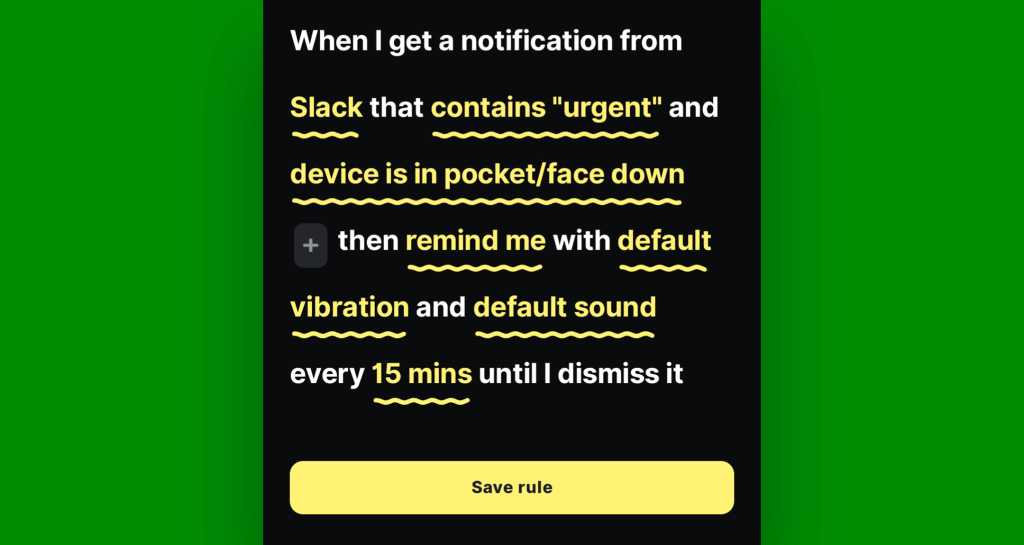
  • Back on the main rule configuration screen, tap the small gray plus symbol directly next to the “contains” line we just went over and select “Filter by in pocket/face down” in the menu that appears.
Android automation: BuzzKill rule (phone face-down)
The new “in pocket” option adds a valuable variable into the BuzzKill rule equation.

JR Raphael, IDG

  • Last but not least, tap “do nothing” and think carefully about what action you want BuzzKill to perform. Options that may be especially relevant for this purpose include:
    • “Alarm,” which will cause your phone to make a specific loud sound and vibration and pop up a full-screen alert whenever the conditions are met.
    • “Remind me,” which will allow you to set up a specific interval at which your phone should continue alerting you to the notification until you acknowledge it.
    • “Unsilence,” which will override your phone’s do-not-disturb setting when a matching notification arrives to ensure you see it.
    • “Custom alert,” which empowers you to create a unique buzzing pattern and sound to make the notification easily identifiable.

Be sure to tap the “Pick action” button at the bottom of the screen to save and confirm once you’re done, and you should then see your final rule spelled out in front of you — possibly with a few extra configurable options, depending on what action you picked.

Android automation: BuzzKill rule (complete)
A BuzzKill rule in its final form, with automatic pocket detection at the core.

JR Raphael, IDG

If you want to adjust any of the available options any further, tap on their words to tweak ’em as you wish. Otherwise, tap “Save rule” — and with that, your fresh slice of advanced Android automation will be silently working on your behalf and doing what you requested anytime your phone’s in your pocket and your conditions are met.

Android automation: BuzzKill rule list
You’ll see any active rules in the main BuzzKill screen, with a prominent toggle confirming their status.

JR Raphael, IDG

This is just scratching the surface of how you can use BuzzKill to make your phone more effective. But whether you’re already an Android automation aficionado or this is your first dip into this delightfully deep ‘n’ briny ocean, you’re officially on your way to a more intelligent Android experience — with a phone that thoughtfully works for you on a genuine, not at all artificial, level.

Get six full days of advanced Android knowledge with my free Android Shortcut Supercourse. Tons of time-saving tricks await!

Court tosses hallucinated citation from Anthropic’s defense in copyright infringement case

Claude has failed its creator Anthropic during the startup’s defense in a court case.

A district court in California has struck a portion of testimony from an Anthropic data scientist that referenced a fictitious academic article hallucinated by the AI.

The mistake was discovered in a court filing from Anthropic as part of its defense in the case in which Universal Music Group, Concord, and ABKCO are accusing the $61-billion-valued startup of using copyrighted song lyrics without permission to train its AI chatbot, Claude.

[ Learn why AI vs. copyright is a particularly ugly legal fight. ]

Anthropic admitted its mistake last week, and must now present 4 million more records of Claude’s interactions with users, particularly focusing on how frequently users prompted the chatbot for copyrighted lyrics.

The development underscores a growing, concerning prevalence of hallucinations introduced by AI in legal filings, which can put enterprises at risk if their lawyers use AI tools in legal discovery and documentation.

“AI-induced laziness is becoming an epidemic in the legal profession,” said Brian Jackson, principal research director at Info-Tech Research Group. “AI research tools shouldn’t be relied upon to create court-ready output.”

‘An honest citation mistake’

In March, Universal Music Group, Concord, and ABKCO asked federal judges in California to stop Anthropic from using their song lyrics to train the company’s models. Judges shot that request down in March; the plaintiffs then filed an amended copyright infringement complaint against Anthropic in April.

One of the points of contention in the case is what constitutes a suitable sample size of Claude’s interactions to be examined.

On April 30, Anthropic data scientist Olivia Chen submitted a filing arguing for a sample size of 1 million, which she said would represent a “reasonable prevalence rate” for a “rare event” (users seeking song lyrics) that could be as low as 0.01% of all user interactions. Her testimony cited an academic article from The American Statistician that does not exist.

Earlier this month, the plaintiffs asked the court to examine Chen and strike her declaration because of the hallucination.

The court gave Anthropic time to investigate the matter. The startup’s attorney called it “an honest citation mistake” and admitted Claude was used to “properly format” at least three citations. In doing so, it generated a fictitious article name with inaccurate authors who have never even worked together.

However, while the text in the document was hallucinated, the footnotes do link to the proper article that was “located by a human being” using Google search. Therefore, judges noted in their decision, this was not a case where “attorneys and experts [have] abdicate[d] their independent judgment and critical thinking skills in favor of ready-made, AI-generated answers.”

Judges called it a “plain and simple AI hallucination” and also questioned how a manual citation check did not catch such an error.

The court determined that a margin of error of roughly 11.3% is “within the range that will yield a representative sample.” Thus, Anthropic must now produce a sampling of 5 million prompt-output pairs equally drawn from pre-suit and post-suit data — 2.5 million from between September 22, 2023 and October 18, 2023, and 2.5 million from between October 19, 2023 and March 22, 2024. These must be randomly selected, and Anthropic must provide them to the court no later than July 14, 2025.

Models trained for law are the best bet

AI gaffes in law are becoming so significant that they are spawning a slew of research papers and legal deep dives. AI researcher Damien Charlotin, for one, keeps a running database chronicling legal decisions in cases where generative AI produced hallucinated content (typically fake citations).

“CIOs have an important role to play in explaining not only hallucinations, but also cybersecurity risks,” said Irina Raicu, who heads the internet ethics program at Santa Clara University’s Markkula Center for Applied Ethics. “Most lawyers, whether in-house or not, are not familiar with these new challenges.”

She also pointed out that last July, the American Bar Association issued its first ethics guidance on a lawyer’s use of AI tools. The use of AI in the legal system has significant implications, not just for competence, but for the duties of confidentiality, communications, and disclosure, and more.

“All enterprises should be encouraging greater sharing of information between their legal and technical staff,” said Raicu.

Legal professionals being called out for including incorrect or hallucinated AI outputs in legal documents seem to typically be using consumer-grade or general AI tools like ChatGPT or Gemini, Jackson noted. But law firms using AI should seek out industry-specific tools. One example is Harvey, built with OpenAI. Others include Alexi and Clio.

Jackson noted that AI research tools can support the work of paralegals or legal assistants who put together case files and relevant materials including decisions, client-submitted documentation, and precedents. They report that it can help them reduce their research work by 30% to 50%.

“It’s augmenting the process, not automating it,” he said. “The human in the loop here should be the lawyer running the case, reviewing what’s being submitted, and spotting the errors in the material and the false citations.”

Generative AI tools not built for legal research will “at best” find cases on the internet, and “at worst” make something up based on their training data, noted Mathew Kerbis, founding attorney at Subscription Attorney LLC.

That said, the Stanford Institute for Human-Centered AI found that even legal models still hallucinate in 1 out of 6 (or more) benchmarking queries.

Kerbis suggests that lawyers use legal AI tools that use retrieval augmented generation (RAG), with models pulling from a database of case law and checking against that database before providing an answer.

“The most reliable tools have a legal-specific large language model (LLM) that does the research, rather than a general model,” he said. “General models will always do worse than specialized models.”