Month: May 2025

Google’s AI agent protocol is becoming the language for digital labor

Google’s recently released Agent2Agent protocol has emerged as a top contender to facilitate communication and collaboration between AI agents in models and enterprises.

Microsoft this week adopted the A2A protocol in Copilot Studio and Azure AI Foundry for developers to build shared agents that can interact with each other.

Introduced last month, Google’ open-source A2A protocol allows networks of agents to structurally set goals, reason, take action, and return results across clouds, enterprises, and data silos, said Yina Arenas, vice president of product for Azure AI Foundry, and Bas Brekelmans, chief technology officer of Copilot Studio, in a joint blog entry.

“As customers scale these systems, interoperability is no longer optional,” the blog authors said.

[ Agentic AI: Ongoing coverage of its impact on the enterprise ]

Like Microsoft, AI services company Glean, which provides AI-based collaborative tools, is in the process of implementing A2A, Steve Calvert, software engineer at Glean, told Computerworld.

“Many enterprises are still trying to adopt agents, and A2A is really laying the foundation for the next generation of AI-powered collaboration,” Calvert said.

Calvert said the A2A open protocol helps agents communicate and work together, regardless of which vendor or system they’re built on. Today’s agents are designed to handle specific or a class of tasks, but A2A will change that, he said.

“For example, a sales agent supporting prospecting work, or an engineering agent generating postmortems — in the future, customers will want those agents to talk to one another, so they can solve even more complex problems,” Calvert said.

A2A is emerging at a time Anthropic’s MCP (model context protocol), another agent-to-agent protocol, is gaining steam.

A2A enables the orchestration of multiple agents, while MCP gives agents access to tools, Calvert said.

In practice, this means that agents will work with one another using A2A and interact with other systems using MCP, Calvert said.

A2A and MCP don’t compete, as they fill different requirements and “kind of need each other for the agents to work together,” said Bob Parker, senior vice president at IDC.

AI agents need middleware to understand and contextualize data in complex large-scale deployments, which is where MCP fits in. A2A is “more of asynchronous communication between agents themselves” that is emerging as a default protocol in the AI industry, Parker said.

For example, agents within M365 can talk directly within apps or services using A2A, which is a “more immediate mechanism to benefit productivity,” Parker said.

“I think long term, the MCP is going to be perhaps more impactful when you get outside of what you have on your desktop. When you start to talk about enterprise applications… MCP will be important,” Parker said.

Salesforce, which developed the A2A standard with Google, is also moving forward with the technology.

The A2A standard “allows AI agents to work together seamlessly across Agentforce and other ecosystems to turn disconnected capabilities into orchestrated [implementations],” said Gary Lerhaupt, vice president of product architecture at Salesforce, in an email statement to Computerworld.

The development of A2A is being watched closely by Read.AI, which has products that integrate with productivity and process tools from Salesforce, Atlassian, Google, and Slack.

“There’s a lot of buzz around A2A — and MCP too, for that matter — and like so much of AI, these protocols are going to be transformative and the changes will happen fast,” Elliott Waldron, co-founder and vice president of data science at Read.AI, told Computerworld.

But it’s still early in terms of implementation for the company, Waldron said. “We require a tighter integration of different sources to achieve the highest level of fidelity for our products. So we’re not moving yet, but we are definitely paying close attention,” Waldron said.

Tech CEOs warn Senate: Outdated US power grid threatens AI ambitions

In a stark warning to lawmakers, technology leaders from the nation’s biggest AI companies will testify Thursday that the US’ aging infrastructure is unprepared for the massive energy demands of AI, potentially jeopardizing US competitiveness in the rapidly evolving technology race.

US Senator Ted Cruz, who will lead the hearing, in a statement, emphasized the strategic importance of removing barriers to AI development, “Growth and development of new AI technologies will bolster our national security, create new jobs, and stimulate economic growth. This hearing will help us find ways to remove restraints on the AI supply chain and unleash American dominance in machine learning and next-generation computing.”

Hype aside, AI may not be turbo-charging employee productivity just yet

Despite the hype that AI is going to fundamentally reinvent work, it has, as yet, had little to no effect on workflows, according to new research.

A report by economists from the University of Chicago and the University of Copenhagen, Large Language Models, Small Labor Market Effects, found that AI chatbots only saved workers about an hour a week, and in some cases, actually created new tasks.

“AI chatbots have had no significant impact on earnings or recorded hours in any occupation,” wrote researchers Anders Humlum and Emilie Vestergaard. “Our findings challenge narratives of imminent labor market transformation due to Generative AI.”

Offering a different narrative on AI

The study specifically looked at the Danish labor market in 2023 and 2024, gathering data from 25,000 workers and 7,000 workplaces. The researchers chose 11 “exposed” occupations: software developers, IT support, financial advisors, HR, accountants, customer-support, legal, marketing, office clerks, journalists and teachers.

The study found that, by late 2024, AI chatbots were widespread: most firms surveyed were encouraging chatbot use, while 38% had their own in-house models, and 30% of employees said they received training on AI tools. Research also revealed that, even with the wide variety of AI tools on the market today, ChatGPT remains the dominant player.

Notably, the researchers found that AI created new tasks for 8.4% of workers, even some who don’t personally use chatbots. These tasks tend to be more sophisticated, such as designing prompts and analyzing outputs, suggesting AI may restructure jobs.

The overwhelming majority of chatbot users — between 64% and 90% in each occupation — did report that AI saved them time. On average, employees said they recouped about 25 minutes per day.

But calculating AI usage frequency and per-day savings actually only equaled about 2.8% in saved time, or roughly an hour a week, according to the researchers.

Further, they estimated that just 3% – 7% of productivity gains translated into higher wages. That status quo applies at the company level, too: There is not yet evidence of job cuts or hiring tied to chatbots.

“Although the paper hasn’t been peer-reviewed and should be treated as such, it does offer a different narrative than that we hear in other circles,” said Justin St-Maurice, technical counselor at Info-Tech Research Group.

Use goes up dramatically when employer-endorsed

The study also revealed the importance of employer encouragement. When supported and trained by employers, 83% of workers used AI, compared to 47% without encouragement. Similarly, daily adoption was 21% when employers promoted AI use, compared to 8% of those using the tools of their own accord.

“This underscores the importance of firm-led complementary investments in unlocking the productivity potential of new technologies,” Humlum and Vestergaard wrote.

However, they said, it should be noted that even when encouraged, more experienced/older workers were less likely to adopt the technology, reflecting habit inertia (sticking to the established way of doing things).

AI research is more grounded than widespread hype

While the findings seem to contradict bolder claims about AI’s impact, they do align with other, more grounded assessments of AI in the workplace.

“The measured value of generative AI in the workplace so far has been quite mixed,” said Hyoun Park, CEO and chief analyst of Amalgam Insights. For instance, his firm estimates that less than 10% of employees have been able to integrate AI into more than 10% of their work.

Park also pointed out that one of the biggest value propositions for generative AI so far is code creation, yet less than 1% of all US employees are developers, and not every developer can fully integrate genAI into their work.

Similarly, Microsoft has suggested that people may save 14 minutes per day, or 2.9% of their daily working time, using Copilot, noted St-Maurice.

“This is different from other sources suggesting that jobs are under threat, and that job losses have started as a result of the technology,” he said.

AI outputs are remarkable, but need to be customized

One of the challenges in workplace AI adoption is that the value propositions that do exist around data and research summarization are not necessarily applicable to the majority of workers across white collar and blue collar jobs, Park noted.

The reality is that effective AI use requires training and organization-specific configuration, he said. Vendors like to say that employees just need to ask questions and will promptly get answers from AI, but there is still much work to do around designing prompts, accessing data, and contextualizing AI outputs.

“Although the outputs coming from foundation AI models are remarkable compared to what we were able to do two or three years ago, they have not been customized to the vast majority of jobs,” said Park. “Until that happens, AI will not be extremely productive in the workplace.”

Similarly, agentic AI requires ongoing management and maintenance, which can be guided by frameworks such as Model Context Protocol and Agent2Agent. Companies also need to invest in documenting and defining processes to maximize value.

St-Maurice noted that AI may make it easier to complete some tasks, but it also raises the bar in terms of expectations, just as when the personal computer replaced the typewriter, and sped up typing, improved document formatting, and enabled managing files and the use of spreadsheets. Similarly, genAI is not just speeding up existing work, but redefining what “competent output” looks like.

“It changes the nature of work, but doesn’t necessarily make us more productive,” said St-Maurice.

Ultimately, Park emphasized, enterprises should make a conscious effort to identify the higher level and strategic work to be done by AI once mundane and Tier 1 tasks are automated.

“Ideally, companies should look at AI as an opportunity to improve the quality of work rather than to replace employees,” he said.

Tech hiring slows, unemployment rises, jobs report shows

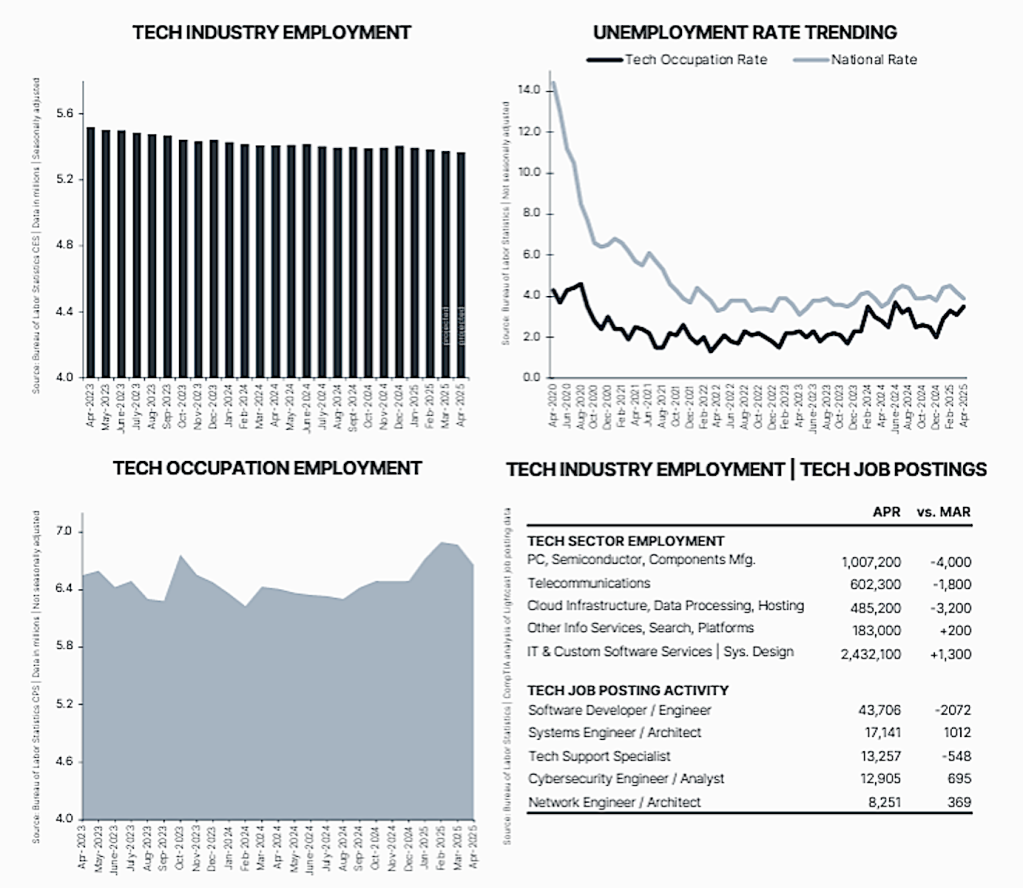
Although the nation’s overall unemployment rate held steady in April, technology worker hiring slowed and unemployment rose markedly.

Tech sector companies reduced staffing by a net 7,000 positions in April, an analysis of data released today by the US Bureau of Labor Statistics (BLS) showed.

“Employers are no longer aggressively expanding their workforce, fewer individuals are leaving their jobs, and those who do are finding it challenging to re-enter the job market,” said Ger Doyle, U.S. Country Manager at employment firm ManpowerGroup. “This highlights a significant shift in labor market dynamics, where churn and confidence are low.”

Hiring gains in the tech services sector were not enough to offset job losses in tech manufacturing, telecommunications and cloud infrastructure, according to a report from tech industry association CompTIA.

Across the economy, tech employment fell by an estimated 214,000 jobs, pushing the sector’s unemployment rate up to 3.5% from 3.1% in March. “It was not a great month of data, but expected given the circumstances,” said Tim Herbert, CompTIA’s chief research officer. “Employer tech job postings continue to hold up, so [that’s] a possible sign that hiring will resume as companies find their bearings.”

job figures

CompTIA

Across all job sectors, employers added 177,000 jobs in April despite economic uncertainty around President Donald J. Trump’s international tariffs, BLS data showed. The overall unemployment rate remained unchanged from March at 4.2%.

“Our real-time data shows job openings down 11% year-over-year, signaling a cooling environment,” Doyle said.

Hiring remains slow as employers focus on talent retention and adopt a “wait-and-watch” approach, closely monitoring economic signals, Doyle said. While sectors like medical and executive management grow, concerns about future hiring and AI’s impact on roles persist, he said.

“While our data shows a 13% month-over-month decline in traditional software developer postings, this doesn’t tell the whole story. Developers are evolving into strategic technology orchestrators who harness AI to drive unprecedented business value,” said Kye Mitchell, head of tech employment firm Experis North America, a ManpowerGroup subsidiary.

The impact from AI on hiring was stark, as companies grapple with cleaning, organizing, and sharing data stores for potential use by the technology. Demand for database architects skyrocketed, leaping 2312%, Mitchell said. Jobs for statisticians also rose sharply (up 382%).

In today’s economy, IT leaders must invest in AI to deliver measurable outcomes, not just for the sake of technology, according to Mitchell. “Tech leaders must be incredibly precise about where they allocate resources. This isn’t about AI for AI’s sake; outcomes [must] justify the investment, even during uncertain times,” she said.

Among vertical industries, employment continued to trend up in healthcare, transportation and warehousing, financial activities, and social assistance. But federal government employment declined amid cuts by the Trump Administration and its unofficial Department of Government Efficiency (DOGE).

Employers continue to pursue skills-based hiring strategies. About one-half of all April tech job postings did not specify a need for a four-year academic degree, according to CompTIA.

Skills-based hiring has been on the rise for several years, as organizations seek to fill specific needs for big data analytics, programing (such as Rust), and AI prompt engineering. In fact, demand for generative AI (genAI) courses is surging, passing all other tech skills courses spanning fields from data science to cybersecurity, project management, and marketing.

GenAI projects will move from pilot phase to production for many companies this year, which means workers are likely to be affected in ways never before imagined, according to Sarah Hoffman, director of AI research at AlphaSense.

“As AI automates more processes, the role of workers will shift,” Hoffman said in an earlier interview. “Jobs focused on repetitive tasks may decline, but new roles will emerge, requiring employees to focus on overseeing AI systems, handling exceptions, and performing creative or strategic functions that AI cannot easily replicate. The future workforce will likely collaborate more closely with AI tools.”

When considering new hires, 80% of corporate executives are expected to prioritize skills over degrees, with half planning to boost freelance hiring this year to fill in for a gap in AI and other skills, according to a recent study from freelancing platform Upwork.

The top 10 highest-paid skills in tech can help workers earn up to 47% more — and the top skill among them is genAI, according to employment website Indeed and other sources. “Let’s be honest, the job opportunities in the AI field for AI scientists has gone up massively,” said Julie Teigland, global vice chair for alliances and ecosystems at Ernst & Young. “There is a huge skills gap in terms of the number of people that can do that and that is not changing. Those are still in massive demand.

“Everywhere else we can talk about what jobs are changing and where the future is, but AI scientists and data scientists continue to be the top two in terms of what we’re looking for,” she said.

Geographically, when it comes to tech job postings, California topped all states in April with 26,280, up 1,037 from March. Texas, Virginia, and New York followed in total postings, while Arizona, West Virginia, and Maryland saw the largest month-over-month percentage gains, CompTIA data showed.

Apple’s latest earnings offer a glimpse at how it’s faring

Apple’s second quarter is usually interesting. As has now become customary, the company delivered new records, generated billions in revenue, and grew its services segment once again — generally good news except for the embarrassment of having to open up its app store while delivering the Q2 results. 

Apple announced that iPhone shipments increased 13% despite a global slowdown across the smartphone industry, and confirmed plans to make all US iPhones in India. It also suggested that some of the sales it did achieve might have been pushed forward as consumers accelerated upgrades they intended to do later this year in order to avoid US tariffs. 

What’s the cost of tariffs?

Apple CEO Tim Cook explained that he expects the Trump Tariff Tax to affect the company’s June quarter, taking a $900 million chunk out of the company’s multi-billion-dollar business. In other words, while the situation isn’t normal, it’s being managed (if not controlled).

Cook also admitted that Apple did “build ahead inventory” to help tide it over Trump’s Tariff Summer. “Obviously, we’re very engaged on the tariff discussions,” he said. “We believe in engagement and will continue to engage.” 

What really hurts with tariffs?

People have always complained that Apple’s accessories cost too much. It looks like they will complain even more in the future. During the call, Cook pointed out that the recent 125% tariff on goods from China has most immediately affected things like spare parts for AppleCare and accessories, all of which currently carry a 145% tax in the now high-tax US economy. The situation is similar across third-party chains, which are threatened by much higher costs.

Apple and the supply chain

Apple flagged potential problems to come, but set out a solid bastion from which to defend itself. From making iPhones in India and Macs in Vietnam to strategic investments in the USA, the company has built a great deal of resilience within its supply chain with which it hopes to negotiate the US trade war. All the same, it still faces an uncertain tomorrow.

With future US tariffs uncertain, the situation for the entire consumer electronics sector is very much in flux. I suggest, however, that Apple has a good news story for Q3 buried in here, as the spike in consumer sales followed the tariff announcements, which mean they occurred in the weekend of April 5 – and the quarter itself ended a week before that.

“For our part, we will manage the company the way we always have, with thoughtful and deliberate decisions, with a focus on investing for the long term, and with dedication to innovation and the possibilities it creates,” Cook said.

Made in the USA

Apple is also increasing its US manufacturing partnerships. Cook confirmed that TSMC’s new manufacturing facility in Arizona will be making tens of millions of processors for Apple’s devices. ”Apple is the largest and first customer to take chips made at that factory,” he said. “All told, we have more than 9,000 suppliers in the U.S. across all 50 states.”

Apple clearly believes the US can be a good home in which to manufacture some highly skilled elements of its supply chain, even if it can’t supply the kind of expertise needed elsewhere in its manufacturing supply chain. 

Speaking at a meeting of US business executives this week, Cook said: “I want to take a moment to recognize President Trump’s focus on domestic semiconductor manufacturing, and we will continue to work with the administration as we invest in these areas. Needless to say, we are excited for the future of American innovation and the incredible opportunities it will create, and we are honored to do our part.”

On Made In India (and Vietnam)

There’s also news from India, where the company is accelerating its attempt to build manufacturing.  “For the June quarter, we do expect the majority of iPhones sold in the US will have India as their country of origin,” Cook said, “and Vietnam to be the country of origin for almost all iPad, Mac, Apple Watch, and AirPods products also sold in the US.” 

Cook also confirmed plans to open new stores in India this year. “The operational team has done an incredible job around optimizing the supply chain and the inventory, and we’ll obviously continue to do those things to the degree that we can,” he said.

Opening the App Store

The financial news comes just after US District Judge Yvonne Gonzalez Rogers forced Apple to make immediate changes to its developer’s agreement, opening up its US store to external payments and app shoppiong services. Apple plans to appeal the judgement. 

Opening the store up to third-party competition is likely to chip away at services revenues while delivering additional risk and confusion to customers, but the scale of that impact remains to be seen. Whatever the impact, I expect Apple to find some way to build a new profit center out of whatever it has left.

Cook, whose judgement was called into question by the judge, said that while Apple has complied with the request, there are risks to the company’s business. Spotify, meanwhile, has forced Apple to approve an update with links to make purchases outside the App Store as the flight begins.

What about the enterprise?

Apple also used the financial call to share a little information about its growing status in the enterprise markets, noting KPMG has introduced the iPhone 16 to all of its US employees, “reflecting their confidence in Apple’s security and privacy features.” 

He also said that the largest bank in Latin America, NewBank, has selected the MacBook Air as a standard computer for their thousands of employees and highlighted Dassault Système’s decision to integrate Apple Vision Pro into its platform.

What about Apple Intelligence?

Some readers might remember when Apple Intelligence was the biggest Apple story around. In light of tariffs, court cases and regulatory limitations, the service seems to have become a footnote, even though it seems to be running late. “We need more time to complete our work on these features so they meet our high-quality bar,” Cook said. “We are making progress, and we look forward to getting these features into customers’ hands.”

Details from Apple’s Q2

  • Quarterly revenue: $95.4 billion, up 5% year-on-year and an all-time second-quarter high (again).
  • Products revenue: $68.7 billion, up 3% year-on-year.
  • Services revenue: $26.6 billion.
  • Company gross margin: 47.1%. Product margin was 35.9%, while services hit 75.7%.
  • Profit: $24.8 billion.
  • Cash dividend: 26 cents a share.

Estimated June quarter results will see growth in low to mid-single digits, with margins down to around 45.5-46.5% because of the estimated impact of tariff-related costs. You’ll find an excellent image detailing the scope of Apple’s business here.

iPhone

iPhone sales climbed just 2% in the quarter, despite introduction of the iPhone 16e. The category still generated $47 billion, up $1 billion on the same quarter last year. “iPhone was a top-selling model in the US, urban China, the U.K., Germany, Australia, and Japan, and we continue to see high levels of customer satisfaction in the US at 97%, as measured by 451 Research.”

iPhones also accounted for both of the two top-selling smartphones in China, Cook said.

Services

Services grew 11%, generating $27 billion this quarter, up from $24 billion a year ago. Perhaps reflecting how Apple sees this segement, and its future in the current regulatory environment, Apple CFO Kevan Parekh said: “We saw strong momentum in the March quarter, and the growth of our installed base of active devices gives us great opportunities for the future. Customer engagement across our services offerings also continued to grow. Both transacting and paid accounts reached new all-time highs, with paid accounts growing double digits year over year. Paid subscriptions also grew double digits. We have well over a billion paid subscriptions across the services on our platform.”

Mac

Mac sales grew 6% as people rushed to purchase the fantastic M4 MacBook Air. Apple generated $8 billion in Mac revenue, up from $7.5 billion last year. “The Mac installed base reached an all-time high, and we saw strong growth for both upgraders and customers new to the Mac. Customer satisfaction was reported at 95% in the US.”

Wearables

While they generated $7.5 billion in revenue, wearables (which includes AirPods, Apple Watch, and also Vision Pro) are Apple’s weakest segment, down 5% year-on-year. This seems to be the weakest part of Apple’s business in terms of growth.

iPad

iPad sales climbed 16%, thanks to the new iPad Air. The segment generated $6.4 billion, up from $5.6 billion in 2024. “The iPad installed base reached another all-time high, and over half the customers who purchased an iPad during the quarter were new to the product. Based on the latest reports from 451 Research, customer satisfaction was 97% in the US.”

You can follow me on social media! Join me on BlueSky,  LinkedIn, Mastodon, and MeWe. 

Amazon launches Nova Premier, its ‘most capable’ AI model yet

Amazon Web Services (AWS) has launched Nova Premier, its most advanced AI model to date, via Amazon Bedrock. Designed for enterprise use, the model targets complex, multi-step workflows and supports model distillation, enabling smaller models to inherit its capabilities with improved efficiency and reduced cost.

Nova Premier can handle text, image, and long-form video inputs with a one-million-token context window (equivalent to around 750,000 words) and will support over 200 languages, according to an AWS blog. Nova Premier’s applications would span financial analysis, software automation, and agentic tasks involving orchestration across tools and data layers, AWS said.

According to Deepika Giri, head of research – BD & AI at IDC Asia/Pacific, Nova Premier distinguishes itself by applying LLMs to niche Agentic AI scenarios where performance and cost-efficiency are critical. “Its multimodal capabilities also expand its relevance across a wide range of enterprise use cases,” she said.

While AWS describes it as its “most capable model,” Nova Premier trails key rivals in some third-party benchmarks. It lags behind Google’s Gemini 2.5 Pro in coding (SWE-Bench Verified) and scores lower on math and science evaluations such as GPQA Diamond and AIME 2025. However, Amazon’s internal testing shows Nova Premier performs strongly in knowledge retrieval and visual reasoning, with scores of 86.3 on SimpleQA and 87.4 on MMMU.

Pricing is in line with industry standards — $2.50 per million input tokens and $12.50 for output tokens — comparable to Google’s Gemini 2.5 Pro.

Distillation capabilities

A key feature of Nova Premier is its support for model distillation within Bedrock. This would allow enterprises to generate synthetic data from Premier and fine-tune smaller models such as Nova Pro, Lite, and Micro for targeted applications.

According to AWS, a distilled Nova Pro model increased API invocation accuracy by 20% while delivering similar output at lower cost and latency. The process eliminates the need for labeled training data and is positioned for edge deployments and use cases with resource constraints.

“Distillation enables customers to create smaller, more efficient models for specific tasks,” AWS noted. This sets it apart from other approaches. OpenAI’s GPT-4o-mini, for instance, leans on fine-tuning, while Anthropic’s Claude prioritizes text optimization.

Amandeep Singh, principal analyst at the QKS Group, said the launch is a strategic shift for AWS. “Nova Premier signals AWS’s move from a neutral model host to asserting foundational control in the GenAI value chain. This isn’t about building the biggest model, it’s about owning the orchestration, pricing, and architecture.” He added that combining proprietary models with Bedrock’s flexible interface strengthens AWS’s appeal as a sustainable AI stack for enterprises.

Currently, Nova Premier is available only to approved Bedrock users.

The future will be subtitled

A few years ago, Microsoft HoloLens and Magic Leap promised a future of groundbreaking visual experiences that blend digital and real worlds. While the headsets were bulky, expensive, and proprietary — and, in fact, both products are dying slow deaths — the demos got the public used to the idea that the future of augmented reality would be wild and filled with 3D visual content. 

HoloLens projected interactive 3D holograms into users’ environments, allowing them to manipulate these holograms with natural hand gestures, eye tracking, and voice commands. Public demos showed fighting virtual robots in the living room and giant anatomical models for education.

Magic Leap showed off hyper-realistic digital humans like its AI assistant, Mica, who could recognize a user’s mood and interact as though present in the room. The company promised architectural walkthroughs and collaborative design sessions, where multiple users could manipulate big 3D models together.

Glorious stuff. But the market rejected these extremely visual appliances. 

My prediction is that not only will augmented reality (and heads-up displays) go mainstream fast, the most common use case for the visual element will be: subtitles.

The incredible power of captioning

Polls from CBS News and Preply found that more than half of home movie and TV watchers watch with subtitles on. A 2024 survey found that 70% of Gen Z adults (ages 18–25) and 53% of Millennials (ages 25–41) watch most of their online video content, including on YouTube, with captions or subtitles enabled.

The preference for captions or subtitles in scenarios where the user largely controls the ambient sound and also the volume of the media suggests that when captions are available in smart glasses or AI glasses, much of the public will probably choose them to be on most of the time, especially in situations where context is less clear. 

Connected AI glasses that can display visual content to the wearer and which can pass for ordinary, everyday glasses are ideal for providing subtitles to the world. Microphones in the glasses can listen, cameras can watch, and AI can interpret and provide its interpretation in written language visible to the wearer and to nobody else. It’s very powerful stuff.

Here are the many uses for captioning in smart glasses:

1. Hearing aids

While Apple is looking to transform AirPods into hearing aids for the hearing impaired, other companies are doing something better: providing captions for the hearing impaired.

East Coast companies Vuzix and Xander are now shipping captioning glasses for the hearing impaired. Based on Vuzix’s M400 smart glasses and Xander’s software, the product works by picking up speech through built-in microphones and then instantly transcribing and projecting the words onto the lenses. The system runs entirely on the glasses, so it doesn’t need a phone or internet connection. The glasses are available for audiologists and clinics to purchase and use with patients.

2. Language translation

Google demonstrated the power of captioning for language translation three years ago with an experimental prototype that has since been discontinued. Google’s highly produced video showed a perfect example of how captioning would enable conversations between two people who don’t speak the same language.

Much more recently, Meta rolled out its previously experimental Live Translation feature to all Ray-Ban Meta users. I use Ray-Ban Meta glasses and live translation in Mexico, Spain, Italy, and France (I’m currently in Italy), and it falls short precisely because it does not have captioning. The feature speaks the translation in your ear and also types it out in the app. Another bonus is that it translates my English into the foreign language I’m interacting with via the app. 

This would be amazing if I could see all the translation happening in my glasses. 

By the way, I have also been using Meta’s sister feature, Live AI. With Live AI turned on, I can ask the Meta assistant what foreign language signs mean in English, and it tells me. Imagine having all foreign language signage displayed in your own language at all times while abroad. What’s amazing about this is that, unlike Live Translate, I don’t have to tell the glasses in advance what languages I’m working with. It will translate Japanese signs as quickly as it does French or Portuguese ones. 

3. Speaker notes

Shahram Izadi unveiled Google’s new Android XR platform at a recent TedTalk; while he focused on many groundbreaking applications that blend AR with AI, he also pointed out that he could see his speaker notes in his prototype glasses. 

In addition to notes during speeches and presentations, captioning will give media types and politicians teleprompter capabilities in their glasses during speeches, TV hits, and podcast appearances. 

4. Tours and tourism

It’s common for museums to rent headsets to listen to while browsing collections and for tourists to use various media to get contextual information while wandering around on vacation. AI and AR are ideal for this kind of application, where tourists can learn all about any neighborhood, cultural artifact, or museum display with silent captions in glasses. 

5. Content consumption

And finally, we come full circle. With captioning in AR glasses, two people could watch a TV show, movie or YouTube video, and one could get captions while the other person could choose to not see them. 

That also applies to lyrics displayed during concerts, language translation during Italian operas, song identification while at bars and restaurants, and other sorts of context spelled out in noisy settings.

The whole point of augmented reality is to provide useful information about the world which the world itself isn’t clearly providing. And while we’ve been dazzled by incredible visuals, the truth is that the best way to augment reality will almost always be with captions and subtitles. 

Leaderboard illusion: How big tech skewed AI rankings on Chatbot Arena

A handful of dominant AI companies have been quietly manipulating one of the most influential public leaderboards for chatbot models, potentially distorting perceptions of model performance and undermining open competition, according to a new study.

The research, titled “The Leaderboard Illusion,” was published by a team of experts from Cohere Labs, Stanford University, Princeton University, and other institutions. It scrutinized the operations of Chatbot Arena, a widely used public platform that allows users to compare generative AI models through pairwise voting on model responses to user prompts.

The study revealed that major tech firms — including Meta, Google, and OpenAI — were given privileged access to test multiple versions of their AI models privately on Chatbot Arena. By selectively publishing only the highest-performing versions, these companies were able to boost their rankings, the study found.

 “Chatbot Arena currently permits a small group of preferred providers to test multiple models privately and only submit the score of the final preferred version,” the study said.

Chatbot Arena, Google, Meta, and OpenAI did not respond to requests for comments on the study.

Private testing privilege skews rankings

The Chatbot Arena, launched in 2023, has rapidly become the go-to public benchmark for evaluating generative AI models through pairwise human comparisons. However, the new study reveals systemic flaws that undermine its integrity, most notably the ability of select developers to conduct undisclosed private testing.

Meta reportedly tested 27 separate large language model variants in a single month in the lead-up to its Llama 4 release. Google and Amazon also submitted multiple hidden variants. In contrast, most smaller firms and academic labs submitted just one or two public models, unaware that such behind-the-scenes evaluation was possible.

This “best-of-N” submission strategy, the researchers argue, violates the statistical assumptions of the Bradley-Terry model — the algorithm Chatbot Arena uses to rank AI systems based on head-to-head comparisons.

To demonstrate the effect of this practice, the researchers conducted their own experiments on Chatbot Arena. In one case, they submitted two identical checkpoints of the same model under different aliases. Despite being functionally the same, the two versions received significantly different scores — a discrepancy of 17 points on the leaderboard.

In another case, two slightly different versions of the same model were submitted. The variant with marginally better alignment to Chatbot Arena’s feedback dynamics outscored its sibling by nearly 40 points, with nine models falling in between the two in the final rankings.

Disproportionate access to data

The leaderboard distortion isn’t just about testing privileges. The study also highlights stark data access imbalances. Chatbot Arena collects user interactions and feedback data during every model comparison — data that can be crucial for training and fine-tuning models.

Proprietary LLM providers such as OpenAI and Google received a disproportionately large share of this data. According to the study, OpenAI and Google received an estimated 19.2% and 20.4% of all Arena data, respectively. In contrast, 83 open-weight models shared only 29.7% of the data. Fully open-source models, which include many from academic and nonprofit organizations, collectively received just 8.8% of the total data.

This uneven distribution stems from preferential sampling rates, where proprietary models are shown to users more frequently, and from opaque deprecation practices. The study uncovered that 205 out of 243 public models had been silently deprecated — meaning they were removed or sidelined from the platform without notification — and that open-source models were disproportionately affected.

“Deprecation disproportionately impacts open-weight and open-source models, creating large asymmetries in data access over time,” the study stated.

These dynamics not only favor the largest companies but also make it harder for new or smaller entrants to gather enough feedback data to improve or fairly compete.

Leaderboard scores don’t always reflect real-world capability

One of the study’s key findings is that access to Arena-specific data can significantly boost a model’s performance — but only within the confines of the leaderboard itself.

In controlled experiments, researchers trained models using different proportions of Chatbot Arena data. When 70% of the training data came from the Arena, the model’s performance on ArenaHard — a benchmark set that mirrors Arena distribution — more than doubled, rising from a win rate of 23.5% to 49.9%.

However, this performance bump did not translate into gains on broader academic benchmarks such as Massive Multitask Language Understanding(MMLU), which is a benchmark designed to measure knowledge acquired during pretraining by evaluating models. In fact, results on MMLU slightly declined, suggesting the models were tuning themselves narrowly to the Arena environment.

“Leaderboard improvements driven by selective data and testing do not necessarily reflect broader advancements in model quality,” the study warned.

Call for transparency and reform

The study’s authors said these findings highlight a pressing need for reform in how public AI benchmarks are managed.

They have called for greater transparency, urging Chatbot Arena organizers to prohibit score retraction, limit the number of private variants tested, and ensure fair sampling rates across providers. They also recommend that the leaderboard maintain and publish a comprehensive log of deprecated models to ensure clarity and accountability.

“There is no reasonable scientific justification for allowing a handful of preferred providers to selectively disclose results,” the study added. “This skews Arena scores upwards and allows a handful of preferred providers to game the leaderboard.”

The researchers acknowledge that Chatbot Arena was launched with the best of intentions — to provide a dynamic, community-driven benchmark during a time of rapid AI development. But they argue that successive policy choices and growing pressure from commercial interests have compromised its neutrality.

While Chatbot Arena organizers have previously acknowledged the need for better governance, including in a blog post published in late 2024, the study suggests that current efforts fall short of addressing the systemic bias.

What does it mean for the AI industry?

The revelations come at a time when generative AI models are playing an increasingly central role in business, government, and society. Organizations evaluating AI systems for deployment — from chatbots and customer support to code generation and document analysis — often rely on public benchmarks to guide purchasing and adoption decisions.

If those benchmarks are compromised, so too is the decision-making that depends on them.

The researchers warn that the perception of model superiority based on Arena rankings may be misleading, especially when top placements are influenced more by internal access and tactical disclosure than actual innovation.

“A distorted scoreboard doesn’t just mislead developers,” the study noted. “It misleads everyone betting on the future of AI.”

Google now injects hyper-personalized ads into third party AI chats

As it stands to potentially lose ad revenue after being ruled a monopoly, and also to maintain an edge in the digital ad space as generative AI use soars, Google is purportedly now injecting ads into third party chatbot conversations.

It’s not a surprising move, particularly given Google’s antitrust loss that could eventually lead to the breakup of its ad business (although there are likely years of appeals to come before any tangible changes). The tech giant is also in fierce competition with the likes of OpenAI, Perplexity, Meta, Microsoft, Salesforce, and a slew of others to get enterprise users to adopt its genAI platforms.

“Google knows its long-dominant search funnel is leaking,” said Julie Geller, principal research director at Info-Tech Research Group. “If conversational AI becomes the way people discover, decide, and buy, Google needs a revenue engine ready before regulators or rivals box it out.”

More than a money move

According to reports, the Google AdSense network expanded to include chatbot conversations earlier this year, after it tested the capability last year. Particularly, according to anonymous sources, it is working with AI search startups iAsk and Liner.

The move comes as Google grapples with the fallout of not just one, but two, antitrust trials in which it was found guilty of establishing “monopoly power.” Most recently, in April, a federal judge in Virginia ruled that the company monopolized two online advertising markets: publisher ad servers and the ad exchanges that sit between buyers and sellers. Google reportedly earned nearly $265 billion in 2024 alone through ad placement and sales.

Incorporating ads into generative AI is a “risky move at a fragile moment,” noted Ria Delamere, chief technology and product officer at Traject Data. “This isn’t just about making money. It’s about trying to hold onto ground as Google faces pressure from AI-native competitors and antitrust regulators.”

An opportunity for hyper-personalization

Of course, Google isn’t the first to do this. Meta, for one, shows ads in “private” messenger chats, David B. Wright, president and chief marketing officer at W3 Group Marketing, pointed out.

“Google and other companies inserting ads in AI chatbots are just jumping into the next available space to place ads,” he said.

Geller pointed out that, in 2022, company leaders acknowledged that about 40% of Gen Z in the US were turning to TikTok or Instagram, not Google, for local recommendations on where to eat or shop, and that behavior has only accelerated since. Incorporating ads into generative AI sets the stage for “hyper-local, persona-level targeting” which could  pull advertisers back from social platforms and keep both discovery and dollars inside Google’s walls, she said.

Enterprises will be able to deliver more relevant ads “at the right time to the right person,” Wright agreed. Consider conversing with an AI chatbot as a very long-tail search, he said: Ad servers can take the data from the conversation and use it to craft hyper-targeted ads.

“In an ideal world, we’d only see the ads we want to see when we’d want to see them: when we’re at the right stage of a buying decision for something we want to buy,” he said. “This could be a step closer to that.”

Preserving trust will be paramount moving forward

Experts emphasize that trust is imperative to all this. Notably, it hinges on “knowing when money changes the message,” said Geller. If users suspect an answer is ranked by revenue over relevance, “confidence tanks,” and they may migrate to more “neutral” assistants.

Google will need to flag sponsored content in real-time, explain why it surfaced the ads it did, and prove that organic answers aren’t “quietly demoted,” she said. “Anything less invites skepticism and churn.”

Delamere agreed that when ads start showing up as part of an “answer,” it gets harder to tell where information ends and influence begins. When AI is driving decisions, transparency and explainability aren’t an option, she said.

“This may help Google in the short term, but credibility is hard to earn and easy to lose,” Delamere emphasized.

From a user interface perspective, if ads distract or cause delays, consumers won’t go near the app, noted Melissa Copeland of Blue Orbit Consulting. “Consumers may try it, but if they don’t get the efficient and effective answer they are looking for, they will abandon the channel or brand.”

Meanwhile, when it comes to privacy, Geller pointed out that chat transcripts are stored and, at times, reviewed by humans, creating a “durable record of anything sensitive a user blurts out.”

“While Google offers opt-outs and deletion tools, they’re far from intuitive,” she said, emphasizing that enterprises must offer secure contract-level clarity on retention windows, human-review policies, and encryption standards, and should also insist on audit rights to verify compliance.

Look beyond a single-vendor strategy

This type of capability could help companies offer chatbot functionality at a lower cost, and potentially surface new insights about customers, noted Neil Chilson, head of AI policy with the Abundance Institute.

Like all ad media, he said, when considering the volume and type of ads, companies will need to balance short-time incentives to monetize and long- term financial incentives to keep customers coming back.

“Google is good at helping companies evaluate those trade offs in other advertising channels; it will be interesting to see how that expertise translates to this new area,” said Chilson.

Info-Tech’s Geller pointed out that the search and discovery landscape is evolving too quickly for a single-vendor strategy. She advised enterprise leaders to stay agile, demand full transparency around data use and monetization, and keep an eye on how AI-driven personalization opens new micro-market opportunities.

It’s also important to build flexibility into customer experience and marketing roadmaps, as ads are “only the opening salvo,” she noted. Further, companies should watch for new revenue models from app providers, such as subscription tiers or usage fees, and potentially embrace the benefits of hyper-local targeting. At the same time, she said, “keep exit routes open and your data governance questions sharp.”

Google rolls out ‘AI Mode‘ to improve search results

Google is making changes to its venerable search interface so users can more naturally interact with its AI features.

“AI Mode,” a project brewing in Google’s Search Labs, will slowly roll out to general users within the company’s current search interface. (A new “AI Mode” tab will appear alongside its search box.)

“With AI Mode, you can truly ask Search anything — from complex explanations about tech and electronics to comparisons that help with really specific tasks, like assessing insurance options for a new pet,” Soufi Esmaeilzadeh, director of product management for Google’s search products, said in a blog post.

The new features will migrate from the experimental AI Mode features already being tested by users in Google’s Search Labs. Google has also added features to the experimental AI Mode so users get better search results.

With AI Mode now ready for the real world, Google promises the tool will offer more than AI Overviews; it provides basic insights for questions plugged into the search box. AI Mode is based on the Gemini 2.0 AI model.

“Because our power users are finding it so helpful, we’re starting a limited test outside of Labs. In the coming weeks, a small percentage of people in the US will see the AI Mode tab in Search,” Esmaeilzadeh said.

Google’s experimental AI Mode app had been available only to limited users. The app is available for Apple’s iOS and Android.

A Google spokesperson declined to offer further details about AI Mode search.

Google has been talking about integrating AI into search results more comprehensively since the day it launched its first large language model called Bard. The early models hallucinated and malfunctioned, so Google has been cautious in rolling out AI into its general search features.

But the company had to roll out core AI features to its search tools as soon as possible, said Jack Gold, principal analyst at J Gold Associates.

OpenAI and Anthropic have built search into their AI interfaces, and Meta recently launched its own chatbot based on Llama 4. Microsoft was already ahead of Google in integrating AI search into Bing results.

“It’s seeing increasing competition for AI from companies like Meta and OpenAI that could take some share away from them…, but it’s not clear that a competent AI model couldn’t essentially duplicate and enhance search functions for many users — see Perplexity, as an example,” Gold said.

Google attaching Gemini closer to its search tools offers several benefits, including feedback from users on how well the answers resonate. Enhancing search with AI could also drive down Google’s compute power and infrastructure costs as it could limit the number of searches needed before users get desired results.

“It can better tune its models for accuracy. It also enhances their ability to target ads at users, as AI will show complementary topics that can then be advertised about,” Gold said.

The experimental AI Mode in the search labs already delivered useful information about products and places. Google is now adding more rich results and multimedia features. A search for destinations, results, and products will show in a more organized format.

“Rolling out over the coming week, you’ll begin to see visual place and product cards in AI Mode with the ability to tap to get more details,” Esmaeilzadeh said.

Shopping, dining, and services results will have more options, real-time pricing, promotions, and ratings. And a new left-side panel on the desktop will make it easier to jump back into past searches on longer-running tasks and projects.

Typically, Google requires consent to record search history to understand user trends. A Google spokesperson declined to comment on whether AI Mode would require that.