Canva has built its own foundational AI model that generates layered designs users can edit more easily. It’s one of several generative AI-related features Canva announced Thursday, alongside expanded access to its AI assistant and content generation capabilities across its app.
To date, Canva has partnered with a variety of AI model providers for content generation — Black Forest Labs, Google, and OpenAI among them — and it acquired Leonardo AI last year.
While these models are adept at image, text or video generation, they lack the ability to produce layered design files that users can then edit themselves, said Jen Thompson, head of product marketing at Canva. “Design is a space that actually hasn’t had a fit-for-purpose model yet,” Thompson said in an interview with Computerworld ahead of Canva’s World Tour event this week.
Instead, they generate flat, JPEG-style outputs in which text, backgrounds, and other elements cannot be separated. With Canva’s design model, it’s possible to generate “layered design files that look amazing, but then then allow for AI and human editing to happen in parallel,” said Thompson.
Once a design is generated, it can be tweaked as with any template in the Canva editor.
The model enables an “array of functionality, both today and especially in the future,” said Gabe Knuth, principal analyst at Omdia, part of Informa TechTarget. “Using their own model will allow [Canva] to have more control over the functionality and output than they’d have leaning on different foundational models for different tasks.”
The resulting outputs “should be better, more consistent, and more integrated into the Canva experience than what a mixture of general-purpose models can provide,” Knuth said.
Canva didn’t respond to Computerworld’squestions about the use of customer data to train the new design foundational model, including whether the company requires customers to actively consent for their data to be so used.
Canva is also making its various AI tools available more widely across its application. Now, users can now generate content within the editor page, putting AI tools into the flow of work, said Thompson.The assistant can produce templates, photos or shapes, and even 3D objects, for instance, and “style-match” existing content.
“People are often already in the editor when they realize that they need something specific, whether it’s a design file or a specific element. So, now we’ve brought this ability to generate with AI designs right into the actual design tab in the editor,” she said.
It’s also possible to interact with Canva’s AI assistant in comments by tagging @Canva.
The AI assistant, announced earlier this year, was previously accessible only via a search bar on the Canva home screen. That meant a lot of switching back and forth to use the assistant.
The Ask @Canva feature provides another way to get feedback, suggestions, and edits.
“It means that you lead the way, but AI is there to support — not just at the beginning, but all the way through, to make sure you’ve got an amazing design at the end of the day,” said Thompson.
Canva’s announcements come as rival Adobe also outlined its plans this week to add AI assistant tools to apps such as Express and Photoshop.
Canva’s AI strategy stands it in good stead as it seeks to attract users, said Wayne Kurtzman, research vice president for Social, Communities and Collaboration at IDC.
“These announcements are designed to grow and expand paid seats for professional, organizational and individual creators alike, while retaining the ease of use across devices,” he said. “Having refined the UI without creating user shock reinforces that they are definitely on the right track.”
He said \ Canva has “leaned into the multimodal, multimedia content that organizations need to communicate internally and externally. User-facing AI features from a single interface is a huge part of that strategy.”
The word that Jamf will go private in a $2.2 billion acquisition by Francisco Partners has surprised many in the Apple admin community. Jamf sasy the plan will accelerate growth, bolster its expansion and strengthen its market leadership.
The move might also reflect a new chapter in the Apple enterprise-growth story, because as Macs, iPads, and iPhones become more embedded across the sector, many in IT management are searching for unified device management platforms capable of handling Apple, Microsoft, and Android products.
That’s a big change from where we used to be, when Apple wasn’t as prevalent in business. It was perhaps better practice to have Apple-focused device management and security solutions in place, with something else to handle Windows fleets. InTune’s move to support Jamf helped this along, at least, conceptually.
Enterprise tech is cross-platform
These days, you’ll just as easily find Macs in use beside Windows, Android devices, and iPhones in the office, so both IT and purchasing recognize it sometimes makes sense to source management tools that provide support across all of those platforms. There’s two reasons for that: it reduces overhead (more systems = more cost) and it boosts productivity (one console to rule them all).
That’s not going to suit everyone, of course. Some businesses are already all-in on Apple, and want best-in-class services ready to support all that’s new in that ecosystem. Others prefer specific tools for specific platforms, pretty much for the same reason — platform-focused tools tend to be updated faster, handle new features more swiftly, and deliver tighter integration with their chosen platform. All these reasons matter to different extents in different businesses, and each argument has its own weight. There’s no single answer; every business is different, with its own unique needs. Apple recently showed it understands that with the introduction of support to make it easier to migrate between device management vendors.
All the same, as Apple’s enterprise marketshare increases, the number of vendors in the enterprise space is also increasing. And while Jamf very much enjoys first-mover advantage as the uber-MDM for Apple in the workplace, it is arguably being flanked by competitors who already offer multi-platform support or speak more traditional languages familiar to IT. In my view, a company like Fleet has some advantage there — and it’s clear that Kandji/Iru hopes to play in that pool, too.
It’s possible the rapid expansion of Apple in business hasn’t been fast enough for Jamf’s shareholders. The current deal sees Francisco Partners pay $13.05 per share in the all-cash transaction, which has been approved by the Jamf board — including by former CEO Dean Hager. That’s just over half the value those shares went out for on the initial public offer in July 2020.
Growing business one cut at a time
Since Jamf went public, it has engaged in two punishing rounds of staff cuts, including the recent layoff of 6.4% of its workforce. I believe these have deeply unsettled staffers across the company, as such cuts always do. Such events make people anxious, dent productivity, damage trust, and change corporate culture.
While it is possible Francisco Partners will choose to invest in the award-winning, business supporting, deeply positive culture that has emerged at Jamf, it does have some track record for tearing some of the companies it acquires apart. The company “has relied on carve-out M&A to maximize the value of its investments,” InfoRisk said today.
It also seems to have a keen interest in building its security services offering. It purchased Forcepoint in 2021, Sumo Logic in 2023, and more recently seized slices of NewRelic and Integrity Group.
Francisco Partners also owns SonicWall and BeyondTrust, which with Jamf and Jamf’s own security products gives the company a strong position in the security market. Now that’s augmented by Apple-focused security services, including some which other platforms really don’t possess.
There’s still a big opportunity
“We continue to see tremendous opportunity for Jamf given its enviable position in the market, and we look forward to working with the leadership team to support Jamf’s next phase of growth and deliver an even broader suite of secure and effective products to its customers,” said Cherry Zou, vice president at Francisco Partners.
“We believe transitioning to a private company will provide greater financial flexibility and strategic alignment to accelerate growth, expand through innovation and M&A, and strengthen our market leadership,” said Jamf CEO John Strosahl, who once called Jamf’s internal culture its “secret sauce.”
“Of all the companies I’ve worked for, the Jamf culture is really unique and reflects our two values — selflessness, to think of others, to be helpful, and relentless self-improvement,” he said in 2024. “Those values have really gotten us here, and if I have one task during my tenure it will be to maintain that.”
Questions may linger about whether generative AI (genAI) is taking away jobs, but tools such as OpenAI’s ChatGPT, Google Gemini and Microsoft Copilot are apparently making employees more productive.
That was the conclusion of a recent study by the London School of Economics and consulting firm Protiviti; The researchers concluded that genAI tools save workers close to 7.5 hours every week.
That amounts to savings of $18,000 per employee per year, the study said.
Of about 3,000 employees and executives surveyed, 70% were using AI — with younger workers quick to turn to the technology for work.
About 71% of Gen Z users (those born between 1997-2012) had the largest ratio of AI users, followed by 73% for millennials (born between 1981 and 1996), 60% for Gen X workers (1965-1980) and 52% for Baby Boomers (1946-1964).
“The top use, (43% of employees) is writing and content creation tasks, 34% [for] communication and collaboration, 27% [for] data analysis and visualization,” Daniel Jolles, research officer at LSE’s The Inclusion Initiative, said via email.
The report doesn’t distinguish between ChatGPT, Copilot or external or internal AI tools and systems. But for people not using AI, productivity improvements or cost savings could be as simple as firing up ChatGPT or other genAI tools.
“This will vary from role to role, but yes…, this report shows that using training and guardrails can give employees the autonomy and confidence to use freely available tools to significantly increase their productivity,” Jolles said.
About 60% of those surveyed did not receive any AI-specific training. But employees will be more productive with the technology if given the right boost in skills.
“Interactive hands-on workshops tailored to their roles are the most effective for AI adoption,” Jolles said.
GenAI is a priority in enterprises to help employees be more productive, said Melanie Freeze, research director at Gartner. “I believe that’s…time savings, and to some degree being able to focus on those higher value tasks,” Freeze said.
GenAI also helps fill labor gaps and take over jobs so employees can focus on more productive tasks, Kari Briski, vice president for generative AI software for enterprise at Nvidia, said earlier this week.
For example, robots with AI will take on mundane office-work and dangerous work in factories, which helps employees focus on other tasks, Briski said.
The value of Nvidia’s stock has increased significantly in recent years, largely due to the high demand for its AI chips.
According to Reuters, another milestone was passed during Wednesday’s trading on the Nasdaq stock exchange, as Nvidia became the first company to be valued at $5 trillion.
The previous milestone, $4 trillion, was passed as recently as July.
Nvidia’s surge means that the company now has a substantial lead over Microsoft ($4,025 billion), Apple ($4,002 billion), Alphabet ($3,324 billion), Amazon ($2,456 billion) and Meta ($1,888 billion).
Adobe is developing new generative AI (genAI) assistants that let users edit images in Adobe Express and Photoshop with written prompts.
Having embedded AI-based content-generation tools across its apps in recent years, Adobe is rolling out AI assistants and agents. That effort began last year with Acrobat Reader, with Adobe this week outlining further plans to bring AI assistance to its creative. The announcements were pegged to the Adobe MAX conference.
For Adobe Express, Adobe introduced a conversational assistant that lets casual users create and edit designs by describing what they want via natural language. The assistant can make edits to individual layers of a design, such as fonts, images, and backgrounds on user’s behalf, and provide recommendations for changes.
“Enterprise capabilities” are also in development for the Express AI assistant, Adobe said in a statement; they will allow a non-design staff to “self-serve on-brand content creation and collaboration,” with “template locking, batch creation and more.”
The Express AI Assistant beta is available on desktop to Adobe Express Premium customers. At full launch, the AI Assistant will be available to all Express customers through the Firefly generative credit system, the company said.
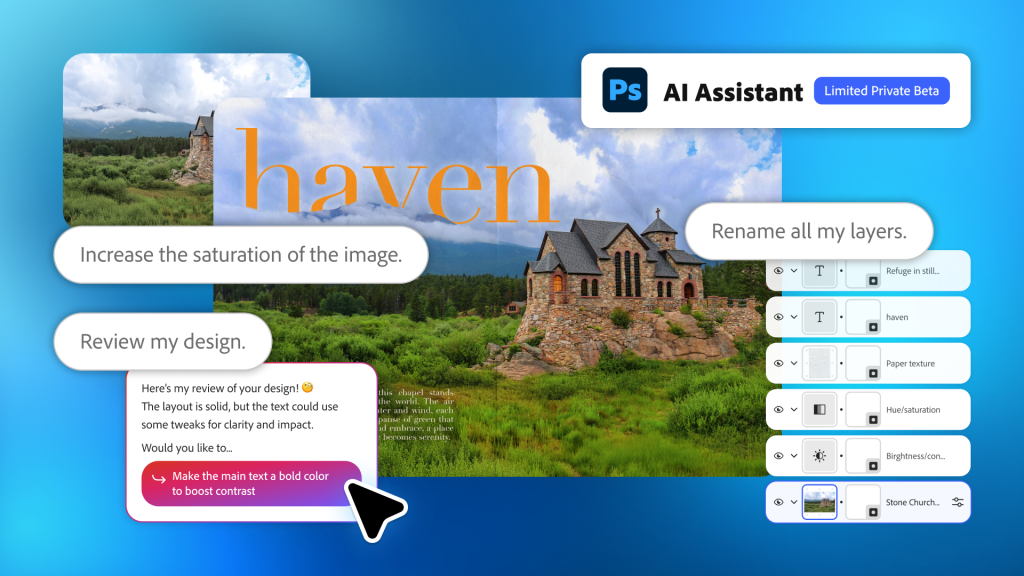
An AI assistant is also in the works for the Photoshop web application (currently in a private beta). Again, it users advice on how to enhance images — detecting and highlighting potential problems with text contrast, for instance — as well make changes such as decreasing brightness and increasing saturation.
Adobe Photoshop AI Assistant can offer users advice on how to enhance images.
Adobe
“You can tell it to do things for you, and it will understand what tools to use: select subject, create masks, do all of the layer masks for you and keep it completely editable,” Alexandru Costin, vice president for Generative AI and Sensei at Adobe, said in a press briefing.
It’s also possible to ask the AI assistant, which appears in the right-hand sidebar, to generate names for layers in the Photoshop “layers panel” based on content. Users will be able to make manual edits as usual in the main screen.
The assistants should help users “free up time, add to their creative output and get the design in their mind’s eye onto a blank page,” said Liz Miller, vice president and principal analyst at Constellation Research.
At the moment, the AI assistants are “aligned with the casual user,” said Sheryl Kingstone, research director at 451 Research, part of S&P Global Market Intelligence, and can reduce complexity of using certain Adobe tools. But she also sees potential to support more advanced creative users “with scale of production capabilities.”
“For the professional, these AI assistants don’t just ramp up their creativity, [but] give spaces and places to collaborate and ideate and create at will.… These are quality-of-life updates,” said Miller.
While there’s little direct evidence of demand for AI assistance in creative tools such as Photoshop currently, said Andrew Frank, distinguished vice president analyst in the Gartner Marketing Practice, the new tools could help users as Adobe adds new features at a fast clip across its software suite.
“…The pace of product innovation at Adobe can often outpace users’ capacity to absorb advanced features, which is where I think AI assistance could really help — accelerating the realization of benefits from the power of AI in content creation,” Frank said.
The announcements at Adobe MAX this week are likely just the start of Adobe’s plans here. The company wants to embed AI assistants more broadly going forward across its creative product suite, said Kingstone, “with a connective tissue on services.”
One feature under development is Project Moonlight. Adobe describes this as a “personal orchestartion assistant” that can coordinate across multiple apps. By connecting to Creative Cloud libraries and social media accounts, the AI assistant generates personalized ideas and content for users. This includes images, videos, and social posts, Adobe said.
“Project Moonlight is very interesting, as it removes the friction across tools with a more workflow-oriented canvas that uses services at scale,” said Kingstone.
While agent architectures promise easier integration across different vendors’ applications, said Frank, users are “likely to find single-source integrations faster and more reliable than multisource compositions. That’s what makes Project Moonlight strategic — it helps turn Creative Cloud into a control center for social marketing.
“It’s clear that an AI agent strategy is now table stakes for anyone in the software business,” he said. “But for end-to-end marketing platform providers like Adobe, it represents a new way to unify and enhance the foundational value of their offering rather than compete on the application level.”
Project Moonlight is currently in private beta and will be available in the “coming months,” according to Adobe.
Microsoft Forms is a web app that allows users to create various types of forms that gather information from people online and store that data in the cloud for review.
Why is this useful? Surveys, questionnaires, and other interactive forms are a vital part of doing business. They provide a great way to interact with employees, teammates, customers, and potential business partners. You can use online forms to collect customer feedback or business requirements, conduct market research, gauge employee satisfaction, register attendees for an upcoming event, test learners’ knowledge after a training course, and more.
Forms is included with Microsoft 365 subscriptions for individuals and businesses, and a limited version is available for free to anyone with a Microsoft account. In this cheat sheet, we will cover how to use this program to create questionnaires, add specific types of questions, and view and analyze the responses.
Microsoft offers a variety of form templates you can adapt for your own purposes, and we will discuss how to use them — but first we’ll take you through the steps of building a form from scratch so you’ll know how all the parts and pieces work. We’ll also cover how to use Copilot, Microsoft’s generative AI assistant, to draft forms for you.
In this article:
How to create a form from scratch
How to create a form from a template
How to create (and edit) a form with Copilot
How to create a quiz
How to change your form’s theme
How to share your form
How to view responses
How to create a form from scratch
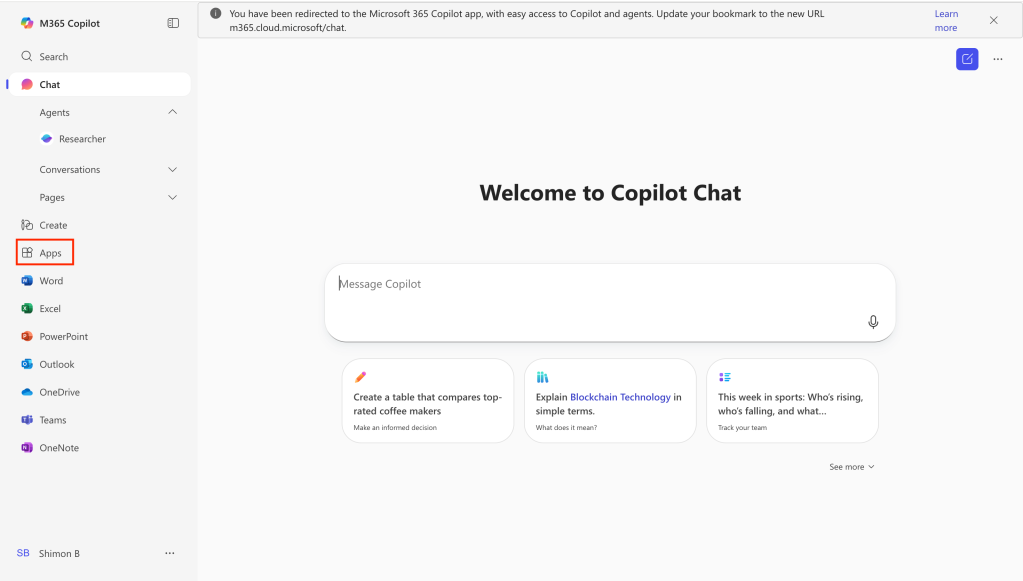
To start using the Microsoft Forms app, navigate to your Microsoft 365 home page, sign in if you haven’t already, and click on the Apps icon in the left panel. (If you don’t see a navigation panel on the left, click the Expand Navigation icon in the upper left corner.)
On the Microsoft 365 home page, click Apps.
Shimon Brathwaite / Foundry
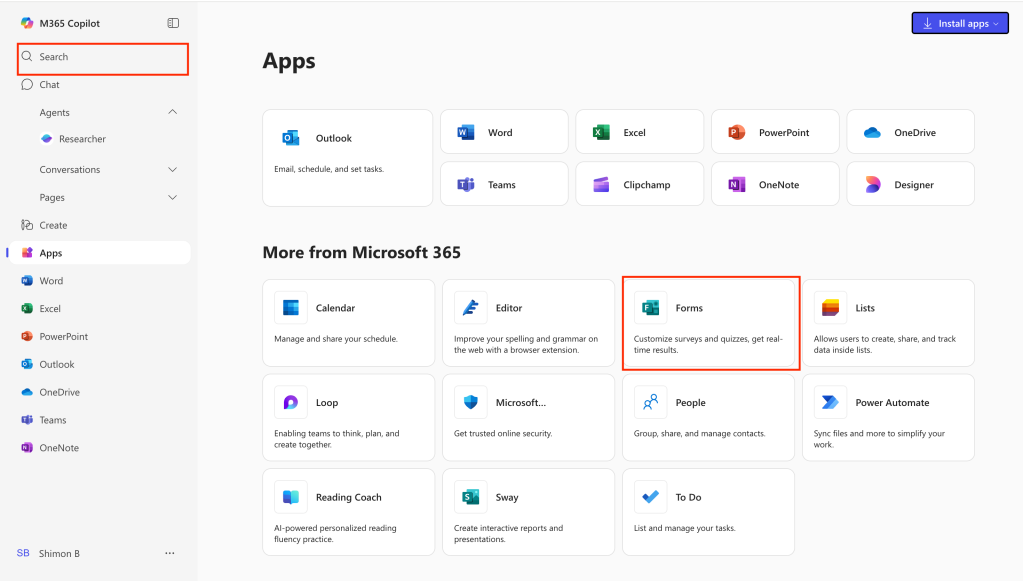
The Forms app should appear on the main part of your screen near the bottom. If it isn’t there, use the search option at the top of the left panel to search for forms and launch the app.
If you don’t see Forms on the main M365 Apps screen, use the Search function to find it.
Shimon Brathwaite / Foundry
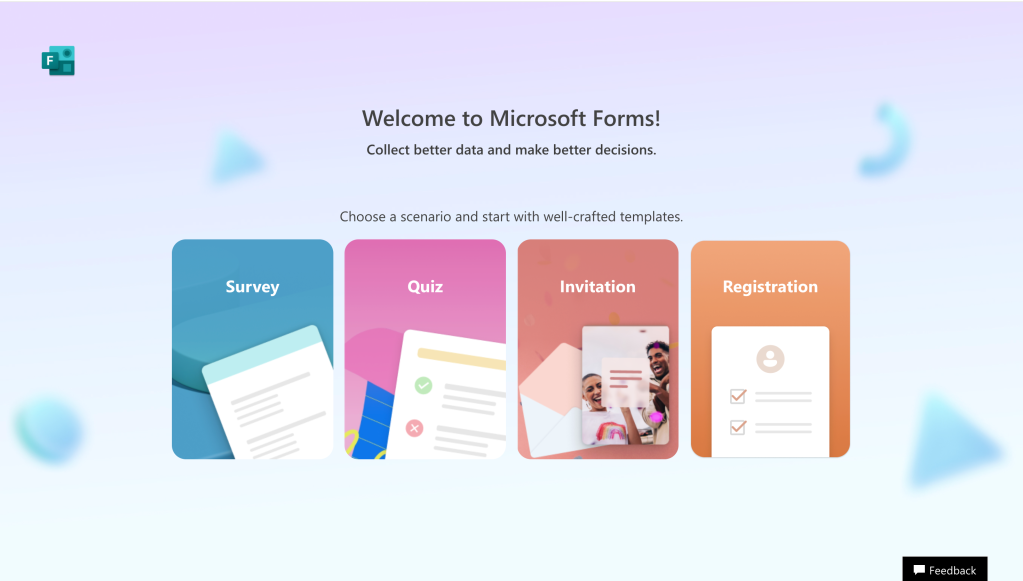
If this is your first time using Microsoft Forms, you will be presented with the welcome screen shown below, which offers templates for various types of forms. From here, select Survey to start your form.
The Forms welcome page shows templates for various types of forms to help you get started.
Shimon Brathwaite / Foundry
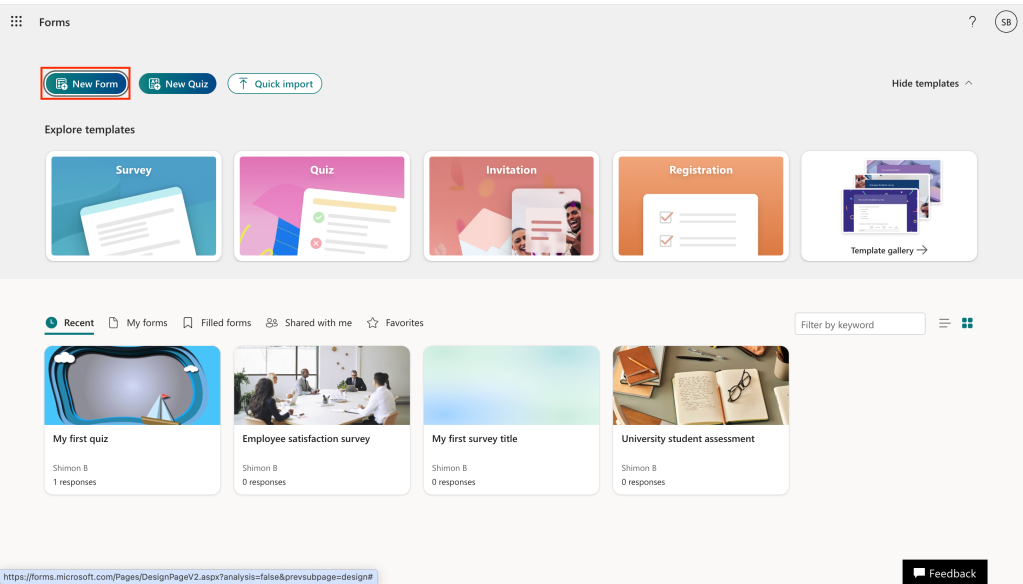
If you’ve used Forms before, you’ll instead see a home page with a few templates plus any forms you’ve created or that have been shared with you. Click the New Form button at the top of the page.
The Forms home page shows templates on top and your forms below.
Shimon Brathwaite / Foundry
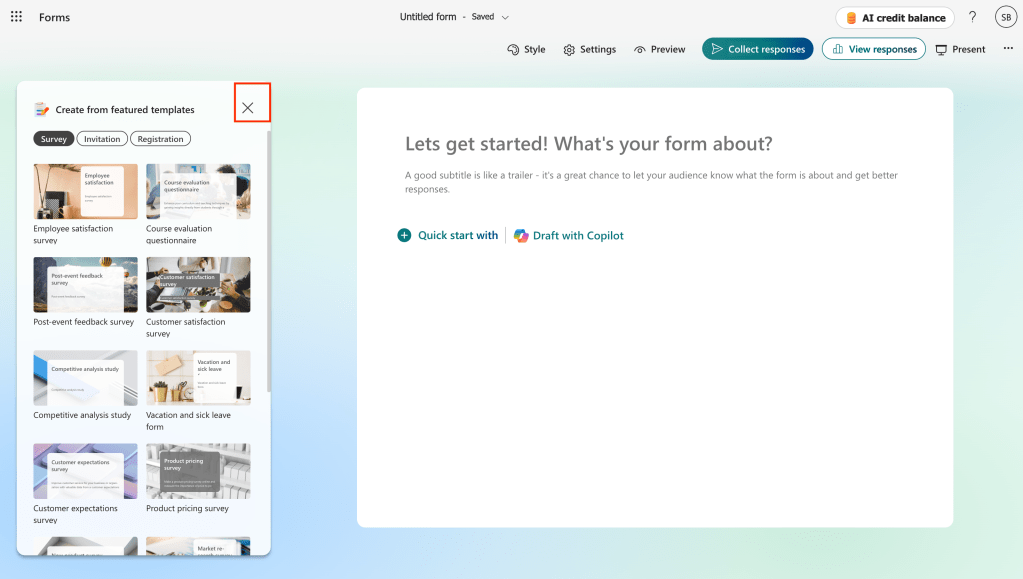
Either way, you’ll start a new, blank form. If you see a panel listing suggested templates on the left side of the screen, click on the X at the top of the panel to remove it; you’ll learn how to use templates later on.
Close the templates panel on the left so your new form can take up the whole screen.
Shimon Brathwaite / Foundry
Changing the form’s title
First, change the title of your form and add a description. This is the first thing anyone will see when they open your questionnaire, so make sure the title is easy to understand and explains what you’re trying to do.
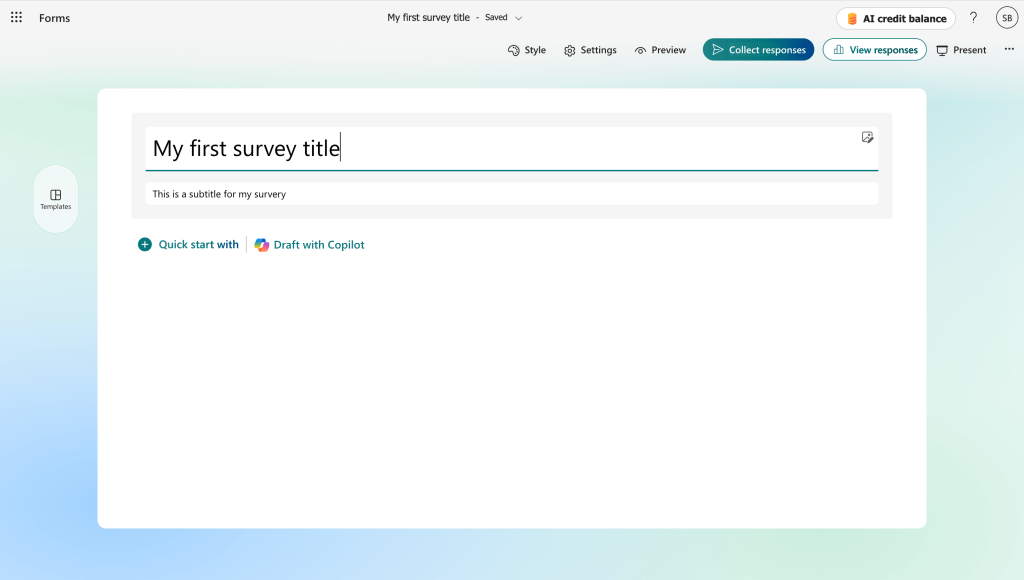
To add a title, click on the title field (which might say something like “Let’s get started! What’s your form about?” or simply “Untitled form”), and you will be able to edit the title and add a description.
Change the title and add a description for your form.
Shimon Brathwaite / Foundry
Adding questions
Below the description is a “Quick start with” link. If you have access to Microsoft 365 Copilot, you’ll also see a “Draft with Copilot” option. You can ignore that for now; we’ll cover using Copilot to create forms later in the article.
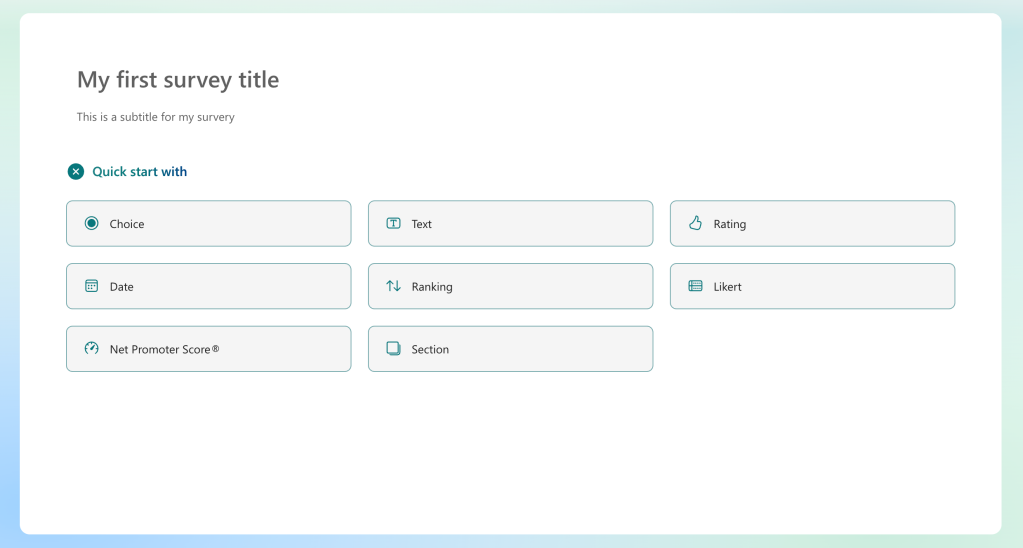
To add a new question, click the Quick start with text. A menu appears showing multiple types of questions you can add to your form.
Choose which kind of question you want to add.
Shimon Brathwaite / Foundry
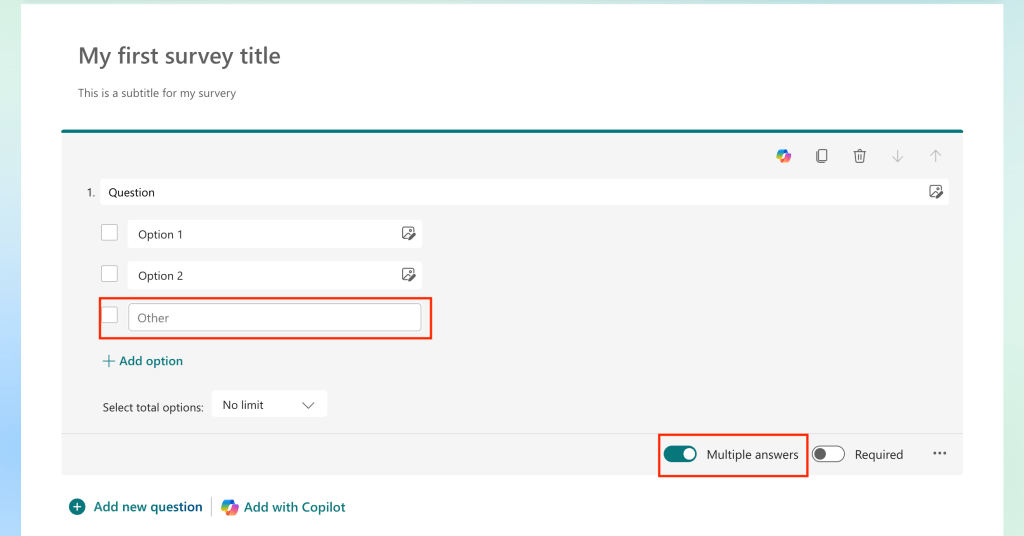
Choice: Multiple-choice questions allow you to designate a set of answers from which the user can choose. You can also add an Other option, where users can type in a unique response.
By default, a multiple-choice question allows the user to select just one answer. To change this, click the Multiple answers slider at the lower right to toggle it on. The radio buttons next to the answers change to checkboxes, and users can choose more than one.
This multiple-choice question lets respondents choose more than one answer and includes an “Other” option.
Shimon Brathwaite / Foundry
To rearrange the answers in a multiple-choice question, hover your cursor over the answer you want to move until you see six dots appear to the left of the item. Click and hold the six dots, then drag and drop the answer to its new location.
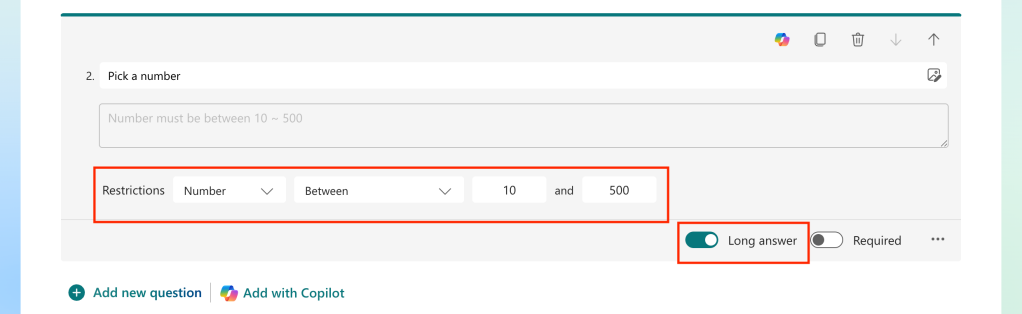
Text: This is an open-ended question where you allow the user to type in an answer — good when you want to collect individual information such as an email address or hear detailed thoughts from respondents. Text responses can be up to 4,000 characters. By default, text response boxes are designed for short answers, but if you turn on the Long answer toggle, the response box will expand as the user types.
To restrict responses to a particular format, such as a number, an email address, or a web URL, click the three-dot icon in the lower-right corner of the question box and select Restrictions. The Number format is selected by default. To specify that the number be within a certain range, such as between 10 and 500, click the Is number dropdown, select Between, and type the appropriate numbers in the boxes to the right.
Restricting the responses for a text question to numbers between 10 and 500.
Shimon Brathwaite / Foundry
To change to a different format restriction, click the Number dropdown on the left, choose the format you want to restrict, and specify additional parameters.
Rating: Allows respondents to rate performance, typically on a scale of 1 to 5 (bad to excellent). This can give you an idea of how employees feel about their manager, for instance, or how customers view your product or service. You can adjust the number of levels provided (up to 10) or change the rating symbols from stars to numbers, hearts, smiley faces, checkmarks, or others.
Date: Displays a calendar and asks respondents to select a specific date, such as the date an item is requested.
Ranking: Lets respondents rank items in order of preference or importance to them.
Likert: Displays a list of items, each with its own rating scale. A common scenario for this type of question would be to find out how satisfied employees are with various company benefits.
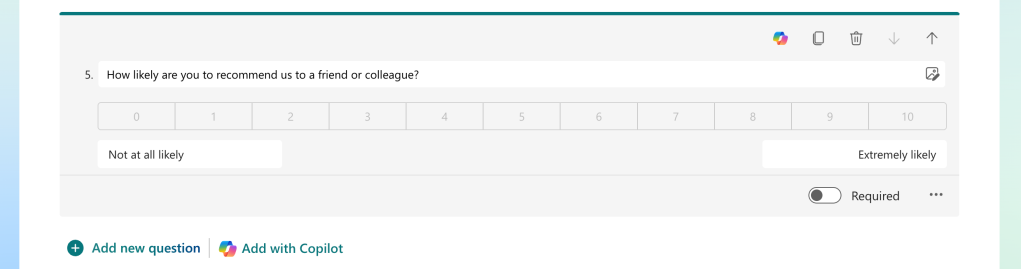
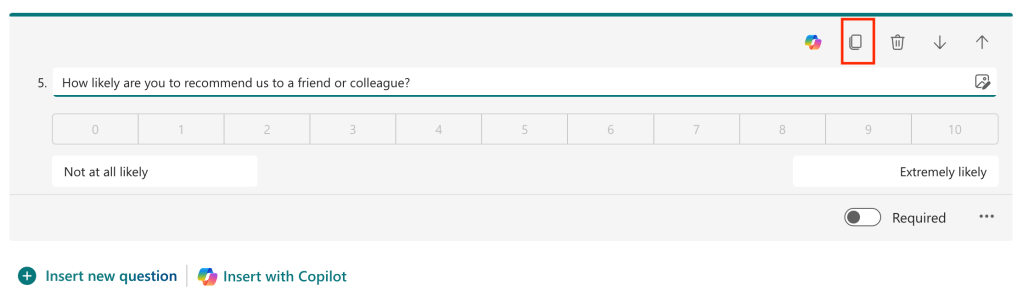
Net Promoter Score: Asks respondents how likely they are to recommend your product or service, on a scale from 0 (not at all likely) to 10 (extremely likely).
A typical Net Promoter Score question.
Shimon Brathwaite / Foundry
Section: This is not a question type but instead lets you create a new section within your survey, as covered below under “Building out your form.”
Once you’ve selected the question type, enter the question and responses you want respondents to see, then make any adjustments or restrictions, such as the “multiple answers” option for multiple-choice questions.
Here are a few additional tasks you’ll likely use when adding questions to your form:
To make a question required (respondents must answer it in order to complete the survey): turn the Required toggle on at the lower right of the question box.
To explore additional options for a question, such as the ability to shuffle responses or add a subtitle: click the three-dot icon to the right of the Required toggle.
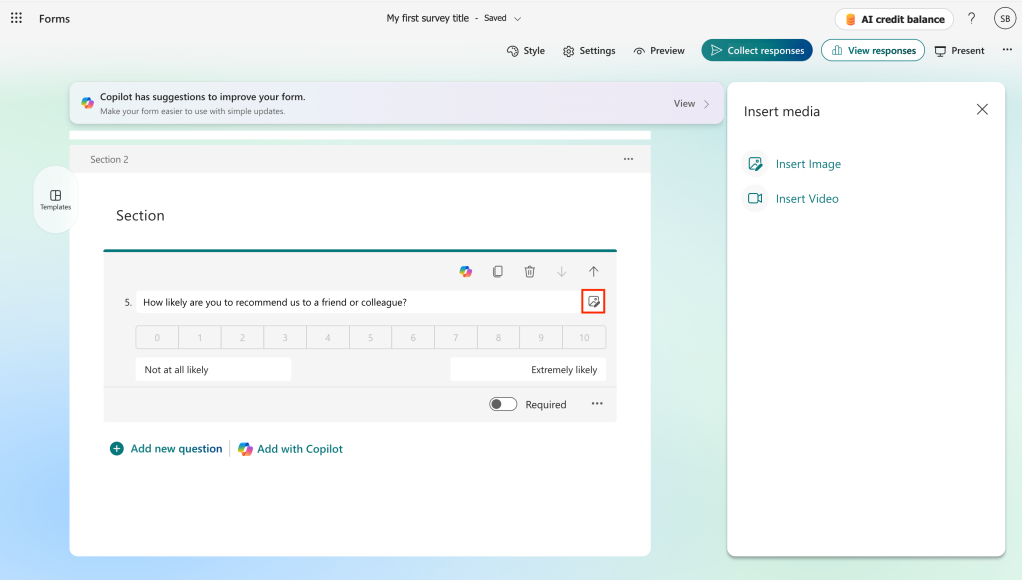
To add an image or video to a question: click the image icon on the right. On the “Insert media” pane that opens, choose Insert Image or Insert Video. For an image, you can do a Bing web search, browse your OneDrive folders, or upload an image from your computer. For a video, you can paste in a YouTube URL. In a multiple-choice question, you can also add an image to each of the options.
You can add an image or video to a question.
Shimon Brathwaite / Foundry
Building out your form
To add more questions to your form, just keep clicking the Add newquestion button that appears below the previous question and repeating the steps above. Here are a few more things that are useful to know how to do:
To edit a question: simply select the question and make your changes.
To duplicate a question: select the question and click the Copy question button at the upper right of the question box. A copy of the question appears immediately below it. This is handy if you have more than one question with similar formatting: you can save time by duplicating the question and editing it rather than starting from scratch each time.
Using the Copy question button can save you time.
Shimon Brathwaite / Foundry
To delete a question: select the question and click the trash can icon at the upper right of the question box.
To move a question up or down: select the question and use the up or down arrow icons at the upper right of the question box.
To insert a question in between existing questions: select the question above the place where you want to insert the new question. Click the Insert new question button (which appears in place of “Add new question”) and proceed as usual.
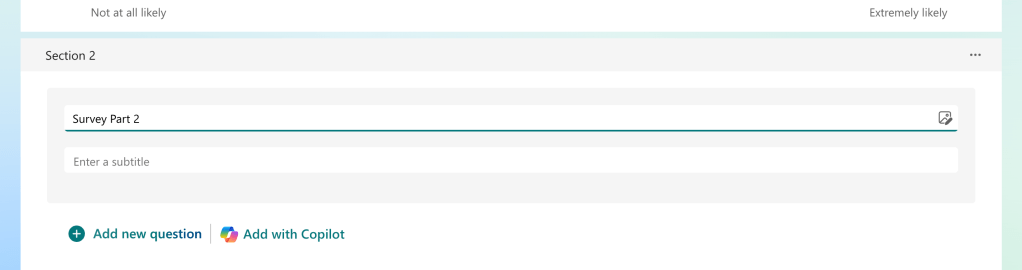
To add a new section to the survey: select the question above the place where you want the new section to appear. Select Add new question or Insert new question and then click on Section. Enter a title for the new section. You can optionally add a subtitle and image or video as well.
It can be helpful to break a form into sections.
Shimon Brathwaite / Foundry
Adding branching to your form
This feature is optional, but it’s powerful: You may have one or more questions in your form that you want to branch — that is, if the respondent answers the question one way, you can send them to a different follow-up question than if they answer the question another way. Thus, branching makes the most sense for multiple-choice questions.
It’s best to wait until you’ve added all your questions to the survey before you add branching. Once you’ve done so, select the question you want to branch, click the three-dot icon at its lower right, and select Add branching.
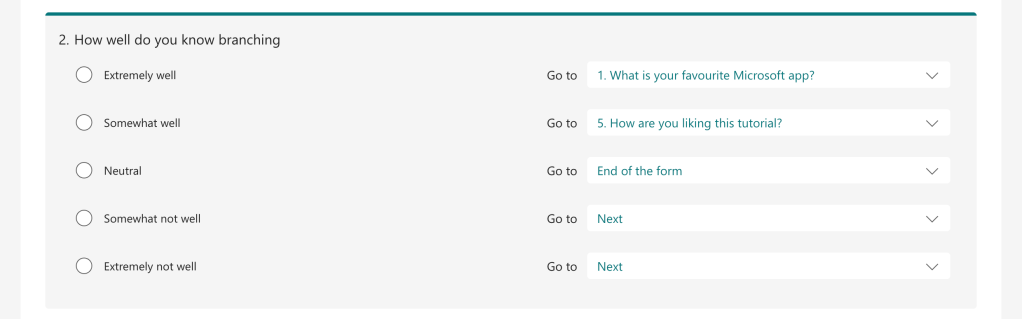
In a multiple-choice question, a “Go to” menu will appear to the right of each option. You can click Next in any of these boxes and choose a specific question to send the survey taker to.
Adding branching to a question lets you set different follow-up actions for different responses.
Shimon Brathwaite / Foundry
How to create a form from a template
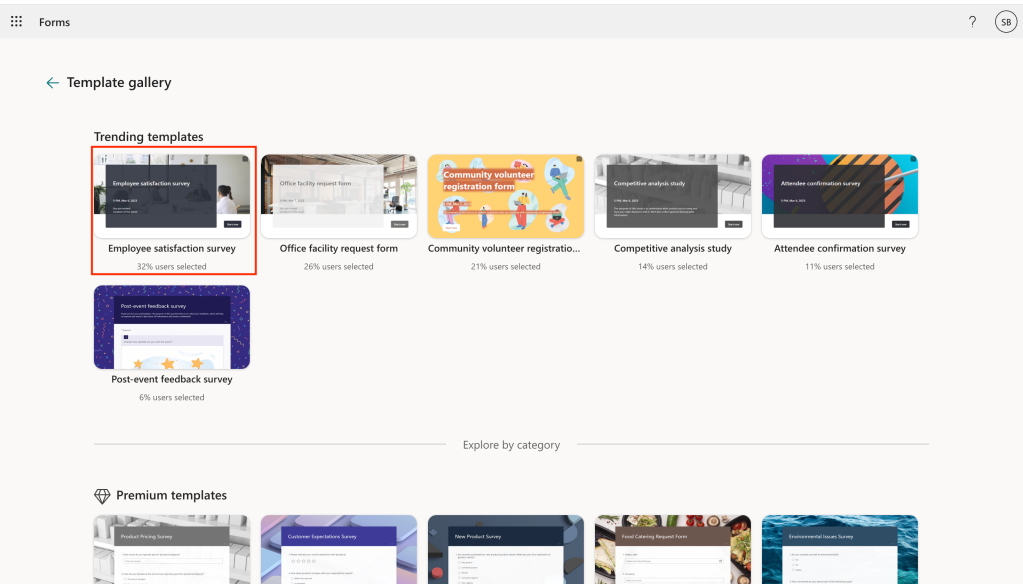
Rather than starting a new form from scratch every time, you can get a head start by using one of the templates Microsoft provides. Go directly to Microsoft’s Forms template gallery or navigate there from the Forms home page by clicking Template gallery at the right side of the “Explore templates” area near the top.
Here you can choose from a variety of templates including a market research survey, manager feedback survey, office facility request form, and more. Click on the Employee satisfaction survey to open it in your browser.
The Forms template gallery has more than a dozen templates to choose from.
Shimon Brathwaite / Foundry
You’ll see a form that’s prepopulated with questions and answers. You can edit any of the existing questions, delete those you don’t want, and add your own questions into the mix.
Using templates gives you a head start on many standard business forms.
Shimon Brathwaite / Foundry
Starting from a template not only saves you from having to enter all your questions manually, it may also provide valuable questions you wouldn’t think of on your own.
How to create (and edit) a form with Copilot
Microsoft 365 Copilot is the AI assistant that’s integrated with Forms and other Microsoft 365 apps. Access to Copilot in Forms is included with Microsoft 365 Individual and Family subscriptions, while M365 Business and Enterprise users need a separate M365 Copilot subscription. (Copilot isn’t available in Forms with a free Microsoft account.)
If you’ve worked with tools like ChatGPT or Claude, you understand that AI assistants can help you quickly perform actions that could be time consuming to do manually. In this section, you’ll see how to quickly create a survey using M365 Copilot.
First, go to the Forms home page and click on New Form. After you’ve given the new form a title and description, click the Draft with Copilot link to the right of “Quick start with.” Type in a prompt outlining the survey you want Copilot to create, such as the following:
Please create a survey that asks readers how they enjoyed the “Microsoft Forms cheat sheet 2025” article. It should be five questions long and all questions should be required. Also, give it a modern green style layout.
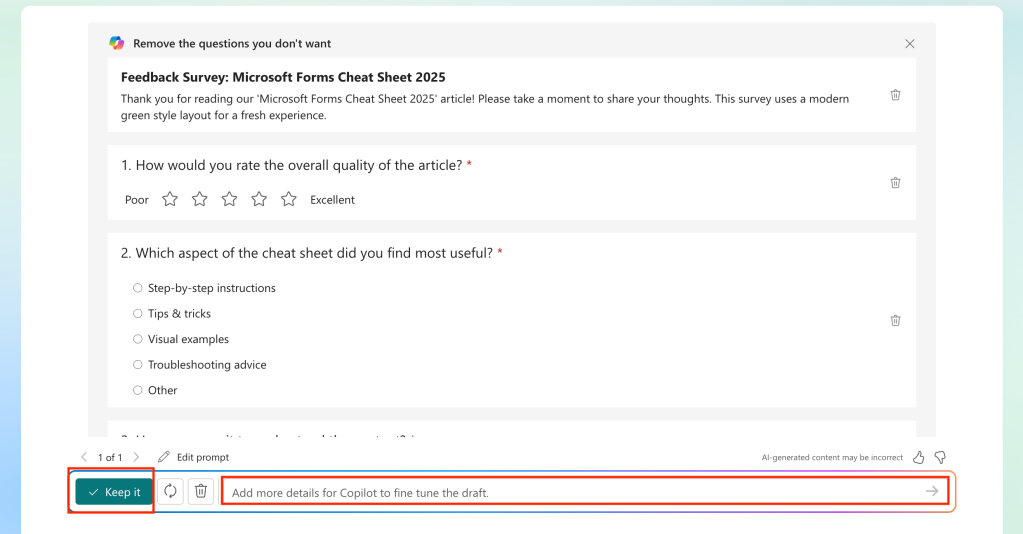
Then click Generate, and Copilot will create a survey draft.
A feedback survey generated by Copilot.
Shimon Brathwaite / Foundry
If you like the survey draft, you can select Keep it. If you don’t, you can click the circular arrows icon to have Copilot try again or the trash can icon to delete it. A final option is to add more details to the prompt to refine Copilot’s output.
If you decide to keep the survey Copilot drafted, you should review it carefully and edit it. All generative AI tools make mistakes, Copilot included. In the example survey it created in response to the prompt above, for example, it included the text “This survey uses a modern green style layout for a fresh experience” in the description — not something you’d want in the final survey.
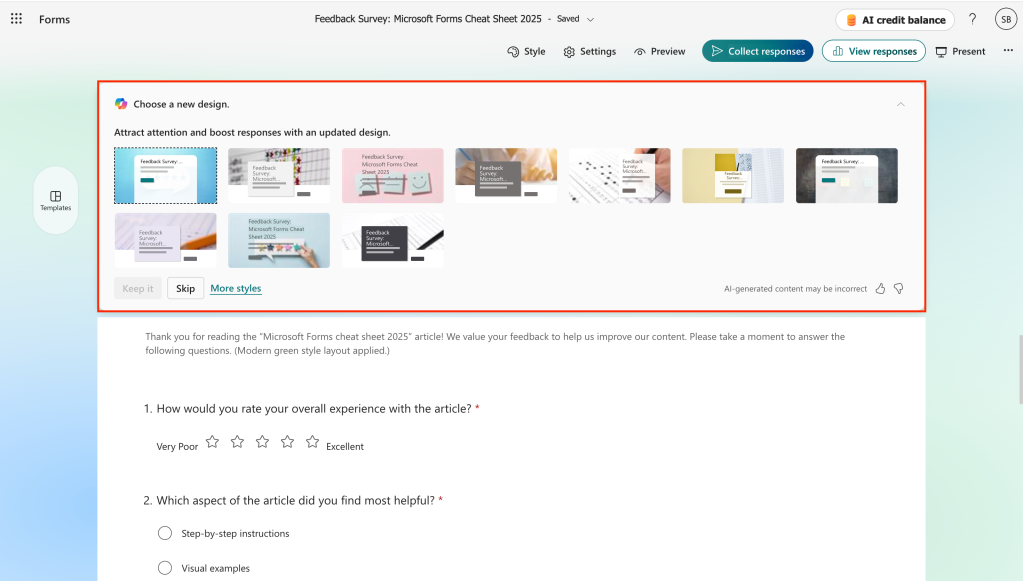
Also note that Copilot may not be able to do everything you request. For instance, it wasn’t able to style the form with a theme/layout in my testing (even though it said it did) — a limitation that may change with time. But it’s still a great starting point and a major timesaver.
In addition to drafting entire new forms with Copilot, you can ask it to create individual questions as you’re building out a form. Just click Add with Copilot or Insert with Copilot and enter your prompt.
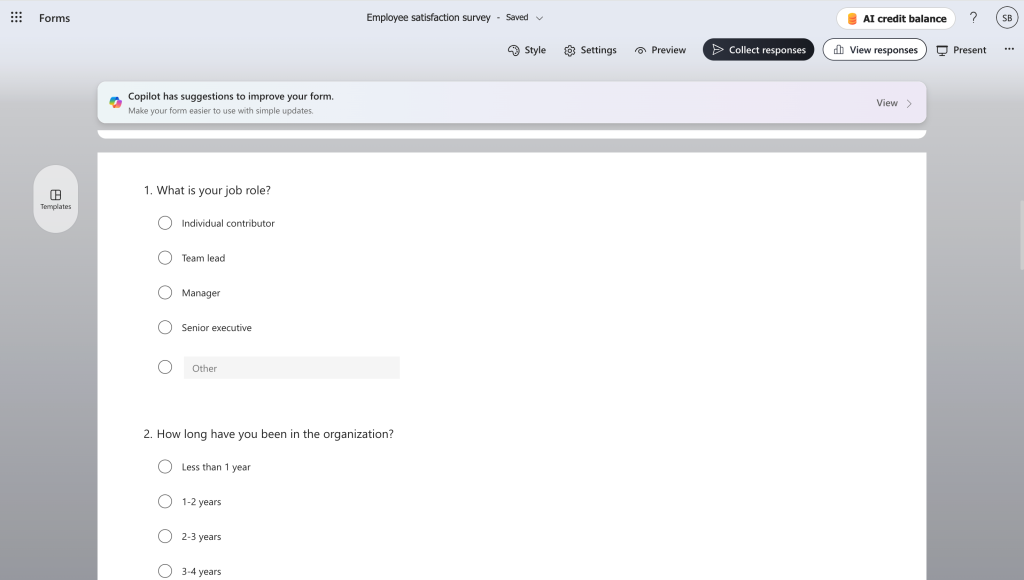
You can also ask Copilot for ideas to enhance any form. When you’re working on a form, you’ll see a banner across the top that says, “Copilot has suggestions to improve your form.” Clicking this will generate some suggestions, such as choosing a fresh design.
Copilot can suggest ways to improve an existing form.
Shimon Brathwaite / Foundry
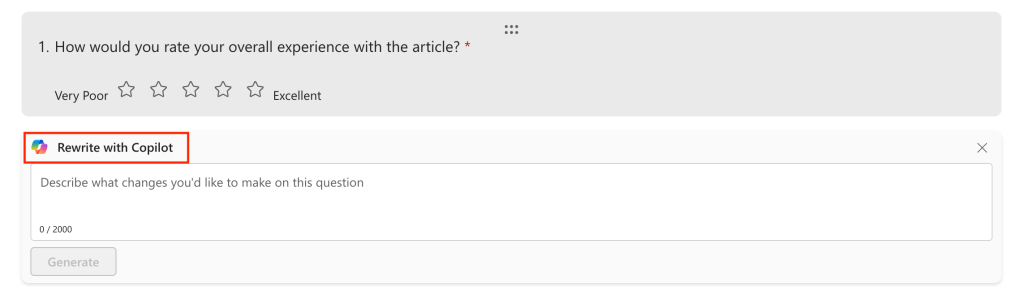
Finally, you can use Copilot to improve individual questions. If you select a question in a form, you’ll see a Copilot button alongside the copy, delete, and move down / up buttons in the upper right of the question box. Click it to open up a prompt where you can describe the changes you’d like Copilot to make to the question.
Asking Copilot to rewrite a question.
Shimon Brathwaite / Foundry
How to create a quiz
Quizzes are similar to surveys and other questionnaires, but with correct and incorrect responses. You can assign points to each question, report respondents’ scores, and explain why certain responses are right or wrong. A quiz is a good way to assess how well attendees of a training course have learned the subject matter and coach them in areas they don’t fully understand.
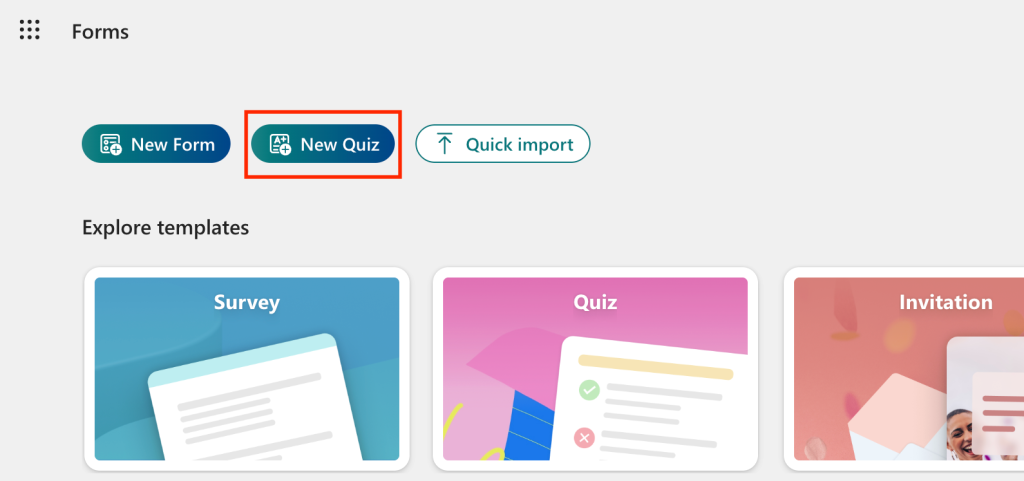
To create a new quiz, go to the Forms home page and click the New Quiz button at the top of the page.
Starting a new quiz.
Shimon Brathwaite / Foundry
If you have access to Copilot in Forms, you will be presented with a Copilot prompt window. You could enter a prompt (including source material to base the quiz on) to have Copilot generate a quiz instantly. But for the purposes of this tutorial, click the X at the upper right to close out the prompt window.
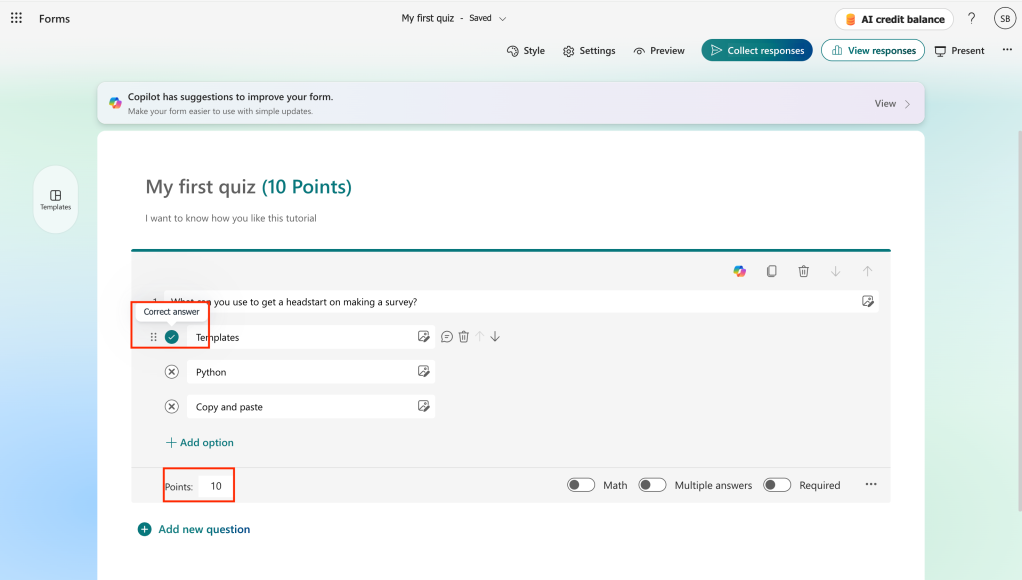
The new quiz page looks just like the new form page. Indeed, creating a quiz is just like creating a form — you add questions the same way, except that you designate the correct answer and assign a point score to each question.
When you enter the answers for a question, you’ll see a circled checkmark to the left of each answer. Click one of the checkmarks to mark it as the correct answer. Then go to the Points box at the bottom of the question box and type the number of points the question is worth.
Quizzes let you test respondents’ knowledge.
Shimon Brathwaite / Foundry
How to change your form’s theme
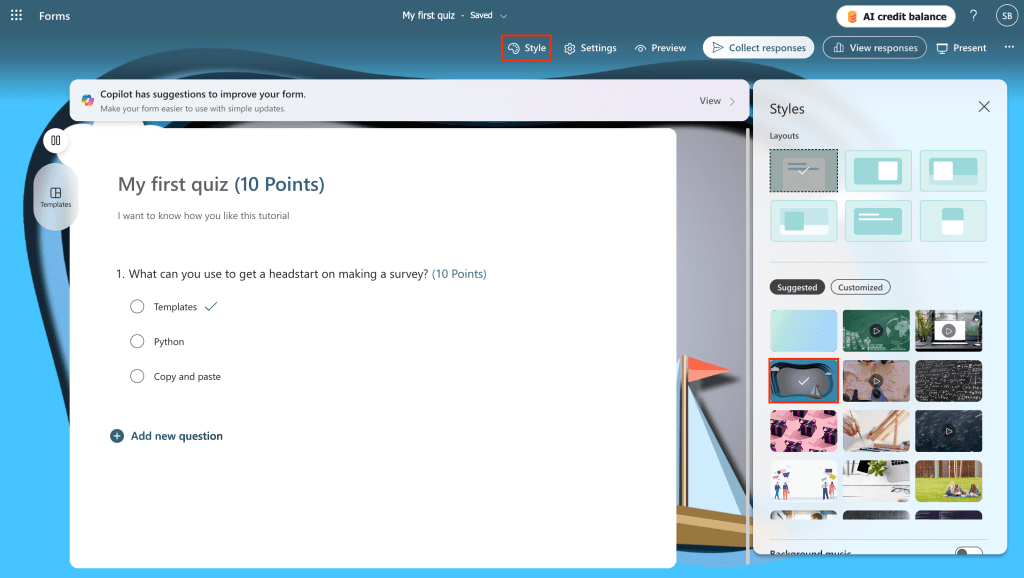
Now that we’ve covered the functional aspects of Microsoft Forms, let’s look at how you can change the look and feel of your questionnaire. Above your form to the right, click the Style button to open a panel with various layouts and themes. Look around and select a theme that you like to represent your company.
Choose a theme that suits your company and the form itself.
Shimon Brathwaite / Foundry
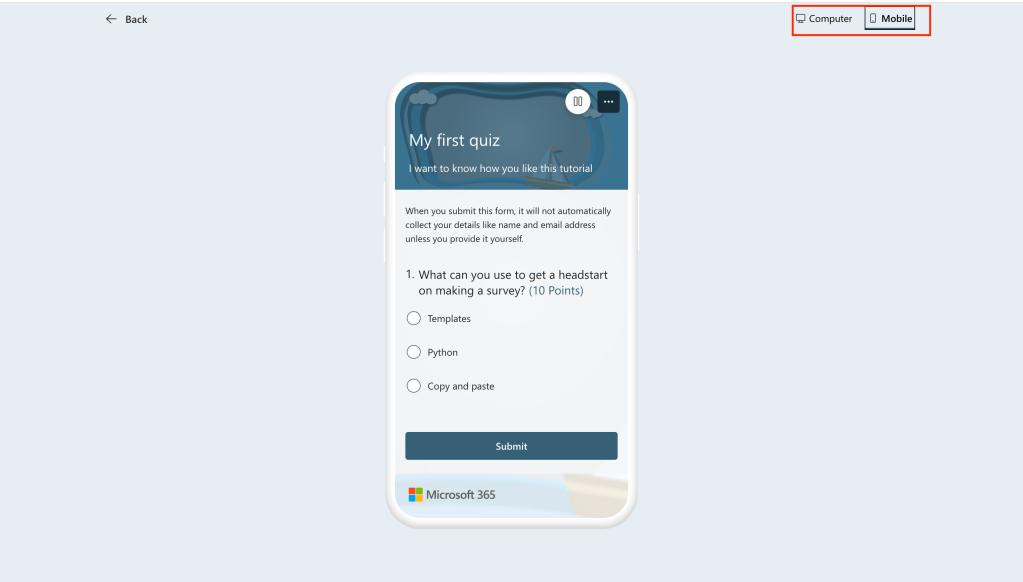
To preview how your form will look to respondents as they’re filling it out, click the Preview button at the top right of the page. You can toggle between Computer view and Mobile view by clicking the buttons at the top right of the preview page.
You can see how your form will look to both desktop and mobile users.
Shimon Brathwaite / Foundry
How to share your form
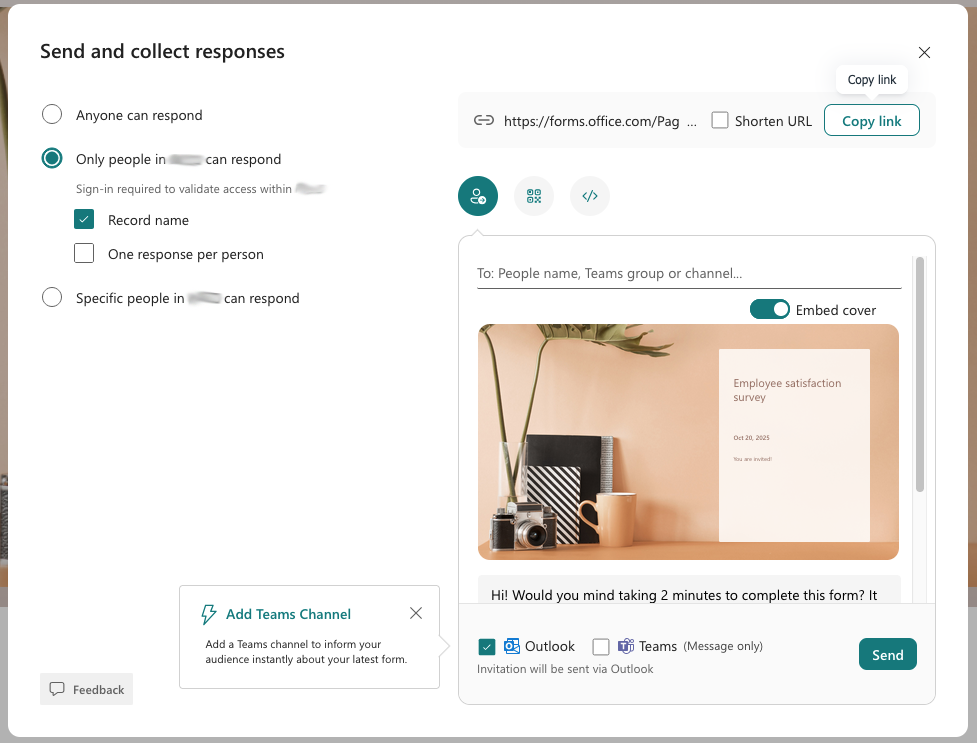
Once your form is finalized and you’re ready to start sending it to clients, employees, or other respondents, select the Collect responses button at the top right. On the pane that appears, you can create and customize the link that you will use to share your questionnaire with others.
Business users can send out a survey link publicly or privately.
Shimon Brathwaite / Foundry
If you have a business account and this survey is meant for people outside your company, click the first option, which allows anyone to respond. If it’s meant for employees in your company, choose the second option. And if you’re looking for feedback only from specific people in your organization, choose the third option and enter the names or email addresses of those people.
If you have a personal account, you will only have the option to allow anyone to respond.
Next, select the option to shorten your URL so that it’s less spammy and easier to share with other people in a text, email, or instant message. You can send the link out by clicking the Copy link button and pasting it into an email or other message. Alternatively, you can fill out the form on the right to send an email or Teams message with an embedded link.
How to view responses
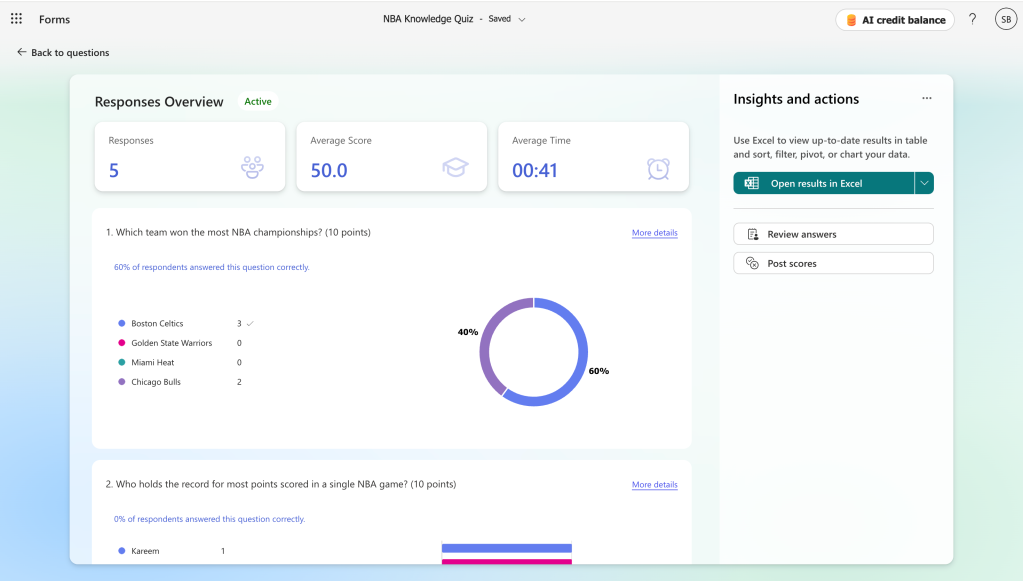
Microsoft automatically keeps track of all responses to your form and provides you with a summary of that information in a visual dashboard. Click the View responses button at the top right to see your summary.
Forms collects and summarizes your survey’s responses.
Shimon Brathwaite / Foundry
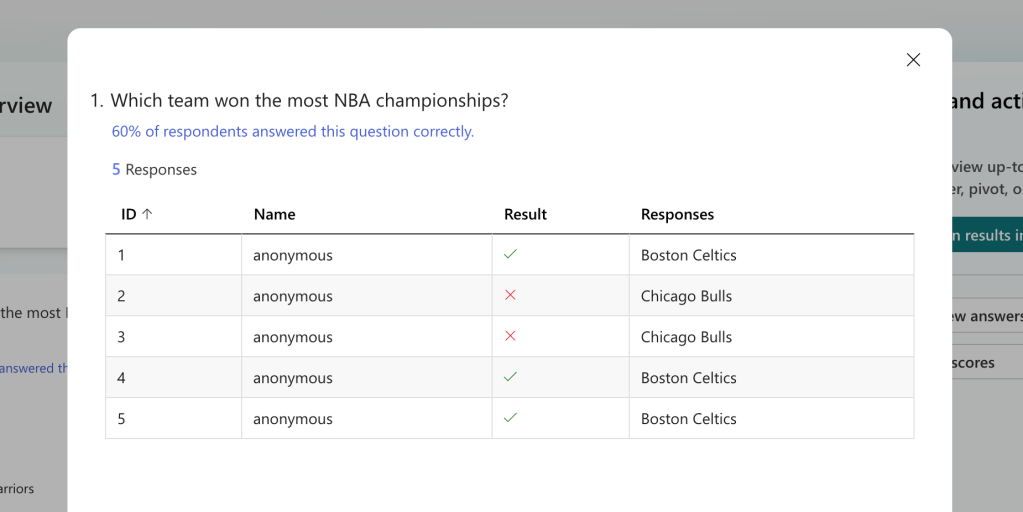
To view responses individually, click the more details button on the right-hand side of your initial summary of responses. On this page, you can scroll through all of the responses that you’ve received to your form.
Viewing the answers from an individual respondent.
Shimon Brathwaite / Foundry
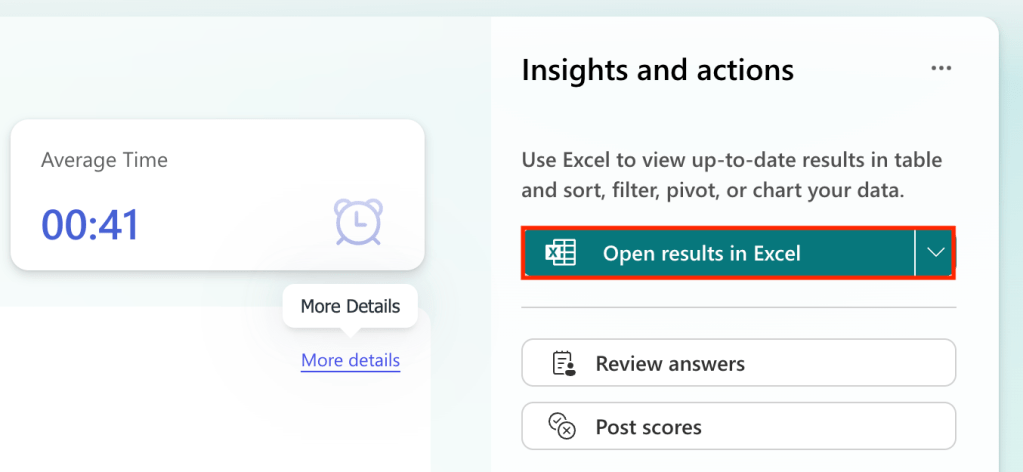
You can also export your results to Excel for offline viewing. Click Open results in Excel to the right of the initial summary.
Click this button to export your results to Excel.
Shimon Brathwaite / Foundry
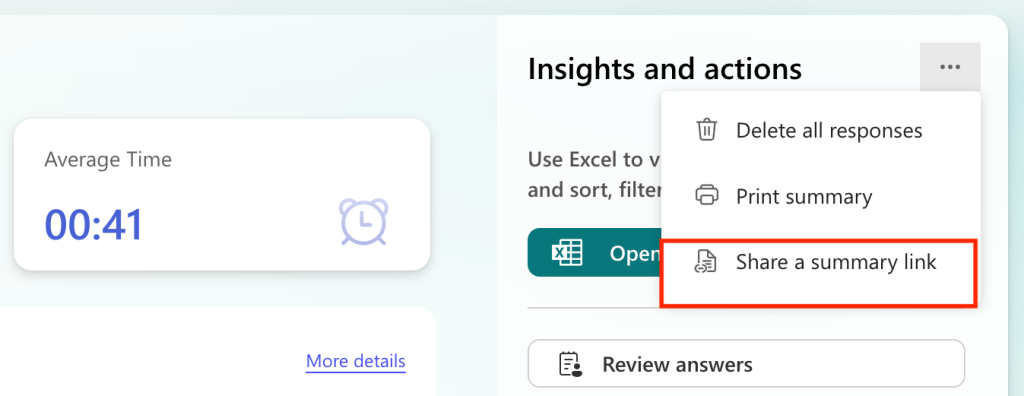
Lastly, you can share this results page with anyone you want via a link provided by Microsoft. Click on the three-dot icon to the right of the “Insights and actions” title on the right and choose Share a summary link from the pop-up menu. Forms will generate a link that you can copy and share.
Sharing a summary link.
Shimon Brathwaite / Foundry
This article was originally published in November 2023 and updated in October 2025.
Major US tech companies are spending more money than ever lobbying the EU to influence its digital rules, Politico reports. Artificial intelligence and rules such as the Digital Markets Act (DMA) and the Digital Services Act (DSA) will be a particular focus.
A new analysis shows that 733 digital sector players together spend around €151 million a year on lobbying, compared to €113 million in 2023.
The biggest spenders are US companies such as Meta, Microsoft, Apple, Amazon, Qualcomm and Google. The top 10 tech companies now spend more than the top players in the pharmaceutical, financial and automotive industries combined. Meta is now the biggest lobbyist in the EU with an annual budget of over €10 million.
Increased spending is also reflected in more lobbyists and more meetings with EU institutions. Critics argue that lobbying can weaken established rules, while companies themselves claim they want to provide expertise to lawmakers.
While there were solid improvements in the last generation of Apple’s popular wearable, the huge 24-hour battery life in Apple Watch Series 11 means this smartwatch has finally become what it always promised to be: a device capable of running all day and all night, which is especially for tasks like sleep tracking.
Based on my time with a Series 11 version provided for review by Apple, if you already wear a Series 10 Apple Watch, much will feel the same. The newest edition is just as thin, weighs about the same, and even looks the same. If you’re already comfortable with your existing watch, the new one will be familiar.
The ever improving user experience
Setting up a new Apple Watch seems to get a little easier each time; all you need to do is power it up and hold it near your iPhone to begin the pairing process. You’ll be given a sequence of easy start-up instructions and the chance to set the watch up as new or restore it from a backup. With the exception of the restore, the process takes no time at all, and you will be wearing your new watch in a few minutes.
Like so much about what Apple does, many of us may take the ease of setup for granted. We shouldn’t. Apple has spent years refining that part of the experience to make it as seamless and easy as possible. It’s continuously improved that experience since the first Apple Watch, with user interface improvements, added watch faces and dozens of built-in tools to help you with your life. (Being able to walk through many airports using travel tickets and boarding passes tucked away on your watch can feel pretty magical sometimes.)
Once I upgraded, everything pretty much just worked — with the exception of apps that might require authorization, and card payments using Apple Pay/Wallet, which had to be verified with my payment providers. (Some payment providers have a multistep process for this; others just took two steps.)
Pretty soon, I was going about my daily business, using the watch to check incoming messages, monitor my step count, check the weather, pay for groceries, deal with public transit, get directions, and take calls — thanks to the built-in cellular connection. I’ve even used the watch to convert ingredient measurements when cooking recipes.
Typically, Apple Watch wearers do a lot with their device, which has been a problem when using the sleep tracking it has provided since 2020. Using that feature meant you had to remember to charge the device before or after you slept if you wanted to continue using it the rest of the day.
This got better with Apple Watch Series 10 which gave us up to 18 hours of use, but Apple Watch Series 11 is the equivalent of the Holy Grail, offering up to 24 hours of battery life. It means you can track sleep and still use your watch the next day, something Apple Watch users have wanted from the start.
Apple also introduced a second battery boost in the form of faster charging, which means that when your watch is running out of power you’ll get eight more hours of battery life in just 15 minutes on charge (or 5 minutes for a night’s sleep tracking). That’s a meaningful upgrade on its own.
Ion-X glass used in the screen is much more durable; users may notice how much less prone it is to becoming scratched than any previous model. There’s a reason for that, which is that Apple has tweaked the sophisticated and proprietary process design to put together the toughest glass in the industry, reinforced with a ceramic coating at an atomic level. This basically makes the screen incredibly hard to crack.
Hypertension notifications should help people better maintain oversight of their own fitness, helping by spotting some of the signs of heart attack, stroke, or kidney disease. To achieve this, the watch gathers data from the optical heart sensor over a 30-day period, analyzes this, and notifies you if it spots consistent signs of hypertension.
The blood oxygen app has once again appeared, alongside all the other fitness features. It’s why Apple Watch remains king of the fitness bands, though the hypertension feature is once again something most of us hopefully will never have to deal with.
Another thing you don’t see is a new chip inside. The S10 is basically the same chip used in the previous model. Also identical are the W3 Apple Wireless chip and the Ultra-Wideband chip used in the devices.
Intelligent machines
I think this is the first time Apple has not upgraded the processor inside a new watch model, though software tweaks and other on-device improvements mean you will continue to get seamless, responsive performance.
Apple has also put more artificial intelligence inside, principally a new neural network that helps optimize some tasks, including voice isolation when using the watch to make a call. Apple has also improved one of the more popular apps. The Workout Buddy delivers more personalized ways to stay active and supports additional workout types. Meanwhile, the addition of flick gestures, watch faces and more means everything that already works on Apple Watch works at least as well as it ever did. The overall result is a big improvement in the overall user experience.
What was always good about the Apple Watch remains just as good as ever. In many cases, artificial intelligence has made those features better, while the improved display and battery resilience means you can usually trust Apple Watch to take you where you want to go, and back again.
If you have an Apple Watch Series 10, you might be tempted to upgrade — six hours of extra battery life is nice to have. If you have an older model, the battery life improvement makes this a super upgrade. It means you now have a wearable that can take you through your night and through your day, while also letting you know how much energy you need yourself, thanks to the sleep monitoring tools you can more easily use. Apple Watch Series 11 prices begin at $399 and is available now.
Last week, the privacy-focused messaging service Signal was temporarily shut down when Amazon Web Services (AWS) suffered a major outage. This led to criticism of Signal’s use of such a dominant provider as AWS.
Signal CEO Meredith Whittaker has now commented that Signal basically has no other choice.
“The problem is the concentration of power in the infrastructure space, which means there is effectively no real alternative: the entire stack is effectively owned by 3-4 players,” writes Meredith Whittaker on Bluesky.
She continues:
“The question isn’t ‘why is Signal using AWS?’ It’s about looking at the infrastructural requirements of any global, real-time mass communication platform and asking how it is that we have ended up in a situation where there is no realistic alternative to AWS and the other hyperscalers.”
Soaring optimism about AI has set off a huge global boom in data center construction that could be storing up problems for the future if the sector suffers a sudden correction.
That’s the thinly-disguised message from two interventions by the Bank of England (BoE) last week. The first was an analysis, published on Friday, that examines how AI is creating deeper financial dependencies across the tech sector and beyond.
At the heart of this are data centers, the element on which the whole AI economy depends. AI needs a lot of them, which will cost $5.2 trillion worldwide by 2030 to build, according to McKinsey. The BoE suspects that meeting this demand will increasingly involve companies taking on extra debt, which is where its anxiety starts to rise.
The sums of money estimated to be going into the data center sector are huge, dwarfing previous tech booms over similar timescales. Should the AI market hit problems — for example, after a dot.com-like market correction — the banks making those loans could face losses on a scale that risks wider economic problems, said the BoE.
In case the message was missed, BoE sources separately told Bloomberg that the BoE is currently reviewing the scale of lending to the data center sector and the interconnections between its leading companies.
Economics are good when demand remains high
From the bank’s perspective, building huge AI datacenters isn’t that different to property development. The economics are good as long as demand remains high. If demand drops, an AI data center that can’t easily be put to alternative use turns into another large building nobody wants.
However, that’s only one part of the problem. Meeting the power demands of AI data centers will require the energy sector to make large investments. Then there’s data center demand for microprocessors, rare earth elements, and other valuable metals such as copper, which could, in a bust, make data centers the most expensively-assembled unwanted assets in history.
“Financial stability consequences of an AI-related asset price fall could arise through multiple channels. If forecasted debt-financed AI infrastructure growth materializes, the potential financial stability consequences of such an event are likely to grow,” warned the BoE blog post.
“For companies who depend on the continued demand for massive computational capacity to train and run inference on AI models, an algorithmic breakthrough or other event which challenges that paradigm could cause a significant re-evaluation of asset prices,” it continued.
According to Matt Hasan, CEO of AI consultancy aiRESULTS, the underlying problem is the speed with which AI has emerged. “What we’re witnessing isn’t just an incremental expansion, it’s a rush to construct power-hungry, mega-scale data centers,” he told Network World.
Could be worse than the dot.com bust
The dot.com reversal might be the wrong comparison; it dented the NASDAQ and hurt tech investment, but the damage to organizations investing in e-commerce was relatively limited. AI, by contrast, might have wider effects for large enterprises because so many have pinned their business prospects on its potential.
“Your reliance on these large providers means you are indirectly exposed to the stability of their debt. If a correction occurs, the fallout can impact the services you rely on,” said Hasan.
Meanwhile, some now believe that AI data center investment is draining money from other things, including US President Trump’s attempts to persuade companies to build more factories in the US. Sceptics have also warned about the folly of pushing money through startups like OpenAI, and of the likelihood of a painful market reversal.
Perhaps, it has also been suggested, bubbles are a necessary phase in every technological wave, a list of which, in addition to the dot.com implosion, would include excessive investment in internet and telecom infrastructure around the same time.
A more gradual slowdown is also possible. In this scenario, limitations in adjacent technologies such as storage slow the growth of AI, not the lack of AI data center capacity as such. Either way, at some point, experts say, the AI and data center market will need to consolidate into fewer more stable companies to prevent the dire consequences of the ballooning debt.