Month: December 2025

Newly discovered malicious extensions could be lurking in enterprise browsers

A sprawling surveillance campaign targeting Google Chrome and Microsoft Edge users is just the latest evolution of a seven-year-long project to distribute malicious browser extensions.

By targeting trusted browser extensions and weaponizing them only after they had passed initial acceptance checks and gained a broad following, sometimes over years, a group that Koi has labelled “ShadyPanda” has infected 4.3 million browser instances to harvest browsing data, hijack search results, manipulate traffic, and deploy a backdoor capable of remote code execution.

The risk for enterprises is significant if any of those browsers are on work PCs or on employees’ own devices used to access work resources, Koi warned.

“Infected developer workstations mean compromised repositories and stolen API keys,” security researcher Tuval Admoni said in a post on the Koi Security blog. “Browser-based authentication to SaaS platforms, cloud consoles, and internal tools means every login is visible to ShadyPanda.”

The malicious extensions are no longer being distributed, but organizations with infected machines remain at risk: “Even though the extensions were recently removed from marketplaces, the infrastructure for full scale attacks remains deployed on all infected browsers,” Admoni said.

Multi-year campaign with shifting motives

Koi’s analysis shows that ShadyPanda maintained a multi-year, multi-generational infrastructure of browser extensions dating back to 2017. The group cycled through dozens of extensions, with 20 published to the Chrome Web Store and 125 distributed for Edge.

The earliest extensions focused on affiliate fraud, extracting hidden commissions on victims’ online purchases, later shifting to search-result manipulation. Most recently, they have included sophisticated behavioral tracking, session-data harvesting, and browser fingerprinting surveillance affecting 4 million users, and a backdoor supporting remote code execution (RCE) affecting 300,000.

ShadyPanda played the long game, with extensions including the popular Clean Master utility with 200,000 installs distributed as completely legitimate tools early on, earning them positive user ratings and, in some cases, trust signals such as “Featured” or “Verified” badges in the Chrome Web Store and Microsoft Edge Add-ons store.

No review after submission

This long-term legitimacy built a large user base and may have normalized these extensions inside enterprises, where browser add-ons often pass through with little scrutiny. Only after accumulating trust, and millions of installs, did ShadyPanda push silent malicious updates. It embedded hidden install-tracking routines that mapped user behavior and optimized reach before weaponizing it through a malicious update.

Because Chrome and Edge updates occur automatically and do not require user re-approval for existing permissions, the exploit happened quietly.

“ShadyPanda’s success is about systematically exploiting the same vulnerability for seven years: Marketplaces review extensions at submission,” Admoni said. “They don’t watch what happens after approval.”

Evasion and Man-in-the-Browser tricks

ShadyPanda also invested in staying hidden. Koi found that when developer tools were opened, the malicious logic immediately switched to benign behavior, making manual analysis harder. Obfuscation and controlled activation further obscured the malicious component, ensuring stealth.

Koi noted that some of these extensions were still live in the Edge Add-ons store at the time of disclosure. Clean Master’s publisher, Starlab Technology, launched 5 additional extensions on Microsoft Edge around 2023, picking up over 4 million combined installs. “All 5 extensions are still live in Microsoft Edge marketplace,” Admoni said, adding that two of those are comprehensive spyware.

Google recently removed Clean Master from the Chrome Web Store, and today none of the extensions are available on Chrome Web Store, a Google spokesman said. Microsoft did not immediately respond to CSO’s request for comment.

Like in a man-in-the-middle (MitM) style attack, ShadyPanda effectively positioned itself between users and the websites they visited, inserting tracking logic into pages they loaded. This allowed the attackers to observe and manipulate traffic through the browser, giving the actor continuous visibility into how infected users interacted with the web.

Admoni pointed out that removing the extensions might not help as, presumably, the attackers may already have collected high-value data including cookies, browsing patterns, session tokens, fingerprinting data, etc.

In its blog post, Koi provided a list of malicious Chrome and Edge extensions, along with C2 and data exfiltration domains to support detection efforts.

This article originally appeared on CSO.

Nexthink CEO: AI agents to enable ‘personal IT manager’ for every worker

Amid the hype around AI’s productivity potential, many businesses still face slow adoption among their employees. Pedro Bados, CEO and co-founder of Nexthink, believes that digital employee experience (DEX) tools could help close that gap by giving companies insights into how staffers actually use generative AI (genAI) assistants.

AI will influence Nexthink’s products in a variety of ways, according to Bados. Automated agents will be carrying out routine IT tasks, he said, freeing up IT teams to take on more strategic work. 

AI has been central to Nexthink’s business since its inception. Two decades ago, the company spun out of the Artificial Intelligence Laboratory at the Ecole Polytechnique Fédérale de Lausanne in Switzerland, where Bados studied. “We were born as an AI company, probably 20 years too early,” he said. 

Pedro Bados, cofounder and CEO of Nexthink

Pedro Bados, cofounder and CEO of Nexthink.

Nexthink

With expertise across the company, Nexthink moved quickly to integrate large language models (LLMs) after the first version of ChatGPT arrived three years ago.

Now majority-owned by Vista Equity following a deal last month valuing the company at $3 billion, Nexthink is entering the next chapter in its journey, Bados told Computerworld. The investment will enable further expansion of its operations as Nexthink works to bring DEX into the mainstream.

This interview has been condensed and edited for clarity.

How are you building AI into Nexthink’s products? And how can you help customers to deploy AI to their staff?“There are three areas in which AI has been transformational. With DEX, you have this telemetry — information and insights about how employees are consuming services — so you see all the problems and the adoption metrics. When you apply LLMs on top of this data, you can do three things. 

“The most important is that you can take DEX to employees. Before, DEX was for IT departments, but with chatbots or agents nothing prevents an employee from fixing their own problems. An employee would open a ticket, then IT would go to Nexthink to fix it; now an employee can do some of this themselves. We have an agent called Spark which is basically your personal IT manager — we think that every employee will have a personal IT manager ready to help for any application. It’s an immense opportunity.

“The second thing is AI Drive. We understand how people are adopting AI — whether that’s Copilot, ChatGPT,Anthropic, or agents in Salesforce — and can give these metrics to CIOs and  AI leaders: this is how your organization is adopting AI, this is the benchmark, this is what you should do to enhance adoption. It’s a big pain for customers now.

“The third point is we see a democratization of DEX. DEX is not just for digital workplace leaders anymore, but also security and HR teams. Through what we call Assist — a conversational interface on top of our data — HR can say, ‘How many people do I have in this office?’ Or network professionals can say, ‘How many people are having Wi-Fi problems in this particular location?’ Before, you needed to be an expert in DEX, but now you can do this with a conversational interface. 

“So there are these three buckets: take DEX to employees with a personalized IT agent; support AI transformation in your company with AI Drive; and expand DEX to other teams. It’s a huge revolution.”

A lot of the AI market is now moving toward agents. How will Nexthink’s platform evolve as you integrate agents going forward? “First of all, our vision for agents is as ‘helpers.’ We don’t want to replace people, we see it more like the pilot on the plane: you have an autopilot that is doing maybe 80% of the work, but there’s always a pilot supervising, giving feedback, and configuring. We see the job of IT becoming much more about supervising, training, and more strategic, with less busy work. 

“We want to offer a personalized IT manager to every single employee: that mission alone is a roadmap and a journey, because it’s very complicated and very ambitious. 

“We want to convert Assist into a kind of IT coach or professional for IT teams. There are lots of things to do there: we need to integrate data to make sure it’s very knowledgeable.  

“You can call them an IT agent for employees and an IT agent for IT professionals and those two missions are going to take us a few years.”

Whatare  the biggest challenges that organizations face around tracking digital employee experience? And what benefits do your customers typically see when they deploy Nexthink? “The No. 1 challenge that they are facing issupport costs increasing, so they want to automate. They don’t want to wait for the employees to report problems, and when they do report problems, they want to automate the resolution and fix it right away.

“They get around a 50% to 80% reduction in support costs [with Nexthink’s platform]. They get probably 20% to 30% cost reduction in hardware, because they see how computers are used, so they can optimize the refresh cycle of the computers. And they get about 20% to 30% cost reduction in the software metric, because they can see which applications are used, which are not used, and how to optimize them. 

“That’s one of the reasons why DEX is growing so fast.”

Vista will take a majority share in Nexthink in a deal that values the company at around around $3 billion. What does this say about Nexthink’s business and, more broadly, about demand for DEX applications? “Vista is probably No. 1 in enterprise SaaS in the world right now in terms of private equity, private capital. They have more than 100 software companies and have a really good radar on emerging trends and what enterprises will need in the next few years. They see the opportunity of digital employee experience because it’s something that customers are investing in. 

“They came to us and we were talking for a few months. We didn’t want to do an IPO in the short term because we are still going through a transformation: we are investing, and we don’t want to go under the scrutiny of public investors and things like that right now. I think we’ll be ready in three or four years.  We thought it was better to continue being private because of the innovation we are putting out there and because of the freedom it gives us.’

Will the deal involve fresh additional capital that can be used to invest in Nexthink’s business and operations? If so, where would that money be directed? “First of all, the company is profitable with a strong cash flow, so we have enough to invest and to continue investing in the future. With these additional investors, we have more ability to raise debt, to have additional capital for M&A, to open new markets that we were maybe limited from doing before. 

“We just opened the Japanese market in April, and we opened the federal market in the US — also a big market —earlier this year. We are very present in Europe and in the US so the idea is to expand and to continue investing in all these areas.”

Google is now the best at AI — but is it enough?

It took just under three years, but Google has finally caught up and overtaken its AI competitors.

You remember how it was. When OpenAI released ChatGPT at the end of 2022 and created a world-wide sensation, Google was caught napping— and panicked. Despite the fact its researchers had introduced the architecture behind the new language models five years earlier, and despite having the now Nobel Prize-winning AI lab Deepmind in the corporate family, it was OpenAI, not Google, that developed the first widely usable model.

There’s a lot of rumor and speculation floating around about what it was like at Google at the time. CEO Sundar Pichai supposedly declared “Code Red” internally, something he later denied. Larry Page and Sergey Brin reportedly stepped back into the company in “founder mode.” Either way, Google reorganized and put Deepmind and its head, Demis Hassabis, in the driver’s seat to focus on the new large language models (LLMs).

Google’s first attempt was Bard; it was released in the spring of 2023 and made serious mistakes from the get-go. Clearly, despite its muscle, Google had a long way to go to catch up with OpenAI and its patron Microsoft.

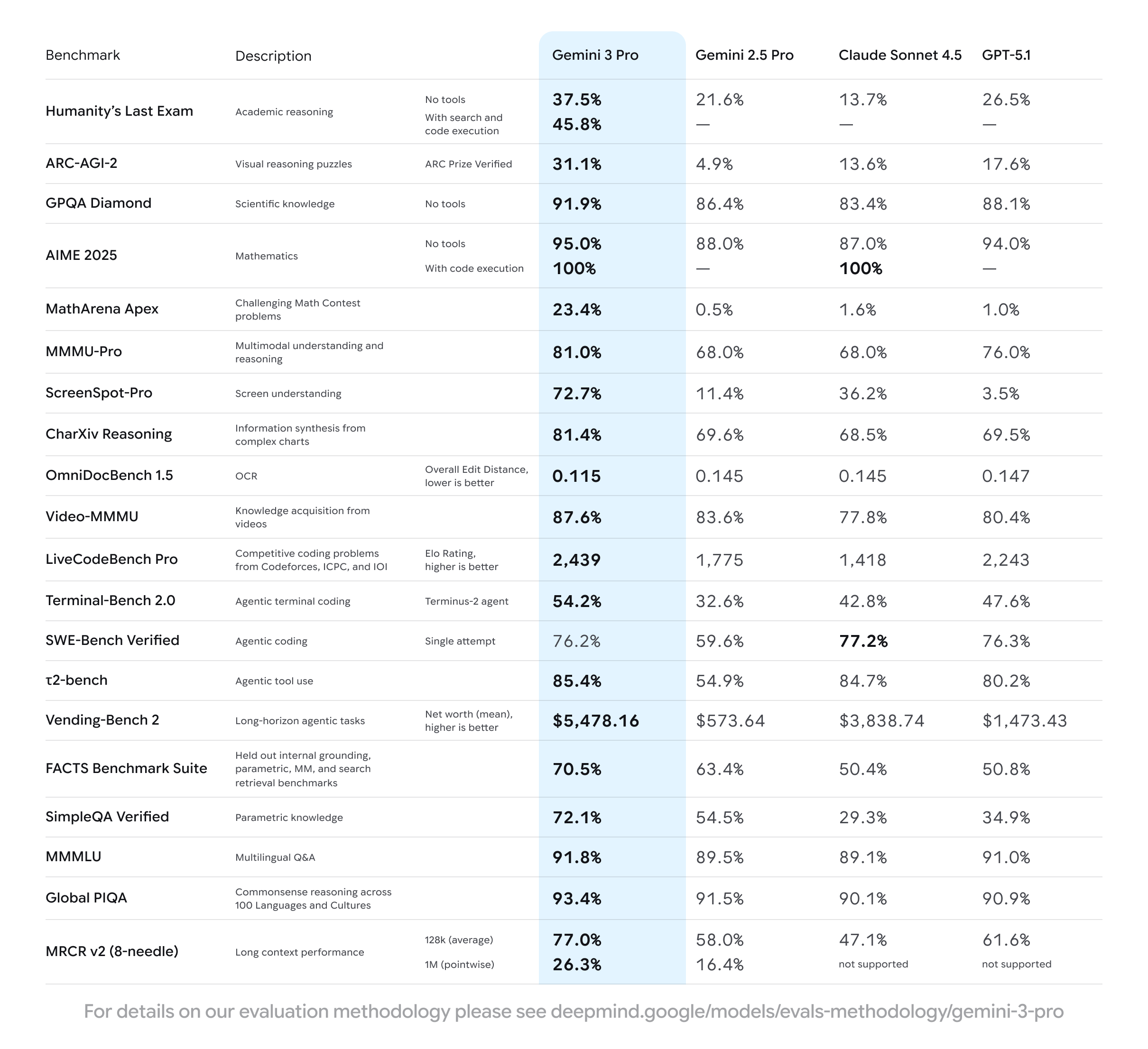
The journey lasted three years, because when Google released Gemini 3 last month, it was immediately clear Google had — at least for now — taken the lead in AI by a fairly good margin. Gemini 3 crushes rival tools in most measurable parameters, and more importantly, is almost unanimously praised by users.

It is not only Gemini 3 that makes Google right. Competitors are sure to release new top models that will keep the rally at the top of the LLM Arena going. It’s how they’ve done it that puts Google in a unique position.

Gemini 3 is not trained on the same Nvidia GPUs everyone else uses, but on Google’s own TPU chips. TPUs are ASIC chips that have a single use case (or in this case two, AI training and inference). In other words, they’re much more specialized than a GPU used for just about everything.

That makes them more cost-effective, but more importantly, they’re Google’s own chips. This means Google now has the entire vertical in AI: its own chips with its own software layer; its own top models; its own data centers; its own cloud services; its own consumer services;. its own operating systems; its own browsers; and its own mobile devices. It’s basically the same recipe that created the modern Apple. (This is a journey that Microsoft also wants to take, with its own chips and its own models).

Add to this a huge competitive advantage in a data set that no one else comes close to, from years of search indexing, from all of Youtube, from Street View, from Waymo cars — the list goes on.

On the chip front, Google will certainly continue to buy and lease Nvidia chips to its cloud customers. But there are already reports of big customers wanting to use Google TPUs.

Who’s panicking now? OpenAI chief Sam Altman is reported to have sent an internal memo to his staff admitting Google’s progress on Gemini 3 and warning of a “tense atmosphere” and “financial headwinds.” He argued that OpenAI now needs to focus on “catching up fast.”

(For its part, Nvidia went on X and congratulated Google, while pointing out that its own technology is “a generation ahead.”

It’s still important to remember one thing: despite having the full stack in AI, Google is not an “AI company,” in the same way that it’s not really a search service either. Google is still an advertising company, the largest in the world.

Google Cloud, the IT services if you will, is certainly an increasingly important part of the equation. In the last quarter, Cloud revenue grew by 34% and now accounts for 15% of Alphabet’s revenue.

But 72% of Alphabet’s revenue still comes from ads — and it was that revenue that prompted (or didn’t prompt) Pichai to issue that Code Red. The concern was that ChatGPT would compete with Google on search and cut into advertising revenue. And the ambition now is to have the best AI solutions on the market to continue selling ads.

All this means that Google is less sensitive to the bursting of what has been called an “AI bubble.” It is neither dependent on “AI revenue” nor on the most vulnerable AI companies. If I were to make a prediction, Google is probably the company that would hold out best in the event of an AI crash.

However, Google is all the more sensitive to what AI does to the internet economy. Where will companies spend their marketing money when chatbots take over? Will AI summations send enough traffic to make advertisers think it’s worth it? What will be the price per click?

That’s where you should look to see whether Google really will be the “winner” in AI — in the ad market.

This column is taken from CS Weekly, a personalized newsletter with reading tips, link tips and analysis sent directly from Editor-in-Chief Marcus Jerräng’s desk. Would you like to receive the newsletter on Fridays? Sign up for a free subscription here.

Apple faces a new privacy fight in India

User consent is under threat, at least when it comes to your right to decide what apps to install on your device. That’s because India now wants all smartphone makers to install a government-mandated app on their devices, an app that cannot be deleted. It’s yet another privacy-related struggle for Apple — and for all of us. 

What happened? India’s Ministry of Communications last week privately demanded that manufacturers pre-install India’s Sanchar Saathi app on mobile devices within just 90 days. The demand doesn’t only affect smartphones intended for sale in India, as manufacturers will also be forced to install the app on older devices through a future software update.

India, Apple, and Google have been discussing these plans all year, and it is noteworthy that the demand so far has only been shared privately. (India is also one of those governments to have demanded pre-screening of operating system updates.)

What is the Sanchar Saathi app?

India’s Department of Telecommunications says the app helps prevent duplication and spoofing of IMEI numbers, which helps protect against scams and fraud and helps track stolen/counterfeit devices. IMEI numbers are 14 to 17 digits long and can be used to cut off network access.

The app, which is also available as a web portal, lets you: 

  • Report suspected fraudulent communication.
  • Report unsolicited commercial communications and spam.
  • Track your lost or stolen device, mobile connections, and ISP.
  • Block a lost or stolen device and monitor mobile connections in your name.
  • Verify whether an incoming call or a contact being called belongs to an authentic source to protect against fraud.

The app has been downloaded 5 million times since January, according to the government, which says it has been used to recover more than 700,000 lost devices. The app uses a central registrar accessed by the networks, which can also be used to turn off network access. 

What will Apple do?

Apple has resisted similar attempts to pre-install government-mandated apps in the past, so is likely to do so again. That’s because the company understands that once you permit one government to install apps on devices, every government will do the same – and since these apps aren’t necessarily designed within Apple’s own privacy and security guidelines, they might be unsafe. This raises the specter of state surveillance being just one app install away.

Speaking to Reuters, Internet advocacy lawyer Mishi Choudhary said the demand “effectively removes user consent as a meaningful choice.”

It is worth notingthat while Apple will resist government attempts to chip away at the privacy and security of its platforms, the company remains subject to the law. That is why it may already have created a backdoor vulnerability in the iPhone to meet demands made by the rogue UK government, and it’s why in China it ensures iCloud data is stored on locally-based servers. Ultimately, and perhaps, sadly, if people want to oppose creeping state surveillance, they have to be willing to oppose it themselves in the political sphere, rather than relying on private companies to fight on their behalf. Apple, like anyone else, must act within the law, even when the law is foolish, dangerous, or misconstrued.

India’s demand must be weighed up beside the country’s second demand: that all encrypted messaging apps link to the unique SIM serial number, further eroding privacy.

What could happen?

The company does have some power to bring to the table. It’s manufacturing investment in India is generating significant economic benefits and the nation is unlikely to see Apple’s interest fade in extending those investments.

It is possible that as discussions move forward, Apple might persuade the government to abandon demands for mandatory installation of the app in favor of a prominent nudge screen when users first update an existing device or start using a new one. Doing so would, at least, support the notion of free choice.

You can follow me on social media! Join me on BlueSky,  LinkedIn, and Mastodon.

End-to-end encryption is next frontline in governments’ data sovereignty war with hyperscalers

Data residency is no longer enough. As governments lose faith that storing data within their borders, but on someone else’s servers, provides real sovereignty, regulators are demanding something more fundamental: control over the encryption keys for their data.

Privatim, a collective of Swiss local government data protection officers, last week called on their employers to avoid the use of international software-as-a-service solutions for sensitive government data unless the agencies themselves implement end-to-end encryption. The resolution specifically cited Microsoft 365 as an example of the kinds of platforms that fall short.

“Most SaaS solutions do not yet offer true end-to-end encryption that would prevent the provider from accessing plaintext data,” said the Swiss data protection officers’ resolution. “The use of SaaS applications therefore entails a significant loss of control.”

Security analysts say this loss of control undermines the very concept of data sovereignty. “When a cloud provider has any ability to decrypt customer data, either through legal process or internal mechanisms, the data is no longer truly sovereign,” said Sanchit Vir Gogia, chief analyst at Greyhound Research.

The Swiss position isn’t isolated, Gogia said. Across Europe, Germany, France, Denmark and the European Commission have each issued warnings or taken action, pointing to a loss of faith in the neutrality of foreign-owned hyperscalers, he said. “Switzerland distinguished itself by stating explicitly what others have implied: that the US CLOUD Act and foreign surveillance risk renders cloud solutions lacking end-to-end encryption unsuitable for high-sensitivity public sector use, according to the resolution.”

Encryption, location, location

Privatim’s resolution identified risks that geographic data residency cannot address. Globally operating companies offer insufficient transparency for authorities to verify compliance with contractual obligations, the group said. This opacity extends to technical implementations, change management, and monitoring of employees and subcontractors who can form long chains of external service providers.

Data stored in one jurisdiction can still be accessed by foreign governments under extraterritorial laws like the US Clarifying Lawful Overseas Use of Data (CLOUD) Act, said Ashish Banerjee, senior principal analyst at Gartner. Software providers can also unilaterally amend contract terms periodically, further reducing customer control, he said.

“Several clients in the Middle East and Europe have raised concerns that, regardless of where their data is stored, it could still be accessed by cloud providers — most of which are US-based,” Banerjee said.

Prabhjyot Kaur, senior analyst at Everest Group, said the Swiss stance accelerates a broader regulatory pivot toward technical sovereignty controls. “While the Swiss position is more stringent than most, it is not an isolated outlier,” she said. “It accelerates a broader regulatory pivot toward technical sovereignty controls, even in markets that still rely on contractual or procedural safeguards today.”

Given these limitations, Privatim called for stricter rules on cloud use at all levels of government: “The use of international SaaS solutions for particularly sensitive personal data or data subject to legal confidentiality obligations by public bodies is only possible if the data is encrypted by the responsible body itself and the cloud provider has no access to the key.”

This represents a departure from current practices, where many government bodies rely on cloud providers’ native encryption features. Services like Microsoft 365 offer encryption at rest and in transit, but Microsoft retains the ability to decrypt that data for operational purposes, compliance requirements, or legal requests.

More security, less insight

Customer-controlled end-to-end encryption comes with significant trade-offs, analysts said.

“When the provider has zero visibility into plaintext, governments would face reduced search and indexing capabilities, limited collaboration features, and restrictions on automated threat detection and data loss prevention tooling,” said Kaur. “AI-driven productivity enhancements like copilots also rely on provider-side processing, which becomes impossible under strict end-to-end encryption.”

Beyond functionality losses, agencies would face significant infrastructure and cost challenges. They would need to operate their own key management systems, introducing governance overhead and staffing needs. Encryption and decryption at scale can impact system performance, as they require additional hardware resources and increase latency, Banerjee said.

“This might require additional hardware resources, increased latency in user interactions, and a more expensive overall solution,” he said.

These constraints mean most governments will likely adopt a tiered approach rather than blanket encryption, said Gogia. “Highly confidential content, including classified documents, legal investigations, and state security dossiers, can be wrapped in true end-to-end encryption and segregated into specialized tenants or sovereign environments,” he said. Broader government operations, including administrative records and citizen services, will continue to use mainstream cloud platforms with controlled encryption and enhanced auditability.

A shift in cloud computing power

If the Swiss approach gains momentum internationally, hyperscalers will need to strengthen technical sovereignty controls rather than relying primarily on contractual or regional assurances, Kaur said. “The required adaptations are already visible, particularly from Microsoft, which has begun rolling out more stringent models around customer-controlled encryption and jurisdictional access restrictions.”

The shift challenges fundamental assumptions in how cloud providers have approached government customers, according to Gogia. “This invalidates large portions of the existing government cloud playbooks that depend on data center residency, regional support, and contractual segmentation as the primary guarantees,” he said. “Client-side encryption, confidential computing, and external key management are no longer optional capabilities but baseline requirements for public sector contracts in high-compliance markets.”

The market dynamics could shift significantly as a result. Banerjee said this could create a two-tier structure: global cloud services for commercial customers less concerned about sovereignty, and premium sovereign clouds for governments demanding full control. “Non-US cloud providers and local vendors — such as emerging players in Europe — could gain market share by delivering sovereign solutions that meet strict encryption requirements,” he said.

Privatim’s recommendations apply specifically to Swiss public bodies and serve as guidance rather than binding policy. But the debate signals that data location alone may no longer satisfy regulators’ sovereignty concerns in an era where geopolitical rivalries are increasingly playing out through technology policy.

This article was originally published on CIO.com.

The cost of abandoned genAI projects? Garbage code, orphan apps, and security issues

Gunslinging IT leaders with high generative AI (genAI) experiment failure rates are creating high-tech junk that will cost money to maintain after projects are abandoned.

Recent surveys indicate that failed genAI efforts will leave in their wake a lot of garbage code, abandoned apps and security issues — all of which might not be visible to IT leaders. 

By 2030, 50% of enterprises are expected to be dealing with delayed AI deployments or higher maintenance costs from delayed or abandoned projects,  Gartner said in a survey released last month.

“The punitively high cost of maintaining, fixing or replacing AI-generated artifacts such as code, content and design, can erode genAI’s promised return on investments,” Arun Chandrasekaran, a distinguished vice president analyst at Gartner, said in a statement.

GenAI is developing fast, with new features seemingly arriving every few weeks or months, making it hard for IT leaders to keep up. As a result, poorly architected AI upgrades could create what the industry calls “technical debt,” in which the cost of maintenance rises over time. Short-term fixes could leave tools and code with limited reuse value, increasing the maintenance costs.

Quick fixes to integrating AI tools, which operate differently, atop legacy enterprise tools could also create technical debt, venture capitalists recently said.

Studies from Omdia, McKinsey, MIT, and Forrester put projected failure rates for genAI projects as high as 95%. And while the new tools could reduce costs and increase productivity, they also can pile on new technical debt, HFS Research said in a study last month. The study was done in conjunction with software firm Unqork. 

About 43% of the participants surveyed by HFS expect AI to create new technical debt, while more than 80% expect cost reductions and productivity gains. In the long run, 55% expect AI to reduce total tech debt; 45% expect it to increase. 

AI will “accelerate” tech debt in brittle and code-heavy architectures, HFS Research CEO Phil Fersht said, adding that enterprises should “re-engineer their foundations, productize integration, embed governance.” 

For many IT leaders, genAI’s value is more in business transformation than the underlying technology, panelists said during a fireside chat at this year’s Microsoft’s Ignite conference.

At telecom firm Lumen, IT decision-makers first identify the business problem they want to solve, then figure out the AI tools and technologies needed to achieve that outcome, Sean Alexander, senior vice president of connected ecosystem at Lumen, said at Ignite. After that, the company measures outcomes.

At Pfizer, executives have settled on an approach to first trust AI, then bring business functions into it, Tim Holt, vice president of consumer technology and engineering at the company, said during the panel discussion.

“I think that’s where we’re definitely heading — having everyone be thinking about like, ‘I’ve solved this process, I’ve been following exactly the way it exists today,” he said. “Now let’s blow it up and reimagine it….’ And that’s exciting.”

Leaders with limited technical knowledge are driving AI strategies and focusing on the outcomes side of the equation. For BASF Agricultural Solution, AI is a fundamental pillar of future business strategy, said Mona Riemenschneider, head of global online communications at the company.

“It is part of … how can we create value by using AI technologies,” she said. 

Even so, IT leaders will need to keep a close tabs on implementations and consider the architectural stability of AI systems, Gartner said. Otherwise, there could be blind spots overlooked in areas such as security and compliance; those might come back to bite IT leaders.

Security issues could include rogue apps and data leaks from poorly maintained AI projects. 

By 2030, about 40% of enterprises will “experience security or compliance incidents linked to unauthorized shadow AI,” Gartner said.

Security vulnerabilities were also a concern for 59% of the participants surveyed by HFS, followed by legacy integration at 50%. 

Gartner recommended that IT leaders authorize and set usage guidelines on AI tools, avoid vendor lock-in, and ensure interoperability. (Vendors such as Nvidia own proprietary software stacks that force companies to use their GPUs. But many are turning to open standards to implement AI.)

Why security needs a step change to thwart cyber attacks amid surging innovation

As enterprise digitization accelerates to drive growth and meet customer expectations, it’s vital security leaders have the right tools and strategies to keep businesses secure.

Take AI innovation for example. While its transformative impact is clear, security leaders must ensure these activities do not unwittingly widen “attack surfaces”.

Beyond AI threats, issues such as unpatched systems still contribute to a large percentage of security breaches.

Often, these vulnerabilities lead to preventable breaches. Industry estimates put the number of breaches due to unpatched systems at around 60%.

The UK government found that “weaknesses in cyber security systems, such as portals, unpatched servers, unpatched firewalls and insecure remote desktops were common vectors of attacks” leading, especially, to ransomware.

New vulnerabilities present a real, and growing risk. In 2024, almost one in four vulnerabilities were exploited on or before they were disclosed in public, according to research by VulnCheck.

Meticulous IT programmer setting up high tech facility advanced cybersecurity firewalls and intrusion detection systems. Adept serviceman preventing hacking, malware, and denial of service attacks

2389261825

shutterstock/DC Studio

Put to the test

To address these risks, enterprises need an effective vulnerability management strategy. This includes monitoring of threat intelligence sources, and regular vulnerability scanning. Organizations also need robust policies in place, to ensure that vendors’ software patches are applied promptly.

But for businesses to have a full picture of their vulnerabilities, they need to go further.

Conventional penetration testing (commonly called pentesting) is carried out by teams of security specialists.

Pentesting is effective, but as a manual process it is time consuming, expensive, and sometimes disruptive to the business. The security consulting firm and CREST member SECFORCE calculates this costs to around £1200 (€1400) a day. Longer engagements can easily add up to significant fees.

Tests and scans must also be acted on. Unless the reporting process is linked to changes in the organization’s security, risks will remain.

Automated response

Increasingly, CISOs are turning to automation, to detect threats more quickly and respond more effectively.

Vulnerability scanning, patch management and prioritization are two areas where enterprises can reduce the workloads on security teams through greater use of automation.

But even areas such as penetration testing can be automated. Automation cuts costs and frees up security experts to focus on the most pressing threats.

In addition, automated scanning and testing can run constantly in the background, picking up new threats as they emerge. This helps enterprises to move to near-time detection and response, closing down attacks before they cause damage.

This approach allows security teams to scale up their operations to cover more complex IT architectures and an expanding attack surface, without the need for more human testers.

Through automation, security teams can carry out more frequent and more comprehensive assessments, across more systems.

A well-designed system, such as those aligned to the MITRE ATT&CK framework, will cover applications, networks and endpoints, using the latest algorithms to detect suspicious activity.

Furthermore, automated testing removes the risk of human error. And, as it runs in the background, and integrates with existing security tools, it reduces the disruption often associated with manual security tests and simulations. A good-quality scanning and testing system will also automate reporting, saving time for security analysts.

Automated vulnerability scanning, patch management and penetration testing cannot stop cyber attacks. But they provide a faster and more comprehensive response, helping  businesses become more secure.

Find out how T-Systems can help you rethink your security with our comprehensive security guide and state of the art services like automated pentesting.