Month: June 2026

Anthropic accuses Alibaba of using 25,000 fake accounts to scrape Claude AI

Anthropic has accused Alibaba of using nearly 25,000 fraudulent accounts to extract capabilities from its Claude AI models, in what the US AI company described as the largest known attack of its kind against it.

The campaign, carried out between April 22 and June 5, generated more than 28.8 million exchanges with Claude, according to a June 10 letter Anthropic sent to senior members of the US Senate Banking Committee, Reuters reported.

Anthropic said the effort involved “distillation,” a technique in which a less capable AI model is trained on the outputs of a more advanced system, potentially allowing rivals to replicate some of its capabilities at lower cost.

The company said the campaign was conducted by operators affiliated with Alibaba and Alibaba Qwen, Alibaba’s AI lab, according to the report.

The allegation comes as businesses adopt generative AI tools across business functions, putting pressure on vendors to show they can detect misuse while keeping services available for corporate customers.

The dispute also comes as AI development becomes more closely tied to US-China technology tensions. Anthropic said the alleged campaign could help accelerate China’s ability to reach the capabilities of its advanced Mythos Preview model, while US officials have stepped up scrutiny of advanced AI systems over fears they could be used by military or intelligence users in countries of concern.

In February, Anthropic said it had identified similar campaigns by DeepSeek, Moonshot AI, and MiniMax to extract capabilities from Claude, with the alleged activity ranging from more than 150,000 exchanges by DeepSeek to more than 13 million by MiniMax.

Alibaba did not immediately respond to a request for comment.

A new supply chain risk

If Anthropic’s claims are true, the alleged campaign could allow Alibaba to build a comparable model in a short period of time and offer it at a much lower cost, said Anand Joshi, an AI analyst at TechInsights.

Analysts said the alleged campaign also points to a broader pattern beyond the two companies. Viewed alongside previous incidents cited by Anthropic, they said, model extraction appears to be escalating rather than remaining an isolated risk.

“The enterprise supply chain no longer ends at software, APIs, and cloud regions,” said Sanchit Vir Gogia, chief analyst at Greyhound Research. “It now includes rented intelligence, and rented intelligence can be copied and redeployed well outside the safety controls it was born with.”

Gogia said distillation should be a board-level concern because a weaker model trained on a stronger one can inherit its capabilities without the governance and controls around the original system.

For enterprises, the allegations point to a potentially more serious risk than conventional intellectual property theft: reverse engineering at scale. If proven, they would suggest that AI models can be copied systematically, turning model extraction into a new AI supply-chain risk.

“If a rival can clone the exact brain of the AI your company relies on, they can easily find its blind spots, hack your automated systems, or cause the AI vendor to panic and shut down services that your business needs to run every day,” said Pareekh Jain, CEO of Pareekh Consulting.

Mitigating the risks


The allegation raises questions about the controls AI vendors have in place and how customers can protect themselves.

“Vendors should provide verified accounts, smart rate limits, abuse detection, usage monitoring, contractual bans on distillation, incident disclosure, and audit rights,” Jain said. “Enterprises should ask how the vendor detects and blocks large-scale model extraction and can demand contracts that guarantee backup plans and financial refunds if the AI service gets attacked or suddenly shut down.”

Joshi said enterprise customers should also press vendors for greater transparency around model development and safeguards.

“Enterprise buyers should ask what training data was used, how it was trained, what guardrails exist, how they can audit it, and so on,” Joshi said. “Model publishers will have to come up with watermarking technology in models as well as model responses. So if the model ‘skills’ are stolen, they should be able to find the thief.”

The article originally appeared on InfoWorld.
Anthropic’s Claude Tag aims to turn workplace AI from a personal assistant into a teammate

Claude Tag is Anthropic’s latest attempt at getting Claude out of your DMs and into your team’s Slack channels.

AI assistants are increasingly showing up in the workplace to perform research, coding, writing, and analysis, but the results of those interactions typically remains tied to individual conversations rather than being shared across projects and teams.

That limitation is what Anthropic is addressing with Claude Tag, a new Slack channel-based experience for its Enterprise and Team customers, designed to give them a shared AI collaborator that retains context across conversations and participates in work with multiple employees.

Tag will replace Anthropic’s previous attempt at this, Claude in Slack, would only interact with one person (although it’s responses were visible to all in a channel) and its context was limited to the last 20 messages in a channel.

Claude Tag has a much larger context and can be asked to complete tasks on its own, returning with results and a log of how it completed the task for review. It can also schedule follow-up work for itself, enabling projects to continue over hours or days without constant prompting, Anthropic said.

Tag also has an “ambient” mode: when this is enabled, it proactively surfaces relevant information from other channels and connected tools, notifying teams about updates that may be important, and following up on unresolved discussions or tasks, the company said.

Shared context could unlock productivity gains

These features could act as an immediate productivity enhancer for enterprises by reducing coordination overhead and improving collaboration across engineering, developer, and business teams, analysts said.

The biggest benefit for enterprises is the reduction in time spent finding information and rebuilding context across AI interactions, according to Pareekh Jain, principal analyst at Pareekh Consulting. “Because Claude remembers what’s been said across channels, it acts like shared team memory, so no one has to repeat context or hold endless catch-up meetings.”

That reduction in coordination overhead, according to Amit Jena, AI development manager at IT consulting firm Kanerika, could deliver productivity gains that go well beyond the incremental improvements associated with traditional AI assistants.

“For engineering teams, Claude Tag will help reduce time spent on debugging through fragmented Slack discussions, summarizing long incident threads, pulling context across repos, tickets, and logs, and documenting decisions after the fact,” Jena said, while for business teams, “It could enable faster decision-making from thread summaries while reducing follow-ups in cross-functional work.”

Sohail Dev Majumdar, principal analyst at Gartner, though, sees greater benefits than mere productivity gains, particularly for CIOs and other technology leaders.

CIOs may need new governance and ROI metrics

The new offering reflects growing demand among enterprises for AI systems that can work across teams, retain organizational context, participate more actively in day-to-day workflows, and generate more measurable return on investment, he said.

On that last point, though, he warned that CIOs will need to change how they measure ROI for collaborative AI systems compared to traditional AI assistants: “ROI measurement must go beyond license counts, focusing on both hard metrics like time savings and error reduction; and soft metrics, such as employee satisfaction and innovation.”

Jena said CIOs will also need to reconsider auditability and governance around Tag, as it can access context, data, and tools outside individual user boundaries and influence downstream systems.

“CIOs should rethink who can assign tasks to AI agents, what data a channel-level agent can access, how AI-generated outputs are reviewed and approved, how long conversational memory should persist, and. how compliance logs map to AI actions,” Jena said.

With this in mind, Anthropic is shipping controls that will enable system administrators to filter access to data, tools, and Slack channels along with spending limits. These controls, the company said, will also enable administrators to create separate Claude instances for different teams, with each instance limited to the channels and information assigned to it.

Teamwork incentivizes

To encourage adoption, Anthropic is offering a one-time pool of launch credits to eligible organizations, enabling employees to experiment with the service before it begins consuming their regular usage allocation. Eligible Claude Enterprise customers will receive $25,000 in promotional credits, while qualifying Claude Team customers with at least 10 paid seats will receive credits worth $2,500, the company said.

The credits can be used only for Claude Tag interactions in Slack channels and will remain valid through September 1, 2026.

Tag will replace Claude in Slack on August 3, 2026 — or administrators can opt in early in the next 30 days.

These Apple OS betas are just what the believers wanted

Apple’s iOS 27/macOS 27 cycle is revealing something new: AI is only as good as the operating system that supports it. The latest beta releases show that after two years in which the company has promised to become AI-native, testers finally believe it’s happening as Apple prioritizes improved system performance and Siri AI.

For example, the second developer beta (released this week) has clarified the vague “indexing” prompt that showed up two weeks ago, replacing it with a clearer message reading “Optimizing Search and Siri.”

What is indexing doing?

Developers digging into the code found the system is proactively building contextual maps of messages, notes, and photos, allowing the updated on-device architecture to swiftly pull up personal data without compromising privacy. It still takes time, but at least its purpose has been clarified.

The improved indexing seems to deliver smoother device performance overall, reflecting the deep architectural improvements supporting the entire release. Across communities like Reddit, early beta testers are reporting an unprecedented level of refinement for such an early build.

Siri gets snappier

Where external server support isn’t required, beta testers indicate Siri is responding faster. Many are also trying out the new Write with Siri feature that appeared in the second beta with a dedicated command for this feature situated above the keyboard in supported apps.

Write with Siri replaces the earlier Writing Tools panel with a natural language interface fully integrated with Siri, which means it can write responses informed by relevant information from messages, email, and other documents that Siri AI can access. When you tap the prompt, a text input field slides down from the Dynamic Island. The new tool will write contextually-relevant messages in Notes, Mail, and Messages on request, while the original Writing Tools remain.

Testers note that while the personalized context works remarkably well for tracking down past vacation details or messages, some functions such as Visual Intelligence and cross-app action tools are heavily restricted or throttled in early builds.

This reflects that Apple has only actively deployed limited server capacity at this point in the beta cycle, with more capacity scheduled to support full operation once the final versions ship. It is important to note that Apple continues to operate a wait list before providing beta testers with access to Siri AI.

The quiet stuff that matters

The update also checks off a massive list of quality-of-life bug fixes. A notorious glitch that broke screenshot cropping in the earlier beta has been resolved, and chronic Wi-Fi connection drops have been stabilized. Native utilities such as the standalone Passwords app received layout upgrades, adding a swift “+” button directly to the main dashboard to bypass multi-step menus.

The new betas also introduce a clutch of interesting cross-device tools; developers can now fully interact with their phone’s interface using a Mac keyboard and trackpad, which makes testing apps during development much easier. They also note that audio routes flawlessly through desktop hardware when working this way.

For most iPhone users, the big improvement is that Apple has made Handoff faster and more responsive. You’ll also find solid RCS upgrades in Messages and a new Insights feature in Wallet to help improve financial management.

An ecosystem getting ready

The new operating systems also appear to support future product development plans, with code identified in tvOS 27 reportedly including a variety of Apple Intelligence frameworks. That’s going to turn HomePods and Apple TV devices into useful, integrated AI devices — just as watchOS 27 will turn Apple Watch into the most widely-used wearable AI platform.

Apple plans to release the first iOS 27 public beta in July, with the final version arriving for everyone this fall. Sadly, the new Siri AI features that arguably underpin the release will not be made available in Europe or China due to regulatory problems, something that has upset customers.

Apple introduced a beta that feels remarkably close to a public release. But the bigger picture is that by improving the inherent architecture across its platforms, Apple is much better able to support the integrated, ecosystem-wide AI on which its future will be based.

Please join me on social media at BlueSky,  LinkedIn, or Mastodon, even better, please subscribe to The Core for your daily fix of human-curated Apple News.

What do the IPOs for SpaceX, OpenAI and Anthropic mean for Microsoft?

The AI IPO tsunami on the stock market has only recently gotten under way, with SpaceX’s more-than-$2 trillion IPO likely to be followed in several months by OpenAI’s and Anthropic’s IPOs — each of which is likely to hit $1 trillion.

That will mint three new trillion-dollar AI companies in a matter of months, all of which compete with Microsoft. 

Wall Street has never seen anything like it. Previously, the most money raised by all IPOs in a single year was $671 billion in 2021. It took 38,644 deals to get to that figure. Compare that to three deals this year that by themselves will likely total $4 trillion.

The numbers are eye-popping. 

For Microsoft though, it’s not the numbers themselves that are important. It’s what will happen to the company once it as three newly minted trillion-dollar AI competitors. Until recently, when it came to AI, Microsoft was king of the hill. But can it keep that place?

Microsoft’s weakened position

The IPOs come at a particularly fraught time for Microsoft. At one point, it was the most valuable AI company in the world, with a big head start on the tech industry.

No longer. Microsoft’s stock price has tanked in the past 12 months, even as the S&P index has soared. In the last year, Microsoft’s stock price has dropped 24%, while the S&P has jumped 24%. The two were pretty much in sync until last fall..

Microsoft has fared even worse against its most powerful AI competitor, Google. In June 2025, Google’s total value was $2.1 trillion, well behind Microsoft’s  $3.57 trillion. By  mid-June this year Google was worth $4.5 trillion, Microsoft, $2.8 trillion. That’s entirely due to Google’s AI push and Microsoft’s failure to improve Copilot significantly.

Matt Vellosso, who worked for Microsoft for 14 years — including four as technical advisor to CEO Satya Nadella and then as Partner Director for fostering AI innovation in Windows before leaving in 2023 — is scathing about what he views as Microsoft’s AI failures. 

He warned: “Microsoft missed the internet wave, the mobile wave and now it missed the AI wave.”

Show me the money

The most immediate likely impact on Microsoft after the three massive IPOs take place will be on the company’s stock price, which could well take another hit. Investors don’t want to miss out on the AI boom, and until now, there’s been a relatively small number of companies in which they could. When Anthropic and OpenAI join SpaceX as publicly traded companies, investors will have three more choices than they did only a few months ago. That could make it tougher for Microsoft to attract AI-focused investors. And that, in turn, could knock down its stock price. 

A lower stock price means the company will have a harder time raising money when it needs it. In addition, Microsoft won’t be able to as easily buy other companies in stock-only deals, because the value of its stock will be less.

Still, the IPOs are not all bad news for Microsoft’s stock position. It does, after all, own 27% of OpenAI. So if OpenAI is valued at $1 trillion after its IPO, Microsoft has a $270 billion stake in it.

Thumbs up for increased Azure revenue

One area where these mega IPOs should be unalloyed good news for Microsoft is in Azure revenue, which should significantly. Microsoft’s final divorce settlement with OpenAI requires the latter to buy $250 billion in Azure services through 2030. And its  estimated trillion-dollar valuation ensures the company will be around for the long term, meaning Microsoft can count on that revenue — and possibly more on an ongoing basis.

Microsoft will likely also get tens of billions of dollars from Anthropic for Azure cloud services. Anthropic might spend $43 billion annually on Azure cloud services by 2030, according to estimates by HSBC, one of the world’s largest banking and financial services companies.

Thumbs down for the effect on Copilot

Although Azure use will boom thanks to the IPOs, Microsoft’s own Copilot could face significant competition at a time when it’s having serious problems gaining traction. In its April 2026 earnings call, the company said Microsoft 365 Copilot had 20 million paid seats. That’s up from 15 million paid seats as of January, but still a minuscule number, considering Microsoft has 450 million Microsoft 365 commercial subscribers. That means only about 4% of the company’s business customers have been willing to pay for it since its launch in late 2023.

Beyond that, developers have been leaving GitHub Copilot and turning to Anthropic’s Claude Code and SpaceX’s recently purchased Cursor. A survey by the software development company JetBrains of more than 10,000 developers found that 29% used GitHub Copilot, 18% used Cursor and 18% used Claude Code. 

Early in 2025, GitHub Copilot had a commanding 67% market share.

More downside than up from the IPOs

Although the IPOs do have some upside for Microsoft — dramatically increased Azure revenue and several hundred billion dollars in OpenAI stock holdings — mostly, they’re bad news thanks to increased competition. 

Unless Microsoft significantly improves Copilot for businesses, developers and consumers, the company’s one-time AI dominance will erode even further.

Entry-level AI workers now need ‘senior-level’ skills, PwC says

AI has created a tough job environment for entry-level workers and things aren’t getting better anytime soon — even those with AI capabilities now need “senior-level” skills to land a job.

“AI-exposed entry-level roles are seven times more likely to require traditionally senior-level skills such as judgement and leadership,” consulting firm PwC said in a study released this month.

That’s because AI is changing the traditional career ladder. Companies are increasingly looking for candidates that use the cutting-edge tools and services to amplify their performance and grow faster. “Organizations must rethink how they mentor and train junior staff, helping them step up to complex decision-making much earlier in their careers,” PwC said.

Entry-level job seekers with or without AI skills are already dealing with stagnant wages,  layoffs, and stalled hiring. 

(The PwC findings echo similar concerns raised late last year in McKinsey’s State of AI report. Many companies are reducing headcount by deploying AI agents to take over entry-level jobs.)

Early-career AI job postings “have flatlined in highly AI exposed sectors,” and listings for junior roles with mid-career or senior-level skills have grown 35% since 2019, PwC said.  The consulting firm largely discounted the notion that AI is taking jobs away, though other studies point in the opposite direction. 

By the end of May, AI-driven job cuts had reached 87,174 for 2026, already outpacing the total of around 54,836 in 2025, according to figures released by Challenger, Gray and Christmas earlier this month.

The AI-driven layoffs haven’t reached the “jobpocalypse” stage yet, and workers are more productive with it, said Andy Challenger, chief revenue officer at Challenger, Gray and Christmas. But companies are rethinking hiring and long-term operational strategies as AI becomes a routine component in daily workflows and processes, he said.

Businesses are “restructuring aggressively as they reposition for an AI-driven economy,” he said.

That’s putting downward pressure on entry-level hiring as AI tools absorb more routine work, said Kye Mitchell, head of Experis US, a part of ManpowerGroup. “That doesn’t remove opportunity, but it changes the expectations. Employers now expect candidates to come in with hands-on experience, AI familiarity, and the ability to contribute faster,” Mitchell said.

Compensation remains strong for specialized, in-demand skills, while more commoditized roles such as customer service, helpdesk, and some entry-level positions  are flattening. “The shift overall is toward skills-based hiring, where demonstrable capability matters more than credentials alone,” Mitchell said.

Graduates who combine technical fundamentals with practical experience, AI fluency and strong communication skills stand out quickly. Job candidates can’t rely solely on academic credentials. 

“Employers are moving away from ‘train-from-scratch’ hiring and looking for talent that can contribute earlier and continue to adapt,” Mitchell said.

The PwC study also focused on the productivity gap between companies that have invested heavily in AI and companies lagging in adoption.

Since ChatGPT showed up in 2022, AI-exposed companies have seen productivity gains of 40% versus other companies. “The companies achieving the biggest productivity gains from AI are not using it only to cut costs,” PwC said.

AI-forward firms are also raising headcounts and wages. “Far from being a job killer, AI may actually be a job expander when used to unlock growth and enter new markets,” PwC said. 

Workers who use their domain expertise to supplement AI tools can advance, with AI-exposed roles “2.5 times more likely to rely on skills like empathy, judgement, and creativity that become even more valuable as AI absorbs some routine work,” PwC said.

The Android dark mode power-pack: 5 secrets for a smarter screen setup

Few things are as delightfully divisive as Android’s dark mode.

Some phones now ship with Android’s darker-style interface activated by default. Most reasonably recent devices offer it as a swift ‘n’ simple toggle. And most people, in my experience, have amusingly strong preferences about which approach they prefer — the standard Android “light” mode, in which screens tend to be bright and with shades of white as a foundation, and the dark mode (a.k.a. “dark theme”), where black and dark gray dominate and everything is much more muted and muddy.

It really is a night and day difference, so to speak — but no matter where you fall on the light vs. dark preference spectrum, it’s well worth your while to noddle over two pertinent points:

  1. Android’s dark mode doesn’t have to be an all-or-nothing decision. With the right setup, you can use it as a dynamically activated sometimes switch that enables itself automatically based on different variables and gives you a darker, less glary motif when conditions call for it while leaving you with the lighter, brighter look the rest of the time.
  2. Regardless of how often you’re using dark mode, a few easy adjustments will make it meaningfully more complete and effective as an end-to-end interface style for whatever you’re doing on your device.

It occurred to me recently that we’ve gone over several smart Android dark mode enhancements over the past weeks and months — and that, put together into a single power-pack bundle, these small-seeming items can add up to create a pretty dramatic difference in your Android-using experience, whether you’re a full-fledged dark mode convert or a more light-preferring vampire skeptic.

Here, specifically, are five easy ways to make Android’s dark mode meaningfully better for you.

[Keep the nerdy knowledge coming with my free Android Intelligence newsletter — something new and useful in your inbox every Friday!]

Android dark mode power-up #1: The app expansion

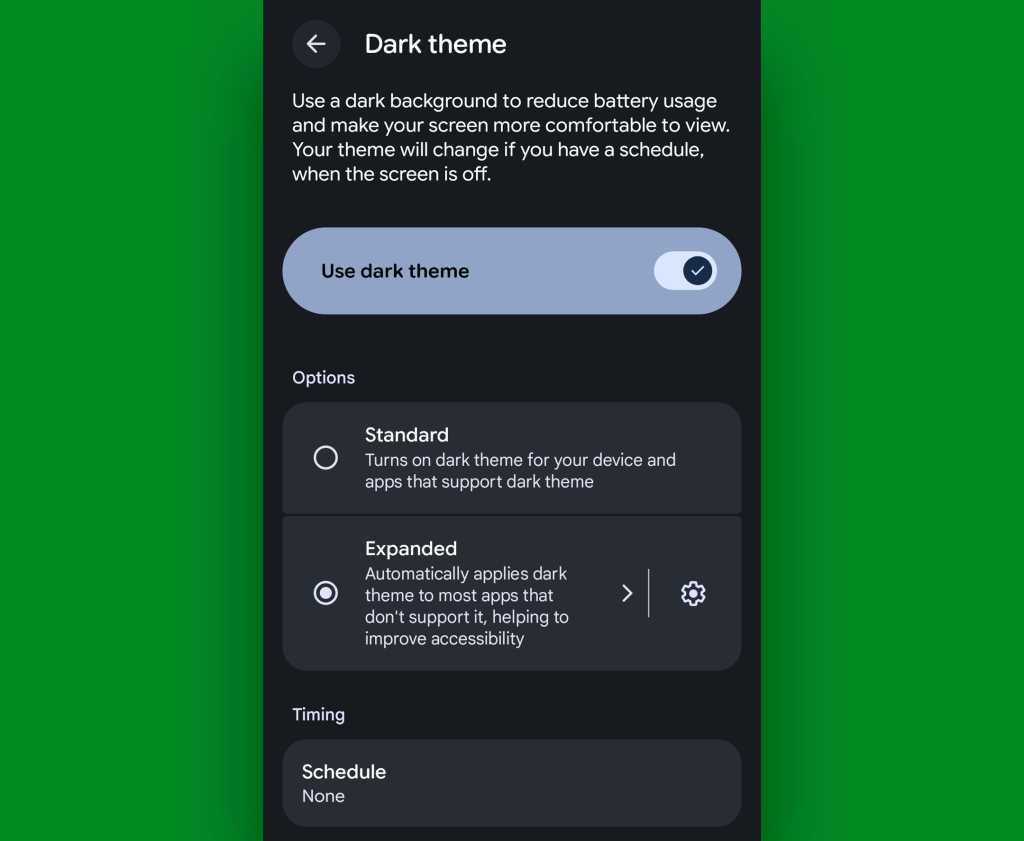
Up first is a feature that arose as part of our Android 17 discussion and sparked the entire idea for this collection — and that’s the one-tap switch in the latest Android version that forces every app on your phone to follow your dark mode preference, whether the program technically supports such a setting or not.

In Android 17, finding and flipping that switch will make every app turn dark whenever the system-wide dark mode is active. It eliminates the irksome exceptions that’ve traditionally stayed stubbornly light (due to developer laziness) even when your dark theme is on.

If you’ve got Android 17 on your phone already, it couldn’t be much easier to make it happen. Just look in the Display section of your system settings, tap the words “Dark theme,” then change the setting that shows up next from “Standard” to “Expanded.”

Android 17 dark theme expanded
Android’s new “Expanded” option lets you force apps into dark mode compliance, even if they aren’t designed to do it on their own.

JR Raphael, Foundry

No Android 17? No problem: On devices with reasonably recent pre-Android-17 system software, you can actually find a switch buried deep in some developer settings that’ll let you enable the exact same option without any waiting.

Follow these instructions and enjoy your new universally consistent darkened dynamic.

Android dark mode power-up #2: A darkened web

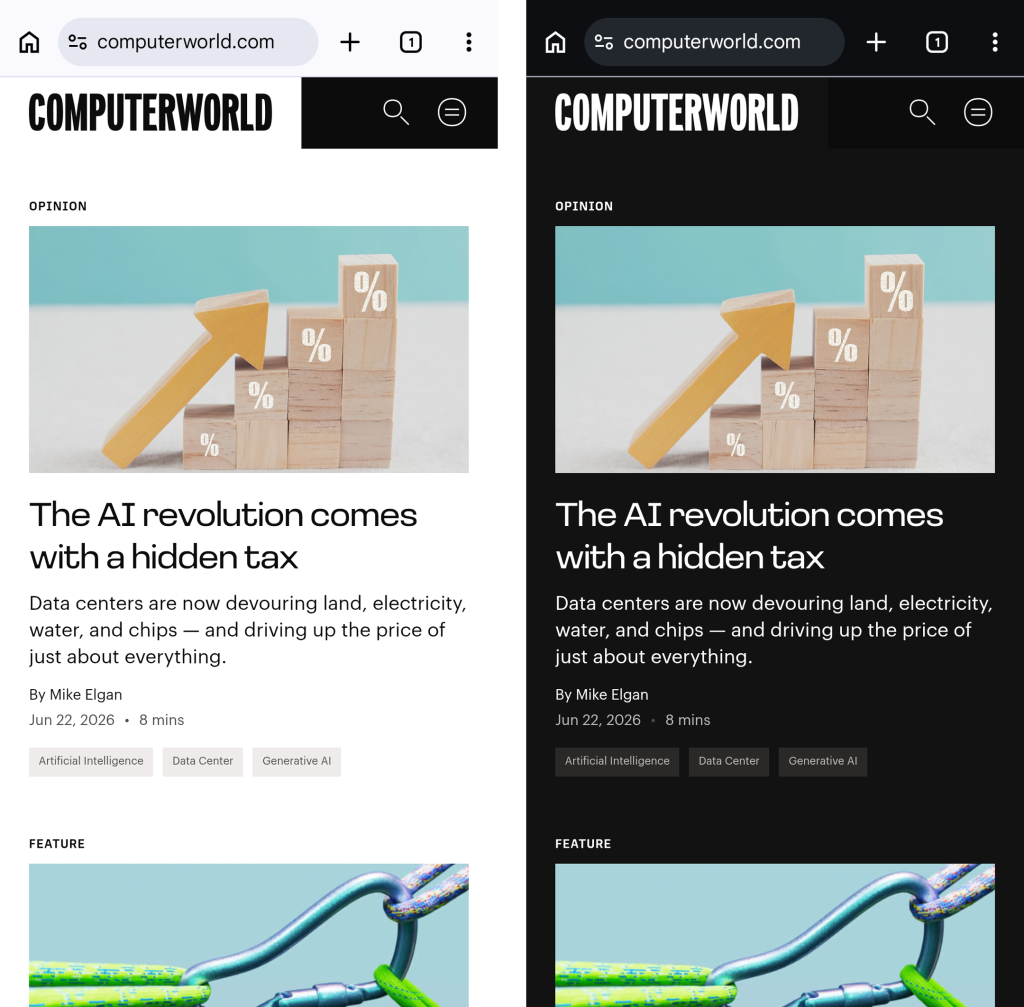
That first trick fixes the issue of certain apps not following your dark mode preference — but what about the web? Most of us spend a fair amount of time in our browsers these days, and most websites won’t follow a dark mode setting and adjust their interfaces accordingly.

They absotively can, though. With the flip of a single switch buried within your browser’s bowels, you can force every website into a darkened motif whenever your system-level dark mode is up and running.

See?

Android dark mode - Chrome web
Viewing a website in Chrome normally, at left, and with dark-mode-associated web darkening, at right.

JR Raphael, Foundry

Here’s the secret:

  • Open up Chrome on whatever Android device you’re using. (And note that this will also work with any Chromium-based Chrome alternative, like Brave, Edge, or Vivaldi.)
  • Type chrome:flags into the address bar.
  • Type darken into the search box at the top of the screen that comes up next.
  • See the line labeled “Darken websites checkbox in themes setting”? Tap the “Default” box beneath it, and change its setting to “Enabled.”
  • Tap the blue “Relaunch” button at the bottom of the screen.

Now, when Chrome comes back a second or so later…

  • Tap the three-dot menu icon in its upper-right corner.
  • Tap “Settings” in the next menu.
  • Scroll down until you see “Appearance.” Tap it, then tap “Theme.”
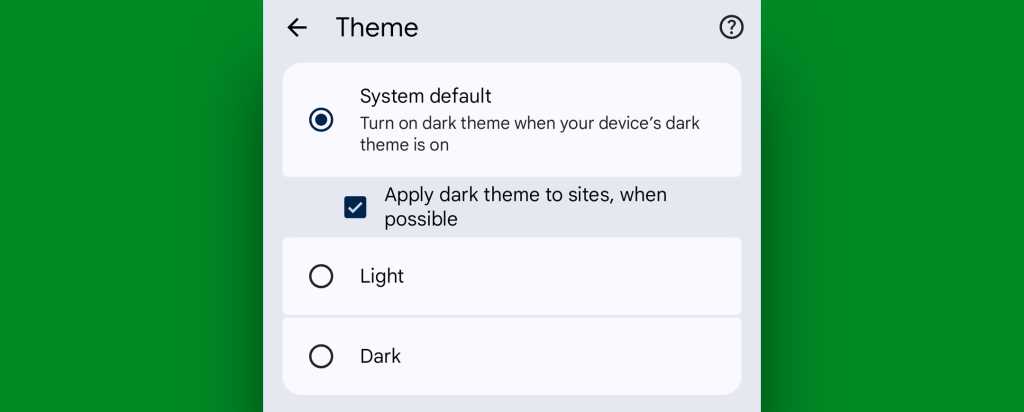
  • Make sure the newly added box for “Apply dark theme to sites, when possible” — which we just magically made appear via our last little modification — is checked and active.
Android dark mode - Chrome web setting
Chrome’s web-darkening option appears only after you’ve enabled an out-of-the-way flag.

JR Raphael, Foundry

And that’s it: From that moment onward, whenever your Android device is switched into its dark mode, any website you’re viewing within Chrome will automatically follow suit. Nothing more to it, and no further thought or action ever required on your part.

Not bad, eh?!

Android dark mode power-up #3: A dark mode schedule

Even as someone who isn’t into dark mode as a 24/7 sort of thing, I can definitely appreciate the presence of a dimmer, less glary look on my device in certain specific scenarios.

It’s incredibly easy to overlook or forget, but Google’s actually got a way to handle that for you. In fact, it’s been built into Android itself since 2020’s Android 11 release.

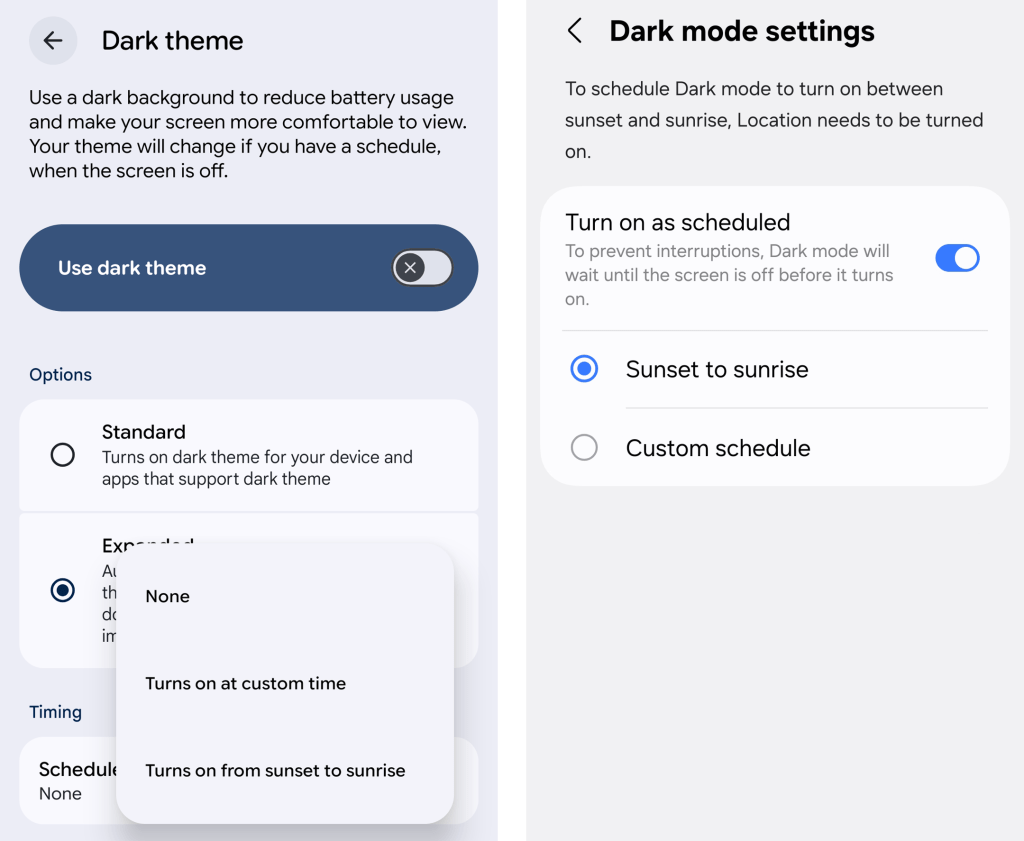
Just look in the Display section of your system settings and tap the line for either “Dark theme” or “Dark mode settings.” If you see a toggle alongside that line, make sure you’re tapping the actual words next to it — not the toggle itself.

Then look for the option to create a schedule.

Android dark mode schedule
An Android dark mode schedule, as seen in Google’s standard Android interface (at left) and in Samsung’s Android style (right).

JR Raphael, Foundry

You can create a time-based rule for when your device’s dark mode turns on and back off again, or — more intelligent yet — you can set it to automatically activate at sunset, wherever you are at any given moment, and then turn itself back off and switch you back over to light mode at sunrise.

You can also integrate dark mode into Android’s rarely noticed Bedtime Mode so that the screen getting dimmer is part of your pre-sleep winddown routine, if you really wanna get wild.

Or — ahem…

Android dark mode power-up #4: Contextual dark mode

A dark mode schedule is pretty forkin’ sensible. But the reality is that even with a time-based setup or a sunset-driven activation approach, you’ll still be using your phone in bright rooms with dark mode active and vice-versa.

And if you want Android’s dark theme present only when you’re actually in a dark room — as makes the most sense in my mind — there’s an even more intelligent option.

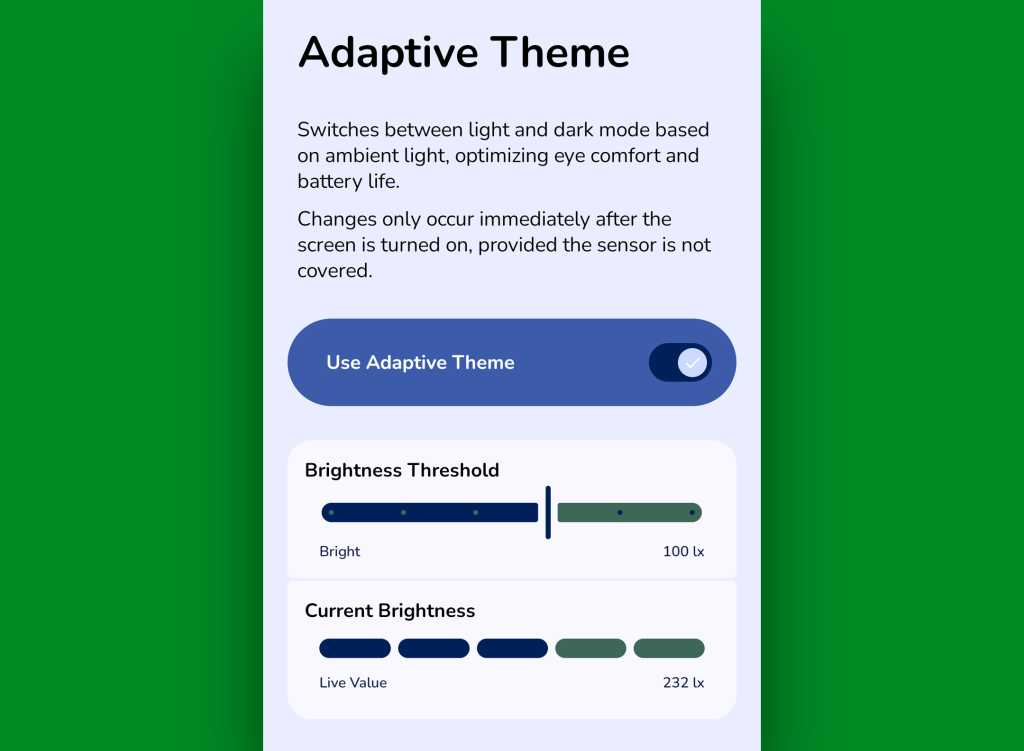
It comes our way via a handy little free app called Adaptive Theme. That app does one thing and only thing only: It automatically adjusts your device’s dark mode setting based on the actual ambient light around you, using your phone’s sensors rather than an arbitrary time or a not-always-relevant sunset status as a guide. It makes so much sense, you’ll find yourself wondering why your phone didn’t just work that way from the get-go.

The app does unavoidably have a slightly complex one-time setup, which I outline step-by-step here. It’s perfectly safe to do, though, and it shouldn’t take you more than a couple minutes to pull off.

And once you’ve done that, your Android dark mode will just work for you — flipping on when the lighting around you is dim (to your exact specifications) and flipping back off when you’re in brighter surroundings.

Android dark mode: Adaptive Theme settings
Adaptive Theme lets you take total control of how and when Android’s dark mode activates based on your environment.

JR Raphael, Foundry

Yes, please — and thank you. Last but not least…

Android dark mode power-up #5: The wallpaper wizard

Superficial as it may seem, the one piece of the puzzle we haven’t yet addressed — that isn’t ordinarily affected by Android’s dark mode setting — is your home screen wallpaper.

By default, whatever wallpaper you set at the system level stays the same even as your interface moves between its dark and light states — and when you’re anglin’ for a dimmer, less glary look in dark environments, that can be pretty darn jarring.

An app called, rather aptly, Dark/Light Wallpaper Scheduler is the answer you never knew you needed. It’s pretty self-explanatory — you tell it which wallpaper you want when your phone is in dark mode and light mode, then it automatically switches ’em out for you based on that status — but I wrote about it in detail here, if you’re interested in reading more about how exactly it works and how you can make the most of it.

And with that, my fellow Android-appreciating animal, your dark mode power-pack is complete. Now, would someone please turn off the lights? I don’t know about you, but all this talk of darkness has me hankering for a nap.

Wake up to even more useful Android wisdom every Friday with my free Android Intelligence newsletter — one practical new trick to try each week, straight from me to ye.

Meta pauses employee monitoring program after data protections fail

An extensive program at Meta to gather a wide range of data from employees to train its AI model has been frozen after employees reportedly broke through its guardrails and accessed restricted data, and then did so again after Meta claimed to have fixed the vulnerability.

Whether or not the data collection by the $201 billion owner of Facebook was a good idea, analysts argue that the data protections deployed were woefully inadequate, given the extreme sensitive nature of the collected data.

“Meta had the resources to get it right, and yet they failed exponentially,” said Karianne Michelle, a director with consulting firm Acceligence. “That is what it looks like when the policy decision and the technical execution are happening in two different rooms that are not fully in sync. It is the kind of gap you see often enough at organizations under structural strain.”

Fritz Jean-Louis, principal cybersecurity advisor at Info-Tech Research Group,  agreed.

“What we just observed from the Meta story is a classic failure mode in AI-era data strategy: collecting high-risk telemetry without equally mature access controls,” Jean-Louis said. “At that scale, a single misconfiguration turns internal data into a systemic exposure.”

The story, detailed in a Wired report, involved a program that Meta rolled out in April called the Model Compatibility Initiative (MCI), which collects computer inputs such as mouse movements, click locations, and keystrokes, as well as screen content, the story said. Meta employees were initially not allowed to opt out. 

The data collected included full prompts and transcriptions, private conversations, people and performance data, Wired said, adding, “Meta executives have repeatedly defended the data-gathering project, saying it was necessary to train AI systems to operate computer software the way humans do, and that employees were the best examples for the artificial intelligence to learn from.”

Wired also quoted Stephane Kasriel, a Meta vice president overseeing AI research, who saying that the company discovered that unauthorized employees were found to have accessed MCI data on June 18, and that the hole was closed “within four hours.” But, he added, “ the initial fix didn’t stick, and access to the data had to be further locked down.”

In an email statement, Meta confirmed that the program was being halted for the time being. “We have carefully designed this program with privacy safeguards, and while we have no indication at this time that any data was improperly accessed by Meta employees, we’re pausing it while we investigate,” Meta said. 

A ‘liability surface’

Analysts, consultants, and industry practitioners said they were more concerned about the inadequate protections than the underlying data exposure.

Carmi Levy, an independent technology analyst, said that although there should be concerns about Meta’s “Orwellian oversight of workers’ keystrokes and mouse movements,” the bigger issue is the paper-thin protections that it used to protect that data.

“As creepy as MCI was and is, the reason Meta has hit the pause button has nothing to do with the moral and ethical fuzziness of everyday employee surveillance, and everything to do with its failure to secure the data it collected in the process,” Levy said. “Conceivably, it will resume monitoring and data collection once it fully understands how highly sensitive data, such as employees’ private conversations, performance data, and transcriptions, ended up being inadvertently shared with the entire workforce.”

One of the critical background issues is that while the data collected was highly sensitive, it was not, from a strict compliance law perspective, PII (personally identifiable information). That distinction might have lulled Meta into a false sense of security and convinced it that the data did not merit strong protections. 

“I think companies can get a little too comfortable saying, ‘Well, it’s not PII,’ as if that makes the data low-risk,” said Tom Findling, CEO of Conifers.ai. “But internal prompts, transcripts, chats, data tables, and performance notes can tell you a lot about how a company works, what it’s building and where things are messy or exposed. That’s sensitive, even if it’s not someone’s Social Security number.”

Findling argued that Meta executives “wanted to pretend that they didn’t understand” how sensitive the collected data was, and that was their excuse for why they should not have to protect it sufficiently. “There is no doubt that Meta did not tag this at an appropriate risk level,” he said.

Info-Tech’s Jean-Louis took particular umbrage at the particulars of the collected data. 

“Employee behavioral data, such as keystrokes, screenshots, and usage patterns, is effectively sensitive by default. If you’re using it to train AI, you have to treat it like production secrets, not analytics exhaust,” Jean-Louis said. “When thousands of internal tables are broadly accessible, you have a liability surface rather than a data platform. Trust nowadays is a security control. Once employees believe their data is overcollected or underprotected, you introduce both insider risk and reputational damage at the same time.”

Acceligence’s Michelle echoed Jean-Louis’ concerns.

“The data Meta exposed is not the real risk. Security policy only works if people believe it, and belief is exactly what is now in question,” Michelle said. “That gap is where incidents like this one do their damage: once employees stop trusting what leadership says about their own data, the doubt follows every policy that comes next, producing workarounds, quiet noncompliance, and employees who stop raising flags.”

This article originally appeared on CSOonline.

Trump vs. Anthropic: The AI wars are heating up

The US government decision to force Anthropic to close down its latest and greatest AI models, Fable 5 and Mythos 5, was only the next step in a burgeoning battle between AI providers and ignorant politicians. 

Anthropic was on top of the world. Its Mythos 5 LLM had everyone excited. (If you believe the hype, it was kind of scary, too.) Even Anthropic CEO Dario Amodei admitted — or boasted? — that Mythos would bring an “enormous increase in the amount of vulnerabilities, in the amount of breaches” to us all. But with that fear came the promise of more AI power than ever. 

Then, the roof caved in.

On June 12, the US Commerce Department used its export-control powers to demand that Anthropic cut off access to its Fable 5 and Mythos 5 models for all foreign nationals, citing national security concerns and fears of jailbreaks. After figuring out it had no way to do that, Anthropic pulled both of its newest frontier AI models offline worldwide.

Just what an AI company needs! All other Claude models, like the Opus and Sonnet series, remain online. But, come on, AI sales are all about the newest and most powerful models.  

Adding insult to injury — and this is true at many high-tech companies — Anthropic has many employees who aren’t US citizens. This means Anthropic’s own programmers can’t work on their latest models.

Of course, this isn’t the first time US President Donald J. Trump and company have tried to put a spoke in Anthropic’s wheels. Back in February, Anthropic refused to give Defense Secretary Pete Hegseth the power to use its models to spy on American citizens and to power autonomous weapons.

This go-around, it wasn’t because Anthropic refused to kowtow to Trump’s officials. It was, they say, out of fear that these new models could be used to attack American interests. 

Mind you, no one in Trump’s regime has the tech chops to know just how dangerous, or not, any AI model is. As I recently noted, Trump’s AI executive order has no teeth. Nor, more to the point, is there anyone in the administration with a clue about AI.

Specifically, at the Department of Commerce, neither Commerce Secretary Howard Lutnick nor William Kimmitt, undersecretary of commerce for international trade, knows a thing about AI. Just what we need, more political hacks deciding tech policy. 

So, how did they discover that Fable and Mythos were theoretically a danger to the US? Good question. According to The Wall Street Journal, it was Amazon CEO Andy Jassy who told the Trump administration that Fable was untrustworthy. Guess what? AWS offers its own full cloud AI stack, starting with Amazon Bedrock for foundation models, Amazon SageMaker for training and deployment, and a growing set of agentic AI tools and services. 

In other words, Amazon is not a neutral party; it’s a competitor. Funny, that.

Sure, Amazon also has partnerships with Anthropic. But, in case you haven’t noticed, all the big AI companies are in bed with each other. That doesn’t stop them from fighting. What’s heating this up is that the AI companies are no longer offering flat-rate subscriptions and are replacing them with far more expensive, token-based pricing schemes. 

Armed with this information, Commerce gave Anthropic 90 minutes to fix its “problem.” Right. AI development is fast, but it’s not that fast. In addition, according to Anthropic, officials haven’t spelled out exactly what’s wrong. They only know that Commerce claims there was a “narrow, non‑universal jailbreak” in Fable.   

That’s it. That’s all. 

Anthropic has also observed, with reason, that similar jailbreaks are possible on other leading models, like OpenAI’s GPT‑5.5. Those others, however, haven’t been hammered with comparable export controls.

The AI and security experts who do have an AI clue believe Commerce is behaving stupidly. (You won’t get any argument there from me.) For example, in an open letter, “On Transparent AI Cyber Protections,” they said Commerce’s directive “has taken the best models away from defenders, created market uncertainty, and risked America’s AI leadership without any real risk to justify it,” warning that pulling capabilities “away from defenders without a good reason when our adversaries are rapidly advancing is dangerous.”

Exactly so. 

Besides, as Alex Zenla, co-founder and CTO of security company Edera, observed, Fable’s capability to identify insecure code sections is the baseline for any model you’d trust to write secure code. The same capability exists in GPT-5.5, Opus, Sonnet, and Kimi 2.7 — it’s not unique to Fable. Pulling Fable from defenders doesn’t remove the capability from the threat landscape. It just removes it from the people trying to build safer systems.”

This is not about AI safety or security. 

What this is really about is opening a new front in Trump’s war against the liberal-leaning Anthropic. Mind you, Anthropic isn’t really liberal. This has more to do with Anthropic not following in other tech firms’ groveling to Trump. 

However, Trump doesn’t seem to realize that by essentially shutting down Anthropic’s biggest move to date, he’s also telling the world that they can’t rely on American AI companies down the road. Sure, in the short run, this hurts Anthropic. In the long run, it’s going to be another reason for Europe and other countries — taking digital sovereignty seriously — to avoid doing business with any American tech company. 

In the meantime, Anthropic and Trump administration officials are in tense talks over whether, and under what safeguards, the models could return to the marketplace. Commerce indicates it might allow a narrower relaunch if jailbreak issues are resolved and additional controls are in place — whatever those might be. 

Since it’s really all about massaging Trump’s ego, I’m not feeling terribly optimistic. Just ask Israeli Prime Minister Benjamin Netanyahu how well letting Trump set the terms of engagement goes. It’s not pretty. 

‘Agentic AI’ PCs? Not much new here, say analysts

Nvidia and Microsoft this month touted the reinvention of computers with a new class of “agentic AI PCs” that will “reinvent the way PCs work.” 

That’s how Nvidia CEO Jensen Huang described the computers at the recent Computex trade show. At the event, Nvidia introduced its first AI-focused PC chip called N1X, which has an integrated CPU and GPU and will be used in agentic AI PCs.

Nvidia’s new RTX Spark PCs are the first in a major “PC reinvention for 40 years,” Huang said, likening them to AI phones. “You could talk to it, it could look at you. You could ask it to read files… [or] go help you do research.”

Not so fast, say analysts, who argue the computers are mostly repackaged AI PCs that shouldn’t necessarily drive enterprise upgrades.

“Agentic AI PCs is a strange term that should probably be deemphasized,” said Leonard Lee, principal analyst at neXt Curve. “Depending on use case, PCs of the last two generations are ‘agentic AI’-capable.”

Skeptical of the hype, analysts said many current PCs are already capable of running agents, such as those spun up on device by OpenClaw. Those agents don’t need to communicate with AI models in the cloud.

In fact, Lee said, Apple has already shown that Windows isn’t needed to run agentic workloads, with the Mac Mini among the most talked-about device for hosting personal AI agents and OpenClaw.

Analysts said the definition of agentic AI PCs really comes down to the hardware inside, which largely defines their capabilities. Most are really just an evolution of earlier AI PCs, which arrived a few years ago amid similar hype.

AI PCs, specifically CoPilot+ PCs, were originally designed with neural processing units (NPUs) to support the requirements of Windows Recall. “Some argue agentic AI PCs need more GPU compute, but…Qualcomm and Microsoft would counter that agentic AI PCs have been around for a while,” Lee said.

To highlight the capabilities of the RTX Spark PC, a demonstration at Computex showed how an architectural design workflow could be split between the PC and the cloud. (An MCP server managed data exchange to facilitate the cloud-PC workflow.)

Adobe has reengineered Photoshop and Premiere for RTX Spark PCs, allowing the software to communicate with AI agents on PCs and tools to run twice as fast, Huang said.

And at the company’s recent Build conference, Microsoft CEO Satya Nadella demonstrated the new Surface Laptop Ultra AI PC based on the RTX Spark design. He positioned agentic AI PCs as running a new execution layer that can act across files and devices, including generating and executing code. 

While AI PCs with agents will be capable, they still lack applications, said Jim McGregor, principal analyst at Tirias Research. “However, PCs — especially the small form factor PCs and workstations — are likely to be the home AI appliance,” he said.

For enterprises, upgrading to RTX Spark PCs at this point could pose problems. That’s because Nvidia’s N1X CPU is based on the Arm processor architecture and could run into compatibility issues with x86 applications designed for Intel and AMD chips.

“Despite Arm processors being available for a while, enterprise penetration stays small, since compatibility with all apps, drivers, and corporate systems is critical and requires extensive testing…, even though Microsoft has done a reasonably good job with Windows 11 on Arm,” said Jack Gold, principal analyst at J. Gold Associates.

Because Microsoft is moving to natively incorporate AI into Windows, those PCs will land in enterprises ultimately, Gold said.

Regardless of hype, it might be a good time for enterprises chasing an agentic AI agenda to upgrade laggard Windows 10 devices, Lee said. “Considering the considerable hype about agentic AI, early adopters will need to upgrade their fleets if they pursue a broad agentic AI agenda for their organizations,” he said.

Your AI strategy may be training employees to stop thinking

For all its potential, generative AI, on the whole, churns out a lot of junk.

Yet employees are becoming ever more reliant on this “workslop” masquerading as high-quality material, says a recent Harvard Business Review blog. They become lazy and less productive, quality control goes off the rails, and integrity and trust begin to erode.

Experts urge enterprises to act now, before they lose control entirely.

“When slopification happens at scale and in sequence across a business’s processes, those processes themselves — and their outputs — start to deteriorate,” Matthias Holweg, professor at the University of Oxford’s Saïd Business School, and analyst Thomas H. Davenport argue in the post. “Eventually, people start to lose trust in the processes that they rely on to do their jobs.”

They call this organization-level phenomenon “knowledge decay.”

Three key challenges

Holweg and Davenport identify three key challenges to address when it comes to AI-generated content in the workplace, to ensure knowledge decay isn’t occurring: verification, validation, and entropy.

Verification requires “disentangling” authentic human content from AI-generated content that could contain glaring errors, they note.

This can be time-intensive and involve critical thinking and additional research, and in many cases the effort negates the gains gleaned from AI use. In the case of hiring, for example, in addition to using AI to write their resumes and CVs, tailoring their prompts to the AI ranking algorithms to ensure they rise to the top of the queue, some candidates are getting crafty, using AI clandestinely to generate responses to interview questions in near-real time.

All this taken together can result in candidates who are subpar or simply not a good fit for an organization. As a result, recruiters may then have to spend more time doing on-site interviews where AI access isn’t available, Holweg and Davenport contend.

Another issue is knowledge validation: confirming how and where humans have provided real value when AI is used in a workflow. For instance, a consulting firm can easily use AI to create standard written reports and PowerPoint slides, while their clients are paying for expert human insights.

“Human experts now have to justify not only the quality of the output submitted, but also that actual human intellectual work has produced it,” Holweg and Davenport emphasize.

Finally, knowledge entropy is like a “risky AI-based game of telephone”: As knowledge is passed through an AI again and again in an iterative process, it moves further away from the original “ground truth” data that was used to create it in the first place, they point out.

“The greater the number of iterations of content through an LLM, the more it will depart from the original,” Holweg and Davenport note. LLMs are probabilistic, “context-agnostic” statistical models that provide next-word-prediction outputs. They have “no conception of fact or truth and simply predict the most likely outputs,” they write.

And when, in some cases, large language models (LLMs) are trained on synthetic data created by other models, the authors write, bigger problems emerge. When this manufactured data subsequently repeatedly goes through the model, it can affect the its accuracy and variability. This is known as “generative inbreeding” or model collapse.

Steps enterprises can take to prevent AI slop

The two experts, therefore, argue for a “fundamental step change” in the ways models are architected, as well as in establishing explicit rules around how they are used.

Naturally, one of the first, and potentially the hardest, steps is restricting employee AI use: It should only be applied to scenarios where it truly adds value, the authors advise.

For instance, when employees or job candidates are allowed to freely design their CVs, they’ll likely use generative AI to “optimize” their work. To prevent knowledge decay, recruiters should rely on structured documents that require factual responses that an AI can’t generate, for example, asking a candidate about a specific role, projects completed, team members involved, suppliers served, and budgets managed.

When generative AI use is allowed or unpreventable, organizations should define what value is being added and establish clarity around the implications, Holweg and Davenport emphasize. “Content does not need to be entirely human-created, but if AI is being used, be clear why and how,” they write.

In one beneficial scenario, AI such as Copilot or Gemini embedded in standard office software makes it “virtually pointless” to manually create more versions of the content of reports and PowerPoint slides, Holweg and Davenport write.

In another example, in performance evaluations, managers can gather specific, detailed information from team members and customers, then use AI to synthesize that material, rather than generating a “tick-box report” of generic bullet points.

Enterprises should also consider how individual AI use impacts an overall process. For instance, in an interorganizational flow like a revenue cycle, everyone involved should know about and agree on how AI would be used and at what steps in the process. It’s not a question of whether AI is better at a given task, as it increasingly is in some scenarios, but whether it is taking over a task to make things more efficient, Holweg and Davenport write.

Ultimately, however, they posit, public LLMs add “little to no real value,” because they are generic and often contain mistakes. On the other hand, small language models (SLMs) and proprietary models trained on company-specific data can augment human work.

From an architectural perspective, enterprises should track the history of both structured and unstructured data and understand “ground truth” information. Materials like customer interviews provide critical facts, emotions, and context; if AI is used to alter or summarize these, enterprises must identify and record the underlying ground truth data and point back to verifiable, authentic content.

In the end, Holweg and Davenport emphasize, enterprises should establish pragmatic practices now, lest they repeat the mistakes of the past.

“If we fail to address the uncontrolled proliferation of generative AI in our business processes, we are likely to see a rerun of the ‘productivity paradox’ observed with the growth of corporate computing half a century ago,” they write.

Blending ‘human capital’ and ‘token capital’

Other experts also agree on the importance of blending the best of humans with the best of AI.

Microsoft CEO Satya Nadella describes this model as the incorporation of “human capital’ with “token capital.” The former is the human “knowledge, judgment, relationships, ingenuity, and pattern recognition,” while the latter is in built and owned AI capabilities. The opportunity is in melding the two in a learning loop.

In this loop, humans will guide AI systems, set goals, and identify patterns, so AI isn’t “running in circles,” Nadella wrote in an X post. Internal evaluations can determine whether AI is improving when measured against company-specified benchmarks, thus creating institutional memory that is “query-able,” using fewer tokens and saving enterprises money.

Nadella noted: “Every improved workflow generates a better training signal, which accelerates the accumulation of tacit knowledge unique to the firm.”

This article originally appeared on CIO.com.