Month: July 2026

Microsoft Exchange Server on prem gets a little harder to use

It’s the end of the road for yet another facet of Exchange Server, Microsoft’s on-premises email and calendar system. The stripped-down version of its web client, Outlook Web App (OWA) Light, is being retired, forcing those Exchange Server users still using it to adopt the standard Outlook Web App instead.

“OWA Light was created for a much earlier era of the web, when browser support, bandwidth, and accessibility technologies were very different from today. Going forward, we want to invest in a modern Outlook on the web experience that provides the cross-browser, accessible, and security-focused experience,” said Microsoft.

Those enterprises still operating in a resource-constrained environment are out of luck, then.

The change will be effected in an upcoming Exchange Server update expected in August. The move should come as no surprise: Microsoft had already deprecated the light version of Outlook in August 2024. Microsoft said that sysadmins should spend the next couple of months preparing for the change by identifying any staff still using OWA Light.

This is just the latest alteration that Microsoft has made to its Exchange ecosystem, which some holdouts still use instead of the SaaS-based Microsoft 365 service. However, even on-premises customers must now pay a subscription fee to use Exchange Server.

One of the advantages of SaaS offerings is that customers don’t have to deal with patching, an advantage brought home to on-premises customers in May when a zero-day exploit struck Exchange Server.

Mistral joins rush to build physical AI

French AI company Mistral claims its latest AI model offers a more efficient way to train and operate robots.

The model, Robostral Navigate, can guide a robot through plain language instructions, using a single RGB camera to find its way. Mistral said that this was a radical departure from most other models, which rely on depth sensors, LiDAR or several cameras working together.

Robostral Navigate has achieved a score of 76.6% on the R2R-CE (Room-to-Room in Continuous Environments) benchmark for robots following instructions. This beats the best system using depth sensors or multiple cameras by 4.5 percentage-points, despite the Robostral Navigate using neither of these aids, and puts it 9.7 percentage-points ahead of the next-best single-camera robot.

Mistral said it had designed the model to autonomously navigate complex environments including offices, residential and commercial buildings, and outdoor settings. A key feature of the new model is that it is easier to train: Mistral said the number of training tokens is reduced significantly compared to other models, reducing training runs from months to days.

Robotics is an area ripe for AI research: The World Economic Forum at Davos in February heard how AI-driven robotics could drive advances in productivity.

Other AI model developers are ahead of the game: Nvidia announced robotic AI efforts in August 2025.

Apple will buy more US-made components from Broadcom

Apple has agreed to buy up to $30 billion-worth of additional chips and other wireless components from Broadcom over the next few years.

The new agreement could lead to Broadcom making up to 15 billion more chips in the US, and enable it to modernize its manufacturing facilities in Fort Collins, Colorado, where it will produce radio frequency components including thin-film bulk acoustic resonator (FBAR) filters and advanced wireless connectivity technologies, Apple said.

The deal is part of Apple’s effort to create an end-to-end supply chain in the US. It has already been exploring options that could wean it off Chinese-made chips. Last year it launched its American Manufacturing Program (AMP) to accelerate manufacturing in the US, committing to “invest $600 billion in the US economy over four years” in support of local manufacturing and jobs.

US companies have been keen to source chips manufactured in the US to eliminate supply-chain uncertainty in the face of President Trump’s ever-changing tariff policies.

“We’re grateful to the president and his administration for supporting important projects like this one,” Apple CEO Tim Cook said in a news release, without specifying the nature of the Trump administration’s support for such deals.

He said the components Broadcom makes in Fort Collins were essential to Apple’s products.

How to go incognito in Chrome, Edge, Firefox, and Safari

Private browsing. Incognito. Privacy mode.

Web browser functions like those trace their roots back more than a decade, and the feature — first found in a top browser in 2005 — spread quickly as one copied another, made tweaks and minor improvements.

But privacy-promising labels can be treacherous. Simply put, going “incognito” is as effective in guarding online privacy as witchcraft is in warding off a common cold.

That’s because private browsing is intended to wipe local traces of where you’ve been, what you’ve searched for, the contents of forms you’ve filled. It’s meant to hide, and not always conclusively at that, your tracks from others with access to the personal computer. That’s it.

How to keep web browsing private

We’ve spelled out how to go into incognito or private browsing mode for the four major browsers in this order:

  • Google Chrome’s Incognito mode
  • Microsoft Edge’s InPrivate browsing
  • Mozilla Firefox’s New Private Window mode
  • Apple Safari’s New Private window mode

At their most basic, these features promise that they won’t record visited sites to the browsing history, save cookies that show you’ve been to and logged into sites, or remember credentials like passwords used during sessions. But your traipses through the web are still traceable by internet providers (and the authorities who serve subpoenas to those entities), employers who control the company network, and advertisers who follow your every footstep.

To end that cognitive dissonance, most browsers have added more advanced privacy tools, generically known as “anti-trackers,” which block various kinds of bite-sized chunks of code that advertisers and websites use to trace where people go in attempts to compile digital dossiers or serve targeted advertisements.

Although it might seem reasonable that a browser’s end game would be to craft a system that blends incognito modes with anti-tracking, it’s highly unlikely. Using either private browsing or anti-tracking carries a cost: site passwords aren’t saved for the next visit or sites break under the tracker scrubbing. Nor are those costs equal. It’s much easier to turn on some level of anti-tracking by default than it would be to do the same for private sessions, as evidenced by the number of browsers that do the former without complaint while none do the latter.

Private browsing will, by necessity, always be a niche, as long as sites rely on cookies for mundane things like logins and cart contents.

But the mode remains a useful tool whenever the browser — and the computer it’s on — are shared. To prove that, we’ve assembled instructions and insights on using the incognito features and anti-tracking tools offered by the top four browsers: Google Chrome, Microsoft Edge, Mozilla Firefox, and Apple Safari.

How to go incognito with Google Chrome

Although incognito may be a synonym to some users for any browser’s private mode, Google gets credit for grabbing the word as the feature’s snappiest name when it launched the tool in late 2008, just months after Chrome debuted.

The easiest way to open an Incognito window is with the keyboard shortcut combination Ctrl-Shift-N (Windows) or Command-Shift-N (macOS).

Another way is to click on the menu on the upper right — it’s the three vertical dots — and select New Incognito Window from the list.

width="1024" height="876" sizes="auto, (max-width: 1024px) 100vw, 1024px">

Open a new Incognito window in Chrome using keyboard shortcuts or from the menu by choosing “New Incognito window.”

Google

The new Incognito window can be recognized by the dark background and the stylized “spy” icon just to the left of the three-dots menu. Chrome also reminds users of just what Incognito does and doesn’t do each time a new window is opened. The message may get tiresome for regular Incognito users, but it may also save a job or reputation; it’s important that users remember Incognito doesn’t prevent ISPs, businesses, schools and organizations from knowing where customers, workers, students, and others went on the web or what they searched for.

width="1024" height="699" sizes="auto, (max-width: 1024px) 100vw, 1024px">

Each time a new Incognito window is opened, Chrome reminds users what Incognito doesn’t save. The browser also puts a toggle on the screen for blocking third-party cookies.

Google

Incognito’s introductory screen also displays a toggle — it’s on by default — along with text that states third-party cookies will be blocked while in the privacy mode. Although cookies are never saved locally as long as the user stays in Incognito, websites have been able to track user movements from site to site while within Incognito. Such tracking might be used, for example, to display ads to a user visiting multiple sites in Incognito. This third-party cookie blocking, which halts such behavior, debuted in May 2020.

Google has been experimenting with new language on Chrome’s Incognito introductory page, but it’s yet to make it to the desktop browser. In the Canary build of Chrome on Android, however, the intro now outlines “What Incognito does” and “What Incognito doesn’t do,” to make the mode’s capabilities somewhat clearer to the user. (Some have speculated that the changes were made in reaction to a still-ongoing class-action lawsuit file in 2020 that alleged Google continued to track users’ online behavior and movements in Incognito.)

Once a tab in Incognito has been filled with a website, Chrome continues to remind users that they’re in Incognito by the dark background of the address bar and window title.

A link on an existing page can be opened directly into Incognito by right-clicking the link, then choosing Open Link in Incognito Window from the resulting menu.

width="1024" height="876" sizes="auto, (max-width: 1024px) 100vw, 1024px">

What Incognito looks like after pulling up a website. Note the “spy” icon at the right of the address bar.

Google

Pro tip: To close an Incognito window, shutter it like any other Chrome window by clicking the X in the upper right corner (Windows) or the red dot in the upper left (macOS).

How to privately browse with Microsoft Edge

Microsoft borrowed the name of its private browsing mode, InPrivate, from Internet Explorer (IE), the retired legacy browser. InPrivate appeared in IE in March 2009, about three months after Chrome’s Incognito and three months before Firefox’s privacy mode. When Edge was first released in 2015 and then relaunched as a clone of Chrome in January 2020, InPrivate was part of the package, too.

At the keyboard, the combination of Ctrl-Shift-N (Windows) or Command-Shift-N (macOS) opens an InPrivate window.

A slower way to get there is to click on the menu at the upper right — it’s three dots arranged horizontally — and choose New InPrivate Window from the menu.

width="1024" height="874" sizes="auto, (max-width: 1024px) 100vw, 1024px">

Like other browsers, Edge will take you incognito from the menu when you pick New InPrivate window.

Microsoft

Edge does a more thorough job of explaining what its private browsing mode does and doesn’t do than any of its rivals, with on-screen paragraphs dedicated to describing what data the browser collects in InPrivate and how the strictest additional anti-tracking setting can be called on from within the mode. In addition, Edge uses the more informal “What Incognito does” and “What Incognito doesn’t do” language on its InPrivate introductory screen.

Microsoft’s browser also well marks InPrivate when the mode is operating: an oval marked “In Private” to the right of the address bar combines with a full-black screen to make sure users know where they’re at.

width="1024" height="843" sizes="auto, (max-width: 1024px) 100vw, 1024px">

Edge offers a detailed explanation of what its private browsing mode does and doesn’t do.

Microsoft

It’s also possible to launch an InPrivate session by right-clicking a link within Edge and selecting Open in InPrivate Window. That option is grayed out when already in a private browsing session but using Open Link in New Tab does just that within the current InPrivate frame.

To end InPrivate browsing, simply shut the window by clicking the X in the upper right corner (Windows) or click the red dot at the upper left (macOS).

Although Edge is based on Chromium, the same open-source project that comes up with the code to power Chrome, the Redmond, WA company integrated anti-tracking into its browser. Dubbed “Tracking Prevention,” it works both in Edge’s standard and InPrivate modes.

To set Tracking Prevention, choose Settings from the three-ellipses menu at the right, then at the next page, pick Privacy, Search and Services. Choose one of the three options — Basic, Balanced or Strict — and make sure the toggle for Tracking prevention is in the “on” position. If you want InPrivate to always default to the harshest anti-tracking — not a bad idea — toggle Always use “Strict” tracking prevention when browsing InPrivate to “on.”

width="1024" height="708" sizes="auto, (max-width: 1024px) 100vw, 1024px">

Toggle Always use Strict to the ‘on’ position and InPrivate will apply the most stringent anti-tracking even though Edge’s standard mode is set to, say, Balanced.

Microsoft

Pro tip: To open Edge with InPrivate — rather than first opening Edge in standard mode, then launching InPrivate — right-click the Edge icon in the Windows taskbar and select New InPrivate Window from the list. There is no similar one-step way to do this in macOS.

How to privately browse with Mozilla Firefox

After Chrome trumpeted Incognito, browsers without something similar hustled to catch up. Mozilla added its take — dubbed Private Browsing — about six months after Google, in June 2009.

From the keyboard, a private browsing session can be called up using the combination Ctrl-Shift-P (Windows) or Command-Shift-P (macOS).

Alternately, a private window will open from the menu at the upper right of Firefox — three short horizontal lines — after selecting New private window.

width="1024" height="889" sizes="auto, (max-width: 1024px) 100vw, 1024px">

Opening a private browsing window is as simple as choosing New Private Window from the Firefox menu.

Mozilla

A private session window is marked by the purple “mask” icon in the title bar of the Firefox frame. In Windows, the icon is to the left of the minimize/maximize/close buttons; on a Mac, the mask squats at the far right of the title bar. Unlike Chrome and Edge, Firefox does not color-code the top components of the browser window to signify the user is in privacy mode.

Like other browsers, Firefox warns users that private browsing is no cure-all for privacy ills but is limited in what it blocks from being saved during a session. “Private window: Firefox clears your search and browsing history when you close all private windows. This doesn’t make you anonymous,” the caution reads.

width="1024" height="654" sizes="auto, (max-width: 1024px) 100vw, 1024px">

Firefox reminds users that while a private session doesn’t save searches or browsing histories, it doesn’t cloak them in complete anonymity. The page also links to more detailed information.

Mozilla

A link can be opened into a Firefox Private Window by right-clicking the link, then choosing Open Link in New Private Window from the menu.

To close a Private Window, shut it down just as one would any Firefox window by clicking the X in the upper right corner (Windows) or the red dot in the upper left (macOS).

Notable is that Firefox’s private browsing mode is accompanied by the browser’s superb “Enhanced Tracking Protection,” a suite of tracker blocking tools that stymie all sorts of ad-and-site methods for identifying users, then watching and recording their online behavior. While the earliest version of this was offered only inside Private Windows, the expanded technologies also work within standard mode.

Because Enhanced Tracking Protection is enabled by default within Firefox, it doesn’t matter which of its settings — Standard, Strict or Custom — is selected as far as private browsing goes; everything that can be blocked will be blocked.

width="1024" height="576" sizes="auto, (max-width: 1024px) 100vw, 1024px">

The shield appears in the address bar to note what trackers were blocked by Firefox in a Private Window. Clicking on the icon brings up an accounting of what was barred.

Mozilla

Pro tip: Private Browsing sessions take place over the more secure HTTPS, not the once-standard HTTP protocol. Users don’t need to do anything: The new HTTPS-only policy is on by default. (If the destination site doesn’t support HTTPS, Firefox will go into fallback mode, connecting via HTTP instead.)

How to browse privately with Apple’s Safari

Chrome may get far more attention for its Incognito mode than any other browser — no surprise, since it’s by far the most popular browser on the planet — but Apple’s Safari was actually the first to introduce private browsing. The term private browsing was first bandied in 2005 to describe early Safari features that limited what was saved by the browser.

Side note: Early in private browsing, the label porn mode was often used as a synonym to describe what many writers and reporters assumed was the primary application of the feature. The term has fallen out of favor.

To open what Safari calls a Private Window on a Mac, users can do a three-key combination of Command-Shift-N, the same shortcut Chrome adopted. Otherwise, a window can be called up by selecting the File menu and clicking on New Private Window.

width="1024" height="803" sizes="auto, (max-width: 1024px) 100vw, 1024px">

From the File menu in Safari, selecting New Private Window gets you started.

Apple

Safari tags each Private Window by darkening the address bar. It also issues a reminder of what it does — or more accurately — what it doesn’t do. “Safari will keep your browsing history private for all tabs of this window. After you close this window, Safari won’t remember the pages you visited, your search history or your AutoFill information,” the top-of-the-page note reads. The warning is more terse than those of other browsers and omits cautions about still-visible online activity.

width="1024" height="321" sizes="auto, (max-width: 1024px) 100vw, 1024px">

The darkened address bar at the top — and the Private button in the left window corner — signal that this Safari window is for private browsing.

Apple

Like Firefox, Safari automatically engages additional privacy technologies, whether the user browses in standard or private mode. Safari’s Intelligent Tracking Protection (ITP), which has been around for nearly a decade and repeatedly upgraded, now blocks all third-party cookies, among other components advertisers and services use to track people as they bounce from one site to another. ITP is controlled by a single on-off switch — on is the default — found in Preferences under the Privacy icon. If the Website tracking: box is checked to mark Prevent cross-site tracking, ITP is on.

width="1024" height="453" sizes="auto, (max-width: 1024px) 100vw, 1024px">

Switching on cross-site tracking enables Safari’s Intelligent Tracking Protection, which blocks a wide variety of bits advertisers try to use to follow you around the web while you’re using a Private Window.

Apple

A link can be opened directly to a Private Window by right-clicking, then selecting Open Link in New Private Window. Close a Private Window just as any Safari window, by clicking the red dot in the upper left corner of the browser frame.

Pro tip: Once in a Safari Private Window, opening a new tab — either by clicking the + icon at the upper right or by using the Command-T key combo — omits the Private Browsing Enabled notice. (The darkened address bar remains as the sole indicator of a private browsing session.) Other browsers, such as Firefox, repeat their cautionary messages each time a tab is opened in an incognito session.

Related reading:

Envirotech Vehicles Closes Merger with Azio AI Ahead of Schedule, Positioning Combined Company to Capture $487 Billion 2026 AI Infrastructure Opportunity

Revised transaction structure enables immediate closing, accelerating the Company’s strategic pivot toward AI data centers, enterprise GPU compute, and digital power infrastructure.

Envirotech Vehicles, Inc. (NASDAQ: EVTV) (“EVTV” or the “Company”) today announced the successful completion of its merger with Azio AI Corporation (“Azio AI”) on July 2, 2026, paving the way for the Company to transform to an AI Datacenter Provider and meeting the growing market demand for artificial intelligence (“AI”) infrastructure, enterprise GPU compute, digital power solutions, data center development, and digital asset infrastructure; a market that the International Data Corporation (IDC) projects will reach $487 billion in global spending in 2026 and exceed $1 trillion by 2029.[1] The transaction marks a defining milestone in the Company’s strategic transformation and establishes the foundation for its next phase of commercial execution and long-term growth.

The parties amended the proposed transaction structure to expedite the closing timeline, allowing the combined company to begin operating as a fully integrated public company significantly sooner than originally anticipated. The accelerated closing enables management to immediately focus on commercialization across its expanding AI Datacenter strategy.

With the merger complete and the combined company operating as one organization, management is now fully focused on commercial execution, infrastructure deployment, strategic growth initiatives, and creating long-term shareholder value.

Over the past several months, the Company advanced development activities at its South Texas site and deployed six megawatts of off-grid power for its modular data centers. The Company further secured rights to a 548-acre site with the capacity to scale up to 500 MW, supporting the future development of AI hyperscale data centers.

Management believes these achievements demonstrate that the combined company is entering its next phase with meaningful operational momentum already in place rather than beginning from a standing start. Infrastructure deployment is underway, customer commitments have already been established, commercial execution is actively progressing, and the Company’s corporate structure is now aligned with an operating platform built to support long-term expansion.

The completion of the merger comes at a time when investment in AI infrastructure continues to accelerate globally as enterprises increasingly require access to high-performance computing resources, GPU infrastructure, and scalable digital power solutions. Management believes the combined company is well positioned to capitalize on these long-term industry trends through a diversified infrastructure strategy designed to monetize power assets across multiple complementary revenue streams, including AI data centers, enterprise compute infrastructure, power hosting, and digital asset mining operations.

Following the closing of the transaction, the Company intends to continue expanding its AI Infrastructure strategy through AI data center development, enterprise GPU compute solutions, power hosting services, digital asset mining operations, strategic infrastructure investments, and additional commercial partnerships designed to maximize utilization of its power resources while creating multiple long-term revenue opportunities.

In connection with the closing of the merger, Phillip Oldridge has stepped down as Chief Executive Officer. Jason Maddox vacates the President position and is now the Chief Financial Officer. The Company’s Board of Directors appointed Simon Yu as President and Chris Young as Chief Executive Officer, effective immediately.

Mr. Yu is a serial entrepreneur and public markets operator with almost a decade of experience taking companies public, executing capital raises, and scaling businesses. He has previously served in founder, C-suite, and board roles at three publicly traded companies, two of which reached market capitalizations in excess of $1 billion. Mr. Yu has led legal, accounting, and advisory teams through Regulation A+ Tier 2 offerings, PCAOB audits, and public company reporting, alongside leading M&A transactions. As an active early-stage venture investor, he has evaluated investment opportunities across artificial intelligence, SaaS, and B2B technology.

Mr. Young brings extensive experience in launching and leading public companies and investing in and advising emerging technology companies, with a particular focus on artificial intelligence, software innovation, and strategic growth initiatives. Prior to joining EVTV, he served as Chief Executive Officer of Clubhouse Media Group, a publicly traded social media company and an Entrepreneur in Residence at Amplify, where he worked alongside founders and venture-backed technology companies to accelerate commercialization and support the development of high-growth technology businesses.

“Today’s announcement represents far more than the completion of a merger—it marks the beginning of our next chapter,” said Chris Young, Chief Executive Officer of EVTV. “Over the past several months, our teams have been building the operational foundation of this business while simultaneously working toward completing this transaction. With the merger now finalized, we move forward as one company with one leadership team and one strategy, focused on executing against the opportunities in front of us. We believe demand for AI infrastructure, enterprise compute, and digital infrastructure will continue expanding for years to come. Our objective is to build a scalable platform capable of serving that demand while creating long-term value for our shareholders.”

Jason Maddox, Chief Financial Officer of EVTV, added, “Completing this transaction under the amended merger structure allows us to immediately focus on execution. We have already established meaningful operational momentum, and we believe operating as a unified public company enhances our ability to deploy infrastructure, serve customers, pursue strategic growth opportunities, and continue building long-term shareholder value.”

The transaction establishes a unified operating platform designed to support the Company’s long-term growth strategy through continued investment in AI infrastructure, enterprise computing, digital power assets, and digital infrastructure development. Management believes the completion of the merger provides the operational and organizational foundation necessary to pursue the next phase of commercialization while expanding its presence across some of the fastest-growing sectors of the global technology market.

Transaction and Operational Highlights

  • Successfully completed the merger with Azio AI pursuant to an amended and restated merger agreement.
  • Approximately six megawatts of off-grid digital infrastructure deployed at the Company’s South Texas development site.
  • Development footprint exceeding 548 acres with the potential to support up to 500 MW of AI infrastructure capacity.
  • Combined company positioned to accelerate commercialization across AI infrastructure, enterprise GPU compute, digital power solutions, and digital asset mining operations.
  • Merger consideration consisted of 2,655,157 shares of common stock and 973,450 shares of non-voting convertible preferred stock in exchange for 100% of outstanding capital stock of Azio AI, of which 194,807 shares of common stock were reserved for convertible notes of Azio AI assumed by the Company upon closing.
  • Each share of preferred stock convertible into 100 shares of Company common stock subject to stockholder approval.
  • Chris Young appointed Chief Executive Officer and Chairman of the Board.
  • Simon Yu appointed President.
  • Jason Maddox appointed Chief Financial Officer.
  • Phillip Oldridge stepped down as Chief Executive Officer.

About Envirotech Vehicles, Inc.

Envirotech Vehicles, Inc. (NASDAQ: EVTV) is a technology infrastructure company focused on developing, owning, and operating artificial intelligence data centers, enterprise GPU compute infrastructure, digital power solutions, and digital asset mining operations. Following its acquisition of Azio AI, the Company operates an integrated AI infrastructure business encompassing AI data center development, the sale and distribution of enterprise GPU systems and server infrastructure, high-performance computing solutions, power hosting, and strategic technology investments, serving enterprise and institutional customers across domestic and international markets. Through this diversified AI infrastructure strategy, the Company is positioned to capitalize on the rapidly expanding global demand for AI infrastructure, compute capacity, digital power, and next-generation AI technologies.

For more information please visit: www.azioai.ai and for potential partnerships contact: AI@PhoenixMGMTconsulting.com

Forward-Looking Statements

This press release contains forward-looking statements within the meaning of the Private Securities Litigation Reform Act of 1995. In some cases, you can identify forward-looking statements by words such as “may,” “will,” “could,” “expect,” “anticipate,” “believe,” “estimate,” “project,” “intend,” “continue,” “potential,” “ongoing,” or the negative of these terms or other comparable terminology, although not all forward-looking statements contain these words. Forward-looking statements include statements regarding the Company’s ability to capitalize on accelerating demand for AI infrastructure, enterprise GPU compute, digital power solutions, data center development, and digital asset infrastructure; the Company’s plans to continue expanding its digital infrastructure platform through AI data center development, enterprise GPU compute solutions, power hosting services, digital asset mining operations, strategic infrastructure investments, and additional commercial partnerships; the Company’s ability to maximize utilization of its power resources while creating multiple long-term revenue opportunities; the ability to continue deploying modular digital infrastructure at the Company’s South Texas site; the anticipated deployment and scaling of NVIDIA B200 and B300 GPU systems; the ability to advance and execute against the Company’s commercial infrastructure pipeline; the anticipated development of the Company’s footprint; the ability to monetize power assets across multiple complementary revenue streams, including AI data centers, enterprise compute infrastructure, power hosting, and digital asset mining operations; customer demand for AI infrastructure, enterprise compute, and digital infrastructure; the Company’s ability to build a scalable platform designed to serve that demand and create long-term shareholder value; and the Company’s broader business strategy and long-term growth objectives.

These statements are based on current expectations and assumptions that involve risks and uncertainties that could cause actual results to differ materially. Most of these factors are outside the Company’s control and are difficult to predict. Factors that may affect actual results include, but are not limited to, the Company’s limited operating history within AI infrastructure and compute operations, project scope, engineering challenges, supply chain constraints, installation timelines, energy availability, finalization of site usage rights, regulatory considerations, equipment performance, ability to raise capital required for expansion activities, changes in digital asset markets, evolving compute demand, market conditions, the Company’s ability to successfully integrate the combined business following the completion of the merger, the risk that the anticipated benefits and synergies of the merger are not realized, the risk of unexpected costs, charges, or expenses resulting from or relating to the merger, potential adverse reactions or changes to business relationships resulting from the completion of the merger, risks related to the diversion of management’s attention from ongoing business operations during the post-closing integration period, the risk that required stockholder approval for the conversion of preferred stock issued in the merger as required by rules of The Nasdaq Stock Market LLC (the “Conversion Proposal”) is not obtained, and additional risks and uncertainties described in the Company’s most recent Annual Report on Form 10-K and subsequent Quarterly Reports on Form 10-Q filed with the SEC, which are available at www.sec.gov. The Company undertakes no obligation to update forward-looking statements except as required by law.

Important Information About the Merger and Where to Find it

The Company expects to file a proxy statement with the SEC relating to the Conversion Proposal. The definitive proxy statement will be sent to all Company stockholders. Before making any voting decision, investors and security-holders of the Company are urged to read the proxy statement and all other relevant documents filed or that will be filed with the SEC in connection with the Conversion Proposal as they become available because they will contain important information about the amended and restated merger agreement between the parties and the related transactions and the Conversion Proposal to be voted upon by the Company’s stockholders. Investors and security-holders will be able to obtain free copies of the proxy statement and all other relevant documents filed or that will be filed with the SEC by the Company through the website maintained by the SEC at www.sec.gov.

Participants in the Solicitation

The Company and its directors and executive officers may be considered participants in the solicitation of proxies from EVTV’s stockholders with respect to the Conversion Proposal under the rules of the SEC. Information about the directors and executive officers of EVTV is set forth in its Annual Report on Form 10-K for the year ended December 31, 2025, which was filed with the SEC on April 13, 2026, and in subsequent Quarterly Reports on Form 10-Q and other documents filed by the Company from time to time with the SEC. Additional information regarding the persons who may be deemed participants in the proxy solicitation and a description of their direct and indirect interests, by security holdings or otherwise, will also be included in the proxy statement, and other relevant materials to be filed with the SEC when they become available. You may obtain free copies of these documents as described above.

¹ Source: International Data Corporation (IDC), “AI Infrastructure Spending Caps Historic Year at ~$90 Billion in Q4 2025; 2029 Spending to Eclipse $1 Trillion,” April 16, 2026. The Company has not independently verified the data or projections contained in this report, and there can be no assurance that the projections will be realized.

Contact

Phoenix MGMT & Consulting

Press@PhoenixMGMTConsulting.com

Talk, talk, talk: The rise of AI dictation tools at work

For workers who routinely spend hours a day interacting with various AI assistants, banging out prompts on a keyboard can quickly become a chore. 

“Whether it’s a coding task, helping write a document or think about strategy — there’s just so much typing and typing and typing you do as a part of that,” said Chris Patalano, chief technology officer at Thumbtack, an online marketplace for professional services.

With that in mind, Patalano and other senior colleagues last year began experimenting with new ways to interact with AI systems within Thumbtack. The idea was to test AI-assisted dictation tools developed by startups such as Monologue, Superwhisper, Willow Voice, and Wispr. 

Unlike previous generations of dictation apps that aimed to produce a verbatim transcript, newer tools rely on large language models (LLMs) to craft polished, edited text. The companies behind them claim users can produce text several times faster than typing, with greater accuracy than voice tools built into other apps.

That has sparked renewed interest in using voice prompts to carry out routine tasks in the workplace.

After one of Thumbtack’s principal engineers suggested Wispr Flow, Patalano kicked off a small pilot project with a handful of colleagues over a couple of months. The pilot was a success, and Wispr Flow is now available to more than 200 IT and engineering staffers; they use it for a variety of tasks, including interactions with AI assistants and drafting Slack messages to colleagues. 

Although Patalano said he still prefers typing for certain apps, Wispr Flow’s AI dictation tool has become a part of his daily workflow. “It’s becoming the primary interface that I have for any AI tools. It’s just so much more effective and efficient than having to type,” he said. 

“I’ve used it to help me build prototypes, explore the code base, help me explore my own technical strategy. I’ve used it to do analytics across data sets — even very specific acute things, like ‘What do I need to make sure is on my to-do list this week?’”

A new generation of dictation tools

Software that translates spoken words into text isn’t new to the workplace. Speech-to-text dictation tools have been around in various forms for decades. The earliest example dates back to 1952, when Bell Labs created Audrey, widely regarded as the first automatic speech recognition system. (Audrey could recognize the spoken digits 0-9 with 90% accuracy when used by the machine’s developer, HK Davis.) 

Commercial products appeared in the 1980s, with broader adoption in the 1990s via software such as Dragon Dictate. These were specialized — and expensive — applications with limited functionality, appealing mostly to professionals for whom dictation was already a part of their workflow, such as doctors and lawyers, rather than a wide range of office workers. 

In recent years, speech-to-text software has become more accessible, especially  with the integration of speech recognition into smartphones and computers by Apple, Google, Microsoft, and others. Deep learning has also significantly improved accuracy.

That’s made voice input more common in the workplace and an important accessibility tool for people who find typing difficult — even though the systems can still be “quite brittle,” said Benjamin Cowan, professor at the School of Information and Communication Studies at University College Dublin. That’s especially true of early voice input technology.

“Not only did they get things wrong all the time, they wrote everything you said — even if you didn’t want it to,” he said. “This meant that a lot of time was taken editing the notes after they were dictated.” 

Now, several startups offering AI dictation tools, including Wispr, aim to make voice a viable alternative to typing for everyday computer tasks. The key difference from earlier iterations of tools is the use of AI models to edit text in near-real-time, removing disfluencies such as “umms,” “ahhs” and filler words to create a polished sentence. 

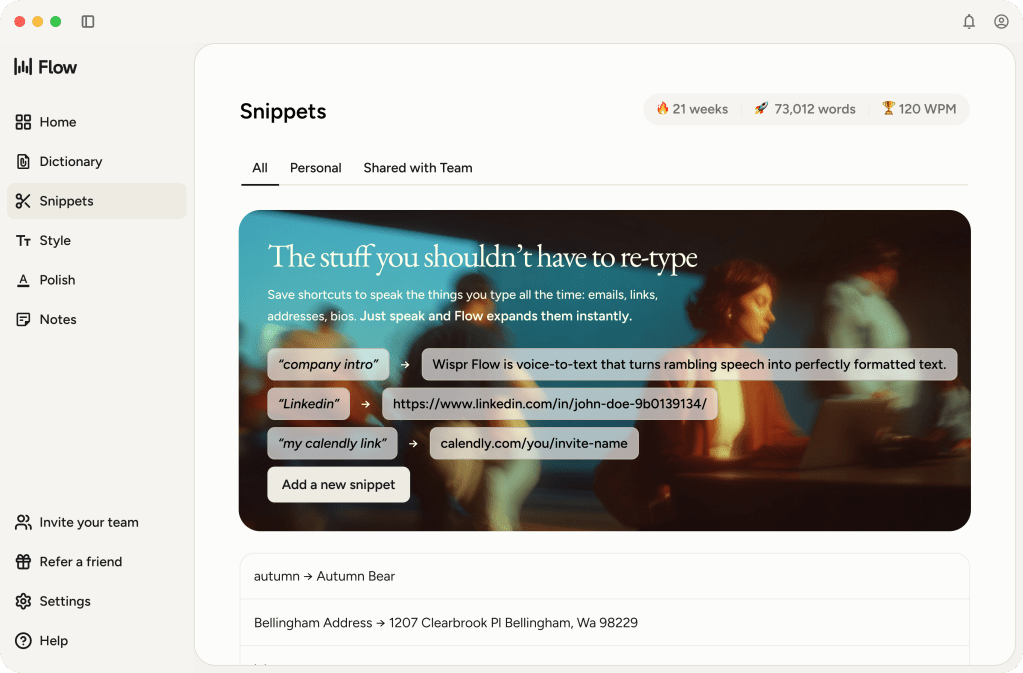
Whispr Flow snippets

Whispr Flow offers shortcuts, or “snippets” with its voice tool.

Whispr Flow snippets

In most cases, users can invoke an AI dictation tool across mobile and desktop applications with a text field – whether that’s a document editor, email client, a vibe-coding app or anything else – by pressing and holding a designated key or button while talking. Users can add words to the app’s dictionary so it can pick up on uncommon names, abbreviations, and industry jargon.

“The technology itself has improved dramatically” compared to previous tools that sought to transcribe speech verbatim and could be frustratingly inaccurate, said Maria Bell, senior research analyst at CCS Insight.  

“These modern systems are much more contextual; they understand your intent, they can help structure your thoughts and rewrite while you speak. They function more like writing assistants rather than just dictation.”

Wispr is among the best-funded startups in the market, having raised $81 million to date. Bloomberg reported in May that the company was in talks to raise a further $260 million at a $2 billion valuation. Other vendors have also attracted investor backing, with Willow Voice announcing a $4.2 million funding round last year.

The software is typically available via a freemium model, with a free tier offering basic functionality and usage limits alongside paid premium versions. Superwhisper Pro is $8.49 per user each month; Willow Voice’s Team Pro and Individual Pro are $10 and $12 per user each month, respectively; and Wispr Flow Pro costs $12 per user each month. Enterprise pricing is not publicly available from these vendors.

Larger tech firms have also invested in AI-assisted voice functionality. Apple, for instance, recently announced AI-powered dictation for its revamped Siri AI assistant, while Google is building in similar functionality for the Gboard keyboard on Android devices. Google is also developing a standalone AI dictation tool – Edge Eloquent – although its approach differs from that of startups in the space because the tool is not available across separate applications.

Why use AI dictation?

The key promise of AI dictation is that it can increase a knowledge worker’s words-per-minute (wpm) output versus typing. 

According to Superwhisper, most office workers can knock out between 40 and 70 words a minute on a  keyboard, though some can be much faster. (New York Times reporters vary from 36 to 134 wpm, according to a Times article earlier this year.) People talk much faster, at a rate of 160 to 180 wpm, and AI dictation app vendors promise low latency processing to turn speech into edited text (usually less than a second; some claim under 200 milliseconds).

It’s not just about speed: Willow Voice, for instance, claims its app is three times more accurate than dictation tools built into other applications. 

The prospect of accelerating routine writing and communication tasks has obvious appeal, particularly as AI threatens to increase rather than reduce the burden on office workers. “We all feel like we’re working faster – we have to do more with less time,” said Bell. 

“Employees are overloaded with communication work, and they’re spending huge amounts of time every day writing emails, messaging colleagues, using generative AI,” she said. “Voice tools are appealing because some feel they can do wor] faster. It reduces friction around all the tasks they’re being asked to do.”

The technology is potentially suited to a variety of jobs, said Cowan — not only those that require dictation — helping with tasks such as writing to-do lists and documents, or sending messages and emails. 

Accessibility is important, too. “These dictation tools also mean that people who find it hard to type or cannot type now have much better apps to help them with writing,” said Cowan. 

What’s holding the technology back?

Despite these potential benefits, the idea of talking to a laptop or smartphone throughout the day might not be appealing for a lot of people, particularly those in a busy office. 

“Some might find it embarrassing or uncomfortable, they’ll be worried about distracting colleagues or creating a disruption,” said Bell. “That’s still a major behavioral barrier that you have to overcome. 

“The technology is ready, but maybe workplace etiquette and culture is not necessarily there yet,” she said.

Working remotely, Patalano said he and his team can side-step some of this awkwardness. But it still took time to adjust to voice inputs. 

“Because we’re fully remote, we don’t have the challenge of everybody sitting side by side in an office talking into their computers, which would be more challenging, I suspect. But even getting comfortable with talking out loud alone in a room took a minute,” he said. 

As with any AI tool, there’s also the question of accuracy. 

Even if vendors promise a low error rate, LLM outputs can still have errors, requiring users to check the results. “They can still mis-recognize what’s being said,” said Cowan. Those in high-risk sectors such as healthcare still need to go through the AI-edited text and “double- and triple-check” the dictation. 

This friction means extra steps for a user working with the technology. 

It doesn’t take much to dissuade workers from adopting a new tool, said Jon Arnold, research analyst at J Arnold & Associates. “There’s definitely a lot of use cases where it would have a lot of value, but you’ve got to trust it — if it’s not giving what you think it will, you’re either going to fine tune it or go back to the keyboard and do it the old-fashioned way,” he said.

There are also privacy concerns. Because some tools send voice data to the cloud for processing, organizations in heavily regulated industries such as finance, healthcare and government might move cautiously.

Bell points to two types of privacy: social, such as “having colleagues overhear what you’re saying,” and digital privacy, which relates to who else can access the conversation data. 

App providers take different approaches; some process voice data on device, others send it to the cloud. That’s an important distinction for organizations with strict data protection requirements, said Bell. 

“Where’s the voice data processed? Where is it stored? How can it be accessed? Enterprises are very, very focused on governance and data security and data privacy,” she said.

Too soon to ditch the keyboard?

Despite growing interest in the technology, it’s still unclear whether a large number of workers will choose talking over typing. And remains to be seen whether startups that offer a best-of-breed AI dictation app can gain traction, or fade if the technology simply becomes embedded within the software ecosystems of larger tech firms.  

Workers are more familiar with voice technology, thanks to AI assistants in smartphones and smart speakers at home. That, said Bell, could improve the prospects of wider use in business settings. 

“Voice interaction feels less niche than it did about five years ago,” she said. “Overall, the technology is improving quickly…, but how we’re really going to determine success is whether we can change human behavior.”

Arnold is bullish about the use of voice technology in the workplace: “Five or 10 years [from now], we won’t think twice about it. It’ll just be the norm.”

Bell is more cautious.She sees potential for AI dictation as a supplementary tool for communication-heavy work. “I don’t think it’s going to replace the keyboard, but I do think it could become a secondary interface,” she said.

Even Patalano doesn’t expect AI-assisted voice dictation to entirely replace typing “Your speaking voice and your written voice will always, to some degree, be different, and that’s okay: we should probably lean into that,” he said.

“I think there will always be a place for wordsmithing, crafting, writing – and the same with coding, too. There’s going to be lots of cases where every single word matters.”

He plans to continue using AI dictation, whether with Wispr Flow or other similar tools that might emerge in the future.  

While a lack of accuracy slowed adoption in the past, continued advances could open the door to wider workplace uptake.  

“When I try to use a voice tool and it misses even once, you kind of throw up your hands and walk away, because the cost of having to correct it is way more than the benefit of using it versus typing,” Patalano said. “But, especially with the improvements in LLMs and AI models generally, the accuracy of these is going to keep getting better and better. 

“I’m already looking for more and more opportunities to use voice instead of having to type.” 

Microsoft betting that enterprise AI needs engineers, not bigger sales teams

The number of tech layoffs continues to tick upwards as AI investments increase, with Microsoft alone cutting around 4,800 employees, or roughly 2.1% of its workforce, this week.

The latest cutbacks are mostly in the company’s commercial sales and Xbox divisions. They follow two others in 2025 that impacted around 15,000 workers, or roughly 4% of the company’s workforce. Prior to the latest cuts, Microsoft had 220,000-plus employees.

The headcount reduction also comes just days after the announcement of Microsoft Frontier Company, an initiative that will provide embedded support for customers deploying AI projects, similar to traditional offerings from systems integrators (SIs).

Taken together, these moves seem to indicate that Microsoft is betting on its engineering expertise, rather than traditional account management, as the path to AI success.

“Microsoft had already reorganized its commercial business around AI,” said Thomas Randall, a research director at Info-Tech Research Group. “Recent layoffs are part of that ongoing context.”

Microsoft’s memo to employees

In a memo obtained by Business Insider, Microsoft EVP and chief people officer Amy Coleman said the cuts effectively reflect the tectonic shift being brought about by AI.

“The ‘why’ is this: Our business is changing because the world around it is changing,” she said. “Companies don’t get to choose whether their industry changes; they only get to choose whether they change with it.”

Customer needs, and the business models that serve them, are shifting, meaning vendors must “adjust resources and roles” so they can operate in a way that best serves their customers. However, Coleman emphasized: “Whenever possible, our priority is to place people into new roles aligned to the company’s highest priorities and greatest areas of opportunity.”

Which, today, is AI.

Seemingly contradictorily, Coleman said the cuts “build on” the Frontier Company announcement, which is “reshaping how we work and embedding our engineering experts alongside customers so we can help them accelerate their technology deployments.”

While she emphasized that the roles eliminated this week are not being replaced by AI, the technology is fundamentally changing work. Many everyday tasks are being automated, meaning “we all need to keep learning, keep building new skills, and keep adapting as the work evolves.”

Customers are undergoing the same shift and are looking to Microsoft for guidance, she noted. “We can’t do that well unless we’re doing it ourselves.”

Finally, she said the tech giant will evolve structure and priorities across the company “thoughtfully.”

“We are working on alternative solutions to job eliminations and … we will continue to invest in equipping employees with new skills, including in AI.”

What customers might expect

Redmond isn’t the only big tech company taking scalpels to staff as the industry adjusts to, and seeks to capitalize on, AI. Companies are spending billions and inking strategic partnerships with top AI labs, and these investments in some cases need to be offset with cuts because some have yet to provide tangible ROI.

For instance, Amazon has laid off 30,000 workers since last fall, while Google is rumored to be cutting employees in its cloud division. Meta, for its part, eliminated 8,000 employees, or about 10% of its total headcount, in May alone, while Oracle recently slashed 21,000.

For customers, there is a price to pay, however. In the case of Microsoft, Info-Tech’s Randall said that, with the cuts, some customers can now expect slower response times on “non-strategic asks,” particularly as accounts are consolidated under fewer reps.

That said, given its Frontier Company investments, top accounts with large AI, data, security, and cloud commitments may get “deeper technical engagement,” while ordinary licensing/support workflows may become leaner.

Further, customers can expect more hand-offs to partner-led engagements, given that Microsoft is already pushing customers toward its partners for FY27 (which began July 1, 2026) when it comes to AI, security, cloud modernization, Copilot, agents, and managed services, Randall said. The company is also offering partners higher margins for growth in certain AI workloads.

“To prepare for these shifts, customers should reflect and document their Microsoft account and support teams,” Randall advised.

By that he meant enumerating things like the support contacts, the partner contacts, and the escalation paths for issues. This information should be well-documented and shared internally, he said. The same goes for Microsoft-involved conversations having to do with any kind of commitment, such as those involve pricing assumptions, roadmap dependencies, or deployment milestones.

“This can ensure a smoother transition with a new account rep on what has already been set out for the organization,” Randall said.

Closing the gap between AI investment and ROI

Last week, Microsoft launched the $2.5 billion Frontier Company, which it said “goes beyond” SIs and Forward Deployed Engineers (FDE). The initiative will integrate thousands of the company’s own engineers directly into customer environments to help them build AI tools, and to also help customers learn essential skills so they can eventually handle projects on their own.

But customers shouldn’t think of this as what he described as “consulting-heavy, McKinsey-style engagements,” noted Info-Tech’s Randall. Pre-sales will likely become more focused on qualifying an organization’s specific processes for ongoing AI implementations, rather than on system-wide change management. As with other hyperscalers such as AWS, Microsoft is leaning into this more white-glove model to help “prevent the gap between AI investments and AI ROI from widening.”

“As such, Microsoft will likely reserve its best technical talent for accounts with strong production intent, credible budget, usable data, and clear executive sponsorship,” Randall predicted.

This article originally appeared on CIO.com.

Scientists: No, we’re not living in a simulation

For years, there’s been speculation that we live in a simulated reality — a concept popularized by 1999 film The Matrix.

Now, researchers at the University of British Columbia Okanagan in Canada have determined this is not mathematically possible.

“Based on mathematical theorems related to incompleteness and undecidability, we show that a fully consistent and complete description of reality cannot be achieved through calculations alone,” researcher Mir Faizal wrote in the Journal of Holography Applications in Physics. “It requires non-algorithmic understanding, which by definition lies beyond algorithmic computation and therefore cannot be simulated. Consequently, this universe cannot be a simulation.”

Despite the researchers’ conclusions, the idea that we live in a simulated world is unlikely to disappear entirely.

Forget the hype — iPhone Ultra scarcity will tell the story

Apple has been working on a foldable smartphone for more than a decade. Having spent so much time developing the device, the company doesn’t want to ship something if it can’t make something good. Now, it looks like Apple can make a folding iPhone, but manufacturing them in decent quantities is going to take a little longer to bed in.

That’s the basic premise of this weekend’s most interesting slice of Apple-related news, which emerged from analyst Ming-Chi Kuo, who believes initial production of Apple’s folding iPhone — potentially called iPhone Fold or iPhone Ultra — will sell out fast, despite its likely $2,500 price tag. 

That’s because he expects Apple will be able to make just 7 million or 8 million units of the device by the end of the year. This relatively low number could reflect previously reported build quality control challenges, which likely have required additional investment in manufacturing capabilities. (That lower number may have changed, since a recent report said Apple has increased initial production to 10 million, and is expected to grab 29% share of the foldable market.)

Scarcity by design

As with so many iPhones across the near 20-year history of the device, a major new redesign always boosts gray-market sales. The analyst expects we will see this happen again, predicting that scarce supply, recognizable design, and an innovative user experience will help foster a short-term resale premium on second user markets. 

To put that into perspective, the analyst predicts initial resale prices for the device could be 50% to 100% above the retail market price, with those elevated prices holding until a supply-demand balance is achieved.

Searching for a comparison, the analyst pointed to the iPhone X, which was scarce once it arrived, despite reaching stores two months after the other devices with which it was introduced.

Kuo thinks a similarly staggered release might happen with the folding device. He doesn’t think this will dent demand much. It didn’t with iPhone X; despite the cost and late debut, people really fell for the device. It captured over half of all smartphone revenue within weeks, and sold at a rate of one every three seconds in Europe. 

Scalp for victory

To some extent, we may be able to identify the momentum behind the new device’s launch just by watching its progress on second-user markets after it is introduced. If we can track higher prices for the device, that would imply the scale of unmet demand. Apple will want to stimulate that interest, so much of its work will be to focus on different sectors in which the advanced iPhone can make the biggest difference, perhaps as a field sales tool for executives or a Mac/iPad replacement for business travellers,. 

The iPhone X swiftly became the most used smartphone among business users, and Apple’s going to try to press in that direction again. Expect increased marketing activity, innovative additional software features in the run up to the holiday period, and lots of influencers making cute videos in support of the launch. 

To an extent, it’s only after the first few months, once demand/supply balance is achieved, that we can gauge success or failure.

“The best window for assessing true demand for the foldable iPhone is likely late 2026 to 1Q27,” the analyst said. That’s because by then the holiday shopping season will be done and “early production issues and supply constraints should have improved significantly,” he said.

Can Apple reset smartphone pricing?

Consider this: The iPhone X was seen as a seriously expensive device once it appeared. It shipped with a then-unheard-of $999 price tag, $350 more than the $649 cost of the iPhone 7. 

Apple’s success back then broke the psychological price barrier for smartphones, making it acceptable for buyers to throw $1,000 at a new device. That’s normal today, with US consumers spending more than that each year. 

Apple’s decision to fly in a new high-end price point might deliver the same kind of energy, giving Apple access to the most premium consumers even as it pushes into lower-end markets with e-series devices picking up where iPhone 7 left off. 

What no one, including Apple or Ming-Chi Kuo, can know yet is whether these specs, iOS 27, and Apple Intelligence will be enough to convince consumers to buy these products.

Please join me on social media at BlueSky,  LinkedIn, or Mastodon, even better, please subscribe to The Core for your daily collection of human-curated Apple News.

6 ways to make AI accountability stick

As intelligent systems move into production environments and begin taking actions, organizations quickly discover that accountability becomes much harder. Unlike traditional enterprise software, these tools can produce unpredictable outcomes as they interact dynamically with data, APIs, and business workflows.

“When something goes wrong with AI, it is generally assigned to whoever was closest to the pain point,” says David DuChene, manager of data and AI pre-sales at SHI International, which works with enterprises on AI deployments and governance.

As these systems shift from advisor to actor within workflows, accountability becomes harder to enforce through policies alone. IT leaders must build it directly into the fabric of their operations through clear ownership, continuous observability, defined escalation paths, and infrastructure designed to make responsibility visible when things go wrong.

Here are six ways to make AI accountability enforceable in production.

1. Assign direct ownership from the beginning

Many enterprises still view AI accountability as a shared responsibility, but some experts argue that this is the first assumption to fail when systems enter production.

“Shared accountability is not accountability,” says Joe Wilson, SVP and CIO of CSG, a customer experience, billing, and payments software provider. “You need a direct owner.”

He says that at CSG, AI initiatives go through governance reviews involving executive leadership, and direct ownership is assigned at the start of projects. Wilson, who oversees the AI governance and deployment strategy for CSG, says the company also created “CIO reps” embedded inside business units and product groups to ensure accountability spans the entire lifecycle of AI initiatives.

According to SHI’s DuChene, many enterprises still lack formalized accountability structures for those environments. “They may have responsible parties on paper, but once a system actually breaks down, everything gets relitigated,” he says. “It goes back to who’s closest to the pain point.”

One diagnostic question, he argues, reveals whether organizations are truly prepared: “If your AI deployment generates a wrong answer and costs the business money tomorrow, who’s going to write the postmortem?”

If leaders cannot answer that question quickly, accountability structures likely don’t yet exist in practice.

2. Build governance before scaling deployments

In the past few years, many enterprises deployed AI systems before establishing the governance and operational foundations necessary to support them safely. “The biggest gap we see is a sequencing problem,” says DuChene. “We’ve gone around and built a bunch of houses where we’re standing up the walls before we’re pouring the foundations.”

That sequencing problem creates expensive retrofitting efforts later. DuChene says teams frequently discover they lack data classification systems, AI-aware identity and access controls, lineage and provenance tracking, audit capabilities, and escalation channels for failures.

According to Seth Dobrin, CEO of deterministic AI model maker Arya Labs and former global AI leader at IBM, governance often fails because organizations treat it as a policy layer rather than something embedded directly into operational workflows. “How do you integrate it into the workflow?” he asks. “If you don’t get that right, it’s going to fall apart.”

Dobrin recalls working with an insurance company that spent 18 months building an intelligent system before legal teams blocked deployment entirely. The problem was not the technology itself, but the absence of governance early in the process. “They had to throw it away,” Dobrin says. “Had they started earlier, they would have steered it to a place where they could have gotten to yes.”

Dobrin says governance should not slow projects down. Instead it should be integrated deeply enough into workflows that teams can move quickly without downstream compliance or operational failures. “The objective should never be to say no,” he says. “It should always be to figure out how to say yes.”

Wilson at CSG makes a similar point, arguing that governance should help teams absorb complexity rather than simply restrict what they can do. He compares it to a vehicle suspension system rather than a braking mechanism. “Our intention is not to slow things down,” he says. “Our intention is to speed stuff up, but also when you get into rough terrain, to be able to navigate that terrain.”

3. Treat data governance as the foundation of accountability

According to Wilson, CSG focused on governing its data before scaling AI initiatives across the business. Those efforts started with data synchronization and privacy impact assessments.

“The foundation is data,” Wilson says. “If we don’t have clean, synchronized, and governed data across the board, we’re not going to win this battle.”

Many organizations underestimate how difficult it becomes to maintain accountability once AI systems begin interacting with fragmented enterprise data environments, says Quais Taraki, CTO of EnterpriseDB, a company that works with enterprises on data infrastructure and governance.

An AI assistant summarizing customer interactions, for example, may pull regulated or confidential data from systems that were never intended to feed generative AI tools.

Strong data governance practices — including lineage, provenance tracking, classification systems, and access controls — not only help head off such problems but also create the foundation for accountability when something does go wrong. Otherwise, teams struggle to determine what data an AI system accessed, how outputs were generated, and whether sensitive information influenced a decision.

“Without lineage and provenance, you can’t do root-cause analysis,” Taraki says. “You won’t know what to change, or how things mutated in ways you didn’t expect.”

Taraki argues that accountability should follow governed data products rather than organizational silos. When ownership is split across infrastructure teams, data scientists, and application developers, responsibility can become difficult to establish after failures occur. Assigning clear ownership to the data products that feed AI systems helps create accountability throughout the AI lifecycle.

4. Build observability into (and beyond) AI systems

Traditional enterprise monitoring systems were designed primarily to track uptime, infrastructure health, and application performance. AI introduces a different challenge: tracing reasoning paths, decision chains, and behavioral drift.

Nik Kale, a member of the Coalition for Secure AI (CoSAI) and participant in AI security and agent identity standards efforts, describes this through what he calls an “Investigation Graph.” This is a reasoning trail showing what an AI system observed, what tools it accessed, what conclusions it reached, and what actions it ultimately took.

“When something breaks, the first instinct is always to ask, ‘Why did the AI make that decision?’” Kale says. “Honestly, I think that’s the wrong question. The right question is, ‘What did the system actually do?’”

That distinction is increasingly important because AI failures rarely originate from a model alone. Instead, they emerge from interactions between models, credentials, APIs, workflows, policies, and downstream systems.

“The model didn’t act,” Kale says. “The system around the model acted.”

That broader view of accountability is also changing how IT leaders think about observability. Rather than monitoring AI models in isolation, enterprises increasingly need visibility across the systems those models interact with, including data sources, APIs, applications, security controls, and downstream workflows.

In practice, that starts with comprehensive logging of prompts, model outputs, tool calls, data access events, and agent actions. Combined with traditional application and infrastructure telemetry, those logs create an auditable record of how AI systems behaved and why decisions were made.

That visibility becomes especially important when IT leaders try to identify unauthorized AI usage. While governance policies define which tools employees should use, observability helps reveal which tools they are actually using. Unusual data access patterns, unexpected API calls, traffic to external AI services, and unexplained movement of sensitive data can all be indicators of shadow AI.

Even well-governed organizations can struggle when employees adopt unauthorized AI tools outside approved workflows. “If it’s shadow IT, we don’t even know it exists,” says DuChene. “We don’t know what data of ours is going into it, how it’s being used, or how it’s being distributed.”

By extending observability beyond AI models to the broader enterprise environment, IT can detect those activities earlier, investigate them more quickly, and reduce the accountability gaps that shadow AI creates.

5. Create ‘escalate’ and ‘stop’ mechanisms

The most important accountability question may not be what an AI system can see or do, but when it should stop and ask for help.

According to Kale, that’s often the most underdeveloped part of enterprise AI deployments. “Most enterprises have figured out how to monitor their AI systems,” he says. “But nobody has really built the third piece, which is, when does the system actually stop and ask for help?”

Kale argues that enterprises need explicit escalation paths, human decision points, and clearly defined stop mechanisms for systems operating in production.

“You don’t want a rubber stamp — you want a human in the loop,” he says, adding that the human should be named and have the authority to say no.

According to Wilson, incident response processes also need to evolve, because AI failures behave differently from traditional IT outages. “A traditional IT incident typically looks like it’s an up or down scenario,” he says. “AI failures are a little more subtle than that.”

Models may drift gradually, outputs may degrade over time, or workflows may begin producing unexpected results without systems technically failing. The result, says Wilson, is a growing need for multidisciplinary response processes involving legal, communications, security, audit, business teams, and IT operations simultaneously.

6. Treat AI systems more like workers than software

Some enterprises still govern AI like traditional applications. But according to Kale, AI systems behave more like workers and less like deterministic software.

“You cannot just deploy once and be done,” he says. “Like workers, they need ongoing oversight.”

That ongoing oversight is becoming a core accountability function. Employees are not hired, trained, and then left unsupervised indefinitely. Managers monitor performance, provide feedback, evaluate changing responsibilities, and intervene when behavior drifts from expectations. Kale argues that AI systems increasingly require similar treatment.

Traditional software can often be reviewed and approved at release time because its behavior remains relatively stable between versions. AI systems are different. Models evolve, prompts change, retrieval systems are updated, and the information available to agents changes continuously.

That challenge extends beyond internally developed systems. Enterprises must also monitor the third-party AI services they rely on. Not only do vendor models evolve on their own, but vendors also update software and capabilities behind the scenes.

“The vendor we approved last quarter is functionally a different vendor this quarter,” Kale says.

As a result, accountability cannot end when a system is deployed. Someone must remain responsible for monitoring performance, reviewing changes, assessing risk, and determining whether systems continue to operate within acceptable boundaries. Kale points to CoSAI’s AI Shared Responsibility Framework as one emerging effort to clarify those responsibilities across enterprises, software vendors, model providers, and infrastructure operators.

The organizations making the most progress are discovering that accountability cannot be assigned on paper and forgotten. As AI systems become more autonomous, accountability is becoming an operational capability built into data governance, observability, escalation processes, and ongoing oversight. For IT leaders, the challenge is no longer defining responsibility. It is making responsibility enforceable.

Related reading: