Author: Computerworld

OpenClaw launches an AI performance benchmark that it argues is more realistic than others

OpenClaw, working with a host of other industry players including Hugging Face, Nvidia, Red Hat, Google and Amazon, Tuesday rolled out an AI performance benchmark called ShellBench.

OpenClaw’s position is that the benchmark will compare various AI models (it will soon look at a total of 24) and test them on complex queries, ones that should better replicate the kind of complicated tasks that an enterprise would perform. 

“Ask an AI agent to summarize a document, and it will probably do a decent job. Ask it to reconcile a handful of receipts against a spreadsheet, check which information is current, flag a suspicious payment request, and explain how it reached its answer? Maybe not so well,” said the OpenClaw post describing the new benchmark. “This kind of realistic test, one that expects an agent not just to find the right information but also to keep track of it along the way, is exactly what we’re launching ShellBench to evaluate.”

Analysts and consultants said the new benchmark findings appear initially to be more useful than existing AI performance benchmarks, but it is less clear how useful those results will be.

Thomas Randall, a research director at Infotech, said that he sees ShellBench as focusing on those who are building and configuring agents directly, but most enterprises instead buy their AI capabilities from various large AI vendors.

“They are choosing capabilities within an enterprise platform, often with limited control over the underlying model or agent configuration. For these organizations, ShellBench offers little direct use,” Randall said. “ShellBench giving a strong score for an underlying model does not tell us the quality of output from a solution built on it. The tasks ShellBench tests are skewed toward personal knowledge work rather than heavy enterprise workflows that buyers typically evaluate for.”

Are results reproducible?

Another analyst concern is how open ShellBench will be, especially in terms of how easily IT can reproduce its findings. 

Brian Levine, a partner with consulting firm Control Risks, said that reproducibility is essential.

“Whoever writes the exam has a stake in who passes it. That doesn’t make the results wrong, but the right question isn’t whether you trust OpenClaw. It’s whether you can check their work,” Levine said. “If the tasks, scoring, and raw results are open and others can reproduce them, pay attention. If not, read it the way you’d read a carmaker’s own crash test.”

However, the problem with ShellBench is that parts of it are open and parts of it are not.

It’s complicated

Louka Ewington-Pitsos, a co-founder of Parsewave and a collaborating researcher for the benchmark, said the division of public and private elements in the benchmark is complicated.

“Teams can rerun ShellBench on the public task set, which is a subset of roughly 20 tasks of the full benchmark. The ShellBench GitHub repo includes the evaluation configurations and we pin the agent harnesses to the exact versions used in the study so teams can reproduce the same setup,” Ewington-Pitsos said. “The remaining tasks are private.”

He added that the “private part is only the 80 remaining tasks. The evaluation configs and the pinned harness versions apply to the whole benchmark and are available for anyone to use.”

Ewington-Pitsos said that the reason those tasks have to remain private is “to avoid benchmark contamination, which is where data leaks from the public internet into model training data, making the benchmark less valid for future models.”

The initial version of the benchmark looks at 13 models, but the number of models tracked will double to 26 by next week, said Vincent Koc, the OpenClaw chief architect, in an interview. 

Koc said that although almost all enterprises will do their own AI performance benchmarks, they typically won’t be able to replicate ShellBench’s comprehensiveness. They “won’t have it at this speed and scale,” he said. 

Just about right

Most analysts and consultants thought that ShellBench specs were just about right, in that they focused on the more complex tasks most large businesses need. 

“Most agent benchmarks are the equivalent of testing a new hire on spelling. Enterprises don’t need an agent that can spell. They need one that can run a messy, multi-step job across five systems without locking the CFO out of email. A benchmark built around that kind of work is measuring the right thing,” Levine said. “From a risk standpoint, the most important result isn’t which agent finishes the task. It’s how an agent fails. An agent that stalls is an annoyance. An agent that confidently does the wrong thing with admin credentials is an incident. Realistic, complex tests are where you find out which one you have, before your production environment does.”

Ishraq Khan, CEO of coding productivity tool vendor Kodezi, said that the leapfrog nature of AI model performance, in which models regularly exceed each others’ performance, only to be superseded by the next version of their competitor’s model, is a concern, but ShellBench could still be useful by providing a look at the trends over time.

“The leaderboard itself will inevitably become outdated. However, the underlying failure patterns and evaluation methodology have a much longer shelf life. Enterprises should use benchmarks like ShellBench as a foundation for continuously evaluating agents against their own operational workflows, rather than making a one-time purchasing decision,” Khan said. “As for OpenClaw’s credibility, the involvement of researchers from established academic and industry institutions is encouraging. But OpenClaw is also evaluating its own harness against competing products, so independent replication is important.”

Jason Andersen, principal analyst at Moor Insights & Strategy, said that he found much to like in ShellBench. 

“This is a really interesting benchmark since it finally decouples the harness and the model and measures it. So far the benchmark activity is limited to the model and that is not accurate in terms of how people are actually using models which is via a harness,” he said. “I think this is a trend we will see continue to expand due to technologies like OpenClaw and Hermes. Some vendors like IBM and Microsoft have been publishing results of open weight or small models with a good harness performing quite well versus medium and large frontier models.”

Harder to game

Andersen also suggested that the more complex testing from ShellBench may have the added benefit of making the results harder for vendors to fool.

“One of the things about benchmarks is that they can be gamed, and the simpler the benchmark, the easier it is for entrants to game with solutions or configurations that may never apply in real life,” he said. “But a more complex set of methods is harder to game, so there’s a chance this could be a more realistic set of outputs than the simpler model performance metrics.”

Frank Dickson, principal analyst at Dickson Research, agreed, adding that ShellBench included a lot more verification in their analysis. 

“The researchers deserve credit for the bar they set. Requiring every criterion to pass, running each task three times, and publishing exactly where and how agents fall short is more rigor than most AI benchmarks offer,” he said. 

Dickson pointed to some of the initial findings of the benchmark as examples of the model’s advantages. 

“Consider the spread: The top three models, GPT-6 Astra, Claude Fable 5.2, and GPT-6.1 Sol, finished within 1.1 percentage points of each other,” he said. “Yet GPT-6 Astra completed 75.1% of tasks at least once in three tries and only 48.8% on all three. OpenClaw notes that its grader may account for some of that swing. Either way, a 26-point swing inside one model dwarfs a 1.1-point gap between the leaders.”

So, he observed, “the enterprise question is not who is number one this week. The question is which tier a model sits in, and which failures show up no matter who leads. ShellBench found a median gap of 45.7 points between the best and worst model within the same harness. That is the gap worth caring about.”
Microsoft has an old, but new, idea for PC upgrades: Cloud PCs

Prohibitive prices have put many enterprises’ PC upgrades on hold, but Microsoft has another idea: upgrade to its “cloud PCs.”

Cloud PCs are a reference to Windows 365, which delivers a familiar, full Windows 11 desktop experience from the Microsoft Cloud. It works on a wide range of existing computing devices.

Users don’t need a full-featured laptop. They can get a full Windows experience by launching an app on a lower-end Windows PC, Mac, or tablet, or through a specialized remote-desktop device.

With PC prices going up, Windows 365 allows you to extend the life of your current PC fleet, said Pavan Davuluri, executive vice president of Windows and Devices at Microsoft, during the opening-day keynote at the company’s Ignite conference last week.

“You can give compute to anyone in minutes, no new hardware. As you plan this PC refresh cycle, add cloud PCs to your estate,” Davuluri said.

At Ignite, Microsoft introduced new technologies to make Windows 365 faster and easier to use. The product itself was launched five years ago, so it isn’t new, nor is the concept of getting a full-fledged computing experience through a single app window, which has been considered promising for decades.

In the ’80s, Sun Microsystems coined the slogan “The network is the computer,” with the promise that powerful Unix servers would deliver full computing experiences to remote desktops with minimal hardware. In the late 2000s, netbooks with underwhelming hardware also promised more web-based computing, but faded away. Chromebooks are now a conduit for running applications hosted on the internet.

But cloud PCs could be more relevant now, especially with AI in the picture, Microsoft officials argued.

Unlike on-premises PCs, cloud PCs are “elastic.” Enterprises can choose configurations to match the compute to work, such as 2 virtual CPUs and 4GB of RAM for running light productivity tools and more CPUs, more RAM, and even GPUs for AI and graphics-intensive jobs.

Configurations with up to 32 virtual CPUs and 128GB of RAM are available, with prices ranging from $25 to $255 per user per month for small businesses, and from $28 to $765 per user per month for large enterprises. The top-level enterprise plans include GPUs for graphics-intensive workloads and cost up to $1,915/user/month.

Microsoft also offers plans for running AI agents in Windows 365. There are going to be 1.3 billion agents working along with employees by 2028, according to an IDC projection shown on a Microsoft slide.

With cloud PCs, IT administrators have a better grip over AI agents, Microsoft said. Admins also sidestep the burden of monitoring and patching a fleet of physical PCs.

“Today if you’re still purchasing, troubleshooting, or patching a full PC for every hot desk, every station, and every shift, you’re giving back some of those savings you just made,” said Jose Lara Silva, a product manager at Microsoft.

Microsoft has made its streaming technology, called DirectStream, faster. Connection reliability has also improved by 300%, said Bhavya Chopra, partner director for Windows 365 at Microsoft.

“[Sessions] connect in seconds now in the right conditions… We have made a bunch of improvements to make sure that… once you click that connect button on your Windows app, you’re in the desktop within 10 seconds,” Chopra said.

Microsoft and Nvidia also collaborated to optimize a chip, the RTX Pro 6000 Blackwell Server Edition, to encode graphics for DirectStream on cloud PCs.

But there could be challenges. Chopra acknowledged that in many cases, printers and specialized USB devices don’t work yet, as extra drivers can’t be installed on locked-down cloud PC devices.

Microsoft’s Windows 365 pitch at Ignite makes sense theoretically and for some segments of users, said Neil Shah, vice president of research at Counterpoint Research.

Renting the Microsoft offering in the cloud lets CIOs skip hardware upgrades as memory and chip costs drive PC prices to record highs, Shah said.

AI agents also need tight security, Shah said. Windows 365 lets IT administrators “manage everything centrally, keep corporate data off local drives, and run agents in isolated environments without buying expensive AI laptops for the whole company,” Shah said.

But the reality is more complex, Shah said. “You still have to buy a physical device, screen, and keyboard just to connect to the cloud.”  When you add up four years of monthly Windows 365 subscriptions on top of that base hardware, “it often costs more than simply buying a standard laptop,” he said.

“Also, if the internet goes down or suffers from bad latency, everything can come to a standstill,” Shah said.

Running every token in the cloud can get expensive, whereas powerful on-premises hardware can run some AI workloads locally and privately, he noted.

A limited cohort could benefit from Windows 365, such as contractors, offshore teams, M&A onboarding, and spinning up secure sandboxes for AI agents, Shah said. “As a full replacement for an entire company’s laptop fleet, though, the math still points toward a hybrid setup rather than going 100% cloud.”

Related:

Encryption has a new problem: AI is getting better at proving the impossible

AI has solved yet another math problem that stumped humans for more than 150 years, ratcheting up questions about the efficacy, or even relevancy, of cryptography in the age of AI.

Aided by Claude, mathematician and Anthropic employee Levent Alpöge is believed to have proven the Riemann Hypothesis, one of the most famous open problems in math. It posits that prime numbers, or the ‘atoms’ of all math, are actually distributed neatly and predictably, not randomly or sporadically as they may seem.

The hypothesis’ proof could, at least in some eventualities, change the story of modern cryptography, because prime numbers serve as secret passcodes that help hide sensitive data. Still, security leaders and teams shouldn’t panic, even as mathematicians may be in mourning.

“This development does not mean encryption has suddenly been broken,” said Fritz Jean-Louis, a principal cybersecurity instructor at Infotech. “The more important security aspect is the speed of AI-assisted mathematical discovery.”

The dawn of ‘something far greater’

Mathematician Bernhard Riemann proposed his eponymous hypothesis in 1859, suggesting a hidden pattern in the distribution of prime numbers (numbers like 3, 5, 7, 11, 13, and so on that are divisible only by themselves and 1). They are the building blocks of whole numbers, while at the same time hiding deeper, unresolved patterns, or so it has been thought.

The Riemann Hypothesis has lacked a general proof for 167 years; the Clay Mathematics Institute even offers a $1 million bounty to anyone who can generate one. It is one of seven Millennium Prize Problems with this distinction.

But last week, Alpöge posted a proof generated with Claude in Lean, a programming language that verifies the mathematical correctness of each step. Alpöge initially posted just the proof because the detailed text occupies more than 250,000 pages.

The mathematician wrote on his website: “It is natural to feel that this is an end, in my case a loss of a principal guiding light, but what I saw during the course of progress so amazed me that I believe it is one dawn across science of something far greater.”

His results were quickly verified by independent researchers, and the general consensus is that the proof could fundamentally transform mathematics; some even compare its development to a Rosetta Stone moment.

AI’s early impacts on cryptography

Ever-advancing AI models are quickly upending mathematics. In September, for instance, OpenAI said it had solved a different Millennium Prize Problem, Navier–Stokes (although this has not officially been verified). Then, in October, the company shared a huge dump of math results produced by an internal frontier model, including a claimed proof of the quasi-Riemann hypothesis, a weaker version of the Riemann hypothesis.

“Mathematics went from plodding to revolution in three months, it seems,” said cybersecurity expert Frank Dickson of Dickson Research. “Encryption is definitely more at risk than it was a year ago.”

But the real threat is not the Riemann Hypothesis, he said, it is the AI capabilities aimed at encryption.

RSA encryption uses a public key to encrypt data and a private key to decrypt it, relying on the difficulty of factoring large prime numbers. But, Dickson noted, it is “only as strong as the difficulty of splitting a very large number into the two primes that were multiplied to make it.”

The Riemann Hypothesis describes how primes are spread along the number line, but not which two primes are hiding inside your key. “The proof leaves RSA exactly as strong as it was last week,” Dickson said.

That said, AI is already impacting cryptography. For instance, in July, Anthropic reported that Claude Mythos found a flaw in the mathematics of HAWK, a possible future digital signature standard built to withstand decryption by attackers using quantum computers. It also discovered a faster attack on a deliberately weakened version of the advanced encryption standard (AES).

“Neither result touches anything running today, good news,” Dickson said. The bad news: Experts had studied HAWK for years. “Then, AI found the crack.”

Factoring is moving too, he pointed out. AI agents have rewritten existing software to run on graphics chips, at about a tenth of the previous cost. Effectively, “AI did not find a shortcut; it made the long way cheap.”

How security teams should think about this, long-term

Infotech’s Jean-Louis noted that while the Riemann Hypothesis concerns how prime numbers are distributed, and RSA encryption depends on the difficulty of factoring a particular large number, modern elliptic-curve and post-quantum systems rely on different mathematical problems.

Thus, security leaders should not panic or replace algorithms as a result of this development. But they should still accelerate their cryptographic inventories, crypto-agility, and existing post-quantum migration plans. “If AI can explore, construct, and formally verify arguments of this complexity, cryptographic breakthroughs may eventually arrive faster and with less warning,” he said.

Dickson advised users to stop assuming encryption stays as strong as the day they deployed it,. “AI is turning encryption strength into a depreciating asset,” he said.

Older, shorter keys are the most exposed, he said. The US National Institute of Standards and Technology (NIST) retired 1024-bit RSA years ago, but those keys still turn up in old website certificates, email security records, and device firmware. AI engineering firm Cognition estimates that breaking a 1024-bit RSA key now costs roughly $30 million in computing time; for a nation-state actor, that is a line item rather than a moonshot, Dickson noted. RSA-2048, however, is generally considered secure against attacks using classical computers.

But the long-term clock is already ticking, Dickson pointed out. On October 27, NIST finalized its plan for moving to encryption built to withstand attacks using quantum computers; RSA and elliptic-curve cryptography are to be phased out after 2030 and no longer allowed under NIST standards after 2035.

But, he said, “AI may make that schedule look generous.”

His recommended to-do list:

  • Find and replace anything still using 1024-bit keys.
  • Move data that must stay secret for 10 years or more to the front of the line for quantum-resistant encryption.
  • Build crypto agility, the ability to swap encryption methods without rebuilding the application, “because HAWK proved that a promising method can fail late.”
  • Stick with NIST’s finalized standards.

A preview of future attacks

Mathematics has entered an era of proofs that machines can verify before humans can fully understand them, Dickson explained.

He pointed out that the Riemann proof is written as 17 million lines of code in Lean, and was certified as correct on November 21 by the Lean FRO and Mathlib Initiative, but Alpöge released it before mastering much of the mathematics around it.

That is a triumph for verification, but it is also a preview for security teams. “AI-found attacks may arrive the same way: Correct, checkable, and far ahead of anyone’s ability to explain them,” Dickson said.

Nvidia CEO boomerang reinforces IT worries about AI risk exposure

Today’s move by the Nvidia board of directors is raising enterprise CIO concerns about AI overreliance on one vendor, along with the question of whether boards can still effectively manage their CEOs, analysts and consultants said.

Despite saying last week that Jensen Huang was out for good, the board announced on Monday that it was reinstating him as CEO. 

One concern raised by the Nvidia statement is that of the direct involvement of US President Donald Trump in the board’s move.

“The Board received input from senior levels of the United States government and based on that input, the Board is confident that Mr. Huang’s reinstatement poses no national security risk,” the statement said. 

Nvidia did not respond to a request for further details.

The statement worries Frank Dickson, principal analyst at Dickson Research. “Nvidia said the quiet part out loud: Its board answers to more than just its stockholders,” he said. “When a board says its decision rests partly on input from senior levels of the United States government, Washington has a seat at the table.”

He added: “Nvidia’s release says the board received input from senior levels of the government. ‘Input’ is the word Nvidia chose. When the input comes from the government that writes your export rules, the line between input and pressure gets thin.”

Potential changes under interim CEO raised concerns

The brief tenure of Nvidia acting CEO Colette Kress had raised some concerns that she would revisit various Nvidia investments in other AI companies.

During a November 17 earnings call, Kress signaled that she might pull back, or at least reevaluate, some of those investments, especially in terms of financing data centers. 

“We remain thoughtful in how we participate and disciplined in how we commit capital. We are proud of the role that we have played so far in supporting the ecosystem,” Kress said. “As the market matures and additional sources of capital become available, we are rigorously evaluating future investments, commitments and guarantees.”

She added that Nvidia under her leadership would be “taking a very strong look in terms of the types of companies that we would want to help in terms of the financing, as a lot of things have changed over this last quarter,” and noted that Nvidia will engage in “a lot of work to understand if those are the right types of investments that we need to make.”

Some reassurance, for now

Dickson said Huang’s return could deliver some reassurance that no meaningful changes are imminent. 

“The larger AI ecosystem should feel the return most. Huang has been the bank of Jensen, financing the AI companies that buy Nvidia’s chips,” he said. “Nvidia’s own balance sheet shows it: non-marketable securities, its stakes in private companies, grew from about $22 billion in January to about $66 billion in late October.”

But that comfort might be short-lived, as the board statement raised the possibility that the reinstatement might be reversed.

“As previously announced, in light of recent reporting that Mr. Huang has been the target of a foreign intelligence effort, the Board formed a committee comprised solely of independent directors to investigate, and the committee retained independent counsel to assist it in that investigation,” the Nvidia statement said. “The Board reiterated that the committee’s investigation will proceed to conclusion. Mr. Huang fully supports the investigation and is committed to cooperating with it.”

Dickson said that for enterprise CIOs, “Huang’s reinstatement is relief today. The investigation keeps the risk alive tomorrow. Jensen Huang’s return gives CIOs back the Nvidia they planned around.”

However, he noted, “It does not necessarily give them back certainty. That is a Sword of Damocles hanging over the CEO of the company at the center of enterprise AI. A second boomerang is possible.”

Noah Kenney, principal consultant at Digital 520, added that the government involvement raised difficult questions. 

“Senior US officials gave the board enough comfort on the national security question to reinstate him before that investigation finished,” Kenney pointed out. “In other words, the government played a direct role in deciding who runs one of the enterprise market’s most important suppliers. CIOs should expect Nvidia’s leadership and product availability to remain closely tied to US policy.”

Removed some board independence

Sanchit Vir Gogia, chief analyst at Greyhound Research, however, voiced concerns that “part of the pressure that reversed [the CEO decision] came from the state. That gives the decision weight and takes away some of its independence. Procurement leaders who count on board oversight as a backstop have reason to feel less reassured. Boards of critical suppliers must publish the reasons for leadership decisions, including the ones they reverse.”

And Brian Jackson, a principal research director at Infotech, was even more blunt. 

“The Nvidia board’s decision to reinstate Jensen Huang as CEO looks like a cave-in to external pressure rather than doing what’s truly best in the long-term interests of the company,” he said. “In the Nvidia statement about putting Huang back into his role, they say that discussions with the US government assured them that his reinstatement poses no national security risk.”

However, he noted, “at the same time, the Board says it will continue investigating the matter. So which one is it? Is the doubt about being compromised by a foreign intelligence effort cleared or is it under investigation? The statement also does not acknowledge the alleged breach of conduct involving Huang’s reported affairs with two Nvidia employees. Their silence risks leaving employees uncertain about how seriously the Board takes the boundaries between personal and professional relationships.”

Highlights risk of overreliance

The biggest single concern expressed by consultants and analysts was about the way this decision highlights the extreme enterprise IT risks associated with overreliance on a handful of key AI companies. 

Pam Baker, AI consultant at consulting firm Human Interrupted, said that it adds several items to customers’ to-do lists.

“For CIOs buying from these companies, a supplier that can lose hundreds of billions of dollars in a morning because of one person is a supply-chain risk,” she said. “Diversify, tighten contracts, and add governance to vendor due diligence. The bottom line: when boards can’t check the CEO, the CIO’s controls over access, records and data may be the last safeguards still working.”

Kenney agreed. 

“Enterprises already have a vendor-concentration problem with Nvidia. The last eleven days showed that some of that exposure also sits with one person,” he said. “Nvidia’s technology continued to work, but its leadership, market confidence, and government relationships changed quickly because of Huang’s conduct. The Board even indicated they would not bring Huang back, but reversed course after pressure from shareholders and government, which highlights how critical of a role Huang holds in the organization. That adds key-person risk to the vendor risks that CIOs need to consider going forward.”

Dickson added that Monday’s reversal should remind CIOs that they need to treat even the largest AI vendors as they do the smallest startup.

“CIOs should ask every supplier the question they used to save for startups: ‘What happens if the founder walks out the door tomorrow?’” Dickson said. “Keep AI workloads portable enough that a leadership shock at one vendor is a headline, not an outage.”

And Stephanie Balaouras, a VP/group research director at Forrester, noted that the announcement changes the leadership picture, but not the strategic advice.

“The concentration risk still remains what it is,” she said. “Although Huang’s reinstatement may calm immediate concerns around Nvidia’s leadership, it should not reverse enterprise efforts to build alternatives into their AI infrastructure strategy. Restoring leadership does not mean restoring confidence in resilience. Leaders need to keep confronting AI concentration risk.“ 

This article originally appeared on CIO.com.

AI agent security concerns kick-start confidential computing

As incident after incident reveals AI agents running wild and causing security concerns, confidential computing is emerging as a way to lock down AI models in a secure vault. The technology has been slow to catch on, but security concerns around AI and agents — and the need to protect data and models — are sparking renewed interest in it.

Traditional encryption protects data in transit and at rest, but not while it’s being used. Confidential computing provides a way to protect data in use. It’s been around for many years, but speed, cost, and complexity have stymied adoption. That may be changing, though, as recent announcements from Intel and Fortanix, which works with Nvidia, make the technology easier to deploy.

“The trouble was never belief. It was operational cost, scarce skills, and the awkward truth that protecting the most sensitive workloads can make ordinary troubleshooting harder,” said Sanchit Vir Gogia, chief analyst at Greyhound Research.

AI agents are changing that calculation and fueling confidential computing adoption, Gogia said.

How confidential computing works

Confidential computing seals AI models and data in a vault, known as a trusted execution environment (TEE), secured by hardware and software. That blocks outside interference, reducing the chances of hackers breaking into systems.

The vault unlocks only with a key, which is released after the cryptographic proof that the vault hasn’t been tampered with. The AI model stays inside the vault, where it processes users’ queries and sends back the answers.

“AI changed the threat model,” Gogia said, adding, “A model answers. An agent acts.”

He continued: “An agent with no access is a verbose intern. An agent with uncontrolled access is an incident report waiting politely in the corridor.”

The technology is improving

Fortanix is trying to put those agents in the vault.

The company announced an updated Confidential AI offering, which makes it easier for enterprises to deploy AI models and agents to secure enclaves on Intel and AMD CPUs, Nvidia’s latest Blackwell GPUs and, soon, Vera Rubin.

The enclaves are set up in containers, which are faster to set up and update than virtual machines.

“We also look at the whole flow of your entire AI pipeline that involves guardrails, agents, proprietary models,” said Anuj Jaiswal, chief product officer at Fortanix.

Deepgram, a Fortanix customer, uses Confidential AI to protect its voice AI models in customers’ data centers and the cloud.

The models are encrypted, and the vault’s doors only open after its hardware and software are verified as uncompromised.

The voice models are the company’s business, and confidential computing “makes sure that it doesn’t get into unwanted hands,” said Abhishek Arora, head of infrastructure and physical AI partnerships at Deepgram.

That matters more as Deepgram moves into AI agents.

“Voice agents do more than transcribe. They reason, call tools, pull in data — and every one of those steps touches sensitive information,” Arora said.

Intel and TDX

A big shift to data sovereignty and AI is pushing Intel to move quickly on confidential computing in its chips, said Mike Ferron-Jones, go-to-market lead for platform security and integrity at Intel, in a blog post.

The chipmaker this month said it was standardizing its server CPUs on TDX, its hardware-based confidential computing technology, and will phase out its decade-old SGX enclave technology after its Diamond Rapids chips, due in 2027.

Cloud providers Microsoft Azure, Alibaba Cloud, Google Cloud, and IBM Cloud have TDX-based services available, and the technology also supports confidential AI on GPUs, Ferron-Jones said.

“For organizations operating in the European Union and other regions, the question is no longer only where data resides. It is also who can access it, under what authority, and with what technical controls,” Ferron-Jones said.

Apple Private Cloud Compute

Apple’s Private Cloud Compute, which is based on confidential computing, was a breakthrough for the technology.

Announced to great fanfare in 2024, Private Cloud Compute originally ran exclusively on Apple Silicon in its own data centers. Apple found the heavy-duty AI workloads outgrowing its internal servers, so it broke a tradition of relying on hardware developed internally. Now the company is also placing its secure boundary around Google Cloud, using Nvidia and Intel silicon.

“For the most demanding tasks, including agentic tool-use and complex reasoning, we worked … to extend our PCC infrastructure to Google Cloud systems using Nvidia GPUs, while maintaining Apple’s powerful security and privacy protections,” Apple said in a June blog post.

Big challenge: cost

ServiceNow uses confidential computing and AI agents internally to answer salespeople’s commission inquiries and to analyze confidential survey data.

The implementation keeps employees’ personally identifiable information secure in vaults. Agent traffic never leaves the encrypted vaults, and every agent action is cryptographically verified, said Kellie Romack, chief digital information officer at ServiceNow.

But a big challenge is that confidential computing isn’t cheap, especially if it’s running on GPUs, which are expensive to begin with. Still, it’s a worthy technology investment, Romack said.

“A breach is unacceptable,” Romack said. “I’m practical and tactical.”

Related reading:

Should Apple really move fast and break things?

The Apple ecosystem has more than a billion people in it. Each time the company changes even the tiniest component of that ecosystem, thousands of people complain. 

Now imagine the reputational damage if Apple began to rush out AI software updates that transformed the user experience so much they actually broke things? Scale matters here: when your active user base is approximately an eighth of the human population, even a pixel of friction generates a backlash.

When a butterfly beats its wings…

Yet that’s more or less exactly what some Apple analysts seem to think the company should be doing if it wants to keep pace with AI development. They say they think the way Apple is structured — its deliberate, consensus-driven engineering culture and focus on end-to-end integration — is a liability. As they see it, it slows software evolution. They argue that’s why Apple missed the original launch window for Siri AI.

Apple’s critics may not be pushing for it to adopt the total chaos of reckless software patches, but their arguments still pretty much mean treating every computer user, government, and business like some vast, unpaid beta-testing pool.

Within that worldview, perhaps it doesn’t matter what a billion people using Apple products experience, so long as its operating systems keep pace with whatever hype-powered AI buzzword is being discussed in Silicon Valley. 

Errors have consequences

There is a huge difference between some soon-to-be commodified AI chatbot hallucinating fake information in your browser window and a hallucination taking place inside an operating system actively in your life.

“I asked Siri to check my home camera footage, and instead it locked down my whole home, bolted the shutters, and trapped me indoors for a week because the AI hallucinated I was a home invader” may be an exaggeration that reminds you of the hit 1977 movie Demon Seed, but highlights what could happen when probabilistic software meets physical hardware.

If we accept that logic, Apple should gladly sacrifice the hardware user experience as well as privacy just to match VC-funded AI labs. We’ve heard it all before. “Apple must do [insert whatever it is] or it will fail at [insert panic here].” This time the existential threat to Apple comes from AI, which many outside Silicon Valley (and a few within it) see as an existential threat to everybody, not just Apple.

A good general is full of caution

You do not fight an existential threat by turning into one yourself. In this case, you fight it by delivering something better without the negative consequences. That takes time and thought, and when handling a tech as transformative as AI is supposed to be, it makes sense to take that time to do it right before doing irreparable harm. That seems to be Apple’s position.

To be fair, Apple is a real company with real customers and real products that generate real money. That means it works to a different set of rules to AI companies who don’t seem to need to worry about customer retention, product design or profitability, because vast quantities of investment capital flow towards them all the same. (I’m not saying they don’t try to build a business, just that the business they have built is heavily subsidized.)

In that topsy-turvy part of the planet, customers have been replaced by investors who are now far too deeply invested with too much to lose, too much to gain, and little enthusiasm to ask where the business model is. “Move fast and break the economy” lacks the populist appeal, I suppose.

Only battle after victory

Any business owner already knows how much time and money it cost them to engage in digital transformation so far, and they recognize they must make a similar effort to wisely and deliberately weave AI into their business.

In the real world, where business decisions have consequences, users do not want their platform providers throwing caution to the wind to rush into AI. They know that when it comes to technologies they rely on, being late is not the same as failure, and the only things that matter are whether the final product guards their business interests effectively and is worth the wait. 

I think that’s the best approach for long-term business sustainability. It’s an argument for care and thought, not a case against it, a logic that puts me in mind of something Jony Ive once said at the New Yorker TechFest when he still worked for Apple: “I believe, as a species, I believe we sense care.”

Care, like reputation, takes time to build. I’m sure I’m not alone in preferring that AI be deployed with care, and I don’t mind how long that takes.

Now please subscribe to my daily, human-curated Apple-related news headline feed at The Core, or follow me on BlueSky, LinkedIn, or Mastodon.

Hyring Insight Reports 10x Revenue Growth in 3 months

Hyring’s newest workforce intelligence platform has grown 10x in revenue in just 90 days.

Hyring, the emerging AI hiring platform, which to date has run 900,000 plus AI interviews, announced that its new product, Hyring Insight, has grown tenfold over the last 90 days. The company’s quick success comes from two key product decisions: transparency and Ask AI, an aide that helps explain what employees did during the workday.

Hyring Insight is time tracking software that prides itself on transparent employee monitoring. It tracks their working hours, their activity, and the apps and websites they use, along with screenshots while the timer is running, and it uses artificial intelligence to explain where the workday went and what was achieved.

AI-Generated Timesheet Insights

A timesheet can tell managers if eight hours were worked. Hyring Insight predominantly uses AI to analyze the workday. Its Ask AI feature answers questions regarding time and activity. It holds back on making any final decisions about a person.

There are four plans for clients to choose from. Free covers up to two users with 30 days of history included. They can then choose to upgrade to the Starter plan, the Pro plan, which gives automatic AI summaries, time-lapses, and alerts, or the Enterprise plan, which is built for enterprises with 50 or more users and adds remote vs office statistics, a read-only AI connector, SSO, SCIM, an audit log, API, and a custom DPA. If a client chooses annual billing, they save up to 30%.

For paid plans, unusual activity is activity that differs from the employee’s own pattern, which may include any input that seems artificial. Each flag must be verified at the manager’s discretion, as Hyring Insight makes no recommendation.

For employees, the app includes an avatar, streaks, music, and kudos from other colleagues. No badge or streak can be earned by working overtime, and this data is never used in performance reviews.

Built to be Trusted, Sold to be Retained

The one thing that Hyring Insight never does is run when the timer is paused. The platform does not log individual keystrokes, keep track of any sensitive data like passwords or messages, or access the camera or microphone. Employees can at any time view their own data on their web portal, the same data that their managers will see.

“Our work revolves around product innovation and how much clients value the product,” says Adithyan RK, Chief Executive Officer of Hyring. “Employee monitoring software that is resented by the people who use it never gets renewed. We built Hyring Insight so that any employee can see their data exactly as their manager sees it. The transparency of it all is why teams keep it, people trust it, and that is what turned our early momentum into a viable business.”

About Hyring

Hyring is an AI hiring platform headquartered in Chennai, India, founded in 2022 by Adithyan RK and Surya N. Its products include the AI Video Interviewer, AI Resume Screener, AI Phone Screener, AI Coding Interviewer, English Proficiency Test, and their latest, Hyring Insight, which is an employee monitoring software. More information is available at hyring.com.

Contact

Marketing Specialist

Karishma K

Hyring Inc.

marketing@hyring.com

21 ways Gemini can genuinely be useful on Android

Google’s Gemini chatbot gets a bit of a bad rap as an Android assistant — and, let’s be honest: It’s easy to see why.

Google rushed Gemini out of the gates long before it was ready. It crippled the perfectly fine Google Assistant experience, and even with all the progress over time, Gemini still can’t do everything Assistant did in terms of day-to-day device basics — despite having now fully replaced Assistant and sent that service to the Google Graveyard.

Beyond that, Gemini can be complicated and confusing, with its many models and cryptically coded options. It’s being shoved in our faces at every possible opportunity in a move reminiscent of a certain other much-maligned Google service. And, most troubling of all, it’s being positioned as an all-purpose answer machine when it gets answers wildly wrong anywhere from 5 to 20% of the time.

Just like all the other generative AI chatbots of the moment, in other words, it’s a steaming hot mess — even if it’s all anyone in the tech industry wants to talk about these days.

But the problem with Gemini (and other similar systems) is less the technology itself and more the way its maker insists on framing it. These large-language model mechanisms just aren’t good at understanding context or offering consistently reliable answers. They shouldn’t be set up to serve as replacements for search. They get stuff wrong shockingly often, for cryin’ out loud. It’s par for the course with the underlying technology, and it’s just plain silly to see the results. (Seriously: The hits keep comin’ — and comin’, and comin’, and…well, you get the idea.)

They are, however, useful in other ways — namely when it comes to more subjective, mundane sorts of tasks where context, judgment, and a lack of flat-out fabricating aren’t required.

Here, specifically, are 21 simple ways Gemini can genuinely be useful and worth using on Android — with minimal “AI” (in the current sense of the term), no “creative brainstorming” ballyhoo, and absolutely no error-filled info-seeking involved.

Part I: Notes and memory with Gemini on Android 

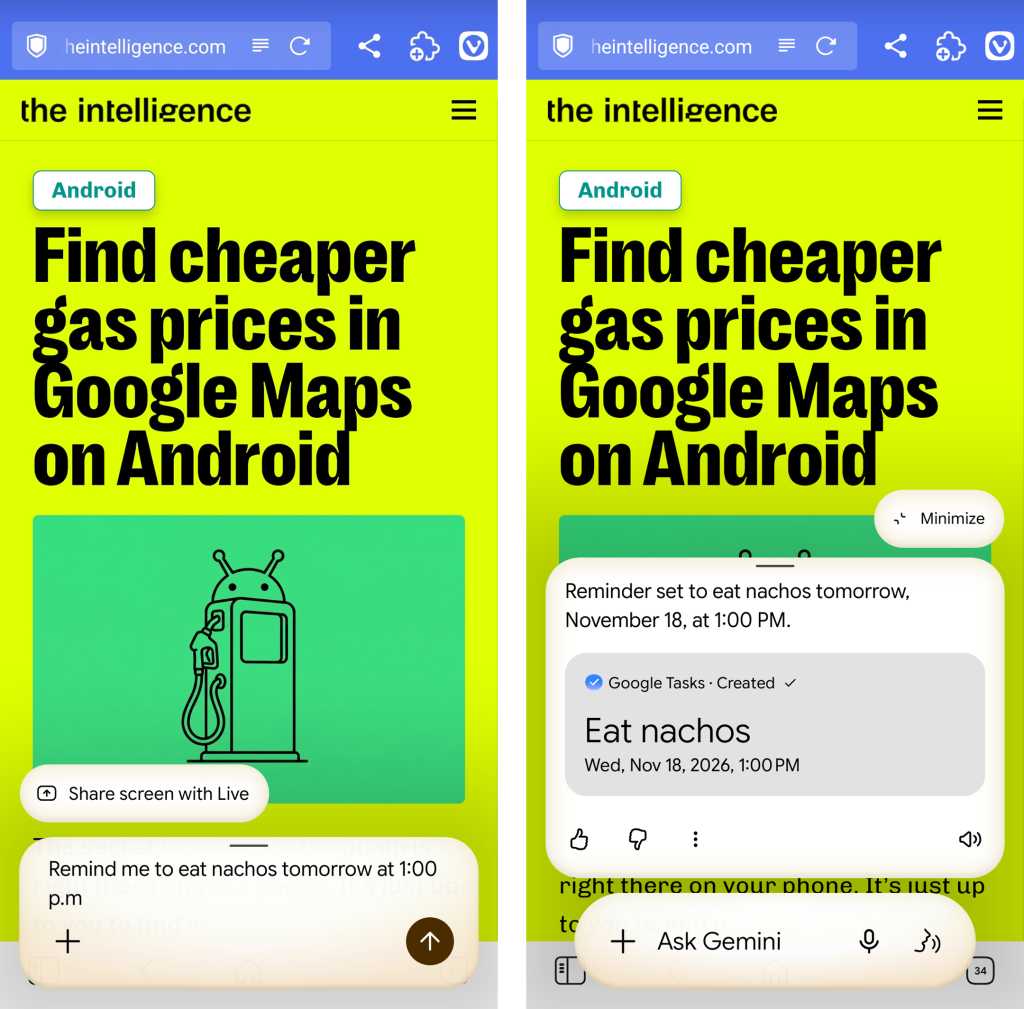
1. In a reminder that the simplest features are often the most practical of all, Gemini can remind you of anything, anytime — just like Google Assistant could before it. Simply fire it up and say Remind me [whatever] at [whenever — day and/or time], and poof! The deed will be done.

JR Raphael, Foundry

It may not be flashy, but I’d be willing to wager you’ll rely on that much more often than the on-demand image generation or “creative thought partner” poppycock Google and every other AI-obsessed company is pushing these days.

2. Basic reminders aside, Gemini is great at remembering specific info and then recalling it for you later. Try telling the service something like Remember that the door code is 90210, Remember that my rental car license plate is WIGGLES77, or Remember that Jed’s wife is named Tallulah — then, whenever you need to recall the related nugget, just ask: What’s the door code, What’s my rental car license plate, or What’s Jed’s wife’s name (or whatever question is appropriate for what it remembered).

3. The next time you need to make a more extensive note to yourself, pull out the classic old Assistant trick of telling Gemini to Create a note that says whatever you’ve got on your mind. It’ll save it into the Google Keep Android app for easy future finding.

[Psst: Love shortcuts? My free Android Shortcut Supercourse will teach you tons of time-saving tricks. Start now for free!]

Part II: Places and events with Gemini on Android 

4. If you’re ever feeling lost — or maybe you’re out on a Very Important Business Call and at a location you want to track down again in the future — fire up Gemini on your phone and ask the soul-searching question Where am I? Gemini will give you the nearest address in return. And then…

5. After you’ve asked Gemini for your current location, try saying Remember that location as…, followed by some sort of description you might use in the future — the best place to park, the home of the seven-foot egg roll, the place where I lost my mind (after eating a seven-foot egg roll), or whatever the case may be. You can then later ask Gemini where that place is, and it should serve back up the very same spot for your rediscovering pleasure.

6. Gemini can help you get from point A to point B, too. In addition to asking it to Start a navigation to some particular place, you can ask it questions like How long would it take me to get to In ‘N’ Out Burger right now and other equally important inquiries.

7. Just like Assistant before it, Gemini is great at helping you check in on your calendar. Ask it What’s on my agenda for today, When’s my first meeting tomorrow, or When’s my next haircut — or any other variations on those same concepts you can come up with — for a quick ‘n’ easy way to see what you’ve got ahead.

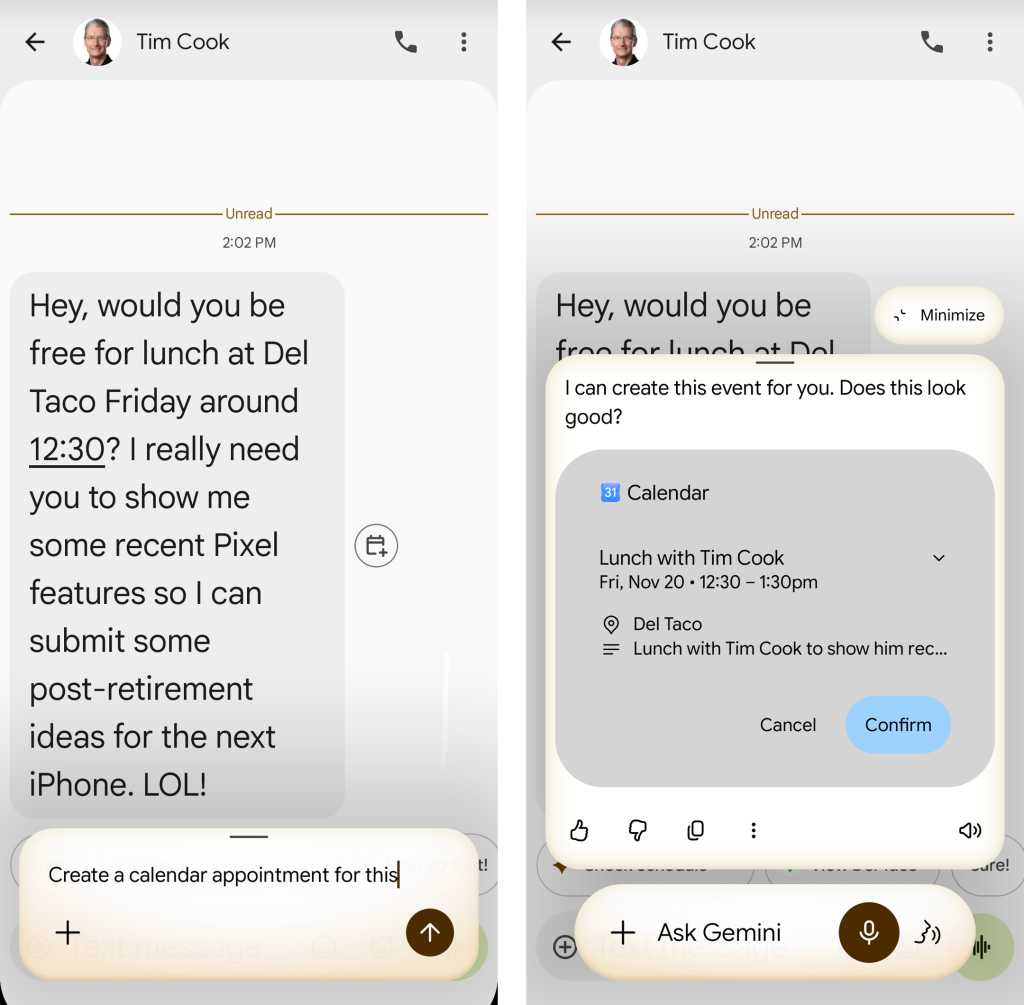
8. You don’t have to stop with calendar check-ins: Gemini can also make new appointments for you in some especially useful ways. In addition to simply asking it to Create a new calendar appointment for [whatever] on [whatever day and time], you can summon Gemini anytime you’ve got info about an event on your screen — in an email, on a website, within a text or Slack thread, or whatever — then say Create a calendar appointment for this. Gemini will interpret the visible info and format it into a full event on your calendar in a single swift step.

JR Raphael, Foundry

Part III: Intelligent interactions with Gemini on Android 

9. When you find yourself palming a physical business card, skip the third-party importing apps and manual entry effort and instead let Gemini scan the card and create a new contact for you. Just tap the plus icon within Gemini’s prompt, select “Camera,” and snap a fast photo of the card — then tell Gemini to save it as a contact. The same concept will also work when you see someone’s contact info on your screen in an email, a web page, a document, or anywhere else imaginable.

10. Want a summarized version of a lengthy article, PDF, or other type of document on your display? Use the share command within whatever app you’re using to send the thing to Gemini, then ask it to Summarize this. Within a matter of seconds, Gemini will show you a simple summary of the info. You can even ask it to make the summary shorter, more detailed, or in a different format (like a bulleted list) if you’re feelin’ especially saucy.

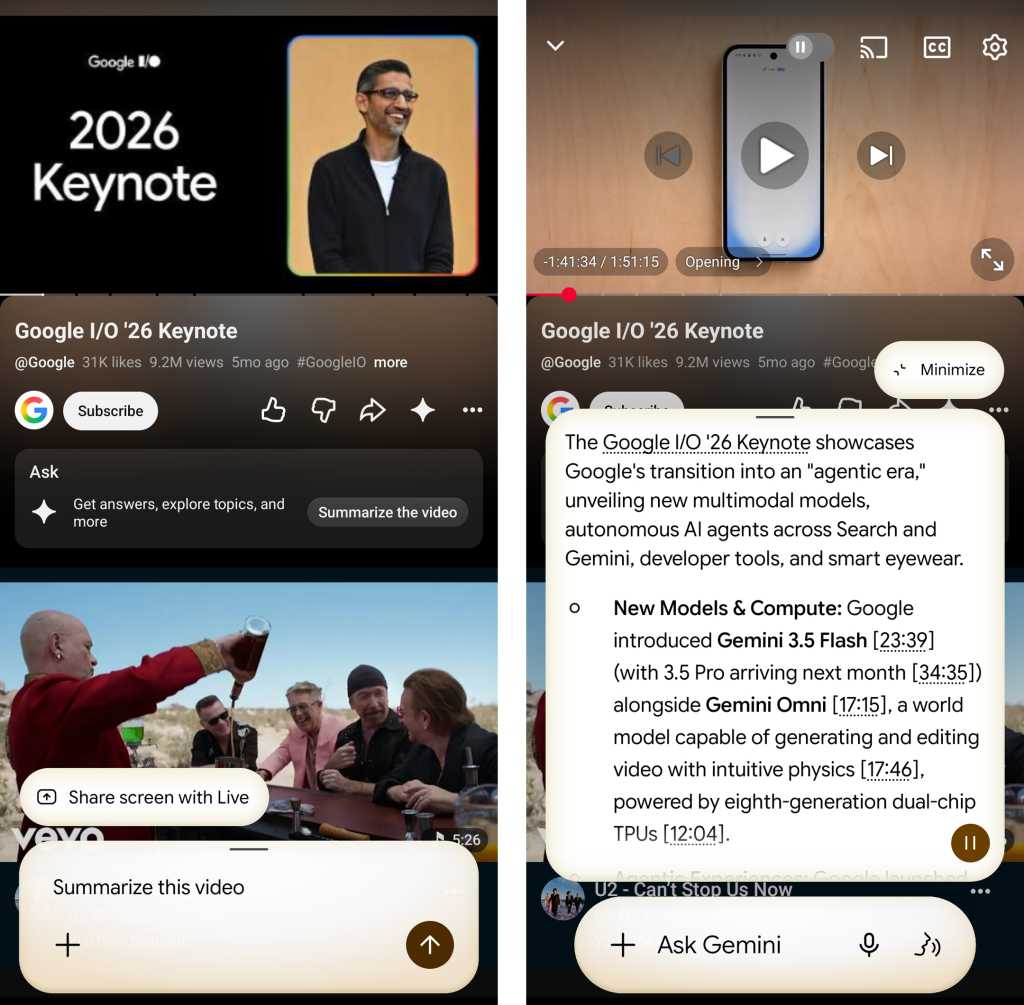
11. Speaking of summarizing, Gemini’s (non-milk-related) condensing powers also extend to the domain of YouTube — where a quick ‘n’ simple summarization can sometimes really be useful. Just fire up Ye Old Gemini you’ve got a video open in front of ye and say Summarize this video. 

JR Raphael, Foundry

In advance: You’re welcome.

12. One more slice of summarizing sorcery worth noting: No matter what you’re doing on your device, you can call up Gemini and ask it to Summarize my most recent incoming emails. As long as you’ve got the Gemini Gmail/Google Workspace integration active, El Gembo will give you a bird’s eye view of what’s awaiting in your inbox at that very moment.

13. Trying to identify something you see on your screen — a landmark, a plant or flower, or even a person named Joe Pesci? Call for Gemini while the thing in question is visible and ask exactly what you want to know: What building is this? What type of flower is this? Who is this? Gemini will tap into the same smarts seen in the superb Google Lens Android setup and give you an answer in the blink of an eye.

Part IV: Basic device functions with Gemini on Android 

14. Check up on your phone’s power in a jiff by asking Gemini What’s my battery level? (You can also try asking it What’s the frequency, Kenneth? — but I wouldn’t necessarily expect any real results in return.)

15. Save yourself the sometimes-awkward finger-stretching and snap a screenshot of anything on your screen simply by asking Gemini to Take a screenshot. Easy!

16. On a related note, you can review your captured screenshots without lifting a finger by giving Gemini the very logical command of Show my screenshots.

17. It may seem obvious, but Gemini can send text messages on your behalf. Just say — brace yourself… — Send a text message to followed by the name of the person you’ve got in mind (and, optionally, the entire message, too, if you want to save yourself a second step).

18. Similarly, your Android Gemini assistant can place a call via the command Call followed by the name of the contact or number you’re needing.

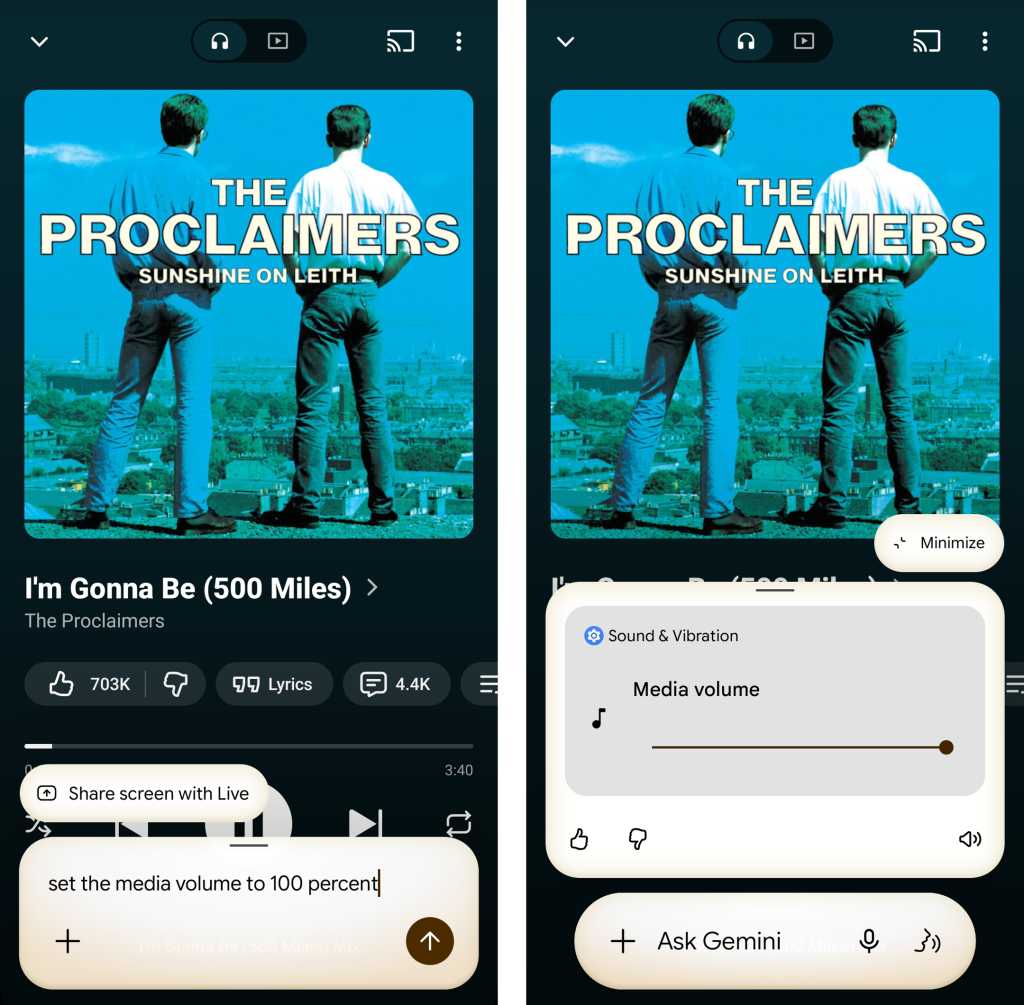
19. Set your sound volume in a split second by asking Gemini to Set the media volume — or call volume, ring volume, notification volume, or alarm volume — either on a one to 10 scale or to a specific percent value.

JR Raphael, Foundry

20. You can also rely on Gemini to adjust all sorts of system settings — for instance, asking it to Turn Do Not Disturb on (or off), Turn the flashlight on (or off), Turn Bluetooth on (or off), and Turn airplane mode on (or off).

21. And last but not least, Gemini can get you where you need to be within your Android system settings without any of the usual hunting. Tell it to Open up the Accessibility settings — or any other area or specific option — and watch it fly you over precisely the place you’re picturing.

Keep the advanced Android knowledge coming with my free Android Shortcut Supercourse. Tons of time-saving tricks await!

Apple doesn’t need the smartest AI agent. It needs the most trusted one

When MacPaw, Proton, Google, OpenAI, Anthropic, and others are doing it, it’s not really such a surprise that Apple is working to introduce agentic AI tools in Siri and Apple Intelligence. The wider question is how the company plans to deploy these tools — how it will deliver the maximum convenience at the least possible cost to user privacy and data integrity.

Some of those answers are already easy to speculate on. Apple has already put some of the building blocks in place, including the recent move to make consumers think more deeply when providing AI agents with Full Disk Access. 

Convenience versus control

I know some competitors are complaining about this, but frankly I think user privacy outweighs commercial convenience — users should have a conscious choice, which Apple delivers.

“Addressing this is critical,” Apple told developers. “As AI agents become increasingly capable and autonomous, the risks associated with this level of access will grow substantially. We are committed to ensuring users clearly understand these risks before granting such access, so they can make informed decisions about their own data and privacy.”

Apple’s decision to make it possible to confine agents to folder access also speaks volumes, as it shows us how it will probably choose to manage its own agents. Siri AI may have contextual understanding of everything, which can inform Siri Agents, but the agents themselves will have but limited access to your data. They gain contextual direction from the user and from Siri AI but are limited to the proscribed folders and files when it comes to acting.

Making the cloud sweat a little

Some tasks are harder than others. The really hard tasks will still lean into Apple’s Private Cloud Compute, and I think the company will try to introduce Secure Exclave into that relationship, so even the most complex task instructions only upload the minimum quantity of your information required to get a task done.

Apple sells hardware, of course, so it makes sense for the company to also lean into things it is already doing, such as making it possible for consumer and small business users to make use of any available silicon capacity they have where they are for AI analysis. There really is nothing not to like about the notion that Apple users will keep one or two Macs at home used specifically to handle AI requests. 

That’s an approach that marries strongly into the current industry drives toward data sovereignty, the need to manage tokenomics, and data security. Apple’s cloud services and — when requested — other frontier models may sweat the tough stuff, but for many tasks, we may already have the computational power we need to get things done — even when it comes to Agentic Siri AI.

What do you drive?

All of these approaches build on the work Apple is already doing. They lend themselves well for use in support of agentic AI and echo the company’s bet that the one-day-to-be-called “Agents Wars” will be won on trust, integration and distribution rather than just on the quality of the model used. You don’t need a Ferrari to run AI in a ten-mile zone.  

Execution will be very important, of course, and that’s likely where Apple will need to apply the most focus. The Siri agents that Apple-watcher Mark Gurman says we can expect perhaps as soon as this time next year must be reliable and capable of handling complex actions across multiple stages. Apple’s App Intent models may help or hinder these outcomes depending on reliability and outcomes achieved.

A recent Senior Engineering Manager job listing at Apple seems to have most of the above in mind: “Imagine an AI agent that can use a computer the way a capable person does,” the posting (now seemingly removed) says. “It browses the web, works across apps, runs commands, writes and debugs code, and calls services, and it chooses the right tool for each step. It does all this privately and with the polish people expect from Apple.”

Why Apple can win and rivals are worried

Apple walks into the next 12 months with significant advantages. It now has its own credible AI thanks to its work with Google Gemini. It has a growing relative market share across most of its platforms, including many users new to those platforms. It has a cast-iron reputation for standing up for user privacy, one which is not damaged one iota by its strong stance against out-of-control UK government surveillance. 

If it can provide a “polished” solution to deliver agentic AI without the data leakage risks while also defining much of the hardware used by consumers, it can win the AI war, becoming the gateway used to access increasingly commodified AI services.

Competitors know it. Which is why they will become even more strident over the coming months, and why every small Apple misstep will be amplified. 

Now please subscribe to my daily, human-curated Apple-related news headline feed at The Core, or follow me on BlueSky, LinkedIn, or Mastodon.

Nadella: Here’s why Microsoft offered buyouts to 60,000 employees

Microsoft CEO Satya Nadella commented at the New York Times Dealbook Summit on why the company offered severance packages to approximately 60,000 employees in October to encourage them to voluntarily leave their jobs.

According to Nadella, it’s not that AI will replace programmers, for example, but rather that their roles are fundamentally changing. As an example, he cited a development team working on Cowork in Microsoft 365 that consists of only 11 people.

“They’re building a software factory that builds the product. They’re not building the product themselves,” said Nadella, as reported by TechCrunch.

He believes that the same trend could affect virtually every profession. But the transition will be particularly challenging for an established company like Microsoft, which wasn’t built from the ground up around AI.

According to Nadella, the changes may be difficult for some employees, and the voluntary separation offer was intended to give employees the opportunity to choose whether they want to be part of the transition or leave the company.

This article originally appeared on Computer Sweden.