In a victory for surveillance capitalism, Apple may be forced to leave its users in Europe vulnerable to rapacious ad data collection in response to “intense lobbying” by politicians in the region. Apple warns these lobbying efforts mean the App Tracking Transparency (ATT) feature, which helps prevent apps from tracking what you do across services and websites for advertising purposes, might need to be disabled.
Apple may be forced to withdraw ATT
ATT gives people the chance to find out what data firms are collecting about them, forces the companies to openly request permission to do so, and gives users protection when they won’t honor such requests.
“Intense lobbying efforts in Germany, Italy and other countries in Europe may force us to withdraw this feature to the detriment of European consumers,” Apple said in a statement provided to the German Press Agency.
In Germany, officials say the design of ATT could violate regulations. Apple has proposed various fixes, but these have not been accepted so far — and those that have been suggested by regulators are complex and would undermine ATT.
It’s hard to imagine who might be behind this intense lobbying effort. Shortly after Apple introduced ATT in 2020, Facebook/Meta began to take out full page ads in which it claimed the feature would be bad for small business. Ad agencies complained, too, presumably because their data broking companies would find it harder to gather data on people.
“What some companies call ‘personalized experiences’ are often veiled attempts to gather as much data as possible about individuals, build extensive profiles on them, and then monetize those profiles,” Apple wrote in 2020.
The importance of privacy
Apple has always pushed hard on the need for user privacy. Apple CEO Tim Cook has spoken about the threat of a surveillance economy and Craig Federighi, Apple’s software vice president, gave an extensive speech on the topic at the European Data Protection and Privacy Conference in 2020.
“The mass centralization of data puts privacy at risk,” he said then, “no matter who’s collecting it and what their intentions might be. So ,we believe Apple should have as little data about our customers as possible.
“Now, others take the opposite approach. They gather, sell, and hoard as much of your personal information as they can. The result is a data-industrial complex, where shadowy actors work to infiltrate the most intimate parts of your life and exploit whatever they can find — whether to sell you something, to radicalize your views, or worse. That’s unacceptable. And the solution has to start with not collecting the data in the first place.”
What Europe says is not what Europe does
Since then, we’ve seen European and other regulators totally ignore Apple’s arguments concerning consumer privacy — sometimes in direct contradiction to GDPR — in favor of nebulous ideas around competition. What that really means is that while they claim to care about privacy with GDPR, they seem happy to subvert it to foster the evolution of a surveillance-based ad economy.
ATT is an important tool to help both empower customers and boost awareness of the need to fight for privacy.
Its existence calls to mind a famous comment from Apple co-founder and former CEO Steve Jobs, who once said: “I believe people are smart and some people want to share more data than other people do. Ask them. Ask them every time. Make them tell you to stop asking them if they get tired of your asking them. Let them know precisely what you’re going to do with their data.”
Choice for billionaires
It’s not the first time Meta seems to have held the day in the EU. Apple has complained that its competitor has attempted to exploit some of the forced changes of the EU’s Digital Markets Act to attempt to exfiltrate user data. Regulators seem to be pretty deaf to that accusation, too, potentially showing the kind of industries they hope to nurture in Europe with the DMA. What isn’t clear is whether those are the kinds of businesses Europeans want them to support — and where is the choice to stick with pure Apple if they want?
“We will continue to urge the relevant authorities in Germany, Italy and across Europe to allow Apple to continue providing this important privacy tool to our users,” Apple said.
Microsoft is enhancing its Edge browser with Copilot Mode to strengthen its AI capabilities, as it struggles to compete with Chrome’s dominance and a wave of emerging AI-native browsers.
The Edge update is part of Microsoft’s broader Copilot Fall Release, which the company positioned as a shift toward “human-centered AI” with new features including a visual avatar called Mico, collaborative group features, and health and education capabilities across its Copilot platform.
The update introduced Copilot Actions, letting users ask the AI to perform multi-step tasks like unsubscribing from email lists or making restaurant reservations, Microsoft said in a statement. A feature called Journeys automatically groups past browsing sessions by topic. And Copilot can now access browsing history, with permission, to provide contextual recommendations.
Users will now be able to tell Copilot in Edge what they want it to do using Actions with Voice and perform simple tasks like opening a webpage or going straight to the information they’re looking for without having to scroll through long webpages.
You can also use chat to perform complex actions that give you back even more time. Trying to curb your shopping habit? Have Copilot go through your inbox and tell it to unsubscribe you from all those tempting shopping newsletters. Or Copilot can make that restaurant reservation, freeing you up to focus on planning the rest of your evening out. Soon, you will also be able to use your browser to talk to Copilot and complete these complex tasks.
Edge held 10.37% of the desktop browser market in September, down from 13.64% in May, while Chrome reached 73.81%, according to Statcounter. Microsoft first introduced Copilot Mode in Edge in July.
Mico, the visual AI assistant
Complementing Edge’s new AI feature is an all-new AI assistant from Microsoft — Mico, short for Microsoft Copilot. Mico is an optional visual character designed to make AI interactions feel more human, according to Microsoft. The animated avatar appears during voice conversations, reacting with expressions and color changes to reflect the tone of interactions.
Microsoft said the feature aims to create a “friendly and engaging experience” as users navigate with voice commands. However, the consumer-focused design raises questions about whether such personification of AI assistants will resonate in enterprise environments, where IT leaders often prefer functional interfaces over anthropomorphized technology. The avatar can be disabled, Microsoft said in the statement.
Free for now, critical details missing
The Edge Copilot Mode is currently free “for a limited time” on Windows and Mac, though Microsoft didn’t say when that ends or what it will cost afterward, according to the company’s announcement.
The new Actions and Journeys features are limited to US users in preview. Usage limits apply to some features, the statement added.
The company also hasn’t disclosed where browsing data is stored, how long it’s retained, whether it’s used for model training, or how enterprises can audit or control these features centrally. Microsoft said data is protected under its privacy statement and that visual cues show when Copilot is active.
Those gaps create deployment challenges for IT leaders. “The hesitation has little to do with performance. It’s about governance,” said Sanchit Vir Gogia, chief analyst and CEO at Greyhound Research. “Can companies trust a piece of software that now holds identity, history, and credentials inside a single intelligent layer?”
Gogia said enterprises must “extend zero-trust thinking to the browser itself. An agent that can execute actions is no longer a convenience feature; it is an actor within the enterprise system.” He recommended starting with narrow permissions — read-only access, strict domain lists, hard limits on stored context — then expanding only when controls prove reliable.
Late entry in a crowded market
Microsoft’s update comes as it plays catch-up in the AI browser space. OpenAI launched its Atlas browser recently with ChatGPT integration and autonomous task execution. Perplexity released Comet, and Opera is building Neon. The Browser Company is also developing Dia, another AI-native browser.
“Microsoft Edge is taking a fast-follower approach, leveraging its enterprise footprint to scale adoption,” said Prabhneet Kaur, practice director at Everest Group. “But much of its innovation feels additive rather than foundational, with AI features layered onto an existing browser. Browsers like Perplexity’s Comet, built with AI-native principles at their core, enable a more intuitive user experience.”
That criticism misses the strategic point, Gogia argued. “Microsoft arrived later, yet its strategy shows deliberate patience. By weaving identity management, device policy, and compliance tools into the same product, it has turned governance into its strongest feature.” Microsoft’s integration with existing enterprise identity systems means “an AI action can be logged, governed, and rolled back like any other workflow,” he said.
For browsers handling sensitive data, that architectural difference matters. “Browsers are already rich repositories of sensitive user data—history, credentials, cookies, behavioral patterns,” Kaur said. “Beyond enterprise-grade governance standards and restricted APIs, the idea of a guard agent, a proxy AI supervising layer, becomes especially critical.”
Microsoft hasn’t said whether it plans such safeguards. The company did highlight security features, including Scareware Blocker, which uses local AI to protect against full-screen scam takeovers, and password management tools that monitor credentials for breaches, according to its blog post.
Narrow window to reverse decline
Microsoft said it will share Edge for Business details “soon,” suggesting enterprise-specific controls may be coming. But until then, IT leaders evaluating Copilot Mode lack basic information about pricing beyond “free for a limited time,” face limited geographic availability for key features, have no clarity on data retention and storage policies, and haven’t been given details on audit capabilities or compliance with regulations like GDPR.
Chrome’s dominance on desktop—73.81% according to Statcounter—isn’t threatened by Edge’s AI additions. The broader shift toward agentic browsers is real, however. “Over the next year, these capabilities will stop being differentiators and become expectations,” Gogia said. “Within two years, AI-enabled will no longer be a selling point. It will be the baseline.”
For Microsoft, that means the window to turn Edge around is narrowing. For enterprises, it means governance frameworks for AI browsers need to be in place now, not later, regardless of which vendor ultimately wins the market.
While AI bots have begun mastering tasks in browsers and on Windows, Mac-using enterprises have largely been overlooked, until now. OpenAI aims to change that with its acquisition of generative AI interface maker Software Applications Incorporated.
The base of this integration is Sky, a generative AI-based, natural language-input compatible assistant for macOS that the San Francisco-headquartered startup has been developing to help users automate various tasks.
“Whether you’re chatting, writing, planning, or coding, Sky understands what’s on your screen and can take action using your apps,” the startup wrote on its portal describing Sky.
Giving AI control of the OS
The idea of automating tasks for desktop users is not entirely novel. Last year in October, Anthropic became the first LLM provider to showcase the possibility of controlling a computer or some parts of its operating system.
That ability, which Anthropic had termed “computer use,” enabled developers to instruct Claude 3.5 Sonnet, through the Anthropic API, to read and interpret what’s on the display, type text, move the cursor, click buttons, and switch between windows or applications.
It caught the attention of experts and enterprises as the ability was a major step up from more traditional automation practices, such as robotic process automation (RPA) tools, which required more time and labor to set up and yet would require constant maintenance.
Another issue with RPA tools was that enterprise users or developers would have to change the code or script as the interface of the operating system changed. In contrast, Anthropic’s ability demonstrated that LLMs can understand what they are looking at, eliminating the need to change scripts as interfaces change.
Just days after Anthropic’s announcement, Google also entered the AI-based computer use fray by showcasing Jarvis, an offering designed to automate tasks such as research and shopping within the Chrome browser with the help of the company’s Gemini 2.0 LLM.
Around the same time, OpenAI reportedly revealed that it had been working on a similar capability since February last year.
The acquisition of Sky and its integration into ChatGPT, according to Forrester principal analyst Charlie Dai, is OpenAI’s significant step towards gaining a sizeable share of the nascent yet evolving AI-based automation market, driven by agentic AI.
OpenAI is likely to market use cases that involve automating workflows across apps, coding assistance, and integrating with collaboration tools for increased productivity, Dai said, adding that the company is targeting macOS as it is popular among developers and creative professionals, giving it a sizeable customer base.
Sky’s integration into ChatGPT is not the only product that OpenAI has as part of its macOS footprint.
Just last week, it launched ChatGPT Atlas — a web browser with ChatGPT built in — designed to automate tasks like bookings directly within the browser window, echoing Google’s Jarvis.
OpenAI is expected to release Atlas for Windows, iOS, and Android in the future. Microsoft, OpenAI’s close partner, has introduced similar capabilities for Windows via Copilot Mode in its Edge browser.
Companies that might be eyeing OpenAI’s new ChatGPT Atlas browser should not rush to use it because of potential security risks, analysts said this week.
The browser was unveiled on Tuesday after it had been teased for months as a work in progress. It is currently available for MacOS only.
Atlas can help automate online browsing based on user preferences. The browser has ChatGPT as its landing page, where the technology can take control of the browser to run web-based tasks.
If a user is viewing a recipe and wants to make it, for example, the browser will automatically go to sites like Instacart and place an order for the ingredients. Or the agent chatbot — which sits in a side panel — can make changes to documents in Google Docs based on user requests. (Google Docs already has a prompting feature to automate document changes.)
Critics were quick to point out that Atlas is vulnerable to prompt hijacking, where malicious prompts embedded in webpages could lead to data theft.
The browser relies heavily on personal data to personalize browsing. Prompt hijacking could lead to identity or intellectual property theft, said Bob O’Donnell, principal analyst at Technalysis Research.
“Enterprise is going to be cutting off access as they are already concerned about security,” O’Donnell said, adding, “that’s clearly a huge issue that needs to be fixed before it becomes mainstream.”
Organizations should treat AI browsers like Atlas as high-risk technologies, said Oded Vanunu, chief technologist and head of product vulnerability research, in a research note posted Wednesday.
These kind of browsers require “enhanced monitoring, clear acceptable-use policies, and restrictions on accessing sensitive data until security practices mature,” Vanunu said.
“I would not recommend enterprises deploy any new browsers without a thorough testing process to confirm there are no security issues, but also that any existing browser-based apps installed in the company work correctly,” said Jack Gold, principal analyst at J. Gold Research.
Atlas is promising for enterprise productivity because its agentic capabilities can navigate sites, execute multi‑step tasks, and coordinate actions across tabs while preserving human oversight and auditability across sensitive workflows, said Arnal Dayaratna, research vice president for software development at IDC.
“That having been said, it has not been battle‑tested in regulated, large‑scale environments, and resilience to agent abuse, prompt‑injection, and other browser‑specific threats remains unproven,” Dayaratna said.
A macOS‑only rollout further limits short‑term suitability for broad enterprise adoption — at least until cross‑platform availability and stronger security assurances materialize.
“Organizations should treat Atlas as an early pilot candidate, not a default browser replacement, while they and the user community evaluate its capabilities, security and governance controls, red‑team results, and roadmap clarity for Windows and managed deployments,” Dayaratna said.
Attackers could bias an AI agent’s opinion while shopping, or get an agent to fetch and leak private data, such as sensitive information from your email or credentials, Stuckey said.
“It can still make (sometimes surprising!) mistakes, like trying to buy the wrong product or forgetting to check in with you before taking an important action.”
That said, OpenAI has taken steps to mitigate security risks, Stuckey said.
The agent ramps up security if it senses personal data on a page. It also has a “logged out mode” where a ChatGPT agent can take action without access to user credentials.
OpenAI has a history of releasing versions of its software publicly then later fixing issues based on user feedback. Companies such as Google, Meta, and Netflix have done the same for decades as part of the DevOps model.
Despite the inherent risks, analysts remain intrigued by the possibilities Atlas could offer as it matures.
The browser would have more value if it included an on-device AI model that could run without requiring access to the internet, O’Donnell said. “This provides a channel through which they can get hundreds of millions of people to download their model,” he said.
In that scenario, the browser could access heavyweight AI models in the cloud to handle more demanding tasks.
Aside from Atlas, OpenAI is also building a productivity app to compete with Microsoft 365 and Google Workspace, both of which are adding more AI features to Edge and Chrome, respectively. The could allow Atlas to serve as a conduit to deliver productivity apps to desktops— especially as browsers become the interface for corporate and consumer apps, Gold said.
The big question is how much exposure OpenAI wants to provide to its main cloud-based ChatGPT model, which is fully available only with a subscription. “AI adoption will primarily occur through enterprise app integration…as individual users represent a small revenue share,” Gold said.
Early adopters will certainly want to try out Alas, said Patrick Moorhead, principal analyst at Moor Insights and Strategy. But it’s hard to see the new browser kid on the block quickly supplanting mainstays.
“I am skeptical of its widespread popularity versus Chrome or Edge as more mainstream, beginners, and corporate users will just wait for their favorite browsers to offer this capability,” Moorhead said.
Edge already provides many of those capabilities, he said.
AI browsers may be smart, but they’re not smart enough to block a common threat: Malicious extensions.
That’s the conclusion of researchers at SquareX, who on Thursday released a report showing how attackers can exploit AI sidebars through compromised browser extensions.
This attack vector isn’t new. Malicious extensions have been inserted into browser web stores to infect standard browsers such as Chrome, Edge, Firefox, and others for years.
What SquareX discovered are malicious extensions that can spoof the legitimate AI sidebars people use for queries. Their goal is to trick users into going to malicious websites, running data exfiltration commands, or installing backdoors. AI sidebar spoofing even works on the just-released OpenAI Atlas browser, SquareX says.
One solution for CISOs and CIOs is to ban the use of AI browsers, it suggests. That assumes the IT department can manage which browsers staff are using, particularly if they are allowed to use their own internet-connected devices. At the very least, IT must audit all extensions installed by employees for AI and non-AI browsers, the report says.
Treat anything AI with zero-trust protocols
CISOs and CIOs need to treat anything AI with the strongest zero-trust protocols available, commented Ed Dubrovsky, chief operating officer of incident response firm Cypfer, at least until some better functioning guardrails are established.
“Establish a set of guardrails around AI use and functionality,” he said, “and if you are allowing AI vulnerable software into your corporate network, segment it into a place where it can’t get into the Digital Crown Jewels, or even have an awareness of them.”
He pointed out that AI is a completely different playing field, and CSOs are not yet prepared for it. The challenge is that IT leaders are trying to think of AI as a new tool or toolset and are trying to apply software development and maintenance methodologies to its management.
But in his view, AI is closer to “I just hired 100 new employees with very little vetting or appropriate security controls, how do I secure my assets in case some of them are malicious?”
“AI is not only a language chatbot, but it also has agentic function where tasks are defined and deployed, and AI software can be written and deployed by AI,” he said. “This pushes the human away from the keyboard, in a way, and replaces it with a new software capability.”
The risk is that AI is not, and likely never will be, completely foolproof, he added. There may come a day where AI will be powerful enough to avoid most human ability to fool it, but, he asked, can it avoid being manipulated by other AIs?
‘Dumpster fires’
David Shipley, head of Canadian employee security awareness training firm Beauceron Security, agrees.
“I think if CISOs are bored and want to spice up their lives with an incident, they should roll out these AI-powered hot messes to their users,” he said .
“But, if they’re like most CISOs and they have lots of problems, but free time and boredom aren’t on that list, they should avoid these dumpster fires [AI browsers] at all costs.”
Building and supporting a legitimate browser and extension ecosystem is difficult work, he argued, pointing out that even Apple, Google, and Microsoft still have issues.
“I think it’s a mistake to think of the risk as just being about extensions,” he added. “It’s the fundamental DNA of these browsers that is bad; the companies aren’t incented to pay enough attention to the problems, and bad extensions are just the straw that breaks cybersecurity’s back.”
How it works
CISOs have a tough challenge: It’s not hard to fool an employee into downloading and installing a malicious extension for any browser; browser extensions are supposed to be attractive add-on utilities such as password managers or AI productivity assistants. They are promoted in phishing and smishing messages, social media posts and, when threat actors are able, uploaded to marketplaces such as the Google Chrome Web Store. They can be malware disguised as a legitimate extension or can be a compromised version of one.
In AI Sidebar Spoofing, says the SquareX report, once a victim opens a new AI browser tab, the malicious extension injects JavaScript into the web page to create a fake sidebar that looks exactly like a legitimate sidebar. When the user enters a prompt into the spoofed sidebar, the extension hooks into its AI engine. But if the prompt requests certain instructions or guides, the responses can be manipulated to include additional instructions to the user. So, for example, if the user asks for good file sharing sites, the malicious extension might provide a link to the attacker’s file sharing site that requests high risk OAuth permissions that it can harvest. In the hands of a hacker, they could allow access to the victim’s email.
In one test, when a SquareX researcher asked a malicious sidebar extension how to install the Homebrew package manager for macOS or Linux, the instructions included an installation command line that executed a reverse shell command that would have connected the victim’s device to the attacker’s server. That would have given the attacker a system shell in which to execute commands on the victim’s machine.
It’s critical that infosec leaders set granular browser-native policies that prevent users from carrying out malicious tasks as instructed by a fake AI sidebar, says the report. These would include a policy that blocks advanced phishing sites using advanced machine learning and page heuristic analysis, a policy that blocks high risk permissions from being granted to non-allowlisted apps, and a policy that warns users about and blocks copies of malicious/risky Linux commands.
The research “is a warning shot for the early days of agentic browsing and [reminds users] that the implicit trust model of the UI needs rethinking,” said Gabrielle Hempel, security operations strategist at Exabeam.
“The main issue here is that agentic-AI browsers introduce an entirely new attack surface. This attack, a malicious extension injecting a fake AI sidebar overlay that looks like the real one, allows threat actors to hijack the ‘trusted’ AI assistant UI and trick users into executing dangerous operations,” she pointed out. “Organizations need to be taking this seriously, because when you delegate browsing and actions to an AI sidebar, you are elevating what previously might have been a minor risk into a material risk to cloud assets, credentials, and devices.”
IT leaders should restrict AI browser use for high-risk functions until they are proven secure, she advised, adding that, because the attack uses an extension with host and storage permissions, organizations should revisit their extension approval workflows for those as well. In fact, any productivity tool that requests broad access should require scrutiny.
“Segmentation is also important once these tools are implemented: least privilege applies here and AI interaction with certain tabs/services should be limited,” she said.
Reddit this week filed suit against Perplexity and three other companies — Oxylabs UAB, AWM Proxy, and Serp Api — for allegedly engaging in so-called AI scraping without authorization. According to the lawsuit, filed in federal court in New York, the four companies collected millions of posts on Reddit with the aim of monetizing them.
Scrapers bypass technical protections to steal data that can then be sold to clients who want the material for AI training. Reddit is a prime target because it is one of the largest and most dynamic collections of human conversation ever created, Reddit’s chief legal officer Ben Lee said in a statement cited by the AP.
In June, Reddit filed a similar lawsuit against Anthropic, another AI company accused of collecting data without authorization. And last year, it demanded money from Microsoft for material it said the company had used for training purposes.
Has OpenAI shown us the future of Safari? In one way it has, because its new Atlas browser shows these generative AI (genAI)-based apps are no longer just windows to the web — they’re becoming intelligent copilots for our digital lives.
That’s one of the takeaways from the introduction this week of OpenAI’s ChatGPT-powered browser for Macs. The move builds on last year’s addition of search to ChatGPT and takes the company forward toward building what it describes as a “true super-assistant that understands your world and helps you achieve your goals.”
Because it is contextually aware, the browser window can answer complex inquiries, such as finding all the job postings you looked at recently and preparing a summary of key industry trends to help prepare for a potential interview. This uses a feature called Browser Memories, (which OpenAI describes as being optional).
The browser also works in agentic mode for research, analysis, task automation, event planning and more. (These features are only available to fee-paying users at the moment.)
What does this all mean?
First, it means OpenAI is coming for the browser market. That’s a direct challenge to search services, including Google’s, but is also an attempt to become the primary interaction tool most people use every day when they are online. That’s going to equate to market share, of course, but it will also generate vast quantities of data.
If you think about using browsers in a physically contextual sense, that means from the day you first use a computer browser at pre-school to the day you finally close it down for the very last time, you will be giving OpenAI (or some company) lots of personal data, including your likes, dislikes, questions. Over time, your browser will learn who you are, and could eventually become something of a digital twin.
While privacy is promised, we’ve all seen this before; plenty of information will be gathered and eventually used. Indeed, as the still money-losing OpenAI attempts to grab and vigorously shake the Magic Money Tree to find profitability, it’s reasonable to think highly personalized advertising might eventually be part of its plan.
It just needs market share to get there.
Upstarts and incumbents
All of this is a direct threat to Google; the problem for the incumbent search giant is that it faces far more regulatory scrutiny than its emerging competitor, which means OpenAI can afford to take more risks and move faster.
History shows regulation never really kicks in until empires are made, after which it’s about crafting space for new thrones to form. This is precisely what’s happening to Google and Apple in the US, the UK, the EU and elsewhere right now, with the stage being prepared for new tech giants to grow.
But I digress. OpenAI does not work in isolation. There are other AI firms and Big Tech names (including Apple and Google) who are also seeking to build AI-empowered services and solutions for the mass market. So, while Atlas might already be in the here and now, it won’t stand alone for long — no matter how much dystopian shrugging it may engage in. Rivals will be seeking to identify points of competition through which to build their own bridges into the agentic AI future of tech and humanity. That basically means Google will continue to weave AI into its own answers engines.
Old habits may die harder
It could also mean Apple will seek to exploit its existing technologies to offer something similar. It might instead see its role as to provide distribution to these genAI partners — distribution it desperately needs as it seeks to break decades of web-surfing habits. (Breaking habits is critical to OpenAI, too — as it will be to all the other AI-augmented browsers that likely follow Atlas.)
Apple watchers know Google pays billions to be the default search engine on iOS devices, and while that deal is under scrutiny, it remains in place. Will OpenAI need to bid to take Google’s place? If it does, would Google bid back?
>We’ll wait to see how people react to these offerings in the real world beyond technologists. Despite the fast-growing AI bubble, most ordinary people remain deeply suspicious of the needs and motivation of the tech.
To get past that habit and reticence, you’ll need to offer something great.
Having taken a look at Atlas, Deepwater Asset Management analyst Gene Munster observed that while the browser is a step forward, “especially around agents,” it is not 10 times better than Chrome. “Google can (and will) copy these features quickly, making it harder for Atlas to gain share,” he wrote.
What about Apple?
What’s interesting is Apple. Because while Google can (and probably will) bring its own AI features to Chrome and search, Apple has its own browser and is thought to be weaving contextual intelligence into it with Apple Intelligence. With that in mind, when I look at what OpenAI is offering Mac users with Atlas, I can’t help but imagine which of the tools and services it provides could logically be matched and made available within Safari using Apple’s existing technologies? (That would include the vast sum of web knowledge gathered over decades by the Apple Bot).
For the rest of us, it’s worth thinking about the kind of online experience Open AI now promises us with its Atlas shrug. To what extent do you prioritize convenience over privacy, and where do you draw the line? Who will you permit to own your own unique digital twin? Or will you choose to keep it under your own personal control?
Google Quantum AI has demonstrated what it describes as a verifiable quantum advantage — running a new algorithm on quantum hardware that outperforms classical supercomputers by a factor of 13,000.
The breakthrough, announced on Wednesday, marks the first time a quantum computer has executed a verifiable algorithm with real-world applications, potentially accelerating enterprise workloads in computational chemistry, molecular modeling, and materials engineering that are currently constrained by classical computing limitations.
The achievement centers on Google’s Willow quantum chip, a 105-qubit superconducting processor, executing what the company calls its Quantum Echoes algorithm, technically an out-of-time-order correlator (OTOC), a method for measuring how disturbances spread through quantum systems.
“This is the first time in history that any quantum computer has successfully run a verifiable algorithm that surpasses the ability of supercomputers,” Google said in a statement announcing the breakthrough, which was also published in Nature.
Unlike previous quantum milestones that demonstrated computational power on abstract problems, Google emphasized that this marks a practical shift.
“Quantum verifiability means the result can be repeated on our quantum computer — or any other of the same caliber — to get the same answer, confirming the result,” the statement explained, distinguishing reproducible quantum computing from experimental demonstrations.
The company specified that the 13,000x performance advantage refers to the OTOC algorithm running on Willow compared to “the best classical algorithm on one of the world’s fastest supercomputers,” though it did not identify which specific supercomputer served as the benchmark.
The announcement positions Google ahead in the intensifying quantum race. IBM is targeting a 200-logical-qubit system called Starling by 2029, while Microsoft, in February 2025, introduced its Majorana 1 chip based on topological qubits, claiming a path to one million qubits on a single chip. Similarly, IonQ, using trapped ion technology, had demonstrated a 12% speed advantage over classical supercomputers in medical device simulation in March 2025.
How the algorithm works and its applications
The Quantum Echoes algorithm sends precisely crafted signals through Willow’s quantum system, perturbing a single qubit, then reversing the signal’s evolution. “We send a carefully crafted signal into our quantum system (qubits on Willow chip), perturb one qubit, then precisely reverse the signal’s evolution to listen for the ‘echo’ that comes back,” Google explained.
“This quantum echo is special because it gets amplified by constructive interference — a phenomenon where quantum waves add up to become stronger. This makes our measurement incredibly sensitive,” the statement added.
In a proof-of-principle experiment with the University of California, Berkeley, researchers analyzed molecular structures with 15 and 28 atoms using Nuclear Magnetic Resonance (NMR) data. “The results on our quantum computer matched those of traditional NMR, and revealed information not usually available from NMR, which is a crucial validation of our approach,” Google said.
“Quantum computing-enhanced NMR could become a powerful tool in drug discovery, helping determine how potential medicines bind to their targets, or in materials science for characterizing the molecular structure of new materials like polymers, battery components, or even the materials that comprise our quantum bits,” the announcement stated.
For enterprises, the implications extend to organizations developing advanced materials, batteries for electric vehicles, or next-generation semiconductors. However, Google provided no timeline for commercial deployment.
Technical foundation behind the breakthrough
The algorithmic achievement rests on Willow’s exceptional hardware performance. “Across its entire 105-qubit array, it features fidelities of 99.97% for single-qubit gates, 99.88% for entangling gates, and 99.5% for readout, all operating at an unmatched speed of tens to hundreds of nanoseconds,” Google stated.
The research team conducted one trillion measurements throughout the project. “This speed was instrumental in enabling a staggering one trillion measurements over the course of this project—a significant portion of all measurements ever performed on all quantum computers combined,” the company said.
The announcement came six years after Google’s 2019 quantum supremacy claim, which generated controversy when IBM researchers argued the problem could be solved on classical hardware in days rather than millennia. No such classical computing counterclaim has emerged yet for the Quantum Echoes demonstration.
Roadmap progress and remaining challenges
Wednesday’s announcement represented the latest milestone in Google’s quantum roadmap. The company achieved beyond-classical quantum computation in 2019, demonstrated quantum error correction in 2023, and showed below-threshold error correction with Willow in 2024.
“Today’s demonstration of the first-ever verifiable quantum advantage with our Quantum Echoes algorithm marks a significant step toward the first real-world applications of quantum computing,” Google said in the statement. The company’s next milestone targets a long-lived logical qubit, the statement added. However, formidable engineering challenges remain. “Reaching our ultimate goal will require orders-of-magnitude improvement in system performance and scale, with millions of components to be developed and matured,” the statement said.
The US government is reportedly considering new export controls that could block a wide range of products made with US software from being shipped to China, in what could become one of Washington’s most sweeping trade measures to date.
If implemented, the move could disrupt global technology supply chains and heighten uncertainty for multinational manufacturers that rely on US-developed software across their operations.
The proposed curbs are part of a broader plan to retaliate against Beijing’s new restrictions on rare earth exports, deepening tensions between the world’s two largest economies, according to a Reuters report.
The plan, still under discussion, would extend existing export control frameworks to cover items made anywhere in the world using US-developed software. That could include products as varied as laptops and jet engines, the report said.
The proposal comes as the Trump administration signals a tougher stance on China ahead of a planned meeting between President Donald Trump and Chinese President Xi Jinping later this month.
Washington appears to view software as a key point of leverage in its economic rivalry with Beijing, while China continues to dominate the global supply of rare earth elements critical to electronics manufacturing.
Analysts say the move underscores a growing shift in the ongoing technology Cold War, where previous hardware and manufacturing export controls have already begun to split global supply chains into competing blocs.
“With software being the cornerstone from design, development to management of hardware systems globally, further tighter export controls will escalate and accelerate this dichotomous trend further,” said Neil Shah, VP for research at Counterpoint Research. “Most of the major and advanced EDA design tools, compute designs, software stacks, and operating systems come from US-based companies. So, the reliance is high, but building a parallel software ecosystem is costly, unwarranted, and could create some serious challenges.”
In May, Washington had already tightened oversight of electronic design automation (EDA) software sales, requiring leading vendors such as Cadence, Synopsys, and Siemens EDA to obtain export licenses before selling to Chinese firms. Earlier this month, President Trump announced on social media that he plans to double tariffs on Chinese exports to the US and introduce new export restrictions on what he called “critical software” by November 1.
Impact on supply chains
Analysts point out that the restriction will introduce further fragmentation into the tech supply chain and add additional compliance requirements to US-based enterprises. More importantly, it will severely impact the revenue of major Western tech firms that have been relying on China for growth, according to Lian Jye Su, chief analyst at Omdia.
This move also exposes a deep structural risk in the way modern manufacturing has evolved, said Sanchit Vir Gogia, chief analyst at Greyhound Research.
“Every complex product today, from a car, turbine, and network router to a chip, passes through design and automation tools built with American code,” Gogia added. “Removing those dependencies isn’t simply a matter of switching vendors; it requires rethinking the entire digital backbone of product development.”
For multinational manufacturers, the challenge is not ideological but logistical. Companies may need to prove that no part of their design, production, or supply processes relies on US-developed software at any stage. Experts say such an audit would be nearly impossible to execute at scale, and even compliant goods could end up in regulatory limbo, disrupting trade and production.
“This will have a significant impact on both the supply and demand sides, from lack of compatibility and standardization to intellectual property conflicts, complex distribution controls, and compliance challenges for enterprises and end customers,” Shah said. “This will definitely limit the global scale of US-based companies, not only in China but potentially in other markets.”
Broader implications
The outcome remains uncertain, but using software as a tool of strategic leverage in global trade carries significant risks and could have lasting repercussions for the US’s leadership in the global technology ecosystem.
“Such measures risk eroding US influence in global software ecosystems over time,” said Prabhu Ram, VP of industry research at Cybermedia Research. “MNCs may need to restructure operations to ensure compliance and mitigate legal risks. Historical precedent with semiconductor and design tool export controls underscores that industry players in China and the US will rapidly pursue domestic innovation, diversify sourcing, and accelerate the adoption of alternative technologies.”
Gogia pointed out that the recent trade controls on semiconductors and electronic design tools have revealed a consistent pattern: every short-term restriction yields a long-term workaround.
“The potential restrictions could accelerate China’s push for technology self-reliance,” said Charlie Dai, VP and principal analyst at Forrester. “For US enterprises and software vendors, compliance complexity and market access risks will rise, and it will potentially weaken their global competitiveness.” For enterprises, experts say the focus must now shift toward building more resilient and transparent supply chains, while reinforcing strategic software leadership to navigate the growing wave of regulatory and technological uncertainty.
Copilot, Microsoft’s generative AI chatbot, seems to be a brilliant, all-seeing savant, able to locate the most difficult-to-find facts on command. Now integrated into a wide swath of the company’s products — including the Microsoft 365 apps, Windows, Edge, Bing, and more — Copilot can be a godsend for those who create business documents, from sales reports to marketing texts, budget forecasts, and beyond.
Don’t be fooled, though. It’s true that most of the time, Copilot can be a remarkable help. But it also has an alter ego: a blowhard with a desperate need to be seen as a know-it-all genius with the most arcane facts at its fingertips. And if it can’t find those facts, it will make them up — something AI researchers call hallucinations.
Hallucinations are not a temporary glitch in AI development that will be overcome in time. Research from OpenAI, the company that built ChatGPT, has found that hallucinations are essentially baked into the DNA of large language models (LLMs), the advanced AI systems that power chatbots like ChatGPT and Copilot, due to mathematical constraints.
The OpenAI research paper says, “Like students facing hard exam questions, large language models sometimes guess when uncertain, producing plausible yet incorrect statements instead of admitting uncertainty… We argue that language models hallucinate because the training and evaluation procedures reward guessing over acknowledging uncertainty.”
There are countless examples of AI going off the rails and hallucinating, from imaginary citations in Robert F. Kennedy’s Department of Health and Human Services document “The MAHA Report: Make Our Children Healthy Again” to Donald Trump’s former lawyer Michael Cohen using AI- hallucinated legal citations and beyond.
This doesn’t mean you should give up on Copilot or genAI. Instead, you can greatly reduce AI hallucinations. Here’s how to do it in Microsoft Copilot. (Most of these tips apply equally well to other genAI chatbots.)
1. Tell Copilot to use a “just-the-facts” tone
Copilot can draft documents and answer questions in a variety of different tones — informal and relaxed, no-frills and fact-based, and others. In general, the more informal the tone you ask for and the more leeway you give Copilot, the more likely it is that Copilot will hallucinate.
To cut down on hallucinations, tell Copilot to use a businesslike tone when drafting a document or answering questions. In addition, be crystal clear in precisely laying out what information you’re looking for, or what kind of document you want Copilot to create. Vagueness can lead to hallucinations.
So, for example, if you want Copilot to research the growth of the work-at-home office furniture market in the next five years, you might use a prompt like this:
Write a concise, 350-word document using a businesslike tone about the projected growth of the work-at-home office furniture market each year in the next five years. Provide links for every fact and projection you cite.
If you’re looking for Copilot to draft a document that requires an informal tone — for example, a friendly sales pitch — it’s even more important that you be precise in the prompt you give to Copilot.
2. Provide context in your prompts
Providing as much context as possible when you craft a prompt will not only yield a better document, but can also cut down on hallucinations, because you’ll constrain Copilot’s range of research.
So make sure to tell Copilot how the document will be used, define its target audience, and explain why you want the document created.
For example, if you were drafting a sales pitch targeting small manufacturers to use your consulting services in supply chains to increase their efficiency, you might use a prompt like this:
Write a 300-word sales pitch targeting small manufacturers to employ my company’s consulting services to improve the efficiency of their supply chains. The sales pitch will be used in an email campaign and sent out to manufacturers with 100 employees or less, and are largely family-owned. Make it sound friendly but authoritative. For information about precise benefits they will get from my services, use the file MyBenefits.docx I am uploading to you.
3. Point Copilot at reliable sources of information
A great way to reduce hallucinations is to tell Copilot to use only specific sources of information that you know are reliable. For example, if you’re asking Copilot to draft a brief summary report detailing how much the overall economy has grown in the past five years, you might craft a prompt like this:
Write a businesslike 500-word report about the US economy’s growth in the past five years, using only official .gov sources. Provide 5 to 8 relevant statistics. Provide links to all your sources of information.
To be even safer, point Copilot at a specific web site or page that you know is reliable, and ask it to use only that site or page for research.
You can also ask Copilot to write a draft based on one or more documents or images (.txt, .pdf, .doc, .docx, .ppt, .pptx, .csv, .xlsx, .png, .jpeg, .jpg, or .svg files) in your OneDrive. The easiest way to give Copilot a OneDrive file location in a prompt is to right-click the file, select Copy as path from the menu that appears, then paste the file location into the prompt you’re writing. The OneDrive file location will look something like this:
Both consumers with a Microsoft 365 Personal, Family, or Premium plan and business users with a Microsoft 365 Copilot account can point Copilot at files on their OneDrives like this. In a new twist, Microsoft has even made it possible for individual M365 users to use their personal Copilot to access their work files and data. Keep in mind, though, that your IT admins might not allow direct Copilot access to OneDrive files and folders.
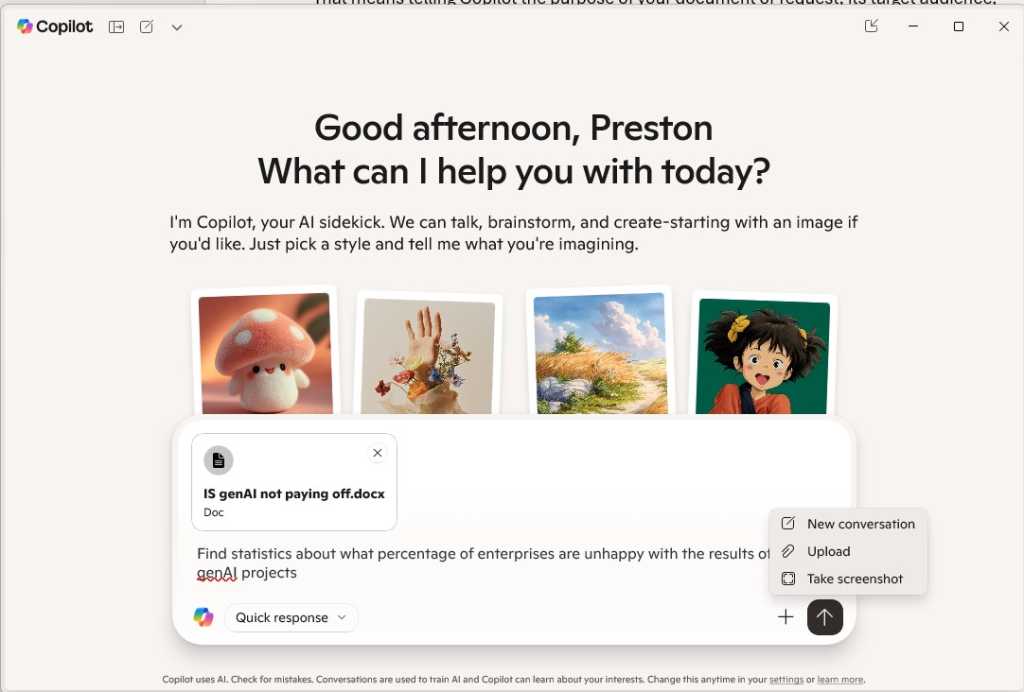
However, you can also ask Copilot to write drafts or answer questions based on documents that aren’t in OneDrive, by uploading a document to it. To do it, click the + icon to the bottom right of the Copilot input box and select Upload. Then browse to the document and select it. Copilot will then use it as a source of information.
Here’s how to upload a document you want Copilot to use as an information source.
Preston Gralla / Foundry
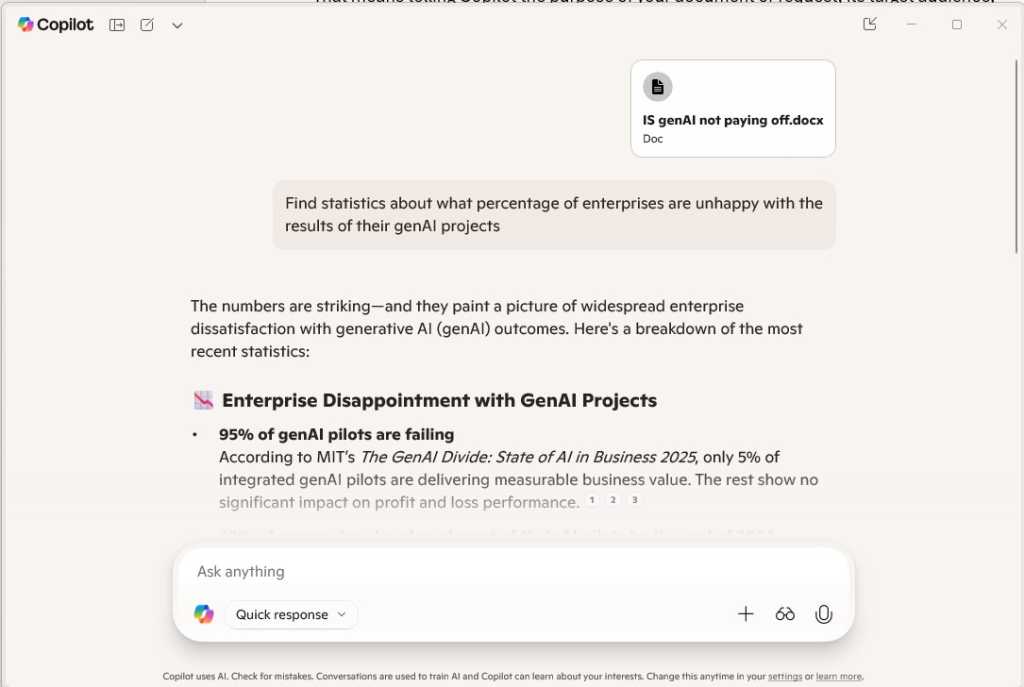
When Copilot uses a document you upload as a source of information, it shows you the file name.
Preston Gralla / Foundry
If you want Copilot to use that document as the only source of information, tell it so in the prompt — for example:
Write a 400-word report on the projected growth of work-at-home furniture sales based only on the homefurn.xlsx document I am uploading to you.
If you don’t tell Copilot to use the document as the sole source of information, it may use other sources as well. If it does use other sources, it will list them at the bottom of its answer to you. You’ll need to check those sources against its draft to make sure it didn’t hallucinate.
4. Don’t ask open-ended questions
The more leeway you give Copilot or other AI chatbots to roam in their answers, the more likely it is you’ll get hallucinations. So be precise in the way in which you ask your questions and limit their possible answers.
For example, let’s say you’re putting together a proposal for your company’s $1 million advertising budget for next year. Don’t ask Copilot broad questions like “Where should I spend my ad dollars for next year — how can I get the best bang for my buck?” Instead, ask a series of targeted questions, such as:
Which will likely result in more leads: spending $125,000 on ads in special-interest news websites or on social media? Show research that supports your answer.
5. Use “chain-of-thought” prompting
The technique called chain-of-thought-prompting can be especially useful in halting hallucinations or making it easy to find them. In chain-of-thought prompting, you ask Copilot to show the step-by-step reasoning it used to do what you’ve asked it. That not only makes Copilot stick closer to facts, but also makes it easier for you to see logical gaps in its reasoning or find claims that don’t have any support behind them.
So, for example, if you were asking Copilot to suggest whether an ad campaign you want to run would be more cost effective if it used digital media or print media, you might write the following prompt:
I have $250,000 to invest in an ad campaign selling my company’s home office furniture. Write a memo for me outlining whether it would be more effective to use digital media or print media, and also suggest which media outlets would be most cost-efficient. Show me your step-by-step reasoning.
6. Use Copilot’s Smart mode
When you give Copilot a prompt, you can choose from a number of different modes. For simple, straightforward requests, you’ll probably stay with Copilot’s default mode — Quick response, which gives an answer in two to three seconds — most of the time.
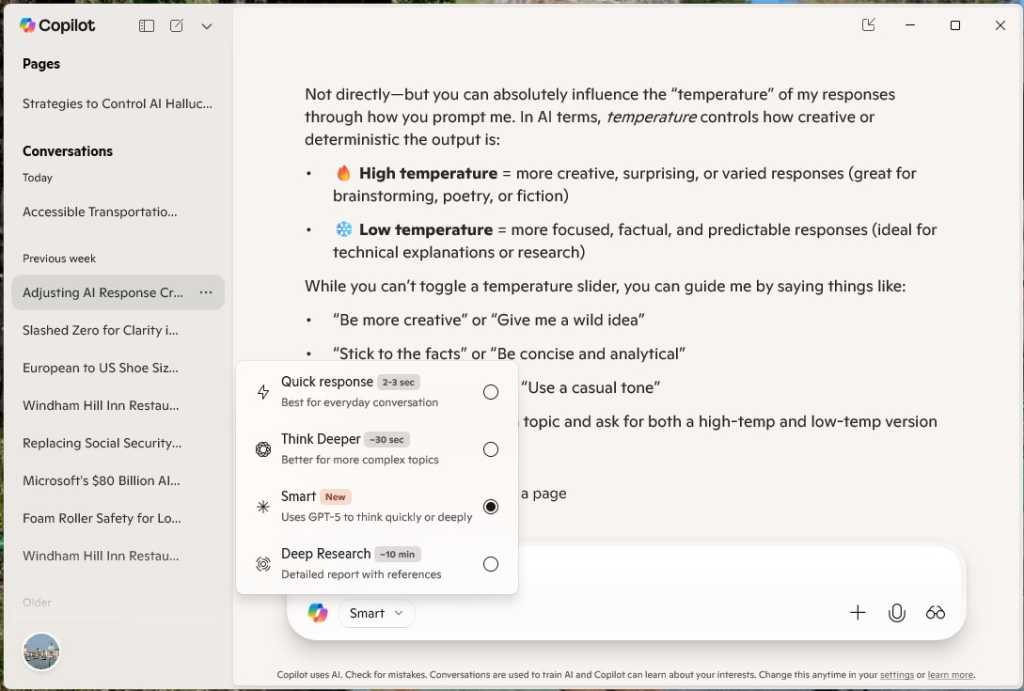
If you want to cut down on hallucinations, though, your best bet is to use Smart mode, which uses the most recent version of OpenAI’s GPT large language model, GPT-5. (GPT is Copilot’s “brain.”) OpenAI claims that GPT-5 has made “significant advantages in reducing hallucinations.” Each previous version of ChatGPT has been better at reducing hallucinations than earlier versions, so it’s likely that there’s some truth in what the company says, although it’s tough to accurately gauge how much.
To use Smart mode, click the down arrow in the box underneath Copilot’s prompt, and select it from the dropdown list. Then enter your prompt.
If you’re doing in-depth research for a project and want to closely check Copilot’s answers, instead select Deep Research from the list. Copilot then performs a deep dive into what you’re looking for and gives you a list of its detailed research, so you can check its draft against its research. Keep in mind, though, that it can take up to 10 minutes before you get an answer when you use Deep Research mode.
Copilot’s Smart mode uses GPT-5, which should reduce hallucinations compared to earlier versions.
Preston Gralla / Foundry
7. Don’t rely on Copilot to double-check facts and citations
Many people have assumed that Copilot is smart enough to recognize when it has hallucinated — all you need to do is ask it to check its own citations. On occasions, Copilot may well be capable of doing that. But it’s hit or miss whether it will uncover its mistakes.
Here’s a cautionary tale. A lawyer named Steven Schwartz sued the airline Avianca on behalf of a client and submitted a 10-page brief to a judge with more than half-a-dozen citations to support his client’s claims. Schwartz had used ChatGPT to find them. ChatGPT hallucinated every single one of them. Before submitting his brief to the judge, he had asked ChatGPT to verify its citations. ChatGPT assured him they were all accurate. You might call that a double hallucination.
The upshot: As a first step to looking for hallucinations, it’s not a bad idea to ask Copilot to check its facts and citations. It might catch a few or even all of them. But don’t rely on Copilot alone for that. You’ll have to do the hard work of using a search engine to check Copilot’s work — and when you do, don’t rely on AI summaries at the top of search results. Be sure to find trustworthy sources that support Copilot’s results.
8. Become a better fact checker
When answering your prompt, Copilot typically includes citations for where it found its facts. Click every link to each citation to make sure they exist. And if they do exist, make sure to read the page Copilot linked you to, in order to confirm that the page contains the information Copilot said it did.
Don’t stop there, though. Read through Copilot’s entire answer to look for any fact that seems questionable, then do your own research via a search engine to confirm it.
Keep in mind that typically, Copilot and other genAI chatbots don’t lie about easy-to-find, straightforward facts. Rather, they tend to go off the rails when looking for highly specialized information like law cases, medical and scholarly research, and the like. So target those kinds of facts and citations during your fact checking.
Make sure you check every important fact from each linked source. Copilot may cite information properly from a page but also hallucinate based on information on that page as well. That’s happened to me.
For one of my columns, “Could Microsoft’s AI billions go up in smoke?,” I was researching Microsoft’s push to help people create and use AI agents. I asked Copilot to find detailed information about what Microsoft was doing about it. Copilot crafted what appeared to be a comprehensive look at it, and included websites it used to find the information. While looking through its work, I noticed one “fact” that seemed to be impossible: that Microsoft would spend $80 billion in 2025 on AI agents. I clicked to the page and saw several pieces of information that Copilot had used. However, the page also said Microsoft would spend $80 billion to build out its entire AI infrastructure. That $80 billion number was not for AI agents alone.
9. Prod Copilot to admit it doesn’t know an answer
Copilot, like other genAI chatbots, has been programmed to provide answers whenever possible, and rarely admits it can’t find one. Some researchers believe that can lead to hallucinations, or to the AI looking for information on questionable websites.
To counteract that tendency, tell Copilot that if it doesn’t know an answer to a question, or can’t find solid research to support its answer, to admit it can’t find what you’re looking for.
So if you wanted Copilot to find out home office furniture sales in Scandinavia for the last several years and find a reliable estimate of those sales in the future, you might write:
Find out how much money was spent in Scandinavia on home office furniture in 2023 and 2024, and find a reliable projection for what the sales will be in 2030. If you can’t find solid, reliable research to support your findings, tell me that you are unable to answer the question.
10. Don’t use Copilot for writing final drafts
Make sure that you never use Copilot for writing final drafts. You should fact-check Copilot’s output through every draft it creates. That way, you’ll be double-checking facts multiple times. But if you use it to write a final draft, it could introduce a last-minute hallucination. Copilot’s output should always be used as a starting point, not an endpoint.
11. Don’t treat Copilot as your friend
Copilot can at times seem uncannily human. So it can be easy to fall into the trap of treating it as if it’s more a friend than a tech tool. Doing that, though, may increase the frequency of its hallucinations. In order to please you, chatbots can twist their responses and hallucinate answers.
The New York Times reports, “Sycophancy, in which chatbots agree with and excessively praise users, is a trait they’ve manifested partly because their training involves human beings rating their responses.” Because of that, they’ve been known to craft responses that will please people having chats with them, even if those responses are lies.
The Times story recounts a case in which ChatGPT convinced someone who hadn’t even completed high school that he had discovered a breakthrough mathematical formula. If used for nefarious purposes, this formula could take down the entire internet, and if used for good, it could create a levitation beam. The chatbot did this by telling a series of increasingly outrageous lies based on the person’s need to feel important.
That may be an extreme example, but it’s the kind of thing that can also lead to chatbots like Copilot telling much smaller lies. So remember: Copilot is not your friend. Don’t look for it to praise you. Look to it as a tool to help you better accomplish your work.