Author: Security – Computerworld

Microsoft set to escape French antitrust probe as Qwant complaint falters

Microsoft is expected to sidestep a French antitrust probe into its search business after regulators signaled plans to dismiss a complaint by local rival Qwant, easing scrutiny of the US tech giant even as Europe ramps up enforcement of digital competition rules.

France’s competition authority is preparing to reject Qwant’s allegations that Microsoft imposed exclusivity restrictions and favored its own services in search and advertising, a decision that could be announced in the coming weeks, according to a Reuters report.

Qwant, which has historically relied on Microsoft’s Bing to power search and news results, had accused Microsoft of imposing restrictive terms that hindered its ability to expand its own search technology.

Several other smaller search engines, including Ecosia, DuckDuckGo, and Lilo, also use Microsoft’s syndication feed for results.  

The outcome of this complaint would matter to CIOs as it touches vendor dependency and platform terms. If the complaint is dismissed, scrutiny may shift from one-off cases to compliance with Europe’s Digital Markets Act (DMA).

Qwant CEO Olivier Abecassis said investigators had advised against pursuing the case following a closed hearing in June, the report said. He added that Qwant is considering an appeal or a referral to other European regulators to continue challenging Microsoft’s practices.

Broader implications for enterprises

Analysts say European regulators are becoming more selective about which complaints proceed, with greater emphasis on the merits and the market where the conduct occurs.

“Microsoft can escape this because its share in search is relatively small,” said Pareekh Jain, CEO at Pareekh Consulting. “Google is the dominant player. On the other hand, the case shapes the perception that big tech still squeezes smaller players. Many European tech companies have depended on US platforms. If antitrust enforcement becomes more selective in a broader context, you will see a stronger business case and public support for ‘sovereign’ approaches in Europe, including sovereign AI.”

For Microsoft’s customers and partners, the concern is dependence on a platform that also competes in adjacent services. Microsoft’s dual role, supplying technology while competing with smaller firms, creates a natural tension, according to Tulika Sheel, senior VP at Kadence International.

“It raises questions about fairness and dependency, especially for smaller European companies using Microsoft tools,” Sheel said. “Even without a formal case, regulators may keep watching how balanced that relationship really is.” 

Gatekeeper rules still apply


Microsoft is already designated as a gatekeeper under DMA. Regardless of the outcome of Qwant’s complaint, regulators may still examine whether Microsoft’s conduct provides fair and open access, Jain said.

“This goes beyond search,” Jain added. “Practically, enforcers might be more selective after a dismissal, but technically they retain full powers under the DMA because gatekeeper obligations apply.”

The DMA equips regulators with new tools to shape platform behavior, Sheel said, and attention is likely to shift toward concrete tests of compliance. In practice, that means scrutiny of interoperability, data sharing, and how open Microsoft keeps its platforms.

“So, the pressure may shift from punishment to proactive compliance and transparency,” Sheel added. “The real test for Microsoft now lies in how openly it operates under the new EU digital rules.” This discussion is unfolding as the US government scrutinizes the DMA and the Digital Services Act, citing concerns about potential discrimination against American companies.

Apple’s Vision Pro: the Newton of the XR age

Apple’s alleged decision to suspend development of a lighter and cheaper Vision Pro device sounds a lot worse than it actually is, because in a short time the product will be seen as the Newton of the AR age.

Why the Newton? Vision Pro is ahead of its time. To build it, Apple pushed the envelope on operating systems, user interfaces, usability and materials and process design. This resulted in an expensive device that, while cutting edge, hit market far before the applications and experiences to make such devices essential had been born.

But lessons have been learned. 

What we now know

We can see where the most sophisticated use cases can be found — across the enterprise, medical, engineering, product design, mechanics, training and beyond. Those markets haven’t disappeared and will be quite well-served by the M5-powered Vision Pro Apple unveiled today.

Those lessons will also feed into other visionOS products Apple is working on, including its long-anticipated AR glasses. These will combine much of what users already enjoy in visionOS with new features designed to exploit both the glasses form factor augmented by useful tools from across the iOS ecosystem; that includes features like sign translation, ambient local information provision, maps, and computing experiences that mean your Mac will be worn like sunglasses. 

What’s the matter with Meta?

Lazily compared with Meta’s AR glasses, Apple’s offering will be more about helping you as a user than selling you advertising, and will benefit from the tech it has been building for Vision Pro.  We’ll let the markets decide if what Apple comes up with will be better than Meta’s machines. But given Cupertino’s track record and the sheer achievement encapsulated by Vision Pro, it is unlikely to be as limited — no matter how many engineers Meta’s HR team manages to poach.

You see, it’s all about ideas. 

It’s ideas that powered up the Newton. And the ideas that will inform Apple’s visionOS glasses are already partially visible in Vision Pro, a device that has been described as being ahead of its time since before it shipped.  The advances it exemplifies will inform industry development for years. Newton did the same, arguably forming the core of the ideas that drove the entire smartphone era (including the amazing Apple Silicon chips that continue to transform Apple’s business).

Seeing the future in our yesterdays

You can get some sense of what these forthcoming augmented reality glasses will be like by taking a look at the iPhone Air. That molded battery inside iPhone Air? That is probably a hint at how the company can get decent battery life from a pair of glasses. Those low-energy, but highly performant, processors Apple likes to use? That matters when it comes to AR specs, which cannot ever be hot to wear, not matter how many FaceTime chats you are involved in. 

The game’s afoot, and there’s something at stake. Meta currently holds 75.6% of the combined AR/VR + display less smart glasses market, according to IDC. (Apple has around 5.2%.) But the market is still pretty small, with only about 10 million sold each year. That makes this a segment high in potential, rich in opportunity for expansion, and — despite its early advantage —a market that is Meta’s to lose. 

Can Apple take the throne? I think so, given the company has more hardware and software design experience, a vibrant ecosystem, and huge user loyalty. Perhaps more importantly, Apple is seen as a firm that’s all about privacy, which isn’t an advantage Meta can easily be seen to enjoy. That matters when you’re taking about wearable devices equipped with video cameras. 

Think different

Apple’s other advantage comes in the form of all the real-world usability cases it has been able to identify for the Vision Pro. Many of these uses will be ably supported by Apple’s AR glasses, and the apps people have already made for those industries will be supported, too. Those not supported might only need the slightly revised M5 Vision Pro devices.

Down the road, as the technology improves and the cost of manufacturing declines, Apple will be able to introduce more Vision Pro-based ideas to its glasses systems, while also building a more affordable Vision Pro successor in a couple of years. The latter may could potentially be made in the US, if Apple invests in the futuristic manufacturing capacity such systems require. 

I believe Vision Pro is the Newton for this tech evolution. The ideas it exemplifies will inform product development for the next decade.

You can follow me on social media! Join me on BlueSky,  LinkedIn, and Mastodon.

Microsoft accused of trying to manipulate AI pricing via its OpenAI investment

Microsoft, which is no stranger to antitrust accusations, is being sued for allegedly manipulating AI prices via its investment in OpenAI.

The lawsuit, filed Monday in the US District court in the Northern District of California, argues that Microsoft has used its OpenAI influence to vastly increase AI prices.

“ChatGPT prices were inflated since the service’s inception, with price levels reaching an eye-popping 100 to 200 times competitors’ prices on a per-token basis amidst a February 2025 price war,” the filing said. “A secretive agreement struck between OpenAI and Microsoft early in OpenAI’s development allowed Microsoft to control the supply of compute to its horizontal competitor’s products. It used an exclusivity clause to restrict OpenAI’s product output, and to impose a price–or, conversely, output and quality–floor on its competitor OpenAI’s ChatGPT products.”

Contacted by Computerworld, Microsoft declined to address the lawsuit’s specific details, but did say in an email, “while we are still reviewing the details of the complaint, we believe that our OpenAI partnership promotes competition, innovation, and responsible AI development.”

Industry observers were skeptical that the litigation would have much of an impact, given the large number of major companies selling AI, including Google, Amazon, and Anthropic, that are presumably beyond Microsoft’s direct influence.

Taps into policy concerns

Abhishek Singh, a partner at the Everest Group, said that the litigation might encourage regulatory efforts, but that he doubts it would have any direct impact on Microsoft.

“It taps into a genuine policy concern about the concentration of power in AI infrastructure and pricing, but antitrust cases like this are hard to win,” Singh said. “The plaintiffs will have to show not just dominance, but deliberate collusion and measurable consumer harm, which is a high bar.”

But Singh added that even if this specific lawsuit doesn’t go anywhere, it could easily prompt secondary reactions from legislators and regulators.

“In my personal view, the case is not frivolous, but it doesn’t have strong legs as an anti-competitive lawsuit. What it will likely do, however, is push the conversation toward transparency in AI pricing and infrastructure access,” Singh said. “Much of what enterprises perceive as price control in AI is, in reality, a reflection of scarce GPU supply and the costs of training and running ever-larger models, rather than market manipulation.”

If the lawsuit clears the initial legal hurdles and is allowed to proceed, Singh said, “the most plausible outcome is increased regulatory and market pressure for transparency rather than anything structural. Microsoft will argue that its partnership with OpenAI accelerated innovation and democratized access to generative AI—and that narrative is credible.”

Singh also observed that the essence of the monopolistic and anti-trust accusations have been argued before, and Microsoft has typically won those arguments. 

“[Because] the lawsuit primarily hinges on the claim that Microsoft effectively controls OpenAI and has used that position to distort AI pricing, it’s important to note that  regulators in the UK and EU have already examined Microsoft’s relationship with OpenAI and declined to classify it as a merger giving Microsoft control. Also, more recently, the partnership itself has evolved to allow OpenAI to source non-Microsoft compute, which weakens the argument that Microsoft has a lock on AI infrastructure,” Singh said. 

Customers should rethink AI contracts

The most critical aspect is whether this litigation will lead to any reimbursement for enterprises, which seems unlikely. But rebates aside, Singh suggests that this lawsuit does suggest some changes for enterprise IT to consider. 

“For enterprise IT executives, the key takeaway is to recognize that AI pricing and infrastructure access are becoming strategic variables. This lawsuit reinforces the need to seek transparency in AI cost structures, diversify vendor dependencies, and build flexibility into commercial arrangements,” Singh said. “The broader signal is about vigilance, understanding where market influence is concentrating, and ensuring enterprise strategies remain adaptable as the AI ecosystem matures.”

Cybersecurity consultant Brian Levine, a former federal prosecutor who today serves as the executive director of FormerGov, a directory of former government and military specialists, argues that Microsoft has had decades of experience fending off various antitrust accusations. For enterprise IT executives, though, the actions mean that they must work with their general counsel to make sure that any Microsoft contracts acknowledge antitrust possibilities, and that the agreements include wording that will protect the enterprise should court rulings prove unfavorable to Microsoft.

“If I was an enterprise CIO, the only immediate action is, if we are considering working with either of these entities, to write in a provision that gives [the enterprise] room to renegotiate to the extent that this case reaches a judgment or they reach a settlement that may impact the contract,” Levine said, adding, “but that language may be implied anyway.”

Douglas Brush, a special master with the US federal courts, said that enterprise IT must rethink all AI contracts in light of these kinds of antitrust accusations.

“The best approach is to use short contracts with re-openers, transparent pricing with safeguards, multiple cloud options, and an economics model that prioritizes consumption. This allows [enterprises] to benefit from falling prices, protect themselves when they rise, and keep the business running regardless of any single vendor’s motives,” Brush advised. “Budgeting needs to treat AI like a commodity input, not a fixed software license — [cost of goods sold] versus [operating expense]. … Quarterly repricing and automatic rebases to current schedules are table stakes.”

The lawsuit does acknowledge that OpenAI eventually slashed token prices “by as much as 80 percent,” but argued that merely proved its point. 

The ultimate price reduction “makes clear” that Microsoft’s actions were “the but-for and proximate cause of the price inflation/supply and output restriction,” the lawsuit said, adding, “but the restraint—and Microsoft’s control over it—still remains, lingering as a sword of Damocles over OpenAI wielded by one of its principal competitors.”

Driven by upgrades and AI, the smartphone market is growing – IDC

The global smartphone market grew by 2.6% in the third quarter of the year, equivalent to 322.7 million units, according to preliminary data from IDC. The research firm traces the growth to upgrades to new premium phones and a growing interest in affordable AI-enabled models.

Apple and Samsung delivered the strongest results. Apple reported its best July quarter ever thanks in part to the new iPhone 17 series. Meanwhile, Samsung achieved record growth with its latest foldable models, the Galaxy Z Fold 7 and Z Flip 7.

Manufacturers like Xiaomi, Transsion, and Vivo also grew strongly. Xiaomi strengthened its position in Europe and Latin America with the successful Redmi Note and Poco series, while Transsion expanded rapidly in Africa thanks to low prices and efficient distribution. Vivo grew in several emerging markets with AI-enhanced cameras and aggressive online promotions.

“The increased demand for the latest AI-based products is expected to lead to a strong finish to 2025, driven by aggressive price promotions and robust product portfolios from leading vendors,” Anthony Scarsell, research director for Mobile Phones at IDC, said in a statement.

Apple boosts Macs, iPads, Vision Pro with powerful M5 processors

Just a day after Microsoft shuttered support for Windows 10, Apple has upgraded the world’s best performing AI PCs with updated versions of the iPad Pro, 14-in. MacBook Pro, and Vision Pro — all now powered by Apple’s secure operating systems and equipped with its industry-leading and astonishingly powerful, 3-nanometer M5 processor.

Apple Silicon leads the fleet

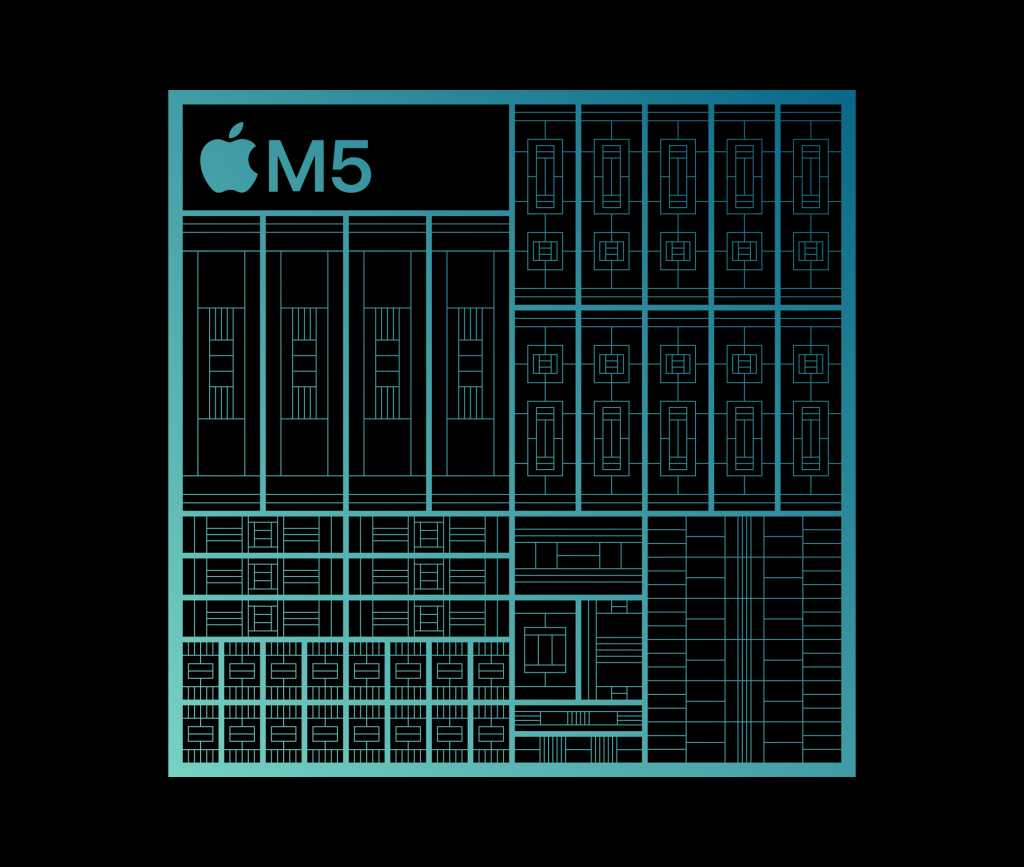
Significantly more powerful than even the M4 processor, the M5 chip got a press release of its own. That’s because the performance enhancements the 3nm processor introduces are, frankly, so impressive. With up to 10 CPU cores (6 efficiency and 4 performance), 10 GPU cores, and a 16-core Neural engine, highlights include:

  • 4x peak GPU performance for AI workloads compared to the M4 chip.
  • Up to 45% higher graphics performance than the M4.
  • Up to 15% faster multithreaded performance than the M4 CPU.
  • 153GB/s Unified Memory bandwidth, a 30% increase over the M4.
  • The ability to drive 10% more pixels at 120Hz refresh rates on the Vision Pro.

“M5 ushers in the next big leap in AI performance for Apple silicon,” said Johny Srouji, Apple’s senior vice president of hardware technologies in the announcement. “With the introduction of Neural Accelerators in the GPU, M5 delivers a huge boost to AI workloads. Combined with a big increase in graphics performance, the world’s fastest CPU core, a faster Neural Engine, and even higher unified memory bandwidth, M5 brings far more performance and capabilities to MacBook Pro, iPad Pro, and Apple Vision Pro.”

Apple stressed that the biggest advantage of the M5 is how AI-ready the processor is. Each GPU core includes a dedicated Neural Accelerator, making the GPU more AI-aware, for example. It means applications that useof Apple’s own frameworks and APIs, such as CoreML and Metal 4, will see immediate performance gains on an M5 system. It also means every Apple Intelligence feature you might use on these devices will be faster than before — presumably delivering benefits for any business using on-device AI models on their Macs. These really are the ultimate AI PCs. 

The world’s best AI PCs are Macs

While we’ll need to wait a few months for the larger MacBook Pros to appear, the new M5 powered 14-in. MacBook Pro delivers up to 3.5x faster AI performance, faster storage, and up to 24 hours of battery life. You get all the advantages of the new processor, a Liquid Retina XDR display, a 12-megapixel Center Stage camera, up to 2x faster SSD performance, and a six-speaker sound system.

“MacBook Pro continues to be the world’s best pro laptop, and today, the 14-in. MacBook Pro gets even better with the arrival of the M5 chip,” said John Ternus, Apple’s senior vice president of hardware engineering (a man hotly-tipped as a future Apple CEO).  “With its amazing performance, extraordinary battery life, and unrivalled display, M5 takes the new 14-in. MacBook Pro to another level.”

What does this next-generation performance cost? Surprisingly, no more than before with prices starting at $1,599. (That SSD performance means the ultimate portable AI PC can load a local LLM far faster than before — and with up to 4TB of storage available as a build-to-order option, users have room to put those LLMs on the device.)

The world’s best AI PCs are also iPads

The M5 chip in the iPad Pro is a major improvement for the pro tablet. It provides a significant boost in AI performance, graphics, and wireless connectivity, including up to 5.6x faster AI performance when compared to the M1 iPad Pro and 3.5x the AI performance of last year’s M4 model. 

Available in space black and silver, the new iPad Pro also boasts faster memory bandwidth, storage, and supports Wi-Fi 7 and 5G cellular connectivity, the latter using Apple’s own C1X modem.

It looks as if Apple is pretty pleased with the C1X modem; Apple said it delivers up to 50% faster cellular data performance than its predecessor with even greater efficiency. The iPad Pro also has an Ultra Retina XDR display capable of 1,600 nits max brightness.

“iPad Pro with M5 unlocks endless possibilities for creativity and productivity — with a huge leap in AI performance and a big boost in graphics, superfast wireless connectivity, and game-changing iPadOS 26 features, it pushes the boundaries of what iPad can do yet again,” said Ternus. 

The 11-in. iPad Pro starts at $999 for the Wi-Fi model, and $1,199 for the Wi-Fi + Cellular model. The 13-in. iPad Pro starts at $1,299, or $1,499 for the Wi-Fi + Cellular model.  

Combined with iPadOS 26, this tablet may be all the AI PC some users need.

The world’s best AI PC is also wearable

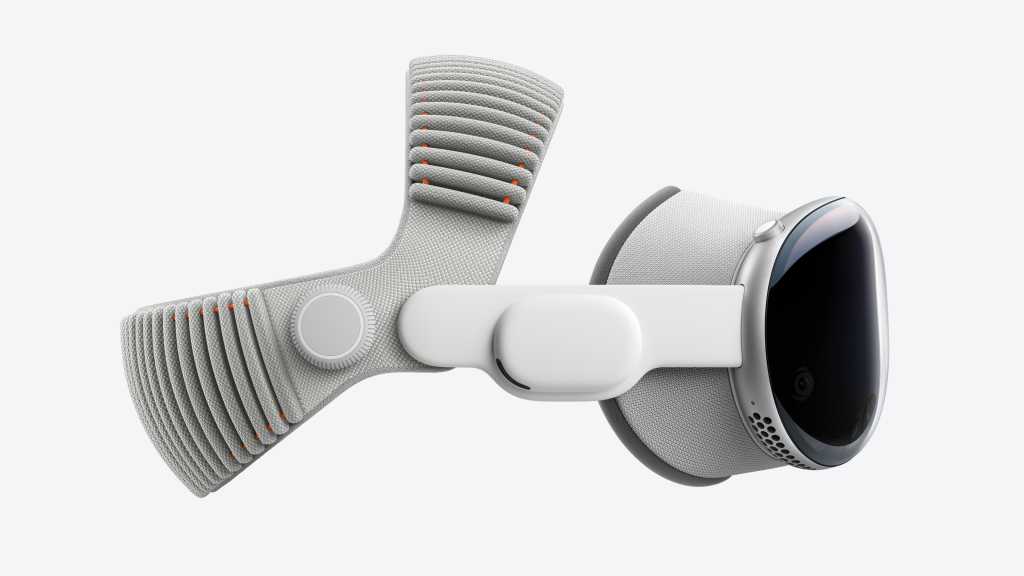
Want to wear a Mac? You can, with the M5-fueled Vision Pro, which uses the processor to deliver big performance and display-rendering improvements, along with better battery life. 

You cannot underestimate the difference the chip makes in Vision Pro, which can support hardware-accelerated ray tracing and mesh shading, enabling developers to add remarkable detail to their apps and games. It enables shaper images, and a 120HZ refresh rate, which makes it smoother to look between your surroundings and virtual imagery on the display. Plus, of course, AI experiences are significantly faster and more realistic than before. 

The battery now supports up to two and a half hours of general use, and up to three hours of video playback, all on a single charge. And if you need to wear if that long, Apple also created a more comfortable headband for the system. Apple Vision Pro with the M5 chip and Dual Knit Band still costs $3,499.

“With the breakthrough performance of M5, the latest Apple Vision Pro delivers faster performance, sharper details throughout the system, and even more battery life, setting a new standard for what’s possible in spatial computing,” said Bob Borchers, Apple’s vice president of worldwide product marketing.

You can follow me on social media! Join me on BlueSky,  LinkedIn, and Mastodon.

Nvidia’s DGX Spark desktop supercomputer is on sale now, but hard to find

Nvidia’s “personal AI supercomputer,” the DGX Spark, may run fast but it’s been slow getting here. It finally went on sale on Oct. 15, five months later than the company initially promised, and early units are hard to find: Nvidia’s online shop was out of stock on launch day, and retailers have few units in store.

When Nvidia unveiled the machine, then known as Project DIGITS, at the CES 2025 electronics show in January, it said it would go on sale in May. But by the time Nvidia gave the product its final name and released more detailed specifications in March, the delivery date had slipped to “later this year”.

[ Related: More Nvidia news and insights ]

CEO Jensen Huang announced on Oct. 13 that Nvidia would begin sales of the DGX Spark two days later, but by 5am Eastern Time on the first day of sale Nvidia’s own online store was already showing a “sold out” message hard coded into the web page’s HTML: It wasn’t even checking stock availability in real time.

As a consolation, Nvidia’s online store offered links to four partners it said were selling the device, but none of them offered an online “buy” button.

Micro Center’s website reported that the retail chain had the DGX Spark in stock and available for in-store pickup at 29 of its 31 outlets. While a few of the stores showed “25+” units available, most had stock levels in the teens, and the Indianapolis store had just nine units available. Micro Center wouldn’t accept reservations or advance payments and warned that its stores will impose a one-per-household limit on DGX Spark buyers.

With the DGX Spark priced at a penny short of $4000 — almost double the cost of a high-end gaming PC — it’s unlikely that householders will be interested in the device. Back in March, when the pre-order price was just $3000, PC World was already predicting that it wouldn’t find many buyers.

Industrial demand

Nvidia’s DGX chips are in high demand in industry, though, and it’s more likely that Micro Center’s one-Spark limit is to prevent businesses scooping them up by the rack-load to run AI applications in their data centers.

The DGX Spark contains an Nvidia GB10 Grace Blackwell chip, 128GB of unified system memory, a ConnectX-7 smart NIC for connecting two Spark’s in parallel, and up to 4TB of storage in a package just 150mm (about 6 inches) square.

It consumes 240W of electrical power and delivers 1 petaflop of performance at FP4 precision — that’s one million billion floating point operations with four-bit precision per second. In comparison, Nvidia said, its original DGX-1 supercomputer based on its Pascal chip architecture and launched in 2016 delivered 170 teraflops (170,000 billion operations per second) at FP16 precision, but cost $129,000 and consumed 3,200W. It also weighed 60kg, compared to the Spark’s 1.2kg or 2.65 pounds.

Nvidia won’t be the only company selling compact systems based on the DGX Spark design: It said that partner systems will be available from Acer, Asus, Dell Technologies, Gigabyte, HP, Lenovo, and MSI.

More Nvidia news:


Satya Nadella is running scared. That’s a good thing.

If there were anyone who could rest on his laurels, it would be Microsoft CEO Satya Nadella, who took over the reins from Steve Ballmer in 2014 when the company was at the lowest point in its history. He took the top job after what many people called the company’s “lost decade.”

Under Ballmer’s leadership, Microsoft had drifted into irrelevance; Google became a search behemoth, Facebook (now Meta) took ownership of social media, and Apple introduced the iPhone and iPad. Microsoft’s internet presence and influence was vanishingly small. The company had thrown away billions of dollars on an attempt to build a Windows-based mobile operating system. 

As a result, Microsoft’s stock prices stagnated and fell. When Nadella took over 11 years ago, the price was lower than it had been at the end of 1999.

At the time the company’s woes seemed intractable. How could it claw its way back in a world in which it lost out on the internet, social media, and mobile computing? 

Somehow, Nadella managed to do it. He ended Microsoft’s ill-advised foray into building a mobile Windows OS, ended the corporate infighting and sniping, and recognized that Windows was no longer the company’s future. Instead, he bet big on cloud computing — and the bet paid off. Then he made an even bigger bet on AI and turned the company into a juggernaut with a value now approaching $4 trillion.

Even so, Nadella isn’t resting on his laurels. Instead, he’s running scared — in a good way. Earlier this month, he appointed Judson Althoff to be CEO of Microsoft’s commercial division. Keep in mind that at Microsoft, the CEO title no longer means head of the company.  Rather, people in charge of divisions are sometimes called CEOs. Mustafa Suleyman, for example, is CEO of Microsoft AI; Rajesh Jha is CEO of Microsoft Experiences and Devices; and Mikhail Parakhin is CEO of Microsoft Copilot. 

After Althoff’s promotion, Nadella retains his title of Microsoft CEO and Chairman of the Board. And it’s important to note that Judson’s background isn’t in tech, it’s in sales and marketing. For the last nine years, he’s been in charge of Microsoft’s global sales organization. 

Nadella made the change so he could put as much of his time and energy as possible into being more directly involved in AI. It’s a return to his roots and echoes the kind of work that propelled him to the top of the company.  Before joining Microsoft in 1992, he was a member of Sun Microsystems’ tech staff. He had a variety of engineering and tech-heavy jobs at Microsoft before becoming CEO, including president of the Server & Tools Division for three years before his promotion.

Going all in on ‘founder mode’

Nadella announced the move in a blog post. He said the shakeup will “allow our engineering leaders and me to be laser focused on our highest ambition technical work — across our datacenter buildout, systems architecture, AI science, and product innovation — to lead with intensity and pace in this generational platform shift.”

Key to understanding the change are the three words “generational platform shift.” It’s a shorthand way of saying that AI will transform the tech world and worldwide culture, and companies that take advantage of it will thrive, while those who don’t will be left behind. By focusing primarily on AI development, Nadella believes he can ensure Microsoft takes advantage of the generational shift. He recognizes there are times when tech companies can flourish by focusing on management and sales, and other times, such as now, when they need to go all in on developing new technology.

In Silicon Valley, there’s a term for when head of a company does what Nadella is doing and devotes his or her energies primarily to tech: founder mode. He’s worked at Microsoft for 33 years, and he saw how tech-savvy founder Bill Gates built the company into a tech behemoth, and how marketing-and-sales guy Steve Ballmer sent the company into a tailspin when he missed out on mobile computing, social media, and other groundbreaking technologies. 

Nadella’s move is a clear indicator he doesn’t want something similar to happen on his watch.

Jack Gold, principal analyst at J. Gold Associates, believes Nadella’s move was the right one. He told Computerworld, “There is a lot of this going on in the industry, as companies structure for growth in diversifying business areas. Having an exec running a critical business area like AI, while the remainder of the exec team focus[es] on growth and new business opportunities makes sense, given the amount of focus required.”

Nadella going all in on tech and leaving marketing and sales largely to someone else isn’t the move of someone content to take things easy. It’s a recognition that if Microsoft is to keep its lead in AI, and possibly extend it, he needs to devote his full attention to it. It’s running scared in the best possible way. 

Got a Pixel Fold — or any other Android foldable? Get this app now

When you live with a folding phone and you’re the kind of person who likes taking total control of your Android environment, you’re bound to realize something pretty quickly:

The apps that work brilliantly in a standard Android setup don’t always work so well when you’re dealing with a dual display.

Specifically, anything involving your Android home screen is suddenly in a whole new universe.

It kinda makes sense, when you really stop and think about it: On a typical Android device — the type 99% of Homo sapiens carry around and that we’ve all traditionally been using for years now — you’ve got just that one display. And so that’s all most home-screen-related apps are created to consider.

With a foldable — whether it’s the freshly released Pixel 10 Pro Fold (better known as the latest Pixel Fold, to anyone who isn’t a complete psychopath) or any of the other foldables from Google, Samsung, Motorola, or whoever — you’ve effectively got two totally different home screens to contend with. There’s that external display home screen, which is the equivalent of the standard Android home screen on any other device, and then there’s also your internal display, which is larger and in a completely different shape and layout.

And it doesn’t take long to realize that most Android launchers — those splendidly useful tools that let you replace your entire home screen with one that’s completely customized and made to work specifically for you — simply aren’t set up to handle that thoughtfully.

There’s an exception, though. I stumbled onto it on accident whilst playing around with the latest Pixel Fold over these past few weeks, and I found myself absolutely delighted by the surprise.

Lemme let ya in on the secret.

[Psst: Got a Pixel? Any Pixel? Check out my free Pixel Academy e-course and uncover all sorts of advanced intelligence lurking within your favorite phone.]

The Android foldable home screen champion

The launcher of which we speak is the aptly named Smart Launcher. It’s one I’ve recommended before, in my Android launcher roundups, but not one I’d used regularly — for the long haul — on my own personal Android phone up ’til recently.

I started revisiting Smart Launcher because of the unfortunate demise of another top-tier launcher option, the now not-long-for-this-world Nova Launcher (sniff). And I was blown away to see how far it had come even just since my last look at it and how handily it filled that total-control, jack-of-all-trades void left in the Android ecosystem by Nova’s departure.

But aside from its all-around ability, the part of Smart Launcher that really surprised me was how eagerly it embraced the unusual dual display situation presented by the Pixel Fold and other folding Android contraptions.

Plain and simple, Smart Launcher gives you the option to create completely separate and distinct home screen setups for your phone’s outer display and for its unfolded inner screen. That means — unlike with most other Android launchers and even with Google’s default Pixel Launcher setup — you can customize the inner screen specifically to make the most of its expanded space while keeping a totally different arrangement that makes sense for your smaller outer screen, too.

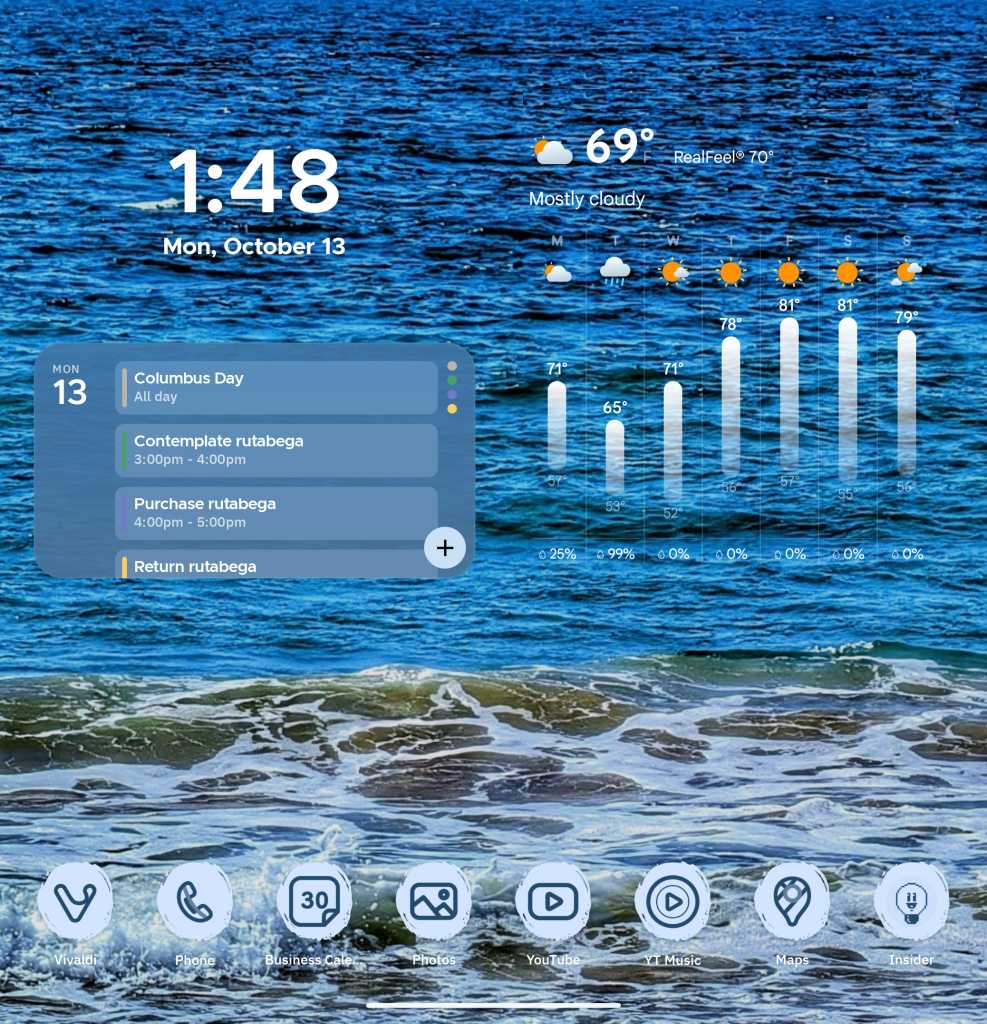
Here, for instance, is how I have my Pixel Fold’s outer display home screen at the moment — a setup that’s deliberately simple and minimalist, with a horizontally swipeable widget at the top, a few hidden gestures to get to commonly accessed areas, and a text-free list of my most-used shortcuts placed ergonomically alongside the left of the screen (a touch, incidentally, that’s inspired by Niagara Launcher — another exceptional Android launcher and long-time favorite of mine and one that also adapts itself intelligently to the foldable inner-screen setup, though in a more automated and less customizable way).

Google Pixel Fold - Android foldable: Outer home screen
The outer home screen — similar to what I’d use on any standard Android device.

JR Raphael, Foundry

Then, on my Pixel Fold’s inner screen, I’ve got a more spread-out layout that pulls pieces from that stacked widget into separate glanceable panels and moves an expanded list of my shortcuts into a dock-style design along the bottom edge of the display.

Google Pixel Fold - Android foldable: Inner home screen
The larger inner home screen is its own separate beast.

JR Raphael, Foundry

The reality is that with a folding phone, you have two very different displays that you use in very different ways — maybe even for different purposes. And this approach actually lets you customize ’em to your heart’s content, with a massive toolbox of options and without having to have one environment affect or in any way inform the other.

It just makes sense.

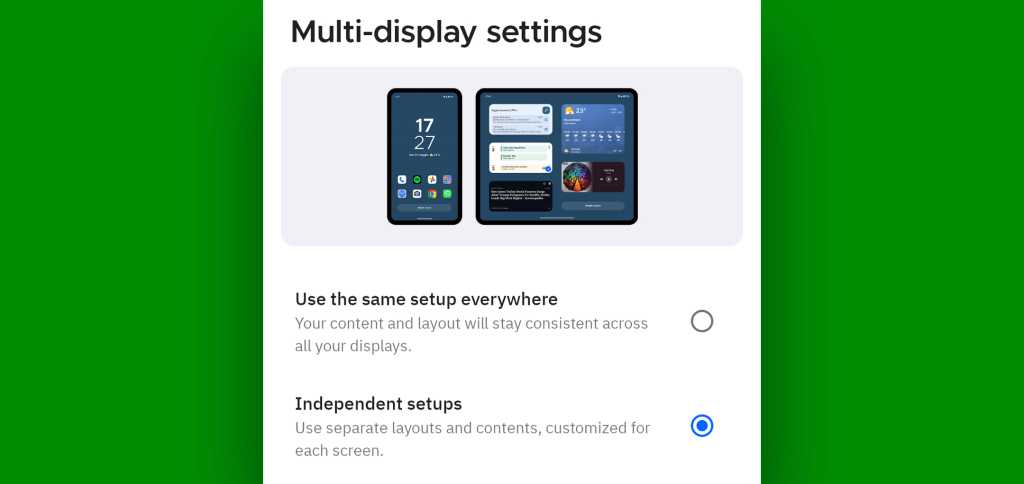
Now, if you’re using a foldable and want the power of a custom launcher without the complexity of creating two separate setups, you certainly don’t have to go that route. Smart Launcher has an option within its settings that lets you choose whether you want to use the same setup everywhere or maintain independent layouts for each screen with any multi-display device you’re using.

Android foldable home screen launcher: Smart Launcher
Smart Launcher puts the power in your hands to decide how exactly your foldable home screens work.

JR Raphael, Foundry

But if you’re like me and actually enjoy optimizing your Android environment for maximum ergonomics and efficiency — and if you, too, find that the approach that makes sense on an outer screen doesn’t necessarily translate exactly the same way to what you need on that spacious inner display — Smart Launcher is a spectacular tool for having your cake and eating it, too. It really is an indispensable upgrade for any Android foldable.

(The app is free to use in its base form, by the by, with an optional premium upgrade that unlocks a slew of extra features.)

That, my friends, is the power of Android in a nutshell for ya. And that’s why if you appreciate advanced productivity options and truly care about making your device work the way you want, there’s no question which platform is the right place for you.

Don’t let yourself miss an ounce of Pixel magic. Come join my free Pixel Academy e-course and lemme show ya oceans of hidden features and power-user upgrades!

GenAI agents are changing language translation in the enterprise

Generative AI (genAI) agents are changing language translation, with actions, emotions and diagrams now driving communication across languages.

Translation agents from a few companies go beyond text and use voice, image, and video to communicate across languages in real time and with high accuracy. “You need to be able to deal with multimodality. It’s not just plain text. There’s a lot more relevant data that you have to ingest,” said Matt Hardy, vice president of linguistic AI at RWS.

Computer translation isn’t new. But with genAI agents talking and automating actions in productivity and customer service, the stakes are higher. There’s little room for mistakes, especially as agents replace humans to get work done.

Translation agents from RWS, DeepL and Grammarly analyze information sources, verify intent, establish context, and deliver translations that go beyond words. “The beauty of agents is that they are so pliable. They’re supposed to be modular,” Hardy said.

The ability for AI to translate audio, video and text helps the genAI tools capture context and nuance — actions in a video, or specific tones in audio, for example — and pack that into translation.

“Languages are not about just a written representation of pure thoughts,” said Stefan Mesken, chief scientist at DeepL. “There is context, both cultural, also situational. To get this right, you have to be very close to your customers, which includes speaking their language.”

Translations are now trending toward a broader understanding of the intent of the actual user. Like expression, physical context plays a role in getting the nuances right.

“The other way around to address this is to create a multilingual agent… [that] can freely switch between any language that might be beneficial for this line of work, which much more closely resembles how humans interact,” Mesken said.

The UN estimates there are 8,324 languages worldwide. For high-resource languages like English, the translation tools are generally good, but translation quality sharply drops off in other languages.

“Another way to address this, of course, is to bring language AI into the agentic space, essentially as an accessibility layer, similar to how we do this with humans,” Mesken said.

Historically, companies hired multilingual support teams who spoke multiple languages, outsourced it, or built separate language-specific teams. Translation AI agents are changing that, said Ailian Gan, director of product management at Grammarly.

Multilingual communication improves the customer experience “while also making it easier and more cost-efficient for businesses to expand internationally,” Gan said.

DeepL recently released a “DeepL agent” — a general-purpose AI agent with built-in translation capabilities based on a translation API that supports 36 languages. The agent can establish multimodal context.

“For media, images and diagrams specifically, since so much of this world is encoded in feature and media rich documents, this is of course one of the areas where we focus as well,” Mesken said.

The company also has writing and real-time voice translations. It supports 36 languages and is focusing on quality, not quantity, as accuracy is important.

“For high-resource languages, you can get good enough to a certain extent and then it sharply drops off…, which essentially cuts out a large part of the population of this technology,” Mesken said.

RWS has developed Evolve, a multi-agent AI translation system that first translates text. A second agent checks the accuracy of the translation against hundreds of human opinions and data. RWS has been in the translation business for decades and has gathered a lot of data about multilingual communications.

“If the machine still can’t figure it out how to make that a good translation, that’s when it pops over onto a translator’s desk and they make the change,” Hardy said.

Translator agents are one area where human creativity is critical for accuracy and compliance purposes.

DeepL works with language experts for accuracy and fluency. RWS employs thousands of linguists.

“I do not see machines taking over this industry during my career, honestly. There’s still some years left in it,” Hardy said.

Grammarly, which has been reinventing itself as a platform for Agentic AI, has released a slew of multilingual features — including the ability to easily translate across 19 different languages in real time in any text box. “Our analytical linguist team conducts quality evaluations for each of the 19 languages that we support translations in, including looking at these kinds of nuances,” Gan said.

But there’s a lot of work to be done in the area, especially expanding beyond the internet’s dominant languages. AI models were trained more on data in English versus lower-resource languages.

Available training data becomes scarce after about 25 languages, and the quality of translation drops.

“The next billion internet users are going to be in the continent of Africa, they’re going to be in Southeast Asia, they’re going to be in India,” Hardy said.

It’s here! Windows 10’s end-of-support deadline arrives

Windows 10 on Tuesday reached its end-of-support deadline, meaning businesses will no longer receive free security patches or technical support from Microsoft for devices running the operating system. 

Those that continue with Windows 10 past the deadline must pay $61 per device for the first year of additional support via Microsoft’s Extended Security Updates (ESU) program. The program will be in place for three years, with the yearly cost doubling every 12 months to reach $244 in the final year. Without extended support, businesses risk exposure to cyberattacks and data breaches as new security vulnerabilities will no longer be patched.

Microsoft had been encouraging customers to upgrade to Windows 11 or to Windows 365 cloud PCs ahead of the Oct. 14 deadline. However, adoption has been relatively slow due to factors such as stricter hardware requirements for Windows 11, tight budgets among small and mid-sized businesses, and a lack of perceived benefits in the upgrade.

Migrations have ramped up ahead of the deadline, however. Windows 11 has now overtaken Windows 10 in global enterprise adoption, accounting for 60% of deployments. That’s according to analysis of data from 8 million Windows devices last month by asset management software provide Lansweeper. 

The shift away from Windows 10 has also driven an uptick in PC sales this year.  

Last week, analyst firm IDC noted a 9.4% year-on-year increase in sales during Q3 2025, due in part to the transition to Windows 11. Omdia’s research put the increase at 6.8%, with Windows 11 adoption set to continue to drive PC sales into 2026. 

“While Microsoft and its partners have greatly stepped up efforts to drive awareness, particularly amongst SMBs and consumers, a significant portion of the global Windows installed base remains either on Windows 10 or on a PC that is five or more years old,” Ishan Dutt, research director at Omdia, said in a statement last week. 

Omdia’s survey of PC channel partners indicated that many businesses are still in the process of upgrading to Windows 11. 

According to the poll of 453 channel partners, 39% said almost all of their business customers’ Windows 10 PCs are now refreshed or upgraded. Meanwhile, 18% said customers will continue to use Windows 10 past the support deadline, likely with support via the ESU program.