French President Emmanuel Macron has told his ministers that the EU should consider targeting the US digital sector. The statement comes after Donald Trump threatened new tariffs in response to European technology regulation and digital taxes, Politico reports.
Trump has long criticized the EU’s digital regulations, the Digital Services Act and the Digital Markets Act, and recently claimed that they discriminate against US companies.
Macron said the EU should not rule out retaliation and pointed to its trade deficit with the US in services, even though the EU has surpluses in goods trade — for example in cars and pharmaceuticals.
Macron has previously said he was not satisfied with the EU-US trade deal and that Europe was not “feared enough” to negotiate a better agreement.
He is expected to raise the issue with German Chancellor Friedrich Merz at an upcoming meeting.
Figures published by Google last week minimizing the energy and water consumption of individual queries answered by its AI services are still not giving us the full picture of AI energy use, according to an article in MIT Technology Review on Thursday. The writer went on to raise further questions about AI’s resource consumption that enterprise IT leaders will need to consider in their budget and ROI calculations.
Google’s estimate for the water and electricity consumption — five drops and a quarter of a watt-hour — of a single text query to its AI services “doesn’t reflect all queries and it leaves out cases that likely use much more energy,” such as images or videos, the article’s author Casey Crownhart wrote. Crownhart co-authored a much deeper dive into AI’s energy footprint for Technology Review in May.
And Google’s estimate is just the median value — half the text queries it handles use less energy, and half more: “We don’t know anything about how much energy these more complicated queries demand or what the distribution of the range is,” Crownhart wrote.
By choosing to publish just the consumption of a single query, Google minimized the impact of its AI. “We don’t know how many queries Gemini is seeing, so we don’t know the product’s total energy impact,” she wrote.
Rival AI operator OpenAI does share total traffic figures, saying that it sees 2.5 billion queries to ChatGPT every day, while Google has only said that Gemini has 450 million monthly active users. And that number only describes a fraction of Google’s AI impact, as it also uses the technology to provide AI summaries in web searches, and to help draft or summarize emails and texts, Crownhart noted, concluding, “So even if you’re trying to think about your own personal energy demand, it’s increasingly difficult to tally up.”
The impact for IT
But it’s not just personal: Enterprises too are paying for these AI services and, indirectly, the cost of their energy and water consumption.
As the cost of these inputs rises, IT departments must make budget projections based on the anticipated number and nature of AI queries: Text? Video? Complex or simple analysis? If CIOs are trying to project those costs for 2026, they will have to make some difficult guesses about new capabilities and new players too.
CIOs may have to consider the direct cost of those inputs too, as they explore the possibility of bringing cloud computing back in house. Setting aside the question of whether they can obtain the needed components, such as volume deliveries of NVIDIA chips, this move would force them to directly deal with energy and water challenges — not just the cost but, depending on where they chose to build, their availability too.
“If you, as a CIO, are not speaking with your operations and facilities teams around forecasting power requirements versus power availability, start immediately,” said Matt Kimball, VP/principal analyst for Moor Insights & Strategy. “Having lived in the IT world, I am well aware of how separate these organizations can be, where power is just a line item on a budget and nothing more. Talk to the team that’s managing power, cooling and datacenter infrastructure — from the rack out — to better understand how to use these resources most efficiently.”
It’s not just computing capacity that contributes to the cost of AI: IT needs to reexamine existing storage operations too, Kimball said.
“I would take a long look at my storage infrastructure and how to better optimize on and off prem. The infrastructure populating most enterprise datacenters is out of date and underutilized. Moving to servers that have the latest, densely populated CPUs is a first start,” he said. “Moving on-prem storage from spinning media to all flash has a higher up-front cost, but is far more energy efficient and performant. It’s easy to buy into the NVIDIA B300 or AMD MI355X craze. Or the Dell, HPE, or Lenovo AI factories. But is this much horsepower required for your AI and accelerated computing needs? Or are, say, RTX6000 PRO GPUs good enough? They are far more affordable and about 40% of the power consumption compared with a B300.”
A different perspective comes from Simon Ninan, SVP of business strategy at Hitachi Vantara, a company that sells many of these services, as the scale of these data centers is forcing IT to reconsider all previous assumptions about power usage. “AI’s energy demands are rendering traditional air cooling insufficient,” he said. “We’re seeing an increasing shift to liquid cooling for AI data centers, but a massive investment is also needed in innovations that cater to environmental boundaries.”
A new version of LibreOffice, a popular open-source alternative to Microsoft Office, won’t run on 32-bit PCs, or support the Windows 7 or 8 operating systems.
The Document Foundation earlier this month released version 25.8 of the free productivity suite, which was downloaded 642,564 times in its first week, according to a blog entry on the organization’s website.
Most Windows software comes in 32-bit and 64-bit versions, and most software vendors offer support for both for backward compatibility.
LibreOffice, which includes apps for word processing, spreadsheets, presentations, vector graphics creation, and more, is popular among Linux users and is included in many Linux distributions. A version is also available for macOS.
The base desktop software is free of AI tools and targeted for customers who want an alternative to Office without the frills. A cloud-based paid version of LibreOffice is available at Collabora Online.
But more AI tools are coming to LibreOffice desktop in the form of extensions. Earlier this month, StableDiffusion released an AI image generator for the software. Chatbots and automated writing extensions are also now available for LibreOffice.
The number of LibreOffice adopters remains modest, but some individuals and organizations are giving it a look as cloud and AI security concerns mount around the market-leading office suites, Microsoft 365 and Google Workspace. Denmark’s Ministry of Digitalization recently announced that it would move half of its employees to LibreOffice from Microsoft 365 this summer, with plans to cut off the Microsoft suite completely by year end.
The next version of LibreOffice is expected to be 26.2, which will be released next year.
With stressful migrations from Windows 10 to Windows 11 still ongoing in many organizations, Microsoft has thrown system administrators a small but helpful lifeline.
Although it announced the new service last November at Ignite 2024, Microsoft only released Windows Backup for Organizations this week. The somewhat misleading name masks its real purpose: making it easier to migrate or restore system settings between machines joined to Entra ID (formerly Azure Active Directory) as part of Microsoft 365.
In short, this is not a utility for backing up data files, folders, installed applications or for executing disaster recovery. Instead, what’s being backed up to the cloud is a user’s Windows settings and a list of their Microsoft Store apps, so that they can be restored to a new machine.
The settings include things like display setup, accessibility, peripheral parameters, language, and power configuration.
The feature is being pitched as helpful for admins migrating users from one OS version to another — specifically Windows 10 to 11 — or when setting up a new machine for an existing user from scratch using the “out-of-box experience (OOBE)” process.
In fact, admins can already do this using tools such as Microsoft User State Migration Tool (USMT). The downside of this is that it is IT-driven, manual and sometimes complex. Someone must be on hand to create and run PowerShell scripts that automate and orchestrate different executables.
In contrast, once enabled and configured as part of Intune mobile device management (MDM) or Entra ID Group Policy, all that’s required for Windows Backup for Organizations to work is for the user to sign in with their Microsoft Entra ID account. No tools or software routines needed — users simply log in and Microsoft’s cloud should do the rest.
Alternatively, a backup can be manually triggered by a user by opening the Windows Backup app and selecting ‘Back up’, Microsoft said.
“For large-scale upgrades and device continuity, Windows Backup for Organizations helps reduce migration overhead, minimize user disruption, and strengthen device resilience against incidents,” Microsoft program manager Miranda Leschke wrote in the blog post announcing the tool’s availability.
Windows 11 restore only
An important caveat is that while Windows Backup for Organizations will back up the settings of devices running Windows 10 version 22H2 or Windows 11 version 22H2 or later, the restore function only works for Windows 11 version 22H2 or later. Anyone staying on Windows 10 won’t be able to restore settings — and Leschke helpfully reminded users that, “With Windows 10 support ending on October 14, 2025,” the new tool could help “ease your transition to Windows 11.”
One other pre-requisite for using Windows Backup for Organizations is that the August 2025 Windows security update be applied. While systems will normally be Entra-joined, on-premises domains can also access the feature if they are hybrid joined (that is, if Active Directory is bridged to Entra ID).
According to Microsoft, “the Restore setting is rolling out gradually, so check back in about a week if you don’t see it in your Intune tenant. Once enabled, backups run automatically every eight days, saving user settings and preferences to the organization’s tenant data store.”
However, with the October 2025 end-of-support deadline for Windows 10 approaching, IT managers grappling with the Windows 10 to 11 transition will have bigger headaches on their plates than migrating settings.
In today’s multi-device, work-from-anywhere world, unified endpoint management (UEM) is crucial for efficiency and security, providing a “single pane of glass” for managing mobile, desktop, and cloud environments. Microsoft Intune is a leading example of a UEM product that has continuously expanded to meet IT’s evolving needs.
What is Microsoft Intune?
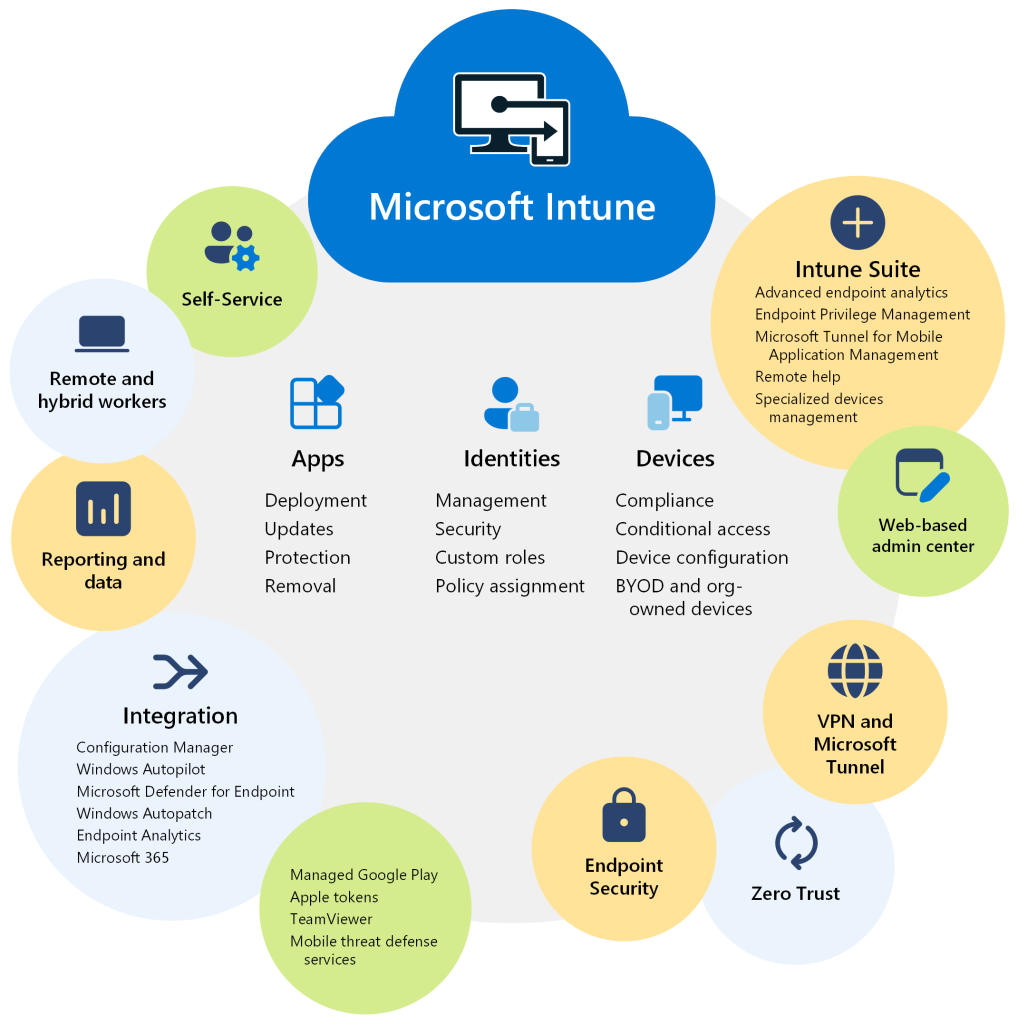
Microsoft Intune is a suite of management tools that are the core of Microsoft’s UEM strategy as well as part of Microsoft 365’s broader technology stack. The company’s goal is to simplify managing mobile devices and applications, PCs, and other devices — and to reduce complexity and cost for IT teams.
For example, Intune’s mobile device management (MDM) capabilities are built to allow IT administrators to enforce security policies, remotely wipe devices, and manage configurations across heterogeneous platforms. Its mobile application management (MAM) features are designed to help businesses manage applications on both corporate and personal devices — enabling deployment, updates, and retirement of applications — and to protect corporate data within apps, preventing data leaks without disrupting user experience. (Download our 2025 UEM vendor comparison chart for a comprehensive list of capabilities in Intune and its main competitors.)
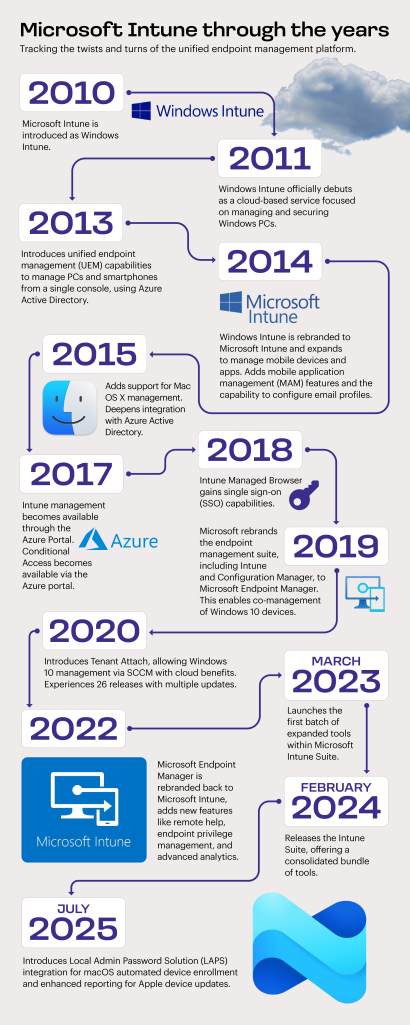
If you’re having a hard time keeping track of Microsoft’s UEM strategy, you’re not alone. What began as Windows Intune in 2010 evolved — and survived an identity crisis — to land where it is today as arguably the leader in the UEM market.
To address the emerging enterprise mobility management (EMM) needs of businesses, Microsoft launched its Intune cloud service in 2010 and added numerous mobile management features in subsequent years. In 2019, Microsoft decided to combine its Intune UEM platform with its longstanding Configuration Manager (ConfigMgr) on-premises management platform, enabling users to access both through a single interface and rebranding the combined service as Microsoft Endpoint Manager. A few years later, in 2022, the service was rebranded back to Microsoft Intune, and the next year Microsoft released the Intune Suite, which consolidated its endpoint management and security solutions to streamline protection for both cloud and on-premises endpoints.
The timeline below shows the many self-imposed twists and turns of Microsoft Intune.
How Windows Intune became Microsoft Intune, then became Microsoft Endpoint Manager, and then became Microoft Intune again.
Foundry
Why Intune is a UEM leader
Microsoft’s UEM strategy revolves around simplifying management with a cloud-first approach and reducing complexity and cost for IT teams by leveraging AI and automation to enhance endpoint security, improve end-user experience, and simplify operations. This jibes with Gartner’s forecast for the UEM market. The research firm predicts that by 2029, more than 50% of organizations will adopt autonomous endpoint management (AEM) capabilities within advanced endpoint management and digital employee experience (DEX).
Driven by corporate mobile device programs, hardware management has been shifting away from a Windows-dominant world to one that is increasingly diverse and includes iOS, Android, and macOS devices. As more worker tasks are carried out on mobile devices, the momentum behind UEM, and its capability to manage all user-facing devices from a single console, continues to grow.
While it’s a competitive market, Microsoft is widely recognized by experts and analysts such as IDC and Gartner as a leader in the UEM sector. According to IDC’s 2024 MarketScape for Worldwide UEM Software report, Microsoft is a leader in the category. The research firm notes that an important trend in UEM is the need account for “unmanaged” devices, specifically through mobile application management (MAM) features that secure corporate data and apps without full device enrollment.
Intune’s integration with other Microsoft services is an advantage it has over competitors. For example, it’s designed to work seamlessly with Azure Active Directory.
Microsoft Intune is designed to allow you to manage your organization’s devices and supports Android, Android Open Source Project (AOSP), iOS/iPadOS, Linux Ubuntu Desktop, macOS, ChromeOS, and Windows client devices.
Microsoft
How to get Microsoft Intune and what you’ll pay for it
Microsoft Intune is a standalone product, but it is also included with certain Microsoft 365 plans. While Basic Mobility and Security is part of the Microsoft 365 plans, it’s a separate, free feature set and is not a full version of Intune. The following versions of Microsoft 365 include the complete version of Intune:
Microsoft 365 Business Premium
Microsoft 365 Firstline 3
Microsoft 365 Enterprise E3
Microsoft 365 Enterprise E5
Microsoft 365 Education A1
Microsoft 365 Education A3
Microsoft 365 Education A5
Enterprise Mobility & Security E3
Enterprise Mobility & Security E5
As a subscription service, Microsoft charges companies on a per user/per month basis in three tiers, which can also be purchased as standalone licenses or in bundles with other Microsoft products. The most common pricing is based on a per-user, per-month model with an annual commitment and breaks down as follows:
Microsoft Intune Plan 1: This core plan includes essential endpoint and application management features. It costs $8 per user per month.
Microsoft Intune Plan 2: This is an add-on to Plan 1, providing advanced capabilities. It costs $4 per user per month.
Microsoft Intune Suite: Bundles all features from Plan 1 and Plan 2, along with additional advanced security and management solutions. It costs $10 per user per month as an add-on to Plan 1.
Additional information on Intune pricing
Add-ons: Advanced features such as Remote Help, Endpoint Privilege Management, and Endpoint Analytics can also be purchased as individual add-ons.
Free Trial: Microsoft offers a 30-day free trial with 100 user licenses, allowing organizations to test the service before committing to a purchase.
Device-only licenses: There are also device-only subscriptions available for specific use cases like kiosks or shared devices that are not tied to a particular user.
Looking ahead: Intune in development
What’s next for Intune? According to Microsoft, these features are currently in development for Intune and will likely be available in 2025:
Microsoft Intune Suite: A new dashboard for endpoint privilege management (EPM) is in design and will provide insights into user status and file elevation trends. EPM will also support Azure Virtual Desktop single-session virtual machines.
App management: Intune app protection policies for Apple’s iOS/iPadOS will allow blocking data sync from policy-managed app data to app widgets, enhancing data protection, according to Microsoft.
Device management: New Microsoft Graph permissions for API calls to device management endpoints will require updates to tools and scripts should be available in August. Remote wipe actions will support multiple administrative approvals. Intune Device control policy will support devices managed by Microsoft Defender for Endpoint.
Monitoring and troubleshooting: Improved declarative Apple software update reports will offer near real-time details on update failures, pending updates, and installation status.
Significant Intune notices
Updates to the latest Intune App SDK and App Wrapping Tool for iOS will be required to support iOS/iPadOS 26 and ensure continued app protection policy enforcement. Apps will need to be registered with Microsoft Entra.
Intune will move to support iOS/iPadOS 17 and later, and Android 10 and later for user-based management methods, with Microsoft expected to drop support for older OS versions.
Updates are coming for strong mapping for SCEP and PKCS certificates to address elevation of privilege vulnerabilities.
New standalone settings for blocking screen capture, Genmojis, and Writing tools in Apple Intelligence will be introduced.
This article was originally launched in September 2018 and most recently updated in August 2025.
Apple is seeing rapid growth in enterprise markets, and in the wake of the Crowdstrike disaster and Microsoft’s forced Windows 11 upgrades, there’s no good reason for that trend to end. It’s no wonder its platforms have become such a big target for organized crime — meaning constant security vigilance is necessary for every user as the scale of attacks intensifies.
That doesn’t mean Apple’s products are insecure; they’re not. But no platform is completely secure, and as more enterprise data is held on those platforms it becomes increasingly essential to ensure you have the correct security stance in place.
How much is too much?
Apple’s highly-skilled security teams are the first line of platform defense to protect system integrity, and they know how constant the attempts against its platforms have become. We don’t know how constant, but only this week we’ve heard of two relatively serious security warnings, including the seventh zero-day attack this year.
CrowdStrike (remember it?) recently warned of a spike in exploits targeting Macs on the part of a bunch of cybercriminals known as Cookie Spider. These attacks use malware infested advertising to trick people into visiting fraudulent help websites where they are fooled into executing malicious commands that steal their data.
The second, perhaps more disturbing, zero-day exploit is one that has been actively exploited in “extremely sophisticated” attacks against “specific targeted individuals.” That strongly suggests it to have been used in a sophisticated spyware campaign. Known as CVE-2025-43300, it enables attackers to compromise Apple device security just by getting the user to open a malicious image file. How severe is this exploit? Very. The Cybersecurity and Infrastructure Security Agency (CISA) has given this vulnerability a severity rating of 8.8 out of 10.
One reason the latter attack exploits malicious images is because Apple has made it much harder to use more conventional link-based attacks. These barriers are far from being complete — Apple has now patched a total of seven zero-day attacks this year — and it’s only August.
In discussing this, Adam Boynton, senior security strategy manager at Jamf, suggested the zero-day attack might have been used by one of the surveillance mercenaries. “While Apple has not confirmed whether this specific flaw was linked to spyware, similar vulnerabilities in ImageIO and WebKit have previously been used in Pegasus campaigns,” he said.
Surveillance-as-a-service
Pegasus is just one of a hungry horde of amoral, zero-day spyware attacks to be sold for profit by surveillance-as-a-service firms, many of which seem to emanate from Israel.
“This is a zero-click exploit that requires no user interaction, and can be triggered simply by processing a maliciously crafted image file, which could be delivered through various channels including messages, emails, or web content,” according to Qualys security research manager Mayuresh Dani.
Developing such attacks is very costly, which suggests the level of resources being thrown into breaking Apple device security. (It’s worth noting that these are the kinds of resources that would also be used to identify and exploit any security backdoors put in place at an operating system level in the event authoritarian surveillance-loving governments get their way.)
That cost certainly doesn’t seem to be a massive turn-off to the highly sophisticated and well-resourced companies profiting from the delivery of digital chaos. Many of these firms, such as NSO Group, have faced international sanctions and lawsuits, which doesn’t seem to have stopped them at all. Meanwhile, many of the exploits they create are sold to repressive governments that use them against journalists, dissidents, political rivals and others. Beyond that, older, patched exploits have reportedly been traded on the dark web, meaning these dangerous attacks can proliferate.
The danger of such attacks should be top of mind for any prominent business executive, as enterprises can be targets, too — particularly as corporate execs jet around the world. Travelers should now carry burner phones with only limited access to important corporate (or personal) data.
Don’t be paranoid, but be aware
The growing sophistication and frequency of attacks reflect Apple’s growing ecosystem but underline the obvious need to maintain a robust security posture. That includes keeping all your devices updated with the latest security patches and ensuring that all the systems you do use are running — or capable of running — the latest security updates.
While Apple is evolving, attackers are evolving in tandem. Are all your systems updated with the latest security patches?
US Federal Trade Commission (FTC) Chairman Andrew N Ferguson warned more than a dozen major technology companies Thursday that censoring US citizens or weakening data security protections at the behest of foreign governments could violate US law.
Ferguson sent formal letters to 13 tech giants — including Amazon, Apple, Google, Meta, and Microsoft — reminding them of their legal obligations to protect American consumers’ privacy and data security despite mounting pressure from overseas regulators, the FTC said in a statement.
“I am concerned that these actions by foreign powers to impose censorship and weaken end-to-end encryption will erode Americans’ freedoms and subject them to myriad harms, such as surveillance by foreign governments and an increased risk of identity theft and fraud,” Ferguson wrote in the letters, the statement added.
The warning shot marks a more confrontational stance toward foreign regulatory influence over American technology services.
Companies receiving the letters included Akamai, Alphabet, Amazon, Apple, Cloudflare, Discord, GoDaddy, Meta, Microsoft, Signal, Snap, Slack, and X, according to the agency.
Ferguson invited the firms to schedule meetings with his office by August 28 to discuss how they will honor their privacy commitments to US consumers while facing competing global regulatory demands.
For enterprise technology buyers, the FTC’s warning creates new questions about vendor reliability and data protection commitments. Organizations that rely on cloud services, collaboration platforms, and security tools from the targeted companies now face uncertainty about whether their providers will maintain consistent global security standards.
European laws driving compliance concerns
Ferguson specifically cited three foreign regulations that he said could pressure tech companies to compromise American users’ rights: the EU’s Digital Services Act, the UK’s Online Safety Act, and the UK’s Investigatory Powers Act.
The DSA, which applies to platforms with more than 45 million monthly EU users, requires companies to remove “illegal” and “harmful” content or face fines of up to 6% of global revenue. The UK’s Online Safety Act establishes similar content moderation requirements for platforms serving British users.
More concerning to US officials is the UK’s Investigatory Powers Act, which “can require companies to weaken their encryption measures to enable UK law enforcement to access data stored by users,” the FTC said.
Earlier this year, the British Home Office secretly ordered Apple to create backdoors in its encrypted cloud services under the Investigatory Powers Act. Apple, however, has ceased offering its Advanced Data Protection feature in Britain rather than comply with the demand.
For enterprise customers, the regulatory fragmentation creates complex compliance challenges.
Legal threat to non-compliance
Ferguson warned that companies could face FTC enforcement action if they weaken security promises to comply with foreign demands. Under the FTC Act, companies that promise consumers encrypted communications but then adopt weaker security measures could be found guilty of deceptive practices, he said.
“If a company promises consumers that it encrypts or secures online communications but then adopts weaker security in response to demands from a foreign government, such an action could be considered a deceptive practice under the FTC Act,” the agency said in the statement.
The FTC has brought dozens of cases over the past two decades against companies that failed to keep promises about consumer data protection, the agency noted.
Encryption controversy escalates tensions
The FTC’s intervention comes amid growing tensions between US officials and foreign governments over encryption policies. Director of National Intelligence Tulsi Gabbard recently called foreign demands for encryption backdoors a “clear and egregious violation of Americans’ privacy and civil liberties.”
The standoff highlights broader concerns about the extraterritorial reach of European and British regulations. Critics argue that foreign laws increasingly dictate global technology policies, potentially undermining American digital competitiveness and innovation.
While law enforcement agencies argue they need access to encrypted communications for investigations, privacy advocates and tech companies contend that backdoors inevitably weaken security for all users.
Gabbard has warned that foreign encryption demands would “open up a serious vulnerability for cyber exploitation by adversarial actors,” reflecting growing concerns within the Trump administration about foreign regulatory overreach.
Industry implications
Ferguson’s warning could embolden other US agencies to push back against what the administration views as inappropriate foreign regulatory overreach. Apple has already demonstrated this approach by withdrawing its Advanced Data Protection feature from the UK market rather than comply with encryption backdoor demands.
The intervention reflects broader concerns about regulatory fragmentation in global technology markets. Organizations operating across multiple jurisdictions must navigate conflicting requirements while maintaining consistent security standards, creating complex compliance challenges for both vendors and their enterprise customers. Google, Microsoft, Amazon, Apple, and Meta did not immediately respond to requests for comment.
Lifelogging is an unfashionable word. But its central idea — using computers as prosthetic memory to remember everything — is appealing.
The idea is 80 years old. In a 1945 Atlantic article, Vannevar Bush proposed a memory machine called a Memex. Bush was an American engineer, inventor, and science administrator who led the US Office of Scientific Research and Development during World War II, helped develop analog computers, and founded Raytheon.
Bush wanted everyone to have a personal desk-sized machine designed to use microfilm to store huge amounts of books, articles, and notes. The Memex would let users add new information by taking pictures and storing them on microfilm, then searching and jumping between related items using a special keyboard, like choosing paths through a branching network, instead of relying on alphabetical or numerical order.
Easy, right? Just two problems: Getting information in and out. Over the decades, ambitious nerds tried to make lifelogging happen.
In the 1980s, a Canadian inventor and University of Toronto professor named Steve Mann built wearable computers and sensors that fed data onto hard drives — video, audio, and other data, sometimes sensing hand positions and environmental information using cameras, microphones, antennas, and other sensors.
In 2000, Gordon Bell became the most influential voice in lifelogging. Bell was a computer designer known for his work at Digital Equipment Corporation (DEC), where he led the development of the PDP and VAX computer architectures.
In the last two decades of his career, Bell worked at Microsoft and in 1998 launched “MyLifeBits” to capture digital versions of “a lifetime’s worth of articles, books, cards, CDs, letters, memos, papers, photos, presentations, home movies, lectures, voice recordings, phone calls, IM transcripts, television, and radio.” He wore two cameras around his neck, which took pictures constantly and automatically. To use his prosthetic memory system, he had to rely on custom-built software.
When I interviewed Bell in 2016, he had given up on lifelogging. There was too much data to capture, he told me, thanks to smartphones. In the future, he said, a revolution in AI will organize that data. Until then, the dream was impractical.
Well, we’ve had the LLM-based genAI revolution —and now lifelogging is possible.
The best lifelogging tool you’ve never heard of
In the past 25 years, data capture apps like Evernote, launched as a note-taking app in 2008 and eventually transformed into an all-purpose tool, emerged. By 2019, it had a quarter of a billion users. Evernote still exists, but with a smaller staff and now owned by Italian software company Bending Spoons, which added AI tools.
The trouble with Evernote is its complexity. Beyond lifelogging, it’s evolved into a productivity suite. Evernote is focused on collaboration and workflow — you can comment on notes, share and co-edit with others (even without an account), and request access or track shared notes. There’s a robust mobile and desktop experience, customizable navbars, and deep template support — including gallery browsing, one-click access, and custom thumbnails. The new AI features include semantic and smarter search, automatic summarization, and content transcription for audio, video, and image files. (The cost is $12.99 per month for personal, and $17.99 a month for pro.)
A more appealing option is the MyMind app. It’s a desktop app, mobile app, browser extension, and cloud service launched in 2021. (It costs $7.99 per month for basic and $12.99 for a more advanced version, and you can use it for free with a cap of 100 stored items.)
MyMind is a clutter-free bookmarking and knowledge-capture app without folders or manual content organization.There are no templates, manual customizations, or collaboration tools. Instead, MyMind recognizes and formats the content type elegantly. For example, songs, movies, books, and recipes are displayed differently based on MyMind’s detection, regardless of the source, as are pictures and videos.
MyMind uses AI to auto-tag everything and allows custom tags. Every word, including those in pictures, is indexed. You can take pictures of information, upload them to MyMind, and find them later by searching a word or two found in the picture. Copying a sentence or paragraph from an article will display the quote with a source link. Every data chunk is captured in a “card.”
Capture is easy. In a browser, click a button (from the extension). Everywhere else, including in any app on your phone, “Share” content and choose the MyMind app.
MyMind replaces information overload with a sense of calm control. Each card has a button that puts you into “Focus” mode, eliminating everything on your screen except the clearly displayed content.
Retrieval is instant. If you parked your car and took a picture of the parking garage floor and space number, you can start to spell “parking space,” but the information is instantly displayed after you type “p” and “a.” For keyboard shortcut fans, you can quickly navigate the app using the keyboard.
Most of the time, you can find anything in under a second. And it’s private, with all data encrypted and no tracking.
MyMind has other features, but the main idea is that we finally have a lifelogging tool that makes it easy to capture and retrieve information. It’s not perfect. For example, it could use a voice interface. I’d love to be able to add information by talking, and get it back by listening. But it’s probably the most effective lifelogging tool available.
Lifelogging hardware, too
Alongside AI-enabled lifelogging tools like MyMind, we’re also entering an era of lifelogging hardware devices. One promising direction comes from a startup called Brilliant Labs. Its new $299 Halo glasses, available for pre-order and shipping in November, are lightweight AI glasses.
The glasses have a long list of features — bone conduction sound, a camera, light weight, etc. — but the lifelogging enabler is an “agentic memory” system called Narrative. It captures information automatically from the camera and microphones and places it into a personal knowledge base. An AI assistant called Noa or Noa Plus (subscription) gives you a natural-language interface to your information. You can even use the glasses to “vibe code” apps.
As Gordon Bell predicted, a revolution in AI has ushered in practical, powerful lifelogging.
Thanks to genAI, which does the grunt work of capturing and retrieving the information in our lives, we can now remember just about everything.
One of the top enterprise IT complaints is that a serious lack of documentation — especially for legacy systems’ homegrown code — makes operations much more complex and riskier than they need be.
What’s rarely discussed are the reasons why there’s such a severe documentation shortage. The sad truth is that the blame mostly lies with IT managers — particularly those in charge back when the coding happened and the documentation didn’t. (Before you judge your predecessors’ predecessors too harshly, how often do you insist that current coding efforts under your authority have comprehensive and accurate documentation?)
The documentation problem starts with a simple fact: Developers hate documenting their work — and they hate it for multiple reasons.
First, it is the antithesis of fun. Coders often enjoy the creative elements of coding, but once they’re done, they want to move on to the next project. Focusing on the last one for a long time to document every aspect and explain every rationale is an annoying chore. Given a choice to avoid doing it, they will do so with alacrity.
Secondly, there’s the self-preservation aspect. Developers know if there is no actionable documentation, managers will be hesitant to fire or lay off that person because they might need them later. And speaking of needing them later, if a coder has left the company, they’re well lined up for a profitable consulting gig to solve the problem. Doing the detailed documentation work makes that little gig less likely.
In case you haven’t yet noticed, this age-old documentation issue shares a key trait with generative AI (genAI) testing issues — an impressive level of lack of self-awareness among senior managers about how they present these issues to their people.
Those CEOs might have just as easily said, “As soon as we can prove that these genAI systems work, we will lay off thousands of our technical team members. (Turns to those technical team members) Please test these systems. It will be your job to determine if they work reliably enough for me to lay off all of you. We will trust your reports.”
IT managers are in many ways doing the same thing when they ask programmers to create detailed and complete documentation for all of their code. Fortunately for the developers, those managers rarely make that request — and they certainly don’t insist on it — for a few reasons.
As much as coders want to move on to the next project, their managers often want that even more. Because once an app or coding tweaks are done and approved by the line-of-business manager who wanted it, IT types want to move to the next 19,000 items on their to-do list.
They don’t want a programmer to spend a day or more documenting details about the now-completed project. And therein lies the mental disconnect. That IT manager will allow and encourage that coder to move on and skip meaningful documentation. And yet that manager will scream about the lack of documentation for legacy code written 18 years ago.
Connect the dots, people: that lack of documentation is because the person who held their position 18 years ago did the exact same thing they just did.
How can this problem be fixed? There are a few options.
First, you have to realize there are actually three distinct problems that overlap: Problem One involves code created a long time ago where the original coder is no longer available; Problem two, involves code created more recently, with the original coder absolutely available; and Problem three involves code your people are writing right now.
As an aside, we should ask whether genAI coding assistants could help. If the problem with coders was solely related to, “It’s boring. I don’t want to do it,” then AI tools could make a big difference.
But we do have that programmer self-preservation factor. It’s not just that they don’t want to create the documentation — they don’t want the documentation created by anyone.
To be sure, IT managers would be fine with AI creating the documentation if possible, because it negates their big concern; they want the coder to move onto the next project.
But applying genAI after-the-fact, where the algorithm tries to guess a coder’s intent with each line, is likely to cause more problems than it resolves. The only way would be for the AI agent to work with the coder every step of the way to understand the full coding process.
In a vacuum, this could solve the issue. But remember — a coder’s financial objective is to stick around and not document themself out of job. Cooperation might be less than enthusiastic.
This brings us to genAI. Could today’s AI agents do a better job of figuring out what is causing a problem in legacy code and figure out how to fix it? And if that were possible, would that reduce the need for documentation?
Adam Resnick, a research manager at IDC, said the documentation issue is a constant concern for enterprise IT. “Poor documentation can make legacy systems harder to modernize, and makes onboarding, security audits, bug resolution, and maintenance more challenging,” he said.
Resnick sees the problem as being an issue of IT priorities: “Enterprises place a high priority on delivery of new features or urgent bugs under tight deadlines, and developers are incentivized towards these goals. Devs get raises and get promoted based on output, not documentation.”
But coder resistance has a lot of psychology behind it.
“Documentation is considered by many devs to be tedious and unnecessary. It takes a lot of time to document well, and devs who feel that they are writing good code often feel that anyone should be able to look over their code, and understand it without a lot of trouble,” Resnick said. “I’m not saying that developers are justified about the ‘unnecessary’ argument, but if they consider documentation tedious, then to them it is tedious. Very few ambitious developers place documentation high on their list of what they’d like to spend more time doing.”
But the problem gets worse the older the code is.
“Documentation is almost always behind, as systems evolve quickly. It is time consuming to update legacy documentation, which is often outdated by many cycles. Enterprises are unlikely to devote the amount of resources needed to catch up,” Resnick said. “Developers are under pressure to deliver new features and fix bugs, [and] are not incentivized or motivated to spend a high percentage of their time on documentation.”
Like almost everything else in IT, throwing money at the problem can actually work. “Incentivize developers to document,” Resnick said. “Tie fat bonuses to documentation and you’ll get more documentation.”
Pixel phones are filled with efficiency-enhancing Google intelligence, and one area that’s all too easy to overlook is the way the devices can improve the act of actually talking on your cellular telephone. That’s true for any Pixel model, no matter how old it may be, and it’s especially true for the more recent Pixel models that have launched over these past couple years.
Talking on your phone, you say? What is this, 1987?! Believe me, I get it, Vanilli. We’re all perpetually busy beings these days, and the timeless art of speaking to another human on your mobile device can seem both archaic and annoying.
But hear me out: Here in the real world, placing or accepting (or maybe even just avoiding) a good old-fashioned phone call is occasionally inescapable. That’s especially true in the world of business, but it’s also apparent in other areas of life — from dialing up a restaurant to confirm your carnitas are ready to dodging your Uncle Ned’s quarterly regards-sending check-ins. (No offense, Ned. I never dodge your calls. Really. Send my regards to Aunt Agnes.)
Whatever the case may be, your trusty Pixel can make the process of dealing with a call easier, more efficient, and infinitely less irksome, and you don’t need the latest and greatest shiny new Pixel to appreciate any of these advantages — including, even, the absolute newest Pixel calling capabilities that are just in the midst of showing up for Android-embracing animals this instant.
As a special supplement to myPixel Academy e-course — a totally free seven-day email adventure that helps you uncover tons of next-level Pixel treasures — I’d like to share some of my favorite hidden Pixel calling possibilities with you, my fellow Pixel-prizing platypus. Check ’em out, try ’em out, and then comesign up for Pixel Academy for even more practical Pixel awesomeness.
Pixel calling trick #1: The call sound sharpener
We’ll start with something critical to the act of communicating via voice from your favorite Pixel device — ’cause if you’re dialing digits and preparing to (gasp!) speak to another sentient creature, the last thing you want to do is struggle to hear the person clearly.
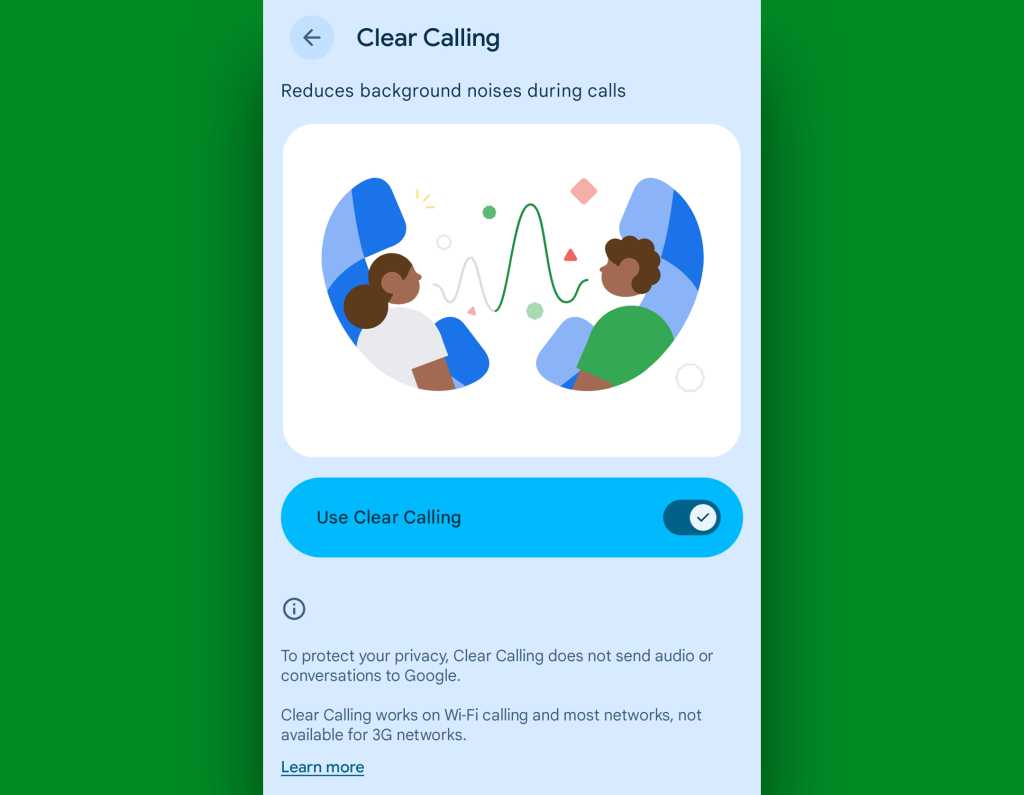
Since 2022’s Pixel 7 series, all Pixels have offered a helpful option called Clear Calling that you’d be crazy not to enable. In short, it’s like noise cancellation for the human voice: It actively reduces the background noise when the person you’re talking to is in a loud environment (as people on cell phones always seem to be). And it genuinely does make a meaningful, noticeable difference.
Best of all? All you’ve gotta do is dig around a bit once to make sure the system is enabled:
First, open up your Pixel’s system settings.
Tap “Sound & vibration,” then scroll down and look for the line that says “Clear Calling.” Again, it should be present on any Pixel model from the Pixel 7 onward.
Tap that, then confirm that the toggle on the screen that comes up next is in the on and active position.
One flip of a switch, and boom: All your calls will be noticeably clearer.
JR Raphael, Foundry
And that’s it! All your compatible calls will now have Clear Calling enhancements in place, and you’ll be able to hear what any comrades, colleagues, and/or caribous you communicate are saying more easily than ever.
Not bad, right? And we’re just getting started.
Pixel calling trick #2: The hassle-free holder
The worst part of phone calls, without a doubt, is having to hold. It’s the time-tested way for some of the world’s most sadistic companies to waste precious moments in your day, test what little patience you have left, and summon the pink-speckled rage-demon that lives deep within your brain.
Enter one of the Pixel’s best-kept secrets: With your Google-made gadget in hand (or fin — no offense intended to any aquatic readers out there), you’ll never have to hold again.
Open up the Phone app, tap either the three-dot menu icon in its upper-right corner or the three-line menu icon in its upper-left corner, and select “Settings” from the menu that pops up. Look for the section labeled “Hold for Me.” It’s present on the Pixel 3 and higher, and it’s presently available in the US, the UK, Canada, Australia, and Japan (sorry, other international pals!) — mostly for English-speaking Pixel owners, though also with the Japanese language in Japan.
If you meet those conditions, tap that line, then make sure the feature is actually active by flipping the toggle into the on position on the screen that comes up. It’s typically off by default on most new Pixels, so you will need to make sure you take this step anytime you reset your phone or move into a new device.
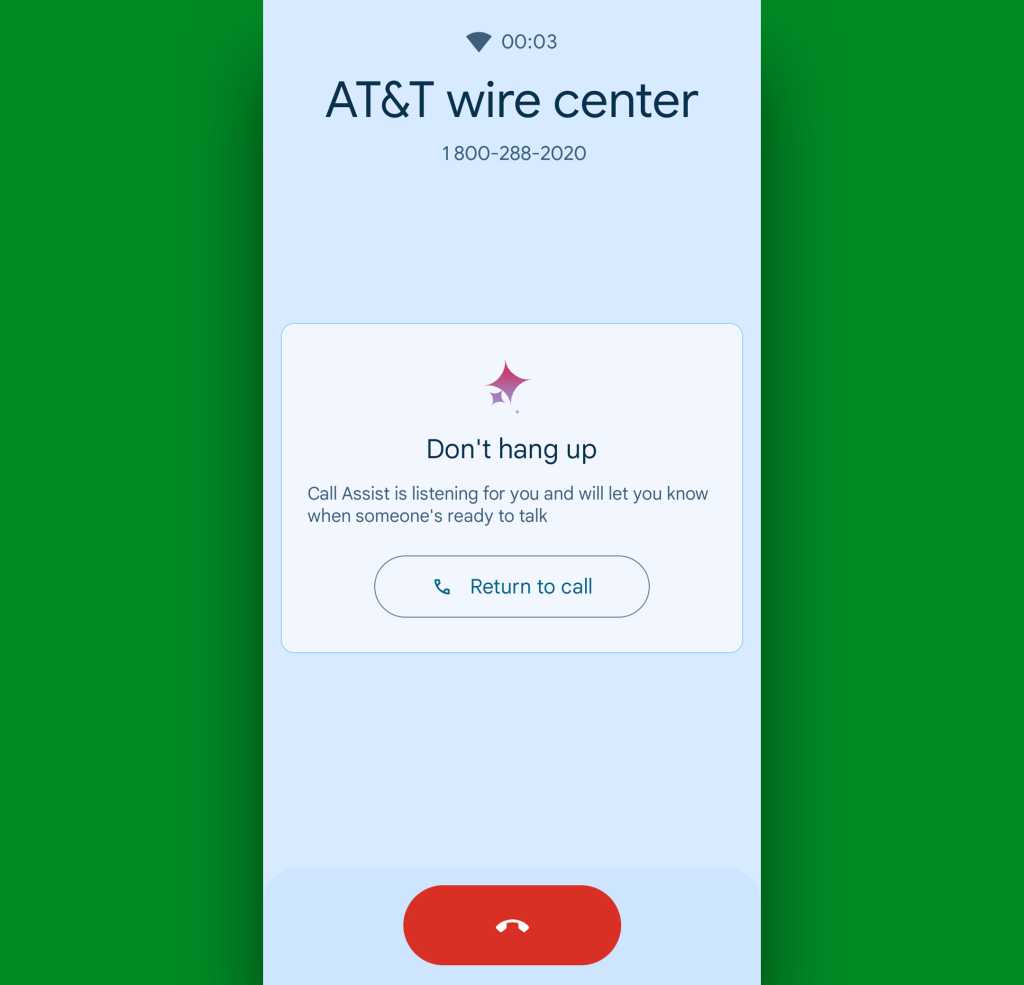
Then just call any crappy company you like (or don’t like, to be more accurate) and look for the handy new Hold for Me option on your screen once the call is underway and your brightly colored rage beast starts polka-dancing around your cranium. As long as the call involves a toll-free number, your fancy new sanity-saving button should show up and be ready for vigorous pressing.
That Hold for Me button is one of the Pixel’s best calling-related tricks.
JR Raphael, Foundry
The second the company places you on an eternal hold, just smash that button, utter a few choice curse words, for good measure, and then just go about your business without having to listen to the sounds of smooth jazz and endless reassurances that your call is, like, totally important to them (and will be answered — let’s all say it together now — in the order it was received).
No more holding for you, thanks to your Pixel’s Hold for Me (occasionally also known as Call Assist) capability.
JR Raphael, Foundry
As soon as an actual (alleged) human comes on the line or some other manner of input from you is required, your Pixel will alert you. At that point, unfortunately, the displeasure of dealing with said company is back on your shoulders. But being able to skip the 42-minute build-up to that point is a pretty powerful perk and one you won’t find on most other devices.
Pixel calling trick #3: The irritation estimation station
Having your Pixel hold for you is fantastic and all, but what if you could avoid putting yourself in a position where you even have to hold in the first place?
Well, hold the phone, my friend — ’cause your Pixel can help with that, too.
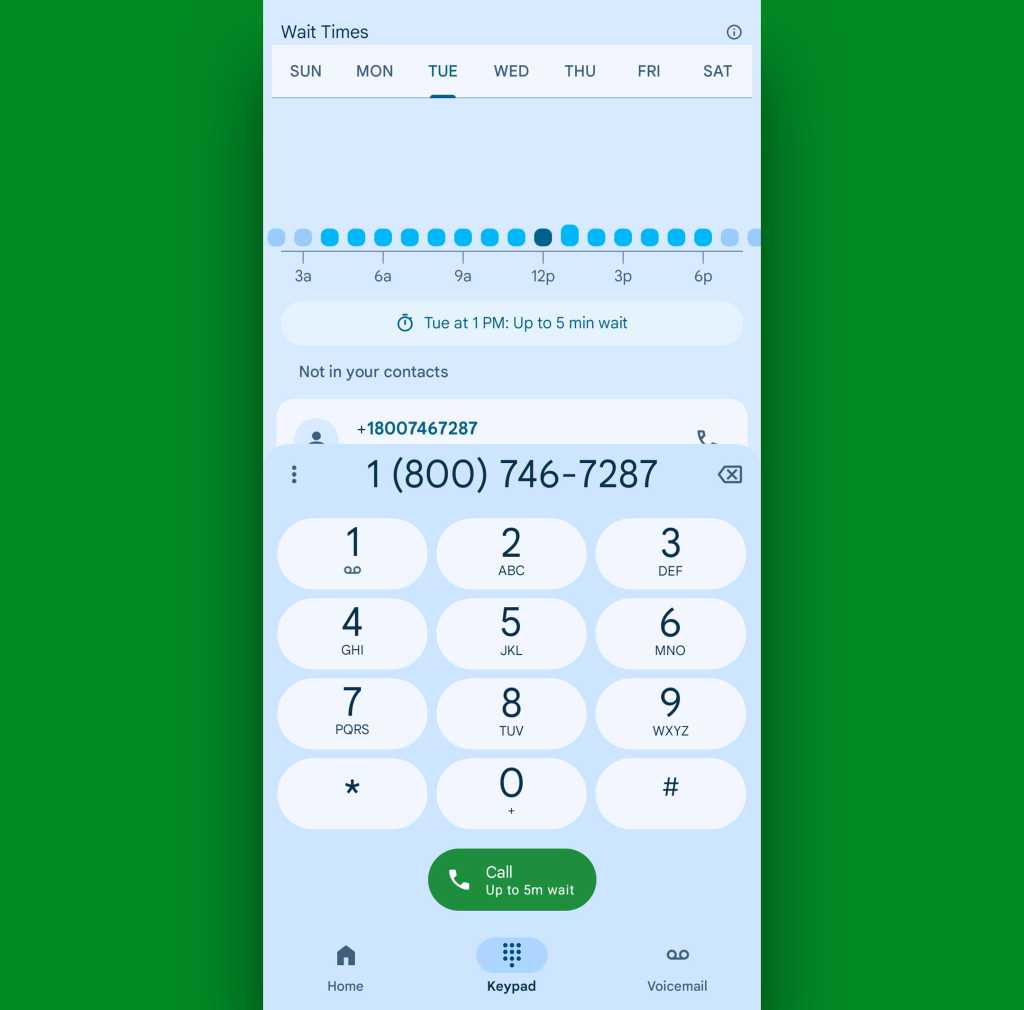
In what may be the most hidden of all hidden Pixel calling perks, the Pixel Phone app has the incredibly cool ability to tell you how busy any given business number is likely to be before you even place the call.
This one happens automatically, whenever relevant info is available, so you mostly just need to know it exists and then keep an eye out for it when the right situation arises.
The way it works is this: When you open up your Pixel’s Phone app and start typing out a number in the dialer, your Pixel will automatically match those digits with its knowledge of typical activity for that business at different times of day and the subsequent likely time you’re bound to wait depending on when you’re calling. As soon as you finish typing in the number, that info will appear on your screen if it’s available — like so:
See exactly how long waits are expected to be with your Pixel phone’s built-in intelligence.
JR Raphael, Foundry
Now, that’s some intel I will happily accept!
What’s especially useful about this setup is that in addition to seeing the expected wait time for your call in the current moment, you can tap any other day or time to compare and see if things might be at least a little less bad at some point in the future.
Yes, please — and thank you.
Pixel calling trick #4: The menu maze skipper
Holding aside, one of the most irritating parts of calling a company is navigating your way through those blasted phone tree menus. You know the drill, right?
For store hours and information, press 1.
For directions to the nearest location, press 2.
For a test of your sanity, continue to listen to these choices.
For the sound of sea cucumbers, press 4.
For the option you actually want to select, prepare to wait through at least 14 more annoying options.
Yeaaaaaaaaah. Not a great use of anyone’s time (though, to be fair, a great way to test your ability to get angry).
Well, my Pixel-palmin’ pal, your Googley gadget’s got your back. But it’s on you to enable the associated feature and make sure it’s ready to save you from your next visit to the haunted phone tree forest.
Here’s how:
Open up that fancy Phone app of yours.
Once again, tap the three-dot or three-line menu icon and select “Settings.”
Look for the “Direct My Call” option and smack it with your favorite fingie.
Flip all the toggles on the screen that comes up into the on position. (Again, they’re usually off by default with any new or freshly reset Pixel phone.)
Flip a pancake in a griddle and then eat it with gusto.*
* Gusto-filled pancake consumption is optional but highly recommended.
This one’s available on the Pixel 3a and higher and only in the US and UK and in English, by the way. Insert the requisite grumbling on behalf of all other Pixel owners here.
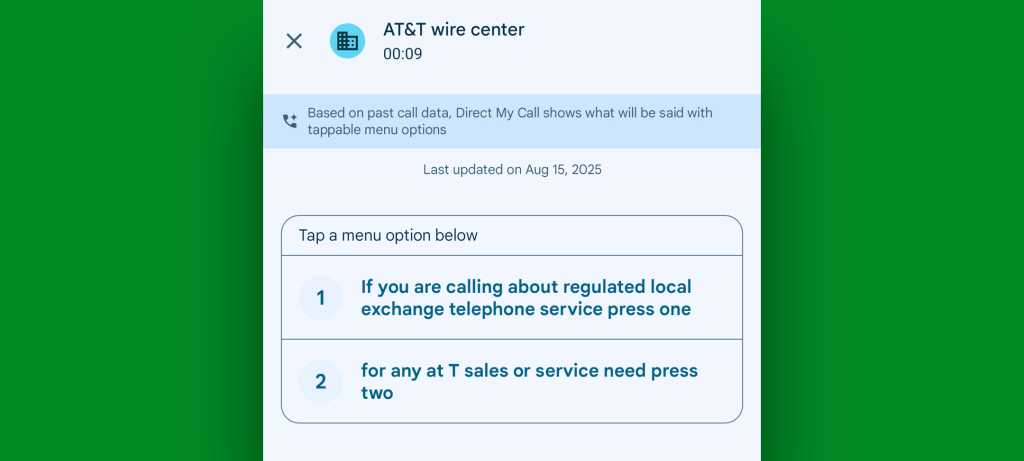
So long as you can get the option enabled, though, just look for the Direct My Call button at the top of the screen after you’ve made a call to a company that clearly hates you. Tap it, and as soon as your Pixel detects number-based menu options being provided, it’ll kick the feature in and start showing you any available options — set apart in buttons alongside a transcription of everything else the obnoxious phone system is saying to you:
Phone menus are far less obnoxious with the help of your Pixel’s Direct My Call system.
JR Raphael, Foundry
Still mildly annoying? Of course. But a noticeable step up from actually having to tune in and listen to all that gobbledegook in real-time? Holy customer service nightmare, Batman — is it ever.
Pixel calling trick #5: The complete call transcriber
Our next buried Pixel calling treasure is technically an Android accessibility feature. But while it provides some pretty obvious (and pretty incredible) benefits for folks who actually have hearing issues, it can also be useful for just about anyone in the right sort of situation.
It’s part of the Pixel’s Live Caption system, and it has a couple of interesting ways it could make your life a little easier. The system itself is available in English on the Pixel 2 and later and English, French, German, Italian, Japanese, and Spanish on the Pixel 6 series and later (tan elegante!).
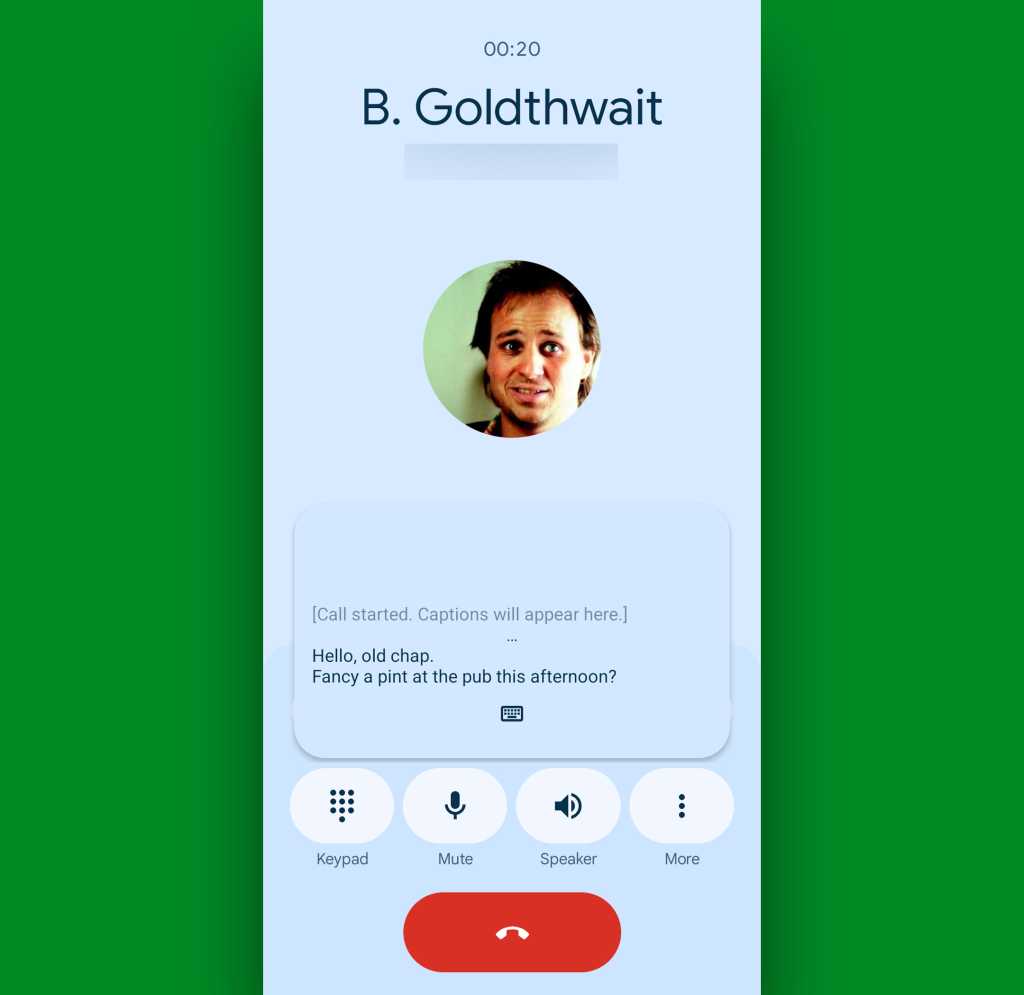
To use it, just press either of your phone’s physical volume buttons while you’re in the midst of a call — then tap the three-dot menu icon in the volume panel that pops up on your screen and select “Live Caption” from the menu that appears next. (On older Android versions, the option may show up directly in the volume control panel, as a rectangle-with-a-line-through-it icon.)
Tap that icon, confirm that you want to turn on the Live Caption for calls system, and then just wait for the magic to begin.
You can see what anyone is saying with the Pixel’s Live Caption option.
JR Raphael, Foundry
How ’bout them apples, eh? Everything the other person says will be transcribed into text and put on your screen in real-time all throughout the call.
If you’ve got the Pixel 6 or higher, you can even have your phone translate the jibber-jabber into a different language on the fly. Those more recent Pixel models can also allow you to type out responses back and then have the affable genie within your gadget read your words aloud to the other person on your behalf — a fine way to have an actual spoken conversation without making a single peep, for times when both silence and voice-based communication are required.
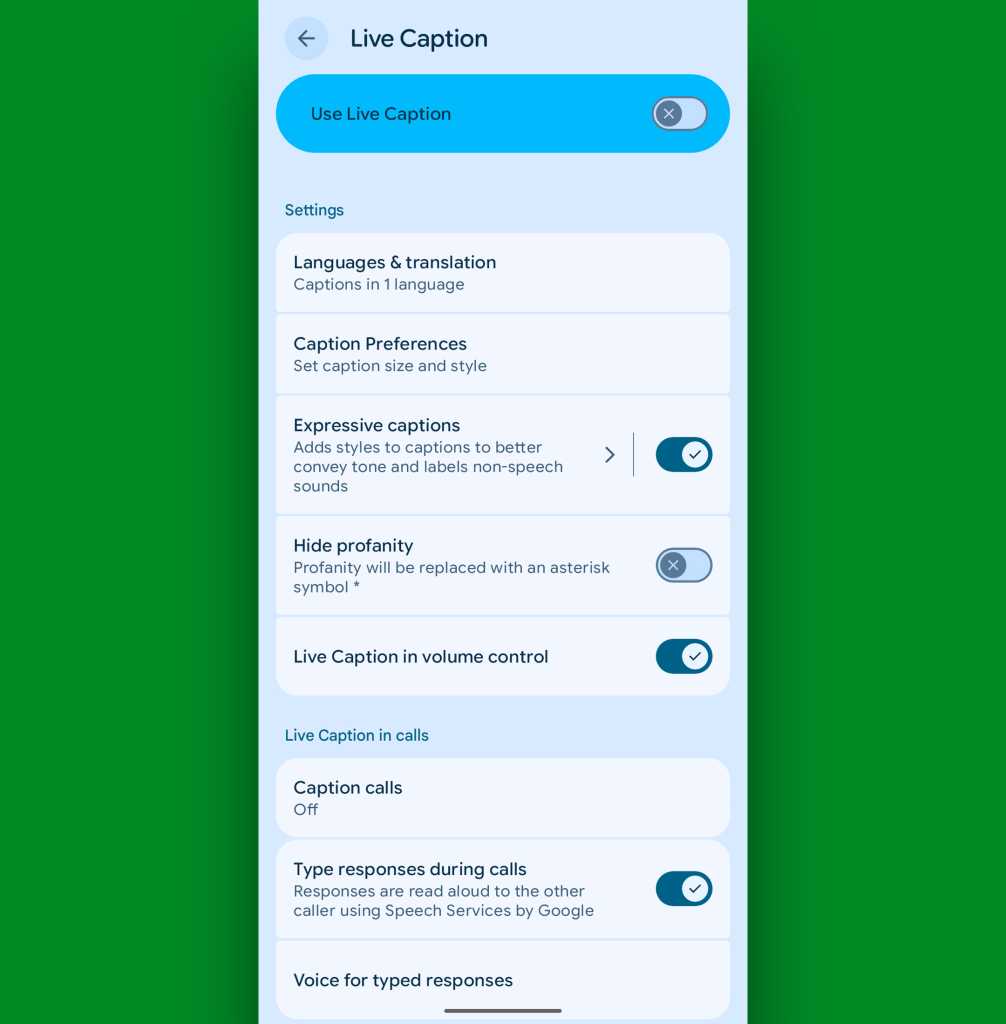
To activate that option and also configure the other Live Caption possibilities, head into the Sound & Vibration section of your system settings and tap the “Live Caption” line. There, you can enable the ability to “Type responses during calls” and also tell your Pixel to caption your calls always or never — or to prompt you every time to check.
The Pixel’s Live Captions settings hold a treasure trove of hidden helpers.
JR Raphael, Foundry
Just be sure to hit your volume button again once the call is done and turn the Live Caption system back off via that same volume-panel icon. Otherwise, the system will stay on and continue to caption stuff indefinitely (and also consume needless battery power while it’s doing it).
Pixel calling trick #6: The automatic note-taker
In addition to that real-time transcribing, more recent Pixels are able to capture complete transcriptions of calls and then summarize ’em for you so you can easily revisit ’em later (if you’re crazy enough to actually want to revisit your voice conversations, that is).
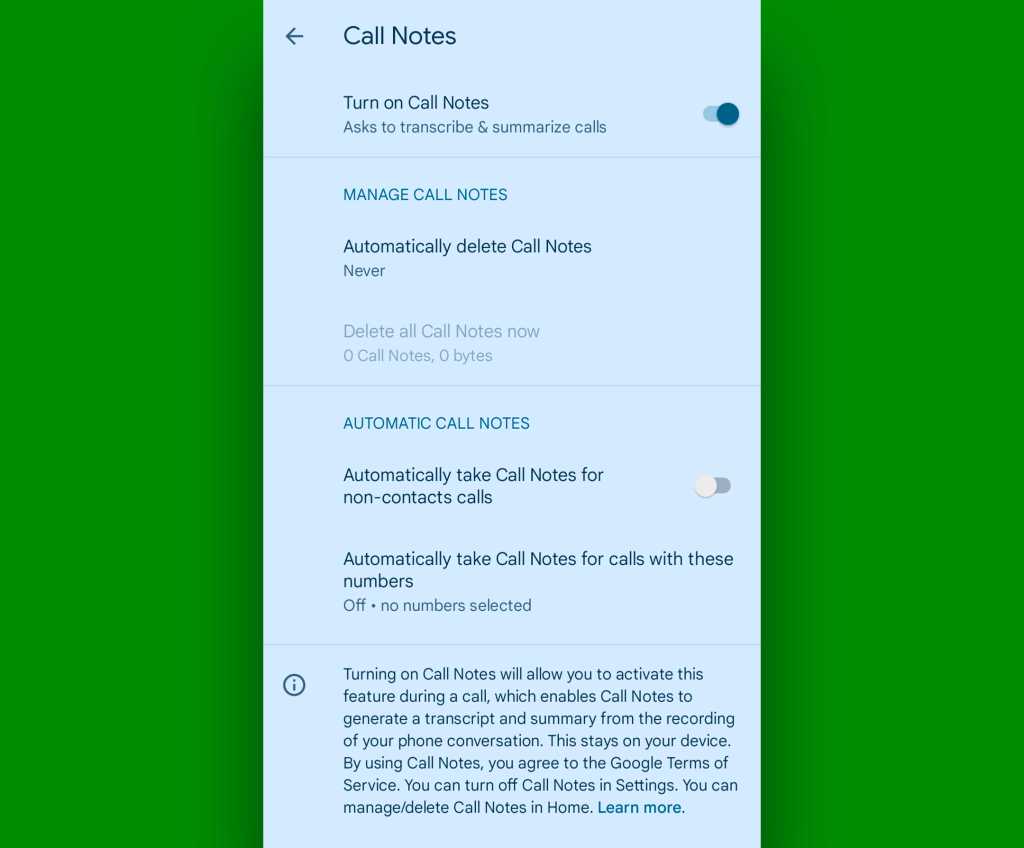
The feature’s called Call Notes, and you’ll find it as an option within the non-“a”-model Pixel 9 devices as well as the newer Pixel products.
All you’ve gotta do is activate it once and decide exactly how you want it to work.
Pixel Call Notes can happen automatically — or, if you’d rather, on demand as well.
JR Raphael, Foundry
But before a call even gets to that point…
Pixel calling trick #7: The automated screener
Perhaps my favorite tucked-away Pixel phone feature is one that brings us into the realm of incoming calls. It’s an extraordinarily sanity-saving system for screening calls as they come in to keep you from having to fritter away moments of your day talking to telemarketers, totally theoretical relatives named Ned, and anyone else you’d rather avoid.
This one’s available on all Pixel models but also only for English and in the US, as of now. The feature sort of works in a bunch of other countries, too, though without the automated element.
To set it up, head back into your Pixel’s Phone app and once again tap that three-dot menu icon followed by “Settings.” This time, find and select the line labeled “Call Screen.”
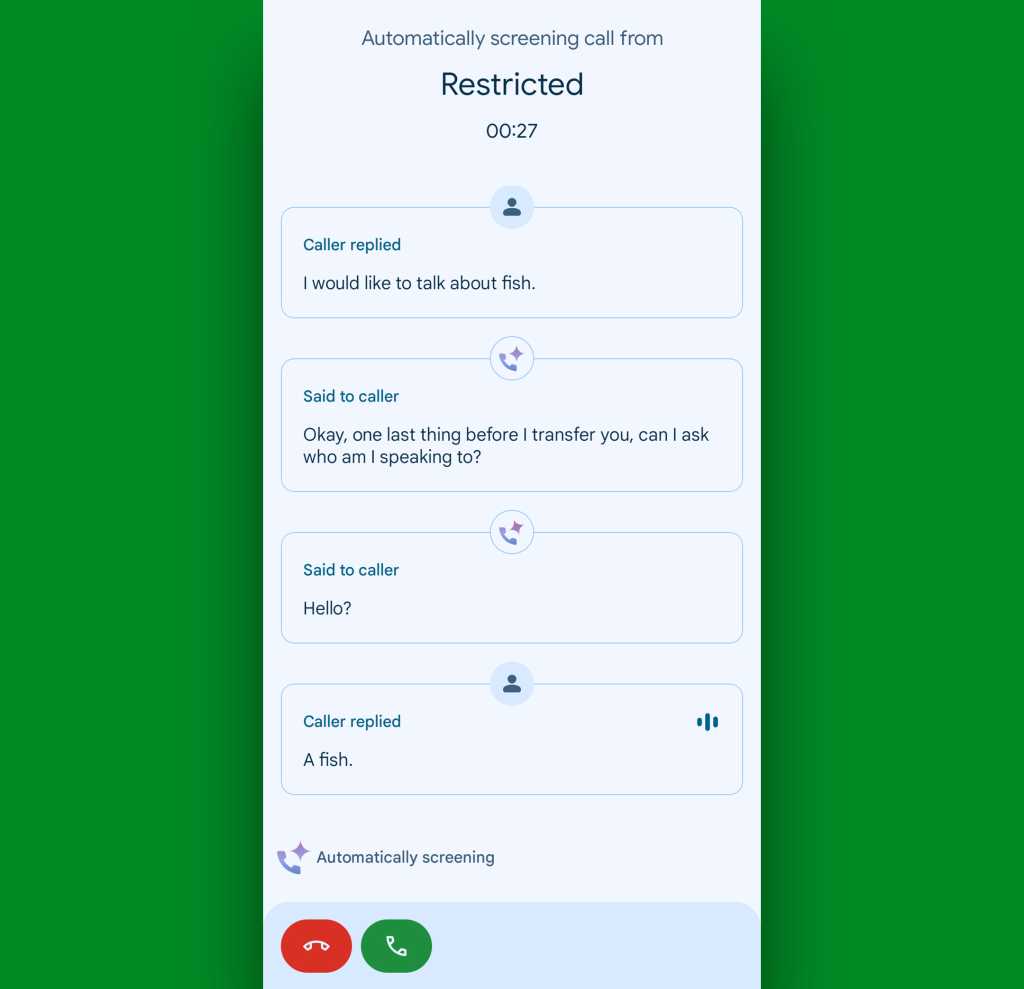
It may take the system a few minutes for your phone to activate the feature the first time you open it, but once it does, you can set up exactly how the system works and when it should kick in. The latest version of Google’s Pixel Call Screen gives you three simple paths to choose from, depending on how aggressively you want your Pixel to screen and filter calls for you:
Maximum protection automatically kicks all unknown numbers (i.e. anyone who isn’t in your Google Contacts on Android) into the screening processes and auto-declines any calls determined to be spam on your behalf
Medium protection takes things down a notch and screens only suspicious-seeming calls, while continuing to auto-decline spam
And Basic protection declines only known spam calls, without all the extra screening
Pick whichever path you prefer, and the next time a person and/or evil spirit on the other line gets sent into screening, your phone will ring while showing a transcription of their response on the screen. That way, you can see what the call’s about before deciding if you want to pick up.
Call Screen lets your Pixel screen and filter calls on your behalf.
JR Raphael, Foundry
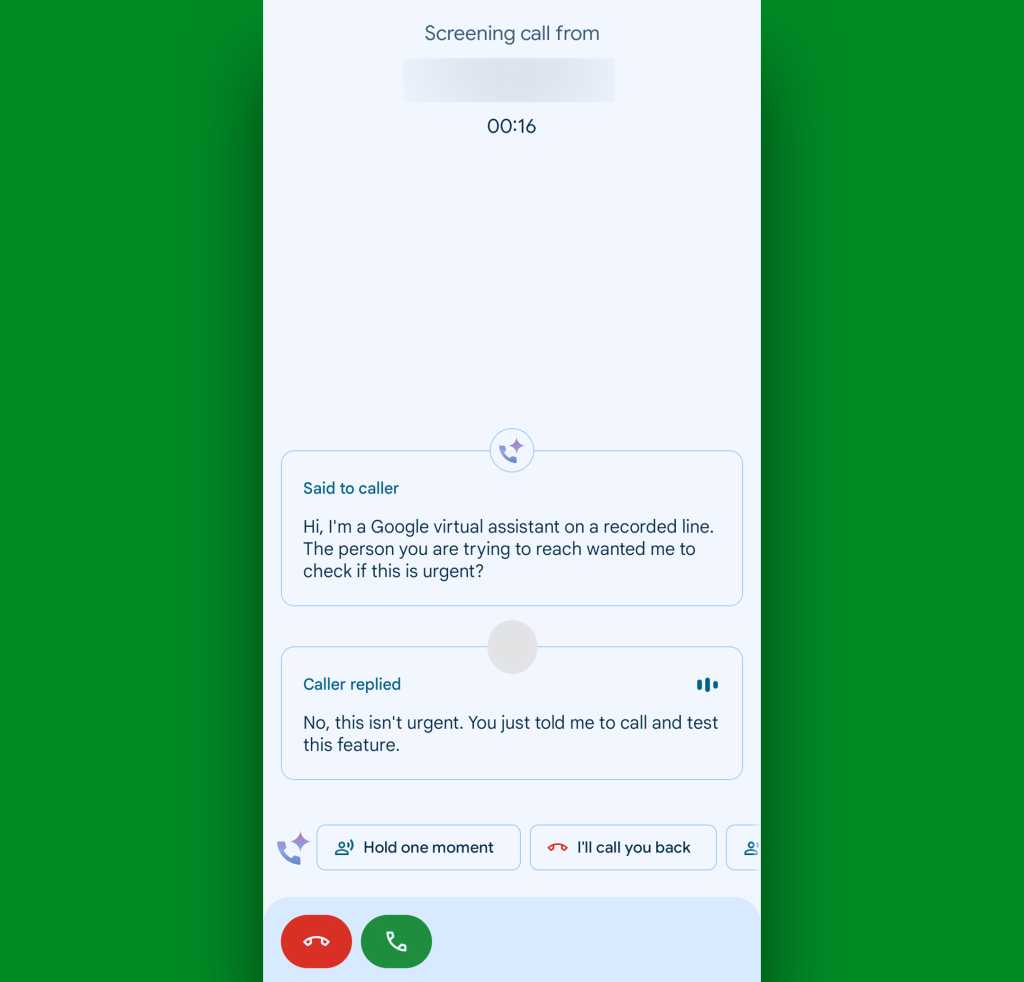
And here’s the especially cool part: Once the system is set up and activated, you can also always activate a version of it manually, too — even when a call is coming in from a known number. Just look for the “Screen call” or, on more recent devices, “Urgent?” command on the incoming call screen. Whoever’s calling will be asked what they want and/or if it’s urgent, and you’ll see their responses transcribed in real-time. You can then opt to accept or reject the call or even consider follow-up questions to get more info (and/or annoy your co-workers, friends, and family — an equally valid use for the function, if you ask me).
Call Screen can ask all sorts of questions for you before you decide to take a call.
JR Raphael, Foundry
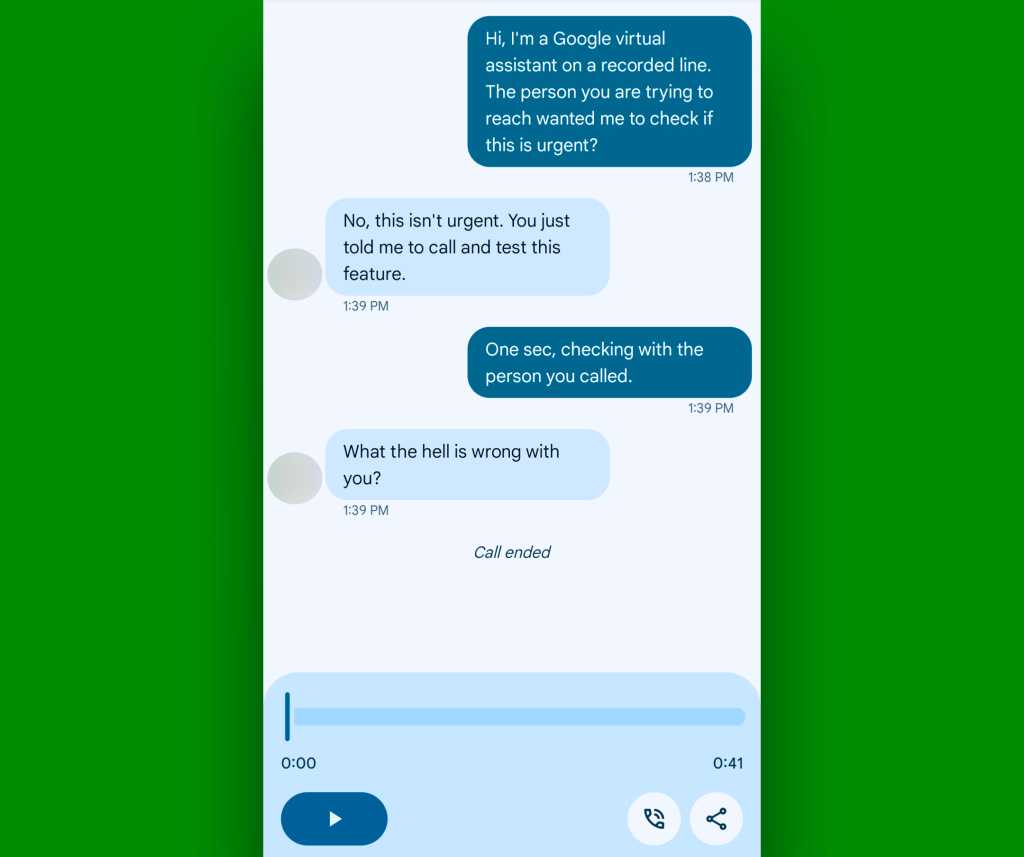
You can always find a full transcription and audio recording of those interactions in the Home tab of your Phone app, too, in case you ever want to go back and review (and perhaps publish) ’em later (hi, honey!).
Your Pixel’s Call Screen recordings and transcriptions are always available, if you ever want to revisit ’em.
JR Raphael, Foundry
Ah…efficiency.
Pixel calling trick #8: The scam spotter
When it comes to scams, detecting a devious-looking call before you pick it up isn’t always enough. But now, the Pixel extends its protection into ongoing calls with a snazzy new Scam Detection system.
It’s limited to the US for now and also only to anyone with a Pixel 9 and up — or with a Pixel 6 and higher, if you’re using the Phone app’s beta version.
If that’s you, march back to your Phone app’s settings and look for a line labeled — yup, you guessed it… — “Scam Detection.”
srcset="https://b2b-contenthub.com/wp-content/uploads/2025/08/google-pixel-phone-features-scam-detection.jpg?quality=50&strip=all 2160w, https://b2b-contenthub.com/wp-content/uploads/2025/08/google-pixel-phone-features-scam-detection.jpg?resize=300%2C183&quality=50&strip=all 300w, https://b2b-contenthub.com/wp-content/uploads/2025/08/google-pixel-phone-features-scam-detection.jpg?resize=768%2C469&quality=50&strip=all 768w, https://b2b-contenthub.com/wp-content/uploads/2025/08/google-pixel-phone-features-scam-detection.jpg?resize=1024%2C626&quality=50&strip=all 1024w, https://b2b-contenthub.com/wp-content/uploads/2025/08/google-pixel-phone-features-scam-detection.jpg?resize=1536%2C939&quality=50&strip=all 1536w, https://b2b-contenthub.com/wp-content/uploads/2025/08/google-pixel-phone-features-scam-detection.jpg?resize=2048%2C1252&quality=50&strip=all 2048w, https://b2b-contenthub.com/wp-content/uploads/2025/08/google-pixel-phone-features-scam-detection.jpg?resize=1141%2C697&quality=50&strip=all 1141w, https://b2b-contenthub.com/wp-content/uploads/2025/08/google-pixel-phone-features-scam-detection.jpg?resize=275%2C168&quality=50&strip=all 275w, https://b2b-contenthub.com/wp-content/uploads/2025/08/google-pixel-phone-features-scam-detection.jpg?resize=137%2C84&quality=50&strip=all 137w, https://b2b-contenthub.com/wp-content/uploads/2025/08/google-pixel-phone-features-scam-detection.jpg?resize=785%2C480&quality=50&strip=all 785w, https://b2b-contenthub.com/wp-content/uploads/2025/08/google-pixel-phone-features-scam-detection.jpg?resize=589%2C360&quality=50&strip=all 589w, https://b2b-contenthub.com/wp-content/uploads/2025/08/google-pixel-phone-features-scam-detection.jpg?resize=409%2C250&quality=50&strip=all 409w" width="1024" height="626" sizes="auto, (max-width: 1024px) 100vw, 1024px">Google’s new Scam Detection system is a valuable extra layer of protection to have in place.
JR Raphael, Foundry
Tap that line, then flip the toggle on the next screen into the on position. And from that point forward, if anything suspicious ever starts happening during an active call, your phone will notify you — hopefully before it’s too late.
Pixel calling trick #9: The custom calling card
As of August 2025, a new Pixel Phone app feature is in the midst of rolling out that lets you completely customize how the incoming call screen looks for specific contacts on your device — thus making it visually distinctive and easy to spot even at a glance when someone important is calling you.
It’s called Calling Cards, and it’s kinda like the iPhone’s Contact Posters feature — only without the arbitrary restriction that lets it work only with other people on the same platform.
With Google’s version, once it appears for you, you can simply mosey into the Phone app’s settings and seek out the line labeled “Calling Cards,” then go about selecting a full-screen photo background and custom font and font color for any or all of your saved contacts.
Then, whenever those people call you, you’ll instantly recognize who it is without even needing more than a passing glance.
Google’s Calling Cards feature let you completely customize the incoming call screen for any individual contact on your phone.
JR Raphael, Foundry
If you aren’t seeing it on your own Pixel yet, give it a week or two and then check back — or bump yourself up to the Phone app’s beta version if you want to increase your odds of getting the feature sooner than later.
Pixel calling trick #10: The single-tap answer
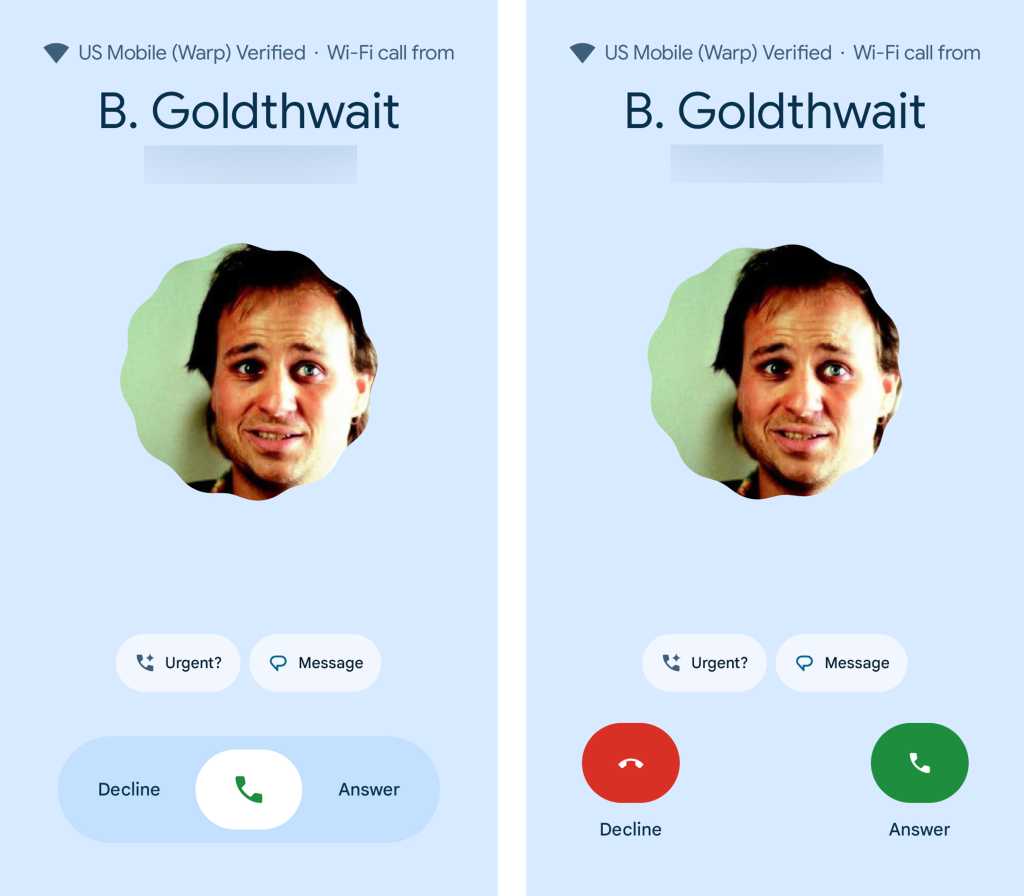
While we’re thinking about incoming calls, do you find it occasionally inconvenient to have to swipe along your phone’s screen anytime you want to answer — or maybe even reject — a call?
That’s the default Android phone-answering gesture, and it often isn’t especially easy to pull off — if, say, you’re got your hands full or maybe your hands just aren’t entirely steady.
At long last, Google’s giving us the option to switch over to a single-tap command for incoming calls, too. Just look for the newly added (and also still in the process of rolling out, as of this writing) “Incoming call gesture” option within the Pixel Phone app to switch from swiping to tapping, if you’d rather.
You’ll see the difference immediately, once you do.
The standard horizontal-swipe setup, at left, compared to the new single-tap option, at right.
JR Raphael, Foundry
Pixel calling trick #11: The out-loud call announcer
Provided you work in a place where occasional noises aren’t a problem, another interesting way to stay on top of incoming calls is to tell your Pixel phone to read caller ID info out loud to you anytime a call comes in. That way, you can know who’s calling as soon as you hear the ringtone, without even having to find your phone or glance up from your midafternoon Wordle break Very Important Work Business™.
This one’s super-simple to set up: Just gallop your way over into the Phone app, tap that three-dot or three-line menu icon and select “Settings,” then look for the “Caller ID announcement” line way down at the bottom of the screen.
Tap it, and you’ll be able to choose to have incoming call announcements made always, never, or with the lovely middle-ground option of only when you’ve got a headset connected.
Hear incoming call info out loud in whatever scenarios you want with the Pixel’s Caller ID announcement options.
JR Raphael, Foundry
And here’s an extra little bonus to go along with that: If you’ve got a Pixel 6 or higher and use English, Japanese, or German as your system language, you can even accept or reject a call solely by speaking a command out loud.
You only have to configure it once: Provided you have one of those devices, head into your Pixel’s system settings and type quick phrases into the search box at the top of the screen.
Tap “Quick phrases” in the list of results, then turn the toggle next to “Incoming calls” into the on position — and the next time a call starts a-ring-a-ring-ringin’, simply say “Answer” or “Decline” to have your Pixel do your bidding without ever lifting a single sticky finger.
Pixel calling trick #12: The polite rejecter
All right, so what if you get a call you know you want to avoid — but in an extra-polite way that prevents you from having to respond to a voicemail later? Well, fear not, for your Pixel has a fantastic feature for that very noble purpose.
The next time such a call comes in, look for the “Message” button on the incoming call screen, right next to that “Screen call”/”Urgent” command we were just going over a minute ago. (And if your Pixel’s screen was on when the call started and you’re seeing the small incoming call panel instead of the full-screen interface, press your phone’s power button once. That’ll bump you back out to the standard full-screen setup, where you’ll see the button you need.)
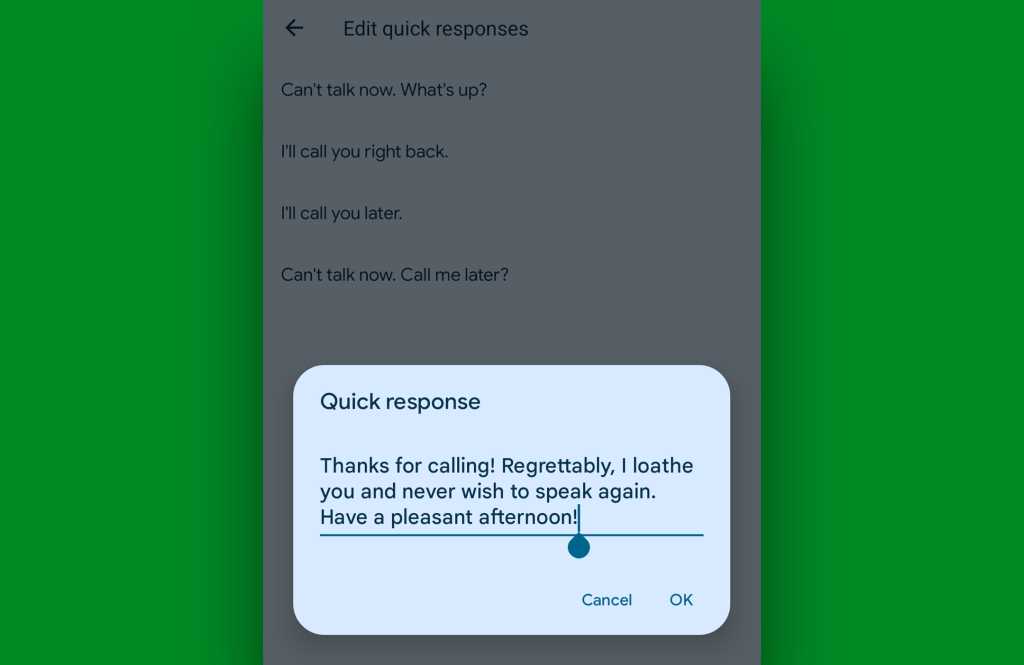
Tap that command, and how ’bout that? With one more tap, you’ll be able to decline the call while simultaneously sending the person a charming message explaining the reason for your rejection.
One-tap rejection with the Pixel’s Quick Responses system — doesn’t get much easier than that.
JR Raphael, Foundry
You can pick from a handful of prewritten texts or even opt to write your own message on the spot, if you’re feeling loquacious. You can also customize the default responses to make ’em more personalized and appropriate for your own friendly rejection needs. Just go back into the settings area of your Pixel Phone app and look in the “Quick responses” section there to get started.
You can create your own custom Quick Responses within the Pixel Phone app’s settings.
JR Raphael, Foundry
Cordial, no? And speaking of simple dismissals, we’ve got another important Pixel calling trick to consider…
Pixel calling trick #13: The simple silencer
Let’s be honest: No matter what type of pleasant-seeming ringtone you pick out on your phone — the gentle tolling of chimes, the majestic fwap! of an octopus violently flapping its limbs, or maybe even the soothing bellows of that weird guy who for some reason shouted in every single song by the B-52’s — something about the sound of a phone ringing always manages to raise one’s hackles.
Well, three things: First, on the Pixel 2 or higher, you can configure your phone to vibrate only when calls first come in — and then to slowly bring in the ring sound and increase its volume as the seconds move on. That way, the actual ringing remains as minimally annoying as possible and only begins (and also only gets loud) when it’s actually needed. To activate that option, look in the Sound & Vibration section of your system settings, tap either “Vibrate for calls” or “Vibration & haptics,” then make sure the toggle next to “Vibrate first then ring gradually” is in the on and active position.
Second, more recent Pixel models have a nifty “Adaptive alert vibration” feature that’ll intelligently turn down your device’s vibration strength anytime your phone is sitting face-up on a surface. That’s a nice way to make that buzzing a bit less bothersome when a call comes in in any such scenarios. You can find the switch for that one in the that same system settings area.
And finally, a super-simple possibility to remember: The next time your Pixel rings and you want to make it stop — whether you’re planning to answer the call or not — just press either of the phone’s physical volume buttons. It’s easy to do even with the phone in your pocket, and the second you do it, all sounds and vibrations will end. You’ll still be able to answer the call, ignore it, send a rejection message, scream obscenities at the caller with the knowledge that they’ll never hear you, or whatever feels right in that moment. But the hackle-raising sound will be silenced, and your sanity will be saved. Whew.
And last but not least…
Pixel calling trick #14: The proactiveprotector
If you know you don’t want any incoming calls interrupting you, don’t wait for a ring to react. Instead, silence your phone ahead of time.
And rather than relying solely on Android’s Do Not Disturb system (or even its more multifaceted and powerful Modes setup) to handle that chore, make it extra-easy on yourself and simply flip your phone down on its face on any surface in front of you.
That’s really all you’ve gotta do — at least, once you’ve taken the time to activate the amusingly named “Flip to Shhh” option in Google’s Android Phone app.
So one more time, scoot into those Phone app settings, scroll all the way down to the bottom of the screen, and tap the “Flip to Shhh” line. Then just flip the switch on the screen that comes up next to activate it.
From there, it’s literally a single face-down placement to silence your phone instantly — anytime, anywhere, and without any on-screen interactions. Not too shabby.
Remember: There’s lots more where this came from. Come join my completely free Pixel Academy e-course for seven full days of delightful Pixel knowledge — starting with some camera-centric smarts and moving from there to advanced image magic, next-level nuisance reducers, and oodles of other opportunities for advanced Pixel intelligence.