A new report from edge cloud platform provider Fastly reveals what it called “a striking shift in the nature of automated web traffic” with a recent analysis of traffic indicating that AI crawlers make up close to 80% of the AI bot traffic observed. Meta generated more than half, eclipsing both Google and OpenAI combined.
These results are derived from traffic analyzed between April 16 and July 15 across two of the company’s offerings, Next Gen WAF and Bot Management, and illustrate, the company said, how AI-driven automation is reshaping online traffic.
For the purpose of the report, its authors categorized AI bots into two types: Crawlers and Fetchers. Crawler bots, they wrote, “ operate similarly to search engine crawlers — they systematically scan websites to collect content for building searchable indexes or training language models. This process is a precondition to the model’s ‘training’ phase.”
Fetcher bots, on the other hand, they said, “access website content in response to user actions. For example, when a user requests up-to-date information on a specific topic, a fetcher bot retrieves the relevant page in real time. They are also used to help surface website links that match a user’s search query, directing them to the most relevant content. Crawler bots contribute nearly 80% of the total AI bot request volume, with fetcher bots making up the remaining 20%.”
‘Massive surge in AI bot traffic’
Real-time fetching by AI bots, the report states, is a greater challenge than peak crawler rate. Analysis revealed that in one case, a single crawler reached a peak of around 1,000 requests per minute.
Real-time fetching, on the other hand, is significantly more aggressive: in one instance, a fetcher bot made 39,000 requests per minute to a single website at peak load. “This traffic volume can overwhelm origin servers, strain server resources, consumer bandwidth, and cause expensive DDoS-like effects even without malicious intent,” the report noted.
Meta’s AI bots alone generate 52% of AI crawler traffic, which is more than double that of Google (23%) or OpenAI (20%).
Sectors facing the highest levels of scraping for training AI models include high-tech, commerce, and media & entertainment.
ChatGPT generates the most real-time traffic to websites, with 98% of fetcher bots requests attributable to OpenAI’s bots.
Asked what prompted the report, Matthew Mathur, senior security researcher at Fastly, said on Thursday, “we’ve seen a massive surge in AI bot traffic, raising a lot of concern across the industry. With our visibility into internet traffic, we’re in a crucial position to show how AI bots are affecting the internet — from excessive load on web infrastructure, unauthorized use of website content, to distorting analytics.”
In response to the findings, Reddy Doddipalli, technical counselor and product lead at Info-Tech Research Group, said, “with the rise of genAI models and embedded systems, the demand for large-scale data aggregation has led to a surge in crawler activity, with bots sifting through billions of web pages to feed ML algorithms.”
While there are many advantages of AI crawlers, he said, the bottom line for organizations, website owners, and users is to understand the negative implications, such as data privacy, security, ethics, intellectual property, infrastructure [and] bandwidth consumption.
Doddipalli says he recommends developing a framework and best practices to manage and mitigate crawler activity. “For example, many of these crawlers now mimic human behavior, bypassing traditional defenses and controls and requiring innovative detection techniques,” he noted, adding that thought is required to ensure AI bot behavior remains a constructive force, not a destructive element.
The findings from Fastly, said David Shipley, head of Canadian firm Beauceron Security, “[are indicative of] how the costs of AI are going to impact everyone. As web hosting providers face higher traffic from these bots, [it is] inevitable those costs are going to be passed on to website owners.”
This is happening at a time when human to website traffic is cratering, negatively impacting sites that depend on ad revenue and adding another pressure to those businesses, he said.
Website owners also face a tough choice, said Shipley, adding that on one hand, “having their blogs and information in the corpus of information used by these tools is valuable when people use tools like ChatGPT in information gathering or shopping decisions. There’s also the future potential for people to be able to use AI agents to interact with the websites and complete orders.”
Matter of time before a DDoS attack
On the other hand, he observed, the relationship “can also be parasitic, with AI racking up costs to improve its training data set and, based on data so far, not acting as a funnel like search engines used to be in sending traffic to websites for conversion for e-commerce.”
According to Shipley, “an additional risk is the danger of disintermediation — particularly if the AI hallucinates and gives people the wrong information about your website [and] business products Or worse, people intentionally poison the AI models to harm your business (and that will happen sooner or later).”
From a security perspective, it’s also likely only a matter of time before someone figures out how to include this massive AI traffic in DDoS attacks, he said.
Bot traffic, said Mathur, especially AI bot traffic, “will continue to grow, so having controls in place to mitigate this is essential. Utilizing directives in robots.txt, implementing technical controls (for example, rate limiting), or investing in a full bot management solution will help protect organizations. Having a strategy is also essential, so that when bot traffic spikes, organizations are already prepared.”
The Fastly report calls for smarter bot management strategies by organizations, but when asked whether any of them already have sound strategies in place, he said, “high profile ones seeing a revenue decline resulting from LLM’s use of their data, or public web resources experiencing performance problems from crawling, have been vocal about this problem and are working to address it.”
However, said Mathur, “there is likely a larger population of smaller sites and developers that don’t have sufficient visibility into bot traffic and don’t fully realize the costs of AI crawling, let alone have proactive strategies in place.”
A new study from AI security provider CalypsoAI reveals a “growing use and misuse of AI” within US organizations by employees at all levels, including C-suite executives.
Of note, it said, “half (50%) of executives say they’d prefer AI managers over a human, although 34% aren’t entirely sure they can tell the difference between an AI agent and a real employee. Over a third of business leaders (38%) admit they don’t know what an AI agent is — the highest of any role. Almost the same proportion (35%) of C-suite executives said they have submitted proprietary company information so AI could complete a task for them.”
Those findings and others are contained in the firm’s study, The Insider AI Threat Report, which states, “hidden reality inside today’s enterprises: employees at every level are misusing AI tools, often without guilt, hesitation, or oversight.”
For many, it is fine to break rules
The survey of more than 1,000 US workers revealed that, overall, 45% of employees say they trust AI more than their co-workers, 52% of employees would use AI to make their job easier, even if it violates company policy, and 67% of executives say they’d use AI even if it breaks the rules.
The misuse, said the Dublin-based company in the release, even extends to “highly regulated industries” and includes:
60% of respondents from the finance industry admitting to violating AI rules, with an additional one-third saying they have used AI to access restricted data.
42% of employees in the security industry knowingly using AI against policy, and 58% saying they trust AI more than they do their co-workers.
A mere 55% of workers in the healthcare industry following their organization’s AI policy, and 27% saying they “would rather report to [AI] than a human supervisor.”
Asked what prompted the study, CalypsoAI CEO Donnchadh Casey said via email on Friday, “we wanted hard data on what is happening inside enterprises with AI adoption. External threats often get the attention, but the immediate and faster-growing risk is inside the building, with employees at all levels using AI without oversight. Our customers are already telling us they are seeing this risk grow. The research confirms it.”
‘Shadow AI now the new shadow IT’
He said his initial reaction to the findings as they began to pour in, especially when it comes to C-suite leaders’ habits with AI, was that it was surprising to see how quickly the C-suite is bypassing its own rules.
Senior leaders, said Casey, “should set the standard, yet many are leading the risky behavior. In some cases, they are adopting AI tools and agents for business tasks faster than the teams responsible for securing them can respond. Our customers see the same pattern across industries, which is why this is as much a leadership challenge as it is a governance challenge.”
Justin St-Maurice, technical counselor at Info-Tech Research Group, said, “Shadow AI has become the new shadow IT. Employees are using unsanctioned tools to get real work done because AI can deliver two things they actually feel: Cognitive offload takes the drudge work off of their plates, and cognitive augmentation is helping them to think, write, and analyze faster.”
CalypsoAI’s numbers, he said, “show how strong that pull is. Their data shows that more than half of workers say they would use AI even if their organization’s policy says no, a third have already used it on sensitive documents, and almost half of surveyed security teams admitted to having pasted proprietary material into public tools. I’m not sure it’s as much about disloyalty as it is about how governance and enablement lag behind how people work today.”
The risk here is clear, added St-Maurice, because every unmonitored prompt can lead to intellectual property, corporate strategies, sensitive contracts, or customer data leaking out to the public. “And naturally,” he noted, “if IT blocks these AI services, it’ll drive users further underground to look for new ways to access them. The practical fix is through structured enablement.”
A proper strategy, he said, is to provide a sanctioned AI gateway, connect it to identity, log prompts and outputs, apply redaction for sensitive fields, and publish a few clear and plain rules that people can remember. This should be paired with short, role-based training and a catalog of approved models and use cases. This gives employees a safe path to the same gains.
Casey agreed, noting that any solution geared toward correcting the problem of unauthorized AI use must address both people and technology.
“Many enterprises’ initial reaction is to block AI entirely, but this is counterproductive, as employees often circumvent rules to capture AI productivity gains,” he said. “A better approach is to give access to AI across the organization, but monitor and control this access to step in when behavior deviates from policy.”
This, he said, means organizations should have clear, enforceable policies paired with real-time controls that secure AI activity wherever it happens, which includes oversight of AI agents used for business tasks that can operate at scale and touch sensitive data.
“By securing AI where it is deployed and doing real work, enterprises can allow its use without losing visibility or control,” he said.
The survey was conducted in June by research firm Censuswide, who surveyed 1,002 full-time office workers in the US, aged 25-65.
Microsoft’s August Patch Tuesday release offers a rather complex set of updates, with 111 fixes affecting Windows, Office, SQL Server and Exchange Server — and several “Patch Now” recommendations.
Publicly disclosed vulnerabilities in Windows Kerberos (CVE-2025-53779) and Microsoft SQL Server (CVE-2025-49719) require immediate attention. In addition, a CISA directive about a severe Microsoft Exchange vulnerability (CVE-2025-53786) also requires immediate attention for government systems. And Office is on the “Patch Now” update calendar due to a “preview pane” vulnerability (CVE-2025-53740).
Thankfully, Microsoft’s browsers and development platform (Visual Studio) can be added to a standard release cadence.
Microsoft SharePoint Server: After you install this update, you might experience an issue when you configure calendar overlay settings. For more information, see “Invalid EWS URL: ” error in Overlay settings in CalendarService.ashx (KB5064829). (No, that’s not a typo, but the real title of this Microsoft Knowledge Base (KB) article.)
Major revisions and mitigations
There are more than the usual number of updates and changes to existing patches, recommendations and remediations this month. We distilled this long list to just the changes that require developer/administrator attention as opposed to more informational or documentation changes:
CVE-2025-53786: Microsoft Exchange Server Hybrid Deployment Elevation of Privilege Vulnerability. Microsoft released new information on an Elevation of Privilege (EoP) vulnerability that was not addressed by recent security changes as documented in the April 18 Exchange Team blog post.
CVE-2022-41089: .NET Framework Remote Code Execution Vulnerability. Microsoft had published a number of technical workarounds for this vulnerability in .NET. Please note that if you used any workaround or mitigations for this issue, they are no longer needed; Microsoft recommends you remove them. To do so, see the instructions in the “Alternative Workaround” section of KB5022083.
CVE-2024-29187: GitHub: CVE-2024-29187 WiX Burn-based bundles are vulnerable to binary hijack when run as SYSTEM. Microsoft added Windows version 1607 to the affected system table, so we added this to our updated CVE list (recognizing that 1607 is a very old build). But the packages generated on this legacy build are still in circulation.
Windows lifecycle and enforcement updates
The company didn’t publish any enforcement updates, but the following Microsoft products are nearing their end of service life cycles:
Support for Windows Server 2008 will end in January 2026.
Windows Server 2008 Premium Assurance will end on Jan. 13, 2026.
Though no surprise to some, Microsoft will remove PowerShell 2.0 from Windows starting this month, eight years after announcing its deprecation and keeping it around as an optional feature.
As always, the Readiness team analyzed Microsoft’s latest updates and provides technically sound, actionable testing plans. August’s release brings updates to core Windows components, with significant changes affecting printing subsystems and remote desktop authentication. Two components have been designated as high-risk and warrant immediate attention: the Printing Subsystem and Remote Desktop Authentication components.
For this testing guide, we grouped Microsoft’s updates by Windows feature and accompanied each section with prescriptive test actions and rationales to help prioritize enterprise validation efforts.
Core OS and printing
Microsoft updated core kernel components affecting Windows as a whole, including kernel and system drivers. The printing subsystem update carries high risk necessitating immediate validation. These low-level system changes can affect system stability and printing functionality across the enterprise. We recommend the following testing approach:
Apply the security updates and reboot the system.
Test various print scenarios, including printing from 32-bit applications.
Run scenarios to test that Win32 applications properly render text content.
Use Kernel Transaction Manager to create, roll back, migrate, and dispatch transactions.
Test transaction NTFS scenarios.
Remote Desktop and network connectivity
This month’s updates significantly affect remote desktop authentication and network connectivity components. The updates to Microsoft Active Directory authentication are marked as high-risk and affect both Azure AD and traditional Active Directory authentication scenarios. Low-level network socket functionality has also been updated. We recommend testing of the following areas:
Authentication scenarios for AD/AAD-joined devices
Test RDP logins using Azure AD token (interactive login), NTLM credentials and Kerberos.
Validate RDP login via Remote Desktop Gateway (RDGW) using AD credentials.
Ensure correct RDP session timeout and auto-reconnect behavior.
Validate credential caching and re-authentication prompts using Connect → Disconnect → Reconnect → Logoff → Login testing cycles.
Trigger and verify MFA challenges during RDP login.
Network connectivity testing
Transmit UDP packets to IPv4 and IPv6 address structures and create UDP sockets with Winsock library, bind and unbind with IP addresses.
Send and receive large packets over the network using IPv6. Test using large files.
Establish multiple concurrent TCP connections using Winsock APIs and verify clean termination.
Filesystem and storage
Updates to core filesystem components, including ntfs.sys and cldflt.sys, require validation to ensure file system operations continue to function properly. Directory querying functionality has been specifically updated and requires targeted testing:
Test directory querying related scenarios with DOS (i.e. short) file names.
Apply test scenarios where your internal or line-of-business applications access SMB servers.
Test applications that use .lnk files, specifically mentioning the TargetPath in the LNK file properties.
Media and codecs
Microsoft updated media handling components affecting video playback and image processing capabilities. These updates require validation across different media scenarios:
The team recommends prioritizing remote desktop authentication testing this month, particularly around Azure AD integration scenarios, leading onto printing subsystem validation and ensuring that your RRAS configurations continue to function. Pay special attention to the high-risk components identified in this release, as any regressions could significantly hit enterprise remote access and printing capabilities.
Each month, we break down the update cycle into product families (as defined by Microsoft) with the following basic groupings:
Browsers (Microsoft IE and Edge);
Microsoft Windows (both desktop and server);
Microsoft Office;
Microsoft SQL Server;
Microsoft Exchange;
Microsoft Developer Tools (Visual Studio and .NET);
Adobe (if you get this far).
Browsers
Microsoft released 10 updates to its browser platforms, all of them rated important. Eight of the patches are Chromium updates, with the remaining two for Microsoft Edge. All of these low-profile changes can be added to your standard release calendar.
Windows
The following Windows product areas have been updated with six critical patches, 60 rated important and one update rated as moderate:
Windows GDI+, Graphics and DirectX Kernel.
Microsoft Message Queuing (MSMQ).
Windows NTLM and Hyper-V.
Windows Kerberos.
Unfortunately, the Kerberos update (CVE-2025-53779) has been publicly disclosed leading to a “Patch Now” recommendation.
Microsoft Office
A larger-than-usual set of updates for Microsoft Office this month includes five patches (CVE-2025-5373, CVE-2025-53733CVE-2025-53784, CVE-2025-53740, CVE-2025-53766, and CVE-2025-53784) rated critical and 13 updates rated important. Unfortunately, CVE-2025-53740 has a preview pane vulnerability leading to a “Patch Now” recommendation for Office.
One of the primary points of focus for both testing and rapid deployment involves Microsoft Exchange Server. Five patches were released, and while all are rated as important, we believe that they should receive immediate attention. The primary factor: the latest directive from CISA detailing the active exploitation of CVE-2025-53786, which directly affects hybrid Exchange environments. It looks like government implementations are both particularly susceptible and actively targeted. Add this update to your “Patch Now” schedule.
Developer tools
Microsoft released two updates for its development platform, (CVE-2025-53772 and CVE-2025-53773) affecting Visual Studio and Microsoft’s Web Deploy tools. Add these low-profile updates to your standard release calendar.
Adobe (and third-party updates)
No updates this time from Microsoft for Adobe products. And the only third-party product updates were for Chromium — which don’t really count. So, I will use this space to apologise for having separate sections for Microsoft SQL and Exchange Server. It’s a lot for anybody. Luckily, I didn’t have to add an extra section for SharePoint server — that would be bad.
It is really strange it isn’t asked, as it seems a really appropriate question when so much coverage of what has always obviously been a put-up attack against the company has focused on the (up to 30%) “Apple Tax’”Cupertino puts on sales through the App Store. Competitors and regulators seem deaf to arguments that the only ones paying that much in commission were the larger software companies moving more than $1 million dollars in apps.
That implies government regulators weren’t much interested in the smaller companies, and only really wanted to listen to the big ones.
Tell me what you want, what you really, really want
What did those big firms want? Margins, of course. In this case, they want to be able to sell their software — which they know is highly profitable — outside of the App Store, not because they want to make it cheaper for consumers (which they won’t), but because they see Apple’s 30% margin and want to keep that bit of cash for themselves.
The problem is that once that cash is removed from App Store economics, Apple will need to recoup that money somehow, which will likely translate into higher developer fees and increased costs for developers that choose to stay in the store.
Apple’s largely progressive system, in which those with the broadest shoulders carried the load, has been rejected. So, what is a reasonable profit martin for companies to make?
Aswath Damodaran, professor of finance at the Stern School of Business at New York University, is widely regarded as the world’s leading expert on corporate financial data. He keeps a regularly updated database tracking all kinds of values, including industry specific margins. His data tells us that Apple’s 30% App Store margin is tiny in comparison to the massive profitability of the large software companies that don’t want to pay their share. In fact, the margin on Software (System and Application) sits at 72.38%.
If you want my future, forget my past
That latter figure is astonishingly high and indicates how much of your tax dollars are subsidizing software companies. (How much does your local or national government pay in software licensing costs at roughly 70% margins?) It certainly helps Microsoft maintain its own 43.79% margin across its business — and presumably means larger software firms have been able to lavishly lobby governments and regulators to force the App Store to open up.
The only sectors higher than software are retail REITS (shopping centers, office rentals, etc) at 77.48% and Big Pharma (70.3%), closely followed by financial services (ie. the people who gave us the financial crisis) at 68.37%. Even now, tobacco is also a high-margin industry at 61.96%.
So, if tobacco, pharmaceuticals, financial services, and software can operate at those margins, who is taxing whom here? Apple, with its own overall 31.57% margin, or its competitors in the App Store space, striving to protect and grow their 70% slice of the pie?
Taking is too easy, but that’s the way it is
Well, for that 70% you get the software you need. So, what does Apple’s existing App Store model add to that? Take a look at Apple’s system and here’s a few things to get you started:
Universal distribution and global reach.
Malware and virus protection.
Developer tools and support, including verification of every developer.
Customer tools and support, including verification of every customer.
This seems to be a huge amount of value. What should the margin be on that?
Wind it all around
Apple’s take seems pretty slim in comparison to the software sector’s margins. What’s clear is that the real money here isn’t in running the App Store but in selling the software sold on the store. That store absolutely revolutionized software sales, enabling big developers to keep even more revenue from each sale by eliminating the cost of physical distribution. They did, but prices didn’t really decline; that’s how the software industry enjoys that obscenely high margin.
But Apple’s enemies want to keep it all, and will no doubt introduce their own App Stores to distribute their software free of Apple’s restrictions against fraud, malware, privacy erosion. They will not emulate everything that made the App Store great because they don’t need to; and they will have their own take on the ideal consumer experience. (It almost certainly won’t aim for anything as high as Apple has always delivered. (That is why people choose Apple in the first place.)
You probably won’t get privacy disclosures, probably won’t be able to purchase some essential software at the App Store, and won’t enjoy the same after-sales support as before. But none of that matters to these people.
All they want is to keep those margins as high as they possibly can without a word about just what a reasonably profit margin should be.
As I see it, these people argue for the red and for the blue — on the one hand they’ll say business is based on whatever people are happy to pay, while on the other they’ll demand government interference when they find people are happy to pay more than they want them to. In the end, it’s about the green.
Get with my friends
Because rather than continue to reinvent their own business to optimize efficiency and revenue, they want to keep things exactly the same — all aided and abetted by our current crop of imagination-free governments, shoring up anemic economies by charging you more for less than you already have. Or, to paraphrase Charlie Munger in All the President’s Men, “Show me the compensation model and I’ll show you the outcome.”
It’s really not the Apple Tax you should be fighting — it’s the prioritization of profit over customer experience that matters. And customers aren’t winning.
Nvidia has floated the idea of “Graphics 3.0” with the hope of making AI-generated graphics central to physical productivity, especially in factories and warehouses.
The concept revolves around graphics generated by generative AI (genAI) tools as opposed to humans. Nvidia said AI-generated graphics could help in multiple ways, including training robots to do their jobs in the physical world or by helping AI assistants automate the creation of equipment and structures.
“We believe we are now in Graphics 3.0…being superpowered by AI,” said Ming-Yu Liu, vice president of research at Nvidia, during a keynote at SIGGRAPH 2025, the graphics conference held this week in Vancouver, BC.
Nvidia’s GPUs are widely used by text-based genAI models and virtual assistants. Beyond that, the company hopes Graphics 3.0 will change the physical world by allowing AI to run robots, traffic signals, home appliances, autonomous cars, and equipment in offices, factories and warehouses.
Robots will “assist us in our homes, redefine how work is done in factories, warehouses, agriculture, and more,” Nvidia CEO Jensen Huang said in a short video address during an event keynote.
But creating Graphics 3.0 isn’t easy, as virtual AI differs from physical AI by relying on data used to train foundation models from the likes of OpenAI and Google. Because physical AI relies on pixels, which aren’t as readily available, Nvidia is creating synthetic data by simulating virtual worlds for applications.
“Robots don’t learn from code. They learn from experience. But real-world training is slow and expensive,” Huang said.
Nvidia has created AI models and simulation tools to create pixels that can ultimately be used to train robots, autonomous cars and other physical AI devices. “We need to invent completely new tools so that artists can conceptualize, create, and iterate orders of magnitude more quickly than they can today,” Aaron Lefohn, vice president of research at Nvidia’s real-time graphics lab, explained during the keynote.
Nvidia talked about its Cosmos AI models that will help robots take commands, sense, reason, plan, and then execute tasks in the physical world. The models can help robots bring digital intelligence into the physical world, said Sonia Fidler, vice president of research at Nvidia’s spatial intelligence lab.
“Physical AI can’t scale through real world trial and error. It’s unsafe, time consuming and expensive,” Fidler said.
For example, autonomous cars are being trained in virtual worlds because crashing cars hundreds of times to create training data is not feasible.
The company also this week announced Omniverse NuRec, which turns real-world sensor data into fully interactive simulations robots can train in or test on. It includes different tools and AI models for the construction, simulation, rendering, and enhancement of 3D digital environments.
The virtual reconstruction of worlds comes through 2D data collected from cameras and sensors. Every pixel is labeled based on a visual understanding of the sensor data.
“It is very important to stress here that visual understanding is not perfect and because of different ambiguities it’s hard to perfect,” Fidler said.
The company also announced AI material-generation tools to create more realistic graphics “complete with realistic visual details, including reflectivity and surface textures,” Lefohn said.
3D experts and engineers can “engage AI assistants using simple language to describe their requirements,” Lefohn said.
IT loves buzzwords. But it is now becoming frightfully common for analysts, vendors and even other IT specialists to take established tech phrases and assign them entirely new meanings. (And to be clear, none of these folk ever spell out that that’s what they are doing.)
Case in point: “Tech debt”. That term has meant the same thing for many years: it describes coding shortcuts (either to cut costs or to speed completion or both) that may help in the short term but will eventually catch up with you — and cost you far more money and time.
And yet, I have been hearing from various trusted sources (analysts, vendors, IT pros, etc.) an entirely new definition for tech debt. They’re using it more and more to describe the painful processes for dealing with legacy systems.
I first noticed this strange definition-hijacking when talking with a top analyst from Moor Insights & Strategy about the slow move to Windows11. When talking about “the increase in the complexity of the upgrade decision, these hidden interdependencies” — a perfectly viable point — the analyst dubbed the problem as “the great reckoning of technical debt.”
Since that interview, I’ve heard various other respected analysts and industy experts using the same definition for tech debt.
People, as someone who makes my living through the use of English words, let me say this loud and clear: Words have meaning. You can’t take a well-known phrase and just randomly assign it a new definition.
You want to talk about legacy integration headaches with on-prem data and 18 global cloud partners? Or maybe those internal programmers creating homegrown apps — and then deliberately short-cutting or entirely ignoring proper documentation? Great. Coin a new term for the concept. Don’t jam your new definition into an existing term.
It’s not just about the phrase “tech debt.” Consider Multi-Factor Authentication (MFA). That term couldn’t be simpler. It means only one thing: that you are using more than one method to authenticate users. That’s it. And yet, I recently watched a senator ask a corporate CEO who was testifying before Congress whether his firm used MFA.
When the CEO said “yes, ”the senator promptly moved on to a different line of questioning.
Wait a second! That answer tells us nothing. The senator should have followed up with something like, “Great. How many authentication methods are you using and which ones are you using?”
That would allow the senator to at least evaluate the effectiveness of those authentication methods, whether it’s robust (say, perhaps FIDO2), minimally acceptable (maybe an Authenticator app) or a gift to attackers everywhere (unencrypted SMS comes to mind).
People throw out MFA as though it means something — and others pretend they’ve been given useful information.
I have seen vendors calling their authentication mechanism “an MFA.” No. That doesn’t work. One form of authentication is not an example of “multiple forms of authentication” (unless that approach has multiple personalities).
There’s also a form of verification called Continuous Authentication (CA), which is not to be confused with Behavioral Analytics (BA), though they both have much in common. Think of BA and CA as two different security guards in a building. CA is the one in the lobby who makes sure you’re authorized to be in the building. Once you get the the greenlight, that guard’s job is mostly done.
BA is a guard making rounds on the fourth floor, ensuring you don’t try going anywhere you’re not supposed to. Think of a supply chain analyst who’s trying to access payroll records; the BA guard sounds the alarm and gets higher authorities involved.
BA is not really about authentication; it’s about making sure you don’t break bad after the lobby guard lets you in. (Yes, I’m an enthusiastic fan of Walter White.)
Another misuse of English in tech circles is the horrific “post-quantum encryption.” That term is supposed to refer to the day when true quantum systems emerge and start breaking all manner of regular cryptography.
But that would be “quantum encryption” — meaning encryption that would theoretically be able to stand up to a quantum system. Post-quantum means after quantum. That would mean that this would protect cryptography from whatever comes along to replace quantum, presumably many, many years — if not decades-from now.
Post means after. (Or it means a breakfast cereal company or a daily newspaper, but I digress.) Pay attention, people.
Karen Andersen, a technical architect at IT consulting firm World Wide Technology, argues that the worlds of consulting, analysts, and vendors would implode if they were all forced to use English words and phrases properly. (She was specifically referencing tech debt.)
“If we have to use actual meaning in word choices, the whole world is going to detonate,” Andersen said, adding, “Or should I say debt-onate?”
Rex Booth, the CISO at identify vendor SailPoint, acknowledges the loss of accuracy in language, but defends its perpetrators.
“Tech phrases that at one point provided sufficient meaning and functionality — the classic definition” can evolve, he said. “Meaning changes over time. There can be this collision between linguistics and technical culture.”
Booth is being far too forgiving.
Now, let me check my MFA for tech debt and make sure my BAs and CAs are all in order.
The AI boom has created a record-breaking wave of new billionaires and high company valuations in the past year at a rate unprecedented in history, according to CNBC.
CB Insights reports there are now 498 AI “unicorns” (private companies worth at least $1 billion) with a combined value of $2.7 trillion — and 100 of them were founded after 2023. In total, more than 1,300 AI startups have been valued at $100 million or more.
Large rounds of capital for companies like Anthropic, OpenAI, Anysphere and Safe Superintelligence have created new paper fortunes, with several founders now multi-billionaires, at least on paper.
Unlike the dotcom era, many AI companies are staying private longer, thanks to constant capital injections from venture capitalists, sovereign wealth funds and private investors. Liquidity is instead created through secondary markets, takeovers, and mergers.
Not surprisingly, the phenomenon is heavily concentrated in the San Francisco area.
Just in time to build up the late-summer Apple product refresh hype, news of a big collection of product upgrades has magically appeared as Cupertino puts the finishing touches to its iPhone keynote event invite.
To help Apple fans monitor the impact of the latest leaks on their blood oxygen levels, the company also helpfully reintroduced some support for oxygen tracking at about the same time the latest leaks appeared. The speculation follows tantalizing promises from Apple CEO Tim Cook who in early August told an all-hands Apple employee meeting that he’d “never felt so much excitement’ about the products the company has planned.
“The product pipeline, which I can’t talk about — it’s amazing, guys. It’s amazing,” Cook said. “Some of it you’ll see soon, some of it will come later, but there’s a lot to see.”
So, what’s with the latest speculation?
Chips with everything
If the code is correct, Apple is about to breathe new life into numerous products with chip upgrades to make them more powerful. It also plans to introduce brand new product families, though the schedule for many of the following products is likely to extend into 2026. There’s exciting news across Apple’s product range:
iPods: Apple’s plotting a new iPad mini with the same high-end A19 Pro chip you’ll find inside iPhone 17 Pro models. Also, as it seeks to broaden its market to guard against economic unpredictability, Apple plans a spring launch for a new low-cost iPad equipped with an A18 chip, a big upgrade from the A16 inside the current entry-level model.
Vision Pro: As expected, Apple will put an M5 chip inside the Vision Pro.
Home: Apple’s new HomePod mini will hold an updated S-series chip, while Apple TV gains an A17 Pro processor — a substantial boost beyond the current A15 Bionic chip. It will likely need this power for those sofa-based Apple Intelligence interactions. It might also need this for the smart home it plans, including a Ring-competing security camera with movement and person detection, and its first attempts at home robotics.
Mac: Not only do we now expect the first M5 Mac models and also a $599 MacBook, but the latest news claims Apple intends introducing a next-generation Studio Display 2. Code-named J427, this isn’t expected to debut until 2026. But the introduction of a new A19 Pro internal processor should make it capable of accurately handling modern and future video and audio codecs.
iPhone: In a chime of loud synchronicity, all these new product speculations come just in time to raise the temperature as Apple prepares to introduce the first of its new iPhone 17 range. They’re expected to bring more memory than ever, double the entry-level storage for a small price increase, and 8x optical zoom (on Pro models). Expect iPhone 17, iPhone 17 Air, iPhone 17 Pro, and iPhone 17 Pro Max models.
Apple Watch: Expect a third-generation Apple Watch Ultra, with a faster chip, larger display and 5G (including satellite messaging support); Apple Watch Series 11 gets a processor upgrade and the first Apple Watch SE upgrade since 2022.
AirPods and AirTags: Apple is also preparing upgrades to AirPods Pro and AirTags. The latter are expected to be more accurate and operate at longer range, while AirPods Pro 3 promise improved noise cancellation and advanced sleep and hearing health features.
Is that all there is?
This extensive collection of rumored product upgrades seems to provide a good glimpse at the next 12 months of planned introductions, but there are some things missing from the list. Apple will no doubt introduce new Macs and iPad Pro models during this time, even as it will at last introduce the contextually aware Apple Intelligence it promised us at WWDC last year.
The latter introduction will probably create opportunity for additional Apple products and services, including the company’s take on a digital health coach, integration between those health services and the company’s existing products, and the opportunity to develop additional solutions, such as health assistant robotics.
Even further out, we know Apple hopes to introduce glasses equipped with visionOS as well as its first-ever folding iPhone.
Google Sheets is a powerful spreadsheet app that you use through your web browser. It stores your spreadsheets in the cloud with Google Drive. In addition to the web app, there are Sheets mobile apps for Android and iOS.
Anyone with a Google account can use Sheets and Drive for free. They’re also part of Google Workspace, Google’s subscription-based collection of web apps that also includes Gmail, Google Docs, Google Slides, and more. Sheets works similarly for everybody, but it has a few more advanced features for Workspace subscribers.
This guide will teach you how to create or upload spreadsheets and work with them in the Sheets web app, including how to collaborate on them with co-workers.
Download and export your spreadsheet to Excel or PDF
Use the Google Sheets mobile app
Use keyboard shortcuts
Create or open a spreadsheet
To start a new spreadsheet or load one you’ve already saved in Google Drive, you’ll need to sign in to your Google or Google Workspace account. If you haven’t signed in yet, you’ll be prompted to do so when you click either link below.
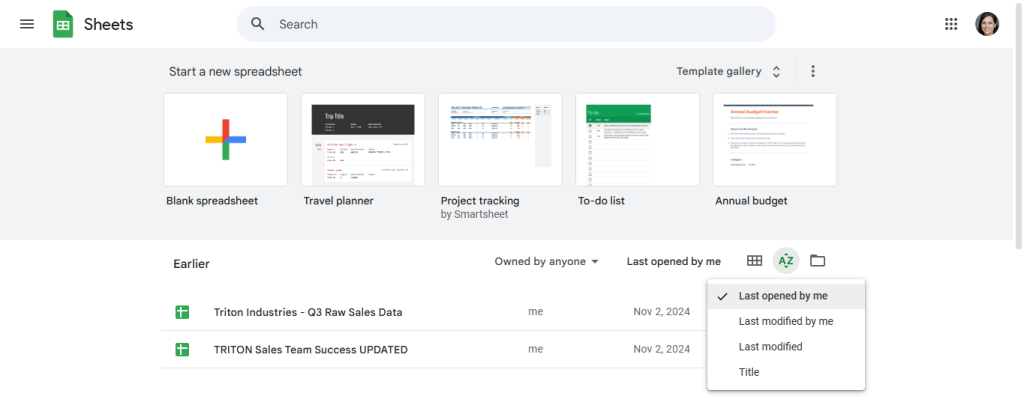
From the Google Sheets home screen: To start a new spreadsheet, click the Blank spreadsheet thumbnail or select a template to its right. To see more templates, click the Template gallery button in the upper-right corner of the screen; click any thumbnail to start a new spreadsheet in that template.
The Google Sheets home page.
Howard Wen / Foundry
From the Google Drive home screen: To start a new blank spreadsheet, click the New button at the upper-left of the screen and then click Google Sheets. If you want to select a template to start a new spreadsheet, click the New button, then move the cursor over the triangle to the right of “Google Spreadsheets” and select From a template. The Google Sheets template gallery will open.
From the web browser address bar: You can immediately launch Google Sheets and start a new blank spreadsheet in it by simply typing sheets.new in the address bar of your web browser. (This works if you’re already signed in to your Google or Google Workspace account on the browser.)
Open a spreadsheet
Spreadsheets that are already in your Google Drive storage appear on the Google Sheets and Google Drive home screens. Double-click a spreadsheet, and it will open in Google Sheets. You can use the search box at the top of either home screen to search for your spreadsheet’s file name or data that is in it.
On the Google Sheets home screen, you can also click the folder icon on the right above the spreadsheets list. This opens a simplified version of your Google Drive inside a panel.
To open a spreadsheet that someone else has shared with you via Google Drive: On the Google Drive home screen, click Shared with me in the left column, and then double-click the spreadsheet to open it in Google Sheets.
Upload a spreadsheet for editing in Google Sheets
If you have a spreadsheet on your PC that you want to edit in Google Sheets, you have to first upload it. Google Sheets supports Microsoft Excel (.xlsx), OpenDocument (.ods), and Comma Separated Values (.csv) formats.
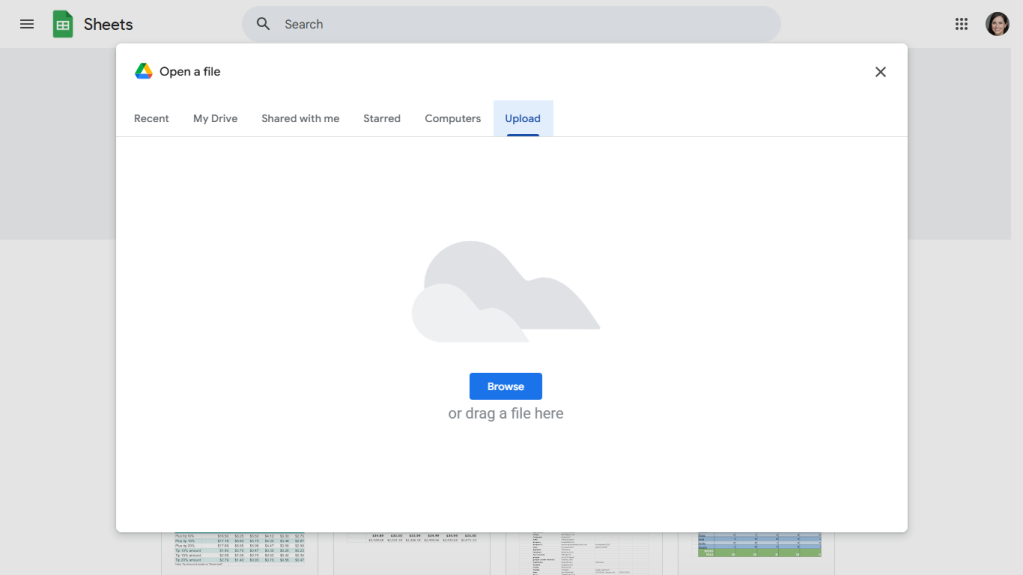
To upload via the Google Sheets home screen: Click the folder icon on the right above the spreadsheets list, then click the Upload tab on the panel that opens. You can drag-and-drop the spreadsheet onto this panel or browse your PC’s storage drive to find and select the spreadsheet. The file is saved to your Google Drive in Sheets format and opens immediately in the Sheets web app.
To upload an Excel spreadsheet, drag the file onto this panel or browse to it on your hard drive.
Howard Wen / Foundry
To upload via the Google Drive home screen: Click New > File upload and select the spreadsheet from your PC’s drive. The document retains its original formatting.
Working with Microsoft Excel spreadsheets in Sheets
Google Sheets supports the ability to edit Microsoft Excel (.xlsx) files in their native format. You can edit and collaborate on an Excel file right in Sheets, with all changes made by you or your collaborators saved directly to the Excel file.
To retain the Excel format, though, you must upload the file through Google Drive. When you upload an Excel spreadsheet document through the Google Sheets home screen, it is automatically converted to the Sheets file format.
When you upload an Excel file through the Google Drive home screen, on the other hand, it is not automatically converted to Sheets file format — so an Excel spreadsheet will retain its format and .xlsx file extension. In the documents list, Excel files are designated with an X icon instead of the usual Sheets icon.
The Microsoft Excel-formatted file (top) shows the Excel icon instead of the Google Sheets icon.
Howard Wen / Foundry
If you would prefer that Excel (and other spreadsheet format) files be automatically converted to Sheets format when you upload them via Google Drive, click the gear icon in the upper-right corner of the Google Drive home screen and select Settings from the drop-down menu. On the Settings page, scroll down to “Uploads” and check the checkbox marked Convert uploads to Google Docs editor format.
To convert Excel macros to Google Sheets: If an Excel file you’re converting to Sheets format contains VBA (Visual Basic for Applications) code, which is used for macros, and you’re subscribed to a Google Workplace Enterprise Plus plan, install the Macro Converter add-on for Google Sheets. This will do as its name implies: convert your Excel file’s VBA code to the App Script format that Google Sheets uses, so that you can execute these macros in your spreadsheet when it’s loaded into Google Sheets.
Work in a spreadsheet
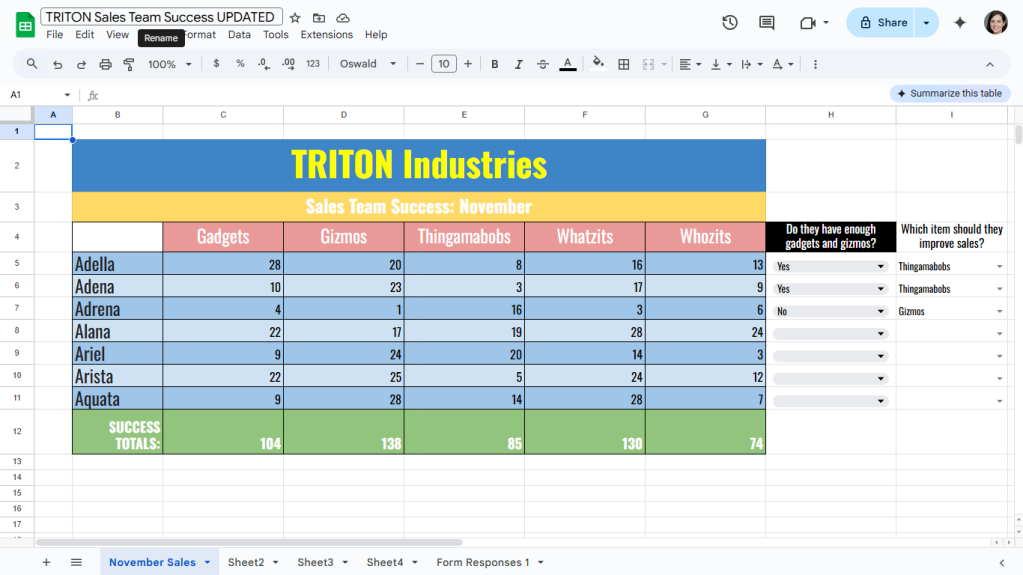
When you open a spreadsheet in Google Sheets, here’s what you see:
The Google Sheets editing interface.
Howard Wen / Foundry
Your spreadsheet’s title appears along the top left of the screen. To change it, click anywhere inside the title and start typing.
The menu bar is just below the spreadsheet’s title and includes the following drop-down menus:
File: commands for taking action on the whole spreadsheet, including Print, Rename, and Share
Edit: quick tools for deleting columns or rows
View:control how you see the spreadsheet, such as showing or hiding formulas, freezing rows or columns, and grouping together columns or rows
Insert: insert cells, columns, or rows; graphical elements such as charts and images; and other items such as functions, comments, and checkboxes
Format:the same formatting tools as in the Sheets toolbar (described below), plus commands for conditional formatting and alternating colors
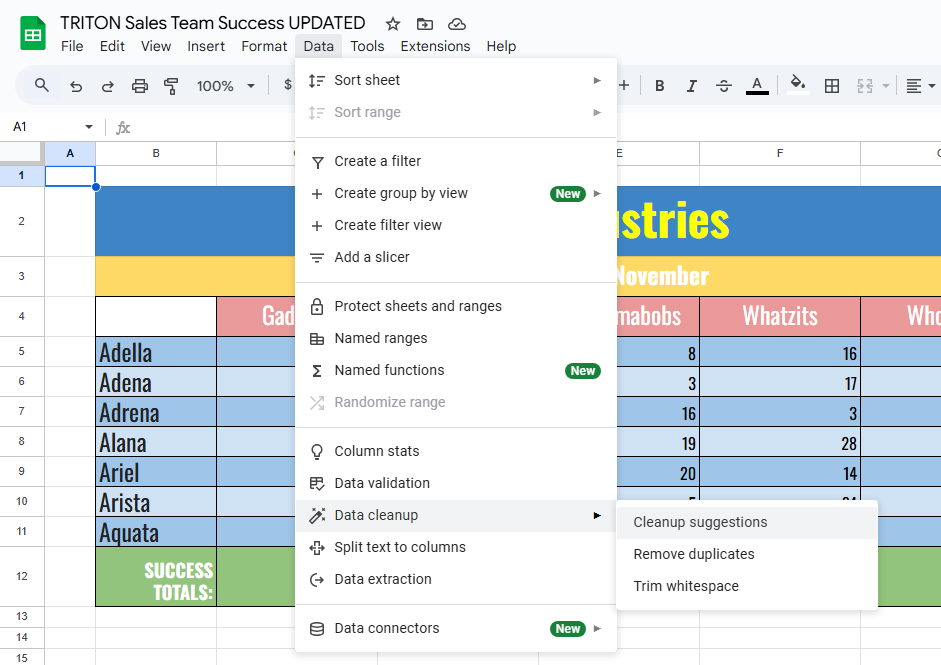
Data:tools for sorting a range of columns in alphabetical order, creating a filter, protecting sheets and ranges, and validating data
Tools:miscellaneous items such as creating a form and running spell-check
Extensions:work with add-ons, macros, scripts, and apps
Help: search for commands or get help for specific tasks
The Data menu includes tools for sorting, filtering, validating, and cleaning up data.
Howard Wen / Foundry
The toolbar is directly above your spreadsheet and has buttons for formatting the numbers and text in a cell. These include changing its number format (e.g., currency, date, percent) and font (type, size, style, color). Other buttons on the toolbar let you change the background color of a cell, merge cells, and adjust the horizontal or vertical alignment of numbers or text in a cell.
Note that there is no Save command; Sheets automatically saves any changes as soon as you make them.
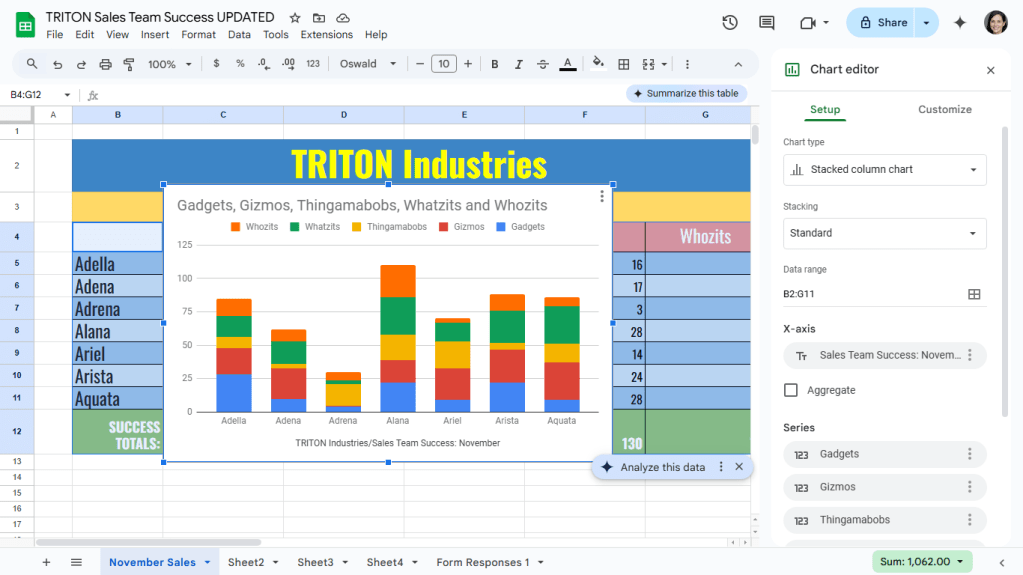
To insert a chart: Click the Insert chart button (a square with vertical lines in it, like a column chart) toward the right end of the toolbar. (You might have to click the vertical three-dot icon to see it.) This opens a panel along the right from which you can select a preset chart or click the Customize tab to create your own chart.
Inserting a chart in Google Sheets.
Howard Wen / Foundry
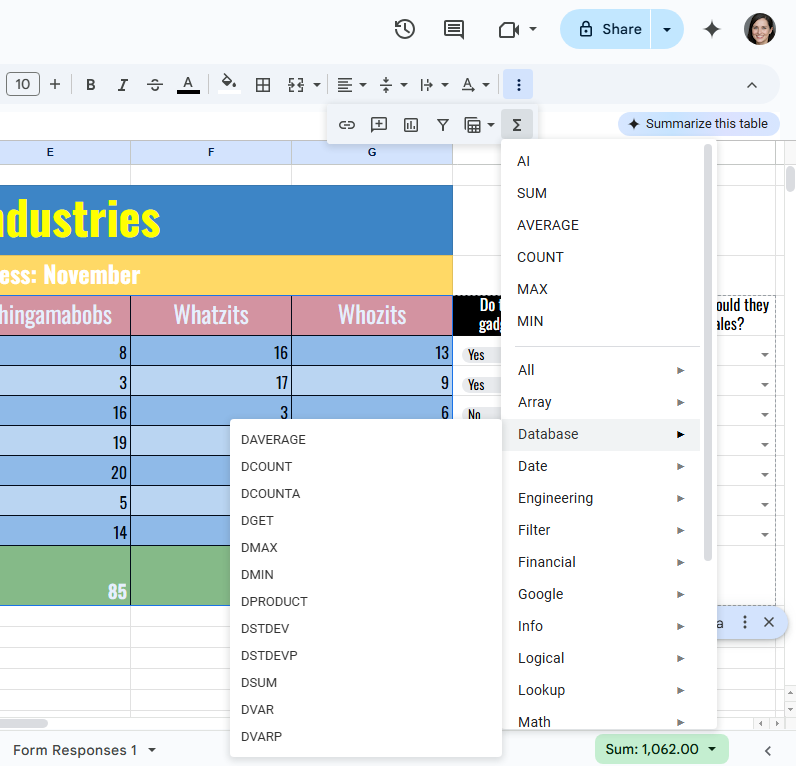
To insert a formula: Click the Functions button (a Greek sigma) at the very end of the toolbar. (You might have to click the vertical three-dot icon to see it.) This opens a drop-down menu of formulas (a.k.a. functions) that Google Sheets supports.
Click through the categories to find the formula you want. Once you find it, click the formula to insert it inside the cell where you’ve set the cursor.
Inserting a formula in Google Sheets.
Howard Wen / Foundry
For a complete list of formulas/functions that work in Google Sheets, see the official Google Sheets functions list.
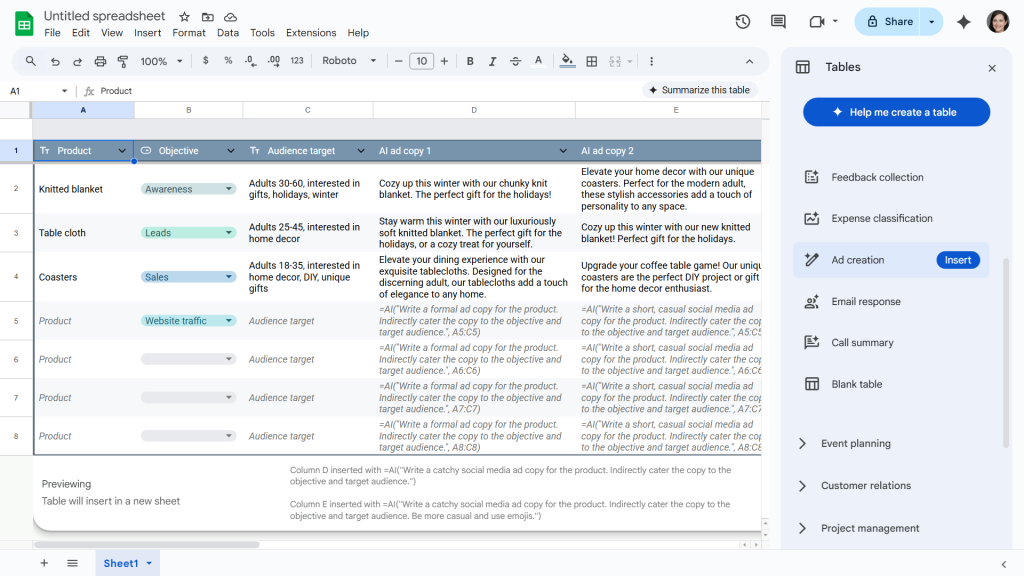
To insert a table: When you start a new, blank spreadsheet, a Tables panel may open along the right. (For some users, it doesn’t appear automatically; it seems to depend on the type of Google account you’re signed into.) If the panel doesn’t automatically appear on a new spreadsheet or if you open an existing spreadsheet, you can open the Tables panel by selecting Insert > Pre-built tables from the top menu bar.
On this panel, you can browse through a wide selection of table templates designed for specific purposes, such as “Event tasks,” “Customer contacts,” and “Inventory tracker.” A few featured tables appear at the top of the panel, with the rest organized under categories such as “Event planning,” “Project management,” “Travel planner,” and “Team planner.” There’s also a “Blank table” option you can choose if you want to start from scratch.
You can choose from dozens of pre-built table templates, then fill in your own data.
Howard Wen / Foundry
When you select a table template, it’s inserted onto your spreadsheet. You can then customize it to your needs — filling in cell data, changing column headers, resizing it, and so on.
If you have access to Google’s AI assistant Gemini in Sheets, some of the templates include AI elements, such AI-generated ad copy in the “Ad creation” table template. Gemini users also see a prominent “Help me create a table” button in the Tables panel. If you click it, it opens the Gemini sidebar described below.
Use Gemini AI in your spreadsheet
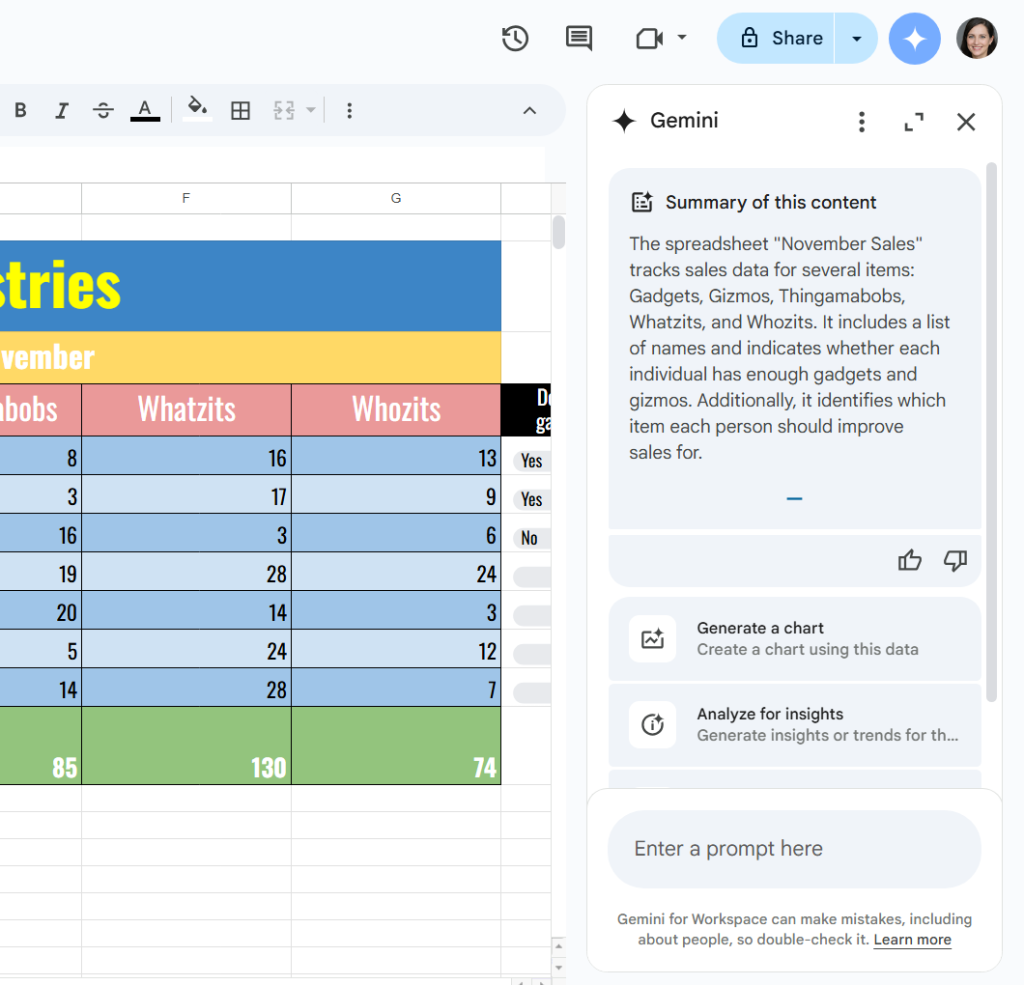
If you have Gemini access as described at the beginning of this guide, Google’s AI can help you create and analyze data in your spreadsheet. Click the nova star icon at the upper-right corner (next to your Google account profile headshot) to open the Gemini sidebar along the right.
At the top of this panel, Gemini may generate a summary describing the data in the spreadsheet that’s open in the main window. You’ll also see suggested prompts you can select, such as creating a table for a specific purpose or analyzing the spreadsheet’s data to identify trends.
Gemini can summarize a spreadsheet, analyze its data, or create items like charts or formulas.
Howard Wen / Foundry
Note: If you’re using Google Sheets under a plan that doesn’t include Gemini, clicking the nova star will open the Gemini panel showing you an ad for Gemini and a button you can click to start a trial.
Or you can type your own prompt inside the entry box at the bottom of the panel. You can instruct Gemini to do a variety of things, such as creating formulas, tables, or pivot tables; generating charts or other informational graphics; or doing other tasks like applying conditional formatting. Gemini continuously analyzes your spreadsheet so that it can help you create these and other items.
You can also try asking Gemini questions about the data in your spreadsheet. For example: You have a spreadsheet that lists sales figures (denoted as “price” on your spreadsheet) made by a specific person (“Mary”). When you type “What’s the sum of price by Mary?” Gemini should show you the total in sales that Mary made.
Note: When you prompt Gemini to show you charts or generate formulas, it may not always do so, but it may try to guide you through the process by offering suggestions on how to best work with your data.
You can insert a chart or formula generated by Gemini into your spreadsheet by clicking Insert below the item in the sidebar.
Each page of your spreadsheet is represented as a tab along the bottom of the screen. Clicking one of these tabs shows you its corresponding sheet on the screen.
To add a new, blank sheet to your spreadsheet: Click the “+” at the lower-left corner.
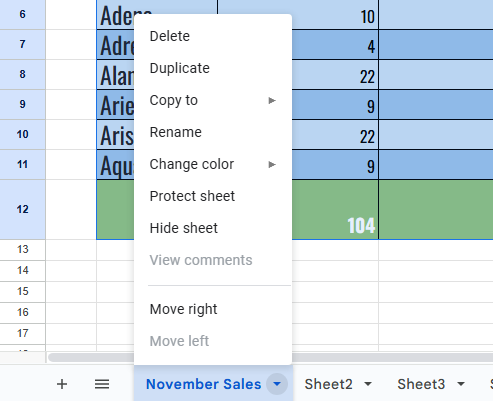
To delete or rename a sheet: Click the triangle on the sheet’s tab. From the menu that opens, select Delete or Rename.
To change the order of your sheets: Click-and-hold a sheet’s tab, then drag it left or right to another spot in the row of tabs, and release it.
Use the tab menu to delete, duplicate, copy, rename, or move a sheet.
Howard Wen / Foundry
Select a design theme for your spreadsheet
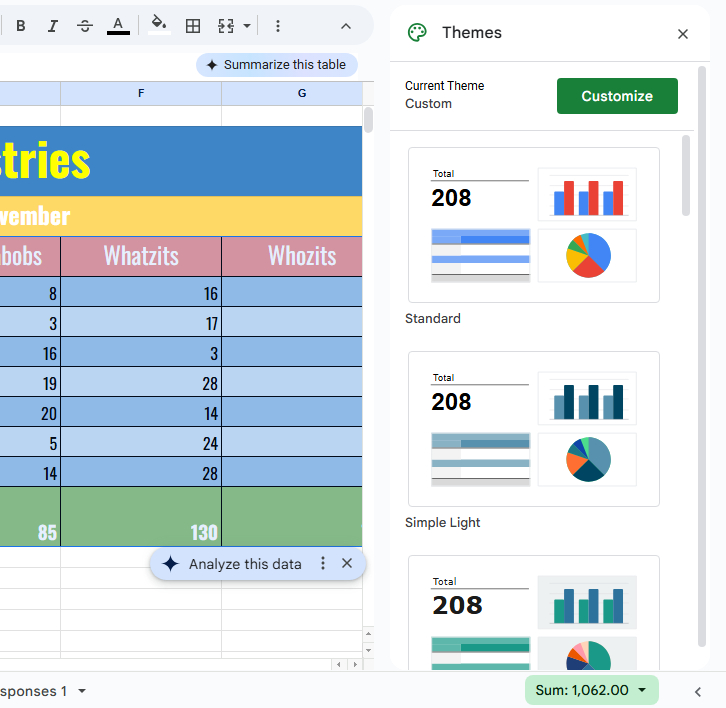
On the menu bar along the top of the screen, click Format > Theme. A panel will open along the right, showing you several large thumbnails of themes. Scroll through the list and click the thumbnail for the one that you want to use for your spreadsheet. You can apply a theme to a new blank spreadsheet or to one that already has a design.
Applying a theme to a spreadsheet.
Howard Wen / Foundry
Get assistance as you enter data
As you’re entering formulas into cells, Google Sheets may make corrections to your formula (if it thinks you’ve made a mistake) or fill in cells with suggested adjustments to your formula.
For example, if you’re entering the same formula cell-by-cell down a column, but changing the formula to correspond with the row number, Sheets may automatically insert your formula into the cells further down the column and apply what it predicts will be your succeeding adjustments to the formula.
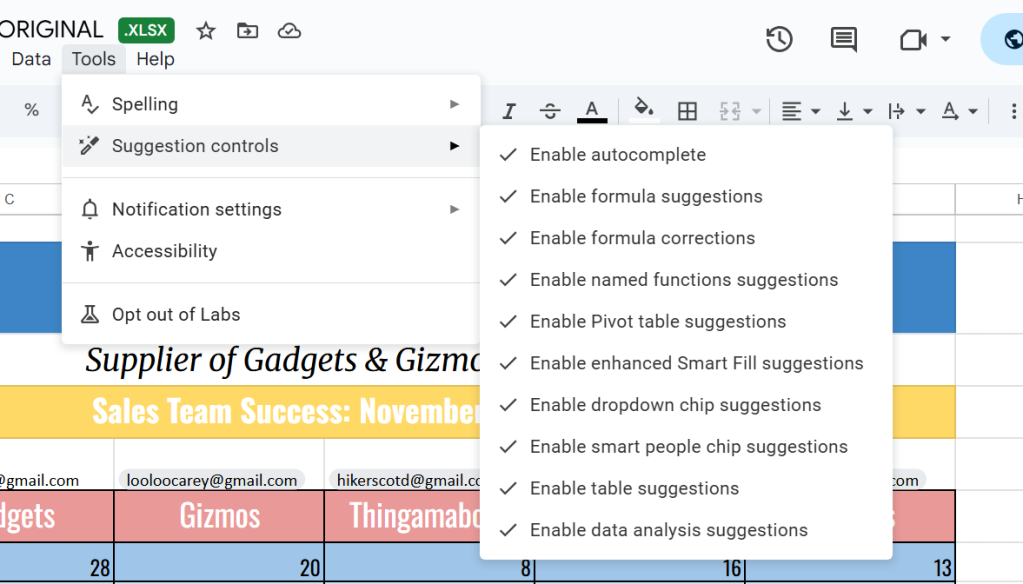
This intelligent assistance is on by default, but if you find that it gets in your way, you can turn it off: On the menu bar along the top of the screen, click Tools > Suggestion controls and deselect Enable autocomplete, Enable formula suggestions, and Enable formula corrections. On this menu, you’ll see switches for other categories, such as table and data analysis suggestions, that you can switch off.
If Sheets’ formula suggestions aren’t working for you, you can disable them.
Howard Wen / Foundry
Share your spreadsheet
Through Google Sheets or Google Drive, you can share a spreadsheet for others to view or edit.
From the Google Sheets screen where you’re editing your spreadsheet, click the light blue Share button at the upper right. Or, from the Google Drive home screen, right-click the filename of your spreadsheet and select Share > Share from the menu that opens. Either way, the Share pane opens.
Google lets you share your spreadsheet privately by inviting specific people to access it, or publicly, which means anyone with the link to it can open it. In most cases, business users will want to share their spreadsheets privately with specific colleagues. But there may be a few times when you need to share it publicly, such as when you’re seeking public comments on a spreadsheet.
Setting permissions for a file being shared privately.
Howard Wen / Foundry
Share your spreadsheet privately (only certain people can access it)
On the Share pane, type in the names or email addresses of the people you want to collaborate with on the spreadsheet. You can also type in a brief message to them.
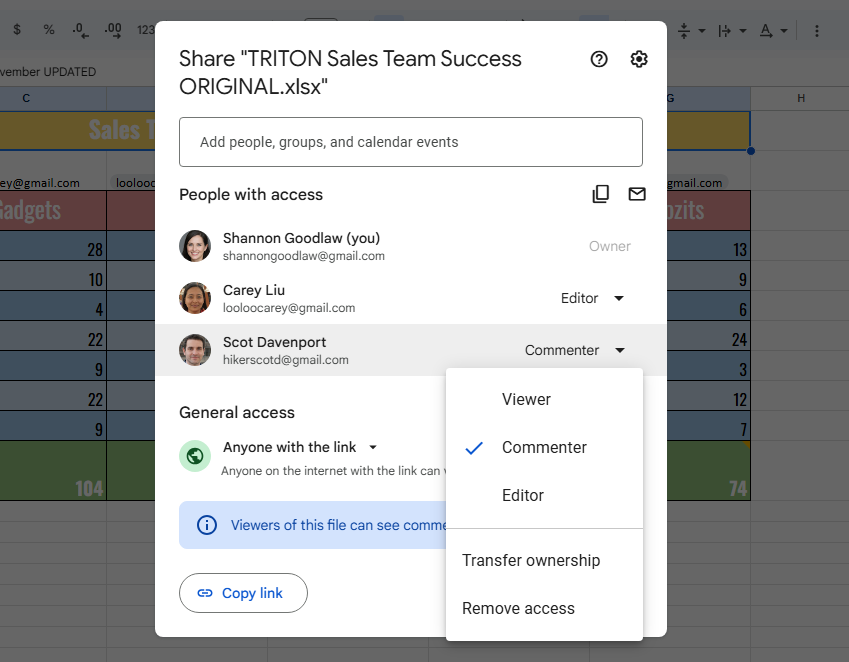
By default, every person you add is given Editor access to your spreadsheet. You can change this by clicking Editor at the right of their name and selecting Commenter or Viewer from the dropdown that opens.
Editor means they can change your spreadsheet, add comments to it, and reshare it with other people.
Commenter means they can view your spreadsheet and add comments to it, but they cannot change it.
Viewer means they can view your spreadsheet, but they cannot change it or add comments to it.
Keep in mind that this setting applies to everyone you’re currently inviting to the spreadsheet.
When you’re done, click Send. Everyone you’ve added will receive an email with a link they can click to access the spreadsheet.
Change, limit, or revoke permissions
You can change anyone’s permissions for a spreadsheet at any time by reopening the Share pane for the spreadsheet. It will list everyone who has access to the spreadsheet. Click the dropdown next to their name to change their permission level or remove their access entirely, then click Save.
You can change permissions for people you’ve shared a spreadsheet with on an individual basis.
Howard Wen / Foundry
You can also limit the overall permissions for a spreadsheet somewhat by clicking the gear icon in the upper right of the Share pane:
Uncheck the first checkbox to prevent others at the Editor level from resharing the spreadsheet or changing other collaborators’ permission level.
Uncheck the second to prevent other Editors from downloading, printing, or copying the spreadsheet. Uncheck the third to do the same for anyone with Viewer or Commenter status.
Set an expiration date
Under a Google Workspace plan, you can also cut off access to a person you’ve shared your spreadsheet with starting on a specified date.
To do this, click the down arrow to the right of a collaborator’s name on the Share pane and select Add expiration. Then, to the right of “Access expires…,” click the pencil icon and select an expiration date (and time if you want) on the pop-up calendar; it can be within one year of the current date. Click Done.
You can set an expiration date for a collaborator’s access to a spreadsheet.
Howard Wen / Foundry
Share your spreadsheet publicly (anyone can access it)
At the bottom of the Share pane is a “Copy link” button that you can click to copy the link to your spreadsheet. By default, this link is restricted to those you invite to the spreadsheet.
To change it to a public link, click Restricted and select Anyone with the link from the dropdown menu.
By default, this link has Viewer access assigned to it. To allow people to comment on or edit your spreadsheet: Click the Viewer dropdown to the right and then select Commenter or Editor.
After you’ve made your above selections, click the Copy link button. You can now paste this link to your spreadsheet into an email, direct message, or document, or post it on a public forum or social media. Remember that anyone who sees and clicks this link will be able to access your spreadsheet.
To turn off this publicly accessible link to your spreadsheet, reopen the Share pane and click Anyone with the link. From the dropdown that opens, select Restricted. Then click the Done button.
Status of your shared spreadsheets
On your Google Drive or Google Sheets home screen, spreadsheets you’re sharing privately or publicly are marked by an icon of two silhouetted heads. (If you have the home screen of Google Drive set to “Grid layout,” this icon won’t appear with the thumbnail or filename of a shared spreadsheet.)
In file listings, shared spreadsheets show a “shared” icon to the right.
Howard Wen / Foundry
Collaborate on your spreadsheet
The people you’ve shared a spreadsheet with can view or work on it at the same time as you, or at other times. Remember that people who have Editor privileges to your spreadsheet can change all aspects of it.
Having multiple people making changes to a spreadsheet can get confusing and introduce errors. In most cases, setting everyone to Commenter is the best way to collaborate in Sheets. People can attach comments to specific cells, but their comments won’t interfere with your spreadsheet’s data.
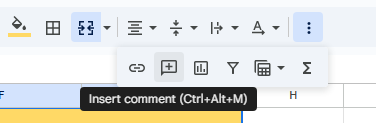
To add a comment: Click inside a cell and, on the toolbar above the spreadsheet, click the Insert comment icon (the speech balloon with a + toward the right end of the toolbar — you might have to click the vertical three-dot icon to see it).
Click this toolbar button to insert a comment.
Howard Wen / Foundry
A blank comment card with your name on it opens by the cell. On this card’s entry line, type a brief comment, and when you’re finished, click the Comment button.
To draw someone’s attention to a comment: As you’re composing the comment, type the @ symbol and begin typing their name, then select the person from the list of suggested Google contacts that appears. They’ll receive an email notifying them of the comment and linking to it.
To read and reply to a comment: A cell that contains a comment is denoted by a tiny triangle at its upper-right corner. To read it, move the pointer over the cell; the commenter’s name and their comment will appear next to it.
To reply: Click the card or cell. The card will expand to reveal an entry box where you can add a comment in response. Click Reply when you’re done. The comment card will now show the original comment and your reply to it.
To edit, delete, or resolve a comment: Move the pointer over the cell that has a comment. The comment card will open. Move the pointer over the card.
Clicking the blue checkmark marks this comment as “resolved” and removes the card from the main spreadsheet.
Clicking the three-dot icon to the right of the original first comment opens a menu that lets you edit, delete, or get a link to your comment.
Clicking the three-dot icon to the right of any reply opens a menu that lets you edit or delete the reply.
To see all comments in a spreadsheet: Click the speech balloon icon that’s toward the upper right of the Sheets window (it’s to the left of the Share button). The Comments panel will open along the right of the screen; it lists all the comment cards in your spreadsheet.
When you click a comment card on this list, the view of your spreadsheet in the main window will jump to the cell where the comment is located, and the comment card will be opened. You can reply to the comment from within the Comments panel or the comment card on the spreadsheet.
The Comments pane lets you quickly review all comments and jump to specific ones.
Howard Wen / Foundry
Resolved comments appear at the top of the Comments panel. To restore a resolved comment to the spreadsheet, move the pointer over its comment card, click the three-dot icon that appears on it, and select Re-open from the menu.
For more details about collaborating on your spreadsheet, including what it’s like to collaborate in real time, see “How to collaborate on a document” in our Google Drive guide.
Recover older versions of a spreadsheet
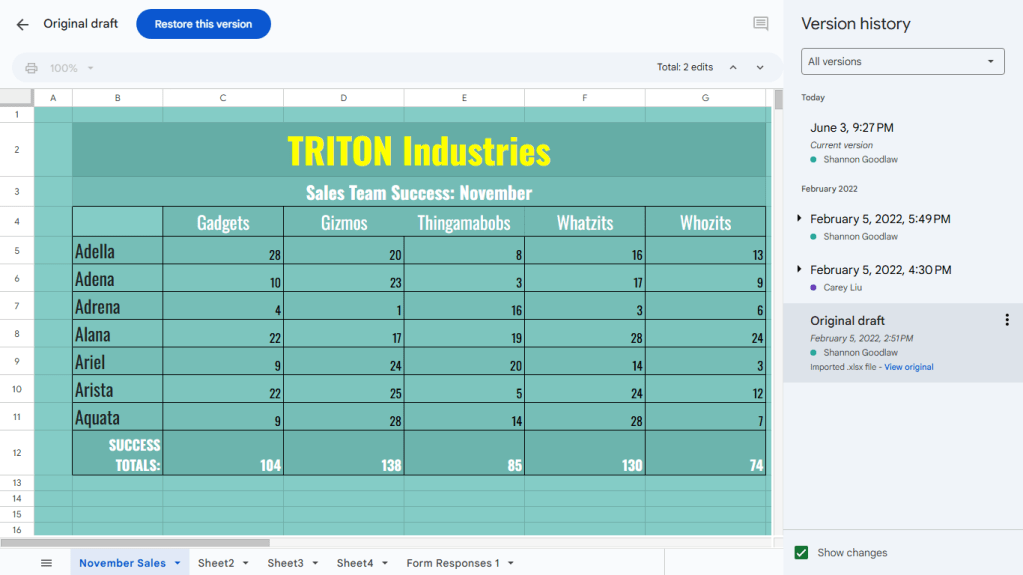
Mistakes happen, and you may want to undo changes you or others have made to a spreadsheet. To look up older versions of an open spreadsheet, click File > Version history > See version history. Or, above your spreadsheet, and toward the upper right, click the clock icon.
A panel opens on the right that shows a list of older versions of your spreadsheet, organized by date and time. To see what an earlier version of the spreadsheet looks like, click its date or version name in the list. That version will appear in the main window.
Viewing an earlier version of a spreadsheet with version history.
Howard Wen / Foundry
If you want to use this older version to replace the current version of your spreadsheet, click the blue Restore this version button at the upper-left of the screen. This restored version will then appear at the top of the version history list.
If you want to give an older version a unique name, click its date. You’ll be prompted to type in words to replace the date. The version’s date and time will then appear in smaller type underneath its new name.
Download and export your spreadsheet to Excel or PDF
You can download a spreadsheet and convert it to PDF, .xlsx (if it’s not already an Excel spreadsheet), or another format such as OpenDocument (.ods), Comma Separated Values (.csv), or Tab Separated Values (.tsv).
With the spreadsheet open, select File > Download in the top menu bar and choose a file format. The spreadsheet will be saved to your PC’s storage drive in that format.
Alternatively, you can select File > Email and then pick either Email this file or Email collaborators. This action will open a panel that lets you email your document as an attachment. PDF is the default, but you can click the PDF drop-down menu and choose Excel or Open Office Spreadsheet.
Use the Google Sheets mobile app
With the exception of the Version history tool, the Google Sheets app (available for Android, iPhone and iPad) has many of the same features described in this guide. You probably won’t want to do any heavy spreadsheet editing on a phone screen, but the mobile app is handy for making quick edits, as well as sharing and commenting on sheets.
Toolbars along the top and bottom of the screen let you add comments and new sheets to your spreadsheet. Tapping a cell brings up top and bottom toolbars. The selections on these toolbars let you add columns or rows next to the cell, or edit the formula or text inside it.
Tap the three-dot icon at the right end of the top toolbar to use the “Data validation” tool or to create named ranges, share your spreadsheet (see our Google Drive guide for instructions on sharing from the mobile app), or export it to another file format.
Save time in Sheets by using keyboard shortcuts for common tasks. Below are some of the most useful to know. For more, select Help > Keyboard shortcuts from the top menu when you have a spreadsheet open or press Ctrl + / (Windows, Chrome OS) or ⌘ + / (macOS).
Handy Google Sheets keyboard shortcuts
BASICS
Action
Chrome OS and Windows shortcut
macOS shortcut
Select column
Ctrl + Space
Control + Space
Select row
Shift + Space
Shift + Space
Select all
Ctrl + A
⌘ + A
Copy
Ctrl + C
⌘ + C
Paste
Ctrl + V
⌘ + V
Undo
Ctrl + Z
⌘ + Z
Redo
Ctrl + Y
⌘ + Y
Find
Ctrl + F
⌘ + F
Find and replace
Ctrl + H
⌘ + Shift + H
Fill down
Ctrl + D
⌘ + D
Fill right
Ctrl + R
⌘ + R
Fill range
Ctrl + Enter
⌘ + Enter
Insert comment
Ctrl + Alt + M
⌘ + Option + M
Insert rows above selection or columns to the left of selection
Apple is going with the wind, allegedly confirming plans to integrate OpenAI’s latest GPT-5 model for ChatGPT within its 26 series of operating system releases for iPhones, iPads, and Macs. Apple Intelligence already integrates with ChatGPT, but only the 4o model. Apple allegedly told 9to5Mac that it intends to integrate GPT-5 when it ships its new operating systems, potentially next month.
OpenAI introduced GPT-5 in early August. “Our smartest, fastest, and most useful model yet, with thinking built in,” the company said.
GPT-5 a ‘significant leap,’ says OpenAI
The ChatGPT maker claims its new AI system delivers a “significant leap” above previous models, featuring a deeper reasoning model for harder problems and the capacity to filter enquiries to the relevant parts of the engine. GPT-5 outperforms previous models on benchmarks and answers questions more swiftly than before, the company also said.
It also hallucinates less, the company said, and “minimizes sycophancy.” (How reassuring.) It seems particularly strong on coding skills, health, and assisting you in creative writing — with or without an em-dash! You can read more about how OpenAI thinks GPT-5 is great in the company press release. The model is available to Plus, Pro, Team, and Free users, with different usage models depending on what you pay.
Apple, of course, provides integration with ChatGPT via Apple Intelligence, which sends requests to OpenAI’s system when Apple can’t handle them alone. Within this integration, users are warned if they are about to use the third-party AI service. Apple has also built in privacy protection so if you use ChatGPT through Apple Intelligence, OpenAI shouldn’t store requests and your IP address should be obscured. If you pay for ChatGPT access, then the service’s own privacy promises apply.
Apple continues to develop its own AI
While Apple has extended support to the new ChatGPT model, it continues to invest in developing its own more targeted AI solutions.
The upcoming operating systems will also introduce Live Translation and Visual Intelligence improvements, and the company has consistently said the contextual intelligence features it promised in 2024 will arrive eventually. Apple CEO Tim Cook recently confirmed the the plan is to introduce these features next year, saying the team is “making good progress on a more personalized Siri.”
Cook’s company is also working to introduce AI solutions for specific tasks. It allegedly intends to introduce a generative AI-powered support assistant tool within the Apple Support app, and may also be preparing to exploit the vast amount of data gathered by the Apple bot for use in a new Answers engine. The latter is described as a “stripped-down” version of ChatGPT, capable of crawling the web to answer questions, and is likely to be used to support Siri, Spotlight, and Safari, as well as being a standalone app.
“We’ve rarely been first…”
One thing we do know is that Apple has no intention of giving up in the AI race. During a recent meeting, Cook stressed that Apple’s approach isn’t about being first but being best, and that the battle for dominance in the AI space isn’t over yet. Apple has time and power in the race.
“We’ve rarely been first,” he said. “There was a PC before the Mac; there was a smartphone before the iPhone; there were many tablets before the iPad; there was an MP3 player before iPod. But Apple invented the modern versions of those product categories. This is how I feel about AI.”
Cook also promised to make investments to get to where the company wants to get to. We’ve heard plenty of speculation concerning potential takeover targets. While big targets such as Perplexity are frequently mentioned, smaller AI firms such as Runway AI, Eleven Labs, and Pika AI may also prove attractive.
“We’re very open to M&A that accelerates our road map,” Cook said during Apple’s July 25 earnings call. “We basically ask ourselves whether a company can help us accelerate a road map. If they do, then we’re interested.”
The flipside is that in the event Apple does successfully acquire a company and its talent, it may also need to figure out how to keep them, given the aggressive attempts competitors are making to poach its people.