
Category: Adobe, Artificial Intelligence, Productivity Software, Vendors and Providers

Adobe opens Creative Cloud apps to third-party AI assistants

Adobe will open its Creative Cloud applications to third-party AI assistants, with the ability to edit content in Photoshop, After Effects, Illustrator, and Premiere from tools such as ChatGPT or Claude, the company announced at its Max event.

The model context protocol (MCP) integration, due in private beta in early 2027, would let third-party AI assistants to make changes to content in Creative Cloud desktop applications, without losing the ability to adjust individual elements of a design or video manually afterwards.

For example, a third-party AI assistant could remove a logo from multiple advertising campaign assets. “Make the change once, then ask your agent to cascade it across the rest of the campaign, and step in at any moment to refine the work by hand,” said Deepa Subramaniam, Adobe’s VP, product marketing for Creative Cloud, in a blog post Tuesday.

Third-party agents could also connect to other apps in a single workflow, so it would be possible to “pull in a project brief from Google Docs, work on it in Adobe’s tools and share the result with your team via Slack,” for example, Subramaniam said.

The MCP connections can help creative professionals “keep their work where they choose to work, without sacrificing the upside of modern collaborative and secure systems,” said Liz Miller, vice president and principal analyst at Constellation Research. “End users … have always relied on multiple tools to capture their taste and bring it to life. For them, these connections are another tool that opens up access to so much more of their toolkit.”

Keith Kirkpatrick, vice president of research at The Futurum Group, also anticipates demand from Adobe users to access Creative Cloud apps via third-party AI assistants, though he expects it will appeal most to a “fairly specific crowd” of “creative technologists, production teams, and power users who already spend their day in Claude or ChatGPT and want an agent to take care of the tedious stuff: organizing assets, setting up layers, building out sequences.”

“Most creative pros are still going to want their hands in the application,” he said.

Opening access to Creative Cloud apps via third-party agents could potentially loosen the direct relationship Adobe has with customers — a scenario that many software vendors are now grappling with.

For Adobe, it’s a necessary adaptation, as employees increase their use of AI assistants to get work done. “Companies are using several AI models at once, and people are starting more of their work inside these assistants,” said Kirkpatrick. “If that’s where the request starts, Adobe wants to be the one doing the work behind it.”

Gartner predicts that enterprise AI assistants will account for more of knowledge workers’ daily interaction time than any other application within the next three years, according to a recent Magic Quadrant report.

Miller said that opening its applications to third-party tools could be beneficial for Adobe’s business. “This won’t negatively impact Adobe’s place with their core creative, marketing, or business users,” she said.

“In fact, the flexibility will give their customers options in where and how to get work done. “For users who have found their flow and patterns of work in ChatGPT or Claude, [they can] stay there but still access the skills and tools you need to use to generate the quality of work expected,” Miller said.

The MCP integration in Creative Cloud is the latest part of Adobe’s strategy to embrace third-party AI assistants — Adobe has previously announced ChatGPT, Claude, and Google Gemini integrations that provide limited editing capabilities for apps such as Acrobat, Photoshop, Premiere, Express, and Lightroom, directly within the AI assistants. This contrasts with the new MCP integrations that let AI assistants make changes directly to content in Adobe’s desktop applications.

“The real question is whether any of this turns into paying Adobe customers, and Adobe hasn’t shown that yet with its existing connectors,” said Kirkpatrick. “Adobe’s edge has to be that its tools are better and that it comes with the IP and brand controls enterprises need.”

Firefly upgrades — Builder, Design, and ‘always-on’ agents

The MCP integration was one of numerous agent-related announcements at Adobe Max on Tuesday, with other updates aimed at enhancing native functionality within Creative Cloud and the Firefly AI assistant.

This includes “always-on” agents that work in the background, taking on recurring tasks for users. Users choose from pre-built agents aimed at specific workflows, then customize what actions the agent takes, set goals, and review plans before it begins. The agents ask for approval for certain decisions, learn preferences from feedback, and are managed via a central dashboard in Firefly.

“On a multi-week video project, for example, an always-on agent can organize incoming footage, remove duplicate clips, and flag camera shake or audio issues for your review,” Mike Polner, vice president of product marketing, Creators at Adobe, said in a blog post.

“For the right person, I think it’s an easy sell,” said Kirkpatrick, such as a social media manager starting their day with a batch of draft posts to review, though it may be less appealing to creative professionals responsible for generating broader ideas.

For some end users, the always-on agents can be “an additional set of hands to drive efficiency,” said Miller, while “others will see this as a force multiplier, allowing them to expand their business flow … while the assistant handles the sorting and cleaning.”

Customers who use the always-on agent should ensure there are sufficient guardrails in place, said Kirkpatrick.

“Before activating an always-on agent, I’d want to know exactly what it can touch, and I’d make sure it drafts but never publishes on its own. Everything it makes should get a brand check,” he said.

He cited Adobe’s own survey of marketing and creative professionals that showed that around a believe that public-facing content is “off-brand.” “An agent working around the clock can make that a lot worse if nobody’s paying attention,” said Kirkpatrick.

Managing costs of an always-on agent with budget controls is another consideration, he said. Adobe hasn’t disclosed full pricing information at this stage. Always-on agents, launching in beta in early 2027, will initially be available for Adobe Firefly.

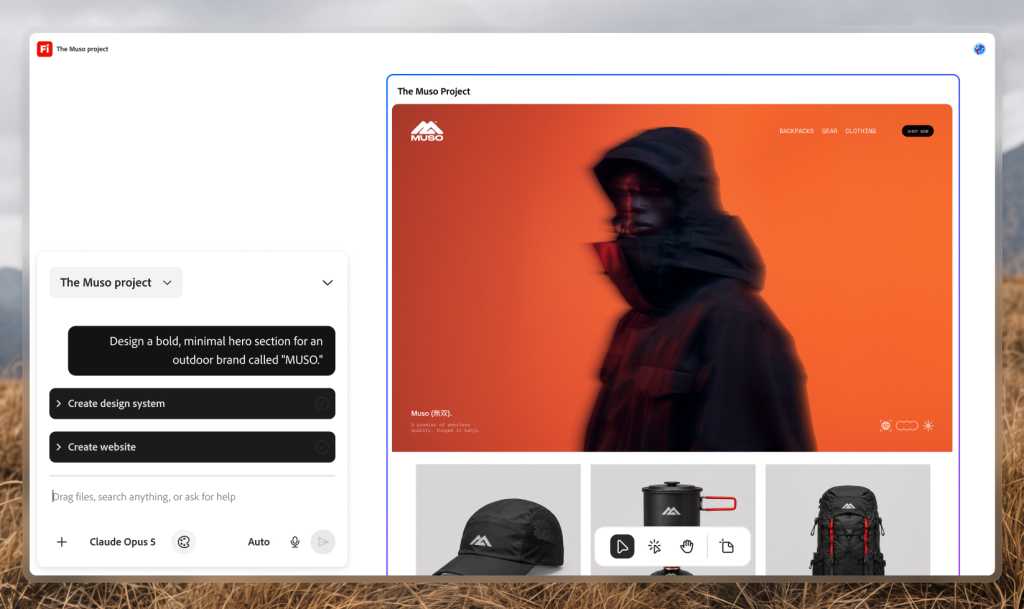
Other Firefly capabilities announced at the MAX event include Firefly Builder, in private beta, which creates prototypes of websites and interactive apps from natural language prompts. Firefly Design, in beta, is a new design workspace app that combines tools for image editing, animation, illustration, and 3D designs.
Adobe

While Adobe builds out its own native and third-party AI features, it also faces competition from other software tools aimed at creative professionals.

“From a competitive perspective, I see Canva and Figma going after the same in-house teams and are showing up in the same AI assistants,” said Kirkpatrick.

Adobe also faces competition from AI model providers such as Anthropic, Google, and OpenAI that are building design tools into their products.  

“Where Adobe really wins is when precision, brand control and commercially safe content matter, and that’s mostly in the enterprise,” said Kirkpatrick. “With individual creators, its lead is a lot smaller, and where Adobe is most at risk for displacement.”

Adobe bets on AI agents to stay at the center of marketing workflows

Adobe is rolling out autonomous agents to orchestrate work across its applications, a move that will reinforce its position at the core of content and marketing workflows as AI disrupts the software landscape, analysts say.

“We’re living at true inflection point; a moment where creativity and marketing are being reshaped by AI, unlocking incredible new opportunities and raising the bar for speed, personalization, as well as scale,” said Shantanu Narayen, Adobe CEO, during his keynote presentation at Adobe Summit on Monday.

Liz Miller, vice president and principal analyst at Constellation Research, described the various agent-focused product updates at Adobe’s Summit conference this week as “an evolution of vision that brings the right AI capability into the right application.”

“The goal … is to continue evolving where and how AI is incorporated into the work of engagement,” she said.

[ More Adobe Summit 2026 coverage ]

Adobe’s recent launches indicate a “clear shift” to prioritize agentic AI investment, said Maria Bell, senior analyst at CCS Insight.

“Rather than focusing on standalone AI features, the emphasis is on building systems that can coordinate and execute work across workflows and functions,” said Bell. “Capabilities such as CX Enterprise, workflow agents and Firefly integrations point to an ambition to move from AI that supports decisions to systems that can act on them.”

Adobe kicked off its agent-related announcements ahead of the customer experience conference, unveiling its Firefly AI Assistant last week.

Using natural language prompts, the agent can autonomously carry out multi-step workflows across Adobe Creative Cloud apps such as Photoshop, Premiere, Express, and others.  Aimed at both novice and expert users, Firefly AI Assistant can also guide users through tasks spanning image, video, audio, and design. A public beta is “coming soon,” according to Adobe.

The launch of Firefly AI Assistant signals Adobe’s intent to “lead in agentic AI for creative professionals, [by] directly addressing workflow friction, usability, and the demand for multi-model flexibility,” said Keith Kirkpatrick, research director at Futurum, in a blog post last week.

“Adobe’s Firefly Assistant is a signal that agentic AI is moving from experimental pilots to production-grade tools capable of handling real creative complexity,” he said, with enterprise buyers “no longer content with simple copilots or one-off automation.”

“The ability to automate multi-step tasks and orchestrate between image and video modalities is quickly becoming table stakes for creative AI platforms,” he said.

Adobe’s main announcement during the Summit event this week was CX Enterprise Coworker; an AI agent that coordinates multi-step workflows and tasks across Adobe’s customer experience applications.

“Adobe is moving to occupy the role of an automated operating system for marketing,” said Jim Lundy, CEO of Aragon Research, in a blog post on Wednesday. “While previous AI tools acted as individual assistants for specific tasks, the CX Enterprise Coworker acts as a supervisor that connects disparate silos of information.”

Lundy said that CX Enterprise Coworker represents a “significant evolution” in the way enterprises will manage the customer lifecycle, replacing manual hand-offs with automated orchestration across customer engagement apps.

“By anchoring this tool in its robust experience platform, Adobe is making a strong case for being the primary intelligence layer in the modern marketing stack,” said Lundy.

There were also updates to GenStudio with Brand Intelligence, a data layer that connects information across Adobe tools to provide context for agents to act upon, alongside a new agent capability in Adobe’s Workfront work management app.

While agents present an opportunity for Adobe, it also faces potential disruption from both design software vendors that build AI into their products and general-purpose AI assistants.

This risk has raised concerns in financial markets, and Adobe announced a $25 billion share buyback scheme this week — a move that can be seen as an attempt to shore up investor confidence amid a period of significant change, both across the industry as AI reshapes the software landscape, and within Adobe itself, with CEO Shantanu Narayen set to step down after 18 years in charge.

Ahead of the event, popular online design platform Canva unveiled its own agentic capabilities, with users able to access various Canva tools via a conversational interface that can complete multi-step processes, such as creating “a multi-channel campaign launch.”

“Canva is focused on accessibility, using AI to simplify and automate design for a broader audience,” said CCS Insight’s Bell. “This lowers barriers to entry and puts pressure on Adobe in lighter-weight and non-professional use cases.”

And, last week, Anthropic announced Claude Design, which lets users create design prototypes and marketing assets such as “landing pages, social media assets, and campaign visuals.”

In addition, Anthropic and Canva announced an integration that brings Claude Design outputs into Canva’s app.

Miller from Constellation Research said that tools such as Claude Design are “powerful additions” to the design ecosystem, enabling non-designers to quickly prototype and test ideas using text prompts. At the same time, these should be seen as more of a starting point. Professional-level design and editing tools are still required to create enterprise-ready prototypes.

“A creator may start in OpenAI, use that output in Claude to further build out the concept, but end in Firefly to ensure enterprise safety and brand controls in a more refined, finely tuned toolset,” Miller said.

Adobe is also working with a range of AI providers to make its software available where customers prefer. This includes the ability to interact with Adobe’s Firefly creative assistant directly from Claude, for instance.

“Our strategy is to meet where the users are,” said Varun Parmar, general manager of Adobe GenStudio and Firefly for Enterprise. A user might invoke an Adobe creative agent via Claude in the morning, he said, “and then later in the afternoon decide to do deeper precision and control work that requires a professional sort of interface, which is where Adobe’s product is world class.”

“We believe that these things will coexist; depending on the use case, you’ll go in and out [of different apps],” said Parmar.

As AI model providers expand into workplace software tools, it makes most sense for Adobe to focus on its core strength of serving creative and marketing professionals, Miller said.

“The risk to Adobe is more of an ongoing challenge to stay focused on customer demand and need, and not veer off course in a never-ending horse race with models proving what can be done, as opposed to commercially safe models that deliver what must be done,” she said.

And despite some media negativity around Adobe’s ability to transition into a new era of agentic AI, Miller said, Adobe’s strategy of embedding data, assets, and workflows into the tools marketers and creatives use remains sound.

Bell sees agentic systems as a “longer-term structural shift, while the more immediate pressure comes from accessibility-focused platforms like Canva.”

Yet Adobe’s access to data and expertise serving large customers provide it with an edge. “Adobe remains strong in professional and enterprise environments, where depth, control and integration still matter,” Bell said.