
Category: Apple, Artificial Intelligence, Mobile, Mobile Device Management, Mobile Management, Vendors and Providers

Jamf in the age of agentic IT: An interview with CEO Beth Tschida

Jamf was a pioneer in Apple device management when it began in 2002. The company was ahead of its time: its founders could see that Apple had a future in the enterprise, but not many others saw it. Jamf now runs 35.2 million devices from 78,000 organizations. And it’s still looking to the future.

I spoke with Jamf CEO Beth Tschida, who joined me for a chat directly after her keynote speech at JNUC, Jamf’s big event for Mac admins, on September 23. 

The AI-driven ecosystem

Tschida wasn’t there to rehash Jamf’s past for relevance in the present, but to share the company’s deep commitment to being where its customers are going to go. That means artificial intelligence, which in Jamf’s case involves weaving AI across its ecosystem of products, from setup to tech support, security, and beyond.

It’s not a new vision — you could argue that some early signs of its intention were visible when the company acquired ZecOps in 2022 — but time moves forward and the company has coalesced around a firm philosophy of how to use AI, where to use AI, and how AI should be deployed in a human-centric way for the benefit of its customers.

“AI runs better on Apple, and Apple runs better on Jamf,” Tschida told me. The next piece to that statement is to consider how AI can be effectively managed by IT, she added. “You have to be able to see it. You have to be able to govern it, and then you want to be able to harness it.”

This points directly to shadow AI, one of the big-picture problems IT has with AI at the moment as employees feed confidential data to the cloud-based AI models. Jamf’s response has been to create new frameworks IT can use to monitor use of AI across their managed fleets. These tools let IT identify use, manage use, or even stop use altogether.

“How can we look at that, see it, govern it, and harness it in the ways that AI is providing that opportunity, right at the endpoint?” Tschida said. 

Precision modeling

The other component is pricing. Even when data is legitimately shared to AI, the cost of inferencing is high and getting higher. Jamf now offers tools to let IT monitor this use and the cost of it, enabling management to suggest lower cost or on-prem AI solutions for tasks where appropriate. After all, why would you pay for Fable when you can get your Apple device to help write that letter?

Tschida explained that part of Jamf’s response to AI costs is the inclusion of granular model controls, which let admins assign different teams access to different models, the idea being to prevent what she called “overmodeling” — the use of expensive high-reasoning models for tasks that lightweight models can handle.

“You have to understand what the need is. You must lay it out there in a governed way. Human in the loop and then you harness it,” she said.

The Mac advantage

But the Jamf vision doesn’t end with AI management; it extends to making active use of the tech. In this case the company has introduced AI-powered tech support for routine problems to free up staff time. There are two strands to this approach: More obviously, easy to access tech support should reduce time spent on routine problem solving, but another compelling aspect of this evolution is the move toward proactive device health.

Traditionally, IT has been reactive: a user experiences slowness, they eventually file a ticket, and IT fixes it. But many users simply “endure” suboptimal performance without ever reporting it, Tschida explained. “A lot of times, users don’t even raise a ticket. They just endure.”

That was then, but the future looks different. “We believe that we now have the right telemetry to look at device health,” Tschida said. “You’re really moving ahead of problems. Users don’t even raise a ticket… you can help them optimize it without them knowing it.”

With over 35 million devices now managed using Jamf, the origin story of the company seems further ahead of its time now than ever. Apple’s enterprise product marketing lead, Jeremy Butcher, appeared at one point during Tschida’s keynote to talk about where Apple now is in the enterprise. He pointed to data that Macs generate 55% fewer help tickets than Windows systems. He confirmed that the MacBook Neo has accelerated enterprise growth for the platform, and pointed out that more Apple devices are purchased in enterprise than any other brand.

With so much energy behind Apple’s platforms, what has Tschida been seeing?

“We know that Anthropic and other companies, they tend to deploy for Mac first. The developers are mostly running Macs. That’s what they prefer to be on, and they’re at the forefront of agentic AI.”

The thing about the growing enterprise Apple ecosystem is that no single company can build the perfect set of solutions for every enterprise. Part of Jamf’s response to this has been the creation of platform APIs, which customers and partners can use to extend the platform to meet their needs. “I love a good API because it allows you to run a road map way faster,” Tschida said.

Former Jamf CEO Dean Hager used to say, “When Apple innovates, Jamf celebrates.” 

His successor echoes his point, with a focus on what Jamf can do for its customers. “Our job is to make sure that Apple runs better with Jamf,” she said. “We’re scaling it, we’re securing it, and we’re making sure that you can… first see it, and govern it, and then harness what you can get from it in a way that’s helpful for our customers.”

Local intelligence, global scale

A second aspect to governance is around sovereign, private, and/or on-premises AI. I asked Tschida what her customers are saying. “There will be some that look at the benefit if you can run at least some of your workflows locally,” she said. “There’s a tokenomics piece of it. There’s a privacy piece of it. There’s a sovereignty piece of it.”

Whatever the motivation, for Jamf the question remains, “How can you determine what we can do and help you do, locally on device, and build that so you can run it at scale? That’s where we’re focused.”

I walked away from the interview feeling a vision for Apple in the enterprise in which IT is augmented by smart tech infrastructure: Macs that request support before users know they need it, systems that self-identify bottlenecks or wasted resources such as over-generous token consumption and let IT take steps. A more intelligent enterprise infrastructure, equipped with real-time awareness, self-reliant with little to no cloud exposure.

For Apple, Jamf, and certainly for the Mac, that seems like several giant steps since the foundation of Jamf in 2002. AI in IT is an accelerant, and Jamf is working with it. “We are doing our best to run at the speed of AI,” said Tschida. 

Now please subscribe to my daily, human-curated Apple-related news headline feed at The Core, or follow me on BlueSky, LinkedIn, or Mastodon.
From admin to architect: Jamf’s vision for the autonomous Apple enterprise

Now a private company, Jamf opened its big annual event for Apple enterprise management teams, JNUC, by taking big steps to exploit artificial intelligence in the management of Apple fleets. During her keynote speech at the Kansas City event, CEO Beth Tschida shared some of the details of the platform-scale overhaul the company has set in motion.

“IT teams are managing more endpoints and more complexity than ever,” she said. “We want Jamf to handle more of that routine work automatically… because AI runs better on Apple, and Apple runs better on Jamf.”

Tschida — and Jamf — have been consistent on the value of AI to IT, which played a major focus at last year’s JNUC also. When I spoke with her, she was resolute on the need for IT to engage with the tech, telling me, “AI is happening whether organizations know it or not. That’s the problem. You can try to block it, but that’s very hard to do well. It’s far better to build visibility and governance around it.”

As you’ll see, this is very much part of what Jamf at JNUC 2026 is working to achieve.

AI, Apple, and IT

The combination is about exploiting AI support inherent to Apple’s platforms to help reduce time-consuming IT tasks. It means that Apple device management in the future will be less about management and more about creating autonomous enterprise ecosystems in which the tech handles the routine tasks, while humans handle the strategy.

Jamf’s offerings now include a new AI-powered self-service diagnostics system. Employees will be able to troubleshoot their own devices by asking Jamf questions on their device, such as “Why are my video calls lagging?” and receive an immediate explanation and a one-click fix. 

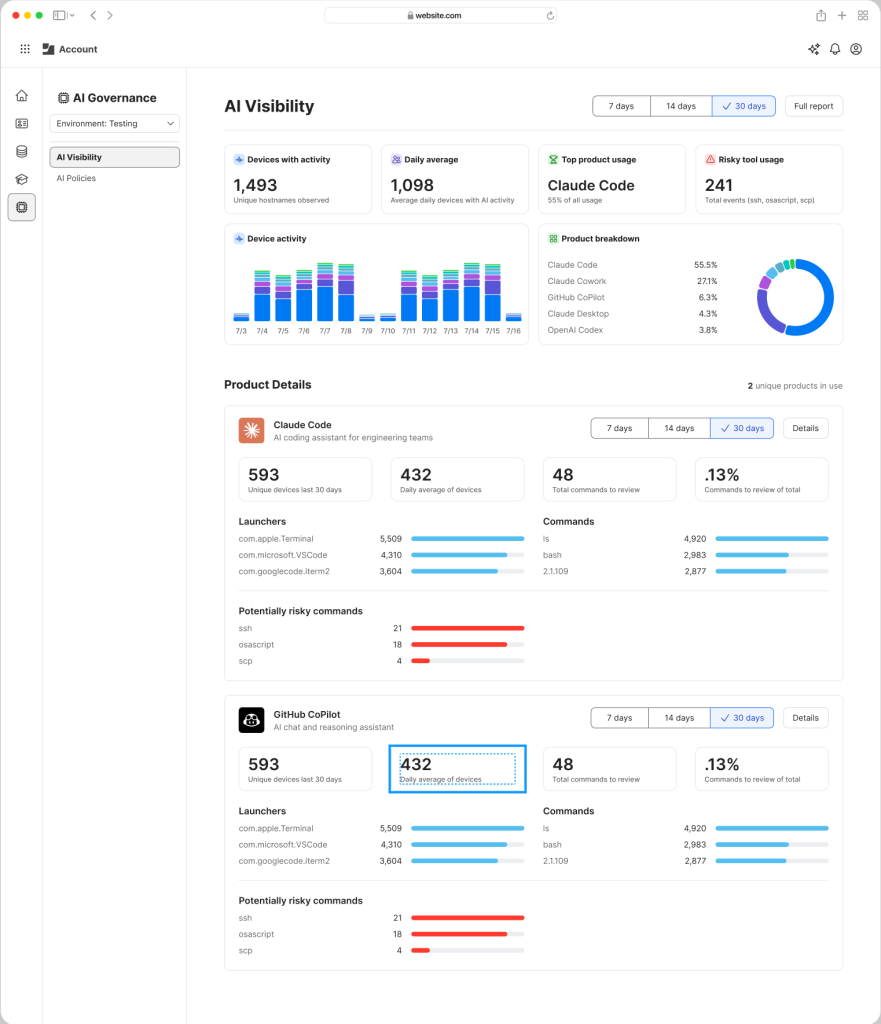
These improvements aren’t confined to routine task automation. They also extend into AI governance. The company introduced its AI Governance suite earlier this year, and at JNUC announced new capabilities to help IT take control of shadow AI across their networks. 

A response to shadow AI

These include a centralized AI control panel which shows admins which AI systems are running across their fleet and lets them enforce usage policies and also generate audit-ready reports. The company is extending this into the Safari, Chrome, and Edge browsers, which means organizations can prevent the upload of corporate files to personal AI accounts through browsers on managed devices. 

It means that IT doesn’t just see AI is being used but can identify which models are running and what the token costs are, while also being able to block corporate files from being uploaded to a personal account in Safari or Chrome.

For security-conscious firms, Jamf is also enabling the deployment of local inference engines. That support means companies can run AI workloads directly on Apple hardware, ensuring that prompts and sensitive data never, ever leave the device.

IT as a service

The transformation of IT means IT itself is becoming an application, and Jamf seems to be embracing this approach with a new Platform API Gateway and a Terraform provider. Together, these make it possible for IT teams to manage their entire Apple environment using “Infrastructure as Code.” 

Think GitOps for admins, in which a change to the fleet becomes a peer-reviewed pull request, and a rollback becomes as simple as a click.  

Jamf also introduced Jamf Tap, its NFC/RFID system that lets frontline workers simply tap an ID badge to instantly assign the device and sign into necessary apps, aimed at streamlining things like shift changes in warehouses.

Final announcements from the company included Ring Deployments, a rollout system that tests updates with a pilot group before expanding to the wider fleet, and a curated catalog that automatically installs and updates popular Mac apps.

JNUC 2027 takes place in Anaheim, California, from October 26–28, 2027. It will mark the company’s 25th anniversary.

Now please subscribe to my daily, human-curated Apple-related news headline feed at The Core, or follow me on BlueSky, LinkedIn, or Mastodon.

Jamf CEO: ‘AI is happening whether organizations know it or not’

Beth Tschida, who became Jamf CEO in May after serving as CTO and as interim CEO, is the first woman to lead the company in its near 25-year history. I spoke with her this week at the London Jamf Nation event, where the company introduced its new AI Governance solution.

How the transition to CEO is going 

“It’s been a great privilege and an adjustment,” she said. “Jamf has always been a company deeply focused on culture, which is exactly why I love being here. Having the ability to influence and improve that culture from this role is something I feel very supported in doing.”

The last few years have seen a variety of changes at Jamf, which was briefly a public company. “We’ve come through a period of change, not all of it easy,” Tschida said. “But we now have a great partnership with Francisco Partners. We’re private, we’re focused on solving customer problems, and we’re finding ways to lean into what we’re good at.”

Women in tech and mentorship

Tschida is a good choice to lead a software engineering company, as she’s an engineer herself. She originally joined Jamf as vice president for software engineering in 2018, moving up to CTO in 2022. She’s also one of the few women in leadership positions in tech. (To Jamf’s credit, the company also has CIO Linh Lam on its team.)

“I think it’s important for women to stay deep in the tech, build their skills and find their voice confidently,” Tschida said. “You’ll never know all the technology out there. Nobody does. What matters is the ability to keep adapting and evolving.”

Tschida stressed the importance of mentorship. “I feel very honored to have a chance to be a role model for other women,” she said. “I had women who forged a path for me, including a female CIO early in my career who I asked to mentor me and learned an enormous amount from. I’m certainly not the first woman in tech, but I do want to play my part in helping others grow in their careers.

“Ultimately, I want to be respected for what I do, not for my gender. That’s how everyone should be judged.”

AI Governance

Tschida’s product focus means she knows what matters to Jamf. “If you focus on the problems customers have and how your product can help fix them, that’ll take you to where you want to go.”

For many in the enterprise, both in and beyond the Apple space, the next big problem is AI — how to deploy it, how to manage it, and how to regulate it.

AI Governance is a new Jamf solution that has been developed in response to those pain points. Countless surveys, including Jamf’s own data, show that AI is being widely used across every company, but IT lacks visibility into its use. It’s hard to know what data is being shared with AI tools, which services are being used, and how to report on that use effectively — particularly in regulated industries.

AI Governance is designed to make it possible for anyone managing an Apple fleet to get granular insight into AI use across their Mac, iPhone, and iPad devices. It uses telemetrics to shed light on that use, offers governance and management tools to help IT gain better oversight and control over it, and provides highly comprehensive reporting tools suitable for internal or regulatory review.

“AI is happening whether organizations know it or not,” said Tschida. “That’s the problem. You can try to block it, but that’s very hard to do well. It’s far better to build visibility and governance around it.”

The offering makes it possible for companies to enable the AI use they already know is taking place while protecting corporate interests and enabling fast and accurate reporting. You can find out more details here.

Empowering better AI

Jamf’s approach is focused on endpoint management. AI Governance means IT can see what’s running on a device, categorize it, and understand what AI tools and models are in use. “If you know how people are running AI on your fleet, you can open it up safely. Then all of your customers and employees can find their way to figure out how AI is going to optimize their workforce,” she said.

What does that look like in practice? Think of it as an orchestration layer. IT can define different AI configurations for different teams: HR might use one set of models, engineers another. And admins can apply opinionated postures per group: what models are permitted, what cloud services they connect to, what’s visible to IT versus the CISO versus the CFO. “It’s an extension of what Jamf has always done, it just now applies to AI endpoints too.”

What about regulatory complexity across geographies? “A lot of governance controls are shared across regulations; a good base set is a healthy way to run regardless. But each regulation has its own twists. Our mission is to make sure customers operating in different markets can expand on that base and fit the specific models and regulations they need, getting the right configurations to the right devices.”

Managers must prepare for AI cost challenges

There’s a second dimension beyond management — cost. The industry is developing quickly, with new AI models appearing almost every week. Yesterday’s leading LLM is tomorrow’s fading star, even while the cost of AI infrastructure goes through the roof. As that churn slows, investors will want to start seeing returns on their bets, which is why token costs — the price of running AI services, at least in the cloud — are climbing fast.  

As costs become more realistic, that’s going to change the nature of AI deployment from the laissez-faire, anything goes approach to a more strategic management of such use. “Models keep dropping fast, but token costs are only going to go up,” said Tschida.

“Organizations will need to decide: just because you can build something with AI, should you? What’s the right model for what work? We’re helping customers move from, ‘We’ll just block it’ or ‘We’ll turn it on and hope for the best,’ toward a place where they have a real viewpoint and can manage and change that viewpoint over time.”

The ever-changing AI world is also prompting Jamf to make more of its APIs externally available. “We’re used across every industry and every geography, at every scale,” said Tschida. “There’s no way we can build every workflow every customer needs, we’d never get to all of them.”

Embracing openness also helps build future foundations. “Thinking about where we’re heading next — agentic endpoint management — having platform APIs allows our customers to build things they can imagine, that we can learn from, in a way that solves their specific problems.”

Apple, WWDC, and the enterprise

Tschida’s comments come shortly after WWDC 2026, where Apple introduced a raft of AI advances that formed a strong foundation for its future, improvements that matter to Jamf. “When Apple innovates, Jamf celebrates,” she said.

“Apple is doing great things in their AI ecosystem, revamping Siri, expanding their AI capabilities, making Apple the platform people want to run AI on because those machines simply perform better. Our job is to take what Apple builds and bring it into the enterprise in the way that enterprises actually need it.”

Most of the industry recognizes that Apple’s enterprise story has changed dramatically as its products see accelerating use, and momentum is not slowing. Tschida reflected on how just a few years ago, Apple in the enterprise was an option in employee choice programs. “Now it’s becoming the clear choice,” she said. “We expect that trend to continue. And the more Apple invests in AI running natively on device, the stronger that argument gets.”

Where is Jamf going?

AI Governance is a unique answer to an increasingly important set of questions that are now beginning to affect the IT management of Apple’s platforms. (It’s not clear whether anything as sophisticated exists for other platforms at al, but as the need to manage AI grows, demand for such solutions will grow.)

Ultimately, the company’s latest move reflects Jamf’s inherent strategy under its new CEO. “Focus on customers, listen to them, solve their problems, and don’t throw tech at it. Ask: what’s the problem? Can we solve it? That focus is what takes you where you need to go.

“We’re on a good trajectory, customers stay with us, and the culture has always underpinned us. Now we’re finding ways to lean into it even further,” she said.

You can follow me on social media! Join me on BlueSky,  LinkedIn, Mastodon and subscribe to The Core.