
Category: Artificial Intelligence, Careers, IT Jobs

AI-related job creation to outpace losses by 2030, says Gartner

Wider use of AI within organizations will lead to more jobs being created than are lost by 2030, according to Gartner.  

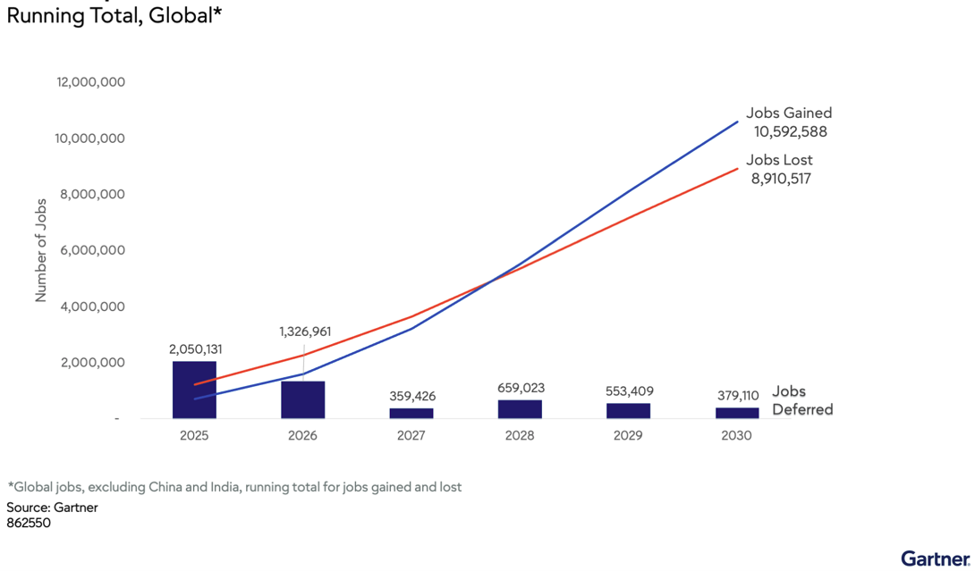
Around 10.6 million jobs will be added globally (excluding China and India) by the end of the decade, with 8.9 million lost, according to a Gartner report — a net increase of 1.7 million jobs. At most, around 1.8% of the workforce will experience job losses attributable to AI during this time period, Gartner predicts.

At the same time, a total of 5 million jobs will cumulatively be deferred during this period. This refers to jobs that “would otherwise have been created, but where AI is used as an excuse to restrain hiring,” according to Gartner’s report. Gartner considers deferred jobs as separate from jobs lost.

“Job deferrals were the first effect felt from AI,” said John Lovelock, Gartner distinguished VP analyst and chief forecaster, with “companies holding off hiring open positions until the effects of AI projects were known.”

A recent KPMG survey of 400 US CEOs showed that 89% expect to increase headcount over the next three years, which KPMG US CEO Tim Walsh linked to AI adoption in an Axios interview last month.

For now, though, job losses attributed to AI outpace those created, according to Gartner’s study. During 2026, there were 2.2 million jobs lost due to AI, and 1.6 million gained.  

Lovelock expects the situation will change in the coming years, however, as organizations see greater success with AI deployments. “This will reverse once AI is through the Trough of Disillusionment,” he said, in reference to Gartner’s Hype Cycle framework.
Gartner

The number of jobs deferred is also forecast to fall in the coming years. During 2026, 1.3 million people experienced a delay in hiring, down from 2.1m last year, according to Gartner’s forecast, with 400,000 jobs forecast to be deferred during 2030.

The impact of AI will vary across sectors, with the technology industry expected to see the largest net job gains compared to other areas, such as public sector and asset-intensive industries. Gartner predicts the creation of 1.9 million new technology jobs by 2030, with 400,000 lost.

Services sector jobs — such as in financial services — are forecast to see a similar level of job creation, alongside large numbers of losses.

A similar Gartner report in 2025 predicted that more services jobs would be lost than created, but the analyst firm now forecasts a net increase as demand grows for data- and system-oriented skills. “This industry is most able to improve productivity of employees and increase employment,” said Lovelock.  

The Gartner report doesn’t specifiy which job roles will benefit from greater adoption of AI, though the analyst firm expects some portion of newly created jobs will be “directly linked to the implementation, maintenance and scaling of AI.”

Government jobs are expected to see the largest net job loss of any industry, said Lovelock. “Without the incentive of revenue growth or industry transformation, governments are expected to focus on the AI benefits of efficiencies and staff reduction,” he said.

Entry-level positions are expected to be the hardest hit by job deferrals, said Lovelock. “We do see many of the deferred positions being hired after a 12- to 24-month delay,” he said.

“Unfortunately, some deferred positions do transition into job loss. In most industries and positions, the employee experience pyramid will skew toward senior positions.”

In a separate report from September, Gartner forecast that 30% of positions eliminated by AI-related layoffs will be refilled by 2029, on average. For enterprise-sized organizations, the figure is likely to be higher, at around 40%.

Microsoft offers exits to thousands, including employees on AI and Copilot teams

Microsoft is offering voluntary exit packages to about 60,000 employees, roughly 27% of its workforce, including staff on teams building Copilot and other AI products, as the company looks for ways to fund its AI investments.

Amy Coleman, executive vice president and chief people officer, announced the Voluntary Exit Offer (VEO) in an internal memo on Monday, which Microsoft republished on its official blog.

“This offer gives eligible employees who may be considering a future outside the company a new choice to make that transition now with support,” Coleman wrote in the memo. It also gives participating organizations “another way to adapt their workforce to changing needs,” she wrote in the blog.

The offer covers employees at level 70 and below in participating teams in the US, Canada, India, and the UK, according to the memo. “Some organizations are providing the Voluntary Exit Offer, and some are not,” Coleman wrote. She added that participation depends on each business’s “priorities, customer commitments and workforce needs.”

However, her memo did not specify how many employees are eligible for this offer. According to a Reuters report, the move will impact about 60,000 employees globally, or about a quarter of the global employee base.

Participating teams include AI experiences, Copilot, Xbox, and Windows + Devices, Reuters reported, citing a person familiar with the matter. Marketing, sales, commercial business, and security teams, along with some data center staff, are excluded, the report added.

Employees have until early December to decide, and those who accept will leave at the end of the year, the report added. The memo describes the offer as time-limited and says it includes financial support and career planning resources. However, it does not give the terms of the packages.

From retirement to exit

The VEO builds on what Microsoft “learned earlier this year through the Voluntary Retirement Program,” Coleman wrote. That program, introduced in April, was aimed at long-serving US employees.

Hood said in April that the retirement program would carry roughly $900 million in one-time costs. In July, she said its expenses had come in lower than expected.

The new offer is not tied to age or years of service, and it extends beyond the US. “The Voluntary Exit Offer is new for us. We’ll learn from it,” Coleman wrote in the blog post.

A smaller company by design

Microsoft has said its workforce will shrink this fiscal year. “We expect headcount will decrease year-over-year,” CFO Amy Hood had said on the company’s April 29 earnings call, referring to fiscal 2027, which began July 1. On the same call, she said the company was changing how it operates “to increase our pace and agility.”

Microsoft employed about 223,000 people full-time as of June 30, 2026, down from 228,000 a year earlier, according to its annual report filed with the US Securities and Exchange Commission. Hood said on the company’s July 29 earnings call that total headcount had declined 2% year over year.

AI spending and the staffing question

The workforce changes coincide with a sharp rise in AI infrastructure spending. Microsoft spent $41 billion on capital expenditures in the quarter ended June 30, Hood said on the July earnings call, and she guided to more than $50 billion for the September quarter.

Microsoft has also urged customers to rethink how they fund AI. On the April earnings call, CEO Satya Nadella said IT budgets would be reshaped by business outcomes and “reallocation from other line items on the income statement, like OpEx.”

Sanchit Vir Gogia, chief analyst at Greyhound Research, cautioned against reading Microsoft’s moves as a template.

“Microsoft’s internal AI use does not establish substitution of particular roles,” he said. He advised enterprises to measure completed work at an agreed quality level across representative roles and difficult exceptions before changing staffing, and to keep experienced staff available while doing so.

“Workforce savings earn credibility through the capability that remains,” Gogia said.

Account coverage in question

Whether customer-facing teams take part is an open question for buyers. Coleman wrote in the memo that participation varies based on each business’s “priorities, customer commitments and workforce needs.”

Microsoft’s annual report counts 89,000 employees in operations, a category that includes product support, consulting services and data center operations. Another 43,000 work in sales and marketing. Microsoft has not said whether staff in either group are eligible.

“The practical test is whether customer-critical capability remains available throughout the transition,” Gogia said. He recommended that CIOs confirm the accountable account owner and a qualified backup. They should then test the successor on an unresolved exception and compare support cases against a recent baseline.

At the same time, Microsoft is adding people to customer engagements. Nadella said on the July earnings call that the company had launched Microsoft Frontier Co., which will embed 6,000 industry and engineering experts with customers.

Gogia said delivery commitments need checking at a granular level. “Aggregate headcount does not identify the expertise required by an Azure migration or a Dynamics implementation,” he said. He advised verifying Azure dependencies by subscription and region, reconfirming Dynamics implementation specialists, and distinguishing previews from contractual milestones on product roadmaps. Microsoft did not immediately respond to a request for comment.

Meta says goodbye to those who won’t use AI

Meta is the latest company to trim its workforce as a result of the growing use of AI within the industry. The company laid off 8,000 employees earlier this week, while also moving 7,000 more to AI-focused roles.

“AI is the most consequential technology of our lifetimes,” Zuckerberg said in a memo that he sent to employees, informing them of the cuts.  “The companies that lead the way will define the next generation,” he added.

The company has not revealed too much detail of the changes in the workforce, but it’s clear that jobs focused on AI infrastructure will be protected.

Meta is not alone in announcing cuts. In a blog this month, Cisco said it was cutting 4,000 jobs and Microsoft is looking at inciting employees to take voluntary retirement for the first time.

The Meta reorganization is following the trend that businesses that don’t adapt to AI usage will struggle. Earlier this year, PwC US CEO Paul Griggs caused consternation when he suggested that executives who failed to get to grips with AI had a limited future in the company.

While workforces are increasingly dependent on AI as a path to progress, IT departments are not necessarily on top of the game. A Dataiku survey earlier this year revealed that 74% of CIOs were fearful that their career paths were dependent on AI outcomes.

OpenAI to double workforce, highlights growing demand for enterprise AI talent

OpenAI is planning to almost double its workforce from about 4,500 to 8,000 employees by the end of 2026. The move comes as OpenAI sharpens its focus on scaling and monetising ChatGPT for enterprise use amid intensifying competition from Anthropic and Google.

Hiring is expected across product development, engineering, research, and sales, along with roles such as technical ambassadorship, the Financial Express reported.

In December last year, OpenAI CEO Sam Altman issued an internal memo declaring “code red” emergency, asking employees to focus on improving ChatGPT.

“Rivals such as Anthropic are racing ahead in enterprise, where most of the dollars are. This is prompting OpenAI to expand its workforce to build and scale its enterprise-focused offerings and sales force. OpenAI has been scaling back its infrastructure commitments to recalibrate and focus on where most of the value is right now, beyond consumer-facing AI demand, which follows a more freemium model, and the ads-driven approach is also not that promising,” said Neil Shah, vice president at Counterpoint Research.

OpenAI did not immediately respond to the request for comment.

AI hiring boom reshaping tech roles

The hiring push also reflects a broader shift underway across the AI industry. In September last year, Anthropic said it would triple its international workforce as demand for its AI models grew outside the US region.

“OpenAI’s plan to double its workforce toward 8,000 employees reflects a broader structural shift across the frontier-AI talent market, not just a company-specific spike,” said Prabhu Ram, vice president, Industry Research Group (IRG) at Cyber Media. “Peers like Anthropic and other model developers are expanding aggressively as the industry pivots from research experimentation to enterprise-scale deployment, integration, and tooling. Most jobs created specialize within existing software and data pathways, focusing on ML engineers, inference specialists, MLOps professionals, AI architects, and safety/governance roles for production-grade workflows.”

Experts say these AI platforms are not creating entirely new categories of jobs, but adapting existing software roles for the AI era, particularly to support enterprise adoption.

“Across the industry, the fastest-emerging roles are hybrid ones that sit between research, software, and client delivery, described as the forward-deployed engineers (FDE). These are one of the hottest jobs in AI for scaling up across AI companies and service providers. These are engineers who embed with customers, write production-grade code, and make models work in messy real-world systems,” explained Pareekh Jain, CEO at  EIIRTrend & Pareekh Consulting.

Companies are already formalising such roles. Just recently, Accenture collaborated with Microsoft to launch forward deployed engineering practice to help large organizations rapidly build and scale industry-specific AI solutions. 

Other emerging roles include AI agent architects, who design autonomous systems capable of executing multi-step workflows.

Technical ambassadors, a key hiring focus for OpenAI, are expected to bridge the gap between advanced research and real-world enterprise deployment, ensuring usability and adoption, added Jain.

Fewer roles, higher pay

The hiring push by these AI platform providers highlights a growing paradox in the AI job market. AI is automating routine, process-driven tasks across sectors, including IT, customer operations, finance, and professional services, leading to job cuts. Simultaneously, it is creating demand for a new class of high-value, specialized roles tied to enterprise deployment. The changing demand dynamics are already driving higher pay for specialized AI skills.

According to PwC’s 2025 Global AI Jobs Barometer, wages are rising for AI-powered workers. The report finds that workers with AI skills earn, on average, 56% higher wages, driven by strong demand, the strategic importance of these roles, and a limited talent pool.

“While up to 300 million global roles face automation exposure, with 83 million displaced and 69 million new specialized ones created by 2027, AI engineering specialists command 20–40% salary premiums over traditional IT, especially in inference optimization, distributed training, evaluation pipelines, and multimodal integration,” added Ram.

Atlassian cuts 1,600 jobs to fund AI and enterprise expansion

Atlassian will reduce its global workforce by approximately 10%, eliminating around 1,600 roles, as the collaboration software maker redirects capital toward artificial intelligence development and enterprise sales.

Co-CEO and co-founder Mike Cannon-Brookes disclosed the cuts in a blog post. The decision, he said, was made to “self-fund further investment in AI and enterprise sales” while accelerating the company’s path to sustained profitability.

The announcement came despite a strong recent performance. Atlassian reported cloud revenue of roughly $1.067 billion, up 26% year on year, and remaining performance obligations of approximately $3.814 billion, up 44%. Its Rovo AI assistant surpassed five million monthly active users, and the company now counts more than 600 customers generating over $1 million in annual recurring revenue, the blog post added.

Cannon-Brookes acknowledged that AI was reshaping the skill mix required. “It would be disingenuous to pretend AI doesn’t change the mix of skills we need or the number of roles required in certain areas,” he wrote.

Reading the fine print

Sanchit Vir Gogia, chief analyst and CEO at Greyhound Research, said enterprise buyers should read the move as a strategic reallocation of capital, not a distress signal.

“Management is treating AI not as a side project or a shiny feature layer, but as something that changes how the company should be staffed, what types of roles it needs, and where it should spend its money,” he said.

But he cautioned that financial strength did not confer operational immunity. “Customers do not feel it on day one in the earnings statement,” Gogia said. “They feel it later in slower escalations, fuzzier accountability, longer roadmap cycles, and support journeys that suddenly feel more automated and less informed.”

He also flagged that the cuts were unfolding alongside a broader platform transition, with Atlassian simultaneously pushing customers toward cloud delivery and embedding AI more deeply across Jira, Confluence, and service workflows. “When vendor operating model change and platform model change happen together, CIOs need to pay attention,” Gogia said. “One moving part is manageable. Two moving parts at once can get messy.”

Impacted employees will receive a minimum 16-week separation package globally, with one additional week per year of service, a prorated FY26 bonus, a $1,000 technology payment, and six months of extended healthcare coverage. Atlassian also disclosed a CTO transition, with Rajeev Rajan stepping down and other leaders elevated around next-generation AI priorities.

It is the second significant workforce reduction at Atlassian in three years. In March 2023, the company laid off approximately 500 employees, or 5% of its workforce, framing the move as a rebalancing toward cloud migration and IT service management.

A widening pattern

Atlassian’s announcement is the latest in a fast-growing list of enterprise technology companies citing AI as a structural driver of workforce reductions.

Earlier this month, fintech platform Block cut approximately 4,000 jobs as CEO Jack Dorsey declared a move to an “intelligence-native” operating model. Similarly, Australian logistics software firm WiseTech Global had announced to eliminate around 2,000 roles, with its CEO stating the era of manually writing code was over. Tech layoffs in 2026 had already surpassed 45,000 globally by early March, according to RationalFX, with AI and automation among the most frequently cited drivers.

Gogia said the pattern reflected a shift in boardroom incentives, not just technology. “Once boards and management teams see that investors reward a story built around AI, smaller teams, and future efficiency, the incentive structure shifts quickly,” he said.

CIOs should expect more vendor reorganisations framed around AI productivity, more support interactions routed through AI-mediated channels, and more pricing experimentation blending subscriptions with usage-based mechanisms tied to AI consumption, a direction Atlassian’s Rovo Dev pricing already signalled, Gogia said.

His advice to enterprise buyers was pointed. “CIOs should stop treating vendor AI announcements as purely product announcements. They are operating model announcements, too,” he said. “The right follow-up question is not only ‘what new features do I get?’ It is also ‘what changes behind the curtain in support, staffing, escalation, and accountability?”

Jack Dorsey shrinks Block to ‘intelligence‑native’ model, cutting 4,000 jobs

Block, the payments and financial services company led by Jack Dorsey, is cutting more than 4,000 jobs, nearly half its workforce, because AI tools have made a leaner organisation not just possible, but strategically preferable, Dorsey said in a letter to its shareholders.

The cuts will reduce Block’s headcount from over 10,000 to just under 6,000. The company is not cutting from a position of weakness. Block posted gross profit of $10.36 billion in fiscal year 2025, up 17% year over year, and is raising its 2026 gross profit guidance to $12.20 billion. In Q4 2025 alone, gross profit grew 24%, the company said in its earnings call.

“Intelligence tools have changed what it means to build and run a company,” Dorsey wrote in the latter. “A significantly smaller team, using the tools we’re building, can do more and do it better. And intelligence tool capabilities are compounding faster every week.”

He added a prediction that will be hard for enterprise leaders to ignore: “Within the next year, I believe the majority of companies will reach the same conclusion and make similar structural changes. I’d rather get there honestly and on our own terms than be forced into it reactively.”

Block is not the first — and it won’t be the last

Block is not alone. Earlier this week, WiseTech Global, the Australian logistics software company behind the CargoWise platform, cut around 2,000 roles, citing comparable AI efficiency gains. Like Block, WiseTech was profitable at the time. Companies, including Amazon, Microsoft, Workday, and Salesforce, have all cited AI in recent workforce reductions.

Similarly, Data analysis vendor C3 AI on Thursday slashed its workforce by 26%, citing agentic efficiencies as a critical factor.

The scale of disruption ahead is significant. A Forrester forecast published in January predicts AI and automation will eliminate 6.1% of US jobs by 2030, equivalent to 10.4 million positions. To put that in context, the US lost 8.7 million jobs during the Great Recession. Unlike recession-driven losses, Forrester notes, AI-driven displacement is structural and permanent. Notably, genAI now accounts for 50% of projected US job losses to automation, up from 29% in Forrester’s earlier forecast, as agentic AI solutions compound the effect.

But Forrester adds a pointed caveat. Nine out of ten times, the firm said, when a CEO announces workforce reductions citing AI, the company does not yet have a mature, vetted AI application ready to fill those roles.

Restructuring from strength, not distress

The context of Block’s cuts is what makes them significant, said Sanchit Vir Gogia, chief analyst at Greyhound Research. “This is not about trimming fat. It is about redefining muscle,” he said. “When a financially healthy company decides to remove nearly half its workforce and openly attributes that to AI capability, it is not reacting. It is repositioning.”

Gogia drew a clear distinction from previous restructuring cycles. “In previous cycles, layoffs followed weakness. This time the order is reversed. Cutting during strength signals belief — it says leadership is convinced that waiting would be riskier than moving early.”

On Dorsey’s prediction that most companies will follow within a year, however, Gogia threw caution. “The structural shift is real. The one-year synchronised wave is not,” he said. Regulatory intensity, labour frameworks, legacy integration complexity, and governance maturity will slow adoption in heavily regulated sectors such as financial services, healthcare, and public infrastructure, he argued. “Predictions of universal twelve-month adoption underestimate institutional friction.”

Speed without architecture is a risk, not a strategy

For IT leaders, the implications run deeper than headcount. Gogia warned that speed without architectural discipline creates risk. “Aggressive compression without escalation redesign creates brittle systems that only reveal weakness during stress.”

He added that workforce planning can no longer operate at the level of job titles. “Planning must move to task clusters, identifying which cognitive workflows are substitution-feasible and which remain human-critical because escalation authority or regulatory accountability demand it.”

Dorsey described Block’s destination as becoming a “smaller, faster, intelligence-native company.” Gogia’s framing offers a useful corrective for enterprise leaders processing that signal: the organisations that navigate this transition well, he said, “will not be those that cut fastest. They will be those who redesign deliberately.”