Month: May 2025

Relying on file storage heritage, Box pivots to AI

AI agents will fundamentally change the value of content and the way people work with data and files, said Aaron Levie, CEO of Box, during a Wednesday webcast that was part of the company’s Content+AI Virtual Summit.

The traditional approach to managing content is fundamentally changing with AI, Levie said.

Over the last two decades, Box has changed its focus from file storage to extracting value from content in those files. The company provides collaborative tools and integrates popular apps for users to work with those files and data.

Extracting value from the content in stored files will take on new meaning with AI. The amount of unstructured data within files has grown at an exponential pace over the last few decades, but most of the data is underutilized, Levie said.

AI will provide instant answers from unstructured data, fundamentally changing the value of content stored in systems. It will also automate workflows and introduce an AI-first culture, Levie said.

“We have the opportunity to drive an incredible amount of new experiences,” Levie said. “We need a better and modern way to manage information.”

Box has kept up with various stages in AI evolution, with integration of AI models and more recently AI agents. As AI advances, the vendor is allowing its clients to do more advanced data extraction, multi-step reasoning, and more complex task planning.

“We didn’t think about AI as an add-on capability on the side,” but as central to the Box platform, Levie said.

For example, the Box interface has an agent that can answer queries and work with content within specific folders. It provides multimedia responses to queries, linking to videos, charts, and citations within files stored in the system.

The company on Wednesday launched a series of new AI agents that serve different objectives, including a “Search” agent for basic results from files and a “Deep Research” agent that digs deeper into information for more comprehensive answers.

The Deep Research agent works with large volumes of enterprise content in files, summarizes findings, and provides links to relevant files.

Box is also integrating a new AI agent for Microsoft 365 Copilot, allowing users of Word, PowerPoint, and other software to work with data stored in Box systems.

In the coming years, Microsoft plans to integrate thousands of agents from third parties such as Box and Adobe to improve user productivity.

Many of Box’s competitors are also offering their own AI technology, though agent-to-agent integrations between vendors are growing.

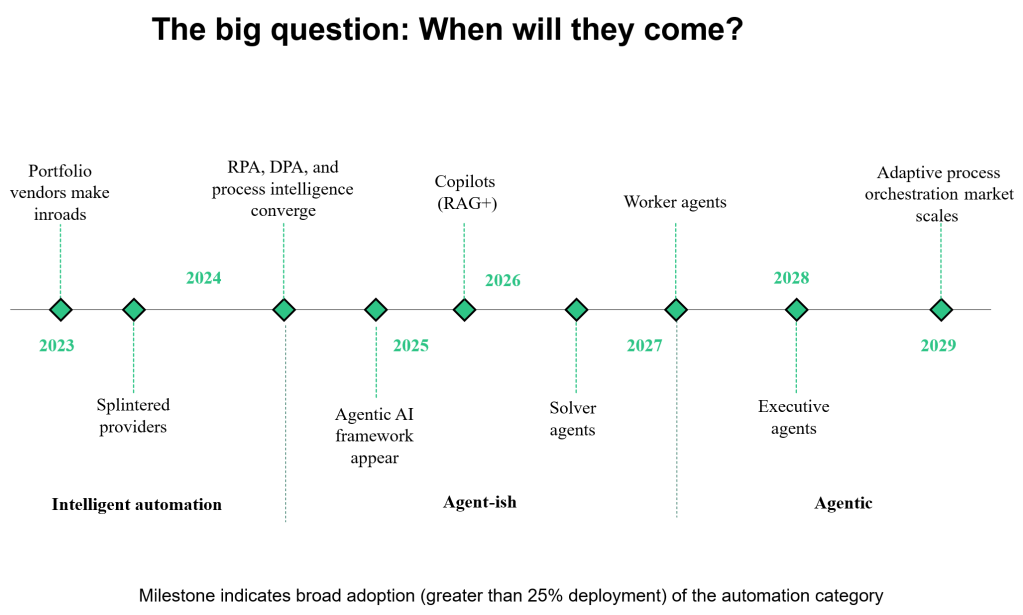
Forrester Research has a roadmap for broad adoption of various agent technologies in coming years. It shows helper-style agents like the ones announced by Box taking off gradually in 2026.

roadmap of ai agent progression from forrester research

Helper-style AI agents will see broad adoption by next year, according to Forrester. More complex agents capable of executive decision-making will take a little longer.

Forrester Research

But as AI agents advance to solving problems and making executive decisions, things will get more complex, said Craig Le Clair, vice president and principal analyst at Forrester.

There’s a huge gap between vendors of AI agents and the actual adoption profile of users and buyers, Le Clair said. “The gap that exists there is astounding,” he said.

Companies are advancing with AI agents, but it’s much more complex when it comes to sophisticated solvers and managing agents, Le Clair said.

“If you’re in a financial institution, you’ve built all these layers of process, control, risk mitigation, and reporting around the technology underneath. And you don’t change that easily, because it takes legal, compliance, meetings, security. It takes longer to change the processes that sit above the technology,” Le Clair said.

US companies are helping Saudi Arabia to build an AI powerhouse

Saudi Arabia unveiled a series of blockbuster AI partnerships with US chip makers, cloud infrastructure providers, and software developers this week, signaling its ambition to become a global AI hub.

Leveraging its $940 billion Public Investment Fund (PIF) and strategic location, Saudi Arabia is forming partnerships to create sovereign AI infrastructure including advanced data centers and Arabic large language models. Google, Oracle, and Salesforce are deepening AI and cloud commitments in Saudi Arabia that will support Vision 2030, a 15-year program to diversify the country’s economy.

Within that, the $100 billion Project Transcendence aims to put the kingdom among the top 15 countries in AI by 2030.

The deals announced during this week’s US-Saudi investment summit in Riyadh include a $20 billion commitment from Saudi firm DataVolt for AI data centers and energy infrastructure in the US and an $80 billion joint investment by Google, DataVolt, Oracle, Salesforce, AMD, and Uber in technologies across both nations, according to a White House fact sheet

The Riyadh summit, attended by US President Donald Trump and Saudi Crown Prince Mohammed bin Salman, drew tech luminaries including Nvidia CEO Jensen Huang and AMD CEO Lisa Su.

AI factories

Humain, an AI company backed by PIF, the Saudi sovereign wealth fund, was at the center of much of the deal-making. Nvidia said it will supply Humain with hundreds of thousands of its most advanced GPUs over the next five years with which the company will build “AI factories” with a capacity of up to 500 megawatts. The first of those will contain 18,000 Grace Blackwell GB300 systems, it said.

AMD announced a five-year, $10 billion collaboration with Humain to deploy up to 500 megawatts of AI compute in Saudi Arabia and the US, aiming to deploy “multi-exaflop capacity by early 2026.”

AWS, too, is expanding its data centers in Saudi Arabia to bolster Humain’s cloud infrastructure.

Saudi Arabia has abundant oil and gas to power those data centers, and is growing its renewable energy resources with the goal of supplying 50% of the country’s power by 2030.

“Commercial electricity rates, nearly 50% lower than in the US, offer potential cost savings for AI model training, though high local hosting costs due to land, talent, and infrastructure limit total savings,” said Eric Samuel, Associate Director at IDC.

Located near Middle Eastern population centers and fiber optic cables to Asia, these data centers will offer enterprises low-latency cloud computing for real-time AI applications.

Late is great

There’s an advantage to being a relative latecomer to the technology industry, said Eric Samuel, associate director, research at IDC. “Saudi Arabia’s greenfield tech landscape offers a unique opportunity for rapid, ground-up AI integration, unburdened by legacy systems,” he said.

Arun Chandrasekaran, distinguished VP analyst at Gartner, said the investments signify Saudi Arabia’s “ambition to become a central hub for AI development, rivaling established tech centers in the US and China.”

Other analysts weighed in on Saudi Arabia’s goals. Neil Shah, vice president research at Counterpoint Research, said the push could make it the next “oil hub” for AI, serving both local and global needs, while Amandeep Singh, practice director at QKS Group, said, “This isn’t just about money. It’s a strategic play to become a long-term AI power and a neutral meeting point for global AI.”

Despite the vast political and financial resources in play, though, the analysts forecast challenges ahead when it comes to attracting top talent, reducing reliance on Western chips, and building data governance trust.

While Saudi Arabia is a lucrative new market for companies such as Nvidia and AWS, “They must navigate questions of control and compliance,” said QKS Group’s Singh. Aligning with Saudi Arabia’s push for digital sovereignty requires a delicate balance between Western regulations, export restrictions, and the Kingdom’s drive for independence.

Political risks

IDC’s Samuel noted that initiatives like Humain can foster trust and alignment with national priorities, but added, “With the right oversight and governance, political risks can be managed and long-term AI development secured.”

Building a real AI power bloc in the Middle East is still a tough climb, the analysts said.

“Saudi Arabia’s ambition needs more than just cash to turn into real influence in the region,” said Singh. “They need shared tech foundations, common AI standards across countries, and everyone to agree on policies — and we’re not quite there yet.”

Making strong partnerships with other companies and countries will be key for Saudi Arabia to turn its big investments into lasting global influence, the analysts said, making sure its AI plans become more than just a showpiece.

Turning Saudi Arabia’s AI ambition into real regional power won’t be easy. “Money alone won’t get you there — you need shared foundations, aligned policies, and buy-in from the neighborhood,” said Singh.

Google patches Chrome vulnerability used for account takeover and MFA bypass

Chrome users are advised to update their browser immediately to fix a critical vulnerability that is being exploited to launch account takeover attacks.

In some environments, this could even give attackers the ability to bypass multi-factor authentication (MFA).

The recently-reported vulnerability, one of four fixed in a Wednesday update, is tracked as CVE-2025-4664 and affects all versions of Chrome prior to version 136.0.7103.113.

Google’s advisory says very little about the flaw beyond stating, “Google is aware of reports that an exploit for CVE-2025-4664 exists in the wild.”

That explains the urgency of the fix being issued outside the normal update cycle, an ‘emergency patch’ if you like. These come along occasionally, and given the daily use of browsers, are always a priority for users and admins alike.

How Apple wins for enterprise IT

It hasn’t been that long since Apple had no status at all in enterprise IT. Its products were used in some creative departments and at home, but that’s as far as things went. The iPod and iPhone changed all that, even while general exposure to powerful mobile tech transformed perceptions around what to expect from the tools you use at work.

The Apple user experience is the company’s biggest not-so-secret weapon, and it is interesting that even decades since the first PCs appeared, Apple still delivers intuitive user experiences  people enjoy using.

Consumer simple, enterprise ready

Those user experiences have generated expectations, and as my old chum Dean Hager, former Jamf CEO liked to describe it, people entering the workplace wanted the systems they used there to be as easy and intuitive to understand as the Apple products they used elsewhere. Apple’s user experience eventually became something incoming enterprise employees expected — many would simply quit their job if they were using crummier tech at work than they were at home.

At the end of the day, Apple won the enterprise one consumer user at a time.

But the other piece to Apple’s success is that organizations that have deployed Apple products at scale have experienced significant improvements on their bottom line. Multiple reports tell us employees are happier using Apple products, they’re more productive using Apple products, and spend less on tech support on Apple products than on PCs. Staff retention rates improve even as productivity grows — and the reduced tech support costs make life easier for IT and dramatically reduce the Total Cost of Ownership of an Apple fleet. 

How Apple wins for enterprise IT

None of this came easy. Apple had to take its basic product (the Mac) and its OS X operating system and figure out how to best apply that tech to mobile devices. That’s what we began to get with the iPod and saw in living Technicolor with the iPhone; Apple took the power of computing and placed it inside the device you always have with you – your phone.

Of course, the ability to run more complex applications on your iPhone made it possible for employees to get more work done using the device, which spawned the Bring Your Own Device wave that really began to express itself around 2010.

Not only did employees want to be able to use the same platform at work as at home, but they also wanted to use the same mobile devices at work as at home. The biggest evidence of that was the abject failure of Windows Mobile as it showed people didn’t want to use the same PC they used at work in their mobile existences; they remained hooked on experience Apple’s ease-of-use. 

They did then. 

They do now.

The evidence is everywhere

You can see this is the direction of travel each time you read yet another report explaining Apple’s growing enterprise sales across all of its products, or the fast-proliferating number of Very Large Indeed Apple deployments at giant global companies. Not to mention that once employee choice schemes are put in place, the majority of employees seem to prefer Apple to any other platform. While it’s still early days on spatial computing, we can already see Vision Pro devices staking spaces across key industries as Apple takes what was once more or less the Mac experience and makes it both ambient and hyper-mobile.

Spatial computing isn’t just about computing that surrounds you, it’s about computing that takes you there.

Along this journey, Apple has thought deeply about what it offers and attempted to take down barriers to enterprise deployment. That’s why the company provides APIs for Mobile Device Management; that’s why it has high-grade security features I’m certain the company’s own CEO also uses, such as Lockdown Mode; that’s also why it remains so deeply committed to delivering regular software and hardware updates, so no enterprise professionals find themselves left insecure or abandoned on their workplace tech journey. 

Want to do more? You can, thanks to the company’s’ rich set of developer tools, which provide a robust environment for enterprise development and integration. 

Support and updates

The fact that Apple’s hardware is reliable is also good for enterprise sales. Coupled with annual software updates that bring sometimes-exciting new features, user engagement remains high throughout the usable life of these devices, which now usually extends to an easy five years. Once that time is up, the resilience and reliability of the devices means they still fetch good value in the second-user markets; most major purchasers might also draw reassurance that the recycling and salvaging of the products will have some impact on their own carbon targets. 

Enterprises also like reliability for another reason, it helps them plan ahead. 

Not only do they know that it is unlikely Apple will make too many major changes (though we do experience smaller ones), but they also know that unlike Windows 11, you will not wake one morning to find your PC has been updated to a new operating system without consent. These little communications do count, particularly if you are running several hundred systems in your fleet. You also cannot ignore the impact of the CrowdStrike debacle on that lovely feeling of peace and calm enterprises perhaps enjoyed before it took place.

Apple’s platform security may not be something we can take for granted any longer, but it still exists — and while it makes sense to stay watchful, it remains unmatched. Its major software updates remain free (at least until regulators utterly wreck the company’s business). That’s always an easy budget line item at the end of the day. 

What Apple gets wrong

It is interesting, given all that it gets right, the extent to which critics like to focus on what Apple gets wrong. Some of the most common criticisms could translate into easy wins for Apple: Yes, I think it should provide more in-depth granular information to assist enterprise IT deployments, but I would also argue that its free certification courses remain the best possible way to find the answers you need to begin managing larger or newer Apple deployments. Those courses are free, well-constructed and give you a thorough grounding for this work. Though I would really like Apple to give Configurator the power to register multiple devices at once – and a little more automation would come in useful to a lot of admins, particularly in the education sector. 

But what’s super-interesting about so many of the criticisms made around Apple in the enterprise is that they tend toward being smaller, more granular problems that the company could conceivably resolve once it stops pouring all of its R&D resources into AI development. 

And that’s my point, really — to quietly point out that the nature of the criticisms Apple’s current enterprise solutions receive actually reflect how successfully it has penetrated the sector. It is now being asked to solve really complex questions that reflect the myriad complexities of enterprise IT requirements. It won’t solve all of them overnight, but its progress in the sector since earlier this century suggests it will probably get around to resolving many of them, one challenge at a time.

And, rest assured, while Apple never speaks about it, I’m confident that the company does actually read criticism; it just needs to be selective concerning which challenges to solve first. And at times it must also consider whether those challenges will still be relevant a few years as tech deployment requirements change.

Please follow me on Twitter, or join me in the AppleHolic’s bar & grill and Apple Discussions groups on MeWe.

Demand for freelancers explodes, thanks to agentic AI

Freelancer, Freiberuflerin, Home-Office

insta_photos – Shutterstock.com

As the spring 2025 edition of Fiverr’s “Business Trends Index” shows, companies are looking for specialists who can effectively implement AI agents. According to new data from the freelancer platform, search queries for this expertise have risen by 18,347% in the last six months. In Germany, inquiries increased by an even larger 19,033%.

According to Fiverr, this is due to technological advances in the field of agentic AI, which enable “digital colleagues” to perform tasks such as reading emails, scheduling meetings, or answering customer inquiries independently and without constant supervision. While experts predict that agentic AI could become a trillion-dollar market, many companies are struggling with the challenges of implementing the technology — so they’re turning to freelancers with these specific skills.

“Nearly 30% of my Fiverr assignments are for AI agent development, with demand shifting dramatically from simple chatbots to multi-agent systems that work across web, WhatsApp, and voice channels,” says Mark Kashef, an AI consultant on Fiverr and founder and CEO of Prompt Advisors. “Companies have gone from asking ‘What can AI do?’ to ‘How quickly can we integrate AI into our workflows?’ — with automation, voice and integration requests now making up 49% of my project pipeline.”

[ Related: Freelancers now represent more than one in four US workers ]

Yoav Hornung, Head of Verticals at Fiverr, explains the increased demand with the strong discrepancy between companies’ ambitions and their technical realities. Despite the great interest in AI agents, most companies do not know exactly what they are or how they can be used. This knowledge gap is driving the increased demand for freelancers.

“Now that generative AI is widely available, many companies are turning to freelancers to elevate their content with new perspectives, creativity, and expertise that will elevate their work beyond what automation alone can achieve,” says Hornung.

According to Fiverr, this paradox is reflected in the 641% increase in global demand for freelancers who can “humanize” AI content — rewriting chatbot scripts, marketing emails, and website content to make it appear more natural.

“I thought my copywriting services wouldn’t be as much in demand after the launch of ChatGPT, but I get requests almost daily to rework AI texts so they still sound human,” the platform operator quotes Gabrielle Gerbus, a freelance brand developer.

In addition to AI itself, companies are also increasingly relying on freelance experts to implement workflow automation tools. Fiverr data shows a growing demand for experts in workflow tools such as Go High Level (up 1,489%) and Make.com (up 1,083%). Experts who can create newsletters on trend platforms such as Substack (up 2,028%) and Beehiiv (up 1,211%) are also increasingly in demand.

Zoho integrates payments into enterprise workflows with Zoho Payments

Zoho has announced Zoho Payments as a unified payment platform for US businesses, aimed at helping CIOs streamline financial operations with enterprise-grade security and scalability.

Fully integrated with Zoho’s ecosystem — including Zoho Books and CRM — Zoho Payments supports card and ACH transactions across 135+ currencies, according to a company statement.

“Businesses need a payment solution that not only offers flexibility, but is also tightly connected to their financial operations,” Raju Vegesna, chief evangelist at Zoho, said in a press note. The platform taps into Zoho’s AI capabilities — from Analytics 6.0 to DDPM — to automate workflows and accelerate digital transformation in a cashless economy.

The move positions Zoho against entrenched players such as Stripe and PayPal, offering a natively integrated alternative built for mid-size companies and large enterprises.

Native integration

Zoho Payments aims to eliminate third-party gateways by integrating with Zoho’s finance and sales apps and reducing system sprawl — a top CIO pain point. Built to mirror the synergy seen in Zoho Analytics 6.0 and DDPM, it is designed to focus squarely on end-to-end financial workflows.

“Our transportation company used third-party portals before, but the extra logins and disconnected integrations disrupted our flow,” James Martin, Founder and CEO of Keystone Transport Services, said in a press release. “Zoho Payments, integrated with Zoho Books, unified our processes and cut onboarding time significantly. Now, one person can easily accomplish over 100 times the work as before,” Martin noted. 

“Zoho Payments’ native integration simplifies IT environments and reduces costs,” said Divya Baranawal, principal analyst at QKS Group. “With automated reconciliation and payout tracking, it eases finance workloads while aligning IT with business goals.”

Market positioning

Zoho Payments provides enterprises with PCI DSS Level 1 compliance and real-time fraud detection, mirroring Zoho’s security focus in Analytics 6.0. The offering supports over 135 currencies, enabling global transactions while maintaining local compliance. Zoho Payments will support both one-time and recurring payments, catering to e-commerce and subscription-based business models.

Industry data indicates a broader trend towards cashless transactions, with approximately 87% of transactions now cashless, according to Capital One Shopping data, and 81% of US consumers preferring card payments. This shift is driving businesses to adopt payment systems that accommodate these evolving preferences.

In a crowded field, Zoho’s edge lies in native plug-and-play integration with Zoho Books and CRM, contrasting with Stripe’s API-heavy setup and PayPal’s SMB focus. Adyen offers strong global coverage but involves more complex integration. While Zoho’s pricing is comparable to Stripe’s, transparency remains limited.

“Zoho Payments’ value proposition hinges on AI-driven automation via Zia Agents and Projects Plus, offering CIOs real-time insight and agility,” said Baranawal. Still, Stripe’s API flexibility remains a key advantage for organizations requiring highly customized solutions.

Data on sale: Trump administration withdraws data broker oversight proposal

The US Consumer Financial Protection Bureau has withdrawn a proposed rule that would have restricted data brokers from selling US citizens’ personal and financial information.  

The decision, announced Wednesday in the Federal Register, marks a significant reversal in consumer privacy protection efforts and raises serious concerns about the security of sensitive personal data. 

Beyond the office: Preparing for disasters in a remote work world

Despite high-profile return-to-office mandates from the likes of Amazon, AT&T, Dell, and even the US government, many organizations continue to support employees who work remotely. According to a November 2024 Gallup poll, 26% of US workers with remote-capable jobs work outside the office full-time.

Embracing remote work opens the door to having employees located in different parts of the country or different regions of the world — and that makes it more likely that individual employees will be affected by emergencies that occur far from corporate headquarters, ranging from simple power outages to catastrophic storms, wildfires, earthquakes, and other natural disasters.

In the US alone, 90 major weather-related disasters were declared in 2024, according to an analysis of federal data conducted by the International Institute for Environment and Development. The researchers estimate that 137 million Americans — about 41% of the population — live in areas that were under major disaster or emergency declarations last year.

When disaster strikes, employees may be without electricity, internet, or cell service for days or weeks. They may have to evacuate their homes. They may be struggling with the loss of family members, friends, or neighbors.

Just as organizations have disaster mitigation and recovery plans for main offices and data centers, they should be prepared to support remote employees in disaster situations they likely have never encountered before. Employers must counsel workers on what to do, provide additional resources, and above all, ensure that their mental health is attended to.

This may sound like a job for HR — and it is — but it’s IT’s responsibility to make sure remote employees have the tools they need to stay in contact during a disaster, to protect sensitive data on their devices, and to help them get back to work when it’s safe to do so.

Organizations that look after their employees when they need it the most may see benefits in the form of increased engagement, productivity, and retention: Who wouldn’t want to work for an employer that truly cares about your welfare?

We spoke with tech leaders and disaster recovery experts for their advice on how companies can prepare for and support remote employees facing a disaster situation.

Plan for the worst through simulations 

Dr. Oliver Schlake, director of the BSE Scholars Program at the University of Maryland and a survival instructor for 40 years, says there is a significant cultural component to disaster preparedness — or the lack thereof.

People often prefer the “hero” over the “person who’s doing the continued maintenance,” he says. For example, people will hail the firefighter who rescues a victim from a burning house, but not the janitor who changes the battery in the smoke detector that helps to prevent the spread of fire in the first place.

As a result of this cultural tendency, organizations under-invest in tools, resourcing, and programs necessary for disaster preparedness. “There’s no ROI on their reliability until [a disaster] happens. And that’s why a lot of organizations cut out those backup systems,” he says.

To avoid this short-sighted thinking, business leaders should prepare well in advance of any disaster. While companies can offer disaster preparedness training in a classroom setting, Schlake recommends hands-on simulations for greater effectiveness. For example, the organization could shut off its intranet or force employees to switch off their usual internet connection to mimic a disaster where connectivity is limited.

Schlake introduces companies conducting these exercises to a decision-making framework called the Rule of Three. “You basically use time intervals of three — three seconds, three minutes, three hours, three days, three weeks, three months — to prioritize your activities in a disaster situation,” he says.

The goal is not for business leaders and employees to respond flawlessly to a simulated disaster. Instead, it is to help them identify gaps they can address before a real crisis occurs.

For example, during an exercise, a B2B organization working with Schlake realized that if its Voice over Internet Protocol (VoIP) system were disrupted, its employees would be unable to make client calls. To mitigate this risk, the company purchased around 100 burner phones, pre-programmed them, and stored them for emergency use. The foresight paid off: six or seven months later, when a disaster prevented employees from coming on-site, the phones became essential for maintaining client relationships.

Organizations will come to their own unique realizations through these simulations, which should include remote and hybrid workers as well as those who work in the office full-time. If a company discovers it has no means of communicating with remote workers in a power or internet outage, for example, they may decide to outfit those workers with additional communication tools or come up with other contingency plans.

Protect employee devices

Depending on the disaster, a remote employee’s home office may be unavailable: It may have been ravaged by a fire or flood, or they may be under evacuation orders from local or federal authorities.

In such cases, employees who are otherwise unaffected by the disaster may go to coffee shops, libraries, or other public locations to connect to the internet and continue working. These environments make organizations more prone to cyberattacks, says Jocelyn Rhindress, a senior manager in business resource initiatives at the Canadian Federation of Independent Business (CFIB).

During an outage of a Canadian telco in 2022, remote workers had to take this exact risk. “A lot of at-home workers flocked to places — coffee shops and quick-service restaurants — to use their public Wi-Fi,” she says. “So one big problem is just unsafe networks.”

To mitigate this risk, the organization’s IT department needs to make sure that employees are provided with the right tools to protect sensitive information, such as virtual private networks (VPNs), says Kris Lahiri, CSO and co-founder of Egnyte. Like all disaster planning, installing VPNs and other security tools on workers’ laptops should be done well in advance of an actual disaster.

Help with ‘personal disaster recovery planning’

Beyond cybersecurity risks, being forced to leave their home environment presents employees with another significant challenge: the potential loss of personal artifacts, from tax documents and family heirlooms to cherished photos.

Lahiri refers to the process of safeguarding such items as “personal disaster recovery planning” and notes that this aspect of worker support is often overlooked. While companies have experience migrating servers from local offices to distributed teams, few have considered how to support employees on a personal level, he says.

Lahiri urges IT teams to take a more empathetic approach and broaden their scope to include disaster recovery planning for employees’ home offices.

“It’s important for IT to help these people to think, ‘Hey, have you thought of your personal stuff? Like, where do you keep your valuables? Are you making sure that your tax files and other financial info is backed up someplace?’” he says.

Some might see advising employees on personal disaster recovery as beyond the IT department’s role. However, Lahiri argues that this guidance is essential as part of the organization’s broader mandate to ensure employees’ safety and well-being.

Mitigate risks across geographies

Beyond addressing individual employees’ needs, companies must also take a macro view of their workforce to prepare for disasters. As businesses become not only more remote but also more global, understanding employees’ locations becomes crucial.

“As a company, I would monitor where all my remote workers are,” says Schlake from the University of Maryland. The goal is to help companies create contingency plans when a disaster is on the horizon for a particular location.

“When I see there’s a crisis coming up in a certain area, I can take preventive measures,” he says. For example, if a typhoon is approaching the Philippines, a company can plan how it will compensate if, say, 5% of its Philippines-based workforce loses internet access.

To maintain business continuity, companies must pay special attention to business-critical roles. Hiring and training should be approached with a global mindset, allowing for backup workers in different locations to step in when disasters affect specific geographies, says Egnyte’s Lahiri.

Oxfam International takes this kind of strategic approach to workforce management. According to CIO Kenny Kamal, the organization’s mission to fight inequality and end poverty often requires responding to natural disasters and crises worldwide.

“This often means that Oxfam staff and partners are responding while managing the risks to themselves and their own communities,” he says.

To tackle this challenge, Oxfam prioritizes “key operational locations rather than individual endpoints,” Kamal says. This strategy relies on hubs that support hybrid teams in disaster-affected areas. These hubs are equipped with redundant power solutions, backup internet connectivity, and prepositioned resources such as satellite kits and solar-powered chargers.

Building on this foundation, Oxfam develops multiple contingency plans to guide employees in crisis situations.

“To prepare for a range of scenarios, organizations should develop scalable disaster response plans. By categorizing disasters by impact — localized, regional, or wide-scale — teams can follow clearly defined protocols,” he says.

Put employee well-being above all else

Preparing for disasters is a complex challenge that requires companies to focus on agility, redundancy, flexibility, resilience, and business continuity. But employee well-being must remain the top priority.

CFIB’s Rhindress notes that in some locations, such as Canada, health and safety are legally mandated components of any disaster response plan. However, organizations should aim to go beyond mere compliance — starting with effective communication.

“It might come down to sharing your personal cell phone number or making sure there’s a way for your employees to always get in touch with someone,” she says.

Mario Jabbour, Chief Finance & Admin Officer for Project HOPE, a global health and humanitarian organization, echoes this perspective.

“Prioritizing employee well-being with mental health resources and balanced expectations, along with clear policies, training, and disaster response guides, is key to navigating crises effectively,” he says.

Oxfam’s Kamal also advocates for mental health support, flexible work arrangements, and open communication. Since no organization will execute employee support perfectly, he stresses the importance of continuous self-assessment.

“After every disaster response, it’s essential to evaluate what worked and what didn’t. Learning from these experiences allows organizations to refine their plans and strengthen their collective resilience,” he says.

Kamal emphasizes that while disasters are inherently unpredictable, proactive preparation can significantly mitigate their impact. “By focusing on resilience, flexibility, and the well-being of hybrid teams, organizations can empower their workforce to navigate challenges with confidence and continue delivering on their mission when it matters most,” he says.

CDAOs might be key to genAI success now — but that could change

Before organizations can effectively deploy generative AI tools, the data on which they must be trained has to be preprocessed to ensure it’s organized, standardized, and cleaned from outliers, duplication, and errors.

Without that, attaining ROI from any genAI project is next to impossible. In fact, over the past couple of years, case studies have shown one in three AI projects fail to reach completion or produce an ROI because of unclean data.

A Gartner survey this week indicated that one top-level position in particular is key to genAI deployment success: the Chief Data & Analytics Officer (CDAO) — so much so that the position has now been given executive status at most companies. (Gartner added “analytics” to the CDO title a few years ago to indicate a changing role, which now involves combining data management with analytics strategy to generate insights and business value.)

“The integration of AI into business strategies has further solidified the CDAO’s role as a top-tier position within companies,” said Sarah James, a Gartner senior director analyst.

Beyond data and analytics, CDAOs are now central to genAI readiness — critical for driving better business outcomes, as shown in Gartner’s CDAO Agenda Survey for 2025. “This year is a critical one for CDAOs, as AI presents a new opportunity for them to establish their rank in AI leadership,” James said.

The exact mission and function of the CDAO role, however, remain unclear.

In Gartner’s CDAO Agenda Survey for 2024, 74% of respondents reported that executive leadership has confidence in their data and analytics (D&A) function, but the rationale for that confidence is not fully substantiated. Only 49% had established business-outcome-driven metrics that allow stakeholders to track D&A value.

“Respondents reported having an average of 14 primary responsibilities — a year-over-year increase of 56% from 2023 — suggesting a tactical rather than strategic focus,” James said. “There is clearly work to do for CDAOs to establish themselves, their function, and their value to the organization.”

Meanwhile, Gartner predicts that by 2027, 75% of CDAOs who aren’t seen as essential to their organization’s genAI success will lose their C-level position.

CDAOs are currently uniquely positioned to lead genAI efforts thanks to their data expertise and cross-organizational reach, according to James. “Their role is pivotal — no one else is better placed to connect the dots and drive AI success,” she said.

According to the survey, 70% of CDAOs have the primary responsibility for building AI strategy and an operating model for the organization. In light of that, 36% of CDAOs now report to the CEO, up from 21% in 2024.

Tom Davenport, a distinguished professor of IT and management for Babson College, said he was surprised Gartner’s survey found 70% of CDAOs reportedly have primary responsibility for genAI efforts. His research shows it’s usually shared with CIOs, CTOs, and CDOs.

If true, he said, it would mark a major shift in the CDO/CDAO role, even as AI is a “hot topic” many execs want to lead. “That said, responsibility for AI will have its challenges for CDOs, who already face a number of them,” Davenport said via email. “An IBM survey of CEOs released last week found that only 25% have seen the expected ROI from their AI projects. It won’t be easy for CDOs to address that issue.”

At the same time the CDAO or CDO role is gaining importance, only 8% of companies considered to be leaders in genAI deployments are scaling the tech at an enterprise level, which means embedding the technology into core business strategy, according to a report by professional services firm Accenture.

Scaling AI starts with data, according to Accenture, and while 70% of the 2,000 companies it surveyed recognize its importance, few fully leverage their proprietary data. And only 15% are “AI reinvention-ready” and have built the essential capabilities needed to scale AI successfully, according to the firm.

The CDAO role is expected to soon evolve in three distinct directions, according to Gartner:

  • Expert D&A Leader: A senior data leader (often a vice president or head of data) with a cross-functional view, overseeing business intelligence, mobile device management, reporting, and data platforms. The person typically reports to IT and supports data strategy across the business.
  • Connector CDAO: Someone who bridges CxOs with D&A, embedding smart solutions into products and services. They drive the AI agenda and act as key leaders in an organization.
  • Pioneer CDAx: A transformational exec who combines the CDO, CDAO, and CDAIO roles, leads cross-functional D&A and AI efforts, ensures ethical governance, and champions innovation.

Some believe CDO and CAIO roles might have a built-in expiration date. An earlier Gartner survey of 400 software engineering leaders indicated that up to half of their software development teams employ various genAI tools to augment workflows, acting as force multipliers rather than replacements.

Davenport agreed, and has written about the phenomenon in the past.

After years of being focused primarily on data — not employee — management, surveys show CDOs often lack the skills to tackle the cultural challenges critical to a data-driven culture, Davenport said. “Surveys of CDOs also suggest that their jobs are less well understood than other C-level executives,” he added.

In one recent article, Davenport argued there are too many technology-focused C-level executives in many companies, including CIOs, CTOs, Chief Data and/or Analytics Officers, Chief Digital Officers, and CISOs. “The CIO role is much better understood and while it, too, once was characterized by short tenures, it’s much more familiar than the CDO role,” he said. “Many CDOs focus primarily on data governance and management activities for which it is difficult to demonstrate value. Those who also have analytics and AI responsibilities have a somewhat easier time of that.”

Given the critical role now of genAI in shaping business strategies, aspiring CDAOs should focus on developing expertise in data, analytics, and AI technologies, James said.

The demand for CDAOs who can effectively lead genAI initiatives, navigate the technology’s complexities, and leverage it for competitive advantage is increasing, she added. “Individuals interested in this career path should aim to acquire skills in AI readiness, data governance, and strategic leadership, as these are essential for driving successful AI integration within organizations,” she said.

Microsoft faces UK class action lawsuit over licensing

Microsoft faces more legal action in the UK, this time from a barrister named Alexander Wolfson who issued an opt-out class action claim this week alleging that public or private organizations in the UK that purchased certain software licenses (including for Microsoft Office and Windows) since October 1, 2015, were overcharged due to Microsoft’s market practices.

Wolfson, who retained the services of Stewarts LLP, a litigation-only law firm, said in a release issued on Wednesday, “Microsoft’s actions have had a significant and far-reaching impact on UK consumers, businesses, and public bodies.”

This claim, he said, “seeks to hold Microsoft to account and to secure compensation for the many affected members of the class. With billions of pounds potentially at stake, this case is about ensuring fairness in the digital marketplace and ensuring even the largest tech companies play by the rules.”

“Microsoft’s conduct has had a profound and costly impact on millions of individuals and private and public sector organizations that rely on its software for daily business operations,” said Kate Pollock, the head of competition litigation at Stewarts. “We believe that Microsoft abused its market dominance by imposing restrictive licensing practices that effectively shut down competition and inflated prices.”

Highlights an industry-wide issue

An FAQ created by the plaintiff explained the format of the suit: “Opt-out collective proceedings are a special form of court proceedings that enable a class representative to bring a claim on behalf of a defined class of persons in the UK affected by an infringement of competition law,” it said. “This means that if your organization fits within the class definition you will automatically be included in the claim and will be bound by any judgment or settlement unless you choose to opt-out of the proceedings.”

Ellora MacPherson, managing director and chief investment officer at Harbour, which has agreed to fund the case, described the suit as “likely to be one of the largest the UK has seen and is an example of how big corporate entities can be held to account.”

Forrester Senior Analyst Dario Maisto pointed out Wednesday via email, “this is not the first time that Microsoft gets attention for allegedly unfair commercial practices. Microsoft was also sued in the UK in 2024 over allegations that it overcharged Windows Server customers to use the software on competing cloud platforms.”

He added, “the Cloud Infrastructure Providers in Europe organization (CISPE) took a similar action on Microsoft’s licensing practices when its cloud computing competitors filed a complaint against Microsoft with the European Commission.”

According to Maisto, “while it is totally understandable why law firms and competitors keep engaging in such lawsuits against Microsoft, we should finally admit that these are all symptoms of a bigger issue, that is, people and organizations’ extreme [dependence] on third-party proprietary solutions and a fundamental lack of alternative standards.”

This is, he said, the problem that we as an IT industry need to solve, as we cannot keep relying on specific lawsuits to address — one at a time — all the problems of what we could start to define now as a much broader market disfunction.” 

Computerworld reached out to Microsoft for a comment but at press time had not received a response.

More Microsoft news:

>