Month: July 2025

Will IT turn the AI bot battle into a money maker? (And is that even a good idea?)

Enterprise IT has been waging a difficult battle against generative AI (genAI) bots and crawlers, and banning some crawlers has simply not worked. That’s led to both data leakage and painful out-of-pocket bandwidth costs.

Cloudflare is one of the few companies that has had some success in blocking these unwelcome visitors, although some have complained that by blocking most of the crawlers, Cloudflare is also filtering out some legitimate traffic. 

Now, Cloudflare is exploring a different tactic: If you can’t beat them, charge them. Cloudflare’s plan is to use different mechanisms to enable charging the visitors. 

“We’re excited to help dust off a mostly forgotten piece of the web: HTTP response code 402,” the company said in a blog post. “Each time an AI crawler requests content, they either present payment intent via request headers for successful access (HTTP response code 200), or receive a 402 Payment Required response with pricing. Cloudflare acts as the Merchant of Record for pay per crawl and also provides the underlying technical infrastructure.”

Cloudflare deserves credit for getting creative with the problem, but its initial description doesn’t go into a lot of details about the pricing particulars, other than saying it’s up to the site owner. 

As tempting as this offer might be — and for a smaller business, it could prove irresistible — enterprise IT should think seriously about whether this arrangement is in a company’s long-term interest.

Setting a price

The key question is whether there’s any reasonable/realistic price that makes long-term sense. 

Cloudflare did not say whether it would require a revenue share with the enterprises. But given the effort it’s putting into this venture, it seems likely there would be some kind of a split. (If it had decided not to take a cut, it seems likely Cloudfare would’ve mentioned that. That makes me think some kind of split is on the table.)

Setting that calculation aside, how much money makes it worthwhile to the company?

For starters, there is the bandwidth issue, which is what started this whole controversy. These spiders tend to spend a lot of time grabbing everything they can, creating a massive bandwidth bill for Cloudfare customers.

But there’s no practical way to determine that figure ahead of time. Will a genAI firm agree to cover the costs of added bandwidth weeks or months ahead? And as I’ve noted before, isolating the added bandwidth costs generated by any one spider is all but impossible.

Even if you could somehow resolve the bandwidth payment issue, that’s only a small part of a larger compensation issue. Shouldn’t companies also be reimbursed for the use of their content? How is that possibly calculated?

Given that a genAI agent will grab once and use many times, what dollar amount is appropriate?

Then there are the compliance and cybersecurity issues. If an agent grabs sensitive customer data (PII, payment details, purchase histories, etc.), how do you offset the financial losses if that data gets out into the wild? Fines? Lawsuits? What if your security credentials are grabbed? What if someone improperly locked down a decryption key and the agent grabs it?  

Will it even work?

Another of the big challenges with genAI agents/crawlers/spiders is that they tend to be quite good at obfuscating themselves and working around barriers. If they can get around most “do not enter” text barriers, how much harder will they work to sidestep “pay here” hurdles?

The strategic question is simple. Is it in a company’s longterm interests to hand over almost all of its data to a genAI agent? And if it’s not, then the money payment situation is at best a distraction. 

Assume this: Once your data gets incorporated in a large language model, it’s gone. This is a forever decision. And that’s why you don’t want to let a quick small cash grab rob you of that.

Cloudfare posed some excellent strategic questions. In its blog, it wrote that companies “might want to charge different rates for different paths or content types. How do you introduce dynamic pricing based not only upon demand, but also how many users your AI application has? How do you introduce granular licenses at internet scale, whether for training, inference, search, or something entirely new?”

The company added another critical possibility: “The true potential of pay per crawl may emerge in an agentic world. What if an agentic paywall could operate entirely programmatically? Imagine asking your favorite deep research program to help you synthesize the latest cancer research or a legal brief, or just help you find the best restaurant in Soho — and then giving that agent a budget to spend to acquire the best and most relevant content. By anchoring our first solution on HTTP response code 402, we enable a future where intelligent agents can programmatically negotiate access to digital resources.”

Interesting. But does your enterprise want to permanently support those efforts?

Also, I hate to be cynical, but why would your team trust an agent’s representations about their intended use of the data? What possible motivation would the agent have to tell the truth?

Send in the clones

We’re all so busy that it’s tempting to wish for a digital clone to share the workload. And now, thanks to AI, you can. 

Many people are embracing generative AI (genAI) tools to make a clone or digital twin of themselves that can speak and even interact on their behalf. 

We’re all familiar with the idea of creating fake people using AI. But a digital clone is an AI replica of a real person, with the same appearance, voice, mannerisms, and pertinent knowledge as that person. 

Of course, the first thing that comes to mind when we think about digital clones is fraud and porn. Creep factor aside, legitimate and ethical applications for digital clone technologies are emerging.

Some of the genAI tools people are using should be familiar to you: ElevenLabs, OpenAI’s ChatGPT, Google Gemini, Anthropic Claude, and others. 

You may be less familiar with Hedra’s Character-3, an AI model that enables the creation of videos featuring talking, singing, or moving digital characters. Led by CEO Michael Lingelbach and CTO Alex Bergman, Hedra released Character-3 in March. 

Here’s one way to use it. You can upload a photo of yourself, along with a recording of your voice. Then, you type a prompt about what you want the digital version of you to say and do. The system then bases the video on the photo, the voice on your sample, and the action on your instructions. 

The model can create full-body movement, not just faces, and accurately matches lip and facial motion to the audio. It handles up to 90 seconds of video in one go, with output up to 4K at 60 frames per second.

Character-3 is used by content creators, marketers, teachers, and businesses. For example, teachers can create videos with virtual instructors, and brands can utilize digital spokespersons for their advertisements. The tool is part of Hedra Studio, a web platform that brings together Character-3 and other AI tools for video, audio, and images. Hedra Studio enables users to build scenes, add backgrounds, and control the look and feel of each video. Developers can also use Character-3 through an API.

The most-watched creators who are assumed to be using Character-3 today are comedian Jon Lajoie, who runs the Talking Baby Podcast, and virtual singer and musician Milla Sofia.

It’s not just influencers. Businesses of all sizes are using Character-3 to make digital spokespersons and brand mascots for ad campaigns. Brands can create custom characters that match their style and message, and use them in ads, social media, and customer support videos. One benefit is that brands can quickly respond to fast-moving current events or changing circumstances and build the creative for a campaign in minutes, not days. 

Businesses can also use Character-3 for internal training, making videos with animated trainers who guide employees through new processes or policies, while developers and AI enthusiasts use the Character-3 API to build new apps and services. (They integrate the model into their own platforms to create custom video tools, chatbots, or virtual assistants.)

Teachers and educational companies can use Character-3 to make lessons with virtual instructors. These digital teachers can explain complex topics, act out scenarios, or speak in different languages, making learning more engaging and accessible. The tool is already used in both schools and online education platforms.

Hedra claims over three million users and more than 10 million videos created with Character-3, showing its broad reach across industries and creative fields.

Clones mean business

Enterprises, mom-and-pop shops and everything in between can use genAI tools to create digital clones or digital twins of their leaders, and for several reasons. These digital versions are virtual copies trained on the leader’s speeches, writings, interviews, and meetings. Companies like Delphi, Tavus, and Personal AI offer services to build these clones by feeding AI large amounts of data from the leader’s communication and behavior.

CEOs like Reid Hoffman, Sam Liang, and Eric Yuan have created AI replicas of themselves to attend meetings, handle investor calls, or answer employee questions when the real person is too busy. 

Another reason businesses create digital clones is to preserve and share institutional knowledge. A retiring executive’s AI clone can serve as a mentor to new employees, passing on wisdom and company culture. This helps keep valuable experience accessible even after a leader leaves. Some companies use these clones to onboard new hires by having the digital leader explain company values and strategies. (You can bet Apple would have created a digital clone of Steve Jobs if the technology existed while he was still alive.)

Digital clones also support decision-making and strategy. By embedding a leader’s style and vision into an AI, companies can empower teams with consistent guidance. The clones act as an always-available resource for employees, clients, and partners, offering the kind of advice and insights the real person might. This can expedite decision-making and ensure clarity throughout an organization.

Clones as a repository of knowledge and advice

While the idea of digital clones sounds like dystopian cyberpunk sci-fi (and, in fact, that is where the idea first emerged in the culture), it actually makes a lot of sense for some thought leaders. When people are so sought after that the demand for their wisdom, knowledge, or advice far exceeds their available time, AI can capture all the things they say and offer them up in an automated, interactive way. For such overwhelmed people, a digital clone is better than nothing. 

Becky Kennedy, a clinical psychologist from Manhattan, built a business around helping parents handle tough moments with their kids. She started sharing advice on Instagram in 2020, quickly gaining a large following of 3.2 million by 2025. Kennedy’s style is direct and practical. She often records videos between therapy sessions or after dealing with her own children.

Kennedy’s company, Good Inside, launched an AI chatbot called Gigi last year. The chatbot is built on her parenting method and uses OpenAI technology. Parents can use the app to get real-time advice, such as how to manage a child’s tantrum or how to talk about feelings.

The inevitability of superclones

A superclone (my own term) is a digital twin that mimics the appearance, voice, and mannerisms of a real person but possesses far greater capabilities and knowledge than the real person. 

The first application of superclones will likely be as personal assistants. When people can craft the ultimate AI helper, they might create it in their own image. 

Napster View is a small, high-resolution 2.1-in. 3D holographic display made by Napster — the same brand but different company as the peer-to-peer file sharing service in olden times. (The company launched Napster View in June, just after it rebranded from Infinite Reality and bought Touchcast for $500 million.) Napster View displays Napster Companion, an AI assistant platform. 

The system allows users to create and interact with their Napster Companion in real-time. It connects via USB-C and works immediately with no setup required. The device weighs less than 2.3 ounces and is made of anodized aluminum. 

Napster View allows users to turn their own face and voice into a digital assistant by recording themselves and submitting the video to Napster’s platform, which then creates a photorealistic 3D avatar that can speak, move, and respond in real-time. 

It looks and sounds like you, but has the knowledge of OpenAI and Gemini, which are the models that power the interaction. 

Another concept for a superclone would be a CEO or business leader who creates a twin with all their knowledge and ways of speaking, but which is fed real-time information about the company, markets, and other relevant data, effectively creating a digital version of that leader that is more knowledgeable than the flesh-and-blood version.

No matter how you look at it, the age of AI-powered digital clones is here. 

The fast way to fix a frozen Start menu or taskbar in Windows

From time to time, certain key elements in the Windows 10 or 11 user interface can go dormant. You click on or touch the Start menu icon, or other icons in the taskbar, and nothing happens. Keep trying, but nothing keeps happening. This can be anywhere from frustrating to infuriating.

Thankfully, there’s an extremely easy fix for this sort of behavior, as I will soon explain.

No need to restart, though that works, too

One ingrained response in many Windows users when the UI starts misbehaving is to restart their computers. And indeed, that does work to fix a nonresponsive Start menu or taskbar icons. But it takes time — at least a minute for most PC users — and can derail your productivity.

Because File Explorer handles processing for the Start menu and the taskbar, including its notification area, there’s a simpler, faster fix worth trying before you pull out the big gun.

If you press the key combination Alt-Shift-Esc or right-click an empty area in the taskbar, you can launch the Task Manager utility quickly and easily. Figure 1 shows the right-click pop-up menu in Windows 11 (left) and Windows 10 (right), from which you should select the Task Manager item to run that tool.

srcset="https://b2b-contenthub.com/wp-content/uploads/2025/06/fix-win-start-menu-taskbar-fig01-launch-task-manager.png?quality=50&strip=all 639w, https://b2b-contenthub.com/wp-content/uploads/2025/06/fix-win-start-menu-taskbar-fig01-launch-task-manager.png?resize=273%2C300&quality=50&strip=all 273w, https://b2b-contenthub.com/wp-content/uploads/2025/06/fix-win-start-menu-taskbar-fig01-launch-task-manager.png?resize=634%2C697&quality=50&strip=all 634w, https://b2b-contenthub.com/wp-content/uploads/2025/06/fix-win-start-menu-taskbar-fig01-launch-task-manager.png?resize=153%2C168&quality=50&strip=all 153w, https://b2b-contenthub.com/wp-content/uploads/2025/06/fix-win-start-menu-taskbar-fig01-launch-task-manager.png?resize=76%2C84&quality=50&strip=all 76w, https://b2b-contenthub.com/wp-content/uploads/2025/06/fix-win-start-menu-taskbar-fig01-launch-task-manager.png?resize=436%2C480&quality=50&strip=all 436w, https://b2b-contenthub.com/wp-content/uploads/2025/06/fix-win-start-menu-taskbar-fig01-launch-task-manager.png?resize=327%2C360&quality=50&strip=all 327w, https://b2b-contenthub.com/wp-content/uploads/2025/06/fix-win-start-menu-taskbar-fig01-launch-task-manager.png?resize=227%2C250&quality=50&strip=all 227w" width="639" height="703" sizes="(max-width: 639px) 100vw, 639px">

Figure 1: Right-click taskbar options in Windows 11 (left) are far fewer than in Windows 10 (right). In either, pick Task Manager.

Ed Tittel / Foundry

Use Task Manager to restart File Explorer

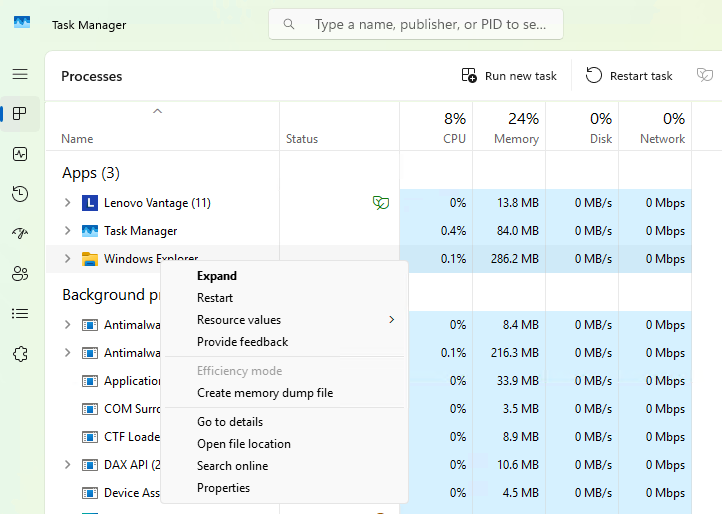
After Task Manager starts up, look for the entry named “Windows Explorer” under the “Apps” heading (see Figure 2). Even though the app itself is named “File Explorer,” it’s shown up as “Windows Explorer” in Task Manager since Windows 95 made its debut 30 years ago.

task manager window with windows explorer right-click menu

Figure 2: Right-click on Windows Explorer, then click Restartin the pop-up menu (2nd from top).

Ed Tittel / Foundry

If you don’t see Windows Explorer listed in Task Manager, no worries. Simply launch an instance of File Explorer. If you can’t do that from the taskbar or Start menu, use the Windows key + R shortcut. This opens the Windows run box, inside which you can type explorer (or explorer.exe). Once launched, it appears in Task Manager as Windows Explorer under the Apps heading as shown above.

Right-clicking Windows Explorer and selecting Restart from the menu that appears usually restores the Start menu and the taskbar to normal operation. This can take up to 30 seconds to complete, so wait for the taskbar to reappear before resuming normal Windows activity. That said, this restart is much faster than restarting Windows.

Don’t be surprised when you see the taskbar go blank and all icons disappear. This is a normal side effect of restarting File Explorer. Before it can be restarted, it must first be stopped — and when it’s stopped, all those UI elements disappear temporarily. However disconcerting this may be, it won’t last long.

As soon as the File Explorer process restarts, it restores the Start menu and taskbar icons and the UI behaviors they support. In the vast majority of cases, that will fix whatever caused the Start menu or taskbar icons to stop responding to user inputs via mouse or touch — and you can get back to work.

The old fallback

If that doesn’t do the trick, then it’s time to restart Windows. If the usual techniques (e.g., Start > Power button > Restart) don’t work, you can use Windows key + R and type the command shutdown /r /t 0 into the run box. (Warning! The /t 0 setting means Windows will restart immediately, so save what work you can before taking this route.)

This article was originally published in July 2021 and updated in July 2025.

More Windows how-tos:

Tariff uncertainty hits US PC shipments in Q2

The impact of threatened tariffs from the Trump administration could cause shrinking PC sales, particularly in the US market, and potentially in other regions across the globe as well.

This prediction was featured in the IDC Worldwide Quarterly Personal Computing Device Tracker, released Tuesday, which showed that, while global PC shipments during the second quarter of 2025 increased by 6.5% from the prior year, with 68.4 million units, the US market is starting to feel the pinch of import tariffs.

Jean Phillippe Bouchard, IDC’s research vice president of data and analytics, said, “what we are witnessing here might highlight US PC demand slowing down in anticipation of the import tariffs looming deadline.”

In an email to Computerworld, he added, “as we’ve seen with the latest quarterly results, the US market remained flat, while the rest of the world grew at 9% year over year. As PC vendors are looking for ways to mitigate the impact of tariffs on pricing, the supply chain is bound to be impacted.”

On Wednesday, Canalys reported similar results for the quarter, estimating that while worldwide shipments of desktops, notebooks, and workstations grew 7.4% to 67.6 million units, “the Trump’s administration’s ever-changing and unclear approach to tariffs continues to generate considerable uncertainty. While PCs were exempt from tariffs in Q2, indirect impacts threaten not only the US, but the global market recovery.”

No pending crisis

Greg Davis, lead US analyst on the Canalys team that put the findings together, said Thursday, “at this point in time, we do not predict that a pending crisis might exist, at least not one that is specific to the PC industry. While, as we have mentioned, there is still quite a bit of uncertainty surrounding the US and its global economic trade policies, many of the larger PC vendors have taken steps to help diversify their supply chains to better navigate what evolving scenarios may occur in the near-term.”

He said, despite that, “what may have a larger impact on the anticipated growth of the PC market this year, and next, is the rising cost of goods for everything else. When you look at consumer purchasing behaviors, expensive electronic devices like PCs are not as high a priority as things like food and energy.”

When overall purchasing power is impacted by rising costs, said Davis, “the PC market will face a downward pressure even if the industry itself is not directly affected by economic changes.”

Tariff situation a ‘moving target’

Scott Bickley, advisory fellow at Info-Tech Research Group, said, “the US market has already moved to accelerate PC purchases in Q1 of this year in anticipation of tariffs being enacted in July. Buyers who have not been proactive should prepare now while the tariff exemption window is still open.”

The tariff situation, he said, “is a moving target and changes daily in terms of the impacted countries, product classes affected, and level of tariff to be levied. PC buyers are sandwiched between the Windows 10 end of life date looming large, normal PC refresh cycles, and the prospect of some level of tariff to be a likely outcome at some point in the future. Some PC vendors are already trying to apply a tariff price increase to new PC sales; buyers should push back on this tactic.”

Mark Moccia, VP research director with Forrester Research, added that if PC shipments, which are currently exempt, do become impacted by tariffs, there’s the potential for ballooning costs for enterprises that are in the midst of an entire fleet device refresh as part of a migration, or just a modest increase in costs for business as usual device refreshes.

The downstream impact of this, he pointed out, “is either the CIO has less money to spend on transformational efforts [such as] AI, or the CEO has to allocate more money from the company P&L toward tech to keep both the run and transformational expenses going.”

And supply chain complexity “provides additional uncertainty in terms of the cost of PCs due to where raw materials are sourced, where chips are produced, and where assembly occurs. The uncertainty with PC costs is especially problematic with the loss of Windows 10 support (and potential mass upgrades) occurring this year,” he said.

A complicated story

Anshel Sag, principal analyst at Moor Insight & Strategy, described the current situation as a “complicated story, because I do believe tariffs are a major issue. Some of the inflationary pressures of tariffs on OEMs are forcing them to keep prices higher, which is affecting their ability to offer deals, and that’s affecting volumes.”

Additionally,  he said, “we are likely already in a recession, which would make both consumers and businesses more sensitive to PC prices. By all measures, this was supposed to be an up year for the PC industry because of AI PCs, Copilot+, and Windows 10, but with so much uncertainty, including tariffs, things are not looking as rosy.”

With tariffs, Bickley pointed out, “the devil is in the details, and those details are not yet finalized. This means any supply chain pre-positioning by the PC manufacturers may be premature. It is safe to say that for PCs manufactured in Mexico vs Southeast Asia, the tariff impact would likely be lower due to the favorable provisions in the USMCA [United States-Mexico-Canada Agreement].”

He added, “aside from the obvious tactic of pre-buying to build stock, I expect organizations to start buying down-the-stack as a means to offset a tariff-based price increase. While suppliers will absorb some of the tariff impact, their supply chains and internal processes are already quite mature, meaning most of the impact may be passed onto the customer.” 

This, said Bickley, mean organizations must become more mindful of the minimum performance level of the hardware required for various job roles. 

Further reading:

>

Zoom’s long-term vision: From conversation to task completion

Because workers don’t want to be in meetings all day — especially if they’re unproductive — Zoom is packing more AI features into its software so attendees get more value from conversations and can use agentic AI to finish projects.

“The vision that our CTO has really laid out is this idea of agentic AI task completion,” said Kim Storin, the chief marketing officer at Zoom.

The approach to agentic task completion is designed to integrate smoothly into corporate workflows to take advantage of opportunities before, during and after meetings.

“That’s why we’ve been able to embed it into the platform instead of bolting it on,” Storin said. “It’s truly part of the overall workflow, versus just a side project of AI.”

Zoom took steps toward its conversation-to-completion goal this week by adding more tools to the company’s Custom AI Companion feature; it shows up in the interface as a chatbot where users can pose questions. 

The Custom AI Companion is now widely available to customers — and the chatbot can get answers from the third-party tools. For example, users will be able to pull out sales records from Salesforce during a conversation by querying the chatbot, and then update records, said Smita Hashim, chief product officer at Zoom.

Zoom has also expanded the functionality with integrations with data storage platform Box and project management tools from Asana and Atlassian’s Jira. That means, for instance, users will be able to update Jira tickets or pull information from files in Box.

Users can also connect to services such as AWS’s Q agents, which is a generative AI (genAI) assistant. Q is Amazon’s version of Microsoft’s Copilot, which helps workers complete jobs and get answers.

“Great meetings are when you’re having an engaging, creative conversation, you are brainstorming, people are alert, they’re not fiddling around,” Hashim said.

Zoom’s AI Companion is available to all users, but the customized AI companion had been available only to large organizations. The add-on is now available to more customers, including small businesses, and will cost $12 per user per month, Hashim said.

“The Custom AI Companion can also join your Google Meet meetings or Teams meetings,” Hashim said.

Zoom’s AI features are based on established large language models (LLMs) from the likes of Anthropic, OpenAI and Meta. The company also uses custom and small language models for AI functions within its videoconferencing software.

“These small language models are more specific to a task and those are becoming better. It’s a federated approach that we are using for models,” Hashim said.

Product integrations are commonplace across productivity suites and project management tools, even if from rival providers. The integrations improve user productivity and keep projects on track.  

Zoom wants to “take that conversation and convert it into something which is really actionable” allowing users to complete tasks “as much as we can in the moment,” Hashim said.

Read more by this author:

Now, they’re coming for Apple CEO Tim Cook

It was only a matter of time before they came for America’s only openly gay CEO, and it’s got nothing to do with performance. How can it? Apple’s valuation has soared under his watch, while the company’s positions on privacy and environmental responsibility lead almost every industry — and should be an example to all.

I imagine that’s precisely what reactionaries dislike about the Cook-led company. It would be so much simpler to introduce various kinds of surveillance (state, services, advertising, etc.) if Apple would just get out the way.

No one likes a goody two shoes

The last thing they need is a company that successfully shows us it is possible to transition to climate neutrality across its business. If it succeeds, it would prove that not only is this possible, but it benefits the business and its customers. Believe it or not, there are powerful forces who will fight to the death to prevent such high-profile successes.

When it comes to artificial intelligence, those with the power and the money (and there’s only a few that have both) know how much easier it would be to train our future MechaHitler overlords if everybody’s digital identities could be turned into open books. In their ghastly vision of tomorrow, privacy becomes something only the very wealthiest among us can afford. 

The rest of us exist solely to feed the machine.

But all of these visions keep hitting the same snags: Apple gets in the way. The company, built on so-called liberal values such as peace, internationalism, diversity, and LGBTQ+ rights, is a conceptual anathema to some of those riding high on the zeitgeist today. Negative energies always focus inward in the end, and they are focusing inward today.

Knives out

In truth, they’ve been after Cook for a while. They didn’t mind Steve Jobs so much; they accepted his ability and genius. Indeed, the kind of people Jobs probably had little use for now use his quotes to sell “business wisdom’”books.

That’s how it rolls.

But Cook’s a different story. The knives have been out for him since he took the CEO throne. And even while the company moves from strength to strength, nothing he does is ever seen as quite good enough; I’ve lost track of the number of people I once respected who seem to take great delight in berating him.

The man who seemingly led development of the Vision Pro, a product so advanced it isn’t expected to become a mass market item until the next decade, is apparently not a “product guy.” The guy who spent a billion on Beats as a flagship to lead a suite of services that now generate almost as much revenue as the iPhone doesn’t get it. Tim Cook’s Apple, which has restored the Mac to glory on the back of Apple Silicon, has lost its way.

I’m sick of reading these kinds of things. They seem to state the news, but miss the reality — that in the current environment, nothing Apple does will be good enough, no matter who leads it. 

The company is beset. 

On the one hand, it faces reactionary forces. On the other it has the current crop of ghastly brain dead neo-liberals (I’m looking at you Europe and the UK), who, by incompetence or design, continue to erode the very values they claim to champion. “Security” means people in the UK don’t even know and aren’t even told the extent to which the dreadful authoritarians in the current government spy on their digital lives, meaning no security at all. While “trade” means Apple products are going to cost more in the US because of the “Trump Tax.” Meanwhile Europe continues to damage Apple’s business and ecosystem so some games developers can make a few dollars at the cost of platform security, using state- sponsored savagery to force an ideological vision of “free market” competition on the business of only one company.

What is there about using state power to undermine the business of one company while leaving competitors untouched that can be defined as ‘free market’?

Climate change

Apple does have its own problems, of course. It’s arguable that its top team has needed refreshment in the form of new talent for a while; hopefully, the company has a wealth of second-line talent to fill the gaps as senior leadership inevitably retires.

It is also interesting that there must be one or two high-placed Apple top 100 leaders who are taking delight in leaking Apple’s secrets, to the detriment of senior leadership’s credibility. Perhaps that is why they do it, reflecting their own ambition?

But for many Apple critics, the biggest problem isn’t Apple, its leadership, its many business challenges, or even Cook. No. The reason they want to force regime change is because Apple, since its inception, has always strived to mean something, to push for positive change. It’s the hopeful antidote to others’ hopeless empty rhetoric. Because at its heart, it has values, values Cook tries to push for, values we must maintain if there is to be any hope at all of surviving this spiritually bereft, morally absent, economically hopeless, nihilistic age.

That’s why I feel the company, despite its own structural imperfections (who else recalls Siri snooping or pressure against in-store unionization?), continues to be worth our time. 

You can follow me on social media! Join me on BlueSky,  LinkedIn, and Mastodon.k

EU finalizes General-Purpose AI Code of Practice for enterprises

The European Commission has published the General-Purpose AI Code of Practice to help enterprises comply with their obligations on transparency, copyright, safety, and security under the European Union’s AI Act.

Following the code of practice is voluntary — but the Commission presented it as a way for enterprises to be sure they meet their obligations under the law.

The Code of Practice was originally scheduled for publication in May, and some European enterprises had called for application of the EU AI Act as a whole to be delayed. However, a Commission spokesperson said earlier this week that it there would be no pause and that it would publish its guidance “in the coming days.”

OpenAI and Perplexity enter browser wars to take on Chrome

Google Chrome’s dominance in the browser market is facing new threats as OpenAI and Nvidia-backed Perplexity unveil AI-powered browsers aimed at reshaping how users interact with the web.

Perplexity AI, this week, launched Comet, a new web browser with built-in AI search capabilities, the company said.

[ Related: More OpenAi news and insights ]

Separately, OpenAI is preparing to release its own AI-powered browser, in a move that could further challenge Chrome’s dominance, Reuters reported.

In a blog post, Perplexity said that Comet offers a unified browsing experience where users can ask questions, complete tasks, and explore information through a single interface.

“Comet allows you to ask questions anywhere they occur to you, whether you want to understand a complex concept, find hidden connections, create new possibilities, or solve problems that have been puzzling you,” the company added.

OpenAI’s upcoming browser is reportedly designed to handle some user interactions within a ChatGPT-style chat interface, reducing the need to visit external websites. The approach is said to be part of a broader strategy to embed OpenAI’s services more deeply into both personal and professional aspects of users’ lives.

Change in browsing approach

AI-driven chat tools like ChatGPT and Perplexity are gaining traction as alternative channels for information discovery, but web browsers continue to serve as the primary access point for more than 90% of users on smart devices.

“Though AI usage is on the rise, the workflow is still distributed and scattered for users,” said Faisal Kawoosa, founder and lead analyst at Techarc. “By default, all web-related tasks happen through browsers. In many cases, collaboration tools and cloud applications are even accessed through browsers. Now, if a user has to use AI during the workflow, it’s a detour, taking the data or information to an AI app, processing it there, and then bringing the results back into the workflow.”

With these companies entering the AI browser market, AI tools could become more integrated into everyday browsing, potentially improving workflow efficiency.

“The industry is witnessing the advent of the ‘Browser 2.0’ era, exemplified by the deep integration of Copilot within the Chromium-based Microsoft Edge,” said Neil Shah, partner & co-founder at Counterpoint Research. “Until AI agents become the primary interface for information access, developing an AI-native browser is a crucial strategy for user acquisition. This approach complements the growth of standalone applications and deeper OS-level integrations, such as the partnerships between OpenAI and Apple, or Perplexity and Motorola.”

An AI-native browser offers a key advantage by bypassing the data restrictions of standalone applications. For firms like OpenAI and Perplexity, it opens the door to detailed telemetry on user browsing behavior, creating new opportunities for monetization through advertising, data deals, and other channels.

Strategic advantage, with challenges

Controlling a web browser offers a direct channel to user behavior and data, an advantage that has long set Google apart. Chrome held 68% of the global browser market in June, according to StatCounter, far outpacing competitors such as Safari, Microsoft Edge, and Firefox.

“Browsers can collect detailed user data, including browsing history and activity,” Kawoosa said. “If OpenAI and Perplexity gain traction with their browsers, they could access similar real-time data streams, potentially boosting the accuracy and efficiency of their AI models.”

That said, since Google, Edge, and other browsers have already integrated AI features, there’s a strong possibility that users may not turn to OpenAI or Perplexity for their AI needs.

“Users are often reluctant to switch from default, OS-integrated browsers like Chrome, Edge, and Safari, which are highly optimized for their respective platforms,” Shah said. “Furthermore, enterprise adoption will be contingent upon the perspectives of CIOs, who will need to assess the privacy, security, and manageability of these new browsers.”

The shift presents both a challenge and an opportunity for firms like OpenAI and Perplexity, which could offer CIOs greater control by integrating enterprise app APIs directly into AI-native browsers, creating a more streamlined and secure environment for search and information access.

A magically minimalist Android makeover

When people ask me about the difference between Android devices and an iPhone these days, my answer is almost shockingly simple: It’s all about choice.

  • With an iPhone, you’re committing to using your phone in the way some sweater-vested executives within Apple think you should use it. It’s the Apple ecosystem and the Apple way, through and through. If you like that and that aligns with your own personal phone-using preferences, hey, bravo! It’s a match.
  • With an Android device, you can use your phone in basically any way you want to use it. You aren’t locked into any one particular ecosystem of software, accessories, or philosophies — and if there’s any part of the standard experience that doesn’t jibe with your style of gettin’ stuff done, you can change it and make it work exactly how you like.

Now, of course, we can quibble all day over the many minute differences between the two platforms — but ultimately, that mindset mostly sums it all up: If you like the precise way Apple thinks you should use your phone and you don’t mind sticking to that specific prescription, an iPhone will work brilliantly for you. If you crave anything more or different with your mobile device experience (and you don’t mind venturing outside of the carefully constructed Apple bubble and its assorted bits of artificial fencing and pedantic perceptions), Android is the path you need.

And there’s no better illustration of the choice-making power Android provides than what we see in the land o’ launchers — the full-fledged replacements for standard home screen and app drawer environments that dictate so much about how you interact with your device.

Android launchers offer an endless array of opportunities for choice and customization. You can create virtually any manner of environment you want and take complete control over your Android-using experience. The power is in your hands, in other words — not solely in the hands of random managers who sold you the gizmo.

And while we’ve long had a splendid slate of commendable Android launchers to choose from, every now and then, a new contender shows up that really opens your eyes.

[Want even more advanced Android knowledge? Check out my free Android Shortcut Supercourse to learn tons of time-saving tricks.]

Android minimalism, to the max

My friend and fellow Android appreciator, allow me to introduce you to a sleek little launcher called Flow — or Flow Minimalist Launcher, if you want to use its full (and notably less minimalist) name.

Flow, as we’ll call it, is designed to do something most modern mobile devices absolutely don’t want to accomplish by default — and that’s actively help you use your phone less. Or, to reframe that slightly: It’ll help you use your phone more deliberately and efficiently and with less mindless swiping and scrolling.

The Flow philosophy is actually quite simple:

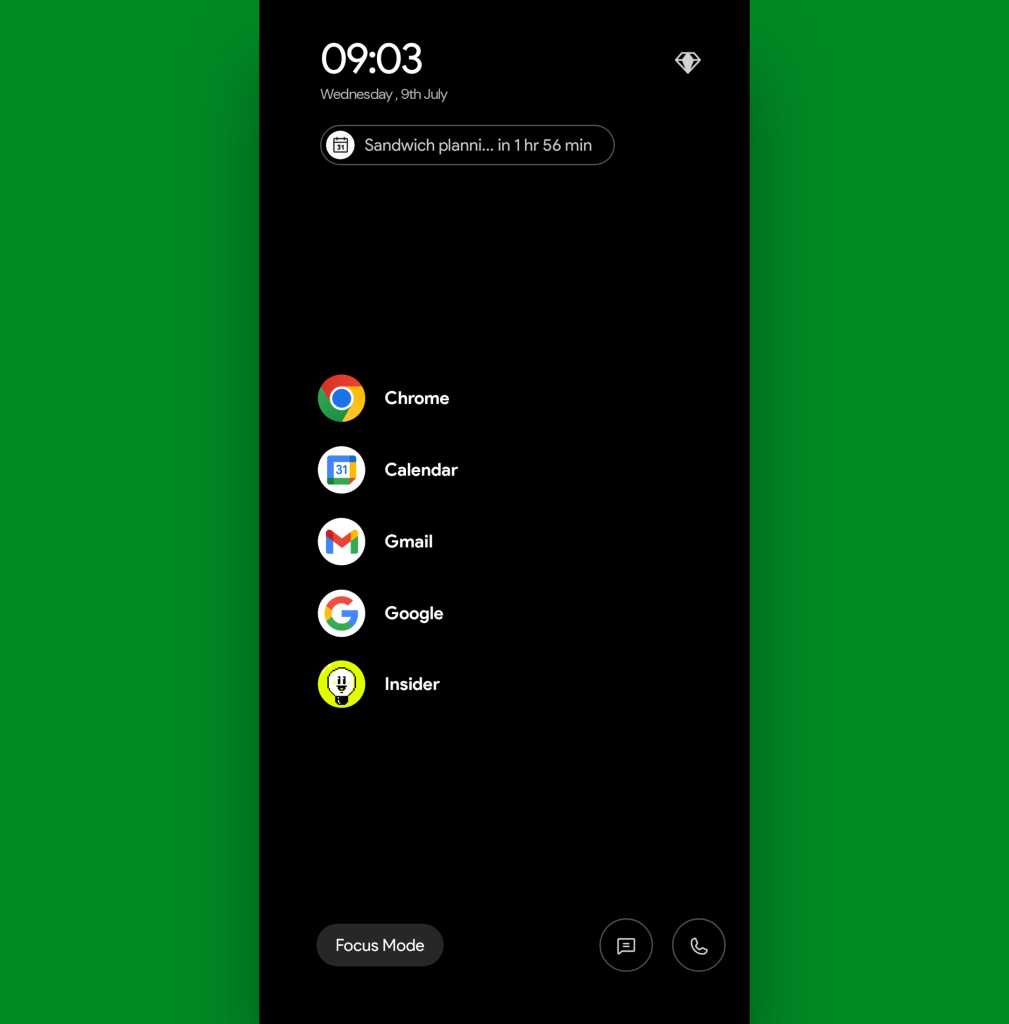
  • On your main home screen panel, you see shortcuts to the five apps you open most often — along with built-in buttons for your Phone and Messages apps and an unfussy time-and-date widget that shows your next calendar appointment.
Android minimalist launcher: Flow home screen
The Flow home screen is simple and free from unneeded distractions.

JR Raphael, Foundry

  • When you swipe up on your screen, you see a complete list of every app installed on your device — with built-in buttons for narrowing the list down based on dynamically created app categories like “Most used” and “Productivity.”
Android minimalist launcher: Flow app drawer
Even Flow’s app drawer is optimized for efficiency.

JR Raphael, Foundry

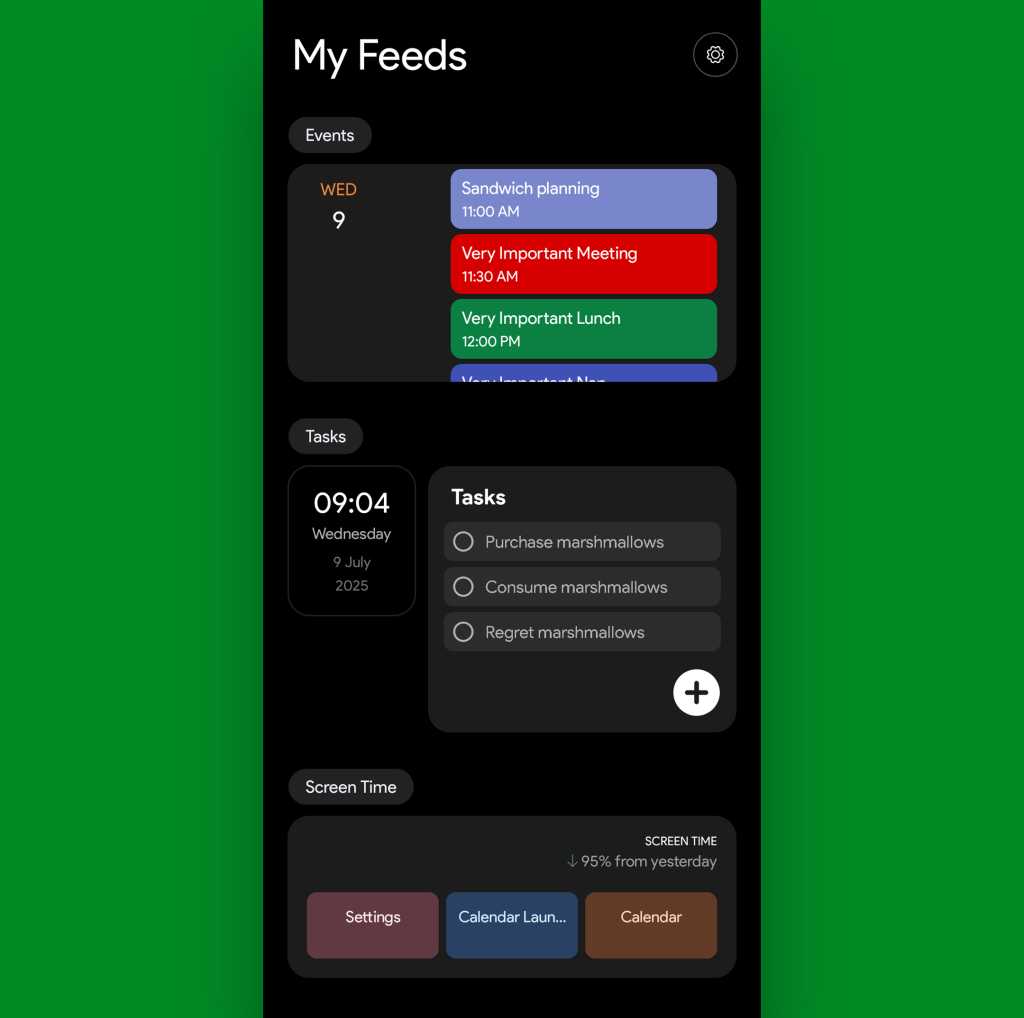
  • And when you swipe over to the right of the main home screen, you see a single “Feeds” panel that holds some sleek built-in widgets for your agenda, tasks, and screen use and can be expanded to include any standard Android widgets as well.
Android minimalist launcher: Flow feeds
Flow’s “Feeds” panel is a clever way to work with widgets on your Android home screen.

JR Raphael, Foundry

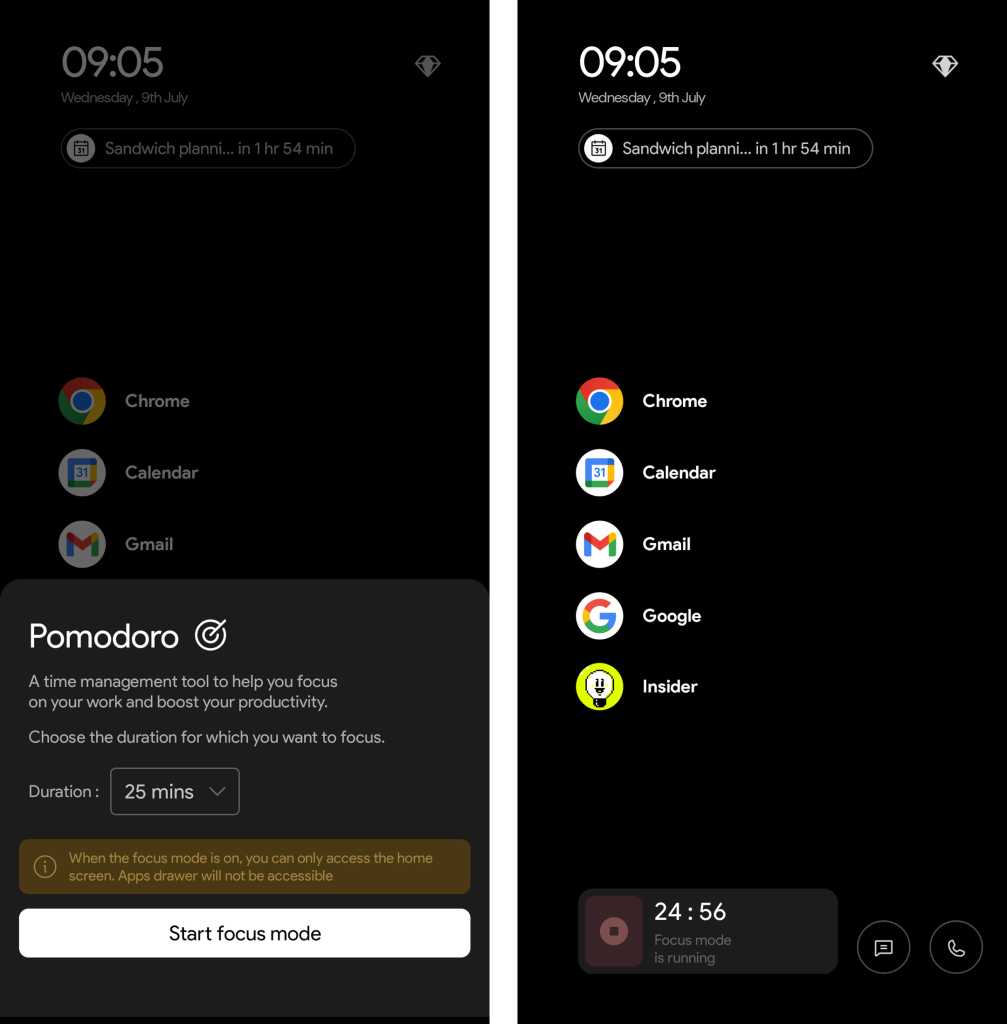
There’s also a noteworthy “Focus Mode” button on the main Flow panel that fires up a Pomodoro-style timer and encourages you to stay away from all apps other than your top five until its minutes elapse.

Android minimalist launcher: Flow focus mode
Flow’s Focus Mode discourages you from poking around within your non-essential apps.

JR Raphael, Foundry

And — well, that’s essentially it. Flow is by design minimal and limited in what it shows you — with the idea that you’ll mostly just see what you actually need for your day-to-day doings and avoid getting lost in endless on-screen screwery. It’s distraction-free and clutter-free, and it’s also mostly effort-free to set up and start using, since everything is built right in and carefully constructed to work that way.

That being said, you can customize a fair amount of things about Flow’s appearance, if you’re ever so inspired. The launcher’s settings include commands for changing the shape and style of your various app icons, for instance, along with other such surface-level adjustments.

Android minimalist launcher: Flow options
Despite its focus on simplicity, Flow offers up a fair amount of options.

JR Raphael, Foundry

But by and large, the appeal of Flow is its simplicity and the lack of contemplation that goes into its configuration. You just decide which five apps are most important to you, think about which widgets you need to see alongside ’em, and then go about your business with a cleanly organized workspace and a fraction of the usual distractions.

It’s a refreshingly different approach to device interaction and an interesting change of pace to try out and potentially stick with — even for short periods, as an alternative to your standard setup, when you really want to focus and frame your device as a work-centric productivity tool.

Flow is free for its core functions, too, without any annoying ads or over-the-top limitations. If you find yourself diggin’ it and want to support its development while unlocking some extras, you can opt for a 99-cent-a-month or $30 lifetime Premium upgrade that provides a smattering of special features and advanced options — but you definitely don’t need that to enjoy the experience.

That’s the power of Android for ya — the power not only to add in all sorts of advantageous step-savers but also to remove elements and make your setup simpler.

The choice, as usual, is entirely in your hands. And now, with Flow, you’ve got one more enticing option to consider.

Get six full days of advanced Android knowledge with my free Android Shortcut Supercourse. You’ll learn tons of time-saving tricks!

US Treasury Department sanctions individuals and entities over illegal IT worker scheme

The US Department of the Treasury’s Office of Foreign Assets Control (OFAC) Tuesday imposed sanctions on two individuals and four companies involved in schemes to provide US companies with illegal remote IT workers whose income would, it said, generate revenue for the Democratic People’s Republic of Korea (DPRK) regime.

Song Kum Hyok, described as a “malicious cyber actor” associated with the already sanctioned DPRK Reconnaissance General Bureau hacking group Andariel, was sanctioned for facilitating the scheme. OFAC said that in 2022 and 2023, Song created aliases for foreign workers using the names, Social Security numbers, and addresses of US individuals, which the workers then used to pose as US applicants looking for remote jobs.  

In addition, Russian national Gayk Asatryan, who OFAC said has used his Russia-based companies to employ DPRK IT workers, was sanctioned for “having attempted to engage in, facilitate, or be responsible for the exportation of workers from North Korea, including exportation to generate revenue for the Government of North Korea or Workers’ Party of Korea,” OFAC’s announcement said.

OFAC noted that in 2024 Asatryan signed a 10-year contract with DPRK’s Korea Songkwang Trading General Corp. to hire up to 30 DPRK IT workers to work in Russia for his company, Asatryan Limited Liability Co. He also signed a contract with Korea Saenal Trading Corp., another DPRK company, to hire 50 DPRK IT workers for his company, Fortuna Limited Liability Co.

OFAC said that Asatryan’s two companies were sanctioned “for being owned or controlled by or acting or purporting to act for or on behalf of, directly or indirectly, Asatryan, a person whose property and interests in property are blocked.” Songkwang Trading and Saenal Trading were also designated “for being North Korean persons, including North Korean persons that have engaged in commercial activity that generates revenue for the Government of North Korea or Workers’ Party of Korea.”

“These sanctions against the DPRK-Russian fake IT worker pipeline are a significant step toward closing a long-standing gap in remote-work security,” said Fritz Jean-Louis, principal cybersecurity advisor at Info-Tech Research Group. “By adding these key brokers to the SDN [US Specially Designated Nationals and Blocked Persons] list, the government has instantly frozen any payments that might flow through Russian front companies or crypto rails to North Korean developers, thereby cutting off a revenue stream that Pyongyang has relied on. They also raise the bar for corporate due diligence, as the IT worker scheme worked primarily because many organizations hired remote contractors on little more than a resume and a US PayPal address.”

Ongoing crackdown with caveats for hiring companies

These actions are the latest efforts in the US government’s battle to stop DPRK’s illegal activities. Last month, the Justice Department’s major sweep across 16 states seized laptops, financial accounts, and websites associated with the illegal remote IT worker scheme, and the FBI and Defense Criminal Investigative Service (DCIS) also took action.

The latest sanctions mean that any property in the US, or possessed or controlled by US persons, in which the sanctioned individuals hold interest are blocked, and must be reported to OFAC, and unless authorized, “OFAC’s regulations generally prohibit all transactions by US persons or within (or transiting) the United States that involve any property or interests in property of blocked persons,” OFAC said in the announcement. The regulations also forbid “any contribution or provision of funds, goods, or services” either directed to the blocked persons, or being received from them.

“These sanctions draw clear liability boundaries and nudge organizations towards stronger vetting without broad new regulations,” Jean-Louis noted. “A key risk to consider: If a US company unknowingly hires or pays a newly sanctioned contractor, the consequences can escalate quickly. OFAC violations are a strict liability, which means that intent does not matter, and civil fines can run up to significant amounts. Organizations can also face criminal penalties and loss of export privileges. Since OFAC is a US law with extraterritorial application, foreign organizations may do well to also consider potential exposure. An improper hire can turn into an expensive legal crisis overnight.”