Month: July 2025

Apple to pour $500M into US rare earth supply for iPhones

As I’ve noted before, it will take the better part of a decade for Apple or anyone else to manufacture smartphones in mass market quantities in the US. Getting there requires huge investments to solve big problems, including training, manufacturing, component sourcing, and raw materials supply.

And now, Apple is about to invest $500 million in the last of those, working with the only US rare earth supplier, MP Materials. The decision includes plans to purchase US-made rare earth magnets from the company in what is being billed as a win for the Trump Administration. Apple and MP Materials will build a new recycling facility in which to extract materials from used electronics, along with another factory to make components for Apple devices.

Unlocking the component supply chain

It’s a big deal because right now China produces around 60% of the globe’s rare earths and processes around 90% of that material. The investment puts at least some of that capacity in US hands, even though a recent deal with China saw the trade in those critical materials between the two nations resume. (The materials are available elsewhere, but they are so rare they are paid for in human misery.)

There’s a lot that matters in the news. First, the reality is that rare earths are essential to manufacture most modern electronic devices, from iPhones to satellites, cars to stealth bombers. Secondly, America’s reliance on external suppliers for these substances is a strategic problem that puts the brakes on any hope of bringing electronics manufacturing back to the US. A recent US Department of Defense decision to invest $400 million in MP Materials has contributed to interest across US rare earth stocks as investors sense opportunity.

“MP Materials is America’s only fully integrated rare earth producer with capabilities spanning the entire supply chain, from mining and processing to advanced metallization and magnet manufacturing,” the company’s website explains. “We extract and refine materials from one of the world’s richest rare earth deposits in California and manufacture the world’s strongest and most efficient permanent magnets.”

The complexity management business

Apple has been in the current US government’s cross hairs in recent weeks, under pressure to build up manufacturing of Apple products in the US. Apple has, no doubt, argued that it has taken steps to reduce reliance on China and invested billions in making products in India and elsewhere. Still, the company has been slammed for not doing enough, even though moving manufacturing is not simple and requires extensive investments in everything from skills development to infrastructure enhancement, not to mention the logistics of component supply.

Apple must hope that by committing half a billion dollars to a US rare earth supplier it will be seen as showing a willingness to invest in the country on a journey toward future expansion of US manufacturing. I see it as most likely that any Apple products made in the US will either be very high-end advanced technologies, or lower-end products that require less skill to manufacture — the US just doesn’t have enough trained staff.

Jaw-jaw beats war-war

Apple CEO Tim Cook’s determination to continue to negotiate with people even where he doesn’t agree with them may be paying off, at least a little. Commenting on the arrangement a White House official told Fox News, “Apple deserves a lot of credit for stepping up.”

While it remains open to question whether the government sees the full significance of this step, it is significant all the same. The principle in play is that if Apple can source raw materials in the US, it is one giant step closer to being able to manufacture some of the more advanced components it uses in its devices. While the practicalities of production and supply mean many of the rest of these components will continue to come from elsewhere, the opportunity to move toward final assembly in the US grows a little each time Apple manages to source components in the US. 

Nothing will – or can – happen overnight. But it is certainly not at all true that Cook’s complex approach to working with sometimes opposing intergovernmental demands has failed – because while there’s no doubt its complicated, he continues to find incremental positives within an incredibly complex politico-business environment.

You can follow me on social media! Join me on BlueSky,  LinkedIn, and Mastodon.

Apple has a durability (perception) problem

This morning, I found an interesting Canalys report shared by analyst Runar Bjorhovde that shows — despite everything Apple does— people still don’t seem to think iPhones are all that durable. That’s strange, given how much cash Apple spends improving iPhone durability and the device’s reputation as leading second-user markets.

I contacted Bjorhovde to get more insight.

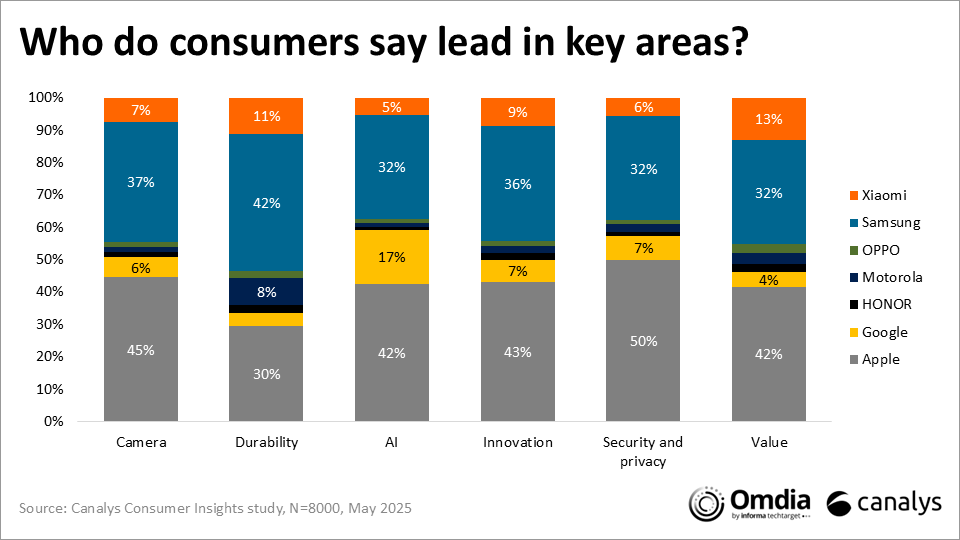
The perception reflected the opinion of more than 8,000 consumers across Europe and shows that while Apple continues to outpace most of the rest of the industry on privacy and security, Samsung over-indexes on durability while Apple seems to score lower than it should. 

Apple has a strong brand value

“Our respondents associate Apple with being [a] reliable brand representing quality design, though being expensive,” Bjorhovde told me by email. “Personally, I think the expensive price perception — and consistently high price tag — is what makes Apple so desirable in many cases through its status.

“Apple’s perhaps greatest benefit compared to its smartphone and PC competitors, is that people have strong opinions about the brand and a clear idea of what it represents,” Bjorhovde said. “Risk aversion amongst buyers can be a massive hurdle for any company seeking to succeed in an establish category.”

But Apple lags when it comes to consumer perception around durability. Here’s the chart that shows the data.

Why is this? 

I think Apple is a scapegoat in this perception because of its size and popularity, which means that when an iPhone gets smashed, Apple gets the blame. It is also worth pointing out that Apple was first to market with a modern smartphone back in 2007, and with so much new technology the original device was more prone to breakage than subsequent generations.

The devices were so new and so exciting that everything about them (good and bad) was reported, including screen breakages, which baked in an assumption that they break. The messaging we picked up then were the first impressions of the modern smartphone industry, and those messages stick. The phone cover and case market among iPhone users remains vibrant as a result.

“There are stories going far back around — for example, around reducing battery capacity over time — that might still be holding Apple’s durability perception back,” the analyst said. “Apple has also been subject to fierce opinion pieces and lawsuits towards its repairability, a lot stemming from companies that have a strong stake in the second-hand value of iPhones,” he added. “More than anything, I think the poor durability score is a result of Apple not owning its durability narrative well enough.”

Follow the money

It’s a perception that is amplified in another way, as repair industry stores tend to focus on iPhones in their advertising, reflecting how popular those devices are. This builds the perception of fragility of Apple products. 

iPhones aren’t the only advanced and expensive devices that break. “Even though the most advanced smartphones today are made with space age materials like titanium, Armor Aluminium, and Ceramic Shield screens, they’re still susceptible to damage when dropped on a concrete sidewalk,” Jason Siciliano, vice president of marketing and global creative director at Allstate Protection Plans, said in a statement.

The perception that iPhones break more often remains, though the data also shows that for innovation, privacy and security, the iPhone indexes well, as it does for the camera. So, perhaps it can afford a little misconception around durability.

Like many prejudices, it isn’t completely true

I think Apple should attack this perception head on. It should not be too hard to break it, either, given that iPhone dominates the used-phone markets. People are happy to buy a second-user iPhone because they know their new/old devices will keep working longer — and this extends to durability.

Ask yourself: How could a device that lasts longer be less durable? “The reality is that Apple might be the most criticized vendor in the smartphone industry when it comes to durability,” Bjorhovde said, “but that doesn’t mean that it actually represents reality.”

In 2024, there were 5.14 billion active smartphones, of which 21% were iPhones, standing several percentage points ahead of Apple’s market share of newly sold devices, according to data from Canalys (now part of Omdia). “iPhones have a longer lifetime and more value in the second-hand market than any other brand,”Bjorhovdehe said. 

He pointed out that other vendors like Samsung even “subsidize the trade-in values of their own smartphones to help them match Apple in attractiveness.”

Europe’s other plan

There is one more thing to consider. Europe has yet another idea to attack Apple, this time in the form of its weirdly formulated energy efficiency labelling scheme, which threatens to be inconsistently applied.

Apple generally scores very well, but has been highly critical of the unclear methodology of that scheme. “The EU Energy Labelling regulation has a number of significant ambiguities in the prescribed transitional test methods,” the company said. (The concern is that Europe might use these tests as yet another way to attack US tech.)

“Apple leans towards durability more than most other vendors,” the analyst told me.

Of course, the problem with erroneous beliefs once they do bed in is that they are remarkably hard to shift. But perhaps sharing a few facts will help change perception. 

You can follow me on social media! Join me on BlueSky,  LinkedIn, and Mastodon.

Google snatches Windsurf execs in a $2.4B deal, derailing OpenAI’s biggest acquisition yet

In a dramatic reversal that has sent shockwaves through the AI industry, Google has recruited the top executives of AI coding startup Windsurf in a $2.4 billion talent acquisition deal, just two months after Windsurf agreed to be acquired by OpenAI for $3 billion.

Google will hire Windsurf CEO Varun Mohan and co-founder Douglas Chen, along with select research and development staff, for its DeepMind AI division. Mohan, an Indian-origin entrepreneur who grew up in California and attended MIT, has led Windsurf’s transformation from Codeium into one of the hottest AI coding platforms in the market.

“Thrilled to welcome Windsurf founders Varun Mohan and Douglas Chen and some of the brilliant Windsurf engineering team to Google DeepMind,” Demis Hassabis, co-founder and CEO of Google DeepMind, said in an X post. “Excited to be working with them to turbocharge our Gemini efforts on coding agents, tool use, and much more.”

Chen, as co-founder, has been instrumental in developing Windsurf’s core technology that enables “agentic coding,” which is AI tools that go beyond simple code completion to provide autonomous software development capabilities.

The executives bring deep expertise in AI-powered development environments, having built Windsurf into a platform with several hundred thousand daily active users and approximately $100 million in annual recurring revenue.

Jeff Wang, Windsurf’s head of business for the past two years, will assume the role of interim CEO. Graham Moreno, the company’s vice president of global sales, has been promoted to president to provide additional leadership stability.

“Most of Windsurf’s world-class team will continue to build the Windsurf product with the goal of maximizing its impact in the enterprise,” Wang announced in a post on X.

The deal that unraveled

The Windsurf acquisition by OpenAI was widely reported in May as a transformative deal that would have marked the ChatGPT maker’s largest acquisition to date. However, reports indicate the deal fell apart due to a fundamental disagreement between OpenAI and Microsoft over intellectual property arrangements.

Under OpenAI’s partnership agreement with Microsoft, the software giant has extensive rights to OpenAI’s technology and any intellectual property it develops or acquires. Microsoft expected these rights to extend to Windsurf’s technology, but OpenAI refused, viewing Windsurf’s innovations as a competitive asset against Microsoft’s own GitHub Copilot coding tool.

Fortune reported that the exclusivity period for the acquisition had expired, freeing Windsurf to explore other options.

OpenAI did not immediately respond to a request for comment.

Strategic implications for AI competition

The stunning turn of events represents a major strategic victory for Google and highlights growing tensions between OpenAI and its primary backer, Microsoft, over intellectual property rights.

“Losing Windsurf’s leadership could impact OpenAI’s ability to advance its AI developer tooling, especially as GitHub Copilot continues to mature within Microsoft’s ecosystem,” said Shreeya Deshpande, senior analyst at Everest Group. “Windsurf’s expertise could have supported OpenAI’s evolution toward more autonomous development capabilities.”

For Google, the acquisition accelerates its AI coding ambitions significantly. “Google’s addition of talent from both Character.AI and Windsurf enhances its foundation,” Deshpande noted. “If integration is thoughtful and well-paced–building on DeepMind’s agentic work and Gemini’s broader platform–Google could solidify its position as a serious contender in AI developer tooling.”

Windsurf has emerged as a leading player in AI-powered software development, originally known as Codeium before rebranding in April. The startup specializes in “agentic coding” tools that enable developers to write code using natural language prompts, gaining particular traction among enterprise customers managing complex, million-line codebases.

The company’s flagship Windsurf Editor is positioned as the first “agentic IDE” (Integrated Development Environment), offering capabilities that go beyond traditional code completion to provide project-wide context awareness and autonomous task execution.

New paradigm in AI acquisitions

Crucially, Google will not take an equity stake in Windsurf, instead paying $2.4 billion in licensing fees and compensation. This “acquihire” structure allows Google to secure talent and technology access while avoiding the regulatory scrutiny that a full acquisition would attract.

“This will hopefully offer a faster, lower-regulatory-scrutiny path to securing top AI teams,” said Charlie Dai, VP and Principal Analyst at Forrester. “We will likely see more such deals for strategic AI talent, to sidestep merger reviews by regulators and jumpstart critical innovations.”

The approach reflects what analysts see as a fundamental shift in how AI companies compete. “The irony about this deal signals a shift in focus on companies ready to pay top dollars for getting access to already scarce top ‘human talent’ and IP to build AI,” said Neil Shah, VP for research and partner at Counterpoint Research.

The move has generated significant attention within the AI community. Logan Kilpatrick, a former OpenAI executive who now works at Google DeepMind, welcomed the new hires: “Big welcome to @_mohansolo and others from the Windsurf team joining DeepMind : )”

Shah compared the current talent wars to the early days of IT software and cloud computing, when similar scrambles for expensive talent led to the rise of IT outsourcing hubs. “Could this be a new ‘AI gig economy’?” he questioned, noting that companies must embrace “strategic openness” through partnerships and acqui-hires to remain competitive.

For OpenAI, the collapse represents more than just a missed acquisition opportunity. “The failed Windsurf acquisition served as a wake-up call,” Shah observed. “It exposed the vulnerabilities of being tied to a single partner and has prompted them to diversify their infrastructure providers, IP access, and customer base.”

As Windows 10 end-of-support looms, IT faces a painful choice

Back in 1933, US President Franklin D. Roosevelt told the country, “The only thing we have to fear is fear itself.” Those were inspiring words for a nation in the throes of the Great Depression — but terrible advice for an IT executive struggling to decide whether to upgrade to Windows 11 by October, when Windows 10 is due to reach end of support.

For IT leaders, there is much to fear. How much of their current hardware is compatible with Windows 11? Far more critically, what about operational technology devices that manage industrial processes, on-prem legacy apps (including tons of homegrown code), and the unknown numbers of applets that IT doesn’t know about?

That “unknown” list includes inherited apps from the company’s last 50 acquisitions, as well as shadow apps that business units never bothered to report to corporate. 

At the same time, there is a noticeable lack of enthusiasm among IT leaders for making the upgrade at all, given the perception that Windows 11 simply doesn’t offer much in terms of materially new or better functionality. 

The decision is being forced, because Microsoft says that it will not add new capabilities or provide security patches for Windows 10 for corporate customers after October 14, 2025 — unless they enroll in the Extended Security Updates (ESU) program for Windows 10. 

Microsoft is doubling the ESU price every year: For the first year, it will be $61/device, which will rise to $122/device for the second year and then $244/device for the third year. After that, the company says it will cut off all Windows 10 support entirely. (Microsoft did not respond to a Computerworld request for an interview for this story.)

Enrolling 5,000 Windows 10 PCs in ESU for the full three years would cost a business more than $2.1 million. A large organization that wants to keep 30,000 PCs on extended Windows 10 support for three years would have to pay more than $12.8 million to do so.

This leaves IT leaders having to choose between a potentially painful upgrade to Windows 11 and having to pay a massive amount of money for continued Windows 10 support, depending on how many seats will remain on Windows 10.

Windows 11 upgrade challenges

Despite the fact that Microsoft has been reminding customers of the Oct. 2025 end-of-support deadline for at least four years, many organizations have put off upgrading to Windows 11 as long as possible. A recent analysis by Digital Employee Experience software provider ControlUp, for example, found that just half of the one million Windows endpoints in its enterprise customers’ environments had been migrated to Windows 11 as of late June.

There are multiple reasons for the delay, according to analysts.

For some CIOs, it’s a matter of priorities. “Most have realized that the Windows 11 migration is relatively straightforward and doesn’t require much effort once started,” said Gartner VP/analyst Stephen Kleynhans. “This allowed them to complete other projects and take a slower, less disruptive pace with the migration.”

However, he added, “Many have realized the ‘window’ to act is starting to close.”

Those are the lucky ones. Other IT leaders have encountered significant hardware and software incompatibilities.

Windows 11 has an extensive list of hardware requirements, including the inclusion of a Trusted Platform Module version 2.0 and Secure Boot support. This means that many Windows 10 PCs now in use can’t be upgraded to the new OS without expensive and time-consuming modifications — on top of the disruption from taking those machines out of service while they are modified.

“Most enterprises are in the midst of a protracted and costly refresh of PCs purchased during the early days of the COVID pandemic. Customers realize that the easiest and safest way to move to the new OS is to buy new machines with Windows 11 already installed,” Kleynhans said.

“However, hardware refresh projects have gone slower than expected due to budgetary constraints and supply chain issues, necessitating more in-place upgrades to meet the October deadline,” he continued. “Most larger enterprises have a few machines incompatible with Windows 11 still in service, but many compatible machines are misconfigured or under-configured, requiring replacement.”

Legacy software — especially in-house or customized apps — and outdated peripheral devices can also cause problems.

“While compatibility between Windows 10 and Windows 11 has been extremely good, most enterprises report having one or two ancient applications or old peripherals that can’t be made to work on Windows 11,” Kleynhans said. “These were often stumbling along on Windows 10 and could have broken with any security update. Enterprises often get bogged down trying to decide how to deal with updating these old apps.”

The hidden software nightmare

The hidden software problem is potentially worse. Every IT director knows that they simply don’t have full visibility into the multitude of small applets that typically perform very narrow functions. 

On an ecommerce site, for example, one small applet — homegrown by a coder 20 years ago — might connect completed purchases with the most relevant shipping partner. Other than the tiny number of people handling that aspect of the site, no one else knows about it or has any reason to know about it. 

But when the upgrade happens and that applet doesn’t work properly under Windows 11, everyone will suddenly learn of that applet’s existence when e-commerce revenue plunges. 

“It speaks to the increase in the complexity of the upgrade decision, these hidden interdependencies,” said Melody Brue, a VP/principal analyst for Moor Insights & Strategy. 

Brue referred to this problem as “the great reckoning of technical debt,” adding, “this will not just be an upgrade. It’s forcing this reckoning that will expose and magnify all of the technical debt.”

Brue is using the term “technical debt” in a non-traditional manner. Typically, it refers to the cost of fixing software that suffered when speed shortcuts were taken when it was developed, presumably to save money or time. But Brue is using it to refer to all manner of unknown or outdated applications throughout the enterprise’s global environments.

Will Microsoft really pull the plug on Windows 10 support?

One burning question on IT leaders’ minds is whether Microsoft will follow through on its threat to stop the flow of security patches for Windows 10 after the October deadline. It depends on many factors, especially how many IT shops stick with Windows 10.

Microsoft has already softened its position on Windows 10 support. After initially saying it would not support Microsoft 365 apps on Windows 10 past the October deadline, the company did an about-face in May, announcing that it will support M365 apps on Windows 10 until 2028. And in late June, Microsoft suddenly offered consumers (but not commercial customers) a way to get one year of Windows 10 security patches for free. The company also noted that it will continue providing security intelligence updates for its Defender Antivirus software on Windows 10 for three more years.

Some tech leaders believe these changes indicate that Microsoft may eventually relent on ongoing Windows 10 support for the enterprise.

“I don’t envision this to be as big a hurdle as people are making it out to be,” said Brian Phillips, VP for Macy’s Technology. “Many are worried about losing ongoing patches, for example. I can say categorically that they will not. Microsoft is bluffing.”

Phillips added that he expects at least some security patches to continue even for customers not in the ESU program. For example, Microsoft may continue to issue Windows 10 patches it rates as Critical or Important to everyone, but will only issue patches rated as Moderate or Low to those paying for extended support, Phillips said

Jeremy Roberts, a senior director of research at the Info-Tech Research Group, agreed that it is far from certain what kind of support, patches, and functionality Microsoft will ultimately deliver to Windows 10 post-October.

“It’s always a game of chicken with Microsoft,” he said.

To put it mildly, it’s challenging for IT to make rational upgrade decisions when the consequences for not upgrading keep changing — and could very well change again over the next several months. 

The ROI factor

Roberts said this decision will likely be driven by the same return on investment factors that always dictate to enterprise CIOs what to do and when to do it.

“If I am spending resources on an OS upgrade, I am not spending it on things that are far more important,” he said. 

A viable choice is to pay the tech support and delay the upgrade, Roberts said. “You’re borrowing productivity from tomorrow and kicking the can down the road,” he said. 

When thousands (or tens of thousands) of employees need to be trained on and get comfortable using a new OS, the productivity hit can be substantial. There’s no avoiding the disruption that will come with a mass migration to Windows 11, so it’s up to company leaders to decide when it’s most feasible.

The decision boils down to a few difficult options: 

  1. Make the upgrade and risk having to spend maybe a couple of months putting out fires from the untold number of apps that fail. During that time, productivity will likely take a sharp hit.
  2. Opt to not initially upgrade, which might mean losing compatibility with partners and customers who do make the move to Windows 11. And that decision means paying a lot for support payments — for an out-of-date OS.
  3. Split the difference by upgrading a portion of the environment. That would reduce the exposure from not upgrading, while minimizing the disruption from the unknown app problems. 

That’s the approach Macy’s takes to OS upgrades, according to Phillips, who said he has seen Windows upgrade problems with small apps that IT tends to not think about. “Everything from training apps to clock-in-and-clock-out, some browser components — they all have to be tested and rewritten,” Phillips said. 

Macy’s tackles that testing by shutting down half the POS units in a store and upgrading them, he said. They use the odd/even method: updating only the odd machines one day and the even machines at a later date. That way, productivity during upgrades is maintained, because an associate can always turn to a machine nearby and use that.

New hardware is typically the most expensive part of an upgrade, but it’s also easier to track, because enterprises generally know about every piece of hardware in their environment. Hardware delivers far fewer IT surprises than software. 

Hardware costs are tied to each enterprise’s unique situation, with dozens of factors including volume, models and configurations, geography, and even tariffs coming into play. But IT leaders can — and should — run their own calculations regarding hardware. Globally, how many PCs have the security and capacity to handle Windows 11? How many PCs are about to be replaced anyway? What is the cost difference between upgrading existing hardware to Win11 specs versus purchasing new Win11 PCs?

Next, there are the support calculations. How does the cost of upgrading or replacing current hardware compare with the cost of continued Windows 10 support? That support cost is based on how many seats need extended protection, so the spreadsheet has to reduce the support costs based on how many machines can make the transition to Windows 11.

One possible projection for a small enterprise might look like:

  • Year 1: Leave 5,000 devices on Windows 10 and pay for extended support for them. Upgrade 3,000 machines that can be upgraded. Purchase 1,000 new Windows 11 PCs.
  • Year 2: Reduce the number of devices on Windows 10 extended support to 2,500. (The support cost for the PCs remaining on Windows 10 doubles this year, so reducing the number by half keeps that cost the same.) Buy new PCs for the other 2,500 that were on Windows 10 that first year.
  • Year 3: Replace the remaining 2,500 Windows 10 devices with new Windows 11 PCs, which means no more extended support costs.
  • Year 4: Buy new PCs to replace the 3,000 old machines that were upgraded to Windows 11 that first year. Now all users are on Windows 11 — just in time for a new operating system/hardware refresh cycle, when IT gets to do this all over again.

Of course, if Microsoft announces in, let’s say, December that it is extending Windows 10 support for another year, all ROI calculations will have to be rerun.

There are additional options for IT leaders to consider as well, including Windows 365, Microsoft’s cloud-based desktop-as-a-service offering, which costs $41/user/month for a standard enterprise configuration.

Forrester senior analyst Paddy Harrington had a different suggestion that will not please Microsoft. 

“Do we even need Windows anymore? How many of our applications are web-based? More and more users are doing the majority of their work in a browser, using SaaS apps. Why are you even keeping Windows desktops?” Harrington asked. “Is Linux an option for you? Or one of the thin clients? You have to be open to changing your religion.”

Triage choices

For those who decide to stick with traditional Windows PCs, Harrington is a proponent of phased upgrades. That means deciding which apps and machines get upgraded now and which are delayed. One option is to “start with the assets that are most critical to your business, such as financial, your HR, your app dev if that is your world,” Harrington said. 

Another approach is to start with the ones that you are confident will be fine in the Windows 11 environment. Instead of legitimately worrying about the small percentage of software that is unknown, focus on the known apps. Throw them into a sandbox and test if they will survive in Windows 11. 

That would allow IT to safely upgrade almost all of its environment, which would reduce the cost of the support for the remainder. “Move what is safe. You know what they are, whether they are applets or extensions,” Harrington said. 

Some IT officials who are having to make this decision have understandably strong opinions.

Kolapo Akande, the founder of Pledge Software and the former performance architect manager at Accenture, encourages IT to upgrade everything.

“Enterprises should not default to extended support. It’s essentially a tax on indecision. Unless they have a mission-critical legacy app with no viable workaround, migrating to Windows 11 now is the smarter long-term play, especially for organizations already on hardware nearing refresh cycles,” Akande said. “Paying for extended support often leads to sunk costs and delays in adapting internal IT policies for modern endpoint security and management.”

For those who can’t migrate their full environment, Akande has a recommendation: “Isolate legacy machines in virtualized or air-gapped environments to minimize exposure. This lets you limit extended support costs to the bare minimum while moving the rest of the org forward.”

Ari Harrison, director of IT at BAMKO, a global promotional products company, said his team concluded that the risks of not moving to Windows 11 were not worth it.

“Every month you stay put, you invite unpatched exploits, shrinking vendor support, and a growing skills gap as admins move on. The ESU program buys breathing room but at a steepening price curve that’s designed to push you off the ledge, not keep you comfortable on it,” Harrison said.

“Think of it as paying rent on a condemned building,” he continued. “The smarter play is to upgrade now, while you control the tempo and can schedule downtime on your own terms.”

Why diversity and inclusion is good for business

In the latest episode of First Person I spoke with Emma Philpott MBE. In a varied career Emma has been an academic, cyber security expert and business leader, and today she is founder and leader of a UK-based cyber security certification company.

In a wide and fun chat Emma told me how – in her words – her career ‘meandered’ to a good place. She explained how mistakes and failure turned into opportunities with the addition of a sense of optimism and an interest in people.

Above all Emma was keen to explain how the organisation she founded and runs succeeds because it is inclusive and the workforce diverse. IASME proactively recruits neuro-diverse people – not just because it is the right thing to do, but because in Emma’s experience it is good for business.

You can view our interview here, listen to it here, or watch in the box below:

Diversity works

I asked Emma what she is most proud of.

“My masterpiece is IASME, our company, but not because we make a profit, and we exited two and a half years ago. Not because we’re the sole delivery partner for the UK government,” she said. “I am most proud of our diversity. We’ve got 120 people, and 30 percent were unemployed when we took them on. Many of them long-term unemployed.”

Emma explained that around half of the workforce is neurodivergent, and a growing number of people in the organization have physical disabilities or chronic illnesses.

“It’s up to us business owners to make sure that our people can have a really good and worthwhile career,” Emme explained. “If you’re saying, no, I’m sorry, you can’t work for us if you have a lot of sick time, you’re just cancelling a whole load of people that could be really, really good for your company.”

“We don’t do it to be nice,” she emphasized.

“We do it because we make a lot of profit and we’re very successful. And we are successful in part because of the diversity of background and thought. If we have a problem, and I can’t think of what to do, I put it out to the organization. The quality ideas and innovation that comes back is absolutely incredible. We wouldn’t have that if we weren’t diverse.”

“Our success as a company – financially – is down to our diversity.” (See also: 8 ways diversity and inclusion help teams perform better.)

Opportunity knocks

So what brought Emma to this point?

“I was an expert in nanotechnology and no one wanted an expert in nanotechnology. There was no money,” Emma explained. “I was just hanging out and it felt like everyone I met worked for a small cybersecurity company. And I thought: what’s that?”

Emma saw an opportunity. She began arranging meetups for cyber security professionals, and never looked back.

“Out of that I founded IASME. So my current job was my first job in IT.”

How is that even possible? Emma believes that her innate optimism was key.

“If you’re a natural optimist, it’s really lucky. I always get excited by change, even change that seems bad,” Emma said. “I get excited because there’s usually good things that come out of it. Because no-one wanted to invest in nanotechnology I couldn’t get a job. Because I was optimistic amazing things came out of it.”

My take? Emma combines optimism and intelligence with a deep concern for and interest in people. It’s a potent mix.

“I’ve ever had any deep knowledge about anything. I know enough to get by, and I know and trust experts. As long as you know experts that really know their stuff and are willing to share that with you, then I think it’s fine.” (See also: DEI that works: 5 companies reaping the benefits of IT diversity strategies.)

How agentic AI will change IT support roles

Support for IT support

Agentic AI is revolutionizing the approach by a range of organizations to IT support. Many IT leaders agree with this week’s CIO columnist that the future is agentic AI that solves problems before they are even reported. He argued that it’s time for CIOs to stop paying the innovation tax of legacy IT tickets and laid out an IT roadmap for agentic AI. 

This caused readers of CIO.com to ponder the implications for their own working lives, asking Smart Answers to explain how agentic AI is going to impact the role of humans in IT support. 

Fueled by years of human reporting, our AI chatbot states that while the role of IT pros will change, they will adapt and survive. The shift will be from manual, repetitive tasks to more strategic and personal interactions. AI will automate high-volume, low-value service desk activities, including incident resolution and data validation, freeing up IT staff for higher-value work such as analysis and customer satisfaction efforts. 

The good news is that IT professionals who embrace and understand AI will be better positioned for future roles. 

Find out: What will my role be in AI-driven IT support? 

Passing on passkeys

Passkeys may be the future, but they sure can be bewildering — especially in a business context. This week Computerworld offered some straightforward answers to your pressing passkey questions. 

The benefits of passkeys are apparent, which may explain why our readers were keen to ask why they aren’t always adopted. While passkeys offer a more secure and user-friendly alternative to traditional passwords, their widespread adoption faces several significant challenges. These include technical complexities, implementation costs, device compatibility issues, and a lack of clear communication from major technology providers, which collectively hinder their full integration into enterprise and consumer environments. 

Find out: What challenges hinder widespread adoption of passkeys? 

When agents take over

Interest in autonomous agents is skyrocketing. This week, CIO.com revealed three industries where agentic AI is poised to make its mark. We heard CIOs from finance, retail, and healthcare discuss how they see the technology impacting their organizations and sectors overall. 

A trio industries on the cusp of widespread adoption speaks to the fact that agentic AI is not yet ready for prime time. When will that change? Smart Answers projects that widespread adoption in real-world workflows will occur rapidly over the next few years. For more details, ask our bot. 

Find out: When will agentic AI see widespread adoption in real-world workflows? 

About Smart Answers 

Smart Answers is an AI-based chatbot tool designed to help you discover content, answer questions, and go deep on the topics that matter to you. Each week we send you the three most popular questions asked by our readers, and the answers Smart Answers provides. 

Developed in partnership with Miso.ai, Smart Answers draws only on editorial content from our network of trusted media brands—CIO, Computerworld, CSO, InfoWorld, and Network World—and was trained on questions that a savvy enterprise IT audience would ask. The result is a fast, efficient way for you to get more value from our content. 

For July, a ‘big, broad’ Patch Tuesday release

With 133 patches in its Patch Tuesday update this month, Microsoft delivered a big, broad and important release that requires a Patch Now plan for Windows, Microsoft Office and SQL Server. A zero-day (CVE-2025-49719) in SQL Server requires urgent action, as do Git extensions to Microsoft Visual Studio. 

To help IT admins navigate these changes, the team from Readiness has provided this useful infographic detailing the risks of deploying the updates to each platform. (More information about recent Patch Tuesday releases is available here.)

Known issues 

Microsoft is doing a pretty good job these days and there are a relatively small number of known issues reported for the desktop and server platforms, including this minor issue with Windows 10:

  • Noto fonts are still experiencing display issues at smaller (less than 96 DPI) resolutions. For additional support, users can report issues related to Noto CJK fonts through the official Google Noto Fonts GitHub repository.

Major revisions and mitigations

So far, Microsoft has not published any revisions or updates to this month’s patches.

Windows lifecycle and enforcement updates

Likewise, there are no further enforcement updates from Microsoft this month. However, for some (strange) reason, every Microsoft support page that deals with Windows 10, displays this \ message;

“After October 14, 2025, Microsoft will no longer provide free software updates from Windows Update, technical assistance, or security fixes for Windows 10. Your PC will still work, but we recommend moving to Windows 11.”

The team at Readiness has analyzed Microsoft’s latest updates to develop technically sound, actionable testing plans. July’s release brings significant updates to core Windows components, most notably in the areas of printing, networking, and media playback. Two components have been designated as high-risk and warrant immediate attention: the Printing Subsystem and Routing and Remote Access (RRAS).

As always, we have grouped Microsoft’s updates by Windows feature and accompanied each section with prescriptive test actions and rationale to help prioritize enterprise validation efforts.

Core OS and printing

Microsoft updated several core kernel drivers affecting Windows as a whole. This is a low-level system change and carries a high risk of compatibility and system issues. In addition, core Microsoft print libraries have been included in this month’s update, requiring additional print testing in addition to the following recommendations:

  • Run print operations from 32-bit applications on 64-bit Windows environments.
  • Use different print drivers and configurations (e.g., local, networked).
  • Observe printing from older productivity apps and virtual environments, paying close attention to the boundaries/margins of the printing area.

Remote Desktop and network connectivity

This month’s updates could affect the reliability of remote access, and regressions in RRAS can disrupt critical network infrastructure. We recommend the following tests:

  • Create and reconnect Remote Desktop (RDP) sessions under varying network conditions.
  • Test modifying NAT and routing settings in RRAS configurations and ensure that changes persist across reboots.
  • Create a VPN profile using the UI or PowerShell and try to connect/disconnect with different VPN servers.
  • Test RemoteApp functionality by setting up and using web feed URLs.
  • Test devices such as touchpads, keyboards, and touchscreens that use the I2C protocol.
  • When validating routing information, ensure property pages report expected settings (checking the following protocols: DHC, NAT, RIP, IGMP, BOOTP). 

Filesystem and storage

Updates to core Windows storage libraries impact nearly every command related to file and storage operations. A minor misalignment here can result in data access issues. These are high-priority components in modern data center and hybrid cloud infrastructure, with the following storage-related testing recommendations:

Media and codecs

Microsoft issued extensive testing guidance for media codecs, indicating a focus on this area. We recommend the following:

  • Perform extensive testing of DVD playback, including menu navigation, chapter selection, and playback of MPEG2-encoded files from local storage.
  • Validate playback on both modern and low-end hardware, monitoring for performance issues or excessive CPU usage.
  • Test advanced DVD features such as subtitle/audio track switching, region encoding, and CSS copy protection.
  • Open and play TIFF files.

Application deployment and SQL Server

Updates to application deployment and management components require validation to ensure that application lifecycle operations are not affected. Additionally, the latest updates include patches for various versions of SQL Server with the following suggested testing:

  • Perform installation, repair, and uninstallation of MSI Installer packages using standard enterprise deployment tools.
  • Test any application deployment operation on the System drive (default) or additional volume (D:\ or E:).
  • For SQL Server, install the appropriate GDR patch on top of the baseline/RTM version and perform a clean installation and removal of the patch.

It’s important to prioritize printer testing this month, leading onto remote desktop and RRAS deployment testing, and ensuring that your core business applications install and uninstall as expected. Finally, validate the media and codec updates, as these have been highlighted by Microsoft as a key area of change.

Each month, we break down the update cycle into product families (as defined by Microsoft) with the following basic groupings: 

  • Browsers (Microsoft IE and Edge) 
  • Microsoft Windows (both desktop and server) 
  • Microsoft Office
  • Microsoft Exchange and SQL Server 
  • Microsoft developer tools (Visual Studio and .NET)
  • Third-party updates (rather than Adobe)

Browsers

Microsoft delivered two important updates to its browser platforms. In addition, Google updated the Chrome engine, addressing the vulnerability CVE-2025-6554. These low-profile changes can be added to your standard release plan.

Microsoft Windows

Microsoft released six critical patches and 95 patches rated important for Windows; the critical vulnerabilities:

  • CVE-2025-36357 — The vulnerability assigned to this CVE is in certain processor models offered by AMD. The mitigation requires a Windows update. 
  • CVE-2025-36350 — This vulnerability is also in certain processor models offered by AMD. The mitigation also requires a Windows update.
  • CVE-2025-49735 — Use after free in Windows KDC Proxy Service (KPSSVC) allows an unauthorized attacker to execute code over a network. 
  • CVE-2025-47980 — Exposure of sensitive information to an unauthorized actor in Windows Imaging Component allows an attacker to disclose information locally.
  • CVE-2025-47981 — Heap-based buffer overflow in Windows SPNEGO Extended Negotiation allows an attacker to execute code over a network.
  • CVE-2025-48822 — Out-of-bounds read in Windows Hyper-V allows an attacker to execute code locally.

Due to the number and severity of critical issues, make this a “Patch Now” schedule for Windows.

Microsoft Office

Microsoft released seven critical updates (and 11 rated as important) for the Office platform. The critical-rated Office patches deal with the following vulnerabilities:

  • CVE-2025-49695 — Use after free in Office allows an unauthorized attacker to execute code locally.
  • CVE-2025-49696 — Out-of-bounds read in Office allows an attacker to execute code locally.
  • CVE-2025-49697 — Heap-based buffer overflow in Office allows an attacker to execute code locally.
  • CVE-2025-49698 — Use after free in Word allows an attacker to execute code locally.
  • CVE-2025-49702 — Access of resource using incompatible type (“type confusion”) in Office allows an attacker to execute code locally. 
  • CVE-2025-49703 — Use after free in Word allows an attacker to execute code locally.
  • CVE-2025-49704 — Improper control of generation of code (“code injection”) in SharePoint allows an attacker to execute code over a network. 

This represents a lot of critical updates for Microsoft Office and is unusual for their concentration in the general aspects of the platform rather than specific issues with World or Excel. We suggest adding Office to your Patch Now release calendar, too.

Microsoft SQL Server

Microsoft released one critical and two important updates for SQL Server, including:

  • CVE-2025-49717 – Heap-based buffer overflow in SQL Server allows an attacker to execute code over a network.
  • CVE-2025-49718: Information disclosure vulnerability could allow an attacker to disclose information over a network.
  • CVE-2025-49719 has been reported as publicly disclosed.

Given the presence of zero-day vulnerabilities, add the Microsoft SQL Server updates to your  Patch Now schedule.

Developer tools

There were two updates (rated important) released this month affecting .NET and Visual Studio. Interestingly, there were several vulnerabilities to the Microsoft Visual Studio platform that were addressed by a third party (Mitre). These updates address security vulnerabilities in how Git integrates with Visual Studio:

Add these updates to your standard developer release schedule.

Third-party updates

This is a big month for third-party updates, with Chrome (CVE-2025-655) and patches to Git extensions adding substantial weight to the July release. In addition, we have Mitre and AMD (CVE-2025-36350 and CVE-2025-36357) as the registered CNA for the Microsoft-targeted updates. I expect that we will see more of this, with an extended range of third-party vendors registering and addressing Microsoft security vulnerabilities.

Apple’s done innovating? Be serious

Everytime anyone says there’s no innovation left at Apple, I think of the big innovation that made so much of the technology we take for granted possible back in 1895, when Guglielmo Marconi successfully transmitted a radio signal over two miles. 

After all, if you’re in the mood for lazy analysis, you could argue that everything that ever followed that invention is just the same rehashed idea, all the way from Bluetooth to Wi-Fi, TV, LiDAR, and 5G. It’s all just Marconi redux. Everything we’ll ever do already happened yesterday, it’s all over. 

Of course, I’m not in the mood for that kind of analysis. Because not only is it not true at all, it also ignores what innovation actually is. Innovation, in truth, is a substance that happens in small tweaks, not broad strokes, and what look like huge steps forward today usually rely on a whole subsystem of smaller innovations that paved the way. (Marconi relied on a whole host of innovations taken from research into electricity, for example.)

The power of nothing

All the same, in our post-truth era, the most tangible realities seem to have become those most easily defined by ignorance, in part because the great thing about untruths is that arguing against them makes you look too cool for school, no one likes you and you have no friends. “What are you? Some kind of liberal?” 

Ignorance is bliss, and people seeking to hang onto their quiet lives stay quiet, leaving headline writers free to appeal to prejudice because it’s easier than educating, illuminating, or campaigning for their audiences. I considered this while reaching for the empty space on my shelves where my Vision Pro headset would almost certainly sit if Apple had done the right thing and sent one to me for “research purposes” (It’s not too late – Ed.). 

“This is just electricity,” I imagine saying in a scathing tone as I fling the expensive headset to the ground. “There’s nothing new here,” I might spit, making a disappointed click and muttering about Marconi. Of course, even electricity probably started with a single, flint-driven spark.

Spoiled brats

In truth, we’ve been spoiled — not by an endless supply of things that genuinely are new and exciting, but by an unyielding buffet of electrical gadgets that claim to be. Many of them are pretty great, but tech does tend to suffer from the PJ Barnum factor with a multitude of promises made but little deliverance. (Apple has recently been guilty of that with contextually-savvy Siri in Apple Intelligence.)

What happens when you over-promise and under-deliver is that you erode trust in what you claim. You also whet the hunger of your audience for things that do meet the mark, even when they don’t yet exist. 

Marketing promise by marketing promise, you destroy the thrill of the new, replacing it with a dull ding as your empty tryst meets base metal and the spark don’t strike. It makes people think there’s nothing going on; it takes the fun out of things.

This, of course, is really what people who claim Apple is done innovating are thinking about. It’s not so much that Apple has stopped making things, because it quite provably has not — unless you think the billions invested in this year’s all-new C1 modem didn’t create a new technology or consider the superb M4 chips to be nothing new at all. The company continues to innovate and invent…

Reality distortion

But we don’t care about that because we’ve become addicted to the big promises. New phone factors will change our lives, this computer will make you tall, that tablet can make you irresistible to would-be love interests, or even those tariffs that raise the prices you pay will somehow make everything great again. 

We’ve been over-sold to the extent that we confuse reality with promise, and many have become so dedicated to believing what they want to believe that even a provable counter-argument can’t quite cut through.  We’re all lost in our received illusions, waiting for Marconi to turn flint sparks into communication signals until we’re surrounded by so much communication we cease to see the forest for the trees.

But the more cynical we become, the more tightly that fake reality grips. It doesn’t matter whether it’s true. Everything is experiential, nothing matters anymore. Nothing counts.

Rock and roll

Anyway, coming in the next few months will be a huge wave of new Apple products, including new inventions and product families; even then there will still be some who say the company has done nothing new. Perhaps they have a point. Perhaps there has been nothing new since that first primitive flint spark. Perhaps it really is time humans returned to banging the stones. 

The next few months will again prove that sentiment wrong.

You can follow me on social media! Join me on BlueSky,  LinkedIn, and Mastodon.

AI coding tools can slow down seasoned developers by 19%

Experienced developers can take 19% longer to complete tasks when using popular AI assistants like Cursor Pro and Claude, challenging the tech industry’s prevailing narrative about AI coding tools, according to a comprehensive new study.

The research, conducted by Model Evaluation & Threat Research (METR), tracked 16 seasoned open-source developers as they completed 246 real-world coding tasks on mature repositories averaging over one million lines of code.

Microsoft’s 19-hour Outlook outage exposes fragility in cloud infrastructure

Microsoft’s Outlook service suffered a massive global disruption on Wednesday, leaving millions of users unable to access email through Outlook.com, Outlook for desktop, and Outlook mobile.

In a series of updates posted on X through the official account of Microsoft 365 Status, Microsoft acknowledged the incident and confirmed that it was actively investigating the issue impacting Outlook services. The incident was tracked under the identifier EX1112414 in the Microsoft 365 admin center. Shortly after, the company acknowledged some users were experiencing issues with Microsoft Teams, which was tracked under the identifier TM1112332.

The incident, which lasted for over 19 hours, began at 10:20 PM UTC on Wednesday and was resolved by 5:25 PM UTC on Thursday.

According to the Microsoft Service Health Status report, the configuration change has fully saturated all affected infrastructure. “We’ve verified that the service is healthy by monitoring telemetry and confirming resolution with previously affected customers,” the update stated.

While the company had initially stated that a portion of the mailbox infrastructure wasn’t performing efficiently, Microsoft did not respond to the request for comment on the root cause of the incident.

“A multi-hour outage across Microsoft Office 365 services such as Outlook, Teams, and SharePoint typically signals a significant disruption in Microsoft’s core cloud infrastructure,” said Manish Rawat, Analyst, TechInsights. “The most common technical culprits include failures in Azure Active Directory (now Entra ID), which handles authentication for all users; any misstep here can lock out access across services globally. Another frequent cause is faulty software updates or misconfigured changes, particularly in critical systems like DNS, Exchange Online, or routing layers. Microsoft’s use of automated, rolling updates increases the risk of such errors propagating quickly.”

Rawat said that global outages can also result from Azure Traffic Manager or DNS-related issues, where incorrect routing or BGP misconfigurations sever external access, even if services remain functional internally. Finally, Office 365’s reliance on a complex web of Azure microservices means that a single point of failure in networking, storage, or orchestration can trigger a chain reaction, disrupting multiple applications at once.

A pattern of recurring disruptions

There have been many service disruptions in recent months, exposing persistent fault lines. In June, a global outage disrupted core applications of Microsoft 365 services, which included Microsoft Teams and Exchange Online. In May, Outlook suffered another outage, which was attributed to a change that caused the problem. Earlier, in March, another outage incident disrupted Outlook, Teams, Excel, and more, impacting over 37,000 users.

Microsoft is not alone, as over the last few months, there have been a growing number of high-profile cloud service disruptions across hyperscalers. In June alone, IBM Cloud services were disrupted twice, and a Google Cloud outage incident impacted over 50 services globally for over seven hours.

“The escalating complexity of modern IT systems, particularly cloud-based services like Outlook and large-scale data storage solutions, is the culprit behind increasing system glitches and outages. This complexity is fueled by the sheer volume of data being generated, transmitted, and received daily, coupled with the implementation of sophisticated controls, policies, and AI-driven algorithms designed for data analysis” said Neil Shah, vice president at Counterpoint Research. This “data tsunami” inherently creates more opportunities for system vulnerabilities, often manifesting as configuration errors, distributed cloud issues, system overloads, or targeted cyberattacks.

High-stakes impact on critical sectors

Outages like these can trigger a cascade of disruptions, halting workflows, delaying decisions, and jeopardizing business outcomes. The stakes are especially high in sectors where timing and compliance are critical, such as finance, public infrastructure, and emergency services.

“In regulated sectors such as BFSI and healthcare, interruptions can compromise audit trails, delay critical communications, and jeopardize compliance with legal and reporting standards. The customer-facing impact is equally severe: service-level agreements (SLAs) may be breached, and real-time support or financial transactions could be disrupted. Such outages also pose reputational risks, as clients expect reliable, always-on communication,” added Rawat.

Financially, the cost of downtime for large enterprises can run into millions per hour, affecting revenue, client trust, and business continuity.

Building resilience with AI and automation

To avoid such cascading consequences, Shah explained that cloud service providers like Microsoft must adopt a more proactive and resilient posture. “This necessitates a continued focus on building enhanced redundancy, implementing robust predictive and automated checks, refining configuration management, streamlining incident response, and improving rollback mechanisms.”

Moving forward, AI is poised to play a crucial role in both the predictive identification and preventive mitigation of these outages, enabling dynamic activation of redundancies and automated rollbacks to maintain service continuity.

More Microsoft news:

>