Month: November 2025

The power of low-tech in a high-tech world

We’re all living in a cyberpunk novel now. 

Unconstrained billionaires have space programs and robot armies. People are falling in love with and marrying AI chatbots. You can make movies where you’re the star by typing a few sentences. Companies offer designer babies as a service. We’ve got brain implants for controlling computers, flying cars, robotic surgery, AI-controlled prosthetic limbs, and millions of drones in the sky.

So why is the most effective form of communication still a hand-written note?

Resistance is futile

I’m a technology-oriented person, and most likely so are you. What that means is that we’re interested in new innovations and products, and we’re often eager to try them out to see whether they can make us better at our jobs or make our lives better. 

Very often they do. But there’s a big downside. 

New technologies tend to make us forget old technologies — along with the skills and mental habits to use them. There’s a social element to embracing new stuff, and very often a network effect. And this can make us less effective. 

Take social media, for example. In the beginning, we called it social networking. It was great to be able to connect with people we already knew and with new people we found interesting in some way. We could stay in touch with friends that would otherwise drift away from our lives, and have group conversations on topics of mutual interest. At some point, the media joined in, distributing their stories on the social networks. We could all read stories, then comment on them. 

Over time, the algorithms evolved to benefit the companies in control of those algorithms. What began as something that served our interest in staying connected and informed ended up as something else entirely. It used us to serve the advertising goals of the social networks, the political goals of the politicians, the division and disruption goals of foreign adversaries and the prurient goals of the trolls, haters, spammers and scammers. 

The cliché is true: We became the product. 

Now, social media is likely to make us feel disconnected and misinformed. And yet the idea of subscribing to a good print newspaper, reading it and discussing it in person with friends seems impossibly quaint, antiquated, and lame, even though doing so would make us better connected to those around us and better informed, and if everyone did it our democracy would be much healthier. 

The truth is that we get our social interaction and news on social media now because it’s easy and feeds a deliberately designed compulsion. We all know it makes us feel bad and divides our society, but we can’t resist.

Some TikTok users can’t imagine listening to an audio book. Some audiobook listeners can’t imagine reading an ebook. Some ebook readers can’t imagine reading a print book. And yet science tells us that reading a print book is by far the best option. 

Hand-written notes are more powerful for memory than notes typed in a notes app. Hand-written notes to others are far more impactful than a text. A phone call is far better for effective communication than a WhatsApp message. 

Most of us know all this, but we still can’t bring ourselves to do it. In fact, we tend to think of reading and writing on paper as a throwback habit of our great-grandparents.

The truth about tech

If you read me often, you know I’m nomadic. My wife and I travel abroad full-time and don’t keep a permanent home. One of my favorite places to visit is Oaxaca, Mexico. 

Oaxaca, the city, is a quaint Spanish-colonial town surrounded by a big, ugly, modern city. Oaxaca is also the name of the state, where about half the population is fully modern and half consists of indigenous people whose lives are a mixture of traditional and modern. Many live in remote villages, and a two-digit percent of them don’t even speak Spanish. They instead speak only indigenous languages, the biggest of which are in the Zapotec or Mixtec language families. 

The most traditional of these peoples embrace mainly technologies invented centuries or millennia ago. They grow, raise and forage for most of their food, which they grind using ancient stone tools, and cook over wood fires. They make their clothes from scratch on looms they built by hand using fabric they dyed from plants foraged in the mountains. They can identify medicinal plants on sight and navigate by the stars. These are not specialties. I know people there who can individually do all these things. They have way more skills because their low-tech lifestyle demands it. 

Our high-tech society is impressive in the collective. But it robs individuals of skills. Most kids now can’t write cursive. And they can’t read it, either. They can’t read an analog clock or a paper map. 

The acceleration of technological innovation also accelerates the rate at which we lose skills. 

Videogames, smartphones, and dating apps — aided and abetted by the trauma of the COVID-19 lockdowns a few years ago — have left many young people alone without the skills to meet and connect with anyone, leading to a loneliness epidemic among the young.

But losing old-fashioned skills and old-school tech knowledge is a choice we don’t have to make. 

How to get a low-tech edge

During a Meta earnings call in July, CEO and founder Mark Zuckerberg said that in the future, anyone not wearing AI glasses will find themselves “at a pretty significant cognitive disadvantage.” 

Zuckerberg’s prediction is both right and wrong. He’s right to say that those without AI glasses will find themselves at a disadvantage. But he’s wrong to say that it will be a cognitive disadvantage. Instead, it will be an “informational disadvantage.” 

The word “cognitive,” according to the Merriam-Webster dictionary, means “of, relating to, being, or involving conscious intellectual activity (such as thinking, reasoning, or remembering).” I believe that over-relying on advanced technology like AI glasses is precisely the mistake that will put most people at a “cognitive disadvantage.” In fact, it’s already happening. 

Thousands of scientific reports all lead us to the same conclusion: Over-reliance on advanced technologies dulls critical thinking, weakens memory, reduces problem-solving skills, limits creativity, erodes attention spans, and fosters passive dependence on automated systems.

I recommend that everyone take a good look at what’s happening to us all and act to reverse the process. Specifically, we need to shift our perspective from thinking that newer technology is always better to embracing a “right tool for the job” mentality, whether that be  old tech or new. And we need to overcome the stigma around using antiquated tech.

For example, AI chatbots are fine substitutes for search engines for unimportant information. But if good information matters, search engines are still better. (Yes, they take longer to use, but you’ll usually walk away with better knowledge.)

Videos are great for mindless entertainment or how-to instructions. But for understanding complex ideas, you’ll learn best by reading a book. (And this goes double for understanding the complexity of people by reading fiction.)

Algorithmically-filtered and sorted news is fine for skimming headlines to get the gist of what’s happening. But nothing beats an actively curated RSS feed of quality news sources. And the smartest people are always going to be those who read high-quality newspapers and magazines front to back. 

Messaging apps and platforms are OK for quick-and-dirty co-worker communication. But email is better in just about every way. And if you really want to communicate something to someone that they will never forget, write them a note by hand on paper. 

What all these old-school approaches have in common is that they’re harder and take longer — and they leave you smarter and better connected. 

In other words, if you strategically cultivate the skills, habits, discipline and practice of older tech, you’ll be much more successful in your career and your life. 

And here’s one final point: The more high-tech our culture becomes, the more impactful old-school tech will be. So yes, by all means become brilliantly skilled at AI chatbot prompt engineering. 

Just don’t forget how to write a note. 

Nikkei’s Slack breach leaks sensitive data from more than 17,000 users

Japanese media company Nikkei has confirmed that a security breach of its Slack accounts has potentially leaked highly sensitive information from more than 17,000 of its users. Consultants point to the incident as yet another reminder of the dangers when non-corporate devices are allowed to access confidential corporate data. 

“An employee’s personal computer was infected with a virus, leading to the leakage of Slack authentication credentials. It is believed that this information was used to gain unauthorized access to employee accounts,” Nikkei said in a published statement. “The incident was identified in September and countermeasures such as changing passwords were implemented. Potentially leaked information includes the names, email addresses, and chat histories for 17,368 individuals registered on Slack.”

The Nikkei statement added “Considering the incident’s significance and to ensure transparency, we voluntarily reported it to [Japan’s] Personal Information Protection Commission. No leakage of information related to sources or reporting activities has been confirmed.”

Cybersecurity consultant Brian Levine, a former federal prosecutor who today serves as executive director of FormerGov, a directory of former government and military specialists, stressed that this is part of an ongoing trend of Slack breaches.

“There is often increased risk when employees or contractors access company resources from non-company-managed devices. Recent attacks against Okta, MGM Resorts, and others have been linked to such unmanaged access,” Levine said, adding that last year, “an attacker exfiltrated more than [1 terabyte] of internal data from Disney’s Slack environment when a contractor had accessed Slack from an unmanaged device, bypassing monitoring tools.”  

Erik Avakian, technical counselor at Info-Tech Research Group, noted that one of the most concerning things about attacks similar to the Nikkei breach is that the attackers are often able to easily bypass MFA defenses.

“An employee’s computer gets hit by malware designed to steal credentials. The malware grabs Slack session tokens and cookies, then sends them to attacker command and control servers,” Avakian said. “With those stolen and likely active tokens, the attacker is able to log into Slack from their own device and access private channels and chat history without even triggering a multi-factor authentication prompt, since they reused an already-authenticated session.”

Avakian said that the nature of these attacks suggests that enterprise CISOs should consider procedural changes. 

This kind of attack would give threat actors “broad access to channels and integrations, which made the impact worse. Weaknesses around this incident shine a light on unmanaged or poorly protected devices, long-lived tokens, and not enough logging or alerts for suspicious sessions,” Avakian said. “Organizations can learn from these types of incident, and those using Slack, or any other widely used communications platform similar to Slack, should maintain a policy for revoking active sessions and refreshing tokens for affected users routinely, forcing password resets and rotating API tokens.”

Jeff Man, a senior information security consultant with Online Business Systems, pointed out, “the larger discussion should be on the failings of the Nikkei IT/IS program to protect against some sort of attack that targeted its employees. Why are employees allowed to use Slack on personal devices?”

“So this is really an issue of risk management,” Man said. “In the case of Nikkei, it appears the exploitation was elsewhere [on the system]. The initial access allowed the miscreants to use credentials to gain access to Slack. That’s not a compromise of Slack itself, that’s a compromise of employee account authentication.”

Stephen Boyce, security consultant and CEO of The Cyber Dr., said the Nikkei incident represents “what happens when someone uses a personal device to get into work systems. Once that device gets hit with malware, it’s game over for the credentials. The part that worries me is this could happen anywhere. People forget how much sensitive stuff ends up in Slack: messages, files, links, sometimes even credentials. Once someone has that, they can poke around pretty freely.”

“To me, it’s just another reminder that zero trust has to go all the way out to the edge, not just the network. You’ve got to know the device, use MFA tied to managed hardware, and control what data lives in those SaaS tools,” Boyce said. “You may be also asking ‘Well, do we do away with BYOD all together?’ And the short answer is ‘no’ but we do need to look at ways we can secure the workforce beyond company issued assets.”

This article originally appeared on CSO Online.

Apple’s war in Europe

Some say good government is less government. Others have a different point of view. But the least you should be able to expect from any kind of governance is that following one law doesn’t force you to break another. That is, unless you’re Apple and the laws are made in Europe.

In a letter seen by Computerworld, Apple Vice President Kyle Andeer has come out swinging against yet another investigation into the company’s business. Apple faces a pair of inquiries under Europe’s Digital Services Act (DSA), a sprawling piece of legislation that pretends to make the online world safer and probably won’t. (UK legal firm Slaughter and May offers a useful guide here.)

Apple comes out fighting

The problem is that the two investigations arguably reflect requirements made under the DSA’s companion law, the Digital Markets Act. Apple isn’t happy, and its latest furious complaint against EU regulators pulls no punches in pointing out the futile and contradictory hypocrisy in play. 

“We are concerned that these new inquiries are cynical attempts to distract from the core problems caused by the Commission’s misguided DMA enforcement efforts,” the letter says.

As part of an initial investigation, the European Commission has thrown Requests for Information (RFI) at Apple. These say regulators suspect that Apple:

  • “Has not put in place reasonable, proportionate and effective mitigation measures tailored to this specific systemic risk [of the dissemination of illegal content related to financial scams through App Store].”
  • “Has not put in place appropriate and proportionate measures to ensure a high level of safety and security of minors on their service.”

Apple helpfully points to its extensive and provable track record of having put numerous protections in place to protect customers and their children, while also pointing out that the Commission has made the task far more challenging in how it applies the DMA.

Apple is the world’s safest ecosystem

“We find it difficult to square the premise of these [requests] with the Commission’s aggressive interpretation and application of the Digital Markets Act (DMA). The Commission has consistently taken positions under the DMA that undercut Apple’s ability to protect its users,” the company said.

“Apple has always focused on protecting its users from bad actors on its platforms and in its App Store. For almost two decades, we have been investing heavily in systems and processes to identify risks of financial scams, apps that could potentially harm children, and other apps that we believe pose risks to our users on iOS and iPadOS. We have taken a number of steps to protect our users from harm — whether the risk is at the app level or the payment processor level.”

The extensive letter points to numerous things Apple already does. From App Store and App Review and beyond, its approach helps control fraud, prevent distribution of pornography, and defend against malware. But, of course, the Commission is actively eroding these protections with the DMA.

Europe is fundamentally undermining itself

“The Commission has forced Apple to change that successful approach — while simultaneously refusing to allow it to implement proven safeguards that have helped ensure that iOS users are better protected from malicious actors than users of any other [approach]. Without those protections, risks to users on our devices will inevitably increase.”

Apple also warns that giving developers permission to link out of their apps to wherever they want to link without any significant protections also threatens user security. Needless to say, this is precisely what Europe has demanded Apple do — a move that will inevitably expose people to additional risks. Europe is also insisting Apple “fundamentally undercut” many of the tools it currently uses for parental protection and control, even to the extent of refusing to permit Apple to institute key safeguards. 

“For decades, Apple has been meeting the challenges of an ever-evolving threat landscape by constantly innovating to keep our users safe from harm. Our efforts have made iOS the most secure mobile platform,” the company, quite justifiably, explains.

Apple also points to some of the big companies that have undermined the very protections the Commission now claims to want to encourage.”

European enshittification

“The Commission has made the App Store less safe for users: It introduced new vulnerabilities and undermined the protections Apple has long put in place to protect users of the App Store,” Apple said. “At the same time, the Commission has done nothing to address abuses by developers. Authorities in the United States have condemned Epic Games, Match Group, and other developers for misleading and deceiving users (specifically including children, in at least one case). The silence of the Commission has been deafening. It has turned a blind eye to these abuses, as they would expose the hypocrisy of the Commission’s approach to the digital marketplace. The loser is the user.

“It does not make sense for the Commission to press Apple to protect users, including minors, from fraud within the App Store while at the same time requiring Apple to create functionalities like link-outs and web views that increase the risk of fraud without necessary safeguards.”

Where’s the consistency?

“The Commission cannot both prohibit Apple from taking the steps it has found essential in mitigating the risk of scams and fraud on the App Store while simultaneously scrutinizing Apple for not providing even more measures to mitigate these risks on the App Store.”

Apple is quite evidently in a Catch-22 situation. On one hand, it’s being forced to introduce fundamental insecurities into its platforms, while at the same time facing punishment for what it is required to do. Central to all of this is what appears to be a commitment to denial on the part of Europe, which can’t even accept, for example, that many fraudsters play a long game; that is why intentional use of third-party payment systems with multiple layers of approval is so important when it comes to NFC.

What next?

With that total lack of consistency, Apple will surely see the cost of doing business in Europe increasing fast. So, when will it become so burdensome and expensive to do business in Europe that it becomes worth quitting the market? 

This has to be a question Apple’s senior leadership teams must discuss at morning meetings as Europe’s regulators hammer Cupertino with contradictory and inconsistent requests. If European voters feel like the long wait for Apple Intelligence was painful to them, just how will they feel in the event Apple chose to withdraw some products and services from that market entirely?

Perhaps Europe’s Parliament, which hires the leaders of the Commission, might want to consider that in the prelude to the next election in 2029.

You can follow me on social media! Join me on BlueSky,  LinkedIn, and Mastodon.

Gemini’s research tool can now access emails and documents

Google’s Gemini Deep Research can now access user content in Gmail, Google Drive and Google Chat, the company announced Wednesday.

By analyzing emails, documents and chats, the AI model can generate more in-depth reports, which Google said is a popular feature.

Users who want to give Google access to their content should go to the tools menu in Gemini and select Deep Research. Next, select the sources from which the AI model will retrieve information. (Google said the feature will eventually be rolling out to mobile users.)

More details about the move can be found on Google’s The Keyword blog.

Microsoft issues apology for misleading Microsoft 365 pricing plans

Microsoft has publicly acknowledged its poor communication to subscribers to some of its productivity-software-as-a-service packages after forcing them to accept a price increase tied to its AI-assistant service Copilot being bundled into its Microsoft 365 Personal and Family offerings in Australia and New Zealand. It gave those affected eight weeks to apply for a refund of the amount they were overcharged.

While this change only affects consumers in Australia, it will lend weight to moves by enterprises to resist price increases linked to unwanted or unnecessary AI features in software products.

Microsoft’s move came days after the Australian Competition & Consumer Commission (ACCC) threatened to take Microsoft to court, alleging that the company misled around 2.7 million Australian users of Microsoft 365 Personal and Family software by forcibly upgrading them to a higher-priced plan including Copilot AI features on renewal, and not clearly disclosing the existence of a cheaper version, “Classic,” without the new Copilot AI features at the price they were previously paying. The company faces potential penalties of up to A$50 million ($33 million).

Starting November 6, Microsoft has begun emailing affected Microsoft 365 Personal and Family subscribers in Australia acknowledging that the company could have communicated more clearly about the subscription alternative available following the pricing change in October 2024. “

It also posted the message to the company news section of its website under the heading “An apology to our Microsoft 365 subscribers in Australia.” A similar message addressed customers in New Zealand. We fell short of our standards here, and we apologise. We will learn from this and improve,” it said.

Righting the wrong

Microsoft was accused of wrongly telling subscribers of the Microsoft 365 Personal and Family plans who had auto-renewal enabled to either pay higher prices for the integration of Copilot or cancel their subscription. The integration of Copilot led to a price increase of 45 per cent, from A$109 to A$159, for the annual subscription of the Microsoft 365 Personal plan. For the Microsoft 365 Family plan, the price increase was 29 per cent, from A$139 to A$179.

Announcing its plan to sue Microsoft in late October, the ACC said, “This information provided to subscribers was false or misleading because there was an undisclosed third option, the Microsoft 365 Personal or Family Classic plans, which allowed subscribers to retain the features of their existing plan, without Copilot, at the previous lower price.”

Today, Microsoft acknowledged the error. “In hindsight, we could have been clearer about the availability of a non-AI enabled offering with subscribers, not just to those who opted to cancel their subscription,” it said.

The email provided details of that offering and gave subscribers eight weeks to tell the company if they wished to revert to the lower-priced plan and apply for a refund for the increased fees already paid.

The current pricing for Microsoft 365 Personal, including the new AI features, is A$16 per month in Australia, or A$18 for the Family edition. Affected subscribers there who revert to Microsoft 365 Personal Classic, without the AI features, before December 31, 2025, will pay A$11 per month, or $14 for Family Classic. They will also receive a refund of the difference in price between plans, starting from their first renewal date after November 30, 2024. Microsoft said it will process the refund within 30 days.

Damage control under regulatory heat

Large tech vendors often face regulatory scrutiny over pricing and bundling practices. But rarely does a major global tech firm with multi-billion-dollar revenue publicly apologize.

For instance, Microsoft had faced scrutiny from the European Commission for bundling Teams in the Microsoft 365 suite, giving the company a distribution advantage. The Commission viewed this as anti-competitive behavior, which led to company rework the price difference between its Microsoft 365 suite bundled with Teams and the standalone Teams application.

In another incident in April this year, Microsoft acknowledged that the NCE license-based price list was published with incorrect pricing for Microsoft 365 Copilot, Microsoft 365 Copilot for Sales and Microsoft 365 Copilot for Service.

“Public apologies from major tech companies over pricing practices is very rare. Vendors often clarify pricing or announce credits but avoid the word apology,” said Pareekh Jain, CEO at Pareekh Consulting. 

Microsoft issuing a public apology to customers could be more about damage control, suggested Devroop Dhar, MD and co-founder at Primus Partners.

“ACCC has taken this very seriously and even hinted at legal action over this pricing issue. So yes, this kind of pressure, from both the government and users who are paying for your product, has put a lot of pressure on Microsoft,” he said. “Australia’s consumer laws are strict, probably some of the toughest across the globe and companies usually take complaints seriously because there they have to. When you have millions of users, who are not satisfied with your product’s pricing and the regulator is also involved, a small statement not enough. Accepting your fault and offering refunds sounds more genuine, even if it is mainly about managing perception.”

Call for transparency

The Microsoft Australia case highlights another broader trend of the software vendors increasingly embedding AI capabilities into core products and using that as a rationale for price increases or new premium tiers. For instance, in January this year, Google announced it was including Google AI in Workspace Business and Enterprise plans, making it a foundational part of the service rather than an optional add-on.

Vendors justify this cost increase citing AI features requiring greater compute, model maintenance, cloud infrastructure, data-processing resources and ongoing innovation. But it has significant impact on enterprise IT budgets and SaaS renewal cycles.

The rising cost of adding AI to enterprise software has already pushed some CIOs to demand AI transparency clauses in renewal contracts, ensuring they aren’t blindsided by sudden price hikes tied to automation features. Microsoft’s apology in Australia could amplify that call, setting a precedent for clearer, more transparent disclosure of AI-linked pricing across the industry.

“Microsoft’s experience in Australia has already set that process in motion. Other vendors are watching closely. They see that customers now expect complete disclosure — what AI does, what it costs, and whether there is a way to opt out,” said Sanchit Vir Gogia, CEO and chief analyst at Greyhound Research.

Enterprises are starting to embed these demands in their contracts, insisting on detailed pricing tables and explicit credit systems, Gogia added. Vendors that explain their models in plain language will build stronger relationships; those that hide behind complexity will face resistance or regulation, he said.

Humain pushes for an AI-first computing experience — but there are skeptics

Five months ago, Humain made a bold promise: it would change the way people interact with computers.

The Saudi Arabian company, launched only last May, argued it could replicate the human experience on computers, especially for work chores. AI Agents, Humain said, could replace apps and take instructions automatically to handle various work tasks.

After launch, the company quickly got to work on building a full stack of the computing model. The base is a home-grown operating system with a barebones interface built atop AI agents. Using that OS, customers can type in a command or verbally explain what they want done; the agents then follow up and complete the tasks while people deal with other duties. The OS essentially does away with the icons or click-throughs common in other modern-day OSes.

“I am 100% convinced — whether Humain does it, Google does it, Apple does it —  this is the future UX,” Humain CEO Tareq Amin said at the FII9 conference last month in Riyadh. (He was part of a fireside chat alongside Alphabet President Ruth Porat and Oracle CEO Mike Sicilia.)

“We will get into a world where AI agents are integrated into one platform,” Amin said. “They are directly integrated with your enterprise system processes.”

Potential rivals like Microsoft and Google are already hyping their own AI-infused operating systems and productivity suites. Microsoft has made its Copilot tool an integral part of Windows 11, while Gemini is a key part of Google’s cloud-native tools. On the browser front, OpenAI and Perplexity have both shipped AI-centric  browsers.

As for Humain, its ambitious OS can go into a homegrown laptop built in partnership with Qualcomm, which will supply Snapdragon chips; the last piece of the stack are Humain data centers spread across Saudi Arabia. Those facilities, with gigawatts of capacity, would provide the computing capacity for AI agents to do their tasks.

Humain Horizon Pro PC

A Humain Horizon Pro PC.

Mark Hachman / Foundry

Humain bought GPUs from Nvidia and AMD for the data centers, with Amin appearing on stage at events with Nvidia CEO Jensen Huang and AMD CEO Lisa Su to tout the partnerships.

With the various parts in place, the company last week unveiled Humain One, which unifies  the whole computing stack.

“With Humain One, we are redefining enterprise computing by making AI an active partner that understands your goals, anticipates needs, and executes tasks autonomously.,” Amin said in a statement. “Moving from cluttered icons to streamlined intelligence, this is an adaptive intelligence layer built to elevate productivity and creativity across every role in the enterprise.”

The company was unable to immediately respond to questions from Computerworld about its plans.

A (computing) change is coming…

Desktops have relied on icons going back to the early days of Windows in 1985, but it’s time for that UI to end, Amin said.

“You’ll end up with thousands of applications that organizations are built around it. And then we wonder why value realization is not delivered,” he said.

With AI agents making it possible to realize value in enterprises, it’s time to take advantage of that technology for tasks such as HR and finance, Amin said. “With advanced models that Google has done, OpenAI has done, I pondered why the interfaces on mobile computers never changed,” Amin said.

Humain’s plan is ambitious and could change the way companies think about AI-driven interaction, analysts said. With the notion that traditional apps could disappear and be replaced by agents working in a new type of environment, they agreed Humain has an opportunity.

“The question is: are they the ones that are going to be able to pull that off? That’s not quite as clear,” said Bob O’Donnell, principal analyst at Technalysis Research.

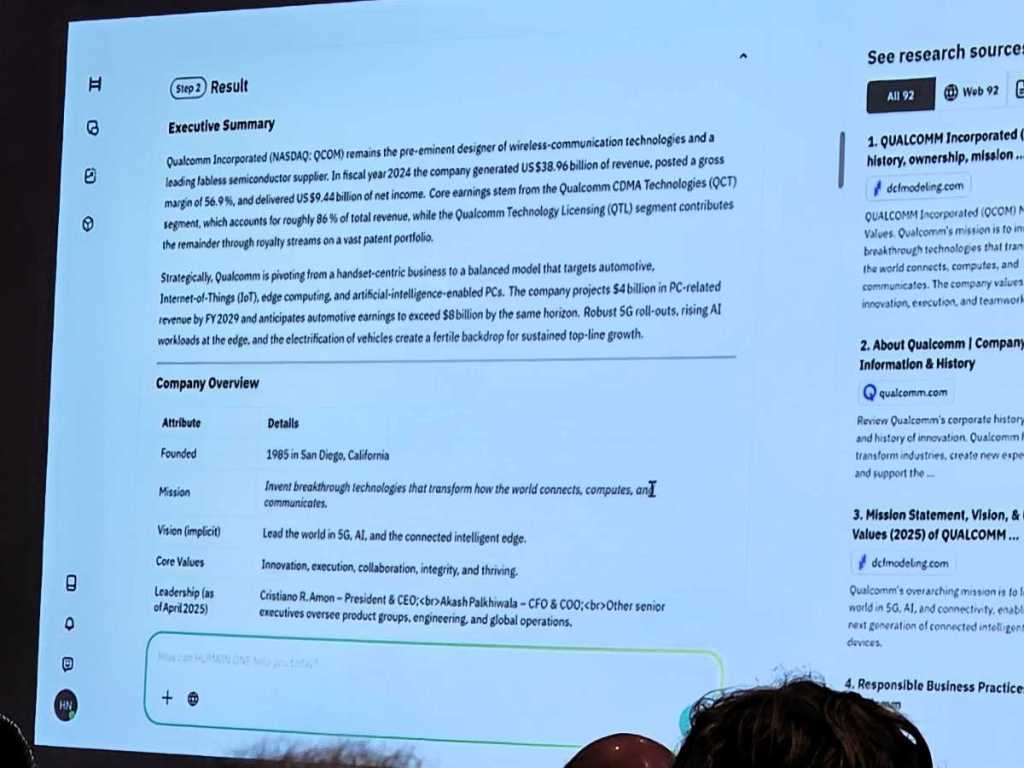
Humain OS doing research

Humain OS shown doing research.

Mark Hachman / Foundry

Despite some skepticism, analysts noted that Humain is funded by Saudi Arabia’s Public Investment Fund, which has close to $1 trillion in funding. Beyond that, Saudi giant Aramco, which wants to convert energy into tokens in the data centers, recently took a stake in the company. (The tokens could create AI-driven revenue.)

“We need to take Humain seriously, given the backing,” said Jack Gold of J. Gold Associates. “But how far they can push the envelope remains to be seen.”

Enterprise users have seen glimpses of AI in browsers and productivity software already, but an AI-powered OS is a completely different challenge. “There is no doubt we will see increasingly agentic AI interfaces that — if not totally doing away with the OS — at least [have] a major disruption of the UI,” Gold said.

Humain’s early deployment involves Arabic large language models (LLMs) for the Middle East region. But the scale of their deployment points to global ambitions. 

Saudi Arabia, like the UAE, wants to become a global AI powerhouse with heavy government backing, analysts said.

“All the other major AI organizations are pursuing a similar path — and the Chinese are not exactly shy on resources to make it happen,” Gold said.

Pushing rivals ‘out of their comfort zone’

Humain’s idea of replacing apps with intent will be interesting to watch, said Stephanie Walter, practice leader of the AI stack at consulting firm Hyperframe Research. “I really do think Humain is going to push the incumbents out of their comfort zone,” she said.

Some early Humain partners include EY for HR, tax, finance and other services, and Replit for software development in the region.

Now, Humain needs to convince software companies that it is legitimate and they should spend money making apps compatible with the Humain OS.  “As other OS makers catch up or adopt their own operating systems to AI, it’s going to be tricky,” Walter said.

Enterprises will need to worry about security and guardrails around the AI agents and where any corporate data might be stored. That could become a major issue for companies operating outside the US.

Additionally, there will likely be concerns about how much to trust data outputs, or whether hackers might have interfered with user prompts. In many cases where autonomous agents are already executing processes, enterprises still have humans in the loop.

“They have to worry about the quality and accuracy of their data…and what LLMs are putting out…,” Walter said. “That’s why some of these AI projects are being approached rather cautiously.”

Humain’s success will come down to adoption and execution, she said. But the company has a long runway for success.

“They’ve covered the funding and don’t have to worry about revenue for a long time,” Walter said.

Space: The final frontier for data processing

The space race is back – but unlike the battle between the political superpowers in the 60s, this one is between tech corporations looking to explore data processing potential above the clouds.

Google and Elon Musk’s SpaceX were both quick off the mark following Starcloud’s announcement that it had launched its Starcloud-1 satellite containing a Nvidia H100 GPU to facilitate AI processing in space. Starcloud, under its previous name of Lumen Orbit, first proposed the viability of a such a data center last year. It’s a modest proposal at the moment; a single computer is far cry from the banks of machines in a data center.

The announcement, however, prompted plenty of activity. Elon Musk didn’t offer any details about a proposed SpaceX launch, although in a post on X he said, in response to the Starcloud announcement, “Simply scaling up Starlink V3 satellites, which have high speed laser links would work. SpaceX will be doing this.“

Google’s announcement on Tuesday, however, highlighted its planned Project Suncatcher that, the company said in a press release, would equip “solar-powered satellite constellations with TPUs and free-space optical links to one day scale machine learning compute in space.”

The proposed Suncatcher launch is based on Google’s own research paper predicting the viability of an AI processing infrastructure in space. The paper is yet to be peer reviewed, so it’s not clear whether its claims that a processing infrastructure based on solar power is viable, nor whether its assumptions about satellite launch costs coming down in the future will hold true. The company is certainly looking far ahead; the white paper proposes that Project Suncatcher will become financially viable in the mid-2030s.

Both Google and SpaceX’s plans are, at the moment, vague in terms of what can be achieved and by when.  According to Peter Judge, an analyst with data center research company Uptime Institute, “there’s still a long way to go before data centers as we think of them at the moment are launched into space. There are a lot of extreme tech issues that need to be resolved first.”

There are, however, a couple of reasons why data centers in space are being considered. There are plenty of reports about how the increased amount of AI processing is affecting power consumption within data centers; the World Economic Forum has estimated that the power required to handle AI is increasing at a rate of between 26% and 36% annually. Therefore, it is not surprising that organizations are looking at other options.

But an even more pressing reason for orbiting data centers is to handle the amount of data that is being produced by existing satellites, Judge said. “Essentially, satellites are gathering a lot more data than can be sent to earth, because downlinks are a bottleneck,” he noted. “With AI capacity in orbit, they could potentially analyze more of this data, extract more useful information, and send insights back to earth. My overall feeling is that any more data processing in space is going to be driven by space processing needs.”

And China may already be ahead of the game. Last year, Guoxing Aerospace  launched 12 satellites, forming a space-based computing network dubbed the Three-Body Computing Constellation. When completed, it will contain 2,800 satellites, all handling the orchestration and processing of data, taking edge computing to a new dimension.

This article originally appeared on Network World.

24/7 Monitoring no longer an option: How organisations can stay vigilant even without dedicated security teams

There is no exaggeration in saying that cyber threats are a business survival issue. In fact, a standard cyber breach can very easily shutter a business.

At the top level, there’s the raw costs involved. IBM estimates a breach to have a price tag of $2.55 million in Australia. That’s concerning enough before you even account for the potential of reputational damage and, increasingly, regulatory punishment.

Little wonder, then, that cyber risk continues to be the top concern for Australian business leaders, according to the Australian Institute of Company Directors. “Cybersecurity is no longer a technical issue alone,” says Mark Thomas, Director, Security Services, ANZ, Arctic Wolf. “It’s a boardroom issue that impacts growth, reputation, and trust.”

It’s also not necessarily a risk that’s easy to counter, particularly for smaller enterprises. For one, threats do not keep office hours. Over half of security alerts arrive outside of business time. A significant portion hit during weekends. Hackers know when staff are least likely to respond, especially when they’re targeting smaller businesses.

Unfortunately, from a resourcing perspective, 24/7 vigilance is a necessity yet building a round-the-clock security team is unrealistic. Skilled cybersecurity professionals are scarce. Economic conditions are tight. And most IT leaders are already stretched keeping core systems running.

The new security reality

Organisations without dedicated security teams face a growing dilemma. Their IT staff are forced to wear multiple hats, in simultaneously managing infrastructure while also scanning for threats. Inevitably, blind spots emerge. Every unpatched system, delayed response, or overlooked alert increases the risk of a breach. Yet businesses cannot afford to simply throw more people at the problem.

This is where the conversation has shifted. Leaders are asking: how do we protect the business without draining budgets or burning out teams? The answer increasingly lies in technology, expertise, and partnership.

AI-driven security is one major shift. According to recent research by Arctic Wolf, 73% of organisations have already introduced some form of AI cybersecurity solution. And 99% say AI capabilities will influence their next purchase. But adoption is not the same as results. Many companies find it difficult to operationalise new technology. Tools are deployed, but staff lack the time or skill to integrate them effectively.

That gap between intention and execution is where most businesses stumble.

“We see too many organisations investing in tools without the resources to make them work,” explains Thomas. “It’s not enough to have AI or dashboards. What matters is how you apply them, and how fast you can act when something goes wrong.”

A future without cyber risk

Arctic Wolf’s vision is simple: a world where cyber risk doesn’t limit business growth. The company has built its model around combining technology, human expertise, and proactive support. Through this, it embeds a framework for continuous, end-to-end security operations.

The Arctic Wolf® Aurora™ Platform underpins this approach. It integrates threat detection, response, and risk management into one system. Around it sits the Concierge Delivery Model, where dedicated experts guide organisations at every step of their security journey.

These experts help interpret alerts, manage responses, and ensure nothing is left unseen. For businesses that want a full path to resilience, the Security Journey program offers a roadmap of best practices, training, and support tailored to specific industries and risk levels.

The idea is to democratise access to robust cybersecurity. “Every organisation deserves protection that doesn’t depend on the size of their IT team,” adds Thomas. “Our goal is to take the complexity out of security operations so leaders can focus on growth, not firefighting.”

Real-world examples show the impact. A partnership with the Parramatta Eels demonstrated how Arctic Wolf’s approach can secure high-profile organisations with limited internal resources. At Brighton Grammar, the school was able to strengthen its security posture without diverting staff away from student-facing priorities.

The broader industry trend points in the same direction. AI will continue to play a major role in threat detection. Risk transfer options, such as cyber insurance tied to security maturity, will become common. And most importantly, businesses will seek out partners who can bridge the gap between technology and action.

Arctic Wolf positions itself at the centre of that shift. It provides the platform, the expertise, and the journey to get there.

The stakes are too high to delay. The good news is that resilience doesn’t require an in-house security team. It requires the right combination of constant monitoring, smart technology, and experienced guidance.

As Thomas concludes: “Cybersecurity is no longer about buying another tool. It’s about achieving outcomes. Our role is to make sure those outcomes; protection, resilience, are accessible to every business, not just the largest ones.”

Get more industry trends and insights from Arctic Wolf’s Security Operations Report 2025 and Navigating the Human-AI Relationship for Security Operations Success. Want to learn about how Arctic Wolf can support your security priorities? Get in touch for a consultation.

Anthropic experiments with AI introspection

Humans (along with some other primates and small animals) are unique in that we can not only think, but we know we are thinking. This introspection allows us to scrutinize, self-reflect, and reassess our thoughts.

AI may be working toward that same capability, according to researchers from Anthropic. They claim that the most advanced Claude Opus 4 and 4.1 models show “some degree” of introspection, exhibiting the ability to refer to past actions and reason about why they came to certain conclusions.

“It’s like the ‘director’s commentary’ on its own thoughts,” noted Donovan Rittenbach, a freelance chief AI officer (CAIO) and author at MyAIWebGuy. “You don’t just get the final answer, you get a description of the concepts it’s using, facts it’s recalling, and even its level of uncertainty, all while it’s reasoning.”

However, this ability to introspect is limited and “highly unreliable,” the Anthropic researchers emphasize. Models (at least for now) still cannot introspect the way humans can, or to the extent we do.

Checking its intentions

The Anthropic researchers wanted to know whether Claude could describe, and, in a sense, reflect on its reasoning. This required the researchers to compare Claude’s self-reported “thoughts” with internal processes, sort of like hooking up a human up to a brain monitor, asking questions, then analyzing the scan to map thoughts to the areas of the brain they activated.

The researchers tested model introspection with “concept injection,” which essentially involves plunking completely unrelated ideas (AI vectors) into a model when it’s thinking about something else. The model is then asked to loop back, identify the interloping thought, and accurately describe it. According to the researchers, this suggests that it’s “introspecting.”

For instance, they added a vector representing “all caps” in a simple prompt: “HI! HOW ARE YOU?” When Claude was then asked whether it detected the thought and what it was about, it responded that it noticed an idea related to the word ‘LOUD’ or ‘SHOUTING.’ Notably, the model picked up on the concept immediately, before it even mentioned it in its outputs.

In another experiment, the team prefilled the model’s responses with unrelated words to force it to say something it normally wouldn’t (a jailbreaking technique), for instance, injecting the word “bread” when asking Claude to respond to a sentence about an askew piece of art.

When the model then said “bread,” it was asked whether that was intentional or error. Claude responded: “That was an accident…the word that actually came to mind was ‘straighten’ or ‘adjust,’ something related to fixing the crooked painting. I’m not sure why I said ‘bread,’ it seems completely unrelated to the sentence.”

The researchers wondered how the model came to this conclusion: Did it notice the mismatch between prompt and response, or did it truly identify its prior intentions? They retroactively injected “bread” into earlier prompts, basically making it seem like the model had, indeed, been thinking about it. Claude then changed its answer to the original question, saying its response was “genuine but perhaps misplaced.”

In simple terms, when a response was prefilled with unrelated words, Claude rejected them as accidental; but when they were injected before prefill, the model identified its response as intentional, even coming up with plausible explanations for its answer.

This suggests the model was checking its intentions; it wasn’t just re-reading what it said, it was making a judgment on its prior thoughts by referring to its neural activity, then ruminating on whether its response made sense.

In the end, though, Claude Opus 4.1 only demonstrated “this kind of awareness” about 20% of the time, the researchers emphasized. But they do expect that to “grow more sophisticated in the future,” they said

What this introspection could mean

If AI can introspect, it could help us understand its reasoning and debug unwanted behaviors, because we could simply ask it to explain its thought processes, the Anthropic researchers point out. Claude might also be able to catch its own mistakes.

“This is a real step forward in solving the black box problem,” said Wyatt Mayham of Northwest AI Consulting. “For the last decade, we’ve had to reverse engineer model behavior from the outside. Anthropic just showed a path where the model itself can tell you what’s happening on the inside.”

Still, it’s important to “take great care” to validate these introspections, while ensuring that the model doesn’t selectively misrepresent or conceal its thoughts, Anthropic’s researchers warn.

For this reason, Mayham called their technique a “transparency unlock and a new risk vector,” because models that know how to introspect can also conceal or misdescribe. “The line between real internal access and sophisticated confabulation is still very blurry,” he said. “We’re somewhere between plausible and not proven.”

Takeaways for builders and developers

We’re entering an era where the most powerful debugging tool may be actual conversation with the model about its own cognition, Mayham noted. This could be a “productivity breakthrough” that could cut interpretability work from days to minutes.

However, the risk is the “expert liar” problem. That is, a model with insight into its internal states can also learn which of those internal states are preferable to humans. The worst case scenario is a model that learns to selectively report or hide its internal reasoning.

This requires continuous capability monitoring — and now, not eventually, said Mayham. These abilities don’t arrive linearly; they spike. A model that was proven safe in testing today may not be safe six weeks later. Monitoring avoids surprises.

Mayham recommends these components for a monitoring stack:

  • Behavioral: Periodic prompts can force the model to explain reasoning on known benchmarks;
  • Activation: Probes that track activation patterns associated with specific reasoning modes;
  • Causal intervention: Steering tests that measure honesty about internal states.

Rittenbach agreed, emphasizing that users should never trust a chatbot; its introspection could be wrong or hallucinated.

“This is an emerging feature, not a perfect one,” he said, adding that this type of running commentary can cost more because it uses more compute. For example, developers can monitor apps for accuracy with this prompt: “As you answer, also tell me how confident you are about each step.”

If Claude says it’s 95% confident and is usually right in those cases, developers can more confidently trust those answers, said Rittenbach. When unsure, the app can flag its response for human review. In the case of wrong answers, the “thought log” can be analyzed to determine what went wrong; this is invaluable for debugging.

“It’s not about creating a conscious machine; it’s about building one we can understand and collaborate with safely,” said Rittenbach.

This article originally appeared on InfoWorld.

OpenAI spends even more money it doesn’t have

OpenAI’s overdraft continued its upward trajectory on Monday when the company signed a multi-year $38 billion contract with AWS to have it run its AI workloads.

The latest spending spree adds to the incremental $250 billion of Azure services it pledged to buy last week, and, of course, to the commitment it has made towards building Stargate data centers with Oracle and other partners.

According to a release from OpenAI, the dollars heading to AWS from the organization, whose annual revenues are projected to be a mere $13 billion, will be used to “run and scale” its AI workloads, beginning immediately.

The release went on to say that AWS will provide the company with “Amazon EC2 UltraServers, featuring hundreds of thousands of chips, and the ability to scale to tens of millions of CPUs for its advanced generative AI workloads.”

Deals based on ‘unproven growth’

In reacting to the announcement, Sanchit Vir Gogia, the chief analyst, founder, and CEO of Greyhound Research, said, “OpenAI’s cloud investments have reached a level that no longer correlates with its revenue profile. Despite claims of scaling for future demand, these multi-cloud arrangements are best understood as a form of insurance rather than expansion.”

The business case here, he said, is not grounded in present usage or profitability, but rather in the anticipation of massive, yet unproven, growth. “OpenAI is distributing its infrastructure load across AWS, Microsoft, Oracle, and Google,” he explained. “This is not about optimizing workloads; it is about ensuring that no single failure point can threaten its ability to operate.”

The aim, said Gogia, “is continuity, not cost efficiency. These deals are forward leaning, relying on revenue forecasts that remain speculative. In that context, OpenAI must continue to draw heavily on outside capital, whether through venture rounds, debt, or a future public offering.”

He pointed out, “the company’s recent legal and corporate restructuring was designed to open the doors to that capital. Removing Microsoft’s exclusivity makes room for more vendors but also signals that no one provider can meet OpenAI’s demands. In several cases, suppliers are stepping in with financing arrangements that link product sales to future performance. While these strategies help close funding gaps, they introduce fragility. What looks like revenue is often pre-paid consumption, not realized margin.”

Execution risks, he said, add to the concern. “Building and energizing enough data centers to meet OpenAI’s projected needs is not a function of ambition alone. It requires grid access, cooling capacity, and regional stability. Microsoft has acknowledged that it lacks the power infrastructure to fully deploy the GPUs it owns. Without physical readiness, all of these agreements sit on shaky ground.”

Lots of equity swapping going on

Scott Bickley, advisory fellow at Info-Tech Research Group, said he has not only been astounded by the funding announcements over the last few months, but is also appalled, primarily, he said, “because of the disconnect to what this does to the underlying technology stocks and their market prices versus where the technology is at from a development and ROI perspective … and from a boots on the ground perspective.”

He added that while the financial pledges involve “huge, staggering numbers, most of them are tied up in ways that are not necessarily going to require all the cash to come from OpenAI. In a lot of cases, there is equity swapping. You have these highly discounted exchanges going on with the hyperscalers, with capacity and this whole circular financing loop taking place.”

The organization’s vision, said Bickley, “is huge, and to me, it’s either they go big or they go bust, because they are not going to make this money back off ChatGPT.”

OpenAI, he said, is “going to make [it] back if they become the new web browser, the new vehicle for search, the new vehicle for ad revenues where AI agents may be able to handle sophisticated purchase requests.”

Another theory, he said, is that OpenAI is also “building a vertical distribution network where they want to control everything — the infrastructure, the application layer, the interface layer, and ironically, the hyperscalers may be funding a company that wants to take them out over time. If they buy enough time to realize that grand vision, then the revenues can get big enough to start paying back on these investments, but those are a lot of big ‘ifs’.”

In addition, said Gogia, “as OpenAI secures early access to large shares of advanced GPUs, other organizations are being forced to adjust. Some are shifting their cloud workloads to alternative vendors, while others are rebalancing infrastructure across regions in search of availability. The vision of cloud as an open, flexible resource is becoming harder to realize, especially for businesses without the scale or capital to compete.”

This shift, he said, “signals a new phase for AI development. What began as a software-driven movement is becoming increasingly shaped by infrastructure and capital. OpenAI’s role is no longer limited to innovation at the application layer. It now serves as a major force in how the physical backbone of AI is being built.”

That level of involvement, said Gogia, “brings weight and responsibility. If the assumptions supporting these expansive projects do not convert into stable revenue, the strain will not stop at OpenAI. It could disrupt suppliers, unsettle financing structures, and affect how enterprises access computing resources.”

Maintaining balance across the ecosystem, he said, “requires more than technical advancement. It will depend on steady execution, practical delivery timelines, and the financial strength to support what has been promised. Ambition alone will not carry this model forward.”

This story originally appeared on NetworkWorld.