Month: March 2026

Anthropic wins reprieve against US DoD ban, buying time for contractors to assess AI supply chains

The Pentagon’s attempt to brand Anthropic a supply chain risk was “likely both contrary to law and arbitrary and capricious,” a US federal judge wrote in a ruling halting a ban on use of Anthropic’s products in defense contracts.

In granting Anthropic a preliminary injunction against the ban, US District Judge Rita Lin of the US District Court for the Northern District of California delivered a legal setback for the Department of Defense and complicated plans by other agencies to remove Anthropic from federal systems.

She also took aim at the scope of the Pentagon’s directive, which effectively sought to extend beyond internal procurement decisions and into the wider private sector contractor ecosystem. At issue was a sweeping restriction under which “no contractor… may conduct any commercial activity with Anthropic,” a move that would have forced companies doing business with the DoD — and other government agencies that have announced their own Anthropic bans — to unwind relationships or risk federal revenue.

Judge Lin made clear that this kind of ecosystem-wide restriction raised serious legal concerns, particularly where it would force contractors to sever commercial ties beyond the scope of federal work.

Following the ruling, Anthropic issued a statement saying, “We’re grateful to the court for moving swiftly, and pleased they agree Anthropic is likely to succeed on the merits. While this case was necessary to protect Anthropic, our customers, and our partners, our focus remains on working productively with the government to ensure all Americans benefit from safe, reliable AI.”

Court questions rationale behind ‘supply chain risk’ label

The Pentagon banned Anthropic in late February, after the company resisted allowing its Claude AI model to be used for certain military applications, including autonomous weapons and domestic surveillance. The Department of Defense took the unprecedented step of formally designating the company a “supply chain risk,” a categorization that has previously only applied to foreign companies.

The designation triggered a cascade of consequences for Anthropic: federal agencies halted usage, contractors distanced themselves, and enterprise customers began reassessing their exposure.

Judge Lin was openly skeptical of the Pentagon’s approach, suggesting it looked less like a narrowly tailored national security measure and more like an “attempted corporate murder.”

“It is the Department of War’s prerogative to decide what AI product it uses,” Lin wrote, using the Department of Defense’s secondary name. “Everyone, including Anthropic, agrees that the Department of War may permissibly stop using Claude and look for a new AI vendor who will allow ‘all lawful uses’ of its technology.”

But the court took issue with the government’s reasoning, rejecting the idea that Anthropic’s restrictions on uses such as mass surveillance or autonomous weapons justified branding it a supply chain threat.

“Defendants’ designation of Anthropic as a ‘supply chain risk’ is likely both contrary to law and arbitrary and capricious,” Lin wrote. “The Department of War provides no legitimate basis to infer from Anthropic’s forthright insistence on usage restrictions that it might become a saboteur.”

She added, “At oral argument, government counsel suggested that Anthropic showed its subversive tendencies by ‘questioning’ the use of its technology, ‘raising concerns’ about it, and criticizing the government’s position in the press. Nothing in the governing statute supports the Orwellian notion that an American company may be branded a potential adversary and saboteur of the US for expressing disagreement with the government.”

What the ruling means for the private sector

The ruling interrupts an active compliance timeline already imposed on both federal agencies and their contractors. A March Pentagon memo had already directed companies doing business with the DoD to begin removing Anthropic technology, with a full phase-out expected within months. The injunction halts that process — but only temporarily.

For federal contractors, the pause is operationally significant, but it functions more as a buffer than as relief. Many had already begun auditing systems, mapping dependencies, and preparing attestations tied to contract obligations.

That work should continue. If a higher court reverses the injunction, or the Pentagon revises its designation to address the court’s concerns, the same obligations could return quickly — potentially with clearer legal footing and less room to challenge them.

More broadly, the case signals that supply chain risk in the AI era is no longer limited to compromised code or foreign ownership. It now extends to how a vendor governs the use of its own technology — and whether that governance aligns with federal priorities.

If a higher court reverses the injunction, or if the Pentagon revises its designation to address the court’s concerns, the same obligations could return quickly, potentially with a clearer legal footing and less room for challenge.

The next move, whether by an appellate court or a revised Pentagon directive, will determine how far federal authority regarding AI contracts ultimately reaches. In the meantime, contractors are left operating in a narrow window of uncertainty, where the safest course is to assume the pressure will return and prepare accordingly.

This article first appeared on CIO.com.

The ‘AI slop’ backlash kills Sora

OpenAI just killed Sora.

That’s an amazing development. When the company rolled out the video-creation site, and later the app, reviewers called it a trailblazer because it combined video creations with sound effects, spoken dialog, and the ability for users to generate a specific character using a reference image and reuse them in multiple videos (a Sora 2 feature called “Character”).

Sora was seen as a threat to jobs in filmmaking and marketing. After watching an early demo of Sora, actor and filmmaker Tyler Perry canceled the construction on an expansion to his film studio in Atlanta, Georgia.

Hollywood’s powerful CAA talent agency in October issued a statement saying that Sora was a threat to the livelihood of actors.

The Los Angeles Times said Sora represented a “firestorm” in the movie industry.

And critics pointed out how easily and convincingly Sora could create realistic videos involving actual people. (OpenAI recently banned users from uploading pictures of real human faces.)

So if Sora was so disruptive, threatening and money-saving, why did OpenAI shut it down?

The company even tore up a $1 billion deal with Disney, signed in December, which would have brought 200 Disney characters into the Sora video app.

Though OpenAI claimed on Tuesday that it killed Sora to focus on robotics, critics and skeptics argue that the real reasons include high computing costs, shrinking user numbers, legal threats over copyright, and a strategic shift ahead of an expected fourth-quarter 2026 IPO.

In other words, AI-generated video isn’t worth it, isn’t a priority, and isn’t the technology miracle everybody thought it was.

Still, that’s a long distance from the hype and fear of two years ago. What happened?

The backlash

With each passing day, it becomes clearer that the initial reaction to ever-improving AI generation tools was more of a parlor trick and novelty, and that the novelty is wearing off.

When gamers reacted negatively to Nvidia’s generative AI graphics enhancement tool called DLSS 5, which launches this fall, fearing that it replaces human artists, Nvidia CEO Jensen Huang said, “I don’t love AI slop myself,” but also said that critics misunderstand what the tool is all about.

A TikTok account got millions of likes and followers for so-called “fruit slop” videos about a reality show called “Fruit Love Island” starring “fruit people,” but the backlash against the account came even faster than its rise. Critics say the popularity of the videos represents a society gone mad and a generational crisis for young people. The account is now gone, replaced by hundreds of copycat accounts.

Parents are also concerned that low-quality AI slop is infiltrating children’s content on sites like YouTube. These videos seem mass-produced with little care about content. Many of these videos show the kind of nonsense we’ve grown to expect from AI slop. From an article on Undark:

“The video opens with the children riding, without seatbelts, in the front row of a moving vehicle. The next scene shows the girl defying physics, floating alongside a moving car, while the boy is seated in what appears to be the hood of the vehicle as it travels backward down a busy street. The third and fourth scenes show the children walking in the middle of the road with moving cars behind them.”

But these stories don’t quite identify the larger problem, which is that a huge number of people and businesses think that AI slop is some kind of secret weapon to represent their ideas and brands in the real world.

Small shops and restaurants in New York City, for example, are using AI pictures to advertise food. The food tends to look nothing like the actual food, creating a persistent, low-level false advertising problem among small businesses.

AI slop is used for all kinds of purposes on social media. One of my least favorite uses is to depict historic information. It’s always misleading. For example, I’m a big fan of Mexican history, and I’ve seen multiple AI slop videos showing, say, the island city of Tenochtitlan (the Aztec city that existed in the place where Mexico City now sits). Designed to enable people to visualize the past, they always create a completely false impression of that past.

AI slop: it’s just cheap

AI slop, which is appealing to some users because it’s cheap, and opposed by other people because it’s cheap, is causing unexpected problems.

Brands like J.Crew and Coca-Cola have seen their reputations tarnished when they tried to use AI-generated pictures or videos for marketing actual products.

It’s also causing resentment because one of its main uses is to emotionally manipulate people. The Chinese version of TikTok, for example, is awash with “regret videos,” whereby aging parents with unmarried offspring use AI to try to frighten their kids into marriage.

The shaming videos use AI to “age” women, showing them bitter and alone, often in hospitals, juxtaposed to happy women with their families. Some have dialog, such as: “I regret it. My parents told me to get married and have kids. I didn’t listen, thinking it was too much trouble. Look at me now!,” according to one report.

AI-generated imagery is often used explicitly to evoke in others the emotions you want others to feel: fear, revulsion, outrage, and pity.

AI-generated slop often seeks to bypass reason and get straight at emotions. It replaces words with pictures. Often, the pictures make no sense, and that hardly matters. The aim is emotion. And while some believe emotional manipulation through AI is something they want, a larger number resent being manipulated.

And the world of content is taking a stand as well. In January, San Diego’s Comic-Con banned all AI comics. Last week, the digital comic platform GlobalComix removed AI content. Marvel Comics Editor-in-Chief C.B. Cebulski established a strict anti-AI policy during the New York Comic Con in late 2025.

Book publishers are resisting as well. Hachette Book Group canceled the upcoming release of a horror novel titled “Shy Girl” by Mia Ballard because they suspected the author used AI to write it.

By early 2026, many public libraries had begun writing strict collection policies to filter out books with AI-generated content.

In early 2026, Instagram updated its system to actively penalize highly polished, synthetic content.

So what we’re witnessing is a massive backlash to AI slop, especially visual content like videos and pictures. And the backlash is so great, it even killed Sora.

AI disclosure: I don’t use AI to do my writing. The words you see here are mine. I do use a variety of AI tools via Kagi Assistant (disclosure: my son works at Kagi) — backed up by both Kagi Search, Google Search, as well as phone calls to research and fact-check. I used a word processing application called Lex, which has AI tools, and after writing the column, I used Lex’s grammar checking tools to hunt for typos and errors and suggest word changes. Here’s why I disclose my AI use. 

Don’t sleep on this powerful new Chrome security booster

When it comes to staying safe online, the teensiest shred of common sense goes an impressively long way.

That’s absolutely true on Android, as I’ve been preaching for more years than I can even remember at this point — and it’s true on the web, too, especially when you’re working within the desktop browser you almost certainly use alongside your mobile device.

With the web, the desktop domain adds in the extra wrinkle of browser extensions — which can add powerful new possibilities into your web-wide work space but can also open up windows into worrisome security scenarios, since many such add-ons inevitably require access to activity-related data or even the ability to modify what you’re seeing on the web and inject extra elements into your view.

For the most part, the “common sense” approach still works wonders. You should always assess something carefully before installing it to make sure the developer seems trustworthy, the reviews seem positive, and the requested permissions seem sensible — particularly with whatever privacy assurances are provided. All of that info is always available within Google’s Chrome Web Store when you’re looking at something new, and ideally, you’ll revisit it periodically and regularly eliminate anything you no longer need.

But increasingly over time, an asterisk has emerged that creates a tricky-to-avoid risk: Sometimes, perfectly legitimate Chrome extensions get sold — and the buyer ends up being far less reputable than the original developer you considered and ultimately decided to trust. And, since you already have the thing in place on your browser, you’re none the wiser to the change and its potential implications for your security.

This very prickly predicament just popped up days ago, when a popular Chrome extension for saving images from the web starting showing signs of shifty behavior. Sure enough, the extension seems to have changed hands a matter of months ago, and the million-plus people who had previously trusted it were suddenly subjected to a new developer’s under-the-hood changes. That continued until enough folks noticed to cause the extension to get flagged — a step that, unfortunately, may have come too late for some people.

Such scenarios may seem hopeless, but take heed: There’s actually an easy way to preemptively protect yourself from these very sorts of shenanigans. And it takes just 20 seconds of one-time setup, now, to achieve.

[Get new knowledge in your inbox every Friday with my free Android Intelligence newsletter. Three new things to try each week!]

Your simple new Chrome security guard

Our wily web-fortifying hero comes in the form of a crafty Chrome extension for desktop web browsers called Under New Management.

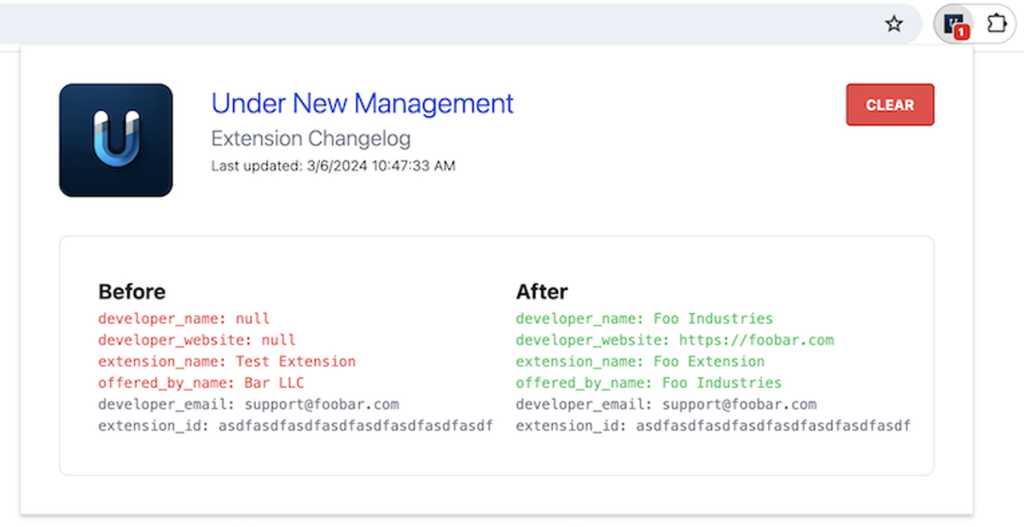
Under New Management does one thing and one thing only: It watches all of your installed browser add-ons and alerts you anytime any of ’em changes hands and accepts a new owner.

Now, software being sold isn’t necessarily a red flag, of course. Developers can legitimately pass the baton to a trustworthy new steward in a reputable transaction that’s no cause for concern.

But with Chrome extensions in particular, we’ve seen so many instances like the one we mentioned a moment ago — where a once-reputable add-on gets pawned off to someone with less-than-honorable intentions and its users ultimately pay the price — that it’s at the very least something you deserve to know about and should be able to consider closely when it occurs.

And that’s what Under New Management is there to do: It just keeps an eye on everything you’ve got installed, quietly and in the background, and puts up a simple red badge in your browser toolbar whenever a developer change occurs.

Chrome browser security; Under New Management
Under New Management alerts you anytime an extension changes hands.
Class V Software

All you’ve gotta do is install the extension from the Chrome Web Store, then pin it to your toolbar (by clicking the puzzle-shaped extension icon in Chrome’s upper-right corner, finding “Under New Management” in the list that appears, and clicking the pushpin alongside it) so you’ll always see any changes it uncovers.

(And since so many other browsers are based on the same Chromium foundation as Chrome, you can also install and use Under New Management in them as well — everything from Edge to Vivaldi, Brave, Opera, and beyond.)

Notably, Under New Management itself doesn’t require access to anything more than monitoring your installed apps and extensions. It doesn’t request any permissions, and its developer is clear that it doesn’t collect or share any manner of data, either. The extension is also open source, so anyone with the right know-how can inspect the code and confirm that it’s doing exactly what it says and nothing more.

So install it, pin it, then forget about it. The extension probably won’t demand your attention often, if ever, and it won’t have any meaningful impact on your day-to-day browser performance or experience.

But if and when it does pop up a warning, you’ll be glad to know it alerted you. And you’ll be able to look closely at whatever changed hands to keep an eye on what it’s doing — or just uninstall it, if you’re in the least bit uncomfortable — before any unfortunate additions come along and catch you by surprise.

Got Android? Get my free Android Intelligence newsletter to keep up with all my latest tips and recommendations — with three new things in your inbox every Friday.

European Parliament votes to delay EU AI Act implementation

The European Parliament’s Thursday vote to delay parts of the EU AI Act adds more uncertainty to the already chaotic AI compliance universe. But analysts say that CIOs must proceed as though the compliance rules are in effect. 

Members of the European Parliament voted to delay application of rules on high-risk artificial intelligence (AI) systems to give European authorities time to prepare planned guidance and standards to help companies with implementation.

Although the Parliament and the European Commission are now in agreement on the delay, they still need the approval of a third law-making institution, the Council of the European Union.

With the first of the deadlines MEPs voted to delay coming up in August 2026, this presents a planning challenge for CIOs: Should they rush to implement changes before the existing deadline, without the promised guidance, or wait and hope the Council approves the delay?

Delay is not a reprieve

Analysts and consultants were virtually unanimous in their recommendations that enterprise CIOs must not wait and must instead operate as though the rules are already in effect.

“It’s good that they have clarified the extension [because] previously it was a moving target,” said Nader Henein, a Gartner VP analyst. “It’s not great that the final decision will happen so close to the old deadline that organizations have no choice but to proceed as originally planned. Since the first draft of the EU’s Digital Omnibus proposal back in November, our guidance to clients has been to treat any potential extension as an opportunity to better test-out and improve the process for cataloging and managing AI systems.”

Henein added: “The major gating factor for the current timeline was that regulators would not have been ready to enforce. This is still the case. Spain is one of a handful of countries who stood up a regulator, and even the EU AI board is behind on the kind of guidance needed by organizations to properly understand their obligations when it comes to high risk AI systems. Those obligations that, as it stands, come into effect on August 2.”

Cybersecurity consultant Brian Levine, executive director of FormerGov, said that the move to delay major AI Act restrictions until 2027 “leaves CIOs in a regulatory limbo, but it doesn’t change the underlying reality: enterprises still own the risk their AI systems create.”

“Whether Brussels enforces the rules next year or two years from now, the operational, legal, and reputational exposure from poorly governed AI is already here. CIOs shouldn’t treat the delay as a reprieve,” Levine said. “The organizations that wait for perfect regulatory clarity are the ones most likely to discover that their models have been quietly generating compliance, privacy, or safety liabilities long before any enforcement clock started ticking.”

Parliament proposed that “for high-risk AI systems specifically listed in the regulation–including those involving biometrics, and those used in critical infrastructure, education, employment, essential services, law enforcement, justice and border management,” the regulation would be applied on Dec. 2, 2027. For AI systems “that are “covered by EU sectoral legislation on safety and market surveillance,” it set a date of Aug. 2, 2028. The statement also noted that members are “in favor of giving providers until November 2, 2026 to comply with rules on watermarking AI-created audio, image, video or text content to indicate its origin.” 

Use time to prepare

Jason Hookey, executive counselor at the Info-Tech Research Group, said that he agreed with some of Parliament’s decision.

“The EU’s choice to delay high-risk AI obligations makes sense. Most people agree with the purpose of these rules, but there are concerns that organizations won’t be able to meet them without sufficient guidance, technical standards, or appropriate support. It’s important to note that the delay only changes the timeline, not the main goals around high-risk AI,” Hookey said. “Organizations that use this time well will be better prepared for compliance, control, and building market trust. Those who wait may only put off problems and miss out on the benefits of well-managed AI.”

Others pointed out that the European Union’s decisions are only recommendations to its many member states, who have the authority to make any changes they want for their countries. 

Procedural risk

EU resolutions operate at two levels, noted Flavio Villanustre, CISO for the LexisNexis Risk Solutions Group. 

“There is a policy decision at the EU level and there is an implementation definition at the member states level. For this reason, even after the policy is set and published, they usually leave years-long implementation times for the member states to comply and release their own legislation that will define the implementation requirements for that member state,” Villanustre said. “I don’t think this particular case will be any different, so the actual deadline may be further in the future than what the draft legislation indicates.”

In addition, Doug Barbin, president of compliance firm Schellman, warned CIOs, “there’s also a real procedural risk here: if Council and Parliament negotiations drag past August 2026, the original deadlines stay on the books. CIOs who’ve been sitting on their hands are the most exposed to that scenario. The organizations investing in governance infrastructure now won’t be the ones in crisis mode later. This is extra time — use it.”

Barbin said the market is slowly shifting to broader strategies. “This is where compliance is going: less around specific actions and more about governance and risk,” he said.

High cost of waiting

Yvette Schmitter, CEO of the Fusion Collective consulting firm, said she is concerned that CIOs will take the wrong message away from what the European Parliament did. 

“I think it is bad in the sense that it gives people a false sense of security in that they have more time. [It is] trying to give them more time, but companies will never be ready,” Schmitter said. “Courts don’t care about your regulatory compliance timeline. When your AI system produces detrimental or discriminatory outcomes at scale, ‘we were waiting for final guidance’ won’t survive depositions.”

Sanchit Vir Gogia, chief analyst at Greyhound Research, argued that these decisions amount to mixed messages, which serve to deepen the AI regulatory confusion.

“The shift in timelines has removed a clear enforcement anchor, but it has not reduced the expectation of accountability. If anything, it has made decision-making harder. Enterprises are now operating in a mixed state where some obligations are already in force, others are expected later, and internal teams are interpreting risk in different ways. That combination creates confusion long before any regulator steps in,” he said, noting that many companies will want to slow down and wait for the final regulation.

“That instinct is misplaced,” he said. “Waiting assumes clarity will arrive early enough to act on it. In practice, clarity tends to arrive late, unevenly, and often after internal decisions have already been made. CIOs who choose to pause are not reducing exposure. They are simply postponing the moment when that exposure becomes visible.”

Gogia also suggested that there are hardcore financial costs associated with waiting.

“There is a belief that delays reduce spend. In reality, the opposite often happens. Work that is paused has to be restarted. Teams lose context. Designs are revisited. Governance added late is more expensive than governance built in from the start,” he said. “Vendor contracts entered into without clarity become difficult to unwind. None of this shows up immediately, which is why it is often underestimated. But over time, the cost of waiting tends to exceed the cost of acting with intent.”

This article originally appeared on CIO.com.

Google: The quantum apocalypse is coming sooner than we thought

Google isn’t just responsible for the encryption of a big chunk of the communications on the internet. It is also building its own quantum computers, so it’s well placed to evaluate how close the technology is to fruition.

Until now, the company has been aligned with the NIST timeline, which specifies 2030 for deprecating quantum-unsafe algorithms and their full disallowance by 2035.

But on Wednesday, Google said that 2029 is now the deadline for the migration to post-quantum cryptography (PQC). It also said that it has adjusted its threat model to prioritize PQC migration for authentication services, and urged other engineering teams to follow suit.

Quantum computers increasingly powerful

Quantum computers are expected to break traditional asymmetric encryption, which is used to secure communications, financial transactions, and websites, once they get powerful enough.

That time is coming, says Jordan Kenyon, chief scientist in the quantum practice at Booz Allen Hamilton. “The first version of Shor’s [algorithm] was projected to require 20 million qubits [to break] and recent results have shrunk those requirements down to as a little as around 100,000 qubits.”

It’s not just that the hardware is getting better, she tells CSO. There have also been advances in error correction and algorithms.

“The magnitude of change is tough to deny,” she says.

In 2019, Google estimated that it would take 20 million qubits to break RSA encryption. By May of 2025, Google revised those estimates down to 1 million. And last month, researchers at Australia’s Iceberg Quantum said in a pre-print report that only 100,000 physical qubits were needed.

Fortunately, NIST has already finalized four algorithms that should withstand quantum computing, and has selected a fifth. But unfortunately, according to the Post Quantum Cryptography Coalition, most PQC standards have not achieved broad adoption yet.

Worse yet, says the Trusted Computing Group, its research shows that 91% of businesses do not have a roadmap in place. In addition, 80% say their current crypto libraries and hardware security modules are not ready for PQC integration, and only 39% have begun their PQC compliance readiness assessments.

CSOs can’t afford to watch and wait

Google has upped the ante on PQC migration, Michela Menting, an analyst at ABI Research, tells CSO.

That means that enterprises will also need to step up their transition plans, she says, “to align earlier than what they might have originally thought was acceptable based on the NIST deprecation timelines — especially if they want to keep pace with hyperscalers.”

She expects Microsoft and AWS to set similar migration schedules, and CSOs will need to move their PQC transition plans up the priority list.

“It’s not a side project anymore, with an extended time frame that they can just get to whenever they have extra time to work on it,” she says. “They really can’t afford to watch and wait anymore.”

According to Google, some data is already being collected by attackers. In a post last month, Kent Walker, president of global affairs at Google and Alphabet, wrote, “Malicious actors are not waiting until a cryptographically relevant quantum computer is ready. They are likely already carrying out ‘store now, decrypt later’ attacks and collecting encrypted data, just waiting for the day when a quantum computer can unlock it.”

This means that enterprises need to up their game. According to Gartner, 61% of organizations lack full visibility into their cryptographic systems. The research firm recommends that companies conduct a comprehensive cryptographic inventory, invest in cryptographic agility and visibility, establish a cryptographic center of excellence, and prioritize PQC migration for assets with long-term sensitivity.

This article originally appeared on CSOonline.

Hexnode CEO: MacBook Neo forces IT to rethink its budget laptop strategy

Apple’s MacBook Neo (reviewed here) challenges what we expect from budget laptops. Accompanied by shrewd enterprise-focused moves, the new model gives Apple a chance to convert hitherto resistant IT purchasers to adopt its platforms. I spoke with Hexnode CEO Apu Pavithran to get some sense of this potential.

Apple’s decision to introduce a $599 laptop is hugely significant, said Pavithran. “Apple is positioning itself on price and gunning for the volume markets it previously ceded to other players,” he said. The company is using its existing strengths with the product, exploiting its in-house processing power, repackaging its hardware for new customers, and “breaking the perception that Mac is premium-only.”

Pavithran leads one of the new breed of device management services designed to serve cross-platform fleets. That gives him insight into the potential attraction the Neo may yield for established Windows-based enterprises.

Opening Windows

“There are growing problems with Windows 10 end-of-life and a wave of users facing upgrade decisions,” he pointed out. At its price, Apple’s Neo offers users in that segment an affordable introduction to the Mac ecosystem. It’s appealing for some enterprise edge cases that need a real computer at a low price point, such as for use as kiosks or at reception desks.

Much of this is about perception, and that’s where Apple has struck a huge blow. “The Neo is shaping up as an industry reset, changing expectations for what a “cheap” laptop can look and feel like,” said Pavithran.

“I can’t think of any entry-level portable computers with Retina display, aluminium build, 16-hour battery, and full desktop OS. This will put pressure on Chromebook and Windows OEMs to justify plastic builds and shorter battery life at similar prices. I hope other makers take up the challenge and we see a race to the top in the budget laptop segment.”

Does the MacBook Neo have enterprise appeal?

As Pavithran sees it, the big challenge Apple still has is winning over IT. There’s plenty of pressure in the company’s favor, not least that employees will now overwhelmingly choose Apple if given a choice. The challenge is to convince IT to offer that choice in the first place. “Competing on price certainly helps because it’s often the biggest hurdle for budget-conscious bosses across SMEs,” he said.

That’s one of the ways MacBook Neo opens the argument.

Since the introduction of the product, Apple has expanded its Apple Business service across 200 countries. Among other things, Apple Business makes it easy for SMBs of any size to secure and manage their Apple-based business systems, including support for zero-touch deployments and SSO. 

I spoke with Pavithran just before that launch. Apple Business will almost certainly help the MacBook Neo open up more space in business markets, as the services it provides are among the challenges he thought Apple faced pushing its platforms to enterprise purchasers. “Apple has the building blocks, but the enforcement layer still relies heavily on third-party tools,” he said then. 

Apple needs to make sure its systems “integrate smoothly with unified endpoint management (UEM) so IT isn’t juggling multiple dashboards, drowning in alerts, and suffering from siloed visibility,” he said. After we spoke, Apple announced that it will offer APIs that enterprises and their device management partners can use to help ease those challenges.

What about the education market?

The MacBook Neo isn’t just for the enterprise; it offers plenty to education too, with a tempting $499 price tag for students, who will be attracted by the looks and brand appeal Apple provides. 

The impact may not be immediate. “K-12 won’t overhaul its entire ecosystem just because there’s a cheaper Mac,” Pavithran said.

“These classrooms are already deeply embedded in Google Workspace and will take some time and tooling to completely onboard. The education sweet spot is in universities and colleges, because these students buy their own devices (rather than school-issued), need creative and STEM software, and benefit most from integration with iPhone,” he said.

Apple needs to sell this product line to admins more than students, and that’s a sticking point for both lower and higher education. “Following the pandemic, Google’s device management in education only got better, with admins feeling very confident in this ecosystem. Moving to Apple devices means rethinking management at scale — and this is where the company will need to make life as easy as possible for those making the switch.”

How Apple thrives in a difficult business environment

Global conflict and the unraveling of decades-long trade agreements in favor of vibes rather than values poses huge strain on business systems. While there’s no arguing away the challenges of that environment, Apple does have advantages, Pavithran points out. “Apple’s vertical integration (own silicon, own OS) gives it more levers than competitors reliant on third-party chips and Microsoft licensing,” he said.

Please follow me on Twitter, or join me in the AppleHolic’s bar & grill and Apple Discussions groups on MeWe. Also, now on Mastodon.

Enterprise laptops adopt Intel’s new Core Ultra Series 3 chips

Intel’s Core Ultra Series 3 processors with Intel vPro, built for business PCs, are off to a fast start, already powering more than 125 designs including newly-announced systems from Dell and HP, the company said.

Unveiled this week at an event in New York City, the Core Ultra Series 3 with Intel vPro brings what Intel described as “next-generation performance efficiency and integrated AI acceleration,” as well as providing an enhanced vPro management platform.

[ Related: More Intel news and insights ]

The company first announced the Core Ultra Series 3 processors in October 2025. Previously codenamed Panther Lake, they will also appear in new consumer PCs.

Users of systems running on the new chips will see over 30% faster performance, up to 80% better graphics, and up to 4x AI performance compared to four-year-old systems, the average PC refresh period for businesses, according to Intel.

While the new systems can run code faster, Intel is also pushing for them to be more intelligent about the code they do run. Enhancements to vPro include the Intel vPro Certification Program that Intel said results in as much as 59% reduced CPU utilization, a 74% reduction in background activity, and power efficiency improved by 56%.

AI is also playing a bigger role in the form of vPro Intelligence with Device IQ, which offers AI-driven analytics to detect, diagnose, and resolve issues. There’s also vPro Fleet Services to simplify out-of-band manageability via a fully managed SaaS-based activation and integration with Microsoft Intune, and security enhancements including Intel Total Storage Encryption for Microsoft BitLocker and AI-based threat detection using Intel’s chip-based Threat Detection technology (DTECT).

Business PCs incorporating these technologies will be available beginning on March 31.

Dell has launched an updated Dell Pro Notebook lineup which includes devices powered by the Intel Core Ultra Series 3 processor. It offers models with and without vPro.

The Dell Pro Premium is designed for on-the-go executives and managers; the Dell Pro 7 is for users such as consultants and sales professionals who need systems that are portable, yet capable; the Dell Pro 5, the company said, provides mobility for users such as financial analysts while maintaining the performance they need for their business applications; and the Dell Pro 3 was created for users who run core productivity applications such as email, document creation, and collaboration.

The Dell Pro Premium will be available on March 31, and the other models will hit the shelves in May. Pricing has not yet been announced.

HP’s refreshed portfolio for business includes 31 new models powered by Intel, AMD, and Arm processors. Intel-powered devices include multiple configurations in the EliteBook 8 G2 series, an AI PC designed for knowledge workers, and the EliteBook 6 G2 series for mobile professionals and office collaborators. Other models are directed at the SMB market. The company also announced the EliteDesk 8 G2 for enterprise workers.

The EliteBook 8 G2 devices are expected to be available in April, as are the EliteDesk models. The EliteBook 6 G2 is scheduled for June. Pricing has not yet been announced.

More Intel news:

What IT leaders need to know about AI-fueled death fraud

Death is always an unpleasant topic, typically ignored until it is fully upon us. But for IT leaders, fraudsters who use fake death documents generated by AI to steal data and commit a wide range of other crimes are simply too dangerous to ignore.

There are two different forms of these death frauds: tricking an enterprise into falsely believing that its customer is dead, and fraudulently leveraging an actual customer death. In both cases, the goal is to gain control of the deceased’s account and/or data by pretending to be their next of kin.

These crimes take advantage of two sides of technology. Using genAI capabilities to create all-but-perfect replicas of various types of death certificates, the fraudster uses powerful technology for a nefarious purpose. The fraud works because of a gaping technology hole: the absence of standardized, continually updated government databases that organizations anywhere in the world could consult for official information about deaths and next of kin.

“Most customer identity systems assume the user who created the account will remain the person interacting with it,” said Sanchit Vir Gogia, chief analyst at Greyhound Research. “Authentication methods, password recovery, and multifactor verification are all designed around that assumption. When the individual behind the account dies, the system is suddenly dealing with a situation it was never designed to manage.”

Gogia added: “Fraud involving false death claims is not hypothetical. It is already happening, and the conditions that enable it are becoming more favorable for attackers.”

Valence Howden, an advisory fellow and distinguished analyst at Info-Tech Research Group, paints the problem as one that is dangerous, partially because so few enterprises are considering it a serious threat. 

“It’s a huge issue, as it is still seen as an outlier issue. Deepfake use has expanded because it is now so much easier to do,” Howden said. “There is a risk to [enterprise] reputation, legal, and compliance. I don’t think people realize how much it is happening now.”

Melody Brue, principal analyst for Moor Insights & Strategy, also sees death fraud as a massive enterprise problem.

“Post‑mortem identity abuse — real or fake — is a real operational risk for every digital platform, not just for banks, because bad actors can use account history, relationship graphs, or credential trails to socially engineer far larger frauds elsewhere,” Brue said. 

A new avenue for fraud

The threat of genAI deepfakes of identification documents has been discussed for years, but the specific use case of either faking a customer’s death or faking the credentials of the next of kin of an actual dead customer has gotten relatively little attention. That lack of focus is a major problem, given the many ways that fraudsters can use that access and/or information. 

The situation does depend on the enterprise’s industry, with highly regulated verticals — especially finance and healthcare — facing a different reality. That is because regulators so highly value money transfers and ultra-sensitive files such as health records that they have placed legal hurdles for transferring those controls. In the absence of a joint account holder or designated beneficiary, for example, a bank must freeze a user’s account upon an alleged death, and then it’s up to the courts to unfreeze it.

The problem is that other verticals also face serious threats without the same regulatory guardrails. Consider an airline or hotel chain where an attacker can steal and use points to game free flights or hotel rooms. That may not be legal currency, but it’s a financial hit for those enterprises just the same.

But the most likely scenarios are where the attackers would use account control to stage highly credible social engineering campaigns aimed at people who might have interacted with the victim for years. The ability to access data such as a history of personal interactions, purchases, or travel could enable effective phishing attacks for yet more information — and outright theft.

Online accounts often hold a wealth of valuable data, such as the user’s home address, stored payment card information and other credentials, relationship data including the addresses of relatives, and photos tagged with people’s names. The fraudster could use that information to convincingly impersonate the account holder and con money, goods, or more data from their close contacts. This is especially likely if the victim is a high-value target, such as a prominent executive or a wealthy person.

And the fake identity documents problem could have a horrible reverse effect: it could make it far more difficult for the real user to convince the company of their identity and to regain control. As the cliché goes, fool me once…

This problem also goes beyond B2C companies. For a typical B2B enterprise, the tactic can be used to convince the enterprise that the primary contact for a business partner has passed away and that the fraudster has been hired to replace them. This attack is easier to foil, but not all enterprises routinely investigate such claims.

Verification hurdles

A big part of the problem is that the procedures that businesses rely on to verify a customer’s death are simply ill-equipped to handle today’s AI-intensified fraud, Greyhound’s Gogia noted. 

“Today it is possible to generate convincing certificates, legal letters, and administrative forms quickly and at scale. An attacker can produce multiple versions of a document and test them across different organizations until one passes review,” Gogia said.

“Another challenge is the absence of reliable verification infrastructure. Many enterprises assume there must be a central database that confirms whether someone has died. In reality, those databases are fragmented. Some are restricted to government agencies. Others are not updated quickly enough to support real-time verification. Cross-border verification is particularly difficult,” he said.

With international claims, “documents may originate from courts in different countries with unfamiliar legal formats. Death certificates and probate orders may be issued in different languages,” Gogia said. “Customer support teams rarely have the expertise required to authenticate those documents with complete certainty.”

Making matters worse is the extreme level of interconnectedness among various app accounts, said Justin Greis, CEO of consulting firm Acceligence and former head of the North American cybersecurity practice at McKinsey.

“There is an identity sprawl, where a user’s digital footprint is not just tied to one account,” Greis said, offering Google and Apple accounts as an example. Those identities are often used as the credential authentication for many partner sites, meaning that death details shared from them can unlock access to myriad other enterprise accounts. “It’s a systemic industry problem.”

And some enterprises can be hurt by their own proper customer service training, especially if that training includes deference and courtesy for such death claims, Gogia said. 

“Bereavement workflows are designed around empathy. When someone reports that a customer has died, the organization usually tries to make the process easier for the family. Customer service representatives are trained to respond with sensitivity rather than suspicion,” Gogia said.

“That approach is entirely understandable, but it also means these workflows are not always designed with adversarial scenarios in mind,” Gogia continued. “A fraudster who claims that a living customer has died can exploit that dynamic. If the organization accepts documents without verifying the event through another channel, the attacker may succeed in triggering account changes or obtaining sensitive information. The real account holder may not even realize what has happened until they attempt to access the account themselves.”

In many cases, companies simply don’t bother policing death requests because death fraud doesn’t significantly impact their bottom line. Even if other businesses or individuals are harmed as a result of the original company’s negligence, that first company is usually not held accountable. It boils down to what Howden calls “the linkage problem.” 

Let’s say that the enterprise in question is a major retailer. They get conned by the fraudster and turn over the account information to someone they incorrectly thought was the next of kin. Within a week, the fraudster uses the information gained from that account to steal money or credentials from a half-dozen people in the not-deceased victim’s circle. 

That’s where the lack of linkage comes into play. It’s highly unlikely that authorities would identify that some of the data the thief used came from successfully conning that retailer. That would mean that the retailer would likely avoid compliance pain or a lawsuit. To fix the problem, we need better linkage and accountability so all businesses are incentivized to clean up their own backyard.

Imperfect remedies

Some enterprises have opted to sidestep the issue by closing the account of a dead customer and sealing it, choosing to give neither access nor data to anyone, even a legitimate heir. 

Info-Tech’s Howden said he is “not a fan” of sealing or wiping the deceased’s account — even after positive confirmation has been received — because of legal and compliance issues. “Do you actually own the person’s information? What are the implications of the loss of that data to the family?” Howden asked.

Former federal prosecutor and current cybersecurity consultant Brian Levine, executive director of FormerGov, argued that if an enterprise chooses to have a policy that a deceased person’s account gets frozen or deleted, that enterprise must explicitly tell users that. “The terms of service should say that if the account holder dies or otherwise becomes incapacitated,” this is what happens to the account, Levine said. 

A good technique for trying to verify a death claim is to carefully examine the usage history and patterns, Levine said. For instance, let’s say the claim is that the person died on March 1. Was there any activity at all on that account after that date? 

“You could confirm that nobody has accessed for a certain amount of time. You also know what that account’s range of normal behavior is,” Levine said. If the user typically only logs in once every two months, he said, not logging in for three weeks may mean nothing. But if the user typically logs in twice a day, seven days a week, that activity halt could support the claim.

Some enterprises are beginning to offer digital legacy planning options that let users designate who should have access to their account when they die. This approach could theoretically help reduce death fraud, but such options are typically lacking on several counts: used inconsistently, not required, not detailed enough, and rarely updated.

For example, these “death forms” often assume that all digital assets go to one designated person, noted Dean Saxe, the founder and co-chair of the Death and the Digital Estate (DADE) community group at the OpenID Foundation. “I might want some of that data to be destroyed, some should go to my wife, some to my kids and not my wife,” Saxe said.

Nader Henein, a Gartner VP analyst, said the typical bureaucratic procedures used by many enterprises can prove to be a good thing when it comes to death fraud. “It takes a long time for them to work through the process, and most fraudsters are not willing to wait 60 days,” Henein said. 

But a problem crops up as initially strict policies get weaker over time. “Most organizations tend to set up a process for this the first time it happens. The process starts as very cumbersome, but then it gets watered down to the bare minimum,” Henein said. 

That’s why it’s important for IT to work with HR, customer support, and other company leaders to develop and codify customer death policies that can’t be circumvented.

AI agents and delegated authority

Mike Kiser is the director of strategy and standards at SailPoint and also serves as another co-chair of DADE. Kiser said that autonomous agentic systems both parallel and complicate the death fraud problem.

“The current approach is impersonation, [where] survivors use the deceased’s passwords. Some AI agents operate the same way, reusing credentials to act as someone rather than on behalf of someone,” Kiser said. “This is insecure and presents legal problems.”

There’s a better way, Kiser noted: “OAuth Token Exchange exists as a technical solution that enables proper delegated authority [in that it] proves Bob is authorized to act for Alice, not just that Bob has Alice’s password. But it’s not widely adopted.”

A related issue is that agentic systems “can now create posthumous avatars and deepfakes of deceased individuals, raising questions about consent and control,” Kiser said. “Unauthorized re-creations have already generated legal disputes, yet no frameworks exist for people to specify whether, or how, their likeness should be used after death.”

This also raises questions about how identity authentication systems today handle autonomous agents. 

“Moving from delegated access, as in having credentials, to delegated authority requires work on multiple fronts. For AI specifically, even with proper delegation, how do you prove an AI avatar was authorized to exist in the first place?” Kiser asked. “There’s no legal framework for what constitutes consent, especially posthumous consent. It’s crazy murky at best.”

Developing and implementing international standards for delegated authority would help address both issues. “Building delegated authority infrastructure for AI agents would solve digital estates, too,” Kiser said. “It is the same fundamental problem.”

Google targets AI inference bottlenecks with TurboQuant

Google says its new TurboQuant method could improve how efficiently AI models run by compressing the key-value cache used in LLM inference and supporting more efficient vector search.

In tests on Gemma and Mistral models, the company reported significant memory savings and faster runtime with no measurable accuracy loss, including a 6x reduction in memory usage and an 8x speedup in attention-logit computation on Nvidia H100 hardware.

For developers and enterprise AI teams, the technology offers a path toward reduced memory demands and better hardware utilization, along with the possibility to scale inference workloads without a matching jump in infrastructure costs.

According to Google, TurboQuant targets two of the more expensive components in modern AI systems, specifically the key-value (KV) cache used during LLM inference and the vector search operations that underpin many retrieval-based applications.

By compressing these workloads more aggressively without affecting output quality, TurboQuant could allow developers to run more inference jobs on existing hardware and ease some of the cost pressure around deploying large models.

Significance in enterprise deployments

Whether this amounts to a meaningful breakthrough for enterprise AI teams will depend on how well the technique performs outside Google’s own tests and how easily it can be integrated into production software stacks.

“If these results hold in production systems, the impact is direct and economic,” said Biswajeet Mahapatra, principal analyst at Forrester. “Enterprises constrained by GPU memory rather than compute could run longer context windows on existing hardware, support higher concurrency per accelerator, or reduce total GPU spend for the same workload.”

Sanchit Vir Gogia, chief analyst at Greyhound Research, said the announcement addresses a real but often overlooked constraint in enterprise AI systems.

“Let’s call this what it is,” Gogia said. “Google is going after one of the most annoying, least talked about problems in AI systems today. Memory blow-up during inference. The moment you move beyond toy prompts and start working with long documents, multi-step workflows, or anything that needs context to persist, memory becomes the constraint.”

These gains matter because KV cache memory rises in step with context length. Any meaningful compression can directly let developers handle longer prompts, larger documents, and more persistent agent memory, all without having to redesign the underlying architecture.

However, Gogia cautioned that efficiency gains may not translate into lower spending.

“Efficiency gains rarely reduce spend,” Gogia said. “They increase usage. Teams don’t save money. They stretch systems further. Longer context, more queries, more experimentation. So the impact is real, but it shows up as scale, not savings.”

LLM interference to benefit

Google is positioning TurboQuant as a technology that could improve both LLM inference and vector search. Some analysts say the more immediate payoff is likely to come in LLM inference.

“The KV cache problem is already an acute cost and scaling limiter for enterprises deploying chat, document analysis, coding assistants, and agentic workflows, and TurboQuant directly compresses that runtime memory without retraining or calibration,” Mahapatra said. “Vector search also benefits from the same underlying compression techniques, but most enterprises already manage vector memory through sharding, approximate search, or storage tiering, which makes the pain less immediate.”

That distinction matters because inference memory pressure tends to hit enterprises where it hurts most: GPU sizing, latency, and cost per query. In other words, the problem is not theoretical. It affects the economics of running AI systems at scale today.

Gogia, however, sees the initial impact playing out differently, with retrieval and vector search systems likely to benefit first.

“Retrieval systems are modular,” Gogia said. “You can isolate them, tweak them, test them without breaking everything else. And they already depend on compression to function at scale. So any improvement here hits immediately. Storage footprint comes down. Index rebuilds get faster. Refresh cycles improve. That is operational value, not theoretical value.”

Gogia said Google’s announcement represents a solid piece of engineering that addresses a real problem and could deliver meaningful benefits in the right contexts. However, he added that it does not change the underlying constraints, noting that AI systems remain limited by infrastructure, power, cost, and the complexity of making all the components work together.

The article originally appeared in InfoWorld.

Apple’s AI endgame: Why waiting for Siri could make it a winner

Not only does Apple already make the world’s best AI PC with the M5 Max MacBook Pro capable of handling up to 90-billion parameter models, now it’s preparing to introduce what it hopes will be the world’s leading personal AI app.

Bloomberg tells us Apple has a big plan for iOS 27 with a massive Siri revamp, turning it into a full-scale chatbot like ChatGPT or Gemini. The update might extend to Siri gaining its own dedicated Siri app, deeper system integration, and potentially replacing or integrating Spotlight search.  The idea is that Siri will be as good as any other chatbot you use, but will also be equipped with information personal to you — only on the device, private, and secure (insofar as there is any privacy and security anymore). 

Hey Siri, will the future be better tomorrow?

If this sounds like something to look forward to, then it’s worth noting that this isn’t really the first time we’ve heard high-placed Apple speculation claiming Siri will be better tomorrow.

Tomorrow has been a long time coming, since similar claims were made at WWDC 2024, and even now it looks as if the meat of these improvements won’t hit the table until late 2026. Supporters can make the point that the company has made major efforts to get to this point, with executive departures, strategic excursions, and unheard of partnerships put in place to enable the company to achieve its aims.

Hopefully, that will be realized by fall.

Managing expectations

The big reason this speculation is appearing now is easy to surmise. Apple announced its upcoming Worldwide Developers Conference this week, and is likely working to set expectations for the event. It must, as we have until recently hoped to see some of the AI features the company has promised for Siri appearing sooner than WWDC. 

However, we’ve recently heard even some of these improvements won’t be ready by Apple’s most recently suggested deadlines. With the world’s attention — and the attention of shareholders — preparing to descend on Cupertino in early June, Apple knows it needs to avoid yet another wave of “Apple has failed in AI” headlines. Maybe the new story of tasty, tasty jam tomorrow’in iOS 27 will be strong enough to keep expectations realistic.

What Apple is doing

We do know that Apple’s is building a new Siri powered using a combination of Google Gemini and its own AI tech; we should see some of those features appear with iOS 26.5, as they failed to make the cut in iOS 26.4.

One big promise in all of the reporting concerns intent. Apple is not interested in shipping something half-baked, which means it would rather delay introduction than commit further self-harm with the rollout of anything that disappoints. 

The company is also in a good position to lean back into the advantages it does have. I mentioned its biggest advantage right at the top, which is that its current crop of A- and M-series processors are already highly-optimized for artificial intelligence. Even without its own AI services, the company already offers the world’s best combined mobile, tablet, PC, headset ecosystem on which to run AI services, on or off device. 

It’s the platform, stupid

That’s not an advantage to sniff at, since it means anyone already on its platforms can easily use all the available AI services quite effectively. More to the point, you can use many models on the devices themselves, rather than sharing data with the cloud. So what? 

Well, in this the “what” is that even if Apple fails to ship its own take on AI services (which it won’t), it already provides the best platform for the services that do exist. That advantage isn’t limited to its high-end products, either; even the newly-minted MacBook Neo is capable of doing some of this work, and will certainly be robust enough to handle the on-device models Apple is building for Siri in iOS 27.

You don’t need Siri to tell you where the wind blows

Zoom out a bit and the extent to which Apple being behind on AI is turning into an advantage for the company. After all, while competitors in the space spent vast fortunes in shareholder capital on massive server deployments and LLM development, Apple did not. 

While others in the industry become deeply reliant on vast stacks of memory to run models in the cloud, Apple’s parsimonious approach means its systems can do more with less, and as GenAI becomes a commodity, Apple remains unique in offering the best platform on which to run those services. 

The result? It’s hardware sales are going through the roof amid the emerging PC industry decline, and it is on the cusp of establishing itself as a peer player based on strategically-managed tactical investments.

While others invested in server farms, Apple invested wisely, giving it a competitive edge and a short road map to profit.The last will be another competitive advantage as some of the world’s wealthiest shareholders retreat investment as a consequence of flailing power politics in the Middle East. The endgame may yet be that unlike so many other situations likely to have existential impacts on our way of life, Apple management successfully built a strategic narrative in which victory conditions are both defined and achievable.

We’re about to find out whether that’s true. 

You can follow me on social media! Join me on BlueSky,  LinkedIn, and Mastodon.