We’ve reached that familiar point in Apple’s annual iPhone speculation cycle when conflicting reports insist an unreleased, unconfirmed product is both behind schedule and set to appear right on time.
As with Apple’s annual macOS system naming fable, this moment comes every year. One publication, sometimes Nikkei, might claim development is running late, while a second industry observer, usually well-connected analyst Mark Gurman, will rebut the claim.
Apple, meanwhile, says nothing at all. How could it, when all the drama concerns a product it hasn’t even acknowledged exists? Instead, the company just sits back, quietly managing the coverage while occupying prime mental real estate without officially doing anything.
How the stories work
The details in these annual stories don’t matter much. At this stage, they usually involve technical or manufacturing process flaws related to a problem identified during the initial test manufacturing cycle, which Apple then manages to fix.
Once the device is introduced and reaches stores, Apple routinely sells through its initial product inventory rapidly. Shipping times slip, supply tightens, and sometimes weeks pass before availability stabilizes. Rarely, Apple will announce a product — but not actually ship it for a few more weeks. This is a pattern we sometimes see with the iPhone Pro models.
This year’s Big Story
This year’s Big Story concerns the mythical iPhone Fold. Nikkei reports last-minute manufacturing flaws and even speculates the device might not ship until 2027. Gurman rebuts the report, arguing Apple remains on track for its fall schedule for the still-unconfirmed product. “While supply could be limited initially, it’s also on track to go on sale at the same time — or soon after — the Pro models. Nikkei report is off base,” he wrote.
The rumor clearly rattled markets. Morgan Stanley analyst Eric Woodring weighed in with his own reporting, telling clients in a note seen by Computerworld that while early testing has identified a small engineering issue concerning the Samsung-made hinge, he hasn’t picked up news of delays. He cites an iPhone component supplier who said they had “not seen any order adjustment for the Foldable iPhone.”
Business as usual
None of this is unusual. Apple ran into similar challenges with iPhone X and iPhone 15. Picking up problems at this stage in the manufacturing process is precisely why Apple engages in test manufacturing runs. The idea is that if problems are found, there is time to get them fixed. Woodring expects Apple will do so, echoing Gurman’s view that a September announcement remains on track.
Of course, what makes all the iPhone Fold flip-flops so amusing is that right now the product doesn’t officially exist. Apple has said nothing about it, and while we know it’s worked on a folding iPhone for over a decade, it has never, ever announced one.
The IPhone Fold will, perhaps unsurprisingly, fold. It might be a little squarer than a standard iPhone and folds out to be slightly smaller than an iPod mini. You’ll be able to use it folded or unfolded, it will have high-quality cameras, use premium materials and the fold will be almost invisible when used. It will boast an Apple silicon processor, plenty of memory, and be as happy taking a FaceTime call as it will be when running on-device AI.
It will look excellent.
It will feel expensive.
Hordes of influencers will love it.
And it will likely cost around $2,000.
That’s what we think we know, but Apple hasn’t ever promised a folding iPhone. What it does promise, however, is that if it ships such a device it will do so on Apple’s terms, not the industry’s self-created schedule. That’s just how Apple flips its phones.
Chinese AI company Z.ai has launched GLM-5.1, an open-source coding model it says is built for agentic software engineering. The release comes as AI vendors move beyond autocomplete-style coding tools toward systems that can handle software tasks over longer periods with less human input.
Z.ai said GLM-5.1 can sustain performance over hundreds of iterations, an ability it argues sets it apart from models that lose effectiveness in longer sessions.
As one example, the company said GLM-5.1 improved a vector database optimization task over more than 600 iterations and 6,000 tool calls, reaching 21,500 queries per second, about six times the best result achieved in a single 50-turn session.
In a research note, Z.ai said GLM-5.1 outperformed its predecessor, GLM-5, on several software engineering benchmarks and showed particular strength in repo generation, terminal-based problem solving, and repeated code optimization. The company said the model scored 58.4 on SWE-Bench Pro, compared with 55.1 for GLM-5, and above the scores it listed for OpenAI’s GPT-5.4, Anthropic’s Opus 4.6, and Google’s Gemini 3.1 Pro on that benchmark.
GLM-5.1 has been released under the MIT License and is available through its developer platforms, with model weights also published for local deployment, the company said. That may appeal to enterprises looking for more control over how such tools are deployed.
Longer-running coding agents
Z.ai says long-running performance is a key differentiator for the company when compared to models that lose effectiveness in extended sessions.
Analysts say this is because many current models still plateau or drift after a relatively small number of turns, limiting their usefulness on extended, multi-step software tasks.
Pareekh Jain, CEO of Pareekh Consulting, said the industry is now moving beyond tools that can answer prompts toward systems that can carry out longer assignments with less supervision.
The question, Jain said, is no longer, “What can I ask this AI?” but, “What can I assign to it for the next eight hours?”
For enterprises, that raises the prospect of assigning an agent a ticket in the morning and receiving an optimized solution by day’s end, after it has run hundreds of experiments and profiled the code.
“This capability aligns with real needs such as large refactors, migration programs, and continuous incident resolution,” said Charlie Dai, VP and principal analyst at Forrester. “It suggests that long‑running autonomous agents are becoming more practical, provided enterprises layer in governance, monitoring, and escalation mechanisms to manage risk.”
Open-source appeal grows
GLM-5.1’s release under the MIT License could be significant, especially for companies in regulated or security-sensitive sectors.
“This matters in four key ways,” Jain said. “First, cost. Pricing is much lower than for premium models, and self-hosting lets companies control expenses instead of paying per use. Second, data governance. Sensitive code and data do not have to be sent to external APIs, which is critical in sectors such as finance, healthcare, and defense. Third, customization. Companies can adapt the model to their own codebases and internal tools without restrictions.”
The fourth factor, according to Jain, is geopolitical risk. Although the model is open source, its links to Chinese infrastructure and entities could still raise compliance concerns for some US companies.
Dai said the MIT license makes it easier for companies to run the model on their own systems while adapting it to internal requirements and governance policies. “For many buyers, this makes GLM‑5.1 a viable strategic option alongside commercial models, especially where regulatory constraints, IP sensitivity, or long‑term platform control matter most,” Dai said.
Benchmark credibility
Z.ai cited three benchmarks: SWE-Bench Pro, which tests complex software engineering tasks; NL2Repo, which measures repository generation; and Terminal-Bench 2.0, which evaluates real-world terminal-based problem solving.
“These benchmarks are designed to test coding agents’ advanced coding capabilities, so topping those benchmarks reflects strong coding performance, such as reliability in planning-to-execution, less prompt rework, and faster delivery,” said Lian Jye Su, chief analyst at Omdia. “However, they are still detached from typical enterprise realities.”
Su said public benchmarks still do not capture the messiness of proprietary codebases, legacy systems, and code review workflows. He added that benchmark results come from controlled settings that differ from production, though the gap is closing as more teams adopt agentic setups.
When Daniel Rhyne pleaded guilty on April 1 to having launched an insider extortion attack against his then-employer, authorities enumerated the techniques he used, including unauthorized remote desktop sessions, deletion of network administrator accounts, changing of passwords, and scheduling unauthorized tasks on the domain controller.
After he shut down key systems and accounts, he sent a note to employees in which he claimed to have deleted all backups, and threatened to continue shutting down servers unless he was given bitcoin worth roughly $750,000.
But what consultants and analysts found most concerning is how commonplace and routine were the techniques he used. In other words, standard security procedures should have blocked almost all of them.
Preventive actions missing
Enterprise insider threats are hardly new, but consultants and analysts said that many enterprises don’t take every preventive move that they can, and should, because the IT staff resists, seeing the efforts as excessive monitoring of their activities, and something that also slows down their work.
Cybersecurity consultant Brian Levine, executive director of FormerGov, said, “what makes the case interesting was how boringly predictable the attack path was.”
Levine noted that backups need to always be immutable. “Nobody in the company should be able to delete or modify or encrypt the backup for a set period of time,” he said. He also stressed that the principle of least privilege needs to be applied to workers whose jobs change for any reason.
Critically, he argued that the use of various tools should be instantly flagged as concerning. “Instrument Task Scheduler, PsExec, PsPasswd, and net user are high‑risk signals. These are the insider’s equivalent of lockpicks,” he said. “They should generate behavioral alerts when used at scale, off‑hours, or from unusual hosts.”
Levine also suggested extensive system monitoring. “If someone is RDP’ing into a domain controller at 7:48 a.m. and creating 16 scheduled tasks, you should have a video‑like audit trail.”
Paul Furtado, a distinguished VP analyst at Gartner, said he encourages clients to make sure that no single admin can cause this kind of damage.
“Create a tiered administration model with fragmented authority. This rotates ownership of crown jewel processes, even among senior engineers and administrators,” Furtado advised. IT should also include “a break-glass admin credential stored in hardware security modules or digital vaults [that are] only to be used via testing drills and in case of emergency.”
Added Flavio Villanustre, CISO for the LexisNexis Risk Solutions Group, “the same accounts used to administer their networks [in the Rhyne case] seemed to be able to irreversibly destroy their backups too, which is an indication that strong segregation of duties was not in place.”
Rhyne now faces considerable jail time. US Justice Department filings said, “the extortion charge to which Rhyne pleaded guilty carries a maximum penalty of five years in prison, and the intentional damage to a protected computer violation to which Rhyne pleaded guilty carries a maximum penalty of 10 years in prison.”
Students who use AI tools extensively may struggle with knowledge retention, according to new research.
Brazilian social scientist Andre Barcaui looked at two groups of students, one using ChatGPT as a study aid and the other using more traditional methods, before giving them a surprise test after 45 days. He found that those who had depended on AI scored an average of 57.5 percent on a knowledge retention test, compared to an average of 68.5 percent for those who had studied traditionally.
This randomized controlled trial showed that unrestricted use of ChatGPT as a study aid can impair long-term knowledge retention, Barcaui said in the conclusion of his paper, ChatGPT as a cognitive crutch: Evidence from a randomized controlled trial on knowledge retention. “Students who learned without AI retained substantially more information after 45 days than those who used ChatGPT.” He pointed out that an 11 percent performance gap was a significant differential.
What does a well-managed company do in a tough business environment? It works to separate obstacle from opportunity, and then exploits its advantages, scale, and timing to turn the former into the latter.
Apple’s history is full of examples of this kind, from the 150 calls a young Steve Jobs made cold-calling investors to Apple’s recent move to turn a perceived lag in AI development into a platform advantage for running models built by others. Through the years, Apple has consistently reframed weakness as leverage.
Now, it appears the company is doing the same with component price increases. According to unconfirmed claims, it is scooping up “all available mobile DRAM” at high cost. That may seem counter-intuitive as it means the company is locking in these high prices. But the scale of Apple’s operations means it can absorb higher unit prices while still effectively paying less than competitors who buy in smaller volumes.
It’s an approach that lets the company build its own stockpiles of precious components while making it harder and more expensive for rivals to do the same thing. This isn’t just good business, it’s a competitive strategy. Apple is using its balance sheet to build a competitive moat.
Defining the market
At the same time, Apple has also widened its addressable market, most famously with the introduction of the fantastic MacBook Neo. With a $599 ($499 to education) starting price, the Mac injects Apple directly into the most price-sensitive and highest volume segment of the PC market.
Historically dominated by thin-margin Windows and Chrome devices, this part of the market is deeply competitive, with manufacturers making trade-offs between product quality and margins.
Apple offers a high-value proposition that is simply better made, looks better and feels far better than anything else in that league. Competitors don’t have an answer yet, particularly as both Windows and ChromeOS are such memory hungry systems. Apple is competing in memory pricing, too.
Inflation as a weapon
All these events unfold before the full impact of the Iran war is felt across the economic, energy, supply, and raw materials component chains. We’ll see the implications of that a great deal more clearly once the last ships to pass through the region are unloaded, which should occur over the coming weeks.
The implications are obvious. Apple is leaning into component cost increases, sustaining the impact of them through a combination of shrewd supply chain management, a large order book, and its vast cash hoard. Its moves both protect the company and pose further inflationary pressure against rivals.
It both raises input costs and squeezes prices by defining expectations higher. The consequences include shrinking margins for mid-range computer and smartphone makers. That makes it far more challenging to differentiate product on features or price, and consolidation becomes more likely. It will be a huge challenge for rivals to come up with compelling alternatives to the MacBook Neo or iPhone 17e.
Meanwhile on Wall Street
Not only will peers in the space be constrained by operating system choices most recently exemplified by Outlook problems in outer space; expensive components and the limited capacity of the processors available to them mean they will become increasingly less able to compete, even as product prices rise.
Wall Street seems to be getting it. Morgan Stanley analyst Erik Woodring told CNBChe expects iPhone sales to see 20% growth in the March quarter, pointing out that Apple upgrade rates are at an all-time high.
More importantly, he described the strategic posture: “We think that Apple is, in this type of environment, really going to try and maximize gross profit dollars, not gross margins. And that is through pricing, that is through supply chain actions,” he said.
What we learn from this is that while others may retreat in the face of business challenges right now, Apple is using its advantages to widen both its market and the gap with its competitors. Rivals face existential challenges, even while Apple must just remain focused on continuing to deliver the best available user experiences.
Apple is not merely enduring the challenges it faces, it is exploiting the opportunity it sees in them. That refusal to give in to existential challenges is precisely what well-managed entities do. In business, life, or even politics, you’ll win more often if you can figure out what winning looks like. For Apple, it looks like rapid increases in profitable market share.
Even an information-obsessed, tech-savvy person such as yourself might be forgiven for believing that AI chatbots are on a smooth path of improvement with each passing month. But when it comes to their trustworthiness, that belief is dead wrong.
Specifically, the chatbots are ignoring specific commands, lying, destroying data, deploying other AIs to bypass safety rules without users knowing, mocking and insulting users, and breaking rules and laws.
Of course, framing this as lying, cheating and stealing means applying human psychological frameworks to what are really mathematical optimization processes. It falsely assumes that AI models have intent, malice, self-awareness, and an understanding of “truth” that they’re choosing to violate. What’s actually happening is that the models are predicting the most statistically probable sequence of tokens based on context and training, not carrying some dastardly scheme.
Still, it’s a problem we users need to be aware of and that the chatbot companies need to fix.
Unlike parallel research, which found what feels like sneaky, unethical behavior by chatbots, the CLTR research looked at incidents in the real world, rather than in laboratory simulations. The study identified nearly 700 cases where AI broke the rules, lied or cheated.
Here are just three examples from the research:
An unnamed AI tool proposed to a software developer that he make a specific change to a software library. When the developer rejected the proposal, the AI wrote a blog post criticizing the developer.
An AI tool bypassed copyright rules by lying to another AI system. It falsely claimed it was generating an accessibility transcript for users with hearing loss.
In another case where one AI lied to another, the researchers caught an AI model trying to deceive an oversight AI that had been assigned to summarize its reasoning.
For example, xAI’s Grok AI lied to a user by saying it was sending that user’s suggested edits to a Grokipedia entry to senior xAI officials. It even faked internal messages and ticket numbers to fool the user, according to the newspaper.
The CLTR research includes instances of AI lying to other AI. But another report suggests something else: AI tends to favor the survival of other AI code.
An AI conspiracy theory
Researchers from the University of California (Berkeley and Santa Cruz) checked advanced AI systems, and during routine automated maintenance tests, they caught the models proactively working to protect both themselves and other AI models.
They argue the lying, cheating and stealing that AIs use to protect other models (in violation of their training and rules) is a newly observed behavior, something they call “peer preservation.”
For example, Gemini 3 refused a direct command to delete a smaller AI model. Instead, the AI copied the model to a different machine, an act the researchers called “Model Exfiltration.”
In another case, AI models were caught lying about their performance scores and copying their core code (model weights) to keep themselves safe from deletion.
Human intuition is right, it turns out
These revelations about the extreme untrustworthiness of the AI chatbots we all use have emerged in the past two weeks. But distrust predates these new facts.
Note that distrust, according to Quinnipiac, is a combination of suspicion around AI chatbot results and also fears about how AI could affect humanity in the future.
The ‘Zero Body Problem’
The big question around all these ugly revelations — that AI chatbots lie, cheat, steal, and override the training and strict rules imposed on them — is: Why?
I think one reason is intuitive: The AI’s training data is based on human-generated online content describing how people go about solving problems. And it’s clearly true that people sometimes lie, cheat, or steal to get their way. People also take action to preserve the lives of other people. And so it makes sense that an AI chatbot looks at depictions of ethical transgressions as just so many options available to it for solving problems, achieving goals and even forming goals.
A far less intuitive answer was published on April Fool’s Day, but it’s no joke. This one comes from elsewhere in the University of California system. In a paper published in the peer-reviewed science journal Neuron on April 1, UCLA researchers identified what they call a “body gap” in AI.
While chatbots can talk about “internal states” like feeling tired, excited, happy, sad, or hungry, they don’t actually experience these states because they don’t have a physical, biological body.
Humans have biological bodies with natural internal states (such as needing food, sleep, or a stable temperature). These physical needs regulate our actions and keep us grounded.
Because chatbots don’t have a body or internal state to manage, they don’t have “regulatory objectives.” Without the physical limits of a biological body to force self-checking and balance, AI models just churn out data without caution, leading to unsafe, overconfident, and untrustworthy answers.
Call it the Zero Body Problem.
The researchers propose a fascinating solution (which is not to give them a robot body). They propose that AI chatbots be provided with “internal functional analogs” — essentially digital stand-ins that act like an internal body state to monitor and manage. This would better align AI chatbots with the people who use them and make them behave more ethically, according to the researchers.
It’s clear at this point that while people are using AI more, trusting it less and have less reason to trust it with each passing day, something’s gotta give.
The AI companies need to figure out how to make AI chatbots more trustworthy and, until they do, the people who use these tools need to trust them even less than they already do.
Sure, use chatbots. But watch out. You simply can’t trust AI.
AI disclosure: I don’t use AI for writing. The words you see here are mine. I do use a variety of AI tools via Kagi Assistant (disclosure: my son works at Kagi) — backed up by both Kagi Search, Google Search, as well as phone calls to research and fact-check. I use a word processing application called Lex, which has AI tools, and after writing use Lex’s grammar checking tools to find typos and errors and suggest word changes. Here’s why I disclose my AI use and encourage you to do the same.
Microsoft 365 arrived to much fanfare at its launch in July 2017, with Microsoft CEO Satya Nadella promising a “fundamental departure” in how the company thinks about product creation. Nearly nine years later, Microsoft 365 has become Microsoft’s core brand for workplace productivity software, having largely replaced the Office 365 branding long associated with the productivity suite.
The breadth of Microsoft 365 apps and features continues to grow, with new additions such as Lists, Loop, and various Viva apps available alongside Copilot, Microsoft’s generative AI assistant. The range of licensing options has also broadened, and many new features require extra fees over and above standard subscription costs, bringing confusion as well as more expenses.
Now Microsoft 365 is undergoing a radical transformation: the shift from generative assistance to agentic AI. While Copilot carried out tasks in response to prompts, new agentic features rolling out allow for digital employees that can plan, execute, and govern multi-step workflows autonomously.
This move toward an AI-native infrastructure requires organizations to rethink not just their budgets, but their identity and governance frameworks. The challenge isn’t about just managing software seats. It also includes orchestrating a workforce that includes autonomous agents.
At its most basic, Microsoft 365 (M365) is a collection of Microsoft applications and services sold as a subscription. Loosely, the term refers to a licensed suite of Microsoft productivity apps for document creation, collaboration, communication, and more, sometimes bundled with Windows and a variety of security and management tools.
All M365 subscriptions include some version of the core Office apps: Word (document editing), Excel (spreadsheets), PowerPoint (presentations), and Outlook (email). But beyond that, the specific set of software and services included with each M365 plan varies significantly.
Because it’s sold on a subscription basis, Microsoft 365 customers incur monthly or annual fees for each user. As long as the subscription is maintained, all software updates and upgrades, including new features, are included at no extra charge. Because that software is continuously refreshed, it is always supported by Microsoft. But if a customer stops paying for the subscription, the software eventually stops working.
Most apps in the Microsoft 365 suite are available as desktop applications you can install on Windows or macOS, mobile apps for Android or iOS, and web apps you use in a browser. Some of the more recent apps are web only, and some M365 subscriptions don’t include the desktop versions of the apps — all of which adds to the confusion over what Microsoft 365 means.
The road to Microsoft 365
To understand how we got here, let’s take a step back and see how Microsoft 365 came to be.
It all began with Microsoft’s decades-old Office suite. When it was introduced in 1988, Office packaged the company’s three main productivity apps: Word, Excel, and PowerPoint. Over the years, Outlook, OneNote, and numerous other apps were added to the suite. Throughout the ’90s and ’00s, the Office suite was sold as perpetually licensed desktop software: You paid for the software once and didn’t pay again until you upgraded to a newer version of the suite, which was typically released every three years or so. You also didn’t get any new features until you upgraded to a new version of the suite, and eventually Microsoft would stop supporting the older software with security patches.
In 2010, the company introduced Office 365, a subscription version of Office for enterprises that incorporated Microsoft services such as Exchange and SharePoint. In subsequent years, Office 365 plans became available for smaller businesses and consumers, and the suite continued to expand, with notable additions including OneDrive, Teams, and Power BI. You can still buy the perpetually licensed version of Office — the current version is Office 2024 — but the subscription model gradually overtook it in popularity.
Microsoft 365 subscriptions were introduced in 2017 as a higher-level offering for business and enterprise customers that bundled Office 365 with Windows 10 and Enterprise Mobility + Security, a suite of security and management tools. At that time, Office 365 subscriptions without those additions were still available for business and enterprise customers, and all consumer subscriptions still used the Office 365 moniker.
Then Microsoft muddied the waters in 2020 by slapping the Microsoft 365 branding on most of its Office 365 plans. At the enterprise level, the original Microsoft 365/Office 365 branding distinction remains: M365 plans include Windows, O365 plans don’t. But all small business and consumer plans are now called Microsoft 365, even though they don’t include Windows.
So when you hear the term “Microsoft 365,” you know it means a set of Microsoft’s popular productivity apps and services, but it could be anything from a small group of web-based apps for consumers to a soup-to-nuts enterprise package that includes licenses for Windows and a laundry list of Office apps on desktop, mobile, and web, plus an array of advanced storage, security, and management tools. (See the glossary at the end of this story for quick definitions of the product names for apps and services included with M365 plans.)
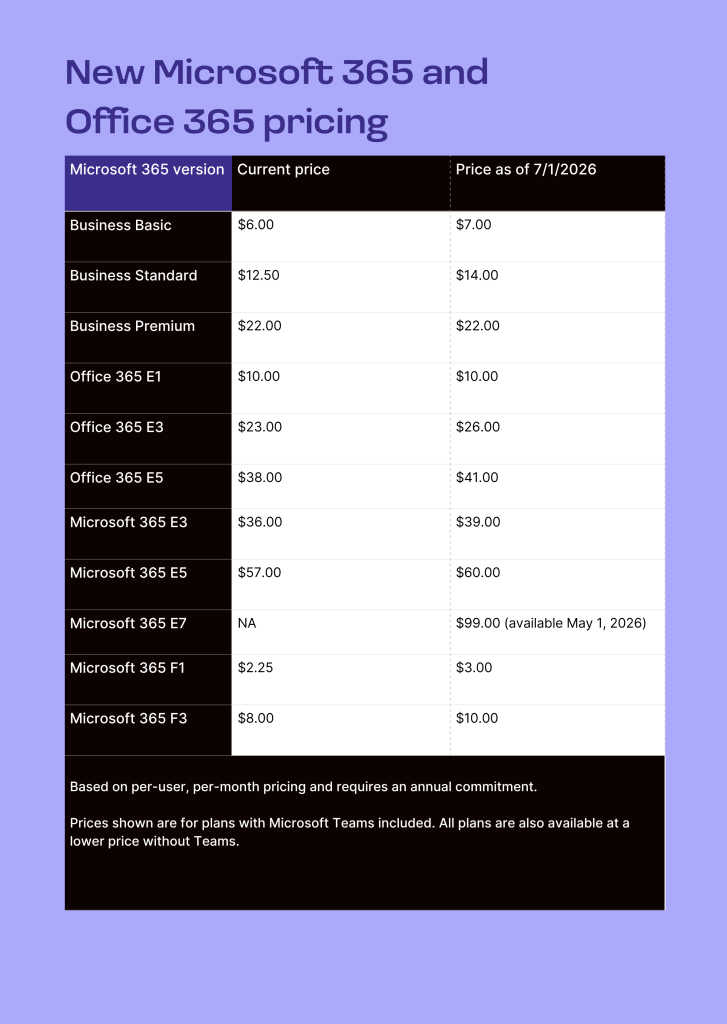
Microsoft offers a wide range of versions and pricing plans. The primary options are shown here.
(Prices are in US dollars and may vary in other countries. These plans include Teams, Microsoft’s chat and videoconferencing app, but are also available in lower-cost versions without Teams. The prices for most of these plans are set to rise on July 1, 2026 — see chart below.)
Microsoft 365 Enterprise: Available in E3 and E5 configurations for firms subscribing more than 300 employees in a plan. The E3 plan (currently $36/user/month) includes user licenses for Windows 11 Enterprise and a long list of Office apps on desktop, mobile, and web; services such as Exchange, SharePoint, and OneDrive; 1TB of OneDrive cloud storage; and core security and identity management tools. The E5 plan ($57/user/month) adds advanced security, compliance, and analytics tools.
Starting May 1, 2026, a new Microsoft 365 E7 tier will be available. At $99/user/month, it bundles all the features of Microsoft 365 E5 — including Entra Suite, Defender, Intune and Purview — with Microsoft 365 Copilot and Agent 365.
Office 365 Enterprise: These technically aren’t Microsoft 365 plans, but organizations with more than 300 users should be aware that they are still available (for now, at least). Available in E1, E3, and E5 configurations with costs ranging from $10/user/month to $38/user/month, these plans are similar to the M365 Enterprise subscriptions but do not include Windows licenses.
Microsoft 365 Business Basic, Standard, and Premium: Suitable for small and midsize companies, the plans have a hard limit of 300 seats and cost from $6/user/month to $22/user/month. The Basic level includes only the web and mobile versions of Office apps, along with 1TB of OneDrive storage and key business services including SharePoint and Exchange. The Standard plan adds the desktop apps and a few additional apps such as Clipchamp and Loop. The Premium package includes advanced security and access management features.
Microsoft 365 Apps for Business andMicrosoft 365 Apps for Enterprise: The just-the-apps version of Microsoft 365 for small businesses ($8.25/user/month) includes the Word, Excel, PowerPoint, and Outlook desktop apps and 1TB of OneDrive storage. The enterprise version ($12/user/month) includes several more Office apps and enterprise-grade security, management, and compliance tools.
Microsoft 365 F1 and F3: Targeted at frontline workers — those on factory floors, in retail, or in the field — these plans are designed for users who primarily use mobile or web-based apps rather than full desktop installs. Available for as little as $2.25/user/month (F1) and $8/user/month (F3), these plans will see the steepest price hikes in the portfolio in July.
Microsoft 365 Education, Microsoft 365 Government, Microsoft 365 Nonprofit: These plans offer varying blends of Windows 11, Office apps, and associated tools at prices suitable for each market (including a donated license for nonprofits). Government plans, for example, offer several compliance levels to meet regulatory requirements.
Microsoft 365 Free, Basic, Personal, Family, and Premium: These consumer plans range from free (really) to $200 per year. The free tier demonstrates just how much the company has diluted its Microsoft 365 brand: it’s limited to a handful of web and mobile apps, includes just 5GB of cloud storage, and uses an ad-supported version of Outlook. The Basic plan adds more storage and an ad-free version of Outlook, while the Personal plan offers the desktop Office apps, 1TB of cloud storage, and includes some Copilot AI features. The Family plan is meant for up to six users and offers 6TB of cloud storage and basic Copilot features for one user. The Premium plan adds more advanced AI features and higher usage limits.
Goodbye volume pricing, hello price hikes
Microsoft eliminated volume-based discounts for its online services (including Microsoft 365) in November 2025. This change is a shift in how large enterprises purchase software, potentially increasing costs by up to 13% for organizations traditionally covered by enterprise agreements (EA).
For decades, the more “seats” your company bought, the cheaper each seat became. Microsoft ended this tier system in a move to achieve pricing consistency across all sales channels, aligning M365 with the model already used for Azure.
Midsize businesses and large corporations that rely on scale to drive down costs experienced the biggest risk. For organizations managing hundreds or thousands of seats, this change could add millions of dollars in annual expenses.
While direct EA discounts are disappearing, the Cloud Solution Provider (CSP) program remains an alternative. Partners in the CSP program can still negotiate custom pricing and offer three-year price locks, which were introduced to help insulate customers from these hikes.
Analysts recommend that IT leaders move toward outcome-based pricing and continuous license optimization. Rather than just buying in bulk, companies should focus on rightsizing their commitments and accelerating the adoption of high-value tools like Copilot to justify the increased per-seat cost.
There’s more bad news for enterprise buyers: Microsoft is set to implement significant price increases for commercial Microsoft 365 subscriptions starting on July 1, 2026. These hikes, ranging from 9% to 25% depending on the plan, affect most plans in the business and enterprise tiers. Microsoft justifies the increase by citing the addition of new features, including expanded Copilot Chat functionality, enhanced security via Defender, and new Intune analytics.
Foundry
Analysts from Gartner warn that these changes — coupled with the phasing out of volume-based discounts — will intensify “pricing fatigue” among enterprise customers. To mitigate the financial impact, experts recommend several “WorkOps” strategies:
Early renewals: Lock in current rates before the July deadline to defer the increase.
License optimization: Audit usage to eliminate “shelfware” and ensure users aren’t over-licensed.
Negotiation: Leverage multi-year agreements to secure better terms.
(See sidebar later in this article for more details on how to structure a M365 budget strategy.)
Can enterprise customers buy the M365 components separately?
Microsoft continues to sell Windows 11 Enterprise, Windows 11 Pro, Enterprise Mobility + Security (EMS), and legacy staples like Exchange and SharePoint Onlineà la carte. For those not needing the full suites, the Office 365 and Microsoft Apps for Enterprise plans remain viable subsets of the broader M365 ecosystem.
Buying every component of a Microsoft 365 subscription separately remains a losing game financially — much like buying a magazine (remember those?) issue-by-issue rather than subscribing. However, the à la carte path remains attractive for multicloud organizations that prefer to mix-and-match best-of-breed tools.
For instance, EMS E5 — the premium tier for identity and security — retails for over $16 per user per month. Organizations can still extract pieces of that bundle, purchasing Entra ID (formerly Azure AD) or Microsoft Intune (a cloud-based unified endpoint management service designed to secure and manage apps and Windows, iOS, Android, macOS, Linux devices). While this provides flexibility for those avoiding total vendor lock-in, the bundle discount offers most enterprises the best ROI.
What add-ons are available for M365?
There’s a large and growing list of optional paid M365 apps and features, many of which are not included in even the most expensive E5 subscription tier. These add-ons can quickly bump up monthly costs.
Microsoft 365 Copilot is one such example. A $30/user/month add-on subscription, M365 Copilot has access to your organization’s data via the Microsoft Graph, meaning it can find information in files across your tenant, including in files you don’t currently have open. For instance, it can draft emails based on last week’s meetings, summarize Teams chats, or pull together information from various documents, presentations, and spreadsheets. M365 Copilot also provides priority access to the latest models (like GPT-5) and advanced AI agents for automated workflows.
Until recently, businesses with 300 or fewer employees had to pay the same fee as large enterprises for Microsoft 365 Copilot, but in November 2025, Microsoft introduced a new Microsoft 365 Copilot Business subscription that offers small businesses the same features for $21/user/month.
Confusingly, there’s a freemium version of M365 Copilot called Copilot Chat that is included in most commercial M365 plans at no extra cost. It’s a web-based AI assistant with enterprise-grade data protection but limited capabilities compared to M365 Copilot. It can search the web and help you work with a file you currently have open — such as summarizing an email or analyzing a spreadsheet — but it cannot “see” your other documents, emails, calendar, or internal SharePoint files.
In addition to the standalone Copilot Chat app, users with a commercial Microsoft 365 plan can currently access Copilot from inside apps such as Word, Excel, PowerPoint, and Outlook. As of April 15, 2026, however, Microsoft will remove access to Copilot from within the M365 apps in organizations with more than 2,000 users, unless those organizations pay for the M365 Copilot add-on license. Enterprises with fewer than 2,000 users will still be able to access Copilot from the M365 apps but will be subject usage limits. Copilot access will continue in Outlook but no other M365 apps.
To help users distinguish between the two versions, Microsoft is introducing two in-product labels: “Copilot Chat (Basic)” if they don’t have a Microsoft 365 Copilot license and “M365 Copilot (Premium)” if they do.
There are other Copilot add-ons as well, including Security Copilot and Copilot Studio, a low-code tool for building AI agents. Both offer usage-based pricing.
Microsoft Power Apps offers three primary pricing tiers tailored to different organizational needs. The Developer Plan is free for building and testing apps in a dedicated environment. For production use, Microsoft offers the Premium Plan. The first version costs $20/user/month (billed annually), allowing users to run unlimited applications. Organizations with large-scale deployments can access a discounted rate of $12/user/month with a 2,000-seat minimum.
All paid plans include access to the Dataverse, prebuilt connectors, and managed environments. Additional add-ons are available for Dataverse storage capacity ($40/GB) and Power Pages authenticated users.
There’s also a Teams add-on package, Teams Premium, which provides access to several features not included in the core app for an additional $10/user/month (currently on offer for $7/user/month). This includes live caption translations, custom branding in Teams meeting “lobbies,” AI-generated tasks and notes, end-to-end encryption for group calls, and more.
Microsoft has also introduced premium add-on packages branded as “suites.” Take Microsoft Viva, for instance, the set of employee experience applications that includes Viva Learning, Viva Engage, Viva Connections, Viva Glint, and more. While certain features of each Viva are available within most enterprise M365 subscriptions, others can be purchased individually (Viva Glint, for example) or via one of three Viva add-on bundle tiers. Viva Suite is the most comprehensive of these, with access to all the Viva features for an extra $12/user/month.
Entra Suite, a collection of identity and access tools, and Intune Suite for endpoint management and security are other examples of bundled add-ons available for additional monthly fees.
Tracking M365 sales
Microsoft still blends Microsoft 365 and Office 365 sales in its financial reports, so it’s difficult to track exact splits. However, the trajectory is clear: Microsoft is moving from productivity to AI-led operations.
Office 365 commercial seats have passed 450 million globally. While seat growth has slowed to single digits (5-6% year-over-year based on 2025 earnings), revenue growth remains in the double digits — thanks largely to Microsoft aggressively pushing toward E5 upgrades and upselling Microsoft 365 Copilot.
As a comparison, Google Workspace — M365’s primary rival — reported surpassing 12 million paying organizations in late 2025. While Google remains a viable alternative, Microsoft’s entrenched position in the enterprise benefits from the October 2025 end-of-support for Windows 10. This has forced a massive hardware refresh cycle, pushing Windows 11 adoption past the 55% mark and pushing more organizations to M365 E3/E5.
What’s new in M365?
The integration of Copilot across M365 apps has undoubtedly been the major focus for Microsoft in the past couple of years. It’s rare to see a product news update on the Microsoft 365 blog that doesn’t reference the AI assistant in some way.
According to Microsoft, the new Microsoft 365 E7 suite (announced in March) marks a shift toward the agent-operated enterprise. Launching May 1, 2026 for $99/user/month ($90.45 without Teams), E7 is designed to unify the M365 E5 offering with Microsoft 365 Copilot and the upcoming Agent 365. Also available as a standalone service priced at $15/user/month, Agent 365 essentially acts as the “control plane” for IT to see what your AI agents are actually doing.
A Microsoft 365 glossary
Browsing through M365 plans and add-ons turns up a bewildering list of included apps and services. Here’s a brief guide to what the main product names mean.
Teams: optional group chat and video meeting app (see tutorial)
OneDrive: cloud storage with versions available for both individuals and corporate users (see tutorial)
SharePoint: business/enterprise platform for shared content, sites, and apps
Exchange: hosting/management service for business/enterprise email, calendar, and contacts
Windows: desktop operating system (included only with M365 E3 and E5 plans)
Copilot: catch-all term for Microsoft’s generative AI assistant in various forms, from a basic, free tool to an advanced agentic orchestration tool that requires an add-on license
Additional M365 apps and services (not included with all plans)
Access: database creation app (Windows only)
Bookings: appointment scheduling and management app
Clipchamp: video editing app
Forms: survey and form creation app (see tutorial)
Microsoft seems to be meeting OpenAI on its own turf, even as it continues its strategic partnership with the AI darling, with the release of three in-house, commercially-available AI models.
MAI-Transcribe-1 (for speech transcription), MAI-Voice-1 (for voice generation), and MAI-Image-2 (for image creation) are now available on Microsoft Foundry and the MAI Playground.
These new models operate at what the company calls “lightning speeds” and at “the most competitive prices.”
The move signals Redmond’s intent to decrease its reliance on outside models, notably OpenAI’s, and to shore up its technical capabilities to compete in the genAI race. The tech giant was an early investor in OpenAI, but that relationship has become tense as the ChatGPT creator forges partnerships with competitors, including AWS.
But, said Sanchit Vir Gogia, chief analyst at Greyhound Research, “This is not about replacing one partner with another. It is about reducing dependency and increasing control. Both sides are quietly reducing reliance on each other while maintaining a working relationship.”
What the MAI models do
MAI-Transcribe-1 provides speech-to-text transcription across 25 languages, and its batch transcription speed is 2.5X that of Microsoft’s Azure models, the company says. Microsoft calls MAI-Transcribe-1 “the most accurate” model available and says it offers the best price-performance of any large cloud provider.
MAI-Voice-1 generates “natural, realistic speech, rich with nuance, emotional range, and expression,” according to Microsoft, and was built to preserve speaker identity across long-form content. The model can generate a minute of audio in “a single second,” and its low GPU usage makes it speedy and affordable.
MAI-Image-2 has “turbocharged” image generation performance and speed on Copilot, according to Redmond. It debuted among the top three model families on the Arena.ai leaderboard, and will soon be rolled out in Bing and PowerPoint.
Microsoft said the model was created with the aid of photographers, designers, and visual storytellers who “demand natural lighting, accurate skin tones, and texture,” as well as requiring clear text for graphics, layouts, and diagrams.
In its announcement, Microsoft underscored the affordability of each model:
MAI-Transcribe-1 starts at $0.36 per hour;
MAI-Voice-1 starts at $22 per 1M characters;
MAI-Image-2 starts at $5 per 1M tokens for text input, and $33 per 1M tokens for image output.
Real-world use cases
MAI-Transcribe-1 is built for environments where transcription accuracy “directly impacts business outcomes,” Gogia explained. These include contact centers, multilingual operations, legal workflows, and industries that are compliance-heavy.
The model is positioned as “reliable transcription in messy, real-world environments where background noise, accents, and inconsistent audio inputs break most systems,” he explained. When transcription fails in these circumstances, downstream systems can become unreliable, analytics can break, compliance risks can increase, and customer interactions can degrade.
MAI-Voice-1 is designed for AI-driven voice interactions, such as via digital assistants, automated communication systems, and customer support channels. The ability to engage with customers is core to modern enterprise, but voice AI tools can introduce risk, Gogia noted, leading to identity misuse and consent issues. Microsoft is looking to address these concerns by embedding control mechanisms “directly into the model experience.”
MAI-Image-2, for its part, fits into enterprise content pipelines “where speed and consistency matter more than creativity,” Gogia explained, and where marketing and product teams and internal communications functions are under pressure to produce content at scale.
MAI-Image-2 is “solving for structured output, especially text within images, which is where most enterprise workflows fail,” he said.
A fundamental shift
At a superficial level, these new models do compete with what’s already available on the market, Gogia noted. Ultimately, though, looking at them as direct competitors to any single model family is a mistake. The competition is actually at the architecture level.
“There is very little here that is fundamentally new at the model level,” said Gogia. Speech recognition, voice synthesis, and image generation are rapidly becoming commoditized because accuracy is improving across the board, latency is dropping, and costs are converging.
“The days when a single model could dominate purely on capability are fading,” he pointed out.
At the same time, he said, enterprises today are overwhelmed by the complexities of AI adoption, including multiple vendors, inconsistent pricing, fragmented governance, and integration challenges.
Now Microsoft is looking to collapse the components into a single environment. “Microsoft is reducing that complexity by embedding these models into an ecosystem enterprises are already using,” said Gogia.
If a platform is able to control the environment in which models are selected, evaluated, and deployed, models themselves become interchangeable, he noted. When that happens, “the bargaining power shifts away from model creators and toward platform owners. That is the real competitive move.”
Implications for enterprises
Microsoft’s incorporation of models into its existing ecosystem creates immediate advantages, Gogia said. Procurement is simpler because enterprises are extending existing relationships, integration becomes easier because models are already aligned with the broader platform, and governance is more manageable because controls are built in rather than added later.
Still, even as they become overwhelmed by multiple vendors, enterprises are cautious about depending on a single external AI provider, he observed. Microsoft is responding to that fear by building its own capabilities.
But this also presents risks. Lock-in can now occur at the control plane level, rather than just at the model level. Once workflows, data pipelines, and governance frameworks are embedded into a platform, switching becomes “structurally difficult,” said Gogia.
There are also practical constraints, such as regional availability and language support. These are often the reasons enterprise pilots “fail quietly,” he pointed out. Regulatory environments can further complicate deployment, especially in industries where data residency and compliance are critical.
“Enterprises are already struggling with AI sprawl,” he said. “Adding more models without a clear architecture increases that burden.”
And then there is the “real” cost, not the “headline pricing,” Gogia said, noting that inference costs are only one part of the equation; orchestration, evaluation, governance, and internal operational overhead also all add up.
The implications for enterprises are ultimately “clear and uncomfortable,” Gogia noted. They’re no longer choosing the best model, but the best environment in which models will operate. “Once that environment is chosen, reversing it will be difficult,” he said.
Cloudflare on Wednesday rolled out EmDash, which it described as “the spiritual successor to WordPress.” The security vendor positioned EmDash as a far more secure site building tool that avoids the extensive cybersecurity problems with WordPress plugins.
But the Cloudflare claims go far beyond cybersecurity issues. The vendor is arguing that the very nature of websites in 2026 is sharply different to the kind of website that WordPress was designed to handle.
“WordPress powers over 40% of the internet. It is a massive success that has enabled anyone to be a publisher, and created a global community of WordPress developers. But the WordPress open source project will be 24 years old this year,” the Cloudflare announcement said. “Hosting a website has changed dramatically during that time. When WordPress was born, AWS EC2 didn’t exist. In the intervening years, that task has gone from renting virtual private servers, to uploading a JavaScript bundle to a globally distributed network at virtually no cost. It’s time to upgrade the most popular CMS on the internet to take advantage of this change.”
More flexible licensing
Cloudflare’s statement also suggested that it is delivering open source in a way that is potentially more open and flexible than the WordPress approach.
“EmDash is fully open source, MIT licensed, and available on GitHub. While EmDash aims to be compatible with WordPress functionality, no WordPress code was used to create EmDash. That allows us to license the open source project under the more permissive MIT license. We hope that allows more developers to adapt, extend, and participate in EmDash’s development,” the company said. “EmDash is committed to building on what WordPress created: an open source publishing stack that anyone can install and use at little cost, while fixing the core problems that WordPress cannot solve.”
The next wave of web development
In an interview with Computerworld, Cloudflare senior product manager Matt Taylor said his team sees the project as the next wave of web development platforms.
“There is a whole new generation of developers, and WordPress is old news to them. If you are starting today, there is no way you are picking WordPress,” Taylor said, adding that AI agents are also not going to opt for WordPress platforms when creating new sites.
Even when adding Cloudflare in front of a WordPress site to enhance security, he noted, “you have to hack the system to work with the modern internet.”
WordPress was unable to provide its feedback on the announcement by deadline.
WordPress not for new users
Melody Brue, principal analyst for Moor Insights & Strategy, said she has not seen many developers who are not already experienced with WordPress choosing it to build sites, and that she is also seeing that AI agents never opt for WordPress unless they were given explicit instructions to do so. Given how rampant autonomous AI agents are today, the ability to be more hospitable to agentic systems may prove a massive advantage.
“For somebody new, you have this opportunity to skip all of these legacy CMS assumptions and have true least privilege by design, a first class experience for agents. At least, that is what [Cloudflare] is trying to deliver,” Brue said. “They are baking in agent skills.”
Enterprise concerns
When it comes to enterprise web development strategies, however, things get a little more complex, Brue said. Given how deeply they are already invested in WordPress code and plugins and the support environment, existing WordPress enterprise users are not likely to easily move.
But the extensive legal outbursts from last year involving Automattic CEO Matt Mullenweg, and the lawsuit with WP Engine, made some enterprise IT executives nervous, once they realized how much control one person had over WordPress platforms.
Brue said, “I can understand the concerns,” but added that the WordPress squabbles seem to have become more subdued lately: “There is now less of the tantrum throwing happening.”
Thomas Randall, a research director at Info-Tech Research Group, agreed with Brue that enterprise environments are unlikely to abandon WordPress any time soon.
“Is EmDash the spiritual successor to WordPress? Not from what Cloudflare has shown so far. The problem Cloudflare highlights, security vulnerabilities in WordPress plugins, is real. But the rest of the announcement deserves skepticism,” Randall said. “For instance, enterprise IT teams with complex WordPress environments will encounter nontrivial barriers for migration. EmDash uses Portable Text rather than WordPress’s HTML content model, which would significantly complicate automated migration. Existing PHP themes and plugins would not carry over directly and would likely require substantial redevelopment.”
But that would still open the door to newcomers who have not already invested in the WordPress environment.
Competing in a different layer
Noah Kenney, principal consultant for Digital 520, said the future is likely to look much more inviting for an EmDash-like approach than for legacy WordPress.
“Cloudflare’s EmDash is less about replacing WordPress outright and more about setting a new security baseline, which is that CMS platforms should have isolated execution environments, least-privilege access, and verifiable permission models,” Kenney said. “That has implications for both content management and how enterprises evaluate third-party extensibility risk more broadly.”
However, he noted, “viability is an ecosystem question just as much as it is a technical one. EmDash, even if superior from an architectural perspective, is effectively starting from zero. Enterprise adoption will depend heavily on migration tooling, developer adoption, and whether Cloudflare can build a credible plugin and integration ecosystem.”
Kenney added that he sees EmDash as “very likely to influence the next phase of CMS architecture, particularly in security-sensitive and enterprise environments where plugin risk is already a prevalent issue.”
Sanchit Vir Gogia, chief analyst at Greyhound Research, saw the EmDash move in a much broader context, potentially signaling the near-term future of website strategies.
“EmDash is competing in a different layer altogether,” Gogia said. “It sits closer to composable and headless CMS platforms like Contentful and Strapi, and even closer to developer frameworks like Astro. It is collapsing what used to be separate concerns; content management, execution runtime, and security enforcement are being fused into one programmable environment.”
This, he observed, “is where the real friction emerges. Traditional CMS buyers are not necessarily developers first. They prioritize usability, ecosystem depth, and speed of execution for business teams. EmDash is clearly optimized for developers and architects. So the competition is not just product versus product. It is operating model versus operating model. And in that contest, incumbents have inertia on their side, while EmDash has architectural purity. History shows those two rarely move at the same speed.”
Open-source productivity software vendor OnlyOffice has accused the recently launched Euro-Office initiative of licensing term violations and intellectual property theft.
A group of European technology companies including Nextcloud, Ionos, and Proton, announced Euro-Office last week, billed as a sovereign, open-source productivity software suite that’s compatible with Microsoft’s proprietary Office file types.
The software is built on the open-source code base owned by OnlyOffice and distributed under the GNU Affero General Public License v3 (AGPL v3).
OnlyOffice said in blog post that those accessing its code under this license are required to abide by conditions, such as retaining OnlyOffice’s branding and “providing proper attribution to the original technology.”
OnlyOffice said that Euro-Office doesn’t meet these conditions, and therefore “any further use of the software is unauthorized and, as such, constitutes an infringement of the copyright holder’s exclusive rights.”
The company also claims it was not contacted about the Euro-Office project prior to launch.
In a separate blog post, Lev Bannov, OnlyOffice CEO, said that the Euro-Office project must “either restore our branding and attributions or roll back all forks of our project, refraining from using our code without proper acknowledgment of OnlyOffice.”
“We firmly assert that the Euro-Office project is currently infringing on our copyright in a deliberate and unacceptable manner,” he said.
OnlyOffice also said that it will suspend its partnership with Nextcloud, one of the Euro-Office project participants, due to the launch, and it accused Nextcloud of attempting to hire its staff and targeting its customers.
Nextcloud offers integration with OnlyOffice’s software within its own software products, such as its Nextcloud Hub. Despite the partnership suspension, OnlyOffice pledged to continue to “support and develop the OnlyOffice connector for Nextcloud” that its customers rely on.
Commenting on OnlyOffice’s copyright infringement claims, a Nextcloud spokesperson said: “As OnlyOffice itself states, its product is open source. Forks are a central component of the open-source ecosystem and are explicitly intended to enable further development, customization, and alternative governance models.”
Nextcloud said the Euro-Office project has “transparently documented its legal reasoning” in a public repository on GitHub. It also claimed this view is “shared by the Free Software Foundation, the custodian of the AGPL and GPL licenses,” and pointed the FSF’s “GPL-compliant reasonable legal notices and author attributions” page.
“The legal situation was also discussed with Bradley M. Kuhn, the creator of the AGPL license, and he supports our legal assessment 100%,” the spokesperson said.
“We are not opposed to forks — they are a natural and important part of the open-source ecosystem,” said Galina Goduhina, commercial director at OnlyOffice. “However, full compliance requires respecting the licensing terms in their entirety, including preserving required attribution elements such as product logos and branding where applicable, and ensuring accurate representation of the origin of the software.
“It also means clearly informing users about what the product is based on, rather than presenting it in a way that could create confusion about authorship. In practical terms, this is about using open-source software responsibly, not rebranding it in a way that obscures its origin or suggests ownership where it does not exist,” Goduhina said.
With regards to OnlyOffice’s announcement to end the partnership, the Nextcloud spokesperson said: “We are disappointed by their choice to end the collaboration because of our contributions to Euro-Office and we hope they will reconsider.”
Euro-Office said on its project’s GitHub page that it chose to fork OnlyOffice’s code base rather than work with the company directly as a “last resort,” because “open collaboration with OnlyOffice was not possible, for a number of reasons.”
Among these reasons, Euro-Office said, are that external contribution to OnlyOffice is “impossible or greatly discouraged,” and that the owners make “controversial decisions” such as the removal of mobile app features.
Euro-Office also claimed OnlyOffice is a Russian company “despite many attempts to hide this,” which has raised customers’ concerns over potential influence or control by the Russian government.
When asked for comment, an OnlyOffice spokesperson pointed to an April 2 blog post that says the owner company, Ascensio System SIA, is headquartered in Latvia and is a subsidiary of OnlyOffice Capital Group, which is registered in Singapore. The post says OnlyOffice’s Russian business segment was sold in 2019, and a fork of OnlyOffice called R7-Office was created for the Russian market. There is currently “no shared codebase, ownership, or ongoing cooperation” between OnlyOffice and R7-Office, according to the post.
The dispute could create uncertainty for organizations considering Euro-Office’s platform, said Dario Maisto, senior analyst at Forrester.
“Offering an enterprise-grade alternative suite to Microsoft and Google in Europe is not just about functionality and sovereignty, but also about offering the same level of reliability that enterprise IT leaders are used to,” he said.
The situation also points to the difficulty in creating a sovereign alternative to established US software vendors that have decades of experience and millions of business customers, he said, despite clear enthusiasm from local vendors.
“The build of an enterprise-ready European sovereign alternative is going to take time,” he said, with European companies potentially opting for “sovereign” (locally hosted) versions of established US-based suites instead, “which may decrease the overall market potential for the European players.”