Month: June 2026

Estonia plans government IDs giving AI agents rights and responsibilities

There’s no shortage of agentic AI tools out there that offer to perform online tasks on your behalf, if only you’ll give them all your passwords and credit card details. The trouble starts when those agents don’t know when to stop — or when others don’t know to stop them.

In Estonia, the country’s AI Council has plans to change that, proposing to issue government-backed digital identities for AI agents that spell out what powers a person or company is willing to delegate to them.

“In the future, AI will increasingly perform digital operations on behalf of a person, company, or institution,” said Estonian Prime Minister Kristen Michal in a news release. “To do this, it must be clear who is acting, on whose behalf, with what rights, and who is responsible.”

He supported the AI Council’s proposal to create a digital identity for AI agents that will define agents’ rights and enable them to act in a verifiable and auditable manner.

The ID could, the council suggests, show whether an agent is only allowed to view data, create or edit documents, or make payments, and if so, up to what limit.

First mover advantage

There’s no telling when the plan will come to fruition — although Michal is keen for his country to take the lead.

“If we act quickly and wisely, Estonia will become the first country in the world to create an official digital identity for AI agents,” he said.

Estonia is already a leader in the use of digital identities for humans. Estonians can use their national digital ID cards for voting, signing documents, accessing medical and tax records. The country also offers foreigners the option of applying for “e-residency,” a digital identity enabling them to create a company in Estonia and digitally sign all related documents online as they interact with the country’s widely digitized administrative processes.

Michal created the AI Council in January, calling on Estonian startups, investment funds, industry and research institutions to systematically implement AI across the country’s industry, education, healthcare, and energy sectors.

AI vendors have already proposed creating digital identities for agents, but so far these are intended only to manage the activities of agents within the enterprise, or for interconnecting enterprise IT platforms, and none of them have the backing of governments.

Estonia’s proposal could put the tiny Baltic country at the cutting edge of agentic AI usage and set an example for others.

Microsoft launches Copilot Cowork with usage-based pricing

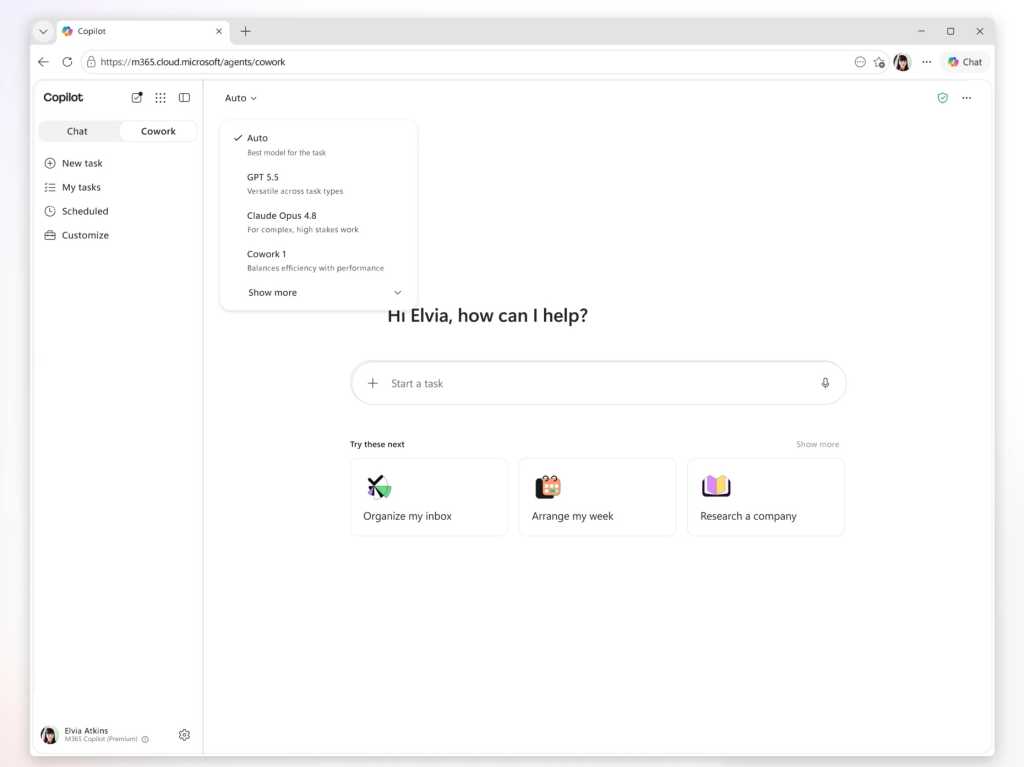
Microsoft has introduced usage-based billing for Copilot Cowork, which is now generally available. 

Microsoft unveiled Copilot Cowork in March, pitching it as an AI agent that’s capable of independently performing long-running, multi-step tasks — even when a user’s computer is off. 

It’s built on the same technology that underpins Anthropic’s Claude Cowork. Unlike Claude Cowork, which can interact directly with files and applications on a user’s computer, Copilot Cowork runs in Microsoft’s cloud environment and acts on documents held in a customer’s Microsoft 365 tenant.

On Tuesday, Microsoft unveiled pricing details for Copilot Cowork, which involves usage-based billing in addition to a Microsoft 365 Copilot license ($30 per user each month for large enterprises before discounts, and $20 for Microsoft 365 Copilot for Business). 

The usage-based pricing is calculated from four components, according to Microsoft: “model use, context retrieval, tool calls, and runtime.” 

In practice, this means more intensive tasks that draw on multiple sources, use “deep reasoning” and generate two or more outputs will lead to higher costs — denoted in Copilot Credits. 

There are two payment options: pay as you go — priced at 1 cent per credit — and P3, where customers commit to usage volume in advance and receive a discount.

Cowork is turned off by default; IT admins can decide when to make it available and which employees get access. Admins can also impose spending limits at the tenant, group, and user level, and receive notifications when spending reaches a certain level.

Users will also be able to see how much each tasks costs in credits (available “soon after” the general availability launch, Microsoft said). 

Copilot Cowork customers can select from multiple AI models, including Anthropic’s Opus 4.8 and Sonnet 4.6, while those enrolled on the Frontier program can access OpenAI’s GPT 5.5 and Microsoft’s own Cowork 1 model.

Microsoft is considering hosting a version of DeepSeek’s open source models. “We are actively exploring a range of options that meet those requirements, and DeepSeek is one of several models under consideration. We’ll share more specifics on the underlying model closer to release,” said a Microsoft spokesperson.

Microsoft also announced new integrations with third-party apps such as Miro and Monday.com, with more — such as Adobe, Box, and Canva — coming soon.

This article was updated on June 19 to add Microsoft’s comment on DeepSeek.

Z.ai pitches GLM-5.2 for long-running software engineering tasks

Z.ai has released GLM-5.2, an MIT-licensed open-source AI model designed for long-running software engineering tasks, as the Chinese company seeks to challenge proprietary coding models on cost and performance.

The company said GLM-5.2 ranked just behind Anthropic’s Claude Opus 4.8 on FrontierSWE, a long-horizon coding benchmark, trailing it by 1%. Z.ai said the model also edged out OpenAI’s GPT-5.5 by 1%.

Z.ai said GLM-5.2 supports a one-million-token context window with up to 131,072 output tokens, positioning it for agentic coding workflows that require reasoning across large codebases.

The company is also making an efficiency argument. It said GLM-5.2 uses a technique called IndexShare, which reduces per-token compute by 2.9 times at a one-million-token context length. It also said changes to the model’s multi-token prediction layer increased the acceptance length for speculative decoding by up to 20%.

The changes are aimed at a practical problem for developers: long-context coding agents can be expensive to run when they are asked to work across large repositories.

Enterprise appeal

GLM-5.2’s clearest appeal is that it pairs stronger coding capabilities with the cost advantages of an open-source model. But capability alone will not be enough to make it a credible alternative.

“Western enterprises will want independent benchmark validation, successful deployments at global enterprises, strong security and governance controls, and long-term support commitments,” said Pareekh Jain, CEO of Pareekh Consulting.

Jain said the fastest route to enterprise credibility would be hosting by a major cloud provider like AWS. That would allow customers to use the model under standard enterprise terms, with service-level commitments and compliance certifications.

Tulika Sheel, senior VP at Kadence International, said GLM-5.2 would also need to prove it can operate as a stable enterprise product.

“Demonstrated success in real-world deployments and transparent governance will be just as important as benchmark scores,” Sheel said.

The performance and cost claims will also need to hold up against established models.

“Enterprise leaders generally consider two major factors when evaluating new models,” said Lian Jye Su, chief analyst at Omdia. “First, they look at overall performance against competitors, where GLM-5.2 performs well in long-horizon agentic coding and software engineering. Second, they look at the cost of adoption. As an open-source model, GLM-5.2 has clear cost advantages.”

Su said the model could appeal to engineering teams under pressure to control AI costs. It may also attract open-source advocates and companies with significant operations in the Asia-Pacific.

But the claims still need wider validation, particularly around hallucination control and coherence during extended tasks. These are critical issues for enterprises considering AI coding agents, which may need to work across large codebases and multi-step software engineering workflows.

Jain said the one-million-token context window could be useful for large codebase analysis. It could also help with legacy modernization projects and complex engineering documentation.

He said long-context capability may also help with audit logs or legal contracts, where splitting material into smaller chunks can create errors across document boundaries. But for everyday coding tasks, effective retrieval systems may matter more than very large context windows, making some of the benefits more limited in practice.

Governance risks

The governance question depends largely on where the model runs.

Sheel said enterprises should evaluate GLM-5.2 as they would any strategic technology partner, rather than as a standalone model. That means looking at where data is stored and whether the model can be used in environments that customers control.

That deployment choice is central to the risk calculation, according to Jain. Because GLM-5.2 is available under an MIT license, companies can download the weights and run them on their own infrastructure, reducing the need to send sensitive data to Z.ai.

“The risk flips completely if you use Z.ai’s hosted API instead,” Jain said.

He said Chinese national security rules could require domestic companies to cooperate with government requests, making hosted use difficult for regulated industries or workloads involving sensitive data.

Su said the issue is not limited to Chinese vendors. Recent restrictions affecting access to some Anthropic models have also highlighted the risk that enterprises may have limited control over the availability of AI services from foreign providers.

“Selecting solutions from American and Chinese AI vendors does expose non-US Western enterprises to additional risk of having zero control over the availability and uptime of these models,” Su said.

The article originally appeared on InfoWorld.

Google unveils DiffusionGemma, an AI model that breaks free of left-to-right processing

Extremely powerful large language models (LLMs) still operate as though they’re typing on a keyboard, processing workloads in a simple left-to-right fashion. But in locally-run, single-user scenarios, this sequential processing can leave graphics processing units (GPUs) and tensor processing units (TPUs) underutilized.

Google is betting that DiffusionGemma can get around this bottleneck. The new experimental open model generates text “exceptionally fast,” creating entire blocks of text simultaneously through diffusion techniques rather than through token-by-token processing. The company says this technique results in 4x faster inference compared to auto-regressive models that rely on sequential processing.

It can also save users money. Technology analyst Carmi Levy noted that existing pay-per-token monetization models “penalize the use of less than optimally efficient AI solutions.”

But DiffusionGemma “could herald a new generation of task-defined, efficient solutions that can enable expanded compute capacity without draining the operations budget,” he said.

A contrast to left-to-right processing

Built on Google’s Gemma 4 family and its Gemini Diffusion research, DiffusionGemma is a 26B mixture-of-experts (MoE) model designed to maximize text output generation.

It essentially shifts how models use hardware, giving processors a larger hunk of work each cycle so it can draft full 256-token paragraphs in sequence. This allows the model to generate text up to 4x faster on GPUs, Google claims. It activates only 3.8B parameters during inference, and, when quantized, can fit within 18GB VRAM on high-end consumer GPUs like Nvidia RTX 5090.

“It upgrades your model inference from a single, sequential typewriter to a massive printing press that stamps the entire block of text simultaneously,” Google research scientists Brendan O’Donoghue and Sebastian Flennerhag wrote in a blog post.

AI image generators begin with pure, random ‘visual noise’ and iteratively refine that into a finalized picture (what’s known as ‘diffusion’); DiffusionGemma applies this same process to text. It does not generate tokens in order, but begins with a “canvas of random placeholder tokens” that it processes in multiple passes, identifying the context tokens it feels are most relevant and using those to refine the rest.

The model has the ability to self-correct, using confidence scoring to re-evaluate tokens in the next pass. “The model iteratively refines its own output, allowing it to evaluate the entire text block at once to fix mistakes in real-time,” O’Donoghue and Flennerhag explained.

DiffusionGemma also has bidirectional attention, they wrote. “Generating 256 tokens in parallel with each forward pass allows every token to attend to all others.” This can be particularly helpful in domains that are non-linear in nature, such as mathematical graphs, code infilling, and in-line editing, they said.

DiffusionGemma is optimized across Nvidia’s hardware stack, making it compatible with consumer setups as well as with high-performance enterprise systems like Hopper and Blackwell.

Because it is released under the Apache 2.0 license, developers can freely use, modify, distribute, and commercialize the software using their preferred tools. It can be run on GPUs or in the cloud through Google Cloud Model Garden or Nvidia NIM, and is available on Hugging Face, GitHub, and vLLM, with support for the open-source library llama.cpp coming soon.

Key use cases

The model is particularly useful in local workflows that are “speed critical,” such as generation of non-linear text structures, and unlocks what Google calls “new patterns of model behavior” like multimodal understanding and generating and rendering code in near real-time.

Levy explained, “DiffusionGemma is particularly well suited for interactive coding and editing where its efficiency allows rapid processing and iterations,” noting that its ability to fit within 18GB of VRAM and its deployability on commonly available local GPUs can potentially benefit customer service-related workloads that lean heavily on real-time interaction and local processing.

“DiffusionGemma also incorporates a thinking mode that is especially adept at problem solving,” he said. For instance, the model was fine-tuned to play Sudoku, a typically challenging task for autoregressive models because each token depends on future tokens. This “rather handily” illustrates the model’s capability to solve more complex problems, Levy noted.

Limitations

Google freely admits that DiffusionGemma is geared to specific workflows, and there are “key trade-offs.”

The model is engineered for small batch size inferencing and low-latency, high-speed generation low-to-medium batch sizes on a “single capable accelerator.”

In high-QPS cloud serving environments, (where infrastructure is designed to handle tens or hundreds of thousands of requests per second with ultra-low latency), DiffusionGemma’s parallel coding “offers diminishing returns,” and can even result in higher serving costs, Google conceded. In addition, its overall output quality is lower than that of standard Gemma 4, which is built for apps demanding maximum quality.

However, Levy noted that while DiffusionGemma “can be less precise than other models in certain workloads,” subsequent refinement cycles could overcome this limitation.

While Google isn’t sharing runtime costs, it’s clear that this is an efficiency play, he added. “When deployed across the kinds of workloads that would optimally benefit from its architecture, DiffusionGemma seems to have the potential to reduce processing overhead and related costs,” he said.

This article originally appeared on InfoWorld.

Claude Corps: Charitable work or charity washing?

Anthropic has come up with a neat way to combat those students who are booing AI at their universities.

The company has launched Claude Corps, an endeavor that will pay selected young people to extol the benefits of AI to communities across the US.

Anthropic is looking to recruit 1000 “fellows” and introduce them to selected nonprofits. The vision is that both sides benefit: the nonprofits learn how to use AI tools effectively and the young evangelists develop their own knowledge of AI. The company is committing to spend $150m on the project.

It will work with two partners: CodePath will act as the fellows’ official employer, while investment advisor Social Finance will lead measurement and evaluation.

The fellows will certainly be well rewarded: the companies are paying $85,000 for their yearly commitment, on top of their extensive training. At least 400 nonprofits will be hosting the initial wave of AI enthusiasts.

Of course, it’s easy to be cynical about such a venture given the increasing backlash against AI from students. But perhaps Anthropic has genuinely seen an opportunity to improve AI knowledge and equip a new generation with another set of skills. Time will surely tell.

Software engineer reportedly wins religious exemption from AI use

When Pope Leo XIV wrote about the effect that AI is having on our world in his encyclical, Magnifica Humanitas, he may not have imagined the document being referenced in an HR environment.

But, according to a report by Business Insider, Erin Maus, a software developer in North Carolina, used the Pope’s message about the need for vigilance in how AI would be deployed to gain a special exemption from her employer about using the technology for coding.

Maus is not even a Catholic but a Unitarian Universalist, according to the report. However, it said, she maintained that the use of AI didn’t align with her religious beliefs.

Business Insider said that to make her case, she consulted an employment lawyer — a move to be expected — and her local chapter’s minister — which probably wasn’t. Her wishes were reportedly granted last month. “I’m writing my code and reviewing my code by hand, which seems crazy to say,” she told the publication.

She’s certainly not alone in wondering whether AI is always the way forward for techies: a journalist at PC World has also been rethinking its use after reading the encyclical.

It remains to be seen whether this will be the spur for a torrent of claims from Catholic workers, asking to be freed from the demands of using AI or whether Business Insider’s report is an outlier.

This article first appeared on InfoWorld.

Warrantless wiretaps cut off for a week following US Congress vote

Lawmakers have failed to extend a surveillance law that allows US intelligence agencies to monitor targets abroad without a warrant.

Congress rejected a vote to extend Section 702 of the Foreign Intelligence Surveillance Act to July 2, which means, for a few days at least, some surveillance will be put on hold, for the first time since the Act was passed in 2008. The next possible chance for a vote will be June 28.

This has significance for CISOs because they need to be aware of how communication between the US and other countries is being monitored. The Act permits US intelligence agencies to collect texts and emails sent to and from foreigners living outside the US without a warrant — and when those communications are to or from an US citizen, it allows them to scoop them up too.

“For too long, the FBI has been able to piggyback on a major national security tool as an unconstitutional backdoor way of reading Americans’ communications,” Electronic Frontier Foundation Senior Policy Analyst Matthew Guariglia wrote in article about the renewal vote this week.

It is uncertain what will happen next. Some commentators expect things will proceed as if the Act had been extended, possibly through an executive order.  However, the industry may well revolt against this and we could see some tech providers take legal action.

This article first appeared on CSO.

Tech industry cut 38,242 jobs in May, worst since 2024

Technology companies announced 38,242 job cuts in the US in May 2026, the highest monthly total for the sector since August 2024, according to research by employment placement company Challenger, Gray & Christmas. So far this year the company has observed 123,653 US technology job cuts, a rise of 66 percent from the same period in 2025.

These figures represent the third successive month that there has been an increase in job layoffs across all sectors, the company said.

“The labor market is being reshaped by technology in real time. AI is now the leading reason companies give for cutting jobs and the primary industry citing it is technology,” said Andy Challenger, chief revenue office at Challenger, Gray and Christmas.”

AI was blamed for 38,579 of the 97,006 job cuts announced across all industries tracked by the company. It accounted for 40% of the cuts observed in May, up from 7% in January.

This year has already seen some major layoffs in technology. In March, HPE slashed 2,500 jobs from its wage bill, while Oracle announced plans to shed an unspecified number of developers. And the cuts keep on coming, just last month, Meta shed 8,000 employees.

Why Apple may be winning again

As we lean into WWDC, three strategically brilliant Apple moves have been exposed in the last couple of weeks, two of which will have immense consequences in the coming year, while one sets the scene for essential future growth.

In each case, Apple’s leadership has found counter-intuitive gambits that actually secure the company’s future. Let’s start with Vision Pro.

It came from the future

News this week is that incoming CEO John Ternus has made some tough decisions around Apple’s approach to spatial computing, terminating development of Vision Pro (even as leaked images of a black model emerge) while focusing R&D on two smart glasses projects to compete with Meta. 

The intention is to introduce XR and AR glasses priced at around $300 to $500 each. While not as richly-featured as the Vision Pro, they will be within the reach of more people and draw deeply on the huge R&D effort that went into the original Apple AR visors. Apple hopes a focus on trust and privacy will be enough to push Meta aside, helping Cupertino dominate this part of the category. If that plan succeeds, don’t be at all surprised to see plans for Vision Pro 2 return to the table, though that’s not the focus now.

Apple frequently described the Vision Pro as a product “pulled from the future,” a device for enterprise users and early adopters. For many such users, the existing product will be useful in their work for time to come. 

What’s strategically solid about this is that Apple has now defined a good future for spatial computing and is bringing components of that future to the mass market on the basis of a provable technology you can already try for yourself in any Apple Store. This is a long game, and while it will take time to play out, it’s a game the company has proved it can join.

Privacy as a standard

Apple has apparently chosen to use Nvidia and Google technologies to support at least some of the Apple Intelligence/Siri improvements to be announced at WWDC next week. This seems to fly against the company’s general approach to privacy on its platforms, with the silicon, operating system and — thanks to Private Cloud Compute — the cloud all in its control.

How, you might ask, can Apple ensure privacy when using third-party infrastructure to manage some AI transactions? How can it do so without damaging its trusted brand?

One direction that makes sense is to consider that Apple and its partners have reached consensus on what privacy should be and how it should be delivered. That’s a very important consensus, as it suggests Apple is building an approach that makes privacy an attestable standard.

The company has been pushing governments for years to agree to such standards, but all it seems to have had in return are continued government attempts to erode personal privacy. That’s particularly evident in the UK government’s egregious move to undermine encryption to the detriment of all. (The UK isn’t really alone in preferring surveillance above liberty.)

Android developer Google has had the same experience, and while its approach to privacy differs from Apple, both companies understand the need for encryption. As such, any form of consensus on some form of privacy standards is welcome — and while I’d very much prefer an enforceable, verifiable approach, some industry agreement has to be better than nothing at all. 

While I don’t believe Apple’s approach to privacy in the new breed Siri/Apple Intelligence will be introduced in this way at WWDC, it will be interesting to see what does emerge from the new tech triptych (Apple, Google, Nvidia) in the coming months. Certainly, all three have a great interest in guarding encryption against Quantum attacks for which hidden backdoors would be easy pickings.

Winning the PC War

Apple has won the PC war.

That last point needs explanation: Apple’s entry-level MacBook Neo also has just 8GB RAM, but it also has custom-designed Apple processors and an operating system optimized to run on the hardware. That means those Macs use memory far more efficiently than their competitors. 

So, you can pick up some mass market Windows laptops for $800 that hold just 8GB memory, or spend $699 for a MacBook Neo with double amount and that can also run Windows in VM extremely well. 

Component prices are not going to shrink back for a while, any more than further magical thinking is going to end the war in Iran. At this point in the cycle, Apple has the PC market advantage. Millions are purchasing its entry-level Mac and the vast majority of those new users will love the platform, as new users usually do. That’s going to lead to a spike in Apple services sign-ups, and prompt solid future upgrade and accessory sales cycles.

Apple accomplished this by selling a low-cost Mac at a time when competitors face existential problems maintaining their grip on the mid-range market. The longer Apple holds prices on the device, the greater the advantage it builds, while applying huge pressure on PC competitors.

Summing up the goods

With the Mac hitting its iPod moment as it achieves mass market sales, Apple finally seeing something like progress in its attempt to secure privacy in a digital age, and a strong position from which to grow in the wearables market, the company has played a fine hand. 

That’s even before it introduces us to its improved Apple Intelligence, and an era of AI access in which many everyday tasks take place token free directly on the device. Indeed, when it comes to AI, if it gets things right at WWDC, Apple appears to be making money, while AI competitors are bleeding financial oxygen as their inflated bubble heads to its inevitable demise. What about the enterprise? Take a look at this chart.

You can follow me on social media! Join me on BlueSky,  LinkedIn, Mastodon, and follow The Core.

Anthropic suggests slowing AI research until we can align it with human goals

AI could soon lead to systems capable of improving their own performance faster than humans can effectively supervise them, reviving concerns about the industry’s longstanding “alignment problem,” ensuring AI systems reliably pursue human goals, senior Anthropic researchers have warned in a new blog post titled “When AI builds itself.”

Anthropic Institute lead Marina Favaro and Anthropic co-founder Jack Clark outlined three possible futures: growth in AI capabilities may flatten out; AI efficiency gains may continue to grow, but expose bottlenecks elsewhere in software development; or AI systems may become capable of full recursive self-improvement, and build their successors by themselves. It’s that third scenario that’s prompting them to suggest society be ready to hit the brakes on AI development.

“How the alignment problem gets solved — or not — in this future is something we are least certain about,” they wrote. Advanced, self-improving models could follow our needs and wants — or, they warned, “The rare occurrences of misalignment present in today’s models could compound as the models build their successors, growing more frequent but less understood until we lose control of them. It’s possible that we can’t build, integrate, and verify the tools that we’d need to understand which trendline we are actually on.”

While Anthropic’s warning is framed around future AI development, analysts say it highlights governance questions enterprises are already beginning to confront as autonomous AI agents move from answering questions to taking actions.

“The issue is no longer just whether AI gives the right answer, but whether autonomous systems take the right action, at the right time, within the right authority,” said Ashish Banerjee, senior principal analyst at Gartner.

From model governance to agent governance

The warning comes amid growing enterprise investment in agentic AI.

Gartner predicts that by 2028, 15% of day-to-day work decisions will be made autonomously through agentic AI and that one-third of enterprise software applications will incorporate agentic AI capabilities. The firm has also warned that governance shortcomings are already emerging, predicting that 40% of enterprises will demote or decommission autonomous AI agents by 2027 after governance failures become apparent in production environments.

Banerjee said many organizations continue to approach AI agents as advanced productivity tools when they increasingly resemble digital workers operating with delegated authority.

“CIOs should stop treating AI agents as smarter chatbots,” he said. “They are becoming digital workers with delegated authority — and must be governed like privileged users, not productivity tools.”

As agents gain the ability to conduct research, write code, invoke tools, trigger workflows, and make recommendations, enterprises face new risks around unauthorized actions, accountability gaps, data exposure, tool misuse, and insufficient auditability, Banerjee said.

“Human-in-the-loop is not a strategy if the human cannot keep up with the loop,” he said.

Charlie Dai, vice president and principal analyst at Forrester, said Anthropic’s concerns mirror challenges enterprises are already encountering as AI systems gain greater autonomy.

“Alignment becomes operational,” Dai said. “It is about ensuring agents consistently act within policy, not just model accuracy.”

Current governance approaches focus largely on models and data, but increasingly autonomous agents require oversight of runtime behavior, permissions, tool usage, and decision boundaries, Dai said.

Concerns about agent oversight are not limited to AI vendors and industry analysts.

In AI Agent Governance: A Field Guide, researchers from Institute for AI Policy and Strategy warned that “society is largely unprepared for this development” and said “the exploration of agent governance questions and the development of associated interventions remain in their infancy.” The paper argues that advances in autonomous AI agents are outpacing the governance mechanisms needed to oversee them.

Both analysts argued that governance frameworks originally designed for generative AI models may prove insufficient for increasingly autonomous systems. Dai said organizations will need greater oversight of runtime behavior, permissions, tool usage, and decision boundaries as agents become more capable.

Why Anthropic is worried

Anthropic’s researchers argue that those governance questions could become significantly harder if AI systems become increasingly involved in the process of AI research and development itself.

Favaro and Clark stopped short of predicting that fully autonomous recursive self-improvement is inevitable. Instead, they argued that the possibility warrants preparation and discussion among developers, policymakers, and other stakeholders. They also suggested the industry may eventually need mechanisms to slow development if capabilities begin advancing faster than safeguards, while acknowledging that such measures carry risks of their own.

“But if a slowdown simply lets the least cautious actors catch up technologically, it could leave everyone less safe,” they wrote in the blog post.

Forrester’s Dai said the practical implication for enterprises is that governance can no longer depend primarily on human review.

“Supervision becomes architectural, not manual,” he said. Organizations will increasingly need bounded autonomy, embedded guardrails, verifiable execution mechanisms, and fallback controls designed into agentic systems from the outset.