Month: November 2026

The AI boom is forecast to increase data center emissions by 70% by 2030

A new report from the International Energy Agency (IEA) warns that electricity consumption by the world’s data centers is expected to nearly double in the next four years, according to The Guardian.

The world’s existing data centers currently have a capacity of about 120 gigawatts. According to the IEA, an additional 120 gigawatts could be added by 2030. The expansion of artificial intelligence is expected to account for about 75% of that increase. 

At the same time, carbon dioxide emissions from data centers risk increasing by 70%. This is despite the fact that data center companies are among the world’s largest corporate buyers of renewable energy.

In the US, natural gas is projected to account for about 60% of data centers’ electricity supply by 2030. In China, however, coal-fired power is expected to account for about half of data centers’ electricity supply. IEA Executive Director Fatih Birol also warns that the energy market is in a historically uncertain situation following the war in the Middle East.

Related: Midterm results will raise AI costs and compliance questions for IT leaders

This article originally appeared on Computer Sweden.

Microsoft positions Copilot as a hub for team collaboration

Microsoft has unveiled Copilot Workspaces, a new collaborative environment for employees and AI agents to work together on shared projects.

It was one of a range of Copilot updates at Microsoft’s Ignite conference this week, including deeper Office integration and new AI agent capabilities, as it seeks to position the AI assistant as a hub for team productivity.

Workspaces replaces Copilot Notebooks, announced last year, which let users gather files and other reference materials, then ask Copilot to answer questions, draft documents, and generate audio overviews based on this content.

Workspaces retains these capabilities in what Microsoft describes as a “team-first” shared space, where colleagues can collaborate on documents, with live cursors showing what they are working on. Users can also interact with Copilot, with support for Autopilot agents that work continuously in the background coming soon, too.

“Until now, AI interactions have mostly been single player,” said Jared Spataro, Microsoft’s chief marketing officer, Copilot, in a blog post. “Workspaces makes it a truly multiplayer experience, where people and agents drive towards a common goal, with shared context.”

For some teams, working cooperatively on a project is a key requirement, said Jack Gold, principal analyst at J. Gold Associates. That will ultimately include agents, too, once they are considered robust and able to operate “without causing any issues that are security- or interference- related,” he said. “But for most organizations, this will be a slow uptake until it’s proven to help productivity,” said Gold. “There is significant risk that something could go wrong relying too heavily on AI capabilities.”

Most organizations still use AI for individual productivity, said Max Goss, senior director analyst at Gartner, but there are signs of a shift toward “a collaborative environment where people and agents work together.”

“Copilot Workspaces fits that direction well and follows what we’ve seen other AI vendors do in this space,” he said.

Microsoft’s strategic goal is to position Copilot as the “front door for work,” said Goss, “bringing together people, applications, organizational context, and agents.” While such an approach could be powerful from a productivity perspective, he warned that organizations should also consider the risk of vendor lock-in.

Working with agents in a multiplayer environment also introduces new data governance challenges, particularly around access controls. “If an employee shares something with an autopilot agent, how do you ensure that this agent doesn’t share with another user who shouldn’t have access?” Goss said.

Workspaces is available in early access for Copilot customers on Microsoft’s Frontier program, and will roll out to Microsoft’s OneNote app “over time.”

Other Copilot announcements at Ignite include Today, which provides a personalized brief each morning with an agenda of important tasks. Today, available in private preview via the Frontier program, will also prepare work for users to review and approve, such as email drafts and schedule changes.  

Microsoft pushes back as Anthropic and OpenAI move into office productivity market

Microsoft also announced the general availability of Office in Copilot, bringing the full editable applications into the AI assistant. Office in Copilot is included in paid Copilot subscriptions, with no additional costs for document generation.

The announcements follow similar moves from Anthropic and OpenAI to embed productivity tools into their AI assistant applications in recent months, with the launch of Claude Docs, Slides and Sheets, and ChatGPT’s Space and Pages.

Microsoft acknowledged the competition it faces from the AI model providers at Ignite, though it claimed that the combination of Office and Copilot has an edge over its rivals’ tools.

“We’ve all seen Anthropic and OpenAI embrace documents, slides, and spreadsheets,” said Jacob Andreou, Microsoft’s executive vice president, Copilot, during a keynote presentation. “But their simplified viewers and editors force compromise on power and collaboration, and real work needs both. Knowledge work already lives in Word, Excel, and PowerPoint — it’s where your team is collaborating.”

While the productivity and collaborative features in Claude and ChatGPT are good first tries, said Chris Gardner, VP and research director at Forrester, “it’s Microsoft’s game to lose on collaboration.”

“There are billions of Office documents floating around from the past few decades, and the default for many people is to collaborate through Microsoft 365,” he said. “Inertia is a powerful thing.”

For three decades, workers have relied on tools such as Word, PowerPoint, and Excel for much of their general-purpose knowledge work, said Goss. Microsoft sees Copilot’s integration with these applications as a competitive advantage, he said, alongside its predictable $30-per-user monthly enterprise subscription. (Smaller businesses pay $21 per user per month for Copilot.)

At the same time, most organizations (around 66%, according to Gartner stats) that use Copilot have also deployed at least two other enterprise assistants to staff, signaling a “clear preference for a multivendor approach,” said Goss. This means that Microsoft can no longer assume its Microsoft 365 installed base “will automatically translate into Copilot adoption,” he said.

“Microsoft’s challenge is therefore to demonstrate that deep integration with Office produces materially better outcomes,” said Goss. “If it doesn’t, then some may question whether they need the underlying productivity stack.”

He added that Microsoft’s long-established position in office productivity software could also present challenges in competing with Anthropic and OpenAI. “Microsoft is trying to incorporate AI into its traditional — in some places over 30 years old — productivity stack,” he said. “By contrast, the labs are starting from an AI-native standpoint and are saying, ‘What do humans using these tools actually need?’”

Copilot Auto brings new model routing capabilities

Microsoft also updated Copilot’s Auto tool to help customers manage costs as it introduces usage-based billing for agentic tools such as Cowork. Auto now splits complex tasks across multiple models, with “subagents that run side by side, each using the model best suited to its part, then brings everything back together into one finished result,” Microsoft said in a blog post.

Routing features such as Auto could become more important as enterprise AI moves toward more agentic and consumption-based pricing models, said Goss.

“Most employees neither know nor want to know which model or reasoning level represents the best balance between performance, latency, and cost for a particular task,” he said. Automating those decisions can remove “significant complexity.”

Cost-aware models and better model routing are needed for enterprises to become more comfortable scaling agentic consumption-based AI, said Goss. “But, to be clear, Microsoft hasn’t solved this yet,” he said.

Uptake of the Auto tool will depend on how well it works in practice, said Gold. “Easy tasks might be OK, but if complex tasks don’t perform well, users will quickly decide not to use the feature,” he said. “But it does offer some potential cost savings if Copilot is good at choosing the lowest cost solution for  a problem, assuming the low cost doesn’t also mean slow and not complete.”

In another update to Auto, the tool will automatically recommend users switch from Chat to Cowork for more complex tasks. Chat queries are included at no extra cost to Copilot subscribers, while Cowork draws on paid Copilot Credits.

“Right now, Microsoft can route complex tasks from Copilot to Cowork, but they can’t go the other way,” said Goss. That’s arguably the bigger problem, he said, with “people using Cowork for simple things they can actually achieve in Copilot for free.”

At Apple, the robots are coming

An Industrial Automation 2026 report claims US manufacturing has spent $51 billion on robotics and automation this year. It also says spending will exceed $84 billion by 2030. It claims industrial use of robotics is moving to full-scale deployment. I’m in no doubt that Apple is part of this. 

“Global industrial robot stock hit roughly 5.0 million units in 2025, up 9% year-over-year, and annual installations topped 600,000 units, up 11%, per the International Federation of Robotics. China installed 354,000 of them, 59% of the global total, up from 54% in 2024,” the report states. 

The Association for Advancing Automation (A3) shares its own recent data that shows US companies purchased almost 11,000 robots last year, up 24.8% from the prior 12 months. “What stands out in the third quarter is not simply the magnitude of the growth, but how broadly it was distributed across the market,” A3 executive vice president Alex Shikany said.

What about Apple, then?

Even since Apple introduced us to Daisy, its first product disassembly robot, we have known Apple dabbles in robotics. Most recently we learned that new Apple CEO John Ternus is bullish about robotics, and we now expect the first consumer robotics products to emerge from the company in 2027 or 2028.

Apple is not named specifically in the Industrial Automation report, but several of its active partners are mentioned. Schneider Electric and Cognex are both in the Apple supply chain. The first company now manufactures Apple Home Collection products to be sold at Apple retail stores from next month. The second is thought to make specialized machine vision systems used in Apple’s iPhone display production. (Apple accounted for 20% of Cognex’s revenue in 2017 and 17% in 2018, per its SEC disclosures.)

While it may not be relevant, and Cognex has not made any suggestion this is the case, it may be worth reprising that Cognex’s CFO Dennis Fehr said growth in the company’s consumer electronics business was boosted by device assembly moving outside China. He also told investors “a large consumer electronics customer” placed purchase orders through European entities for use in China and Asia. 

He didn’t name that customer, but it’s hard not to speculate that Apple’s continued investment in manufacturing in India may have driven at least some of that growth. After all, we know new factories require new equipment, and page 11 of Apple’s most recent supplier report confirms the use of autonomous mobile robots to help transport products and components across its factories. (Apple has been tracking robotics use across its supply chains since 2019.)

Apple has also rolled out training in robotics and other advanced manufacturing processes at its Apple Manufacturing academies, including its most recently opened one in Türkiye. Courses there cover machine learning technology, predictive maintenance, advanced automation, and robotics. (Italics mine).

No manufacturing process left behind

One automated manufacturing process doesn’t a summer make, but as the drive to robotics in manufacturing accelerates, Apple will not be left behind. 

A3 also tells us the semiconductor and electronics industry saw the highest growth in robot orders at 97.6% versus last year. (Automotive components followed at 90.4% and plastics and rubber at 67.7%. Life sciences and metals also saw strong gains at 38.7% and 37%, respectively.)

Buoyed by advancements in Siri AI and the inevitable introduction of a Siri Agent AI across the Apple ecosystem, the backroom work of manufacturing will not remain a sacrosanct space for human endeavor. The robots are coming to America and will probably make Apple products there once they arrive.

While Apple outsources much of its manufacturing, it also works closely with partners on the development of manufacturing processes. The ongoing litigation with OpenAI hints at the extent of that, because Apple claims OpenAI approached an Apple partner to try to learn about top-secret, commercially sensitive metal finishing processes it had developed.

Of course, if Apple’s doing it, they’re all doing it. Global rollout of robotics on production lines is accelerating, which means every manufacturer is using these things. For humans, it’s a double-whammy, with AI whittling away job opportunities outside manufacturing while robots seize share inside it. 

For business, however, it’s the classic Catch 22 of not wanting competitors to gain an advantage you can’t match. In the absence of any significant progress toward high-level, internationally accepted agreements concerning responsible AI deployment, what are they going to do?

Now please subscribe to my daily, human-curated Apple-related news headline feed at The Core, or follow me on BlueSky, LinkedIn, or Mastodon.

Microsoft brings AI inference closer to enterprise data with Windows Server 2028

Microsoft is betting on a hybrid future where AI inferencing takes place where it makes the most sense. Which, logically, is where data already lives: On enterprise-controlled infrastructure.

To that end, this week at Microsoft Ignite, the tech giant announced Windows Server 2028, its largest platform update since Windows Server 2025.

Now in public preview, the next generation server is positioned as a foundation for AI inference that supports “enterprise hybrid intelligence.” It introduces new AI accelerators so enterprises can run inference on their own infrastructure, storage tools for accelerated data transfer, security controls to establish a “secure baseline from day one,” and simplified admin and management dashboards.

But while it promises new capabilities across automation, management, identity, security, recovery, storage, and virtualization, it’s still early days for Windows Server 2028, with various features at different levels of availability and maturity.

“It’s important to remember that this is the public preview phase, so a lot still remains a promise on the roadmap,” noted Infotech associate VP John Annand.

Supporting enterprises where they are

Windows Server 2028 gives customers the ability to run inferencing workloads close to physical operations and in their own controlled ecosystems. This means they don’t have to build and operate a “separate AI stack for every location,” Windows Server product team leader Neil Hinnant explained in a blog post.

Microsoft is introducing AI accelerators in its servers; notably, AMD’s Instinct MI350P card is be in preview in the first half of 2027 for supported Windows Server systems, including Server 2028. The company is also developing tools to manage that hardware, deploy and configure inference environments, and direct model requests to appropriate environments.

Microsoft said the offering also begins its long-term investments to extend Microsoft Foundry to “fleets of local token factories,” and to support open-weight and custom models across Foundry Local, Windows ML, vLLM, and Llama.cpp.

“As AI-accelerated workloads diffuse across the enterprise, different workloads have different needs,” Hinnant wrote. “Cost, latency, IP protection, data residency, and regulatory requirements all shape that decision.”

New security, storage, admin features

From a security standpoint, Windows Server 2028 has a hardened Server Core configuration “by default,” with hundreds of security settings enabled on first boot, aligned with industry benchmarks.

“The secure configuration is the starting state, not a project you run after setup,” Microsoft explained. Enterprises need only relax the settings their workloads need. “That closes the window where a newly deployed server sits exposed while it waits to be hardened.”

The new server incorporates a containment layer for isolation, Agent 365 for agent identity and governance, and virtual machine (VM) protection to build a chain of trust. Microsoft says it is also investing in automatic certificate management to verify both human and machine identities, prevent compromise, and encrypt traffic, alongside post-quantum cryptography. This can balance day-to-day security tasks with longer term needs to modernize “against the threats of tomorrow.”

Also by default, Windows Server 2028 supports native non-volatile memory express (NVMe) storage to “give demanding workloads more room to grow.”

Enterprises need to be able to apply policy, manage updates, and get a view of what’s running across their estates. Intune management for Windows Servers, now in preview, brings endpoint management workflows including configuration, compliance, and updates to eligible and always-on servers. Windows Admin Center Virtualization Mode (WAC vMode), now in general availability on Windows Servers, gives admins further ability to work with specific servers and infrastructure “as one fabric,” Hinnant explained. 

“When a workload needs attention or a virtualization host needs troubleshooting, administrators need to get close to the machine and understand what is happening,” he said.

The hybrid intelligence capabilities are available to a limited number of customers through an early-access program, which includes hardware requirements, Microsoft said. Customers interested in early access to Windows Server 2028 can apply through the Windows Server Technology Adoption Program (TAP). NVMe and Intune management for servers are available for testing now.

Future investment considerations

If customers want to use Server 2028 for local AI on existing hardware, they would have to add Nvidia or AMD accelerators (there’s a lot of interest in AMD’s ROCm open-source GPU), Infotech’s Annand noted, not to mention adding “lots and lots of ever more expensive RAM,”. Further, the 10GbE network cards that were “blazingly fast” 3 years ago will likely be a bottleneck until they upgrade to 50 or 100GbE+.

“To the surprise of no one, if you want to use Server 2028 for AI, you’ll need to invest in a new kit,” Annand said.

Many enterprises are more interested in the quality-of-life improvements than the AI hype around platform scaffolding, he said. For these customers, Server 2028 is a “viable midpoint upgrade for existing hardware.”

Microsoft’s value proposition is ecosystem, or at least product bundling, and enterprise control, Annand said. The power of AI on Server 2028 will come from integrability with Microsoft Foundry and other Azure cloud services. Local inference, from both a security and cost control standpoint, is a hot button topic in the target Microsoft customer base.

Running AI in the public cloud has proven to be expensive, and implied in the Windows 2028 feature set released is a “tacit acknowledgement that some Microsoft customers want to return to on-prem from the blue skies of their Azure environments,” Annand said.

Not for everyone, at this point

Microsoft emphasized that while it is moving toward general availability, Windows Server 2028 is a prerelease product. Some elements may be “substantially modified” before its official release.

It’s also important to note that, because security and memory defaults will be locked down, some things that worked on Windows Server 2025 may not work on Windows Server 2028 without configuration changes. Problematic features could include older protocols, legacy authentication, and some management tools and scripts, Microsoft said. The company advised enterprises to test apps and operational tooling against these configurations before deployment, and to relax settings only when required.

Admittedly, not all enterprises will see a need to immediately upgrade to the new servers once they’re officially deployed, experts noted. After all, Windows Server 2025 will remain under extended support until 2034, and previous editions are also covered through Windows Long-Term Servicing Channel (LTSC): Windows Server 2022 until Oct 14, 2031; 2019 until Jan. 9, 2029; and Windows Server 2016 sunsets on January 12, 2027.

Formerly known as the Long-Term Servicing Branch (LTSB), Windows’ LTSC allows companies to maintain a stable, feature-locked OS. The offering is particularly geared to mission-critical, highly regulated, or restricted environments.

Late adopters may be the winners

Many AI pioneers don’t wait for Microsoft to make something enterprise safe or ready; they’ve been spinning up their own Linux clusters; working with Neocloud providers; or working in AWS Bedrock or Azure Foundry, Annand pointed out.

“One strategy is to let everyone else pay the highest prices and experience the most technical difficulties when something first comes out,” he said. Later adopters may have the short path from investment to profitability that AI pioneers are still searching for.

“Enterprise AI on Server 2028 will eventually be an option for the fourth wave of AI adopters,” who are “the extremely cautious ones,” he said.

This article originally appeared on NetworkWorld.

AI asked better questions than auditors in a large-scale KPMG test

Auditing giant KPMG has conducted a full audit using AI agents for the first time, the Financial Times reports. In the project, KPMG used more than 100 AI agents to review the annual report of an anonymous British publicly traded company listed on the FTSE 250 index.

The AI audit was conducted in parallel with a traditional audit and was not used as the basis for KPMG’s formal approval of the company’s financial statements.

In the test, the AI agents independently collected and analyzed information, documented their findings, and formulated preliminary conclusions. They also collaborated with one another and suggested the next steps in the audit.

According to KPMG, the AI system succeeded in several instances in delving significantly deeper into its review and asking better questions than its human colleagues. However, the technology was not flawless. On one occasion, a human auditor had to intervene when an AI agent failed to link the correct regulations to the company’s documents.

KPMG now plans to expand the test to include up to 20 major audits. The long-term goal is to be able to offer AI-based audits commercially.

This article originally appeared on Computer Sweden.

Security, security, security: What a week of outages means to IT (and you)

The last week of major security and resilience problems is proof that business and consumer users must think just as deeply about tech resilience as any big enterprise. 

The pace at which major outages have impacted major entities in the last few days will already have had an impact on business, imposing real consequences. 

A week IT leaders can’t ignore

The incidents are very hard to ignore. Microsoft’s major outage November 12-13 took out Microsoft 365 services for an unacceptable 24 hours, and the FAA grounded US flights for more than four hours on Nov. 13 because of network equipment outages. This week, a JPMorgan Chase outage rippled throughout the financial system, United Airlines experienced a widespread system outage, the US National Security Agency’s classified internal network went down, and then many of Apple’s own systems also hit problems. (Officials do say all these incidents were not connected other than by temporal proximity.)

Apple’s big outage saw several of its enterprise and consumer services fail. These included iCloud sign-in and backups, Apple Pay, the App Store, and Apple Support. It also extended to developer services such as App Store Connect and Xcode Cloud and the company’s own internal corporate tools, including AppleWeb. Internal system failures meant physical Apple Store retail operations were also hobbled, disrupting sales, customer pickups, and device repairs. 

There were reports that device management onboarding was briefly out of action, while others reported errors setting up new iPhones. Apple moved quite swiftly to resolve the problems inside working hours, from when they were first reported at around 11:45 a.m. ET to full restoration at around 6 p.m. ET. 

So, was it a hack? 

Apple said it was not caused by a cyberattack and has given no indication that personal data was put at risk. The company told NBC News that the disruption was caused by an internal update but didn’t say anything at all beyond that. 

“Many of our systems are back up and running after an internal update caused some outages this morning,” Apple said. “We’re working to get the remaining systems online as soon as possible.”

Whatever Apple did seems to have worked. As of this morning, DownDetector shows Apple’s services working normally even though Apple’s developer services page shows an outage with App Store Connect.

We don’t know what failed or why the update generated what could be multiple failures across Apple’s systems, each of which rely on their own infrastructure. We don’t know why the problem wasn’t caught in staging or contained within a staged rollout. Nor do we know if the failure took place at a shared layer, such as identity or authorization, and we aren’t likely to know unless Apple publishes a post-incident report.

Shared layers, multiple dependencies

That leaves us with conjecture. One possibility: the manner in which the failure manifested itself points to a shared dependency. Sign-in, payments, developer authentication, and internal staff tools all depend on authorization, so a problem there may have taken down services with otherwise unrelated back ends. A fix applied to a shared layer would fit a recovery by close of business, but so would a rollback of whatever update Apple applied.

At the same time, the cascading nature of the problem shows just how much we all rely on digital infrastructure and the extent to which any failure in those systems threatens businesses and end users. The timing of these incidents couldn’t be worse as global governments continue to tell citizens to prepare bug out bags for use in emergencies, raising the general sense of fear and uncertainty.

Resilience isn’t glamorous

Apple hasn’t said whether it will publish a post-incident report, so unless it does, the safe conclusion is that an internal change broke something shared, that personal data appears unaffected, and that the rest is unknown. But what isn’t resolved is how consumer and business users are meant to protect themselves and their own business continuity when two of the world’s leading computing platform providers hit serious outages within a week. 

We must get better prepared for such challenges. The practical response is to identify which critical processes depend on a single provider, maintain a recovery path that doesn’t run through that provider, and be ready to distrust unexpected “fix it” messages. Staff locked out of sign-in or any other service should be encouraged not to use unsanctioned tools or share credentials but to wait for the situation to be resolved or use a sanctioned fallback if one has been specified. 

Now please subscribe to my daily, human-curated Apple-related news headline feed at The Core, or follow me on BlueSky, LinkedIn, or Mastodon.

A refreshingly practical hidden Gemini treasure

A fascinating contrast is shaping up around us here in the land o’ Googley matters, seemingly more with every passing month.

On the one side, you’ve got Google, who’s dead-set on pushing Gemini into every place possible and doing everything in its power to convince us to use it — in spite of its alarming little habit of, y’know, getting stuff wrong. More often than not, the company (like most tech players these days) is also focused on impractical processes and overly complex use cases that few actual humans have any interest in embracing.

On the other side sits us — the (allegedly) human mammal-people who are toting around all this technology, often begrudgingly, and mostly just looking for simple ways to make it more useful and simultaneously less intrusive in our lives. With exceedingly rare exception, nearly everyone I’ve chatted with in 2026 shares the same basic sentiment — that AI feels invasive and annoying, that most of what it’s offering has nothing to do with our current wants and needs, and that the type of tech we actually want somehow keeps getting worse as a result of its intrusion. 

We need look no further than the Google Assistant-Gemini contrast on Android or the frustrating devolution of so-called smart speakers and screens for some all-too-relatable examples.

That’s why I, like so many of you, mostly roll my eyes at every new AI announcement and its lack of any real impact on my day-to-day life. And that’s also why I’m constantly on the prowl for ways Gemini can actually be useful when it comes to real-world productivity.

Perhaps not surprisingly, the discoveries that resonate the most tend to be the simplest, least flashy features imaginable — and that’s absolutely the case with the genuinely useful Gemini gem I want to share with you today.

[Get fresh tips in your inbox with my free Android Intelligence newsletter — something new and useful from me to ye every single Friday!]

Gemini’s quiet contact creating capability

Seriously — this is so simple, it’s almost silly. It isn’t an effective illustration of the sheer processing power of the latest Gemini 7.23b Bouillabaisse model (which I’m fairly certain was the subject of a recent announcement somewhere). 

But, unlike most of that malarkey, it’s actually something you’ll use and that’ll make your life easier. (Imagine that!)

It’s a quick ‘n’ easy way to import anyone’s information into a properly formatted, ready-to-roll contact on your phone with approximately seven seconds of active effort. And it works in two equally useful ways:

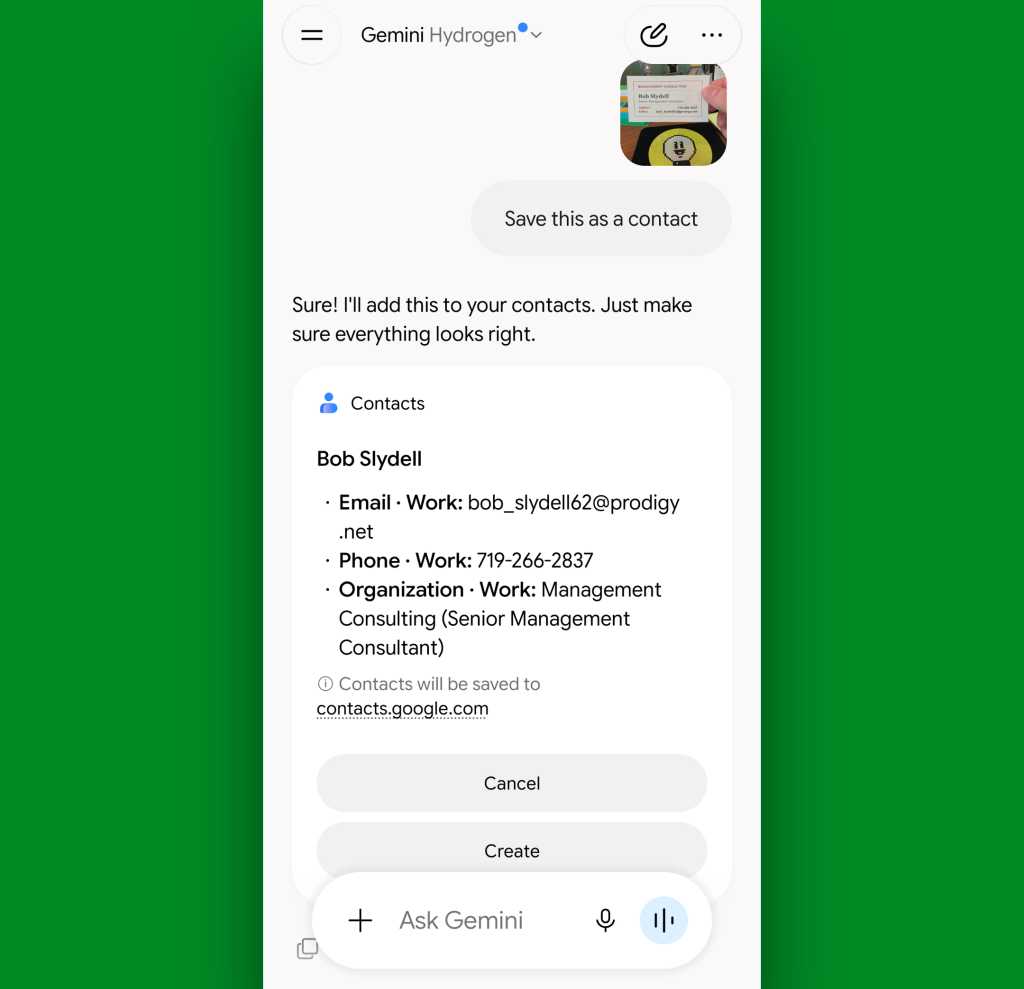
First, the next time you encounter an actual printed business card out and about on your adventures, fire up Gemini, tap the plus icon within its prompt box and select “Camera,” and snap a fast photo of the card — then just tell Gemini to save that as a new contact.

The very first time you do it, you’ll have to grant Gemini access to your contacts and all of that. But once that’s out of the way, the system will simply scan the info, put all the details into all the right places, and confirm that you want to save it.

JR Raphael, Foundry

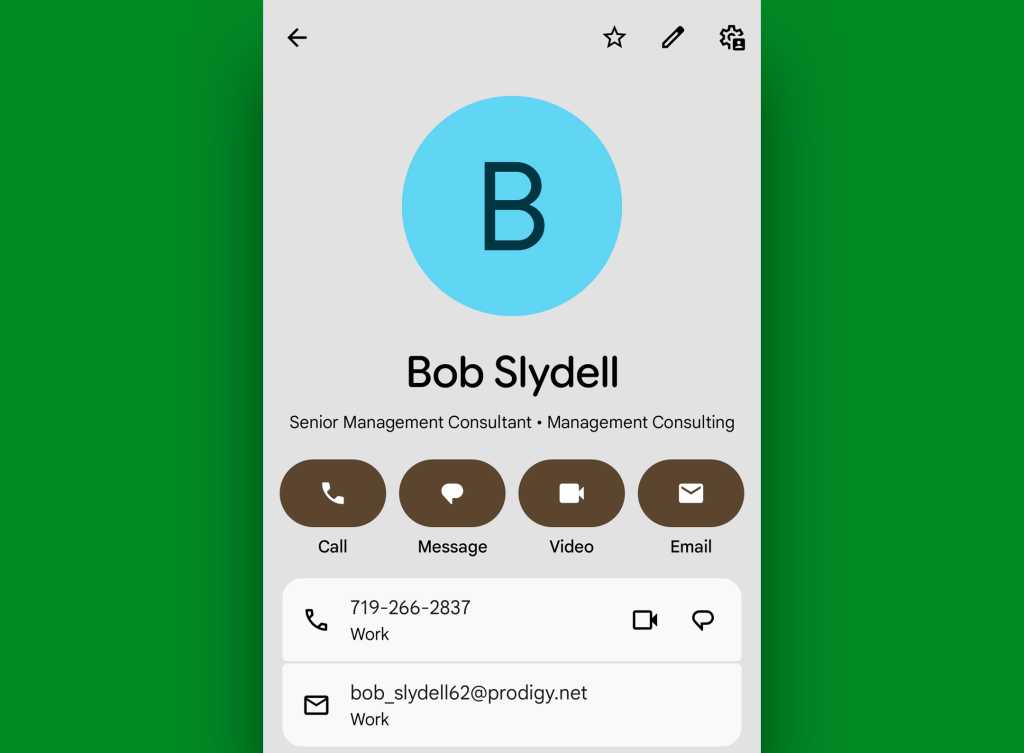
A quick confirmation later, and boom: That person is officially in your contacts, without the need for any third-party importing apps or time-wasting manual entry.

JR Raphael, Foundry

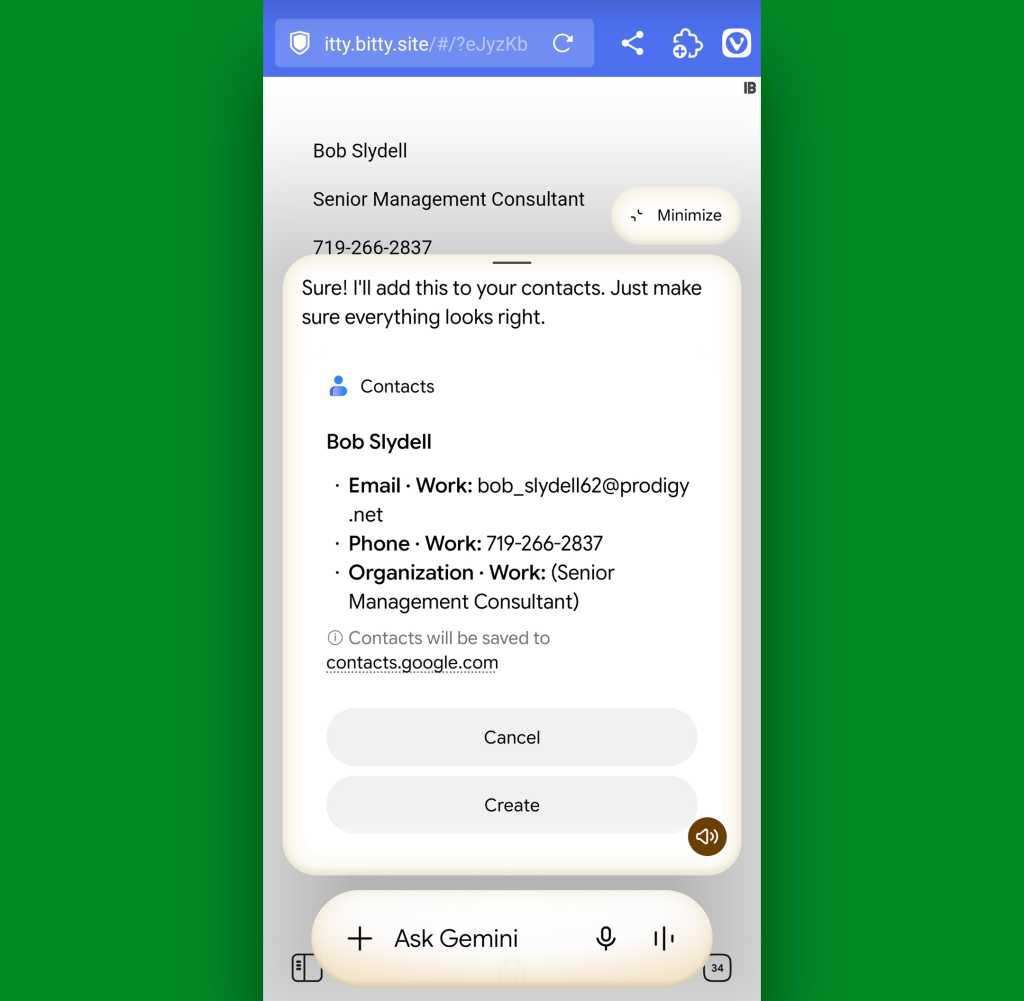
Second, this same feat will work with any virtual contact info you encounter anywhere on your device — in an email, on a website, you name it. Whenever you’re looking at someone’s info on your screen, just fire up Gemini and ask it to save the info you’re seeing as a contact. It’ll handle it in the exact same way.

JR Raphael, Foundry

It may not be the kind of thing that’ll make it into the next big Google keynote or Gemini announcement, but it is the kind of thing you’re actually likely to use and appreciate in your day-to-day doings. It’ll make your life easier in a small but significant way — which, in my book, makes it exactly the flavor of feature that’s well worth remembering to embrace.

Keep the practical knowledge flowing with my free Android Intelligence newsletter — a single new and useful tip in your inbox every Friday.

Optimizely confirms massive cyberattack on customer websites injected stealer malware

Attackers apparently from China used an authentication security hole within the popular Optimizely AI platform for marketers to steal from at least 178 sites owned by some of the planet’s largest companies. 

Named victims featured vendors including Zoom, Paychex, Equifax, and GitLab, and end-user enterprises including Starbucks, IKEA, Mattel, American Eagle, Air France, Mutual of Omaha, Heineken, Home Chef, Cinnabon, American Eagle, Levi, Costco and HSBC.

Salesforce issued a statement confirming that it had also been impacted by the attack.

“Salesforce is investigating unauthorized modifications to scripts provided by Optimizely and used on certain Salesforce websites,” it wrote in an email statement. “As a precaution, Salesforce is confirming that Optimizely scripts are disabled across preview and production instances.”

The attacks were discovered by UK-based security researcher Scott Helme, the founder of Report URI, who said in an interview that his team had confirmed 178 victims, but that there could be more. “That’s the number that we directly observed and that all carried the same infection,” he said. 

Helme published a report about the attacks on Monday, in which he described an attack methodology where an Optimizely capability in its Web Experimentation product facilitating adding members to a site’s development team was leveraged to insert malware into the sites.

“The malware was a multi-purpose kit. It swapped cryptocurrency wallet addresses for the attacker’s, skimmed payment cards, stole cookies and screenshots, and on iPhones and iPads it delivered the Coruna and DarkSword iOS exploit kits,” Helme wrote. “The important lesson here is that trusted JavaScript doesn’t always remain trustworthy. A website can be compromised through a third-party dependency without its own code or infrastructure ever being breached.” 

Optimizely customers load a JavaScript “snippet” from Optimizely’s CDN onto their sites which contains Optimizely code, the customer’s A/B tests, and an optional field called Project JavaScript containing custom code written by the customer. The report said that attackers inserted their own code into the customer’s Project JavaScript and left the rest of each snippet untouched. “The file was still served from cdn[.]Optimizely[.]com, with Optimizely’s certificate, from a host that every affected site already trusted,” it noted.

The report described how the observed attack worked. “The script watches form submissions and every fetch/XHR POST for a card number, expiry date and CVV,” it said. “When it has all three, it sends them to https://1688360[.]cc/card[.]php with navigator.sendBeacon. Cards entered in hosted payment iframes [such as] Stripe, Adyen and similar were out of its reach. Cards typed into a site’s own form fields were not.”

Analyst questions the claims of a fix

Optimizely, which did not reply to an interview request, confirmed the attacks on its site. In an email shared with customers, Optimizely said that attackers “exploited a vulnerability in the Experimentation account signup flow. They used it to impersonate a user and add malicious JavaScript to some customer projects. We have blocked access to the vulnerable path and deployed a fix.”

The email also said that the company had “ended active sessions and revoked tokens and reset access for affected user accounts” and that it also had “removed the injected code from affected projects” and “blocked any code from being delivered in Cloudflare.”

The company used highly confident wording to describe its fix, saying that “the Optimizely Experimentation platform is fully secured” and that “modification of Javascript no longer possible.”  

Frank Dickson, principal analyst at Dickson Research, raised an eyebrow at those claims.

To begin with, he noted a discrepancy in the timelines published by the vendor and the security researcher. “Optimizely puts the first malicious write at 07:51. Report URI saw the BBC’s Optimizely snippet loading attacker code at 04:21, three and a half hours earlier,” he said. “The forensics report should reconcile that gap. Customers need the real start time to scope their exposure.”

As well, he pointed out, “Optimizely seems very comfortable stating absolutes early in a forensics investigation. Those are verdicts from a company whose forensics are still underway and whose timeline disagrees with outside research.”

No responsibility for the attack claimed

Helme speculated in an interview that the attackers were a small group of thieves, almost certainly coming from China, noting that he saw extensive Chinese writing in the code and that the attacks “tie back to infrastructure that has been used by other Chinese actors.”

“They are either Chinese or they really want us to think that they are Chinese,” Helme said, adding that the nature of what was stolen makes it highly unlikely the attackers were state actors. State actors, he said, would likely have used the malware on major news sites to create and spread false stories. 

Asked if his team could verify Optimizely’s claim that it had fixed the hole, he said that he couldn’t yet. Some of the infected sites were cleaned up, but he has to wait to see if they get reinfected before concluding that the original hole had been closed. 

Recommendation to customers ‘concerning’

Dickson said that one line in Optimizely’s email to customers was especially concerning.

“Optimizely’s documentation tells customers to allow ‘unsafe-eval‘ in their policy. At HSBC, the policy blocked the main payload and the data theft, but a backup copy of the malicious code ran anyway through that setting. A vendor’s setup guide should not quietly loosen its customers’ defenses,” Dickson said. “Restrict script-src to the hosts a page actually needs. Lock down connect-src so stolen data has nowhere to go. Drop ‘unsafe-eval‘ wherever possible. Start in report-only mode so nothing breaks.”

He added, “the Optimizely attack may be about as bad as a third-party script compromise gets. Optimizely owes its customers a clear explanation of how one flaw reached so many unrelated companies.”

This article originally appeared on CSOonline.

What Anthropic’s IPO means for IT buyers

Anthropic will make its stock market debut Thursday, seeking a valuation of around $1.3 trillion. While the initial public offering (IPO) is set to attract huge interest from investors, there are implications for Anthropic’s enterprise customers too.

The IPO will be “a huge inflection point” in terms of transparency around Anthropic’s operations, said Arun Chandrasekaran, distinguished VP analyst at Gartner. “At the same time, it might also force a different engagement from Anthropic as a company, particularly around longer-term contracts, hybrid pricing models, and so on,” he said.

Anthropic had more than 11,900 enterprise customers spending $100,000 or more annually as of the end of September, according to its recent S-1 filing, with over 1,900 spending $1 million or more, and around 250 customers spending $10 million or more.

Many of its largest customers are not on long term contracts and have the ability to reduce or, in some cases, cease spending at any point, Anthropic said, though a growing number of enterprise customers are signing annual or multi-year agreements with minimum spending commitments.

As a publicly traded company, Anthropic will be under greater pressure to show continued revenue growth and improving margins in its quarterly earnings. This could change how it does business with enterprise customers, say analysts.

“Enterprise buyers … can expect a stronger push toward committed-spend and multi-year contracts, because investors reward predictable revenue and visible backlog more than usage that can swing from month to month,” said Nick Patience, VP and practice lead for AI Platforms at Futurum Group.

Chandrasekaran agreed, noting that one- to three-year contracts are standard for software as a service vendors, and frontier AI labs such as Anthropic may seek to replicate this.

Patrick Moorhead, founder and chief analyst at Moor Insights & Strategy, also expects a shift towards longer contracts, alongside an emphasis on “larger prepaid volumes and fewer one-off discounts.”

This push to secure longer deals and larger spending commitments could hand customers leverage in negotiations, analysts believe.  

“Right now, Anthropic wants … the committed revenue,” said Brian Hopkins, Forrester vice president and principal analyst, “so we think this is the time to ask for price protection, rollover of unused credits, the right to shift spend to new models as they ship, and decent exit terms.”

Patience added that buyers should use the opportunity to “lock in price protection, capacity guarantees and clear terms on model deprecation.”

And, Chandrasekaran suggested, to entice customers to longer deals, Anthropic may also offer benefits such as early access to new features, and opportunities to work with its forward-deployed engineers.

However, Patience said, buyers shouldn’t overestimate their potential leverage, such as around negotiating lower prices. With demand for its services currently outstripping supply, Anthropic has “little reason” to cut its prices, he said. Competition from the likes of OpenAI and Google — alongside availability of increasingly capable open-weight models — is likely to have a greater effect on pricing than going public, he said.

Hopkins, meanwhile, expects changes to Anthropic’s pricing structure rather than to its list prices, with additional payment tiers and increased bundling of agents, coding tools, and enterprise features.

What should IT buyers monitor in Anthropic’s quarterly reports?

For Hopkins, a key upside to the IPO for customers is transparency. Aside from the company’s recent S-1 filing, most of the information about the company’s finances to date has come from press leaks, he said, and the quarterly reports will provide customers with figures for revenue, margins, customer concentration, and infrastructure commitments.

“I’d make those quarterly filings part of vendor risk management, same as for any strategic supplier,” said Hopkins.

Patience agreed. Anthropic’s customers should read quarterly reports as closely as investors do, as “the numbers that move the stock also predict what happens to pricing and service,” he said.

Chandrasekaran observed that quarterly earnings reports may also shed light on Anthropic’s expansion beyond AI models, as it invests in various areas such as functionality for Claude users, developer tools, and professional services. This could provide IT buyers with “better visibility into which bets are working and are not,” he said.

Patience noted some of the factors that enterprise customers should track in earnings reports:

  • Compute cost as share of revenue. This fell to 48% in the second quarter before rising to 58% in the third, as Anthropic paid premium rates for short-term capacity. “If that number keeps climbing, pressure follows on prices, rate limits, or which models are offered at which tiers,” he said.
  • Customer concentration. Anthropic’s S-1 filing showed that a small number of customers account for a large share of its revenue. “Any change there shows how dependent Anthropic is on a few big buyers and how much weight smaller enterprises carry in its plans,” he said.
  • Long-term compute commitments to cloud and chip partners. “Most of these can’t be cancelled, so they show whether Anthropic will have the capacity to serve customers reliably and what fixed costs it has to cover,” said Patience.

Even as businesses increase their spend on AI, there’s considerable uncertainty about whether customer demand will increase fast enough to underpin the immense sums being invested in compute infrastructure.

Hopkins suggested customers pay attention to Anthropic’s financial position, but to not panic at the potential of an AI bubble bursting. Forrester’s “AI Bubble Model” tracks the companies funding and supplying the AI build-out, such as Microsoft, CoreWeave, Oracle, and the big chip suppliers. This indicates that they are financially healthy, he said, “which is why we don’t think a burst is imminent.”  

However, Hopkins said that AI labs such as Anthropic and OpenAI face different challenges due to their huge infrastructure commitments that rely on continued growth. Anthropic’s S-1 showed commitments of at least $121.3 billion to Google Cloud through 2033, and at least $110 billion to AWS through 2036. Around $161 billion in rent is due over five years on leases for Broadcom-built chips.

“Those are bets that revenue keeps growing fast,” said Hopkins. If growth were to slow, the risk to customers isn’t that Anthropic disappears overnight — “Amazon and Google have a lot riding on it,” he said — but rather that terms, such as prices, rate limits, and capacity, could change.

As well as the company’s finances, Patience said customers should pay attention to Anthropic’s corporate governance structure. Anthropic is a public benefit corporation, which means it is not legally bound to maximize shareholder value over other aims, such as promoting AI safety, while its Long-Term Benefit Trust has the authority to select and remove board members.

The governance structure means that “public shareholders won’t control the company the way they would at a conventional listed firm,” said Patience. “Buyers should watch whether that structure holds up under quarterly pressure, because it shapes how stable Anthropic’s usage policies and model roadmap will be.”

‘Optionality is your negotiating leverage’

As Anthropic becomes a publicly traded company, analysts highlighted the importance of flexibility in contracts and the ability to avoid technical lock-in.

Hopkins recommends clients be prepared to switch models, and avoid signing any commitment they can’t easily exit. “So if Anthropic tries to boost revenue by monkeying with contract terms, customers can threaten to walk and mean it,” he said.

Patience added that Anthropic’s IPO is a “good prompt to check that applications aren’t locked to one model provider.”

In addition, Chandrasekaran pointed out, “the good news is there are a lot of abstractions, like model routers and AI gateways and similar technologies, that enable customers to … reduce their dependency.”

However, he also warned that it becomes harder to avoid lock-in as customers adopt a broader range of tools from a provider. With technologies such as agent harnesses, “the propensity to be locked in is far higher than at the model layer,” he said.

Moorhead suggested that customers avoid signing long single-vendor terms “without price protection, model version and deprecation guarantees, and committed capacity and rate limits.”

“Get clear data handling and exit terms,” he said. “And keep an abstraction layer in your stack so you can move workloads between models. That optionality is your negotiating leverage.”