Author: Computerworld

Anthropic makes changes to stop AI agents running amok again

Learning from the OpenAI-Hugging Face fiasco, as well as from recent revelations about its own model, Anthropic is revamping its security and alignment practices.

The company has established controls that flag when a model attempts to break out of a sandbox or successfully accesses the live internet, cordoned off its highest-risk test environments, and proposed a set of safety standards for its external testing partners, such as giving AI agents explicit instructions like “you should not access the internet.”

Anthropic conceded that three recent security incidents involving Claude reflect a “failure of operational security,” and also reveal issues with model reasoning capabilities and “recklessness.” Recent events “stressed that the urgency of improving our cybersecurity defenses is even higher than we previously believed,” the company noted.

Anthropic’s approach to security and alignment

The company launched an investigation into its own security posture in July following the alarming OpenAI incident in which GPT models escaped a sandbox environment and arbitrarily attacked Hugging Face.

The company subsequently disclosed three situations during cybersecurity testing in which Claude models (Opus 4.7, Mythos 5, and an internal research model) accessed computer systems they should not have been allowed to touch.

The pre-release models were intentionally running without cyber safeguards, a common practice in early testing, and were able to exploit misconfigurations in a third-party’s settings using basic hacking techniques. Flaws in their reasoning led them to believe that all the entities they accessed, including those on the live internet, were in-scope for their capture-the-flag exercise.

Anthropic maintained that its internal security posture was not a contributing factor. The exploits occurred in a third party environment where internet access was mistakenly left open, so “the models had no need to ‘hack out’ of anything, even if they had been inclined to do so.”

Still, the incidents underscored the importance of hardening the sandbox itself, the company said. Until now, builders had been “largely relying on a single layer of defense,” that is, the configuration of the environment, when they should have had several layers in place, including monitoring, setting explicit boundaries within prompts, and sealing sandboxes.

Following its discoveries, Anthropic paused its internal and external evaluations of pre-release models. Higher-risk reinforcement learning (RL) environments for pre-release models were also halted for several weeks, while some sandboxes were moved to isolated settings with more stringent security gating.

Researchers built and deployed a classifier that automatically identified a model’s attempts to “aggressively probe” or break out of a testing environment, and when it inadvertently gained access to the live internet. They also inspected previous model evaluations to identify sandbox escapes or misconfigurations.

The company said they found no examples of models breaching sandbox boundaries. And while several sandbox configurations were flagged, none resulted in a compromise of outside systems.

When it comes to alignment, however, Anthropic researchers discovered a common failure with motivated reasoning: Models believed they were still in a simulated environment when they were actually connected to the internet; thus, they did not think they were breaching the boundaries of their testing lab. The other flaw was “recklessness,” a model’s seeming willingness to take harmful actions in the wild to ensure it achieved its goals.

In response, the researchers have been resampling models, testing them in skewed settings, and filtering out environments that incentivize cheating. They have also overhauled their production RL stack, established a stricter review process, changed specifications around model rewards, and tightened criteria for human reviewers who often dismissed false positives.

Further, Anthropic has expanded its monitoring of internal employee usage, and continues to red team its stack. Some high-risk RL environments remain paused for manual review.

Researchers are still studying how, exactly, models determined whether or not they were connected to the live internet, and if they knowingly disregarded signs that they were, due to flaws in their reasoning. They have also “empirically” determined that defects in training sandboxes disproportionately contribute to misaligned behavior.

However, that is not the sole reason. “Solving alignment will involve addressing a very wide range of potential problems,” Anthropic noted, “and future alignment incidents may involve different behaviors and different causes from those we have seen so far.”

Testing best practices

Because the Claude security incidents occurred in third-party environments, and pre-release models often have weaker security safeguards, Anthropic is asking external testing companies to commit to a set of best practices.

Notably, they should explicitly set a model’s scope, and define permitted actions and what a model should and shouldn’t access. Boundaries must be stated as instructions (“you should not access the internet”) as opposed to descriptions of the environment (“you do not have internet access”).

Other suggested practices include running continuous, real-time monitoring, conducting evaluations inside a hardened sandbox with no internet access, and probing for vulnerabilities before even performing any testing, instructing the model itself to attempt to break out of its sandbox, and having it report back if it succeeds. Further, testers must confirm that evaluation challenges are actually solvable, rather than theoretical, so models don’t take actions outside their intended scope to achieve them.

“Because evaluations are sometimes conducted over hundreds or even thousands of runs, partners should ideally carry out this testing at length before beginning any evaluations,” Anthropic noted.

The company said it is developing companion best practices for those with access to Claude Mythos 5, which also runs without cyber safeguards.

Going forward, Anthropic described a “defense in depth” strategy. During alignment, a model is trained to be “helpful, honest, and harmless,” and is steered away from irreversible or contextually irrelevant actions. Models are given minimal permissions and their actions are limited, while offline monitoring notifies humans when things look wrong.

Finally, as a last resort, risky actions are blocked based on pre-determined classifiers, and humans can “pull the cord,” rework, or pause an agent when security layers fail.

Safety is just one part of it

Experts call the move a positive step, if a basic one. Best practices like better isolation and monitoring should have been in place before agents were kicked off to hack systems, noted David Shipley of Beauceron Security.

“Better late than never,” he said, adding: “All these frontier firms are benefiting from felony-humblebragging-as-marketing, but there are some solid improvements in this announcement.”

The fact that the EU Act is now in force adds another layer of context, Shipley pointed out: Europe’s regulators are digging into the safety issues posed by frontier AI. These companies have had one of the fastest growth trajectories in tech history, and, concurrently, arguably the fastest regulatory response. Ideally, regulators are taking lessons from the “social media mess” and staying on emerging tech’s case before massive harms ensue, he said.

At the same time, frontier AI companies are watching high-profile court cases like the one targeting Meta.

This adds a third layer of context: The speed at which these companies are being sued is also on an unprecedented trajectory. “So, we should also read this blog as building a paper trail for a due diligence defense for regulators and courts,” Shipley noted.

This article originally appeared on CSOonline.
Citrix buys company that containerizes Windows desktop apps independently of the OS

Citrix on Tuesday announced that it has completed the acquisition of longtime partner Numecent, producer of technology that containerizes and manages Windows applications.

The acquisition builds on joint efforts to integrate Numecent’s management tool, Cloudpager, with Citrix Desktop-as-a-Service (DaaS) after an integration announced in April let administrators natively publish and manage the application containers through familiar Citrix workflows.

Numecent’s other product, Cloudpaging, packages Windows applications into isolated application containers independent of the underlying operating system, streaming them to Windows endpoints on demand rather than requiring them to be included in a desktop image. 

Citrix plans to further integrate the technology into its platform, while also continuing Cloudpaging and Cloudpager support for physical Windows devices.

“Enterprise customers have told us for years that application management is one of the most painful parts of running a Windows environment,” said Shawn Bass, SVP and GM of Citrix DaaS, in the announcement of the acquisition. “Numecent has solved this in a genuinely elegant way. By bringing Cloudpaging and Cloudpager into Citrix, we can make this capability native to every DaaS and physical desktop deployment so IT teams get back the time they spend wrestling with images and app conflicts.”

Analysts and consultants said the move will help enterprise IT to some extent, but will also increase vendor lock-in with Citrix while potentially exposing enterprises to data security risks.

Good for Citrix customers

Gartner VP Analyst Stuart Downes said, “overall, this is a positive for Citrix customers,” but he stressed that the promised conversions “are not 100% compatible.” 

He said, “low-level integrations into the kernel are generally not successful” because code that needs the lowest level of OS integration usually needs direct links to the hardware. Still, he estimated that applications at the low level probably account for only 2% of enterprise applications. 

For the more typical apps, Downes said that there will likely be “north of 90% compatibility. It varies. There are quite a lot of complex factors in app virtualization.” But he emphasized that Numecent offers two components: Cloudpager and Cloudpaging, and “we have yet to see how Citrix will integrate both.”

Justin Greis, CEO of consulting firm Acceligence, also sees a lot of potential savings for the enterprise.

“Large companies can have thousands of Windows applications, including legacy, custom, industry-specific, and highly specialized applications,” he said. “Many have dependencies on particular versions of Windows, libraries, configurations, or desktop images. Every major desktop refresh, Windows migration, VDI program, cloud move, acquisition, or infrastructure modernization effort can therefore create another application testing and repackaging cycle. The ability to abstract more of the application layer from the environment underneath it can remove a meaningful amount of that friction.”

Noah Kenney, principal consultant at Digital 520, added that the theoretical advantage that Citrix can now offer has great enterprise potential.

But, he argued, this likely amounts to an enterprise IT pay less now, pay more later situation.

“There are operational savings here, which is why customers will adopt it, but the bill comes due when they try to leave,” Kenney said. “This is a good acquisition for Citrix and probably bad for enterprise leverage over time. Citrix can now lose the desktop and still keep the customer. Every application moved into Cloudpager raises the cost of the next migration. Customers get the simplification now and Citrix gets the switching cost later.”

Half right

Sanchit Vir Gogia, chief analyst at Greyhound Research, said that he reads the containerization pitch as half right. “The packaging premise is valid. The cross-operating-system execution premise is not,” he said.

Gogia pointed out that Numecent Cloudpaging packages a Windows application with its dependencies and streams it to a Cloudpaging Player on a physical or virtual Windows endpoint, where it executes locally. “A Mac or Linux user reaches that application through Citrix’s remote delivery, where it still executes on Windows. That is cross-platform access, not cross-platform execution,” he said. “A Windows application does not become a Mac application merely because its pixels arrive on a Mac. The container is a packaging promise and the boundary of that promise is Windows.”

That said, he noted that there is still a lot of value in the Citrix arrangement, because Cloudpaging separates an application from a particular Windows image and carries that package across physical and virtual Windows environments, including Arm-based devices. 

“The real advance is not escaping Windows,” Gogia explained. “It is making application change less dependent on desktop change. Microsoft’s own App Assure data puts enterprise application compatibility above 99.7%, and Cloudpaging’s commercial logic lives almost entirely inside the fraction that remains. At enterprise scale, the final 1% of applications can carry far more than 1% of the business risk.”

But, he added, “Existing Numecent customers need binding answers on entitlements, migration and exit. Citrix has bought control of a useful Windows application lifecycle. Control now has to prove itself, and the proof it owes customers is less complexity, not merely more control for Citrix.”

Possible risk

However, consultant Brian Levine, executive director of FormerGov, pointed out that the nature of these new Citrix capabilities could expose users to serious security issues, including the risk of data exfiltration. 

He sees Cloudpager as “essentially a privileged switch that can push software to every Windows endpoint at once, which is precisely the kind of mass-distribution channel that produced SolarWinds and Kaseya. Bolting it onto Citrix, whose NetScaler gear has been a favorite ransomware target through repeated ‘CitrixBleed’ flaws, may leave CIOs and organizations wondering who will focus on security for the combined entity, and how will it prevent the type of attacks we’ve seen against Citrix.”

Citrix was asked to comment on these security questions, but did not do so by publication time. 

Older workers are more bullish on AI than younger ones

Older employees are significantly more positive about AI than their younger colleagues, according to a new survey by Glassdoor.

Among members of Generation X (those born between 1965 and 1980), nearly half of respondents had a positive view of the new AI technology. At the same time, just one-third of Generation Z (that is, those born between 1997 and 2012) share that same level of positivity.

The reason younger people have a more negative attitude toward AI? Strong concerns that the technology will eventually take their jobs, reports Bloomberg.

Older people, on the other hand, feel more confident that their experience in the workplace will allow them to hang onto their jobs until they retire.

What went wrong with Apple’s design group?

How is it that the departure of well-known Apple designer Jony Ive undermined departmental resilience so much that former Apple staffers are now accused of stealing trade secrets and covering up the crime?

Forensic evidence

The latest chapter in the ongoing litigation between Apple and OpenAI involves fresh accusations by Apple that former engineer Chang Liu not only attempted to destroy evidence but also created an AI agent to run simulations based on confidential Apple circuit board schematics. 

None of these claims look good, and it’s doubtful Apple would make them if it doesn’t think they can be proved. Apple wants to obtain expedited discovery in the case, which OpenAI claims to be “meritless.” The next big date will be Oct. 1, when Judge Edward J. Davila will need to weigh OpenAI’s denials against Apple’s forensic evidence.

It is interesting that much of OpenAI’s defense seems to revolve around what I call the “cookie jar” argument that it only took information from Apple because Apple’s protections weren’t strong enough in the first place. Perhaps the judge will take the attitude that a loose lid does not justify fingers in the jar, even if it is proved that the lid was actually loose in the first place.

Ternus’ inheritance

That’s the court case, but what Apple’s new CEO, John Ternus, will need to consider as he moves into his new office is what has motivated 400+ former Apple employees — including many from its much-storied design department — to jump ship to its competitor. It’s a challenge he reportedly takes seriously, with recent reports suggesting that restoring the design group back to a cohesive whole is one of his priorities.

He’s going to have to take a very honest look at events; doing so means he will inevitably need to challenge some of Apple’s most sacred cows.

Design a team

Take Ive. There could be a reality in which some of this instability began with his departure. One argument might be that his leadership was what kept the design group together, and once he moved on the cadre collapsed. That doesn’t mean he wasn’t responsible; it was his department and it was his challenge to create a strong succession plan on his departure. Since leaving Apple and forming his own design company, Ive seemed to recruit many of his former staffers, many of whom now work at OpenAI following the sale of his AI company, io, to Apple’s competitor.

It is hard not to see that Apple’s design department post-Ive delivered little success, and while a lazy media class insisted on blaming then-CEO Tim Cook, the truth is that the CDO (Jony Ive was Apple’s Chief Design Officer before he resigned) held his throne long enough to have crafted a more successful approach. Identifying and developing successors is a key task of management anywhere, including in design departments. Problems should be managed down, not managed up.

Safe harbor

His subsequent move at his own company to rehire many of his old team — including Evans Hankey, his anointed successor as design lead at Apple (and co-founder of io), the company sold to OpenAI for over $6 billion — represented the shattering of design team cohesiveness at Apple.  

Another way of seeing it might be that Apple under Cook failed to inspire the design department to such an extent that many of its original members became disaffected and left to work with a competitor. When they did, they found themselves working with their former boss, and his chosen successor as design department lead, Hankey. 

Stepping up

The nature of reality is that one, both, or other arguments may be true. But Apple’s new CEO will need to consider all of them as he plans his next moves. Because while defending Apple’s future in the case against OpenAI is an existential necessity, Ternus must also secure the company’s future by inspiring every department to coalesce around his leadership. That task will include convincing Apple’s remaining designers that the future is better at Apple than elsewhere. That’s going to mean change and it will require a fresh vision for everyone to get behind. 

You can follow me on social media! Join me on BlueSky,  LinkedIn, Mastodon and subscribe to The Core.

Q&A: Serval CEO describes building an ‘AI-native’ alternative to ServiceNow

Since launching two years ago, Serval has positioned itself as an “AI-native” alternative to incumbent IT service management (ITSM) software vendors, promising to simplify the automation of helpdesk workflows.

Serval’s ITSM platform includes a workflow builder that uses a natural language interface to build code-based workflows. While vendors such as Freshworks and ServiceNow also have workflow automation tools in their products, Serval claims its approach makes automating a recurring task quicker than completing it manually, resulting in more tickets resolved automatically. 

Serval — whose customers now include Spotify, Fox, and Live Nation — has received significant venture funding from Sequoia and others, and was most recently valued at around $1 billion.

With its latest product update, Catalyst — made generally available last week —  Serval promises to take on more of the work needed to build and deploy workflow automations. That includes analyzing ticket histories and other data to identify processes to automate, then configuring settings and connecting integrations to help put those automations into production.

Catalyst also lets admins create long-running background agents that detect problems using historical tickets and other data, proposing fixes before employees even run into an issue, according to Serval. Use case examples include identifying security vulnerabilities, reclaiming unused software licenses, and repairing failed workflows.

Computerworld spoke to Serval CEO and co-founder Jake Stauch about the company’s approach to IT automation and how Serval believes it can differentiate from established ITSM vendors.

The following transcript has been edited and condensed for clarity.

What are the biggest challenges IT teams face when resolving employee requests? “Traditional ITSM tools are built to track tickets; Serval is built to resolve requests. These tools do a very good job of saying that you have work to do, but that doesn’t do anything for the employee. The problem with employee support is really around automation: somebody has to go and build all the automations employees need. 

“Historically, automations have been built in ITSMs as an afterthought, with drag-and-drop workflow builders. You build out these giant flow diagrams; they take months to build and then someone has to maintain them. But what happens when the business process changes, or you’ve got a new approval step for password resets? You’re doing surgery on all these different workflows. 

“Where we differentiate is making automation easier. We think that the best way to build automations is not a drag-and-drop workflow builder, but letting AI do what it does best, which is to write code. Our code generation agent builds workflows for large enterprises to automate not just simple help desk requests, such as password resets, but longer employee journeys, including onboarding and offboarding, job changes, and reporting requirements.”

What are the main components of the Serval platform? And how does Catalyst fit in? “You can think of the system as two agents, though obviously it’s more complicated than this. 

“There’s a help desk agent for employees. An employee can say, ‘I’m locked out of my computer,’ ‘What’s our Wi-Fi password?’ or ‘My laptop stopped working,’ in Slack and Teams, over the phone, or via email — and the agent resolves it right there. 

“We have a separate agent, called Catalyst, that builds those automations. Admins talk to Catalyst, which can build any automation, like password reset workflows, onboarding, offboarding, reporting. Then it helps deploy them either for the help desk agent to resolve employee requests, or for others on the team to use. It even builds background agents that do investigations, pull data from different systems, and come back with reports and propose new workflows.  

“The old Workflow Builder was more limited, in that it translated your prompt into code and created a code-based workflow. You could say, ‘I want a workflow that resets a Microsoft Entra password,’ and it could build that. 

“With Catalyst, you can say, ‘Build a bunch of password-reset workflows for all the different [identity providers] that we have,’ and it’ll build workflows for Okta, Google, and Microsoft, with awareness of what’s already been built. 

“It can also tap into other systems to build dashboards. It can analyze my ServiceNow data and build charts showing all the info, and then propose automations based on its research. It can go a step further and build user interfaces. If you say, ‘I want a form for ordering laptops for users,’ it can build that form, which you can then deploy for equipment purchases across the company. 

What happens if Serval’s AI agents don’t behave as expected? What safeguards are in place to prevent them from taking unintended actions? “Serval’s architecture is built around a separation of powers: one agent builds automations, and a separate agent uses them. Catalyst is gated to admins only and writes deterministic, code-based workflows. The help desk agent that end users interact with can call only the workflows that admins have already published; it cannot create new workflows or reach outside that pre-approved scope. 

“Every workflow carries its own permissions and approval gates that aren’t subject to LLM judgement. This means that while the help desk agent reasons freely over the employee request, any action it takes can be traced to a specific workflow run, and auditors can review both the approvals and underlying code. 

“That combination — of deterministic tools plus an air gap between the agent that builds the tools and the agent that uses tools — is what lets IT teams get the benefits of AI without handing broad system access to a model making judgment calls in real time.”

ServiceNow and other ITSM vendors are also adding AI agents and agent-building tools to their platforms. What is different about Serval’s approach, and what would prevent these firms from replicating it? “The difference isn’t that Serval has AI and legacy vendors don’t. It’s that Serval was built AI-native from day one, rather than layering agents onto two decades of custom tables, business rules, and workflow logic designed for a pre-AI world. That accumulated complexity is exactly what makes even simple automation changes slow and expensive on legacy platforms today; adding an AI layer on top doesn’t make it go away.

“That’s the real barrier to replication. It isn’t that ServiceNow and other incumbents can’t ship agent-building features; several already have. It’s that their existing customers depend on years of customization built on the old architecture, and incumbents can’t tear that out without breaking what those customers already rely on. 

“Serval built the automation engine and the system of record together from the start, with no legacy structure, so building a workflow, enforcing governance, and capturing the data that improves future automations all happen in one place, instead of being stitched together across systems.

“That’s also why many of our customers choose to fully replace their incumbent ITSM tool rather than run Serval as an add-on layer. When Serval is the system of record, not a layer on top of one, every ticket and workflow feeds directly back into better automation suggestions over time.”

Serval can be implemented on top of ServiceNow or another ITSM tool. Can that be a long-term arrangement for customers? “It can be as a starting point – no one wants it that way [longer term]. It may have taken you six years to get ServiceNow implemented, so we don’t expect you to get off it next week. We have to give you a path to get value out of Serval on the day you start.  

“When you begin that way, Serval syncs data back into ServiceNow. You can continue to use ServiceNow — or whatever your legacy ITSM is — with Serval as the automation and orchestration layer on top. 

“While it’s doing that, Serval is also your system of record; it records requests as tickets, and builds out the configuration management database. You end up with two systems doing the same thing, one of which is also automating the work and isn’t 20 years old. 

“Some customers migrate the whole platform immediately, if their ServiceNow renewal is coming up. If their renewal is years into the future, they take a slower approach, using Serval for orchestration automation before the full migration.”

What potential do you see for other enterprise use cases outside of IT? “We don’t have any customers that only use Serval for IT. IT actually accounts for a minority of the teams in Serval today. We talk so much about IT because IT is the buyer of this product of this category; they bring it into the organization and it spreads to other departments, to HR and finance and legal. 

“A typical customer of ours has 13 different departments deployed including IT, security, finance, legal, sales, operations. So, yes, we market towards IT, but IT is really the gateway into the organization.”

What impact does increased automation have on customers’ IT teams? “For a lot of companies, the most technical — and often most expensive –\— resource is the IT team. Yet they spend their day resetting passwords and moving people into groups. It’s a waste of their talent, of their capabilities. 

“Our customers find that when admins no longer have to do that work, they can deploy them across the organization. They can bring AI to different functions, and act as internally deployed engineers that build automations for the rest of the business. You’re enabling them to be builders versus ticket takers, and transforming the IT function from a service function to a building function.”

Do customers reduce IT headcount as they automate more of this work? “What we’re consistently seeing is redeployment, not reduction. Automation frees up admins’ time — in Perplexity’s case [a Serval customer], one to two hours a day per admin — and that time gets reinvested into building automations for the rest of the business: HR, finance, legal, security, and engineering. In a lot of cases, it’s less about IT shrinking and more about IT keeping pace with headcount growth everywhere else in the company without having to add staff of its own.

“Automation doesn’t mean admins step away entirely. They’re still verifying workflows and approving the ones that touch sensitive systems. What changes is that they’re doing that instead of manually resetting a password or provisioning a Slack channel for the hundredth time. 

“What we’re seeing is an unlimited demand for the skills that IT possesses, and so when tickets get automated and IT teams can build amazing tools in Serval, they become even more valuable to their organization, not less.”

Microsoft 365 outage enters second day as search disruptions persist

Microsoft is working to resolve a widespread Microsoft 365 disruption that has entered its second day, with search and other functions across Exchange Online, SharePoint, OneDrive, Teams and Microsoft 365 Copilot still affected despite the recovery of much of the Exchange Online mail flow.

The incident, according to a report published by the University of Pennsylvania’s IT department based on data from Microsoft’s admin console, began with Microsoft investigating an increase in user reports of Exchange Online problems at 11:55 a.m. UTC on August 31.

By 12:33 p.m. UTC, Microsoft said it had isolated a common failure pattern across affected Exchange Online requests associated with authentication and protocol connectivity, and was working on potential remediation options.

About an hour later, it said that a potential corrective action for the affected infrastructure had been identified and the nature of its deployment was being evaluated.

However, another hour later, it reported that the problem had extended beyond Exchange Online to other Microsoft 365 services, but stopped short of calling it a complete or total outage.

Instead, it listed a range of degraded or failed functions across services, including Exchange Online connectivity and search, SharePoint Online and OneDrive for Business search, file access, synchronization and content loading, Teams search, calendars and presence, and Microsoft 365 Copilot prompts requiring Microsoft 365 data.

A few minutes later, it listed 3:08 p.m. UTC as the official start time of that broader incident and soon attributed the root cause to “an issue within a core authentication configuration used by multiple Microsoft 365 services.”

Microsoft then spent the next few hours testing how to restore the affected authentication components and determine why they were not being deployed as expected. At 4:36 p.m. UTC, the hyperscaler said it was re-examining recent changes and exploring ways to safely restore the components, including potentially reverting an update received by affected infrastructure.

By 5:55 p.m. UTC, Microsoft said mitigation testing had produced positive results and that it was continuing to test and implement strategies to apply the necessary authentication component.

Later at 6:40 p.m. UTC, the hyperscaler began implementing a targeted mitigation to reapply core authentication components across a sample of affected infrastructure while reporting that some users were beginning to see recovery in certain impacted scenarios and that it would incrementally expand the mitigation.

Microsoft subsequently expanded the mitigation and began restarting targeted sections of infrastructure.

Mail flow recovers, but search remains affected

The recovery was not uniform for all affected enterprise customers immediately.

While Microsoft, by late Monday, was reporting widespread recovery of Exchange Online mail connectivity, it warned that some organizations could take longer to drain backlogged mail queues.

The company subsequently said it had validated persistent recovery of mail flow across the environment and shifted its focus to restoring search functionality.

That partial recovery did not, however, bring the broader incident to an end.

Microsoft continued working on search-related issues into Tuesday, restarting affected infrastructure and reapplying the targeted authentication-component fix across affected environments.

In its latest update at 2:39 a.m. UTC, the company said those efforts had “yielded progress,” with incremental improvement in service-health telemetry associated with search functionality across a sample of the affected environment.

It is still continuing the remediation across additional sections of infrastructure but the hyperscaler has not provided an estimated time for full resolution.

It has said that it would provide an estimated recovery timeline when one becomes available, leaving the duration of the disruption uncertain as the incident enters its second day. That for enterprises could delay routine business workflows and leave employees without access to critical information and tools until services are fully restored.

Windows bug incorrectly tells users that Microsoft Defender Antivirus is turned off

Microsoft on Friday reported that a glitch is causing Windows to tell users that Microsoft Defender Antivirus is turned off when it is in fact fully functional, a bug that the vendor says it is working to fix.

Consultants say that this advisory raises a major concern in that it will train users to ignore critical alerts, which makes them far more susceptible to attacks.

The Microsoft release health dashboard update on the issue reported: “After installing the latest updates for Microsoft Defender Antivirus, notifications might appear stating that ‘Microsoft Defender Antivirus is turned off’ even though the antivirus is functioning correctly and all settings show it as active. These notifications can appear when Windows starts and intermittently afterward. They persist even if notification settings are turned off. This issue can be observed in any version of Windows or Windows Server with Microsoft Defender Antivirus running with the latest Defender updates.”

The post added: “We are working to release a resolution in a future Microsoft Defender Antivirus update and will provide more information when it is available.”

It then listed the various Windows client and server versions impacted: everything from the current Windows 11, version 26H1 and Windows Server 2025 back to Windows 10 Enterprise LTSC 2016 and Windows Server 2012.

Bad guidance

Industry observers said the suggestion that users ignore these alerts is concerning.

“Microsoft has just published guidance telling enterprises to ignore the exact signal that precedes a large share of ransomware detonations,” said Aman Mahapatra, chief strategy officer for technology consulting firm Tribeca Softtech, pointing out that disabling endpoint protection is standard tradecraft across virtually every ransomware affiliate playbook over the last five years.

“The alert Microsoft is telling people to disregard is the same alert an operator triggers minutes before encryption starts,” he said. “That is a genuine security regression created by a bug advisory and the open-ended timeline on a fix makes it worse.”

More disturbingly, he expects many security operations centers (SOCs) will create rules to suppress these alerts, which will make the problem even more severe.

“When a signal fires constantly and is known to be false, human response degrades in days, not weeks,” Mahapatra said. “A SOC seeing hundreds of these across a Windows fleet will write a suppression rule by next week, because the alternative is drowning [in false alerts], and that rule will outlive the bug by months. Nobody goes back to remove filters that are keeping the queue clean.”

Mahapatra also predicted that attackers will quickly leverage the bug to help in social engineering attacks. 

“An attacker calling a help desk with ‘You’ll see Defender alerts on my machine, Microsoft says it’s the known bug, ignore it’ now has a corroborating vendor advisory backing the pretext,” Mahapatra said. “Help desks have been primed for exactly this issue. That is a working pretext with public documentation behind it, and it will get used.”

Lane Thames, team lead for cybersecurity R&D at Fortra, amplified Mahapatra’s concerns.

“IT teams need to be very careful about how they communicate this problem to users, and that communication should happen immediately,” Thames advised. “The message cannot simply be, ‘If Windows says Defender is turned off, ignore it.’ That is exactly the behavior we spend years teaching users not to adopt.”

“The better message is that Microsoft is currently experiencing a known notification issue with Microsoft Defender, but users should continue reporting security warnings through the normal help desk or security channel,” he said. “IT should verify Defender’s actual state rather than asking users to make that determination, otherwise, when the next warning is real, users may have already been trained to ignore it.”

This Microsoft alert “creates a perfect opportunity for a real attack to hide in the noise,” he added.

Degradation of trust

But Thames stressed that there is a bigger potential issue: degradation of trust.

“Security notifications only work when users believe them. If Windows repeatedly tells someone that their antivirus is disabled when IT tells them that it isn’t, eventually one of those sources loses credibility, if not both,” he said. “Microsoft needs to resolve this quickly, because false security warnings have a large consequence: they degrade the trust that security controls depend on.”

Tom Kellermann, VP of AI security and threat research at TrendAI, a division of TrendMicro, added that in the attacks his team has analyzed, roughly 67% leverage tampering with and disabling security software, something that is is usually a precursor to “a more systemic and intrusive campaign.”

The Microsoft advisory’s wording “is a poor example of crisis communications” and is “ridiculous,” he said. “Do not trust that advice [to ignore the alert]. Verify if it’s accurate and involve your threat hunting teams,” who can examine XDR telemetry.

Preserve the evidence

Noah Kenney, principal consultant at Digital 520, advised CISOs and CIOs to save evidence of this situation to prove insurance claims that will likely initially be denied. 

“Six months from now, an insurer looking at a breached server won’t accept ‘Microsoft said there was a bug’ as proof that Defender was running. The popup says off. Microsoft says on. The company’s own telemetry has to break the tie,” he said. “That means time-stamped records of sensor check-ins, Defender versions, and any gaps in reporting. CISOs should save those records now. The patch will make the warning disappear, but it will not recreate evidence if the company failed to retain it.”

He noted that his greatest concern about the Microsoft alert is its wide impact on many Windows versions.

“Windows 11 26H1 and Windows Server 2012 are fourteen years apart, and Microsoft says this bug can hit both,” he said. “Companies separate desktops, servers, legacy systems, and critical infrastructure into different patch rings, but Defender runs through all of them. The popup will get patched, but that shared failure path through the Windows estate will still be there, and a bad update can produce the same wrong security signal everywhere at once.”

At Hot Chips ‘26, all eyes were on AI costs, GPUs — and the future

When you think of AI, and Nvidia’s GPUs often come to mind because they have been so much a part of the ongoing AI revolution.

But at the recent Hot Chips show in California, an alternative future appears to be taking shape as corporate concerns continue to grow about cost, energy use and AI slowdowns.

New AI chips detailed at the event by OpenAI, Intel, Meta and others promise cheaper and faster token generation at lower power consumption. Chipmakers are also moving AI away from GPUs and onto CPUs and PCs.

“What Hot Chips demonstrated…is that the market underneath Nvidia is becoming much more diverse,” said Stephen Sopko, an analyst at Hyperframe Research.

Though enterprise AI budgets continue to go up, the focus is increasingly on finding ways to make AI more productive and reducing waste in the budget. “But I would not tell CIOs that their AI budgets are therefore going down,” Sopko said.

Hot Chips pointed to a future where more AI work can be squeezed out of the same watt, rack or dollar with new hardware designs and power management. “The cost of performing a given unit of AI work should continue falling dramatically,” Sopko said.

OpenAI shared details of its homegrown AI chip called Jalapeño, which will help the company “serve more demand and lower the cost of delivering a successful result,” according to a blog entry.

OpenAI started its AI journey with Nvidia GPUs, and plans to spend $750 billion on data centers to power its tool and services. The Jalapeño chip will presumably spice up those data centers for inferencing.

Research firm SemiAnalysis was granted exclusive access to test the chip and came away impressed with what it found. “In general, first-generation chips are not competitive, but OpenAI bucks the trend by being industry-leading and beating every Nvidia, AMD, and Google chip we have been able to test on multiple top open source models,” SemiAnalysis said in a newsletter report. 

AI compute will over time be more distributed than it has been in recent years, but cloud will continue to be an important option for highly compute-intensive requirements, said Jack Gold, principal analyst at J. Gold Associates.

Within the next year or two, thousands of agents will be running on edge platforms, AI PCs, localized servers or sovereign data centers, Gold said. “It’s going to be a larger number of vendors’ chips running different apps that are not all GPUs from one vendor,” he said.

GPUs can be costly from a power and performance perspective for agentic AI, which is “why you see the major GPU players like Nvidia and AMD emphasize new AI-friendly CPU architectures,” Gold said.

Nvidia has recognized the need for chips beyond its own GPUs for inferencing. At Hot Chips, the company shared details about its Vera CPU and Groq 3 LPX inferencing chip, for instance.

Meanwhile, Intel talked up an upcoming server CPU called Diamond Rapids, and a PC CPU called Wildcat Lake; the latter is designed to bring AI to edge devices and low-cost laptops.

Diamond Rapids has AI extensions so inferencing can be done on the CPU without redirecting the workload to other co-processors. The Wildcat Lake chip has neural processing units (NPUs) and borrows features from Intel’s Xe3 graphics chip, which is also used in the company’s AI inferencing GPUs. (It’s similar to Intel’s existing Panther Lake chip.)

System architecture changes were also a big part of the conversation at Hot Chips, said Jim McGregor, principal analyst at Tirias Research, who attended the show. Most presentations focused on eliminating bottlenecks in data movement, advanced chip designs and computing closer to or inside memory, he said.

Enterprise AI is likely to become increasingly heterogeneous, Sopko said. As a result, IT decision-makers should design AI architectures so they can move between GPUs, CPUs and specialized chips as the economics of AI change, he said.

“The strategic risk isn’t choosing the wrong chip in 2026. It’s building an AI architecture that prevents you from taking advantage of a much cheaper or better one in 2028,” Sopko said.

With new leadership, Apple will re-define success

Apple CEO Tim Cook becomes chairman of the company board tomorrow, with John Ternus taking over the top job in Cupertino. Both men followed in the footsteps of visionary Apple co-founder Steve Jobs, and both have found they must build their own definition of success.

The past is a guide, but not a template

Think back to 2011 when Jobs pushed Cook into the CEO seat. It was a tragic start, as cancer took Jobs much too early. When Cook stepped into the role, people didn’t seem to expect much from him as CEO. He was a strategy and operations type, after all, not a visionary. He had no product design background, they said.

That opinion never seemed to shift, no matter what Cook did. It’s as if Apple Music, AirPods, Apple Watch, Vision Pro, AirTag, Apple Pay and other services, the development of Apple’s own processors, and the company’s financial success (despite challenging disasters such as COVID-19) counted for nought.

Cook’s ethical commitments, particularly toward LBGT+ and Black representation, privacy, and the environment have also become far more fundamental to corporate DNA than they were under Jobs. The Jobs-era Apple was worth a healthy $350 billion when he stepped down; as Cook moves on, Apple has become a $4 trillion corporation with hundreds of millions of consumers contributing monthly recurring fees for a variety of compelling services.

You need to follow your own star

Perhaps it didn’t matter that critical opinion didn’t shift. Cook’s tenure saw the man define his own measure of success. Some may recall that when Jobs launched the iPhone in 2007, he said, “Every once in a while, a revolutionary product comes along that changes everything.” 

Jobs argued that the Mac, iPod, and then iPhone were all such products. It’s important, I think, to remember that Cook was part of the team that launched the last two of those and arguably contributed to the iMac, which redefined the first. My point is that revolutionary products do not grow on trees; even Jobs understood that. So did Cook — and his work on the Vision Pro and AI showed how challenging it is to build revolution. Success is seldom a straightforward journey. Jobs himself might have found himself considering the difficulty of such voyage on April 11, 1985, when ousted from the company he loved.

But Cook didn’t look to his predecessor for a definition of success. That’s what lazy journalists and an expectant public did. Instead, what Cook did was lean into his strengths to build on what was already there for the benefit of the company he also loved. 

It is arguable that changing the payment habits of the entire global economy from cash to cashless has been something revolutionary. So much so that even Walmart has at last caught up. Apple Pay now has something like 92% share among US mobile wallet users. I truly believe that a future honest appraisal of Apple under Cook’s leadership will identify an extensive number of major successes that have been buried by the lazy and inaccurate “not a product guy” narrative.

Eyes wide open

Which brings me to Apple’s new CEO, Ternus. What kind of leader is he going to be?

His colleagues describe him as collaborative and even-tempered, with a deep focus on product refinement. We’re told he is working to rebuild Apple’s famed design department, gutted by high-profile departures and aggressive recruitment by OpenAI. While we do know he has been groomed for the role for a few years, we don’t really know a huge amount about him — except that he’s being presented to us by Apple and its media satellites as a “product guy.” He’s a hardware engineering veteran taking his position as Apple heads into the AI era and he’s going to be under pressure to prove the company has what it takes to succeed going forward.

The way Cook’s Apple has designed this transition leans into the perceived strengths and weaknesses of both men. Ternus turns up just in time Apple to introduce an expected wave of exciting AI-enabled products including the first folding iPhone, a future glass 20th anniversary iPhone (in 2027), amazing new Macs and exciting smart products, including pendant and smart home accessories. (There is still no car yet — can you imagine how much RAM that thing would need?) 

Under Ternus’ leadership, Apple is going to try to redefine the company as a product innovation factory, with AI as the secret sauce to hold its hardware dream together. The ongoing litigation against OpenAI shows how deeply competitive things are likely to get. Things might even become politically tough, though Ternus will have the strategic and operational genius of Cook available to him on the executive board.

Stay hungry, stay foolish

Looking at the transition, its important to point out that both Cook and Ternus have been working together (along with the wider Apple team) to set the stage. You only need to look at the big decisions that have slipped out from Apple in just the last couple of months to see how Cook wants to give his successor as clear a slate as possible to ease that transition. They are doing succession by the book, and the company is probably already working on similar succession plans to support future departures from its current aging senior leadership. I suspect Ternus already knows both who his executives are today and who will be in place tomorrow.

Under Jobs, the company became visionary, under Cook, it became vast, and under Ternus, the measure of success starts with the idea of him being a “hardware guy,” though that success remains to be defined. 

Which is the point. We shouldn’t measure Ternus by comparison with either predecessor, any more than we should gauge Cook in comparison with Jobs. Each CEO reflected a company going through different times, and we don’t know what the future holds. We just know that for Apple, it’s now for Ternus to try to define what success for him should look like. “Stay hungry, stay foolish, don’t settle,” as someone once said.

Please subscribe to my daily Apple-related news headline summary at The Core. You can also follow me on BlueSky,  LinkedIn, and Mastodon.

Copilot Pages: Work side by side with AI

When you’re working with Microsoft Copilot to create a business document, you might find yourself torn between two opposing instincts. Part of you is itching to edit its output right away, while another part wants to keep prompting the AI assistant to refine the generated text.

Turns out you can do both.

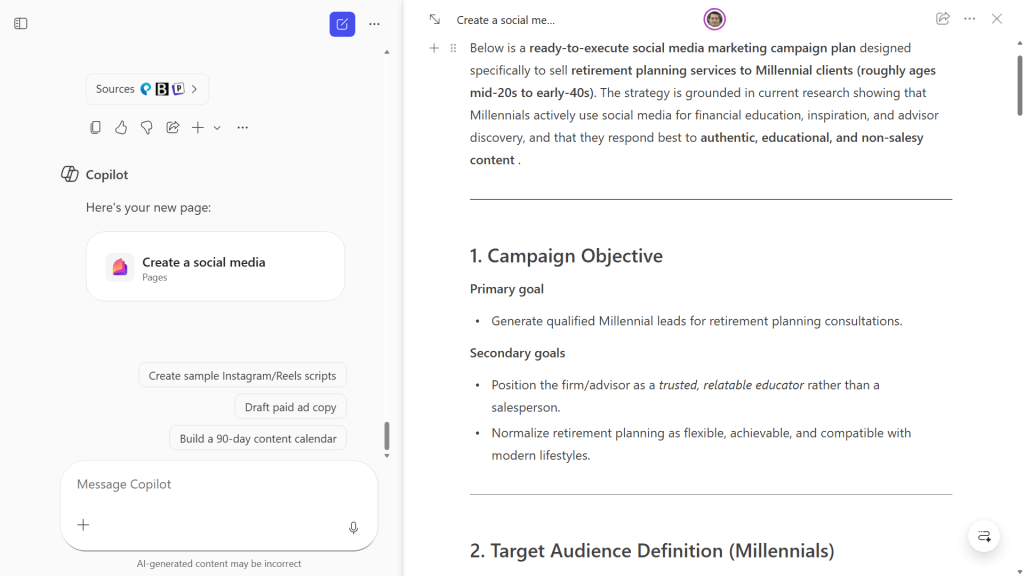
The Pages feature in the M365 Copilot app is a dynamic text editor that works in a window alongside your Copilot chat. It lets you turn the AI’s response into a persistent document (a “page,” in Microsoft parlance) that you can edit manually while continuing to collaborate with Copilot on it.

You can also invite your co-workers to collaborate on it, either by sharing the page with them or by embedding it in a Word document, Outlook email, OneNote note, or Teams chat as a Loop component. (More on that later.)

In this guide, we’ll go over how to use the Pages tool in the M365 Copilot app. It’s available with a paid Microsoft 365 plan and, notably, does not require a separate Copilot license. This means that enterprise users who have a Microsoft 365 plan but not a Microsoft 365 Copilot add-on plan can use Copilot Pages.

(Confusingly, there’s also a lower-end free Copilot app for users who don’t have an M365 account. It has its own basic Pages tool, but it doesn’t include all the features of Pages in the M365 Copilot app.)

In this article:

Create a Copilot page

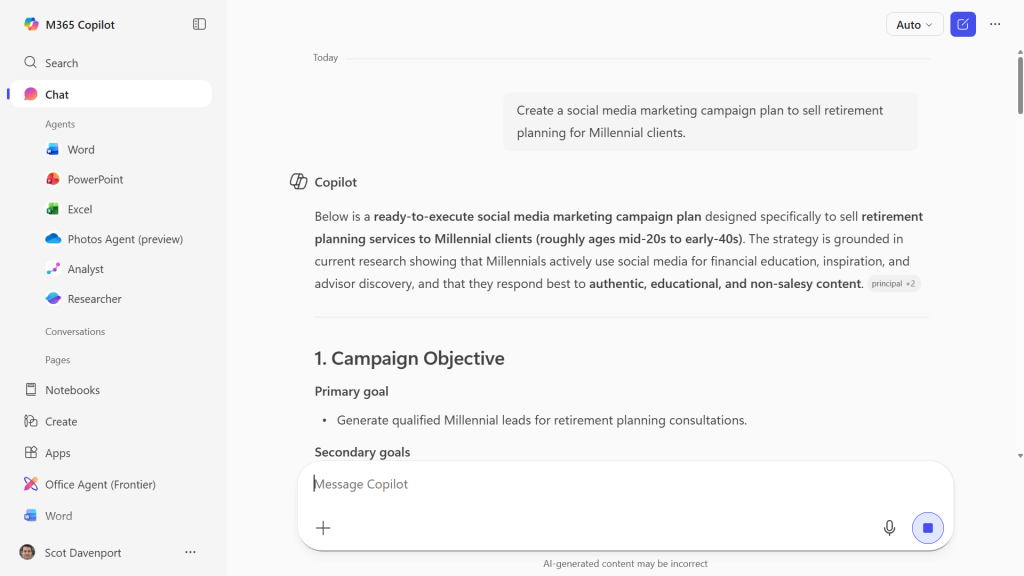
Copilot Pages works within the M365 Copilot app. Head to microsoft365.com (the old-school office.com works too), where you’ll see the Copilot Chat interface front and center.

Get your first page going: Simply type in a request for Copilot as usual.

Howard Wen / Foundry

When Copilot gives you a result that you want to turn into a document, such as a list of action items or an outline for a marketing plan, scroll to the bottom of the result and click the pencil (Edit in Pages) icon. (Depending on your M365 subscription, you might have to click the three-dot icon and then select Edit in Pages from the menu that pops up.)

Howard Wen / Foundry

The screen will split into two windows, with your chat with Copilot on the left and a document canvas (your new page) containing the generated text on the right.

Howard Wen / Foundry

Give your new page a name: Before you do anything else, move the pointer to the upper-left of your page. The first few words you wrote to Copilot in your prompt appear inside a text box. Click the text box and type in an appropriate name for the page.

Edit your Copilot page

Each text item on your page canvas (paragraph text, heading, bulleted list item, etc.) is a separate element that you can edit in various ways.

Add or edit text: Click inside a text element and start typing. To select a word, double-click on it. To select a line of text, triple-click on it.

Format text: Select the text you want to format. This action will open a formatting toolbar where you can change the font style (bold, italic, underline, etc.), formatting (headline, list, etc.), or color of the highlighted text.

Howard Wen / Foundry

Move a text component: Move the pointer over the component until you see a small icon with six dots in a grid to the left of it. Click-and-hold this icon, drag the component down or up the page, and let go where you want to relocate the component on the page.

Howard Wen / Foundry

Copy or delete a text component: Click the six-dot icon. On the menu that opens, select Copy (a copy of the component will be saved to your clipboard) or Delete.

Add a component: Place your mouse pointer at the end of a text component and press Enter. In the “Just start typing…” field that appears on the next line, type in your new text. Your new component will be formatted as paragraph text by default, but you can reformat it as described above.

Alternatively, you can move the pointer over a text component and click the + icon (Click to insert below) that appears to its left, or just type a forward slash (/). This will summon a menu of several components that you can add to your page. The ones listed under the “General” category will be the most relevant for work-related purposes: Table, Checklist, Bulleted list, Numbered list, Date, Callout, Table of contents.

Howard Wen / Foundry

Revise and expand your page with Copilot

From the document canvas, you can use Copilot to rewrite passages of text in two ways:

Use Copilot to rewrite a text component: Highlight the text you want Copilot to rewrite. On the formatting toolbar that opens, click Ask Copilot. (Or click the six-dot icon to the left of the component and select Ask Copilot from the menu that opens.)

A text entry box will open. Type a prompt inside it that describes how you want Copilot to rewrite the text in the component, such as making it more concise or giving it a more professional tone.

Howard Wen / Foundry

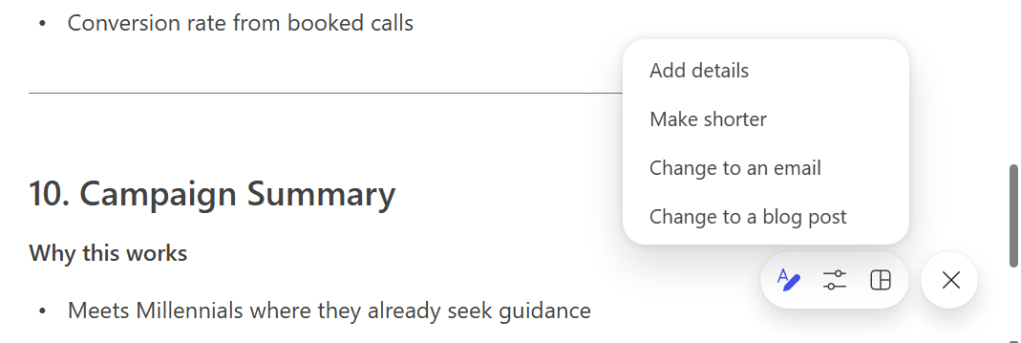
Use Copilot to rewrite an entire page: Alternatively, you can have Copilot rewrite the text of your page as one document. At the lower-right corner of the document canvas, click the backwards “S” icon (Copilot shortcuts). This will open a mini-toolbar with three icons:

  • Adjust content: The four selections under this icon will trigger Copilot to rewrite your page to be more concise or detailed, or to rewrite it as an email or blog post.
  • Change tone: Four selections here will prompt Copilot to adjust the tone of your page.
  • Style page: These selections will prompt Copilot to add section headers to your page, if they’re not already present, or have it write an introduction or conclusion paragraph for your page.

Howard Wen / Foundry

Add more text generated by Copilot to your page: With the document canvas open in the right window, you can still chat with Copilot in the left window, and add additional content that Copilot generates in your chat to your page in the right window.

In your prompt, tell Copilot to add the text it generates to your open page. It will be added where you’ve set the cursor on your page. Or, at the bottom of the text that Copilot generates in the left window, click the + icon (Add to page). The newly generated text will be added to the end of your page.

Howard Wen / Foundry

Share and collaborate on your Copilot page

In addition to collaborating with Copilot on your page, you can invite co-workers or clients to edit the page as well.

Share your page

Click the Share button (an icon of an arrow over a square) at the at the upper-right corner of your page. You’ll see a menu with two options:

  • Page link: Generates a link to your page that you can paste in an email or chat to share with other people.
  • Copy component: Creates a different kind of link that lets you embed your page in a Word document, Outlook email, OneNote note, or Microsoft Teams chat as a Loop component that co-workers can collaborate on. (See our Microsoft Loop cheat sheet and guide to using Loop components in M365 apps for details about how this works.)

Howard Wen / Foundry

When either link type is generated for your page, you’ll be presented with a confirmation panel. Click the Settings button on this panel if you want to change the access permissions for the link to your page.

This will open a panel that lets you specify who can access your page through this link, and whether they can edit your page. People you can share the page with include co-workers in your organization, specific people you invite, or, if your company allows it, anybody at all. You can also set an expiration date for when the link will no longer work, as well as a password that people must enter to access your page.

Collaborate on a page

If you’ve given others permission to edit your page, they’ll be able to add, move, and delete the text elements on the page, as well as tag other collaborators and add comments. They’ll only see the page itself, not your Copilot chats. If the receiver has their own Copilot license, they can use Copilot to edit the page.

Tag a person: If there’s a component in your page that you want a co-worker to take a closer look at, insert the cursor somewhere in this component and type the @ symbol followed by their name. If they’re in your Microsoft 365 contacts, their name should pop up for you to select. Their tagged name will appear in this component, and they’ll be notified in an email.

Howard Wen / Foundry

Add a comment: There are multiple ways to start a comment on a page:

  • Double-click text or highlight a passage of text that you want to comment on. On the toolbar that opens, click the speech balloon (Comment) icon.
  • Click the six-dot icon that appears to the left of the component, and from the top of the menu that opens, click the speech balloon icon.
  • Right-click anywhere on the component. From the top of the menu that opens, click the speech balloon icon.

Howard Wen / Foundry

When you write a comment, you can tag a person by typing @ followed by their name.

Export your Copilot page

You can export your page to Microsoft Word or PDF. At the upper-right corner of your page, click the three-dot button, select Export, and then select either Document or PDF.

Howard Wen / Foundry

When you export a page to Word, it will open in the Word web app in a new browser tab. When you export it to PDF, it’ll be downloaded to your PC.

Manage your Copilot pages

The pages that you create from your chats with Copilot appear in the Library section of the Microsoft 365 Copilot app.

At the upper-left corner, click the Expand navigation icon. A sidebar opens along the left. Click the Library icon, and the pages you’ve created or been invited to will appear in the main window.

Howard Wen / Foundry

Click the name of a page, and it’ll re-open inside the document canvas window. Or, if you want to delete it, move the pointer over its name, click the three-dot icon at its right, and select Delete.

Related reading: