A court has dismissed Google’s case against SerpApi over that company’s scraping of search results to train AI models.
The US District Court for the Northern District of California found that there was no indication that any copyright had been breached.
Google announced in December that it was suing SerpApI for its alleged web scraping, claiming that it was protecting copyright holders. In February, SerpApI fought back and asked the court to dismiss Google’s case. And this week, Judge Yvonne Gonzalez Rogers agreed with SerpApi that Google’s case has no merit.
Google’s argument was that SerpApi’s actions breached the US Digital Millennium Copyright Act (DCMA). It made two claims: first, that no person shall circumvent a technological measure that effectively controls access to a work protected under this title, and second that no person shall manufacture, import, offer to the public, provide, or otherwise traffic in any technology, product, service, device, or component protected by the Act.
SerpApi claimed that the URLs and other links that were being served by Google did not in themselves entail copyright and the judge agreed. In her judgment, she said that there was no indication that the copyright holders had authorized Google to take action against SerpApi.
The case is not completely over as the judge has given Google 21 days to amend its complaint to demonstrate that it was acting on behalf of the copyright owners. It remains to be seen whether its war against the web scrapers is finally over.
Microsoft cloud and Azure services hosted on the West Coast of the US went down for hours on Thursday when network connectivity failed. Although services running entirely within Microsoft’s West US cloud region were unaffected, any traffic entering or leaving the facilities was affected.
Microsoft has now published a Preliminary Post Incident Review (PIR) of the incident, reporting that connectivity was lost for five hours between 14.44 UTC (7.44 a.m. Pacific Time) and 19.41 UTC on July 23. The problem was caused when a set of IP routes was removed in error while isolating a device for routine maintenance.
Before starting the maintenance work, Microsoft checked that at least one of the two redundant paths to the facility remained operational. When it came to starting the work, however, automated systems included some additional devices in the perimeter to be isolated, and removing some IP routes that had not been included in the initial assessment.
Customers discovered the problems very quickly, and engineers identified the issue within the first hour and started to reconnect services. Microsoft said the disruption had been caused by some “recent fiber maintenance activity”.
To minimize the risk of disruption from such errors in the future, Microsoft advised organizations handling mission-critical data to consider a multi-region approach.
“Phishing volume linked to the platform fell 92% from pre-disruption averages, including QR code phishing and CAPTCHA-gated phishing both declining from their March highs,” the company wrote in the report.
The takedown reduced activity across multiple phishing categories, forcing attackers to shift to newer delivery methods.
Riding this shift in were a few notable phishing campaigns, including an automated business email compromise (BEC) campaign that reached 42,000 organizations in under three hours, and a multi-stage phishing campaign that used nested email (EML) files, calendar invitations, and a Microsoft authentication redirect to deliver malware.
To counter phishing attacks, Microsoft recommends blocking emails containing known bad URLs/ subject fields, enabling password-less authentication methods, or moving to MFA for accounts that still require passwords.
Tycoon2FA disruption sent attackers exploring
The take-down of Tycoon2FA forced its operators to abandon portions of their infrastructure and rework hosting, domain registrations, and delivery mechanisms.
“After falling 15% in March and another 22% in April, Tycoon2FA-linked phishing volume dropped 74% in May to just 1.5 million messages, then fell another 20% in June to 1.2 million, by far the lowest monthly volumes observed in at least a year,” Microsoft said.
The decline extended to QR Code lures and fake CAPTCHA pages, two phishing techniques in which Tycoon2FA accounted for 12% and 14% of industry activity in June, respectively. This indicated that the platform’s customer base had not been able to migrate to a replacement infrastructure.
But cutting off one head of the hacker hydra only gave rise to new tactics elsewhere.
The adaptation came in the form of using Microsoft Teams as a social engineering channel. Attackers established conversations to build trust before attempting credential theft or delivering malicious payloads. “Teams-based phishing volume climbed steadily throughout Q2, with the average number of detected attacks rising 19% from March to April, holding roughly flat into May (+1%), then increasing another 10% into June,” Microsoft said.
Microsoft also observed a highly automated BEC campaign that reached over 67,000 users using scripted emails, Amazon Simple Email Service (SES), and engagement tracking, alongside a separate phishing campaign targeting 107,000 users that abused Microsoft’s authentication flow and trusted cloud services, including Teams archive recording and ICS calendar invite, to disguise malware delivery behind legitimate infrastructure.
Phishing changes but the defense doesn’t
While QR Code and Captcha-based phishing attacks dropped significantly in the second quarter, business email compromise (BEC) charted jumped 121% between March and April, before dropping down again in May.
QR Code phishing represented 8.3 million attacks in June 2026, down from a peak of 18.7 million in March. Similarly, Captcha-gated phishing fell from 12 million attacks in March to 2.2 million in June.
BEC attacks hit 9 million in March, falling to 3.9 million in June.
But even as these phishing classics lost momentum and newer techniques emerged, Microsoft’s defensive advice remained rooted in the basics. It noted organizations should complement email filtering with phishing-resistant authentication such as passkeys and phishing-resistant MFA to reduce the effectiveness of credential theft campaigns.
The company also recommended strengthening Exchange Online Protection and Microsoft Defender for Office 365 with capabilities such as Safe links and Zero-hour Auto Purge (ZAP), in which malicious emails already delivered to mailboxes are removed before they are read, alongside enforcing password-less authentication methods like Windows Hello, FIDO keys, and Microsoft Authenticator.
Microsoft concluded its report with a list of indicators of compromise (IoCs) from the threats observed in the quarter to support detection efforts.
The European Commission has fined Google a total of €890 million ($1 billion) for its breaches of the Digital Market Act (DMA).
Just over half the fine — €460 million — was because Google illegally gave preference to its own services in Google Search results.
The remainder was because in the Google Play store for Android apps, the company prevented app developers from leading consumers to alternative, often cheaper, purchase channels. Under the DMA, app developers who distribute their apps via Google Play or Apple’s App Store should be able to inform customers of alternative offers.
Now Google must give third-party services featuring in its results the same treatment as its own services, and allow developers of apps in the Play Store to communicate about offers both in and outside the Play Store, or face further fines.
AMD executives took to the stage at its Advancing AI 2026 event in San Francisco today to detail the company’s next generation of AI infrastructure solutions, from Instinct MI455X AI accelerator GPUs and 6th Gen EPYC “Venice” CPUs, to Pensando networking, ROCm.AI software and its Helios rack-scale platform that ties it all together.
AMD has been working towards rack-scale AI system solutions for years. Its ZT Systems acquisition last year added valuable engineering talent and intellectual property that is now finally bearing the real fruits. Its Helios AI platform is a major platform evolution for AMD, with shipments scheduled to begin in the second half of this year (which is here and now).
The announcements at Advancing AI show how the company has engineered its AI platform solutions for large reasoning models, sustained inference and agentic workflows. These workloads pressure memory capacity, data movement, networking and CPU orchestration. AMD’s approach is to keep as much data close to the compute engines as possible and move it more efficiently throughout the system, but there’s deeper nuance here that’s obvious versus AMD’s chief rival, NVIDIA.
AMD’s MI455X targets the AI memory wall
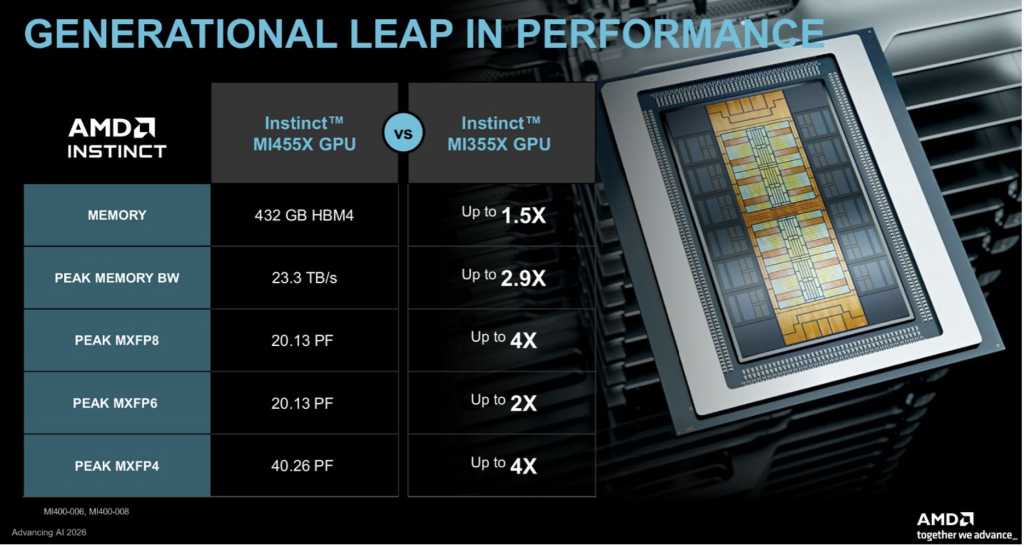
The Instinct MI455X GPU is the compute engine that fuels the Helios rack, and the first GPU based on AMD’s new CDNA 5 architecture. Built with a modular mix of 2nm and 3nm chiplets, it carries 432GB of HBM4 and 23.3TB/s of peak memory bandwidth.
Compared to AMD’s current MI355X, the MI455X offers 1.5 times the memory capacity, up to 2.9 times the peak memory bandwidth and up to four times the peak matrix performance with MXFP4 and MXFP8 data types, which are lower-precision numerical formats designed to accelerate AI processing while reducing memory demands. With MXFP6 (6-bit floating point), performance is rated at up to twice that of MI355X.
AMD also shared some actual, measured internal results using production silicon. The company claims MI455X delivers 3.8 times higher FP8 decode performance, 3.5 times more measured FP4 compute performance and between 2.5 and 3.5 times more networking bandwidth than MI355X, depending on the transfer path tested. Those figures provide more context than just numerical specifications, though they remain AMD-provided comparisons that will need independent validation.
AMD
The architectural choices behind the numbers are important. Reasoning models and long context windows require sizeable KV caches for maintaining AI attention states, while mixture-of-experts models frequently move large amounts of data across accelerators. MI455X should let more model data, activation states and cache remain local. New dedicated IP in hardware can transfer data while the GPU continues processing, and expanded cache and multicast capabilities are designed to reduce redundant data movement to further improve efficiency.
The aforementioned lower-precision formats can also raise throughput and reduce memory use, but model developers still have to determine where they can be applied without unacceptable accuracy loss.
AMD’s Helios rack takes aim at Vera Rubin
Dave Altavilla
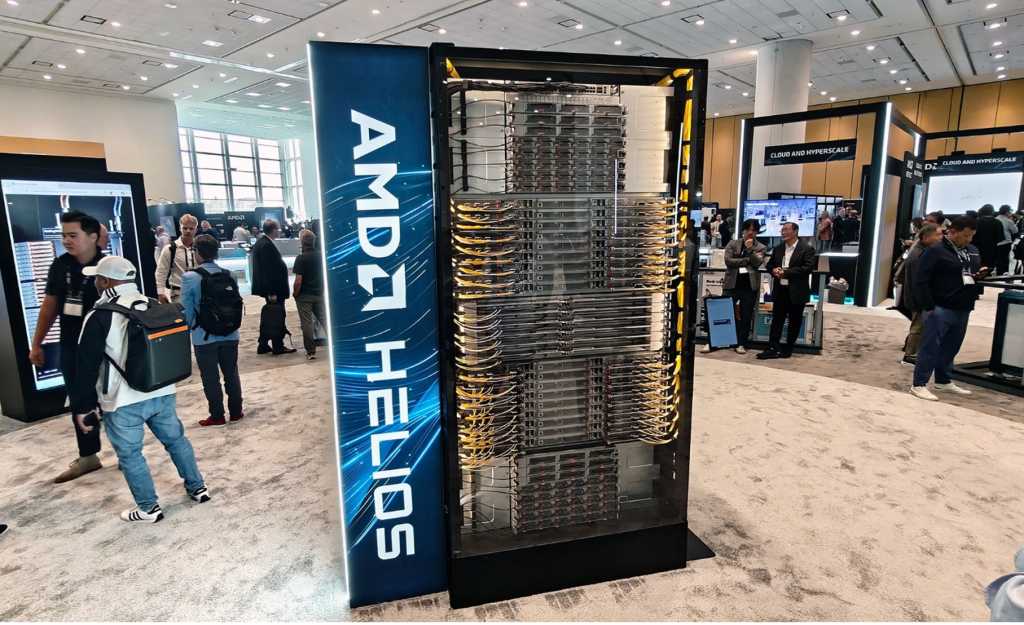
Helios is AMD’s primary rack-scale competitor to NVIDIA’s Vera Rubin platform. Each liquid-cooled rack combines 72 MI455X GPUs, 18 single-socket Venice host CPUs and Pensando networking technologies.
In its most complete, premium configuration, AMD rates Helios for 2.9 exaflops of low-precision AI compute, with 31TB of aggregate HBM4 capacity, 1.7PB/s of memory bandwidth, 260TB/s of bidirectional scale-up bandwidth and 43TB/s of scale-out bandwidth.
These are formidable figures, but they are technical specifications rather than actual application benchmarks. The more consequential development is AMD’s move from collections of eight-GPU servers to a 72-GPU shared-memory domain. Models too large for one node can operate across the rack without treating every exchange as a scale-out networking transaction, which benefits large-model inference as well as training.
AMD uses UALink over Ethernet, or UALoE, for an open standard scale-up fabric. Each MI455X provides 3.6TB/s of bidirectional scale-up bandwidth, while the complete rack delivers all-to-all connectivity through a single switch layer. AMD also claims six times more scale-out bandwidth per GPU than MI355X when MI455X is configured with three Pensando Vulcano 800 AI NICs.
While open standards give cloud providers more control over suppliers and system design, AMD and its partners now have to prove those components can deliver the predictable performance, reliability and deployment experience customers expect from a tightly controlled, more vertically integrated platform.
Finally, AMD designed Helios with automatic rerouting around failed links, virtual rack partitions, tray-level serviceability and rack-wide power, cooling and health monitoring. Major hyperscalers and potentially large-scale enterprise customers will likely key in on these capabilities, which can affect the availability, total cost and consistency of the AI services they consume.
Kind of like cowbell, AMD Venice gives agentic AI more CPU
AMD
AMD’s agentic CPU messaging regarding its upcoming Venice-based EPYC processors is mostly marketing speak, but the underlying requirement is very real. An AI agent can invoke retrieval, databases, security checks, code execution and other tools before a GPU generates a response. Running many agents concurrently increases the amount of conventional compute requirements surrounding the accelerators.
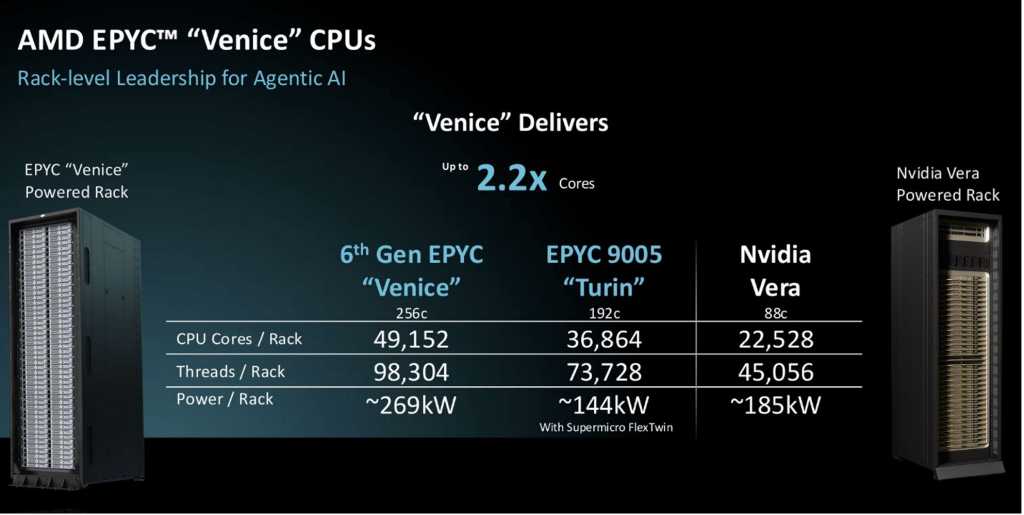
Venice scales to 256 Zen 6 cores with support for 512 threads, 16 memory channels, up to 1GB of L3 cache per socket, along with PCIe 6.0 and CXL 3.1 connectivity. AMD is also offering several Venice configurations for other applications, including general-purpose servers, high-frequency workloads, GPU hosts and high-density CPU sandbox systems used to execute agent tools.
Treating the CPU solely as a GPU host understates its role. Gateways, tokenization, vector search, databases and short-lived code execution stress different mixes of per-core performance, thread count, memory bandwidth and I/O. Specifically, AMD’s internal testing shows Venice significantly outperforming its current EPYC 9965 Turin CPU across five parts of the agentic AI pipeline, including gateway processing, context assembly, vector search, enterprise applications and short-lived tool execution. Individual gains vary by workload, but AMD details the overall generational improvement at up to a 1.7 times lift. As with the MI455X figures though, these comparisons come from AMD and will require independent validation.
Pensando networking and ROCm software advance
Keeping GPUs fed with data and coordinating traffic across racks directly affects utilization and operating costs. In fact, GPU utilization is a pretty sad state of affairs currently for some of the major frontier model providers.
As such, Pensando networking has become central to AMD’s roadmap. Helios can connect each MI455X to as many as three 800Gbps Vulcano AI NICs, while Salina DPUs handle front-end networking and infrastructure services.
On the software side, which is an equally critical component, AMD also introduced ROCm.AI, an AI-assisted development layer due to arrive in August. It includes reusable skills for coding agents, simplified management and Hyperloom, which can profile workloads, tune serving configurations, modify kernels and validate results.
These tools address two persistent AMD challenges: developer efficiency and ease of use, and software tuning. Automated optimization still has to produce repeatable gains without creating hard-to-maintain code, however. And while ROCm has progressed significantly over the last few years, NVIDIA’s CUDA retains an advantage in maturity, tooling and developer familiarity.
AMD now has commitments that give its MI450 generation and Helios considerably more weight. Meta and OpenAI have announced multi-generation agreements composed of up to 6GW of AMD compute capacity, with initial 1GW deployments planned for the second half of 2026.
Oracle plans a 50,000-GPU public cloud cluster beginning in the third quarter, while Microsoft will deploy Helios for Azure AI inference. Finally, just before the AMD event, Anthropic announced a strategic partnership for up to 2 Gigawatts of AMD-fueled AI compute, with its first gigawatt expected online in the first half of 2027.
Commitments of this scale reflect confidence in more than just MI455X performance. These customers are evaluating the complete architecture, including Venice CPUs, Pensando networking, ROCm software, rack integration, serviceability and AMD’s ability to deliver and execute across multiple product generations.
There is some financial alignment behind the agreements as well. AMD issued OpenAI performance-based warrants and committed to investing up to $5 billion in Anthropic. That context matters when evaluating these deals as market validation, but these planned deployments are substantial nonetheless and put Helios on a much stronger foundation as it begins shipping.
AMD expands its robotics and embedded foundation
AMD also expanded its physical AI portfolio, building on credible traction from its Xilinx-derived Kria adaptive system-on-modules and embedded technologies that are already powering robotics, machine vision and industrial automation applications.
The new Ryzen AI Embedded X100 combines up to 16 Zen 5 CPU cores, integrated Radeon graphics, a second-generation NPU and as much as 128GB of unified LPDDR5X memory shared across its compute engines. To me this looks a lot like a repackaging and optimization of the company’s Strix Halo platform, but with specific optimizations for the embedded space. Regardless, AMD is pairing X100 with the Kria AI Robotics Developer Platform, which includes a System Module or SOM, and a new Robotics Partner Network spanning hardware, software and platform providers.
Samples began shipping in June, with full production expected in the fourth quarter. This broader objective is to give developers a path across AMD x86 CPUs, GPUs, NPUs and FPGAs for real-time autonomous systems, rather than requiring them to assemble those hardware engines and software components independently.
Execution for AMD is now the test
AMD has assembled a credible platform for the burgeoning agentic AI market that’s blowing up currently with no signs of stopping. MI455X addresses memory and data movement, Venice handles dense agentic CPU workloads, Pensando networking connects global system resources, and ROCm.AI addresses software complexity. Finally, Helios assembles these components into a true competitive threat for NVIDIA’s latest Vera Rubin platform.
AMD’s open architecture may appeal to customers seeking supplier choice, but openness must also translate into reliable deployments, competitive total cost and software that does not require a significant rip-up. NVIDIA enters this cycle with a stronger ecosystem and far more rack-scale deployment experience. The true test will be how easily and reliably customers can integrate, operate and maintain these AMD solutions at scale.
As it stands, AMD now has major customers and a clearly defined architecture with systems engineering expertise behind it. Delivering Helios on schedule and showing that its performance claims translate into a real production workload throughput advantage and total cost of ownership gains will determine how much the competitive gap narrows. And of course, this is in a market that is clamoring for ever-more compute resources with a seemingly insatiable demand for AI services and capacity. That’s an environment for big iron success. Now AMD just has to deliver optimized, turnkey AI platforms. This is far easier said than done, but time will soon tell as deployments take shape this year.
This article is published as part of the Foundry Expert Contributor Network. Want to join?
Google CEO Sundar Pichai has sought to allay concerns over the delayed release of the Gemini 3.5 Pro large language model. He dodged questions about it in Google’s quarterly earnings call on Wednesday by focusing on the company’s next frontier AI model, Gemini 4, and plans to release subsequent LLMs at an almost monthly cadence.
His comments came a day after Google unveiled Gemini 3.6 Flash and 3.5 Flash Cyber but offered no update on the release of Gemini 3.5 Pro, the company’s delayed flagship reasoning model that many developers had expected to arrive weeks earlier.
Google introduced the Gemini 3.5 family at its annual I/O conference, promising to release the Pro model in June. That timeline has since slipped, with Bloomberg suggesting Gemini 3.5 Pro is months late because the model’s coding performance is falling short of internal expectations, especially when compared to better performance by similar models from OpenAI and Anthropic.
Instead of revisiting the Gemini 3.5 Pro timeline, Pichai used the earnings call to shift the discussion toward Gemini 4, when asked about how his company planned to navigate an increasingly competitive race to release frontier AI models by to Barclays Investment Bank analyst Ross Sandler.
“We are creating a baseline on top of which you will see us rapidly iterate on subsequent model releases. And so picking up pace and releasing models almost at a monthly cadence is part of our road map as we are building Gemini 4 as well,” Pichai said during the call.
Sandler’s question followed one from JPMorgan Chase & Co analyst Douglas Anmuth, who asked Pichai if Google was releasing frontier AI models frequently enough to keep pace with rivals OpenAI and Anthropic.
Pichai had responded to Anmuth’s question that Google remained confident of competing at the frontier and was investing heavily in a larger Gemini 4 base model.
Analysts, though, aren’t as confident as Pichai.
While delays to Google’s frontier model roadmap have not triggered an exodus of existing customers, either because of high switching costs or because many enterprises already running multi-model architectures, they have made CIOs evaluating AI platforms more cautious about making new commitments, said Bhupendra Chopra, chief revenue officer at IT consulting firm Kanerika.
A monthly model release cadence could prove to be a double-edged sword for enterprises and their CIOs.
While a monthly release cadence could help enterprises gain faster access to improvements in model performance, cost and capabilities, it will also require CIOs to invest more heavily in testing, governance and version management to safely adopt those updates, said Sanchit Vir Gogia, chief analyst at Greyhound Research.
Similarly, Pareekh Jain, principal analyst at Pareekh Consulting, said enterprises will embrace a faster release cadence only if each successive model delivers measurable improvements in performance, cost or safety, rather than simply changing version number.
The challenge for CIOs, Jain said, is not just keeping up with model releases; it’s deciding whether each new version is worth the cost of validating it.
It’s difficult to ignore the fact that Apple seems to have turned its MacBook Neo into a weapon to promote platform growth, with enough performance under the hood to make competitors seem inferior.
And even as the PC industry moves to try to compete with Apple’s last huge Mac success, the company is already planning a powerful follow-up.
That points to the discipline Apple has applied to the Mac since the introduction of Apple Silicon. The company has built a clear product roadmap, strong entry-level pricing, and steady performance gains. This focus is now paying dividends, giving people the impetus to keep placing their trust in Apple and its Macs — even as the industry raises prices in the face of RAMageddon and price increases.
The numbers don’t lie
“Apple’s recent price increase seems to be an inevitable response to these cost increases. In the second half of the year, other PC OEMs are expected to continue to raise prices, and the overall ASP increase is expected to continue,” Counterpoint said in a post Wednesday. The researcher tells us global PC shipments shrank 4% in the second quarter of 2026 as rising costs hit demand. The Mac maker, by contrast, moved in the opposite direction, generating 13% growth in the quarter — mainly on the back of the MacBook Neo introduction.
Recent IDC data gives Apple 10.1% year-over-year growth and just under 10% (9.9% to be exact) of the worldwide PC market, even as the overall market declined 4.9%.
“With emerging supply chain and tariff challenges inflating memory prices…, Apple’s incredibly aggressive price-point for the MacBook Neo makes its release feel all the more like a gut punch to one of the PC market’s most valuable price tiers,” Futurum Research Director Olivier Blanchard said when the Neo was released.
Neo 2.0 is already coming
In the immediate future, as competitors raise prices on the PCs that compete with Apple’s lower-cost device, Cupertino is already plotting the path toward MacBook Neo 2. Reports claim this will debut in March in new colors and use the A19 Pro chip from the iPhone 17 Pro, with performance boosted by slightly more unified memory (12GB, rather than 8GB). That’ll make it a much better Mac, likely with 10-15% performance gains and the ability to run Apple Intelligence, making it the best and most affordable AI PC in its class.
Just four months after the Neo’s rollout, Apple is already in position to leak rumors of an even more computationally capable follow-up, while competitors struggle to compete with the original on performance, build quality, and price. Still, the Neo might get more expensive, reporting warns, with the lowest-price 256GB model now gone, making the $599 Mac a mirage we can only wistfully hope to see again.
That might matter less in context, as PC makers everywhere boost prices while RAM, chips, and storage prices head north, along with transport, logistics, and energy costs. “While [Apple] did raise prices in line with the broader market, it still remains well positioned against rivals facing the same cost pressures,” said Jean Philippe Bouchard, vice president for consumer devices at IDC.
“As market conditions continue to worsen, the importance of supply chain management and capabilities are increasingly important,” Bouchard said. “The largest vendors, with their buying power and long-standing supplier ties, are best positioned to take share from smaller rivals.”
This was never about luck
This isn’t solely a market take about competition, it’s about planning.
Few in the industry seemed prepared for the massive memory price increases that hit this year. Apple clearly planned its low-cost Mac well before that happened, hoping to seize the PC market at the low-mid-range. This is precisely what it seems to have done, what it continues to do, and what it will continue to do.
The recent reports that it has a successor planned shows the breadth of the Mac company’s strategic vision, as Apple has quite clearly sought to fully exploit the failings of Windows and the internal contradictions of a value-conscious industry in stiff competition with itself.
With the first M-series Macs about to enter the replacement cycle, Apple has built a market it can capitalize on for at least a decade, meaning it already has a vision for PC sales that extends at least as far. That’s the kind of road map corporate purchasers want when they make platform deployment decisions, which is why Apple’s 10% share gains are the beginning of even more significant market change.
You can follow me on social media! Join me on BlueSky, LinkedIn, Mastodon and subscribe to my daily Apple-related news summaries at The Core.
OpenAI has launched Presence, an enterprise service for deploying voice and chat agents that can resolve customer and employee requests, potentially automating some work now handled by frontline support teams.
The agents can answer questions and operate IT systems, and enterprises can decide what actions the agents may take and when they should seek human approval for actions or transfer a case to a human.
OpenAI is already using Presence internally for its English-language phone support channel, where it verifies callers and uses account information to complete approved actions. The company said the system resolves 75% of inbound issues without human assistance.
Another OpenAI service, Codex, can be used to monitor agents and suggest updates or improvements to processes. In OpenAI’s own tests, suggestions from Codex helped reduce handoffs to humans by 15 percentage points over 10 days, it said. Presence also includes simulation and evaluation tools that allow companies to test an agent before deployment. The tests assess whether it reaches the correct outcome, follows company policy, and hands a case to an employee when required.
OpenAI intends each Presence deployment to deal with one kind of task, for example billing issues, insurance claims, or employee IT service requests, with agents getting only the knowledge and system access required for that task.
Presence is not a self-service product: Enterprises will have to sign up for the limited availability program, with integration performed by OpenAI or selected global systems integrators.
Companies exploring or testing Presence include Spanish bank BBVA, which is evaluating the service for everyday banking support in Mexico, and Japanese technology group SoftBank, which is using it in trials involving Japanese-language customer interactions. Australian insurer IAG is assessing whether the technology can help it respond to surges in customer demand during severe weather events.
Workforce impact
OpenAI’s announcement did not address the potential effect of Presence on employment. But its claimed automation rate raises questions about how the technology could affect staffing in customer service and other support functions.
Pareekh Jain, CEO of Pareekh Consulting, said CIOs should regard the 75% figure as evidence that the technology can work, rather than as a benchmark that every enterprise can expect to reach.
Jain said OpenAI’s deployment benefits from being built around the company’s own products and data. Large enterprises may achieve lower automation rates because they must contend with fragmented legacy systems, uneven knowledge bases and more complex compliance demands.
“Most organizations should expect lower initial automation levels that improve over time as the AI agent is refined,” Jain said.
“The roles most exposed are likely to be repetitive, high-volume functions such as frontline customer support and routine back-office processing,” Sheel said. “However, I would expect the first impact to be on hiring and team growth rather than immediate large-scale job cuts. Over time, enterprises may redesign roles around AI-assisted workflows, with humans focusing more on complex cases, escalation, and relationship management.”
Jain said Tier-1 support agents handling predictable queries would face the most exposure. Broader reductions would become more likely only after companies reorganize their operations around the technology.
However, Lian Jye Su, chief analyst at Omdia, said Presence is unlikely to increase the threat of job displacement because companies have used similar customer-support automation from vendors such as Genesys, NiCE, Five9 and AWS for years.
Enterprises are more likely to use Presence alongside employees, with AI handling routine requests while people remain responsible for work requiring judgment and empathy, Su said.
Cost and operational risks
Analysts said CIOs should examine whether Presence can maintain resolution quality as usage grows, since fewer human handoffs could leave employees dealing with a more difficult mix of cases.
“The key question is not simply how many tasks AI can handle, but whether it can handle them reliably at scale,” Sheel said.
The financial case will depend partly on the cost of connecting Presence to existing systems and maintaining the controls needed to govern its use, according to Jain. “Often the biggest cost of enterprise AI is not tokens but integration and governance,” Jain added.
Companies will need to determine what systems and data the agents can access, monitor their performance, and audit the actions they take. Those investments could offset early savings.
Su said the complexity of enterprise IT will make it difficult for OpenAI to automate entire workflows on its own. Enterprises will still need to work with other technology providers and human employees, while CIOs will favor systems that can be audited and integrated with existing infrastructure.
Jain said the economics could improve if companies use the same integrations and governance controls across additional workflows.
Healthy software companies typically don’t suddenly eliminate one-fifth of their workforce, but monday.com is doing just that as it bets on flatter teams, AI agents, and customer implementation expertise as the winning combination in the AI era.
Monday.com co-founder and co-CEO Eran Zinman today announced the “very difficult decision” to reduce the AI work platform company’s global workforce by about 20%, or 620 people.
The move has nothing to do with increasing margins or replacing humans with AI, he insisted in his post on LinkedIn; rather, it’s a calculated decision to trim down and hone the company’s focus as AI becomes integral to day-to-day workflows.
“This is not a distress signal; it is a deliberate reset, disclosed with its price attached,” said Sanchit Vir Gogia, chief analyst at Greyhound Research. “The industry has quietly swapped the meaning of productivity, and this filing is the clearest exhibit yet.”
A ‘significant opportunity’ in technology
In a SEC filing this week, monday.com said its restructuring plan reflects the “ongoing transformation of its product, marketing, and go-to-market strategy.” The move is intended to support a “leaner, more focused operating model” as the company continues to invest in its AI-driven strategy.
Zinman noted in his post that the company has shifted to “doing the work with AI and not just managing it,” and is focused on building environments where “people and AI agents [work] together in one workspace.”
In recent months, monday.com has evolved its products, strategy, and the way it serves its customers, and Zinman contended that “the organization we built for our previous chapter is not the organization that fits the new AI era.” Monday.com needs to “execute more decisively,” take on new challenges, and quickly respond to market changes, he said.
“We have never seen such a significant opportunity in software, driven by such exciting technology,” Zinman noted. He emphasized that the reduction is not to replace people with AI, nor to improve margins; the “vast majority” of savings will be reinvested into talent, products, and AI.
The restructuring will result in a “flatter organization” with fewer management layers and smaller, more autonomous teams, and monday.com also has a new go-to-market model, Zinman explained. Customers expect “deeper implementation support” as they deploy AI, and the company will work more closely with customers, increase its on-site presence, create new roles, and “adapt many existing ones.” In its SEC filing, the company said it expects to continue hiring in “key strategic areas” throughout 2026.
Workers will be expected to work better, “not harder,” Zinman noted. He pointed to several past examples where work could have been done in a few days, but instead took many months with “multiple meetings and endless friction.”
“This wasn’t people’s fault and everyone was frustrated by this,” he said. “Our new org changes ownership to allow people to make decisions and move fast.”
A spokesperson for monday.com declined to comment further on the staff reductions.
Monday.com’s key market advantages
Monday.com certainly isn’t struggling; the company expects 19% to 20% year-over-year growth in 2026.
“Companies in that position do not restructure because they must,” Greyhound’s Gogia noted. “They restructure because they have decided to become something else.”
Melody Brue, VP and principal analyst at Moor Insights & Strategy, pointed out that organizational redesign is important for real AI transformation, but while it can signal confidence to the market, it can still be “devastating” to humans.
While the company looks as though it’s trying to do right, that ultimately remains to be seen, she said. “There are often hidden internal bruises that can surface long after layoffs.”
Monday.com’s advantage is in its “structured substrate,” Gogia noted; its boards, permissions and typed workflows give agents something firmer to act on than just documents and chat history. The company highlights its natively built agents that can be configured by any team member, as well as connectors with Claude, Microsoft Copilot, and ChatGPT, and dedicated routes for external agents to authenticate and operate.
“For some time, the sharper enterprise question has been shifting from who has an agent to who owns the governed runtime in which an agent can safely act,” he said. “Structured work is a serious claim on that runtime.”
But parts of monday.com’s agent estate remain in staged release, and its product is ultimately “mid-transition,” Gogia pointed out; its agent builder carried a beta label as recently as March,. Also, the company’s pricing model changed in May to a hybrid model charging for seats as well as mandatory AI credits. And, while its AI-powered no-code builder monday vibe passed $1 million in annual recurring revenue within two and a half months, monday.com has not released subsequent outcomes, usage volumes, or attach rates.
Further, there’s an element of “gravity” with its competitors, he observed. Asana is reorganizing teams around agents, Atlassian is wiring agents into the developer estate, and others are simply bundling them into their offerings: Microsoft is doing so across the productivity stack, and ServiceNow across enterprise operations, each with identity and procurement built in.
“Their pull is strongest exactly where monday.com wants to grow, in the largest accounts, where control-plane depth and administrative reach decide the deal,” said Gogia.
Actions for the near-term
Going forward, buyers should focus on operating risk, not headline risk, Moor’s Brue noted. In practice, that’s continuity of service, roadmap consistency, and strength of enterprise support. Productivity should be valued as better outcomes per unit of organizational effort, not mere activity.
“It should be a measure of how much smoother, faster, and more effective the operating model becomes when AI is built into the work,” said Brue.
Gogia noted that strain surfaces first in customer service, and monday.com’s attention is being redistributed. The company’s annual report disclosed that its focus is now concentrated on the largest accounts, with support for medium-sized clients moved to an AI-first and human-supported model.
During the first month of the transition, buyers should track named account continuity and escalation times, he advised. By the first quarter, keep an eye on whether credit governance and admin controls mature on schedule, and if the roadmap beyond the AI estate keeps pace. By the half-year mark, determine whether promised implementation depth is producing outcomes or “simply more billable engagement.”
Support tiers should be enumerated in writing before renewal, and buyers should contract for “side exits,” Gogia emphasized, with overage pricing fixed in advance, the right to pause consumption, and portability for workflows and agent configuration “if the relationship sours.” Finance should also insist on monthly consumption reporting by capability. Further, integration efforts, partner dependency, and change management should be considered first-class costs of the agent era, “not as afterthoughts to a license.”
“A license was a known cost,” said Gogia. “A meter is a behavior, and behavior is harder to forecast than headcount.”
Just in time for the iPhone’s 20th anniversary, Apple is moving closer to becoming a service company. It is set to launch its new deal with Klarna next week and when it does, Apple enthusiasts in the US will effectively be able to subscribe to their favorite Apple hardware, with the cost spread across up to three years.
This matters because when combined with Apple One and Apple’s Creator Studio subscriptions, the Klarna arrangement brings Apple closer to offering a full subscription model for hardware, software, and services. The only thing you don’t get under the new arrangement is AppleCare, for which you’ll allegedly need to pay extra.
Moving closer to hardware-as-a-service
Apple has slowly been transitioning toward hardware-as-a-service for almost a decade. Back then, Forrester analyst Frank Gillet predicted the company would eventually offer bundles of services and products for a monthly, all-in, fee.
This isn’t quite where we are yet; you still need at least three subscriptions to get close. But, after the better part of a decade, Apple has moved much nearer to the hardware-as-a-service idea.
There are some products reportedly excluded from the arrangement, including MacBook Neo, Apple Watch SE, the entry-level iPad, and iPhone 16. Clearly, Apple sees those products as sufficiently affordable.
Easy payments for RAM-ageddon
The new Klarna arrangement comes as Apple is forced to increase product prices as AI-driven memory price inflation becomes widely felt across every economy. In theory, I assume, Apple hopes to make its products available to cash-strapped consumers who need new hardware, while also navigating a time of deep economic tumult and uncertainty. It’s thought the company has previously rejected these plans to protect normal hardware sales, but normality is a kingdom we no longer seem to possess. Interesting times. Probable inflation incoming.
“Apple Upgrade lands at precisely the moment Apple needs it,” IDC analyst Francisco Jeronimo wrote in a note seen by Computerworld. “Having just pushed Mac and iPad prices up on the back of the memory shortage, with iPhone increases widely expected in September — as well as the new iPhone foldable expected at $2,500 — Apple’s real risk is that rising prices even further can impact the upgrade cycle.”
New age, new shopping habits
The introduction of the scheme gives consumers a way to purchase the company’s popular high-end devices when they are introduced — no doubt,at higher cost — this fall. Plus, of course, if it’s good enough for GM, it’s good enough for Apple.
Reluctance to embrace “Access Not Ownership’”purchasing models has dropped dramatically since Apple — and CEO Tim Cook — first began banging the drum for services income. Apple’s services stream has now become its second-biggest revenue driver after the iPhone. It has over 1 billion paid subscriptions, and an active hardware installed base of more than 2.5 billion devices globally.
A combination of changed customer habits and external threat means the stars are now aligned for hardware-as-a-service models. “Reframing a device as a low monthly payment protects that [upgrade] cadence and allows Apple to start marketing their products as device-as-a-service to consumers, which no other vendor was ever able to do,” Jeronimo wrote to me.
There is a one-more-thing aspect to this: the products are effectively being leased, a new approach that will give Apple a stronger grip on EOL devices, helping it grab more of them for refurbishment, resale, and recycling. Over time, this will give the company a much stronger grip on the lucrative second-user market that exists around Apple equipment, even while for almost every consumer product we find the life we want is something we can rent, but probably can’t afford to own.
Managing future risk
The other solid reason to take a partnership approach is risk management. Apple had intended to develop its own buy-now, pay-later scheme via Apple Pay Later, but abandoned that plan as it became riskier with rising bank rates. “Also, by backing the program with Klarna rather than reviving the in-house subscription plan it shelved in 2024, Apple captures the demand upside without taking the credit risk onto its own balance sheet,” Jeronimo said.