
Month: June 2025

Disney and Universal vs. Midjourney: A landmark copyright fight over genAI

In a move that could redefine the boundaries between generative AI (genAI) and intellectual property, Disney and Universal have joined forces to file a lawsuit against Midjourney, one of the world’s most popular AI image generators. 

You may think you’ve heard this story before — The New York Times‘ 2023 lawsuit against OpenAI and Microsoft and News Corp. vs. Perplexity — but this case is different. For one thing, this is the first time major Hollywood studios with far more cash to prosecute the case have directly targeted a genAI company for copyright infringement. For another, Disney and Universal are both big AI users.

Disney and Universal allege that Midjourney’s platform is a “bottomless pit of plagiarism.” With Midjourney, all a subscriber need do to create unauthorized images of iconic characters such as Darth Vader, Elsa, the Minions, Shrek, and many others is to type in a prompt.

Stills from Iron Man with genAI copies

Original ‘Iron Man’ image is on the left; genAI-created image is on the right. 

Disney/Universal lawsuit

Images of Thanos

Original image is on the left; genAI image is on the right. 

Disney/Univeral lawsuit

There’s no question anyone can do it. If you don’t feel like trying it yourself, just look at some of the images in the Disney/Universal lawsuit complaint (shown above).

Can you tell which ones are the original from Avengers: Infinity War and which were generated by Midjourney? I can’t, and I have a good eye for this kind of thing. GenAI image creation has come a long way since all you had to do was count the number of fingers. (The originals are on the left.)

This didn’t require some kind of fancy prompt. As researchers have found, all you had to do to generate them was name the character and use the keyword “screencap,” and you quickly received your fake image. Or you could simply ask for “master super villain” or “armored superhero.” 

“This is not a ‘close call’ under well-settled copyright law,” the lawsuit claims. 

Correct. It’s not close at all.

In the company’s defense — if you can call it that — Midjourney CEO David Holz is on record as saying his AI has been trained on  “just a big scrape of the Internet.” What about copyrights on these images? 

“There isn’t really a way to get a hundred million images and know where they’re coming from. It would be cool if images had metadata embedded in them about the copyright owner or something. But that’s not a thing; there’s not a registry. There’s no way to find a picture on the Internet, and then automatically trace it to an owner and then have any way of doing anything to authenticate it.”

I think when it comes to Disney, it’s pretty darn obvious who owns the images. I mean, this is Disney, the big bad wolf of copyright. After Walt Disney lost the copyright to his earlier character, Oswald the Lucky Rabbit, he made darn sure that, starting with Mickey Mouse in 1928, he’d lock down its intellectual property for as close to forever as he could.

Indeed, over the decades, Disney has been behind laws to increase copyright coverage from a maximum of 56 years in 1928 to 75 years with the Copyright Act of 1976, and then 95 years with the Sonny Bono Copyright Term Extension Act (CTEA) of 1998, better known as the “Mickey Mouse Protection Act.” 

Disney has also never been shy about suing anyone who’d dare come close to their copyrighted images.  For example, in 1989, Disney threatened legal action against three daycare centers in Hallandale, FL., for painting murals of Disney characters such as Mickey Mouse, Donald Duck, and Goofy on their walls. 

Why? Because it’s all about the Benjamins. 

Disney, and to a lesser extent Universal, live and die from monetizing their intellectual property (IP). Mind you, much of that IP is generated from the public domain. As the Center for the Study of the Public Domain noted: “The public domain is Disney’s bread and butter. Frozen was inspired by Hans Christian Andersen’s The Snow Queen. … Alice in Wonderland, Snow White, The Hunchback of Notre Dame, Sleeping Beauty, Cinderella, The Little Mermaid, and Pinocchio came from stories by Lewis Carroll, The Brothers Grimm, Victor Hugo, Charles Perrault, Hans Christian Anderson, and Carlo Collodi.”

What Disney did with the public domain, MidJourney, and the rest of the AI companies want to do with pretty much everything on the Internet. OpenAI CEO Sam Altman, for instance,  has consistently argued that training genAI on copyrighted data should be considered “fair use.” He’s not alone.

On the other side of the fence, Disney and Universal’s lawsuit is not just about damages, which the pair puts at $150,000 per infringed work, but about setting a precedent. They want to stop Midjourney’s image and soon-to-be-launched video generation services in their tracks.

At the same time, the film studios freely admit they’re already using genAI themselves. Disney CEO Bob Iger has said the technology is already making Disney’s operations more efficient and enhancing creativity. “AI might indeed be the most potent technology our company has ever encountered, particularly in its capacity to enhance and allow consumers to access, experience, and appreciate our entertainment.” He also, of course, stressed that, “Given the speed that it is developing, we’re taking precautions to make sure of three things: One, that our IP is being protected. That’s incredibly important.”

This lawsuit is more than a Hollywood squabble; it’s a watershed moment in the ongoing debate over genAI, copyright, and the future of creative work. Previous cases have challenged the boundaries of fair use and data scraping, but none have involved the entertainment industry’s biggest players.

It might seem like a slam dunk for the Hollywood powerhouses. The images speak for themselves. But, if there’s one thing I’ve learned in covering IP cases, it’s that you never know what a court will decide.

Besides, there’s a real wild card. Donald Trump’s AI Action Plan is still a work in progress. The AI companies are arguing that it should give them permission to use pretty much anything as grist for their large language models (LLMs), while the media companies want all the copyright protection they can get. 

Which way will Trump’s officials jump? We don’t know. But I have a bad feeling about where they’ll go.

You see, what we do know is that after the Copyright Office released a pre-publication version of its 108-page copyright and AI report, which strived to strike a middle ground  “by supporting both of these world-class industries that contribute so much to our economic and cultural advancement.” However, it added that while some generative AI probably constitutes a “transformative” use, the mass scraping of all data did not qualify as fair use.

The result? The Trump administration, while not commenting on the report, fired Shira Perlmutter, the head of the Copyright Office, the next day. She’s been replaced by an attorney with no IP experience. 

Oh, also, hidden away in Trump’s “One Big Beautiful Bill” is a statement that imposes a 10-year ban on the enforcement of any state or local laws or regulations that “limit, restrict, or otherwise regulate” AI  models, AI systems, or automated decision systems. If that becomes law, whatever is in Trump’s AI Action Plan is what we’ll have to live with for the next few years.

As an author, I can’t tell you how unhappy that prospect makes me. I expect Trump to side with the AI companies, which means I can look forward to competing with my own repurposed work from here on out. 

Further reading:

>
Microsoft announces Windows 365 Reserve: Backup cloud PCs for the enterprise

Microsoft (Nasdaq:MSFT) has announced the preview of a new service, Windows 365 Reserve, which aims to provide enterprises with backups for PCs that are lost, stolen, or simply fail.

It offers a temporary pre-configured Cloud PC, accessible through a browser, that, Microsoft said, “looks and feels like a physical PC, and is accessible from any device, anywhere.”

The Reserve Cloud PC is managed through Microsoft Intune, and includes corporate applications, settings, and security policies, as well as Microsoft 365 apps (assuming the organization subscribes to M365) and OneDrive data sync.

The free preview will begin “soon”, the announcement said, and will run for up to 12 weeks.

There are restrictions, however. Preview participants must have a Windows E3 license, an Intune license, and Microsoft Entra ID P1 (formerly Azure Active Directory Premium Plan 1, or AADP1). Sovereign cloud customers are not supported, and participants must perform a few chores, including completing what the sign-up form calls “a set of admin and end user validation scenarios,” and then provide feedback on the experience.

Andrew Sharp, research director at Info-Tech Research Group, is impressed with the concept.

“In preview, the service claims it will allow an administrator to pre-stage a cloud PC, already loaded with the company’s policies, apps and security controls, so it can be handed to a stranded user in minutes,” he said. “Imagine your laptop dies at a client site. Helpdesk fires off a link, you open it in a browser or the Windows app, and you’re back at a familiar, compliant desktop before your coffee gets cold. At least that’s what they’re promising.” 

He likes the idea that Intune manages the virtual devices, so there’s no new control plane to learn, and he also sees potential for other use cases besides providing backups for PCs.

“Reserve could also be a low-friction way to dabble with virtual desktops with minimal commitment,” he noted. However, he does have reservations. “Microsoft’s value proposition is clear: quicker, safer recovery for lost, stolen, or broken devices,” he said. “At the end of the day, IT will still need an operational playbook. How does a user reach support when the primary device fails? Is a physical replacement shipped, or is Reserve the stopgap? Which applications and policies belong in the Reserve image? IT teams will need to sort out those workflows to make Windows 365 Reserve a practical resilience tool and not just another SKU.”

More Microsoft news and insights:

>

>

Meta’s $14.3B stake triggers Scale AI customer exodus, could be a windfall for rivals like Mercor

Scale AI has been attempting to quell fears about its company sovereignty and data security after its ‘acqui-hiring’ by Meta, but customers appear to be defecting anyhow, and competitors are being rewarded with a slice of the limelight.

Meta is investing $14.3 billion in the data labeling and model evaluation startup, which gives the social media giant a 49% stake in the company, and is bringing Scale’s founder and former CEO Alexandr Wang onboard to work on AI “superintelligence.”

Within days of the news of the deal, OpenAI said it would be phasing out its work with Scale, although not explicitly because of the Meta deal. For the last several months, the AI leader has been backing away from the relationship and opting for competitors like Mercor, reportedly because Scale doesn’t have the expertise it needs for its increasingly advanced models.

Others are also purportedly hitting the brakes on their relations with Scale, including xAI and Google, the latter over concerns that Meta could access information about its AI developments.

Scale’s interim CEO Jason Droege has pushed back, emphasizing in a blog post that the company will remain “unequivocally an independent company” and will not provide Meta with access to its internal systems.

Despite this assurance, an analyst understands industry concerns.

“Meta’s move signals a trend toward vertical integration and supplier lock: Owning the data annotation pipeline to secure control over the quality, provenance, and scalability of training data,” said Thomas Randall, AI lead at Info-Tech Research Group. “Moreover, OpenAI’s pullback shows how quickly partnerships in this space can shift based on alignment, data strategy, or concerns about competition.”

Rivals in the data labeling game

Data labeling is a critical step in AI development, as it involves tagging raw data to provide context for models so they can continue to learn and iterate.

The Meta-Scale deal underscores the importance of the capability, and, perhaps counterintuitively, has drawn much more attention to rival, potentially superior data labeling companies. This includes five-year-old startup Surge, which reportedly had more than $1 billion in revenues last year. Others in the growing space include Turing, Snorkel, Invisible, Toloka, CloudFactory, and Label Your Data.

However, Droege asserted that Scale is “one of the only providers capable of serving customers at volume” with the “largest network of experts training AI.” Going forward, the company will focus on building out its applications business units and will continue to be model-agnostic and human-driven, he said.

“The spike in competition from players like Surge, Turing, and Invisible gives enterprises more leverage, but also more responsibility,” said Info-Tech’s Randall. These vendors differ significantly when it comes to workforce models, automation levels, and quality controls, he noted. Enterprise leaders should evaluate providers not just on price or throughput, he advised, but on whether they offer robust annotation auditability, support for domain-specific edge cases, and alignment with ethical AI practices.

“The quality of labeled data is a leading indicator of model performance and a lagging indicator of strategic oversight,” said Randall. “The enterprises that succeed in AI won’t just be the ones with the best models, but the ones with the most intentional, resilient data ecosystems.”

Not just about selecting a labeling company

But the ultimate conversation around data labeling is a little more nuanced and complex, analysts note.

Hyoun Park, CEO and chief analyst with Amalgam Insights, pointed out that Scale has built its reputation on text and image labeling, and its ability to identify global talent. This is a “powerful fit” for Meta, as Facebook, Instagram, and its other applications and services have massive amounts of data that can be further tagged and indexed to support large language models (LLMs) and AI, based on Meta’s ownership of accounts and digital assets.

“Scale works well with social networks and other media-based websites with self-refreshing and original media creation that can be labeled and used to train models on an ongoing basis,” he noted.

For OpenAI, Google, Anthropic, and other LLM providers selling directly to businesses and large organizations, however, the competitive landscape is quickly shifting. It is no longer enough to simply take in and process general data; providers must be able to automate code and conduct higher-level tasks, said Park. When digging deeper into programming, healthcare, legal services, and other specialized fields, they need subject-matter expert data.

Enterprises must be able to contextualize their own internal data and jargon, and have the ability to trust their AI enough to allow it to take action, he said. This means that the AI needs to be trained well enough to understand the common sense ramifications of the requests it receives, and the data that it accesses.

“This training and contextualization ultimately requires specific expertise that is often coming from veteran employees and highly trained professionals, not just from outsourcing firms that can provide scale-up capabilities for specific areas of AI training,” said Park.

Randall agreed that enterprise leaders must treat their data labeling decisions as part of a broader AI governance and operational strategy, not just a technical outsourcing choice. He said his firm’s research on vendor management indicates that organizations should treat labeling vendors as they would treat cloud providers.

That is: “diversify, insist on explicit contractual firewalls around staff mobility and data reuse, and build contingency plans so an acquisition doesn’t strand your model pipeline or expose proprietary data,” he said.

More Scale AI news:

After AI setbacks, Meta turns to Scale AI and ‘superintelligence’ research

OpenAI walks away from Scale AI — triggering industry-wide rethink of data partnerships

OpenAI has ended its long-standing partnership with Scale AI, the company that powered some of the most complex data-labeling tasks behind frontier models such as GPT-4.

The split, confirmed by an OpenAI spokesperson to Bloomberg, comes on the heels of Meta’s $14.3 billion investment for a 49% stake in Scale, a move that industry analysts warn could redraw battle lines in the AI arms race.

It also secured Scale founder Alexandr Wang to lead Meta’s AI division, accelerating what Deepika Giri, AVP for BDA & AI Research, IDC Asia/Pacific described as a profound challenge to data neutrality in foundational AI layers. “The world is shifting toward vendor-neutral ecosystems,” Giri cautioned, where data security and open platforms are paramount. But with hyperscalers now commanding the core pipelines, that neutrality faces unprecedented pressure.

The high stakes of AI data and talent wars

Meta’s $29 billion valuation of Scale highlights its two-front war for both data infrastructure and elite talent. While the investment aims to shore up Llama 4’s competitiveness, the social giant is also offering unprecedented “seven-to-nine-figure” packages to lure top employees, including OpenAI staff reportedly targeted with $100 million offers, as CEO Sam Altman disclosed on the Uncapped podcast. Yet not all are swayed. A Menlo Ventures VC posted on X that many still choose OpenAI or Anthropic.

The fallout from OpenAI’s exit and Meta’s investment is poised to disrupt the data-labeling industry, projected to reach $29.2 billion by 2032. Jason Droege, Interim CEO, Scale, in a blog post, maintained that its data governance remains independent, stating, “nothing has changed about our commitment to protecting customer data.”

Those reassurances may already be falling short. OpenAI, Bloomberg reported, had already been quietly scaling back its use of Scale’s services for months, citing a need for more specialized data.

OpenAI’s exit redraws the AI data landscape

Scale, which began as a data-labeling pioneer built on a global contractor base in countries like India and Venezuela, reported $870 million in revenue for 2024. But with major clients like Google, which spent $150 million last year, its future is uncertain.

The CEO of Handshake, a Scale competitor, told Time that demand for his company’s services “tripled overnight” in the wake of the Meta deal. The exodus reflects a fear among Meta’s rivals that proprietary data and research roadmaps could leak to a competitor through Scale’s services.

This realignment also exposed blind spots in enterprise AI contracts. Most lack robust “change-of-control” clauses or vendor conflict safeguards, leaving companies exposed when partners align with rivals. As Ipsita Chakrabarty, an analyst at QKS Group, noted, many contracts still rely on static accuracy metrics that crumble against real-world data drift. The result, she warned, is that companies may end up “outsourcing intelligence but retaining liability for failures.”

Yet Scale’s value remains in its elite trainer network (historians, scientists, PhDs) handling specialized tasks costing reportedly “tens to hundreds of dollars” per unit. While Meta’s non-voting stake avoided automatic antitrust review, regulators may still investigate the blurred line between influence and control. For now, the full implications will take months to unfold, as regulatory reviews, vendor transitions, and internal audits continue to reshape the AI data supply chain.

The new realities of AI development

As companies such as Google rush to build in-house data labeling capabilities, the industry faces a choice to repeat the mistakes of the cloud consolidation era of 2010-2015 or take a more open route.

“The AI race is causing vendor fragmentation in the short term, but I expect consolidation in the long term,” said Anushree Verma, senior director analyst at Gartner. “Vendors will struggle to scale their implementations if they continue with a fragmented approach. As a result, the need for interoperable ecosystems—supported by hybrid cloud collaboration and integration—will drive consolidation in this space.”

This resonates with IDC’s suggestion for “vendor-neutral ecosystems where data security, regulatory compliance, and open platforms take center stage,” a philosophy now clashing with the industry’s walled-garden reality.

For CIOs, this moment demands more than procurement checklists. Successful AI adoption requires baking in “change management, decision traceability, and human-AI interaction design” from day one, QKS’ Chakrabarty.

The challenge now goes beyond compliance. It requires stress-testing AI ecosystems with the same urgency as applied to cloud and chip vulnerabilities. “The best approach,” according to IDC’s Giri, “is to evaluate capabilities independently and avoid deep integration across the stack, because a monolithic system may lack the flexibility to keep up with tomorrow’s needs.”

More OpenAI news:

>

Microsoft to cut thousands more jobs, mainly in sales

Microsoft is set to cut thousands of jobs, mainly in sales, amid growing fears that AI advances are accelerating the replacement of human roles across the industry, Bloomberg reports.

The cuts follow a previous round in May, which saw approximately 6,000 roles eliminated.

Microsoft has been ramping up its AI investments to strengthen its position as enterprises across industries rush to integrate the technology into their operations.

Earlier this year, the company announced plans to spend around $80 billion in fiscal 2025, largely on building data centers to support AI training and cloud-based applications.

Adding to industry unease, Amazon CEO Andy Jassy said this week that generative AI and AI agents are expected to shrink the company’s corporate workforce over time.

AI or other factors?

AI is being used as an excuse for layoffs this year, but there may be more to it than what meets the eye.  

“One, we are still rebalancing employee counts from the over-hiring of the past decade,” said Hyoun Park, CEO and chief analyst of Amalgam Insights. “Tech companies were hiring with the assumption that they would grow at ridiculous rates that have not come to pass. Also, some tech companies think they can simply get rid of salespeople, especially in cash-cow industries where renewals seem to come in with little to no effort. Whether that is actually true or not, we are about to find out.”

The job cuts may also signal concerns about the near-term revenue potential of AI, Park said. While Microsoft is under pressure to invest heavily in AI to sustain its stock valuation, it may be turning to short-term operating expense reductions to support its financial performance.

“The planned $80 billion investment in AI infrastructure is especially interesting because those numbers assume a massive number of people will adopt Microsoft-related AI products,” Park said. “Are 50 million+ people willing to pay an additional amount on Microsoft products to support AI? That is a massive bet that has been completely unjustified by the current AI market today.”

Others point out that the company is betting on a long-term inflection in enterprise workload patterns driven by GenAI, but current adoption patterns remain volatile.

“Reports of Microsoft pausing or renegotiating data center leases reflect a prudent but necessary response to these uncertainties,” said Sanchit Vir Gogia, chief analyst and CEO at Greyhound Research. “If workloads fail to scale or regulatory barriers increase, Microsoft, and by extension, other hyperscalers, could face underutilized infrastructure, prompting pricing recalibrations or service tier stratification.”

Changing sales environment

The focus on sales roles in the planned cuts is notable, with analysts saying it reflects a broader shift in how enterprise sales functions are evolving.

“The rise of AI copilots, telemetry-rich self-service portals, and data-driven journey mapping is reducing the need for large in-region sales teams,” Gogia said. “Microsoft’s realignment is part of a broader pattern also visible in Amazon, Google, and Salesforce.” However, while AI can personalize interactions at scale, it lacks the relational depth required in strategic deal-making, compliance negotiation, and multi-stakeholder orchestration, Gogia added.

More Microsoft news and insights:

>

>

How to fix a Windows black screen

The “black screen” phenomenon in Windows 10 and Windows 11 shows poignantly how nothing sometimes matters quite a lot. Seeing nothing except a black screen where the desktop and its applications normally appear is disconcerting for users, because they literally can’t see what the PC is — or isn’t — doing.

When experienced Windows users encounter a black screen, they know at least two things immediately. First, they know that something is wrong with their PC. And second, because nothing (or nothing much) is visible, they can surmise that the graphics subsystem is likely involved, based on the absence of information on display.

That’s a good start, but what users really want is to get their desktop back. In this story I’ll guide you through the different types of black screen in Windows 10 and 11, and the surest methods I’ve found to fix them.

[ Dealing with a Windows blue screen instead of a black screen? See “What to do when Windows won’t boot.” ]

Two kinds of black screen, one subtle difference

Windows cognoscenti recognize two different types of black screen for both Windows 10 and 11. The first is a black screen, plain and simple. This means the screen is completely dark with nothing at all showing. Zip, zero, nada.

If you see a completely black screen, it’s worth checking to see if the PC is actually powered on. Sometimes when Windows shuts down, it kills the power, too — in which case the fix could be as simple as powering and booting up the device. (Or not.)

The second type is what’s called a “black screen with cursor.” Just as it sounds, this means that the display is completely black, except that the mouse cursor is shown on that black background. Often, the cursor will track mouse movement even though it’s mousing over a completely black screen. The image at the top of the story shows this second kind of black screen.

In my personal experience, the black screen with cursor occurs far more frequently than a black screen by itself (no cursor). I’ve found that two causes are the most likely culprits when a black screen with cursor appears.

First is a failure of the graphics subsystem to interact with the display upon waking from sleep. Second is symptomatic of a problem with the graphics driver, the special software that interacts with the display on behalf of the graphics subsystem inside the OS to render pixels on the screen, itself.

The presence of a cursor that responds to mouse movement — as it often will — is actually a good sign. It indicates that the OS is still working (at least to some extent) behind the scenes. It also shows that the mouse driver can still track cursor position onscreen. This means that there’s a very good chance that the desktop can be restored to normal operation using a few well-known key combinations.

Two keyboard combos can (often) restore normal operations

Even if there’s no cursor present, it’s worth trying these key combinations as a first and second step. Both combos involve pressing multiple keys simultaneously. This usually means using one finger to depress the first key and holding it down, using a second finger to depress the second key and doing likewise, then more of the same for a third key, and so on.

Combo 1: Restart the graphics driver

This four-key combination tells Windows to stop, then restart any and all graphics drivers that happen to be running. Most Windows systems use only a single graphics driver, but those with multiple graphics cards (or perhaps a graphics card plus the CPU’s graphic chipset) and multiple displays may have multiple drivers running.

This keyboard combo reads: Windows key + Ctrl + Shift + B. I usually do the first three keys with my left hand, then press the B key with my right forefinger while the others remain depressed.

If you see immediate disk activity (from a disk activity indicator), that’s a good sign. Sometimes the screen will return to normal operation a few seconds later, showing that the driver has reloaded and is now running successfully. Sometimes, nothing else will happen after the disk activity light ceases flashing. That signals it’s time to try the second combo.

Combo 2: The three-fingered salute

This is a familiar key combo to longtime Windows (and even DOS) users. It reads: Ctrl + Alt + Delete.

It’s notorious to those who’ve been using Microsoft OSes for a long time (since the mid-’90s or earlier), because it used to forcibly reboot the OS when struck. Starting with Windows 95 (and Windows NT version 3.5), this key combination now invokes the secure sign-in screen shown in Figure 1 below.

srcset="https://b2b-contenthub.com/wp-content/uploads/2025/06/windows-black-screen-01-ctrl-alt-del.png?quality=50&strip=all 566w, https://b2b-contenthub.com/wp-content/uploads/2025/06/windows-black-screen-01-ctrl-alt-del.png?resize=300%2C292&quality=50&strip=all 300w, https://b2b-contenthub.com/wp-content/uploads/2025/06/windows-black-screen-01-ctrl-alt-del.png?resize=173%2C168&quality=50&strip=all 173w, https://b2b-contenthub.com/wp-content/uploads/2025/06/windows-black-screen-01-ctrl-alt-del.png?resize=86%2C84&quality=50&strip=all 86w, https://b2b-contenthub.com/wp-content/uploads/2025/06/windows-black-screen-01-ctrl-alt-del.png?resize=494%2C480&quality=50&strip=all 494w, https://b2b-contenthub.com/wp-content/uploads/2025/06/windows-black-screen-01-ctrl-alt-del.png?resize=370%2C360&quality=50&strip=all 370w, https://b2b-contenthub.com/wp-content/uploads/2025/06/windows-black-screen-01-ctrl-alt-del.png?resize=257%2C250&quality=50&strip=all 257w" width="566" height="550" sizes="(max-width: 566px) 100vw, 566px">

Figure 1: Ctrl-Alt-Del invokes the Windows secure sign-in screen on both Windows 10 and 11.

Ed Tittel / Foundry

Even when the preceding combo gets the graphics driver going, it sometimes still won’t light up the screen. And sometimes when that’s the case, this key sequence will repaint the screen to show you the secure log-in options.

What this screen capture doesn’t show is the power buttons at the lower right, with networking, ease of access, and power controls (shut down, restart, and so forth) from left to right. If this screen does appear, click Cancel, and your desktop may reappear in working order.

What if the screen stays black?

If the cursor is absent, these key combos often won’t help — and sometimes they don’t help even when the cursor is present. In such cases, there’s really only one thing to do next: forcibly power off the affected PC. For most devices, this means holding down the power button until the PC shuts down. On desktop PCs with a discrete power supply (aka PSU), you may have to power that PSU off, wait 30 seconds, then power it back on to get the same effect.

A minority of devices may have the power button action redefined so that the PC keeps running despite this action. In that case, it may be necessary to disconnect the PC from its power source. For laptops, this may also mean waiting until the battery runs completely down (or disconnecting the battery, on PCs that permit this).

For most PCs, a subsequent restart will return the device to normal operation — including a working graphics subsystem with no black screen. If the screen remains black despite all these efforts, additional troubleshooting is needed.

I will now briefly describe additional troubleshooting techniques that may or may not lead to a working system. The further you must go down this list of options, the more likely it is that a hardware failure of some kind is involved.

For desktops, this may mean you need to replace an external graphics card (or the CPU or motherboard if a built-in CPU graphics chipset is in use). For laptops, it may mean replacing the motherboard or making a trip to a repair depot, assuming that the problem device is still covered under some kind of service or repair contract.

The troubleshooting sequence for persistent black screens

1. Try a different display. Perhaps the graphics circuitry is indeed working. (This is possible if the disk activity light runs for a while after restart, but the screen remains black.) Plugging in an alternate display may work, in which case troubleshooting has just identified the display rather than the GPU or graphics chipset, and associated drivers, as the culprit.

2. Boot into Safe Mode for various checks. This requires access to bootable Windows 10 or 11 recovery media. (I describe how to build such media near the end of another Computerworld story: “How to repair Windows 10 or 11 in 4 steps.”) If the PC will boot to recovery media and the display works, congratulations! You’ve just established that something is wrong with the normal boot image for Windows on the affected PC.

You can try a boot repair utility (I like the “Fix Windows Boot Problems” tool on Macrium Reflect Free’s Rescue Media) or get some repair ideas from the afore-cited “How to repair…” article. If the PC retains its black screen, it’s pretty conclusive that something is wrong with the GPU or built-in graphics circuitry. Proceed to Step 3.

3. Try different graphics circuitry. Though this troubleshooting technique can also serve as a repair, it depends on a USB 3 external GPU to see if the internal GPU or graphics circuitry isn’t working. If you can plug such a USB device into the affected PC, and then graphics work when a display is hooked up to the device, you’ve just demonstrated where the problem lies. That problem must now be addressed. Proceed to step 4.

(Don’t have a USB 3 external GPU for testing/troubleshooting? See this Newegg search for some good potential USB 3-based candidates, many of which are available in the $60 to $100 range for HDMI, DisplayPort, and DVI displays.)

4. Replace the graphics hardware. It’s up to you (and prevailing service contract arrangements) whether this is a DIY exercise or if it involves turning the PC over to a repair shop or a designated, official repair outlet for an OEM or maker. But some way, somehow the graphics hardware must be replaced. For some laptops, especially older ones, this may mean that outright device replacement, rather than repair, is the best option.

Nobody wants to see a black screen on Windows

If you (or one of your users) does encounter this particular phenomenon, you should now have a pretty good idea of how to address it. In most cases, reloading the graphics driver or restarting the PC will do the trick. In other cases, there’s no choice except to work through the standard troubleshooting sequence as outlined above.

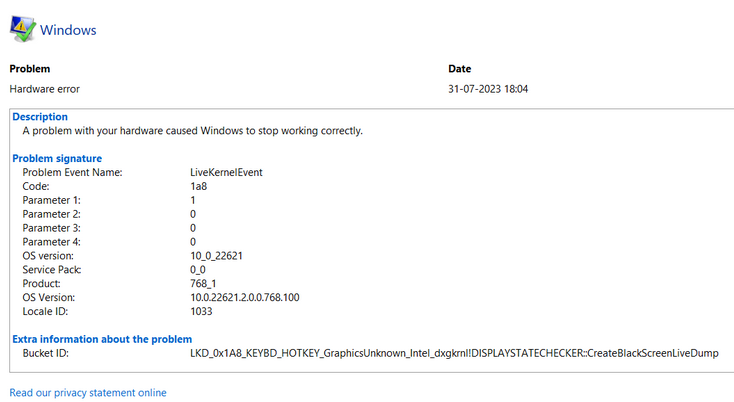
If you’re really, really lucky, a quick dive into the Windows Reliability Monitor can reveal the same kind of error details shown in Figure 2 below, which started appearing in Windows 10 with version 2004. Prior to that release, black-screen errors went mostly unacknowledged in Windows error reporting.

window reliability monitor showing black screen error

Figure 2: Note the black screen mention in the Bucket ID info at bottom of the error detail.

Ed Tittel / Foundry

This particular image comes from Windows 11 22H2 (as you can see from the beginning of the build number, 10.0.22621). The Bucket ID includes the string “CreateBlackScreenLiveDump” — that’s your indicator that the OS snagged a black screen error on your behalf.

This story was originally published in November 2020 and updated in June 2025.

Sam Altman: Meta tried to lure OpenAI employees with billion-dollar salaries

After reports suggested Meta has tried to poach employees from OpenAI and Google Deepmind by offering huge compensation packages, OpenAI CEO Sam Altman weighed in, saying those reports are true. He confirmed them during a podcast with his brother Jack Altman.

“There have been huge offers to a lot of our team,” said Sam Altman, “like $100 million in sign-on bonuses, more than that in annual compensation.”

According to Altman, the recruitment attempts have largely failed. “I’m really glad that, at least so far, none of our best people have chosen to take it.

Sam Altman says he thinks it’s because employees have decided that OpenAI has a better chance of achieving artificial general intelligence, AGI, than Meta. It could also be because they believe that OpenAI could one day be a higher-valued company than Meta.

More OpenAI news:

>

Hackers lean into social engineering to attack Apple security — Jamf

Every Mac, iPhone, or iPad user should do everything they can to protect themselves against social engineering-based phishing attacks, a new report from Jamf warns. In a time of deep international tension, the digital threat environment reflects the zeitgeist, with hackers and attackers seeking out security weaknesses on a scale that continues to grow. 

Based on extensive research, the latest edition of Jamf’s annual Security 360 report looks at security trends on Apple’s mobile devices and on Macs. It notes that we’ve seen more than 500 CVE security warnings on macOS 15 since its launch, and more than 10 million phishing attacks in the last year. The report should be on the reading list of anyone concerned with managing Apple’s products at scale (or even at home).

Security begins at home

With phishing and social engineering, protecting personal devices is as important as protecting your business machines. According to Jamf, more than 90% of cyberattacks originate from social engineering attacks, many of which begin by targeting people where they live. Not only that, but up to 2% of all the 10 million phishing attacks the company identified are also classified as zero-day attacks — which means attacks are becoming dangerously sophisticated. 

This has become such a pervasive problem that Apple in 2024 actually published a support document explaining what you should look for to avoid social engineering attacks. Attackers are increasingly creative, pose as trusted entities, and will use a combination of personal information and AI to create convincing attacks. They recognize, after all, that it is not the attack you spot that gets you, it’s the one you miss.

Within this environment, it is important to note that 25% of organizations have been affected by a social engineering attack — even as 55% of mobile devices used at work run a vulnerable operating system and 32% of organizations still have at least one device with critical vulnerabilities in use across their stack. (The latter is a slight improvement on last year, but not much.)

The nature of what attackers want also seems to be changing. Jamf noticed that attempts to steal information are surging, accounting for 28% of all Mac malware, which suggests some degree of the surveillance taking place. These info-stealing attacks are replacing trojans as the biggest threat to Mac security. The environment is similar on iPhones and iPads, all of which are seeing a similar spike in exploit attempts, zero-day attacks, and convincing social-engineering-driven moves to weaponize digital trust.

The bottom line? While Apple’s platforms are secure by design, the applications you run or the people you interact with remain the biggest security weaknesses the platform has. Security on any platform is only as strong as the weakest link in the chain, even while attack attempts increase and become more convincing and complex. 

Defense is the best form of defense

Arnold Schwarzenegger allegedly believes that one should not complain about a situation unless you are prepared to try to do something to make it better. “If you see a problem and you don’t come to the table with apotential solution, I don’t want to hear your whining about how bad it is,” he says.

With that in mind, what can you as a reader do today to help address the growing scourge of Apple-focused malware? Here are some suggestions from Jamf:

  • Update devices to the latest software.
  • Protect devices with a passcode.
  • Use two-factor authentication and strong passwords to protect Apple accounts.
  • Install apps only from the App Store.
  • Use strong and unique passwords online.
  • Don’t click on links or attachments from unknown senders.

And, of course, don’t use older, unprotected operating systems or devices — certainly not when handling critical or confidential data.

Layer up, winter is coming

Organizations can build on these personal protections, of course. Apple devices need Apple-specific security solutions, including endpoint management solutions; enterprises should adopt device management; and they should prepare for the inevitable attacks by fostering a positive, blame-free culture for incident reporting and by eliminating inter-departmental siloes. Investment in staff training is important, too. 

It is also important to understand that in a hybrid, multi-platform, ultra mobile world there is no such thing as strict perimeter security anymore. That’s why it is essential to secure endpoints and implement zero-trust. It’s also why it is important to adopt a new posture toward security — there is no single form of effective security protection. At best, your business security relies on layers of protection that together form an effective and flexible security defense.

You can follow me on social media! Join me on BlueSky,  LinkedIn, and Mastodon.

How US employers can protect immigrant tech workers

The ongoing protests in Los Angeles have pushed a national issue further into the spotlight: recent actions by the US Immigration and Customs Enforcement agency (ICE), including the detention of immigrants and, in some cases, the revocation of visas.

Naturally, immigration is a hot-button topic. But for companies with diverse workforces — particularly those employing foreign-born workers on H-1B visas — the priority is not to take a political stand, but to provide appropriate counsel and protection for affected employees.

Rajeev Madhavan, cofounder and general partner at Clear Ventures in Silicon Valley, notes that while these issues have not yet directly impacted the computer science and AI sectors where he invests, work visa approvals are taking longer than usual.

“The H-1B visa is a very impractical — or at the very least, unpredictable — process. As a result, when you hire someone on an H-1B visa, it may take much longer than you realize to get it,” he says.

This poses a challenge for the US startup and technology ecosystem, Madhavan says, pointing out that many tech founders are immigrants.

“They went to do some good work at places like Google, Meta, or any of these companies, and spend three, four years getting experience — getting their green card in the process — and then they turn to becoming an entrepreneur on some idea that they originate,” Madhavan says.

Of the 42 US-based companies appearing on Forbes’ 2025 list of the top 50 startups developing promising AI applications, for example, 60% were founded by people born outside the United States, according to the Institute for Progress. And new research from Stanford’s Venture Capital Initiative found that 44% of America’s billion-dollar startups were founded by immigrant entrepreneurs.

Because of the uncertainty around immigrants’ place in the US workforce under the Trump administration, Madhavan is seeing more talent either working remotely or launching ventures in other markets, such as Canada, China, and India. He’s concerned about the long-term implications of this shift.

“You will certainly have a lot more stringent rules that will be enforced, which is actually very sad — our leadership and technical background may get eroded in that process,” he says.

What Madhavan sees potentially happening on a national scale can also unfold within individual companies. We spoke with business leaders and legal experts about how to best support foreign-born talent, sustain a strong culture during turbulent times, and reinforce an employer brand that genuinely welcomes diversity.

Three rules: compliance, compliance, and compliance

Jean-Noël BenHamou, a licensed US and Canadian attorney and executive managing partner of BHLG, which specializes in global immigration law, explains that much of the online fear surrounding visa revocation and deportation stems from misinformation.

“The US immigration system is far from being perfect, but it is nevertheless based on the rule of law. And it does not just revoke visas without serious cause,” he says.

Because of this legal foundation, BenHamou believes maintaining immigration status is straightforward — if approached with diligence.

“When it comes to immigration, we have the same three rules: Compliance, compliance, and compliance. This is the name of the game,” he says.

Compliance can be a heavy burden for individual employees. “It’s hard to do your job and know foreign countries’ law at the same time,” says Thomas Sykstus, an attorney from Bond, Botes, Sykstus & Tanner.

To ease that burden, Sykstus recommends that companies offer proactive legal support, beginning with clear organization. For H-1B professionals, that means keeping thorough records — including approval letters, I-94 records, job offer letters, and pay stubs — readily accessible.

H-1B workers should be provided with copies of all such records, and companies should also be able to quickly produce these documents on behalf of their employees.

BenHamou stresses the importance of promptly reporting any changes in work status.

“If your role changes — whether it’s a promotion, whether it is a shift in responsibilities, whether it is a change in location, whether it’s a change from full-time to part-time — these changes must be reported,” he says.

While this might seem like a routine task, he notes, many workers fail to recognize the significance of such changes.

“If it is a material change, it needs to be reported. And if it is not clear whether or not it would be considered a material change, then in an abundance of caution, just disclose it,” he advises.

Another common misstep is violating visa terms through actions that may seem harmless. Moonlighting, for example, is common in the tech industry but is off-limits for H-1B holders.

“It technically is a violation of your visa conditions: You’re hired by the petitioning employer for that specific role, for that specific location. Anything outside of that, they haven’t sponsored you. That’s where the issue is,” says Sykstus.

While H-1B professionals should strive to stay in good standing with the law, BenHamou reassures them that not every minor infraction poses a risk to their visa.

“A regular parking violation is not going to get you in trouble. I think that any crime that would involve moral turpitude would definitely put you in big problems: for instance, DUI or reckless driving, causing death or severe injuries. These are the types of crimes that you want to stay away from, period,” says BenHamou.

ICE at the door

Despite following best practices, H-1B holders may still face visits from immigration authorities. BenHamou warns that site inspections by ICE or US Citizenship and Immigration Services (USCIS) may become more common.

“So employees should always have access to their original visa documents. Bring your passport to work. Bring your approval notice. Be prepared for any type of encounter,” he says.

Under intense pressure from the White House, ICE is significantly ramping up efforts to find and deport undocumented immigrants. That makes it more likely for people who are in the country legally to be mistakenly targeted, according to former ICE director Sarah Saldaña.

“You’re going to have [ICE agents] who are being pushed to the limit, who in a rush may not get things right, including information on a person’s status,” she told the New York Times.

Sykstus notes that while ICE visits are more common in blue-collar industries such as construction, they are still possible in tech settings.

In such encounters, he emphasizes, H-1B professionals should protect their rights. “Don’t speak with them. Don’t sign anything. Call an attorney first. Talk your options out,” he says.

Companies that employ H-1B workers should also be prepared, with HR and legal teams ready to quickly step in with documentation and legal counsel.

Employer responsibility beyond compliance

While legal compliance is critical, BenHamou emphasizes that immigration support shouldn’t stop at the letter of the law. For companies, the responsibility goes deeper. “It’s cultural, it’s ethical, and it’s strategic,” he says.

After an employee has fulfilled their I-9 requirements and completed onboarding, BenHamou believes their immigration status should be kept strictly confidential — limited to HR, senior leadership, and possibly their direct manager. He sees this discretion as a standard that should be embedded in the company’s culture.

He also stresses the importance of transparency with potential hires around what it takes to achieve permanent residency in the US. “Those individuals are putting their life on hold for 5 to 10 years before seeing the end of the tunnel,” he says, referring to current USCIS processing times for green cards.

Providing this clarity early on helps foster a healthier team dynamic.

“As an employer, by being transparent and open about what it takes to get there from the first minute you join the company, you’re facilitating their integration with their team and vice versa. You’re bringing cohesion within the team,” he says. 

Sykstus agrees that transparency is key. He recommends holding company-wide information sessions to explain how work visas like the H-1B function — not just under current law, but in anticipation of future policy changes.

“If you know something’s coming down the pipe, sitting on the president’s desk, who is likely going to sign it, and it will affect your [employee’s] immigration status, it’s probably important to get ahead of the ball there,” he says.

In light of recent instances in which visa holders who had traveled abroad were denied re-entry to the US, at least two major tech firms in Silicon Valley have advised H-1B holders to limit international travel, Sykstus says.

“Sudden policy changes and heightened border security could bar re-entry. So if you leave, you might have trouble coming back, [even] if you’ve already been here and have had no problems whatsoever,” he says.

This climate of uncertainty can understandably cause anxiety, not just for foreign workers, but also for teammates who rely on them and have formed friendships with them. Sykstus encourages companies to provide access to employee assistance programs or counseling services — whether in-house or through third-party providers — that include support for immigration-related stress.

Angelina Gennis, a principal analyst at Forrester, adds that companies must also be prepared for situations where, despite best efforts, an employee has to leave the US due to circumstances beyond the company’s control.

“However, what we can control is ensuring that our people are okay, even if they need to leave us — so what sort of resources we can offer legally if they do have to leave us to make sure that they get home safely,” she says.

Supporting diversity in turbulent times

Building a culture that supports global talent requires more than behind-the-scenes policy work — it must also be reflected in the company’s outward messaging. And that messaging must align with employees’ lived experiences, says Shahar Silbershatz, CEO of Caliber, a brand reputation analytics company.

“If international hires feel uncertain, unsupported, or in the dark about immigration processes, that story travels quickly and can undermine even the most well-intentioned DEI messaging,” he says.

According to Silbershatz, the solution lies in proactive and empathetic communication with employees. “That means explaining policy shifts in plain language, providing real support to impacted employees, and making your long-term commitment to diverse talent visible,” he says.

Gennis believes businesses should first zoom out and anchor the conversation in their brand values. “That way, the company is being consistent in the messaging,” she says.

Gennis also emphasizes the importance of equipping managers to lead these conversations with care. She advises training managers to engage employees thoughtfully, using intentional language, checking in personally, and ensuring team members understand both the process and where to seek support.

This alignment between managers and the company’s employer brand is especially critical for organizations recruiting globally for highly specialized roles, such as in artificial intelligence. Just like these workers’ skills, the employer messaging must be targeted and intentional.

Employers should be aware that internal communications around immigration policy may be leaked publicly, Silbershatz cautions. Leaders should “approach how they communicate any new policies with clarity and conviction, keeping employee well-being central to any messaging,” he says.

That emphasis on clarity and care feeds into a broader organizational responsibility — one that BenHamou believes must be embedded in the company’s culture and long-term vision.

“The goal is to build a workplace that does not just hire global talent — it’s to build a workplace that protects it, supports it, and thrives because of it,” he says.

China’s MiniMax launches M1: A reasoning model to rival GPT-4 at 0.5% the cost

Chinese AI startup MiniMax has thrown down the gauntlet to established AI giants, releasing what it boldly claims is the world’s first open-source, large-scale hybrid-attention reasoning model that could fundamentally change the economics of advanced AI development.

MiniMax defines “hybrid-attention” as a combination of its Lightning Attention mechanism and Mixture-of-Experts architecture, which activates only the relevant parts of the model for each task.

The Shanghai-based company said its new MiniMax-M1 model delivers a knockout punch to computational inefficiency, requiring just 30% of the computing power needed by rival DeepSeek’s R1 model when performing deep reasoning tasks — a breakthrough that could democratize access to sophisticated AI capabilities.

“In complex, productivity-oriented scenarios, M1’s capabilities are top-tier among open-source models, surpassing domestic closed-source models and approaching the leading overseas models, all while offering the industry’s best cost-effectiveness,” the company said, announcing the hybrid-attention reasoning model.

A David vs. Goliath moment in AI

What makes MiniMax-M1 particularly intriguing isn’t just its performance — it’s how the company achieved it. While tech titans have been throwing hundreds of millions of dollars at AI development, MiniMax managed to train its model for a mere $534,700.

To put that in perspective, DeepSeek spent $5-$6 million on its R1 model, while OpenAI’s GPT-4 reportedly cost over $100 million to develop.

“The entire reinforcement learning phase used only 512 H800s for three weeks, with a rental cost of just $534,700,” the company explained. “This is an order of magnitude less than initially anticipated.”

However, industry analysts urge caution. “MiniMax’s debut reasoning model, M1, has generated justified excitement with its claim of reducing computational demands by up to 70% compared to peers like DeepSeek-R1,” said Sanchit Vir Gogia, chief analyst and CEO at Greyhound Research. “However, amid growing scrutiny of AI benchmarking practices, enterprises must independently replicate such claims across practical workloads.”

Extended context capabilities

M1’s most impressive feature might be its ability to handle massive amounts of information simultaneously. With a context window supporting one million input tokens and up to 80,000 output tokens, the model can essentially read and understand multiple novel tasks at once while maintaining coherence across the entire conversation.

“A significant advantage of M1 is its support for an industry-leading 1 million token context window, matching the closed-source Google Gemini 2.5 Pro,” MiniMax noted in the post. “This is 8 times that of DeepSeek R1 and includes an industry-leading 80,000 token reasoning output.”

For context, OpenAI’s GPT-4o can handle only 128,000 tokens — enough for about one novel task. M1’s expanded capacity opens doors for applications that were previously impractical, from analyzing entire legal documents to debugging massive code repositories.

Real-world performance that matters

Beyond impressive technical specifications, M1 demonstrates strong real-world capabilities across multiple benchmarks. The model comes in two variants — M1-40k and M1-80k, referring to their “thinking budgets” — with the larger version consistently outperforming its smaller sibling across most tests.

In software engineering tasks, both versions scored 55.6% and 56.0%, respectively, on the challenging SWE-bench validation benchmark. While slightly trailing DeepSeek-R1-0528’s 57.6%, they significantly outpaced other open-weight models in this critical area of productivity.

“MiniMax-M1-80k consistently outperforms MiniMax-M1-40k across most benchmarks, which fully validates the effectiveness of extended computational resources during testing,” the company added.

Breaking down barriers to AI access

Perhaps most significantly, MiniMax is releasing M1 under a true Apache 2.0 open-source license — unlike Meta’s Llama models, which use restrictive community licenses, or DeepSeek’s partially open approach. This decision could accelerate innovation by giving researchers and developers unprecedented access to cutting-edge reasoning capabilities.

Gogia sees this as particularly significant for mid-market companies. “MiniMax’s M1 represents more than just architectural efficiency — it symbolizes the new accessibility of advanced reasoning AI for mid-market enterprises,” he noted. “With open-source licensing, reduced inference costs, and support for 1 M-token context windows, M1 aligns squarely with the evolving needs of midsize firms that seek capability parity with larger players but lack hyperscaler budgets.”

The company is backing up its open-source commitment with competitive pricing for those who prefer API access. Input processing costs just $0.4 per million tokens for contexts up to 200,000 tokens, rising to $1.3 per million tokens for the full 1-million-token capability.

“Due to its relatively efficient use of training and inference computing power, we are offering unlimited free use on the MiniMax APP and Web, and providing APIs on our official website at the industry’s lowest prices,” the company announced.

What this means for the industry

M1’s release comes at a pivotal moment in AI development, as the industry grapples with the massive computational costs of training and running advanced models.

The timing is particularly noteworthy, coming just weeks after fellow Chinese company DeepSeek shook the industry with its own cost-effective approach to AI development. This pattern suggests Chinese companies are finding innovative ways to compete with better-funded Western rivals through superior engineering rather than just throwing money at problems.

Yet challenges remain for Chinese AI models in Western markets. Despite technical achievements, Gogia notes that “Chinese LLMs remain under-adopted in North America and Western Europe” due to concerns around governance and regulatory compliance in industries with strict procurement frameworks.

A company on the rise

MiniMax isn’t exactly a household name yet, but it’s rapidly becoming one of China’s most-watched AI companies. Founded in 2021 by former SenseTime executives, the startup has raised $850 million from heavyweight investors including Alibaba, Tencent, and IDG Capital, achieving a $2.5 billion valuation.

This M1 announcement kicks off what MiniMax is calling “MiniMaxWeek,” with additional product releases planned for the coming days. For enterprise users and developers, M1 represents something potentially transformative: enterprise-grade AI reasoning capabilities without enterprise-grade infrastructure requirements. However, as Gogia cautioned, “The real test will lie in how quickly CIOs can extract operational savings at scale, without compromising accuracy or governance.”