Month: September 2026

Wanna make your own Android ping tone? Ask Gemini

By now, you probably know my stance on Gemini and other generative AI gobbledegook — right?

In short: It’s an insanely powerful form of technology (obviously). But it’s also wildly inaccurate and ineffective as an all-purpose answer engine, and by cramming it into every last nook and cranny, Google is doing a serious disservice to its users — and to itself.

That being said, generative AI can be incredibly useful. The key is simply to frame it as a purpose-specific tool for the right type of limited task as opposed to treating it as the end-all answer for everything, as most tech players seem overly eager to do these days.

Here in the land of Android, I’m always looking for purpose-specific ways Gemini can make our lives easier. Over time, I’ve found those ideas often aren’t the big headline-making features Google and other tech companies market but rather random little off-the-beaten-path possibilities that rarely get emphasized.

Today, I’ve got a new Gemini Android advantage for you to explore — another one that I’ve never seen advertised anywhere but that works brilliantly well and solves a long-standing limitation of our modern mobile gizmos.

It’ll take you all of a minute to master and cost you precisely $0 to pull off. Ready?

[Get next-level knowledge in your inbox with my free Android Intelligence newsletter — one useful new thing to try every Friday, straight from me to ye.]

Gemini’s custom sound advantage

This Gemini-provided power-up very much follows the path of thinking about AI as a limited, purpose-specific tool for a narrow task — the exact sort of area where AI excels.

I won’t keep you waiting: Gemini, as I discovered whilst poking around within it recently, is really good at generating unique, custom ringtones and notification sounds based on your personal preferences and specifications.

It almost seems obvious, once you think about it. But I sure hadn’t thought about it up until now — and I suspect most other folks haven’t, either.

The advantage here goes beyond just superficial silliness, too: By creating your own custom ringtones and notification noises, you can know exactly what event your phone is alerting you to within a split second of hearing the associated sound — without having to rely on the same limited and often underwhelming pool of default options that everyone else uses (or, worse yet, having to lean on shady, ad-ridden “ringtone apps” to find mediocre alternatives). That means you’ll know within a heartbeat when your boss or an especially important client is calling or if an incoming call is a random unknown number.

On the notification front, you can create a specific, memorable sound to accompany a new message in an important work-related Slack channel and a different distinctive sound for a high-priority email. They’ll all be sounds that you make and identity with and that no one else in the world uses. That’s pretty powerful.

And creating these custom sounds couldn’t be much easier, either, once you realize it’s possible:

First, just fire up Gemini on your phone (or on any device you’re using) and tell it what you want. So, for instance…

  • Create a soft, subtle ringtone that’s reminiscent of an old office phone sound.
  • Create a ringtone that sounds like an 8-bit version of The Final Countdown.
  • Create a one-second high-pitched notification sound that brings to mind the Super Mario Bros theme song.
  • Create a short notification sound that mimics the Back to the Future time circuits noise.
  • Create a notification sound that sounds like a robot saying “ALERT, ALERT!”

The only limit is your imagination. And if you’re not feeling especially imaginative, you can even ask Gemini to give you a list of ideas for distinctive, memorable ringtones or notification sounds based on geeky nostalgia, 80s pop-metal, or whatever it is that tickles your fancy.

Once you’ve sent a request, Gemini will — somewhat confusingly — spit back a big honkin’ block of HTML code. This is because, for reasons unknown, the system can’t or won’t just provide a sound file directly. Go figure.

JR Raphael, Foundry

But from there, it’s just one more quick step to get the file you need: Click or tap the copy icon in the upper-right corner of that code block — the icon that looks kinda like two stacked, rounded rectangles — to copy the entire chunk of code onto your system clipboard.

Then open up your browser and go to the website JSFiddle.net. It’s a well-known, long-standing tool for running code like HTML right in your browser and seeing the result, and it works entirely in the browser and without any downloads or special permissions required.

Tap or click into the “HTML” field, then paste in the code from your clipboard (by long-pressing any open space, on Android, and selecting “Paste” from the menu that appears). Click or tap the “Run” button, and — ta-da: You’ll see a player to listen to your custom Gemini-generated sound and a button to download it.
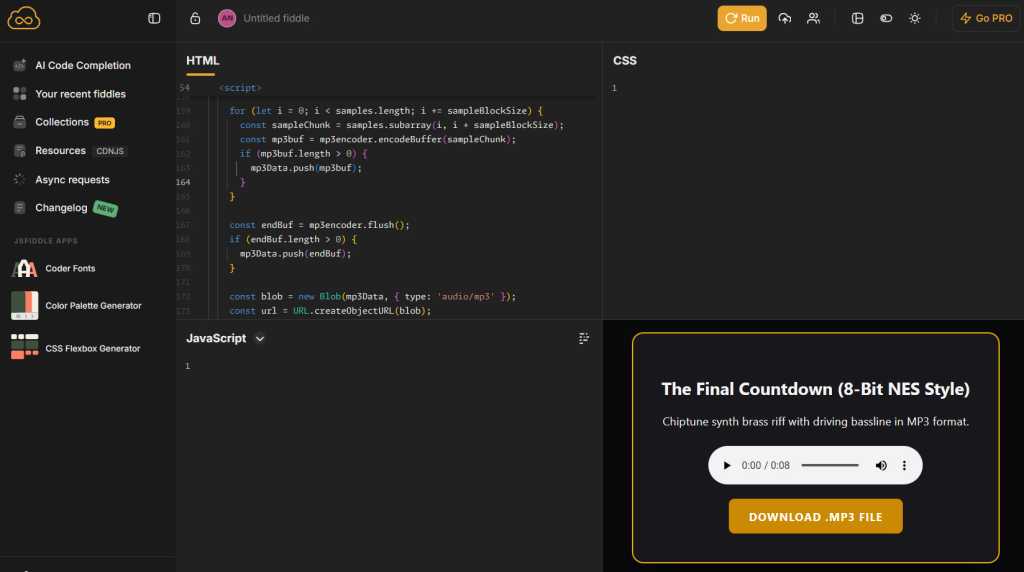
JR Raphael, Foundry

Provided you like what you hear, hit the button to download the file, then head into the Sound section of your Android system settings to save it and make it available for applying as any kind of alert or ringtone. The exact steps for doing that will vary from one type of Android device to another, but on a Pixel or another phone that follows Google’s core Android interface, you’ll tap on either “Ringtone” or “Notification,” then tap “My Sounds” and tap the plus icon to import your own custom file from your phone’s local storage.

On a Samsung device, you’ll start the same way but look for the plus icon within the “Ringtone” section of the settings, then tap the “Folders” tab to find your locally downloaded files. Samsung doesn’t make it easy to add in your own custom notification sounds, annoyingly, so what you’ll have to do is open up the Google Files app, find the file you downloaded in your “Downloads” folder, then tap the three-dot icon alongside it to copy it to the folder called “Notifications.” Once the file is in that folder, it should show up as a notification noise option within the Samsung Android settings.

And remember: You can use Android’s notification channels to set specific sounds to be used for different types of alerts, even within a single app — and you can use the Google Contacts app to set custom ringtones for different people, too.

With Gemini as your personal composer, you’ll never be stuck with generic overused sounds again — and you’ll always know exactly what’s happening from the first note of whatever noise you hear.

Keep the experience-enhancing wisdom coming with my free Android Intelligence newsletter. One new useful trick in your inbox every Friday!
Leap second proposal will keep software stacks in sync

For decades, global time experts have mapped atomic clock time to the earth’s rotation, periodically adding a second (aka a leap second) as rotation slowed. But the planet’s rotation has now slightly sped up, which could mean that a negative adjustment will be required. 

The problem is that computer systems have not been programmed to do that.

To avoid this issue, the General Conference on Weights and Measures (GCWM) in October will vote on a proposal to maintain the Coordinated Universal Time (UTC) as a continuous time from May 20, 2027, without adjustment via leap seconds, allowing UT1, the measure of time based on the earth’s rotation, and UTC to drift apart by up to one hour.

It pointed out, “a negative leap second has not previously been applied, and it is considered to pose a high risk of causing anomalies and disruption to critical infrastructures that are largely unprepared, and the preparation would create, for the industries that rely on time synchronization, a need for financial investment, whose amount is estimated to be similar to their preparations for the millennium bug.”

The group said that a 2025 workshop which included experts on Earth rotation estimated that the probability of a negative leap second will increase rapidly in the near future, reaching 30% by 2035. Acceptance of the proposal, it said, will ensure the long-term continuity for UTC for several centuries.

Unexpected requirement

Jeremy Roberts, senior director at Info-Tech Research Group, said that authorities never expected the need to reverse time. 

“We have been adding leap seconds for decades, basically to keep atomic time in line with observed time, but this is the first time we’d have to take one away. The problem is that computer systems aren’t designed to work this way,” Roberts said. “Rather than introduce a negative leap second, the proposal here is to let the two clocks go out of sync rather than keep adjusting to keep synchronicity with UT1 time and atomic time, which is much more consistent and not impacted by changes in the Earth’s rotation. This would make it easier for those building and maintaining infrastructure, because the clock would behave in a predictable way.”

Still, Roberts stressed that the proposed approach might eventually cause problems. 

“As with all things, this will require work to implement, and because the proposal includes a provision that allows for the clocks to go up to an hour out of sync, that would presumably create a problem for our descendants when we eventually reach that point,” Roberts said. “[But] being indecisive could cause fragmentation in standard time as different entities move to different standards, which could come with its own set of problems.”

Frank Dickson, principal analyst at Dickson Research, added that this proposed move is revolutionary in time-keeping circles.

“This is the biggest change to civil timekeeping since the leap second itself was adopted in 1972,” Dickson said. “Earth’s rotation has historically been slowing down, so that’s the only direction the system has ever had to handle. What’s crazy is that the Earth’s rotation has been speeding up in recent years, requiring a negative leap second, subtracting a second instead of adding one. Nobody has ever run that in production, at global scale, on the systems the world actually depends on.”

Dickson said that it is critically important that the vote pass, because the IT community has seen what happens when clocks malfunction.

“In a world of interlocking software applications, you cannot always predict how a global change will impact digital systems. In 2012, one ordinary positive leap second took down Reddit, LinkedIn, and Qantas’s booking system,” Dickson said. “It also triggered a race condition in the Linux kernel that spiked CPU load across servers worldwide. Nobody had tested for it because it had never happened before.”

And another incident involving timekeeping took down the Telstra network in Australia just last month. 

A ‘more rational’ engineering decision

Mike Wilkes, enterprise CISO at Aikido Security, pointed out that the consequences of a negative leap second could be significant. “Skipping a second can expose assumptions buried in databases, distributed systems, authentication systems, schedulers, market infrastructure and logging platforms,” he said. “The CGPM proposal is effectively saying that, rather than forcing the entire digital economy to prepare for a novel failure mode, we should make UTC continuous. That seems like a far more rational engineering decision.”

Most consultants and analysts agreed that if the vote to adjust current time procedures fails, the resultant problems would likely happen gradually, and possibly dramatically.

“The most likely problem would not necessarily be one spectacular global outage. I would be more concerned about thousands of smaller inconsistencies occurring simultaneously,” said Boris Kolev, global head of technology at JA Worldwide. The problems he anticipated included timestamps appearing out of order, distributed transactions behaving unexpectedly, authentication tokens being interpreted incorrectly, monitoring and audit trails becoming inconsistent, or different systems disagreeing about the sequence of events.

Systemic technology risk

But Kolev warned of a potentially more severe problem, as different companies sharing varied technology dependencies with enterprises try tackling the time problem differently.

“That means an enterprise does not only have to worry about what its own servers do. It has to consider what happens when its cloud provider, operating system, identity provider, database, external APIs, and on premises systems interpret the same moment differently,” Kolev said. “This is precisely the type of systemic technology risk that concerns CIOs: individually, every dependency may look manageable, but globally there are millions of interconnected systems maintained by different organizations, written in different eras, and operating under different assumptions.”

Justin Greis, CEO of consulting firm Acceligence, also said that he hoped the proposal would pass. 

“I think this is one of those cases where delaying what appears to be the technically correct answer may actually be the more responsible engineering decision. At some point, you have to ask whether preserving the relationship between civil time and the Earth’s rotation to within a second is worth introducing operational risk across financial systems, telecommunications networks, cloud platforms, power infrastructure, transportation systems and countless other technologies that depend on precise synchronization,” Greis said. “For the overwhelming majority of enterprise technology, I don’t think it is.”

This article originally appeared on Network World.

Apple after Cook: The Ternus age begins this week

We’re hurtling toward the loss of something big. Finally, after months of speculation, Apple is about to introduce its first-ever folding smartphone. And once it does, the conversation will change as the annual iPhone rumor season is replaced with the reality of whatever Apple unveils.

Except, it won’t quite be the same as in the past. Because no sooner will new Apple CEO John Ternus finish his iPhone announcement keynote speech tomorrow than the speculation will shift to next year’s 20th-anniversary iPhone, what’s coming to the iPhone 18 and e-series iPhones, and expectations around Apple’s upcoming wave of smart home products, including health and home security services. There’s a lot going on.

Meet John Ternus

Having a lot going on is one of the prime expectations of Apple under its new boss. A family man with a wife and kids, he’s led Apple’s hardware division for five years after an eight-year stint running hardware engineering. He joined the company in 2001 and is described as a highly competent, hugely talented, and modest by nature. 

His hobby is quite revealing — he drives race cars, is a regular at California’s Laguna Seca Raceway, and owns an incredibly rare 2019 Porsche 935. To me it suggests a calm, competent, individual with excellent mental and physical reflexes who can make life or death decisions at speed. He’s also deeply committed to good product design.

He’ll need that calm embrace of speed and adrenaline to manage the company his predecessor, Tim Cook, led to become the world’s most valuable firm. 

A hard act to follow

He’s also got a hard act to follow, as while Cook had to carve out his reputation in the shadow of Steve Jobs, Ternus must sculpt his own destiny in the shadow of Cook, who managed to make shareholders of record in 2011 around 20 times richer by the time he quit. (Apple stock rose from $13.74 per share on a split adjusted basis to $319.97 per share today.)

While Cook was frequently criticized for not being a product guy, he presided over the launch of the Apple Watch, AirPods, Apple Silicon, and the Vision Pro, and helped grow Apple’s services income to become its second-biggest product category, diversifying Apple’s revenue and creating financial stability. That’s no easy task.

Building his own team

Can Ternus improve on that? He’s certainly being positioned as someone who can. His deep experience in hardware has led to expectations that Apple will double down on product under his watch, so a great deal is expected of him in consequence. He is also putting together a hardware-focused team, including Laura Legros, former vice president of hardware engineering, as a direct report.

What will we see of this tomorrow? To be fair, while he will lead the announcement on the keynote stage, development of this first tranche of products took place under the leadership of Cook, and while Ternus will have had a big hand in development, this year’s Apple event should be seen as a moment of transition. 

“I’m just as excited about what lies beyond that, including the incredible products already in the works and the ones we haven’t even imagined yet that we’ll dream up and create together. There’s no team in the world I’d rather build the future with,” Ternus told Apple staff in his first memo as CEO.

It’s what Apple does in the next couple of years that will truly define the new leadership. He’s literally been CEO for a week!

What to expect on Sept. 9

Here’s my TL; DR list:

  • First folding iPhone: Apple’s response to folding devices from Samsung, Google, Huawei, Xiaomi. It’s expected to have a highly durable, near invisible hinge and a powerful 2nm A20 chip around 20% more performant than the 17 series devices; Touch ID; a 48MP camera; and be able to unfold from a 5.5-in. to a 7.8-in. display. Potentially called iPhone Ultra, some predict it might be the “iPhone Duo” or “iPhone Fold.” It’s likely to cost $2,000+.
  • iPhone 18 Pro series: Equipped with a fantastic new display, smaller Dynamic Island, 48MP main camera, and telescopic lens and supported by a fresh tranche of pro-photography features, the 18 Pro/Pro Max range will also use A20 chips. Both the fold and Pro devices will carry significantly more RAM, enabling them to handle on-device AI tasks. Apple is expected to introduce the iPhone 18, iPhone Air 2, and iPhone 18e devices at a spring 2027 event. Prices on all iPhones are expected to increase by $100 or more, depending on model.
  • Apple Watch Series 12, Apple Watch Ultra 4: While Apple is thought to be working on new designs for next year, this year’s models will — for the first time in years — include an improved processor, better networking, and more accurate heart monitors. A model with a ceramic body is expected, while the devices will be equipped with additional storage, and integrated satellite emergency features. 
  • AirPods 5: Earlier speculation about cameras inside AirPods remains, but these aren’t expected at the launch. Instead, Apple’s AirPods 5 will be boosted with a new H3 Wireless Chip for better voice isolation, noise cancellation, and spatial audio. They may also provide some basic health monitoring features with a built-in temperature sensor and heart rate monitoring.
  • Smart home products: Apple is still expected to introduce additional products for smart homes, including an Apple TV with a faster processor and SiriAI support, a HomePod mini upgrade, and — potentially — a new home hub. The latter could effectively be a combination of an iPad with a HomePod to run apps, control smart devices, take and make calls, and run Siri.

Finding the next big thing

While all these products are important to the company, the smart home devices should demand attention (if they appear at all), as the indicators suggest Apple intends to explore the smart home space with a range of future hardware, including domestic robotics, security services, and smart devices. This hardware proliferation in new markets could end up becoming one of the hallmarks of Ternus’ Apple leadership, as will Apple’s AR spectacles (once they are introduced). 

Equally, it cannot be ignored that one of Ternus’ main tasks since becoming vice president of hardware has been the introduction of new Macs and the transition to Apple Silicon. So he’ll be expected to strike a balance between improving Apple’s traditional product lines while racing his company toward new and emerging opportunities in hardware. (I believe Apple should pay much more attention to the enterprise space within that.) 

Apple’s little AI problem

The biggest challenge to all of this will be Apple’s success in implementing AI that’s good enough to get things done while avoiding the unexpected dangers of poor implementation. We don’t want AI agents corroding smart home security, for example, which is why Ternus seems likely to maintain Cook’s focus on security and privacy as enabling technologies to support trusted hardware/software product designs.

Another thing? Tomorrow’s keynote will likely begin with the single word, “Hello,” and feels very likely to also include that classic Apple keynote line, “…One more thing.”

We’ll find out more as the conversation moves from speculation to reality after the 10am (PT) keynote.

Please subscribe to my daily, human-curated Apple-related news headline feed at The Core, or follow me on BlueSky, LinkedIn, or Mastodon.

Swiss government explores replacing Microsoft 365 with open-source software

Swiss authorities have launched a pilot project to determine whether it is possible to replace Microsoft 365 with similar open-source services, RTS reports. This follows a proof-of-concept project in which 172 civil servants tested the German open-source platform openDesk.

According to Matthias Stürmer, a professor at the University of Bern, there are three main reasons for the switch: to reduce dependence on US services, to improve operational reliability, and to reduce costs.

In the first phase, the migration involves 3,000 computers, which corresponds to 7% of Switzerland’s federal workforce. The government has more than 54,000 workstations in operation. The pilot will prioritize employees who have access to highly sensitive data, according to RTS.

A move by the Swiss Armed Forces from Microsoft 365 to openDesk is already underway, with that migration expected to be completed in October, It’s FOSS reports.

Switzerland’s move is part of a larger ‘digital sovereignty’ effort in the European Union that aims to retain local control over data, applications, and infrastructure. In January, lawmakers directed the European Commission to map critical technology dependencies and then develop policies to reduce reliance on foreign providers.

This article originally appeared on Computer Sweden.

More on the EU’s digital sovereignty push:

Judge spares Google’s ad-tech business from a breakup

Back in April 2025, the US Department of Justice (DoJ) proudly proclaimed that it had prevailed in a landmark antitrust case against Google’s ad business. Yeah. Right.

You see, just last week, US District Judge Leonie M. Brinkema rejected the DoJ’s effort to force Google to sell its AdX ad exchange. What began as a major anti-monopoly victory has become a mouse-sized settlement. 

[ Google US antitrust trials: A timeline ]

Does any of this this sound familiar? It should. We’ve seen this show before. Last year, Google had also been convicted of abusing its search business. At first, all the talk was about how Google might be forced to divest itself of the Chrome browser and/or the Android operating system. 

Instead, Google was allowed to keep making search deals and only had to share some search data with its rivals. 

I say rivals, but in fact Google still dominates the search market. Indeed, its control has actually expanded a bit. By StatCounter’s numbers, in August 2025, Google search owned 89.89% of the market. By last month, almost a year after the company had been slapped on the wrist, its share had grown to 91.1%. 

Boy, wasn’t that a win?

The remedies phase of the government’s ad-tech antitrust case order is a similar Google win. No, it doesn’t overturn the April 2025 finding that Google unlawfully maintained monopolies in the publisher ad-server and ad-exchange markets, or that it illegally tied its ad server and exchange together. Instead, it determines how the company must change its conduct.

The DoJ wanted Google to divest itself of AdX, the company’s ad exchange for matching publisher inventory with advertiser demand. It also sought to require Google to open-source the final-auction logic in its DoubleClick for Publishers (DFP) ad server and, if necessary, divest its DFP business. 

Brinkema rejected all three requests. Instead, her short order accepts “most” of the parties’ proposed behavioral remedies, subject to modifications described in a memorandum opinion that remains sealed while the parties identify confidential information for redaction.

Specifically, the court directed Google and the plaintiffs to meet and submit a joint proposed final judgment within 30 days. If they cannot agree on the details, each side must submit its own proposed version.

Google — as it should — sees this as a win. As Lee-Anne Mulholland, Google’s vice president of regulatory affairs, said in a statement, “We’re very pleased the Court rejected the DOJ’s proposal to break apart tools that help small businesses reach new customers and grow.”

Far less convincing is the DOJ’s characterizing the decision as a win. “The Antitrust Division is pleased that the court ordered substantial relief in the Google ad-tech case. We are one step closer to restoring competition and bringing relief for the American people in online advertising markets.” 

Oh please! It does nothing of the sort.

To quote Laurel Kilgour, research manager at the American Economic Liberties Project, an anti-monopoly, nonprofit group: “Judges keep finding Google guilty, but Google keeps walking away with both its ill-gotten gains and its empire intact. Without actual structural remedies, antitrust rulings are just inconvenient speed bumps that allow Google to lock down search and ad tech markets today while using that same unchecked power to monopolize tomorrow’s AI frontier.”

Exactly so. 

The specific obligations Google will face are not yet public, because Brinkema’s explanatory opinion remains under seal. Earlier, Google had proposed making real-time bidding responses from AdX available to rival ad servers, removing Unified Pricing Rules, and accepting a monitoring trustee for a three-year supervision period. None of that will even dent Google’s ad business.  

When all’s said and done, Google is still in charge of both its exchange and publisher ad-server operations. I expect the minor changes required won’t amount to a hill of beans. Restoring competition in markets where the company was found to have used its vertically integrated position unlawfully? Give me a break. 

Public Knowledge, a free speech and internet advocacy group, described the decision as one that leaves Google’s monopoly power substantially intact. 

As Public Knowledge Legal Director John Bergmayer said, “The court found that Google illegally acquired and maintained monopolies in publisher ad servers and ad exchanges, and used its control of DFP and AdX to shut out rivals.” He concluded, “Telling a monopolist to do better is not the same as restoring competition.… A finding of liability means little if the remedy leaves the market fundamentally unchanged.”

Ya think? 

In Google’s last reported quarter, the company reported $81.6 billion in advertising revenue. Next year, when Google is being “punished,” I expect its revenue will be even higher. 

How to automate your Gmail inbox — without AI

Gmail is filled with hidden features and add-on possibilities, but one of the service’s most powerful organizational tools is sitting right in the heart of its regular settings.

As you may have guessed by now (especially if you read this story’s headline, you clever little cat), I’m talking about filters — Gmail’s long-standing system for automating your inbox with a series of custom-crafted rules. At a glance, filters can seem complicated. They can seem overwhelming. They can even seem unnecessary.

But don’t let yourself be fooled by the feature’s curiously crusty exterior. Gmail filters have the potential to completely reshape your inbox and the way your incoming messages are handled. They can help you keep your email in order with no ongoing thought or effort.

And, unlike Google’s new AI Inbox option (which notably still doesn’t seem to be available for most people as of this writing), filters (a) don’t require your personal messages to be processed by generative AI systems — and (b) give you complete control over exactly how your email is handled instead of forcing you to rely on inherently unreliable technology to figure out what you want for you (and then likely come up short at least some of the time).

Best of all? All it takes is a teensy touch of one-time planning to get Gmail filters set up to your exact specifications and working for you quietly and automatically from that moment onward.

Follow the filter-centric Gmail tips in this guide, and your inbox will be running like a well-oiled (but not too greasy) machine in no time.

Part 1: Figuring out your Gmail filters

Let’s start by thinking through some Gmail filter possibilities to get an idea for the sorts of setups you might want to consider — then, we’ll go step by step through the process of creating them.

With Gmail filters, you could:

  • Ensure messages from specific high-priority senders always go into your inbox’s Primary tab, where you’re certain to see them
  • Ensure specific sorts of lower-priority messages — like invoices, reports, or updates from different services you use — automatically get sorted into an out-of-the-way location and never even show up in your inbox
  • Keep messages from annoying people out of your hair (but still available in case you need to find them) by automatically archiving them as soon as they arrive
  • Forward messages from a specific address or with a specific phrase in their subjects to other members of your team or family
  • Instantly respond to messages to or from a specific address with a prewritten template
  • Label messages sent to a specific variation of your Gmail address (like youraddress+vip@gmail.com) or written with a specific word or phrase in the subject (like “urgent,” “important,” or “hey jerkwad, pay attention to this”) as “VIP” and then receive notifications only for messages with that designation
  • Mark specific types of messages from yourself as reminders by giving them a bright yellow “REMINDER” label that makes them stand out in your inbox
  • Get a snickerdoodle delivered to your desk every time your boss emails you

All right, so that last one isn’t really possible (not yet, anyway) — just wanted to make sure you were still paying attention. Everything else in that list, however, is absolutely doable and actually quite easy to set up with Gmail filters.

Got some ideas of your own? Good deal. Time to make ’em happen.

Part 2: Creating your Gmail filters

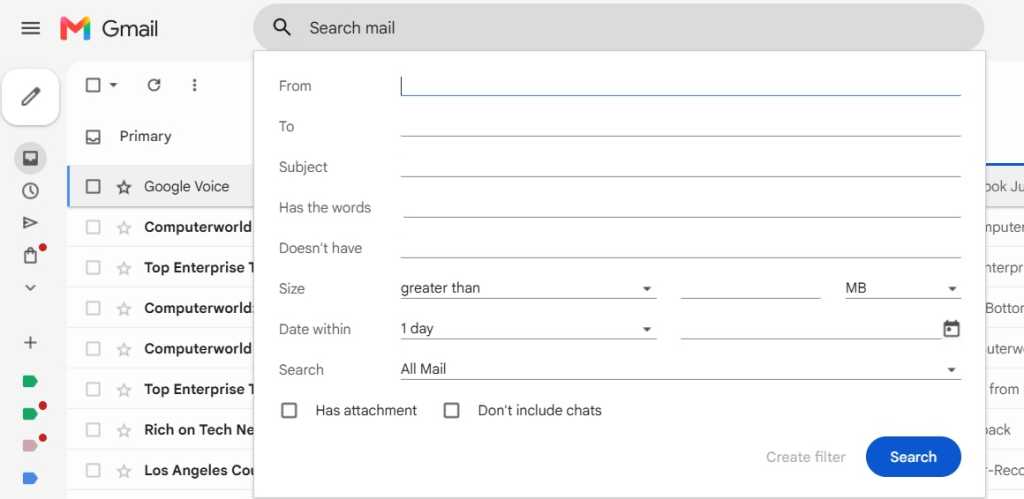
The simplest way to start a new Gmail filter is to click the control panel icon — the symbol showing three horizontal lines stacked on top of each other — within the big search box at the top of the Gmail website. (Filters can’t easily be managed on mobile, unfortunately, so you’ll need to do all of this in a desktop browser.)

That’ll pull up a form where you can fill in whatever you want to use as the basis for your filtering — a word or phase that might appear within an email’s subject or body, an address from which a message could originate, or any other variable or combination of variables you like.

JR Raphael / Foundry

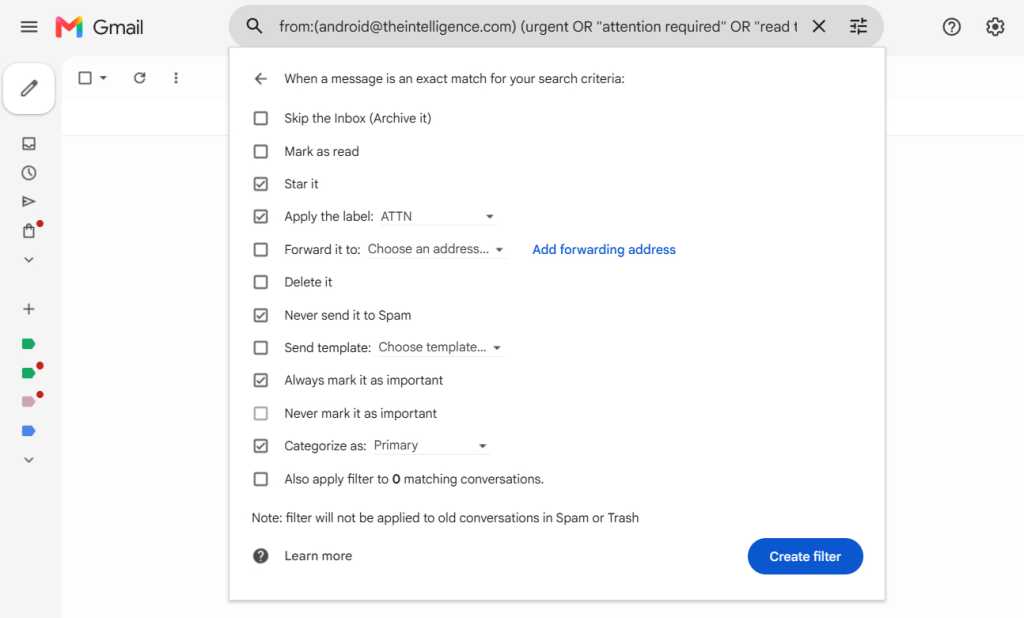
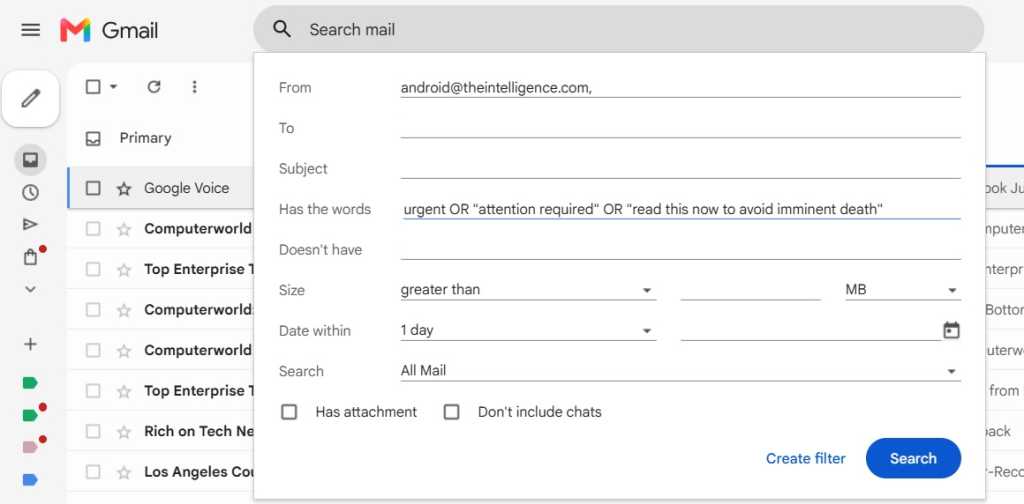
Fill in the fields as appropriate, using however many variables you want — even employing quotation marks around multiword terms along with operators like “AND” and “OR” between terms, if you really want to get fancy — and then click “Create filter” at the bottom of the box.

JR Raphael / Foundry

One quick warning: By default, your filter will apply to any and all incoming messages — hence the “All Mail” setting that shows up next to the “Search” option in the filter creation pop-up. If you change that option to “Inbox,” you’re likely to see an error message informing you that the parameters you chose are not recommended and may not work properly. Leave that “Search” option set to “All Mail” — which is probably what you want, anyway — and you’ll steer clear of any errors and allow things to work the way they should.

Now it’s time for the fun part — the part where you decide exactly what happens when a message meeting your conditions arrives. You can select any combination of actions from the list and then configure them as needed. You can even tell Gmail to apply your filter retroactively to messages already in your account (as opposed to using it only for new messages that arrive from that point forward) by checking the “Also apply filter to matching conversations” option at the bottom of the box.

JR Raphael / Foundry

Once you’ve got that finished, click the blue “Create filter” button — and that’s it: Your new Gmail filter is officially in place and active. The next time any message comes in that meets the parameters you outlined, the actions you specified will automatically take place faster than you can say “I embrace Workspace in my workplace cyberspace.”

Part 3: Managing your Gmail filters

Last but not least, make yourself a mental note in case you ever need to adjust your filters in the future: If you want to edit, delete, or even just revisit a filter you created, just click the gear-shaped icon in the upper-right corner of the Gmail website, click “Settings,” then click the “Filters and Blocked Addresses” tab at the top of the settings screen. You’ll see every filter you’ve ever created there and can tweak or remove any of ’em with a couple quick clicks.

Now if only we could find a way to get the filters to deliver those blasted snickerdoodles for us. Hey, Google: Any chance you can make that happen?

This article was originally published in October 2019 and most recently updated in September 2026.

Nvidia-Hugging Face deal could require an enterprise AI rethink

IT industry experts and analysts are still trying to piece together Nvidia’s surprise plan to pay $12.9 billion for open-source AI company Hugging Face.

Nvidia dominates AI with its GPUs, and the company generates billions of dollars in revenue through a proprietary approach to the fast-moving technology. Hugging Face, on the other hand, hosts open models and has been a neutral player between chip vendors and model labs.

“This is about Nvidia having more say in how the stack gets built,” said Stephanie Walter, analyst at Hyperframe Research.

Hugging Face is wildly popular with developers, and Nvidia is buying early influence with that crowd. “You have a better chance of being part of the production environment later,” Walter said, adding that she wasn’t sure how Nvidia reached a nearly $13 billion price tag for the acquisition.

“Hugging Face has near-uncontested market primacy over where developers go for open-weight model releases. Now Nvidia owns that,” said Mark Petty, senior director analyst at Gartner.

Nvidia’s chase for developers should force IT decision-makers to review how much of the AI stack they control, said Hector Liu, director of Institute of Foundation Models’ Silicon Valley Lab. IFM is part of the Abu Dhabi-based Mohamed bin Zayed University of Artificial Intelligence.

Liu said CIOs should ask themselves three questions: “Can you run the model on hardware you already have, without a dependency you didn’t choose? Can you see how it was built?” And, “is the license one you can build a business on?

“A model that passes all three is durable, no matter who buys whom next year,” Liu said.

IFM’s latest K2 Horizon model, which was introduced on the same day Nvidia’s deal was announced, is hosted on Hugging Face. The open model was built to answer all of those questions.

K2 Horizon runs on AI hardware from Nvidia, AMD, Cerebras, and major cloud providers, said Liu, who doesn’t expect that to change. “Nvidia has said Hugging Face stays an open platform for every builder and every accelerator, and we’ll take that at face value,” Liu said.

Nvidia pledged to maintain Hugging Face’s hardware and model independence, and said its compute won’t be required. 

Even so, Nvidia isn’t paying nearly $13 billion for a model repository, said Jake Newfield, CEO at Hermetiq — it’s buying the front door to open AI.

(Hermetiq develops AI build and code observability tools.)

AI-generated output is becoming abundant and the infrastructure that makes it testable, reproducible and deployable is becoming strategically valuable, Newfield said. “Nvidia can accelerate it with capital and compute, but the real test is operational neutrality,” he said. 

That involves assessing whether competing hardware remains equally supported across the tooling, benchmarks and deployment paths developers actually use, Newfield said.

Beyond distribution, Nvidia is also buying Hugging Face for data, Petty said. That data showed that agents overtook humans as its largest traffic source in July, the kind of insight that could prove valuable down the road.

“Every model pulled tells Nvidia what the market wants next,” Petty said.

Nvidia has every reason to grow demand for open models and to keep them cheap, Petty said. “That’s good for enterprises, as it prevents market consolidation around a small number of proprietary model owners,” Petty said.

Closed and open models will coexist and lead to a world “where you’re going to continue to train these models and run these models at scale,” Justin Boitano, Nvidia’s vice president for Enterprise AI, said in a press conference after the deal’s announcement.

Nvidia will benefit “through the training that’s done and the inference that’s done on our hardware as models get diffused into the ecosystem at scale,” Boitano said.

That’s one motivation to keep the ecosystem open and neutral, so “developers can work wherever they want to work,” Boitano said.

Open source makes AI more accessible by lowering the barriers to experimentation and adoption, said Jon Carvill, senior vice president of marketing at AI chip maker Nuvacore. “Bringing Nvidia and Hugging Face closer together should help accelerate that choice, access and innovation,” Carvill said.

But there are still unanswered questions around whether Hugging Face will remain open and how much proprietary control Nvidia might exert, said Jack Gold, principal analyst at J. Gold Associates.

Microsoft traveled a similar path with its acquisition of open-source repository GitHub, which “did not really pan out as well as Microsoft hoped,” Gold said. “With Nvidia’s acquisition, will it still be as open to competitive hardware-software access, or will there be some barriers employed?”

Macs don’t just do AI, they’re replacing the cloud for it

I surprised myself this morning when I came across an interesting Apple-commissioned report — Rethinking critical AI infrastructure — I’d not seen before. It looks at the shifting expectations for AI infrastructure and recognizes that enterprise users want (and need) secure, on-device AI solutions for critical parts of their business.

That’s why tens of thousands of companies are already investing in Macs, because they recognize that Macs do indeed do AI. The study, published earlier this year and put together by Omdia, reflects insights gathered across 1,500 conversations with enterprise tech leaders and practitioners, noting that for many in business the current cloud-based approach to AI fails to deliver on three key metrics:

  • Costs: Current pricing models seem unsustainable. Particularly when it comes to agentic AI, costs climb fast and business users need to get those costs under control. 
  • Security: Even the most secure cloud services include some degree of data risk. When it comes to using AI for regulated data in industries such as healthcare, business users need much more security than the cloud inherently provides. After all, data that is not transmitted will not leak in transmission.
  • >Capacity>: Workload requirements change and capacity needs to scale. That can boost the cost of accessing additional cloud capacity, or impose limitations in the event it can’t be found. It’s also true that while frontier models can provide all the bells and whistles of AI for advanced tasks, the vast majority of the AI work does not require anything near as much power. As Omdia explains: “57% of enterprise models are under 10 billion parameters, well within the capabilities of modern devices like MacBook Air or the entry-level MacBook Pro.”

What they think

As you might expect, the researchers believe on-premises AI set-ups respond to all three needs; not only that, but once you’ve coughed up cash for the necessary computational infrastructure, you don’t have to pay much more. “On-device infrastructure has near-zero marginal cost after initial investment, enabling unlimited experimentation without budget constraints,” the report said. 

Basically, once you’ve invested in on-premises capacity, you can divert mundane AI tasks to those machines for processing — limiting costs, boosting security and releasing capacity, turning to cloud-based models only when higher end AI solutions are required. While that’s good news for Apple, that’s bad news for many AI companies’ revenue models. (Perhaps they should have recognized that even the most advanced LLM’s will run on a standard iPhone eventually.)

The other advantage is that if AI is not used as widely as expected across a company, the same hardware can be used for other company tasks.

What’s actually happening

Enterprises already using AI are learning these lessons, which is why we see more of them buying Macs for these tasks. They do so because Apple’s computers deliver the computational power and performance to run AI effectively, from chip design to power consumption to the OS itself. Apple has intentionally built its platforms to be the best in class for running AI on device, and the Unified Memory architecture Apple has created in Apple Silicon scales really well, meaning you can run ever larger LLMs on Macs. 

It’s not just Macs, either. An iPad can run up to 14 billion parameter models quite happily; a Mac Studio reaches 480 billion; and a cluster of four Mac Studios will take you all the way to 1.6 trillion parameters using off-the-shelf cables.

To put that into context, Omdia found that 57% of the AI models typically used by the enterprise come in at under 10 billion parameters, which implies that enterprises could run a huge chunk of their AI tasks on an iPad, an iPhone, and certainly on a Mac. The ability of Apple’s ecosystem to scale is precisely why most AI developers at frontier model companies already use Macs. “Organizations that build AI solutions in-house adopt Mac for AI workloads at nearly double the rate of organizations buying commercial solutions,” the report explained.

The takeaway

Apple is emerging as an important component of an overall ecosystem for applied AI in the enterprise — or anywhere else — challenging frontier models with a scalable, controllable, economical, and secure approach to deployed AI that delivers most of the bang expected for the enterprise buck. 

While Apple paid for the report, that doesn’t necessarily invalidate its conclusions, which are not myopic around the Apple platform. Apple does not replace everything else, it just becomes one of the pillars to build success with AI. Companies can use other AI services and solutions, but they’ll want Macs along for at least some of the ride. And as the models themselves evolve and become slimmer and more refined, the platforms that run them best will deliver the advantage business users need.

Now, we need Apple to develop tools for the management, deployment, and governance of these solutions.

Please subscribe to my daily, human-curated Apple-related news headline feed at The Core, or follow me on BlueSky, LinkedIn, or Mastodon.

Nvidia lets you build your own AI clusters locally with PAIR software

Nvidia has released a free tool that will enable users to build an AI inferencing cluster from disparate PCs on the same network, accessible from a single interface.

Released as a beta, Nvidia Personal AI router (PAIR) connects devices running Windows, macOS or Linux to process AI inferencing workloads privately.

While the system is aimed primarily at home users, it could find favour with enterprises looking to put idle desktop compute capacity to use.

PAIR works with DGX Spark desktop supercomputers, PCs containing RTX GPUs, and some MacOS devices. The systems in the cluster run tasks in parallel, but PAIR does not turn them into a virtual GPU, Nvidia said.

The beta version of Nvidia PAIR is available for download now.

This article first appeared on Network World.

Bidding war for defunct Spirit Airlines’ employee data will not die

The destiny of Spirit Airline’s data is still undecided, months after the company sought bankruptcy protection.

AI data company Micro1 has now offered $12.5 million to acquire a trove of the company’s emails, Teams chats, operations and employee productivity data, according to a report by aviation website Simply Flying,

It said the data includes about 600 million email and chat records generated by 17,000 employees, as well as 17 million OneDrive files, 20.5 million SharePoint items, and more than 30 million recorded customer service calls. Such a large repository of information is a gold mine to any company looking to train AI models more effectively. The report says that this data includes sensitive, decades-old employee and workplace records.

But Micro1’s offer comes weeks after Google acquired the data at auction, with its $10 million bid beating the $7.5 million offered by another AI training company, Mercor.

The airline’s former employees objected to the sale, and last week their unions took legal action to block the it.

Nelson, international president of the Association of Flight Attendants-CWA, which continues to represent more than 5,500 of Spirit’s flight attendants, told Forbes that former flight attendants were unhappy about Spirit attempting to cash in on sensitive data when they still have not been paid their accrued vacation time, sick leave, and outstanding compensation.

However, this type of personal data is extremely valuable to the likes of Google. It means that AI models can be trained in more realistic scenarios. One option that is being explored is whether the data can be anonymized, which may offer a way forward to keep both sides happy.

This article first appeared on CSO.